
This sermon was preached at the 2021 East Grand Forks’ Heritage Days community church service.
Because the service was held outdoors, the audio quality is sub-par.
Luke 18:9-14
9 [Jesus] also told this parable to some who trusted in themselves that they were righteous, and treated others with contempt: 10 “Two men went up into the temple to pray, one a Pharisee and the other a tax collector. 11 The Pharisee, standing by himself, prayed thus: ‘God, I thank you that I am not like other men, extortioners, unjust, adulterers, or even like this tax collector. 12 I fast twice a week; I give tithes of all that I get.’ 13 But the tax collector, standing far off, would not even lift up his eyes to heaven, but beat his breast, saying, ‘God, be merciful to me, a sinner!’ 14 I tell you, this man went down to his house justified, rather than the other. For everyone who exalts himself will be humbled, but the one who humbles himself will be exalted.”
In the name of Jesus. Amen.
A Pharisee and a tax collector go up to the Temple to pray. The Pharisee assumes a posture that we would recognize as prayer. He stands off by himself. He is likely looking up in thankfulness to God, but his eyes are busy scanning the other worshipers in the Temple, and his eyes look down in contempt for those who are there.
Now, we need to be careful about our animosity toward the Pharisee because he is simply doing what you and I do all the time. Remember, Jesus repeatedly warns against becoming like the Pharisees (Mt. 16:6-12; Mk. 8:15; Lk. 12:1), and Jesus wouldn’t give these warnings unless it is actually easy to become like them. But why is it easy? Why are we in danger of becoming like Pharisees?
Well, when we see others sin and when we notice the results of those sins, it confirms that good, upright behavior is beneficial to us and those around us. The stuff God calls us to do in the Ten Commandments is really good stuff, and your life is much better if you live according to God’s Commands. Think about it. When people commit adultery, do their lives get better or worse? Of course, they get worse. When people steal, they are more likely have their things stolen. If you deal drugs, your odds of getting shot, robbed, or thrown in prison are much higher.
The reality is that God didn’t just come up with a set of ten arbitrary rules. Instead, the Ten Commandments are written into the fabric of creation. When you go against the natural laws that God has woven into creation, it isn’t going to go well for you or for those around you.
And just a little side note here: Christians, we need to stand firm on the truths of the Commandments – especially that it is good to live in obedience to them. It is not loving to condone or promote the sins of others. When there is sin, we should speak of it as sin. We need to lovingly show how it hurts the individual committing that sin and how it harms those around that person.
But when you do that, you will face hostility. The world is likely going to throw Jesus’ words in your face about the speck in your neighbor’s eye and log in your own eye (Mt. 7:3-5). But don’t let them take those verses out of context! Remember, Jesus says to first remove the log in your eye so that you can see clearly and remove the speck in your neighbor’s eye. Jesus wants eyes to be free from both logs and specks. And Christ, in His mercy, has purchased forgiveness through His death and resurrection. In other words, when you point out someone’s sin, always do it in a way that points them to the freedom from and forgiveness of sin that comes only through Jesus. Amen?
Back to the Pharisee: He is there in the Temple praising himself and his own good works rather than praising God. This is so ludicrous! The Temple is the very place where God said that He would dwell with His people in order to forgive their sins. When King Solomon prayed at the dedication of the Temple, he said six times that when God’s people prayed toward the Temple that God would hear their pleas and, in His mercy, would forgive (2 Chr. 6:12-42).
But there, in the place of forgiveness, this Pharisee doesn’t want forgiveness because, in his mind, he doesn’t need forgiveness. Instead, he wants recognition, he wants accolades, he wants God’s applause. His prayer is nothing less than, “Hey, God. Look at how great I am.” Not even, “Hey, God. Look at how great You have made me.” God gets none of the credit from this Pharisee. His prayer is one of the most self-centered, self-interested, self-idolizing statements in the Scriptures.
Now, let’s consider the tax collector. The tax collector, when he looks at himself, sees nothing good, nothing worthy, nothing laudable. So, there is nothing for this tax collector to ask God for except mercy. Our translation records his prayer as, “God be merciful to me, a sinner!” But this translation is weak on two points. First, it is not just ‘a sinner’; in the original Greek he says, ‘the sinner.’ The tax collector doesn’t know about any sins except his own. Second, the translation of his prayer, ‘be merciful,’ falls a bit short here.
Throughout the Gospels, many people call to Jesus, “Lord, have mercy” (Mt. 9:27, 15:22; Mk. 10:47; Lk. 17:13). That is always an excellent prayer. Praying, “Lord, have mercy,” is asking Jesus to do exactly what He has come to do. But what the tax collector in this parable actually prays is something similar but importantly different. The tax collector prays to God (lit.), “Be propitiated to me, the sinner.”
You get to have a little vocabulary lesson today. The noun ‘propitiation’ and the verb ‘propitiate’ have never been commonly used in English, but it is an extremely important Scriptural word and concept. To ‘propitiate’ means to make an atoning sacrifice. And the tax collector prays that God would be made the atoning sacrifice for him.
Remember again, this tax collector is praying in the Temple courtyard. In the Greek translation of the Old Testament, this word, ‘propitiation,’ was also used for the mercy seat on the Ark of the Covenant – the place where the high priest would sprinkle the blood on the Day of Atonement and where God promised to meet with His people (Ex. 25:22; Lev. 16). The tax collector prays that God would do that forgiveness, that mercy, that cleansing to him.
Scripture goes on to teach us that Jesus is the place where God makes the atoning sacrifice. Christ is the real mercy seat. 1 John 2:2 says, “[Jesus] is the propitiation for our sins, and not for ours only but also for the sins of the whole world.” So, when the tax collector prays, “God, be propitiated to me, the sinner,” he is praying that God would be reconciled to him by the blood of Jesus. And that is why the tax collector, who is the far greater sinner, goes home justified rather than the well-behaved Pharisee. He looks to God in faith and asks God to be exactly who God has promised to be – a merciful, forgiving God.
So, what should we learn from this parable? Of course, this parable teaches that the worst of sinners can go to heaven. We know this, but unfortunately, we can grow a little numb to it. But the main reason Jesus tells this parable is to destroy any self-righteousness and contempt we would have against other sinners.
Christ wants us to recognize are not better than other people, but, because of our sinful nature, we are always tempted to be like the Pharisee thinking the worst of others and imposing our conceived motivations behind others’ actions so we can look down on them. Stop it. Repent.
Maybe that waitress who seems to be annoyed with you was in court fighting to keep custody of her children and away from her abusive boyfriend. Maybe that driver who is completely incompetent behind the wheel is on his way home after watching his mother die. Maybe that rude, intrusive, foul-mouthed kid on the playground hasn’t gotten any love or attention from his parents in months. Don’t look down on them and treat them with contempt.
But we should also take this a step further. Remember, Jesus told this parable to those who trusted in themselves and treated others with contempt. We are so sinfully arrogant that we often take pride in being humble like the tax collector. We are mistaken if think, since the Pharisee’s pride condemns him, that it is the tax collector’s humility that sends him home justified. Too easily we switch out the good works that the Pharisee mentions – his upright living, his fasting, his tithing – with the tax collector’s humility.
When we do that, humility becomes just another good work, and we begin boasting about our humility. We quickly swap the Pharisees’ prayer with our own version, “God, I thank You that I am not like other men, self-righteous, pretentious, holier-than-thou types, or even like this Pharisee. I’ve given You my heart, dedicated my life to You, and made You my Lord.” Stop that too! A person’s humility is not what merits or earns justification.
The point Jesus is making in this parable is to not look to yourself at all. Don’t try to find some super spirituality inside of yourself – whether it’s good works or humility. The thing, the only thing, that the tax collector looks to is the mercy of Christ.
Dear saint, you look there too. Look to the cross. Look to the blood of Jesus shed for you on Calvary. Look to His death. Look to His resurrection. Look to His ascension. And know that Jesus promises that all of that is for you. Through Christ – and through Him alone – you are redeemed, forgiven, and sent to your home justified. Amen.
The peace of God, which surpasses all understanding, will guard your hearts and minds in Christ Jesus. Amen.
This sermon is a reworked, revised, and merging from sermons preached in 2019 & 2020.
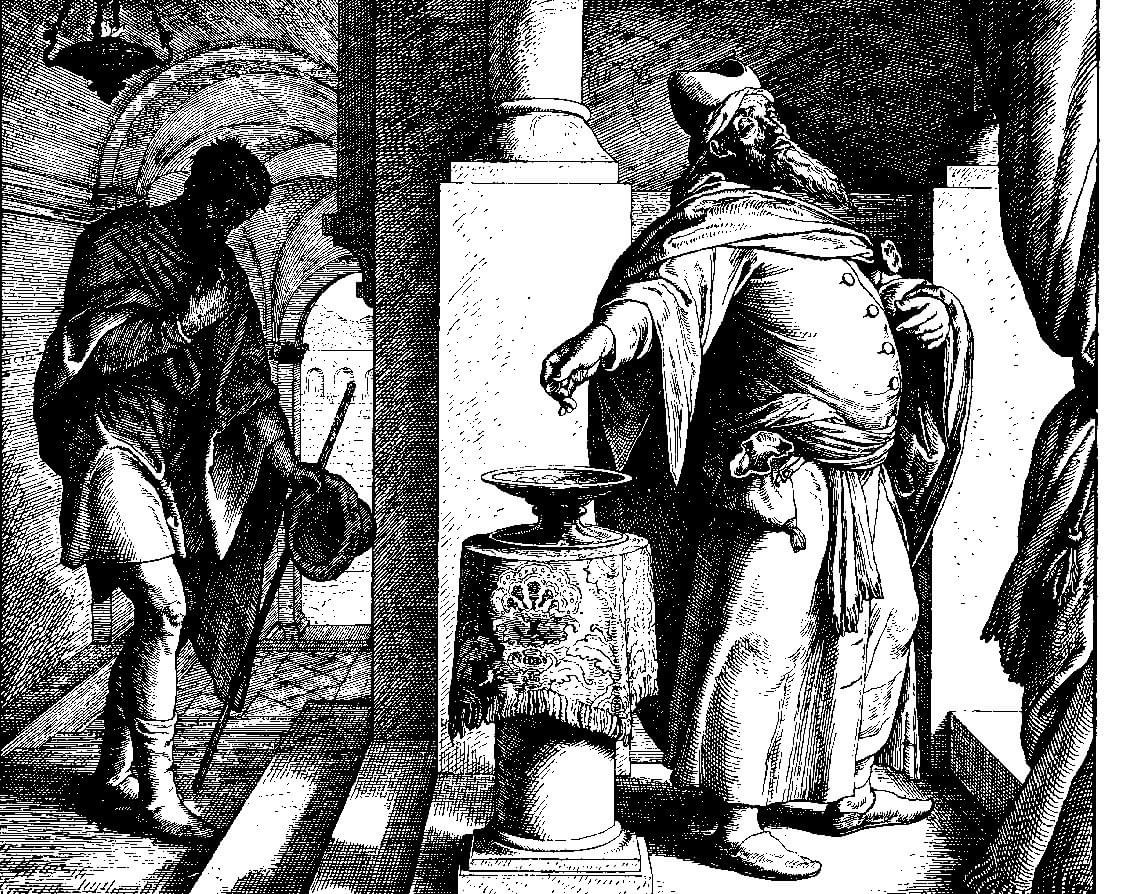 10 “Two men went up into the temple to pray, one a Pharisee and the other a tax collector. 11 The Pharisee, standing by himself, prayed thus: ‘God, I thank you that I am not like other men, extortioners, unjust, adulterers, or even like this tax collector. 12 I fast twice a week; I give tithes of all that I get.’ 13 But the tax collector, standing far off, would not even lift up his eyes to heaven, but beat his breast, saying, ‘God, be merciful to me, a sinner!’ 14 I tell you, this man went down to his house justified, rather than the other. For everyone who exalts himself will be humbled, but the one who humbles himself will be exalted.”
 The tax collector’s eyes of prayer are much different. He doesn’t look to heaven, and he doesn’t look at the sinners around him. He stands far off from the others, likely with his face to the floor, tears flowing down his cheeks, and beating his chest. He looks two places – at himself where there is no hope and to God where the only hope lies.
 When in the hour of deepest need
 She prays because she remembers that the God of Israel promised to deliver His people from the devil, which is why she addresses Jesus as the Son of David – to remind Him of His promises. And she remembers that she doesn’t deserve Jesus’ help because of her sins, so her prayer is, “Have mercy on me.”
 Boone, and all of you, be bold in your prayers. Even when it seems that God is distant and ignoring you, He hears you. He loves you. Jesus has died and risen for you and is even now interceding for you before His Father in heaven (1 Jn. 2:1).
 20 And behold, a woman who had suffered from a discharge of blood for twelve years came up behind him and touched the fringe of his garment, 21 for she said to herself, “If I only touch his garment, I will be made well.” 22 Jesus turned, and seeing her he said, “Take heart, daughter; your faith has made you well.” And instantly the woman was made well.
 He says to the mourners, “Go away, for the girl is not dead but sleeping.” And the mourners laugh, mocking Jesus and His words.
 He will raise you from the dead when He returns in glory. Even if you don’t get the things you want now, Christ will give you everything on the Last Day.
 armor of God, that you may be able to stand against the schemes of the devil. 12 For we do not wrestle against flesh and blood, but against the rulers, against the authorities, against the cosmic powers over this present darkness, against the spiritual forces of evil in the heavenly places. 13 Therefore take up the whole armor of God, that you may be able to withstand in the evil day, and having done all, to stand firm. 14 Stand therefore, having fastened on the belt of truth, and having put on the breastplate of righteousness, 15 and, as shoes for your feet, having put on the readiness given by the gospel of peace. 16 In all circumstances take up the shield of faith, with which you can extinguish all the flaming darts of the evil one; 17 and take the helmet of salvation, and the sword of the Spirit, which is the word of God, 18 praying at all times in the Spirit, with all prayer and supplication. To that end, keep alert with all perseverance, making supplication for all the saints 19 and also for me, that words may be given to me in opening my mouth boldly to proclaim the mystery of the gospel, 20 for which I am an ambassador in chains, that I may declare it boldly, as I ought to speak.
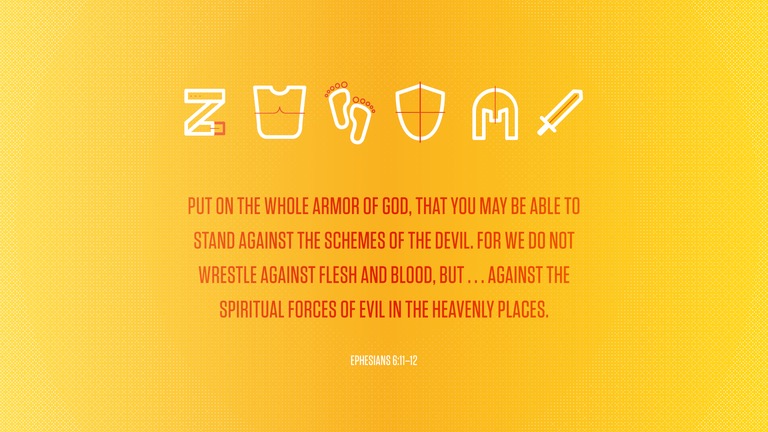 Where is the battle? It’s not in the Middle East. It’s not in Washington D.C. It’s not in the media. It’s not even in the schools and universities. The devil brings the battle to the church. The devil attacks here, this congregation, and he attacks you.
 So you, Christian, are to be praying at all times (v. 18), and keep alert with all perseverance, making supplication for all the saints. Now, that doesn’t mean that you shouldn’t ever sleep at night. And it doesn’t mean that you will be executed if you fall asleep during the sermon. Instead, you are to be spiritually aware and ready. Be watchful in your prayers.
 The promises given to you in God’s Word are the very things you are to pray. When the fighting comes near you and you have to fight toe to toe with the devil, use God’s Word. It is what Jesus used when He was tempted by the devil. And when you pray, you are calling in the reinforcements, you are calling in Christ Himself. The Champion who defeated the devil. It looked like the devil won when Jesus was in the grave. But Jesus stood up. He vanquished Satan and crushed the serpent’s head. And you, dear Christian, you stand with Him. Amen.
 1 On one occasion, while the crowd was pressing in on him to hear the word of God, he was standing by the lake of Gennesaret, 2 and he saw two boats by the lake, but the fishermen had gone out of them and were washing their nets. 3 Getting into one of the boats, which was Simon’s, he asked him to put out a little from the land. And he sat down and taught the people from the boat.
 Getting a catch like that would be the dream any fisherman. But it is too much of a good thing. This catch is threatening their livelihood, nearly breaking the nets and causing the boats to sink; it is killing them. And these fish – which had been their life and livelihood – could not save them. This fishing expedition is a massive success. Surrounded by what would provide for his life for months if not years, Peter can only see his sin.
 Jesus’ will is that you be caught by the net of the Gospel, that you be brought into the boat of the church, and that you have fellowship with Him now and forever. It is Jesus’ will that He not depart from you but that He draw you to Himself.
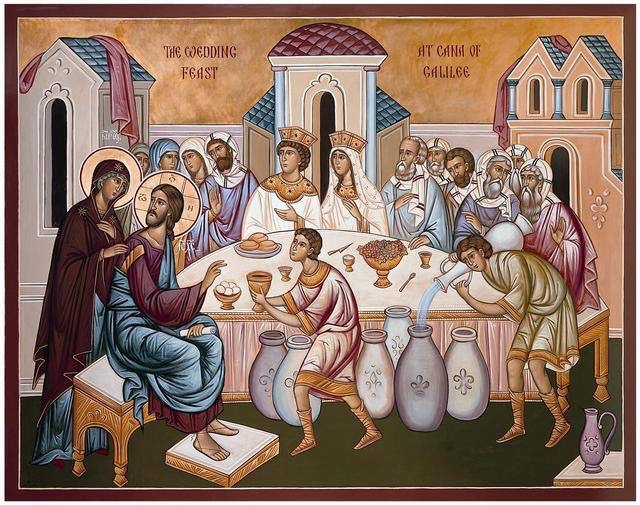 5 His mother said to the servants, “Do whatever he tells you.” 6 Now there were six stone water jars there for the Jewish rites of purification, each holding twenty or thirty gallons. 7 Jesus said to the servants, “Fill the jars with water.” And they filled them up to the brim. 8 And he said to them, “Now draw some out and take it to the master of the feast.” So they took it. 9 When the master of the feast tasted the water now become wine, and did not know where it came from (though the servants who had drawn the water knew), the master of the feast called the bridegroom 10 and said to him, “Everyone serves the good wine first, and when people have become drunk, then the poor wine. But you have kept the good wine until now.” 11 This, the first of his signs, Jesus did at Cana in Galilee, and manifested his glory. And his disciples believed in him.
 sin of this world. He has answered them by sending His Own, beloved Son to die and rise again. He has glory for you that is unspeakable and unimaginable.

You must be logged in to post a comment.