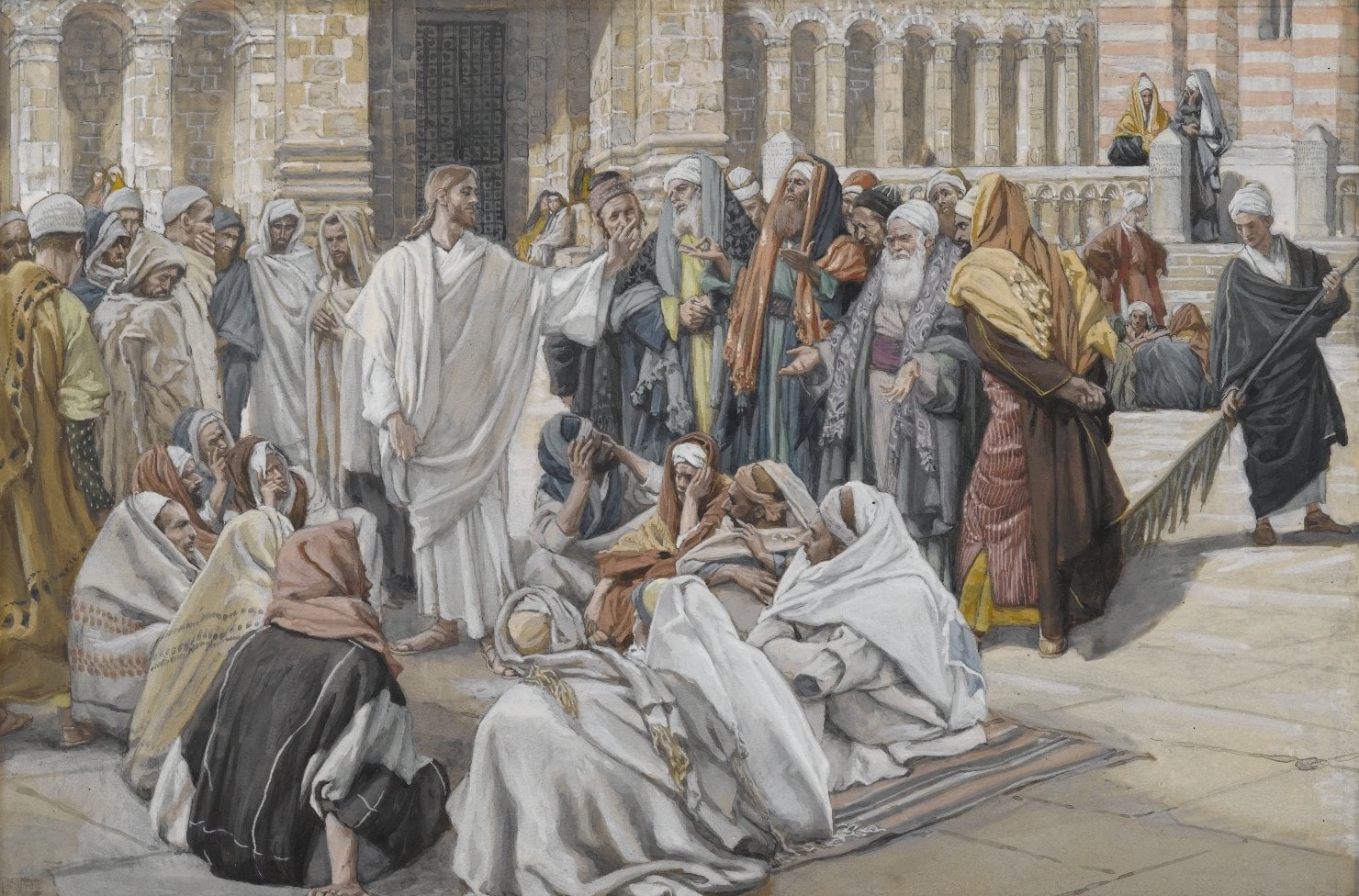
Comfort to the Heart – Sermon on Isaiah 40:1-8 for the Third Sunday of Advent

Isaiah 40:1-8

In the name of Jesus. Amen.

In your lowest moments – and even before those lowest moments arrive – God is there tenderly speaking, “Comfort, comfort,” to you, His people. He speaks that comfort to remove the burden of the debt of sin, and this changes everything for us sinners.

Just before our text, in Isaiah 39, Hezekiah, the king of Judah, welcomes an envoy of ambassadors from the king of Babylon. That empire was growing in strength and power, and Hezekiah wanted to have Babylon as an ally in case the Assyrian Empire attacked Judah. While those ambassadors were there, Hezekiah does what kings often do. He shows off. He gives the ambassadors a tour of his palace and shows them all of his treasure. He flaunted his silver, gold, and spices. Hezekiah displayed all the weapons of his armory – his entire treasury. He left nothing hidden. Basically, Hezekiah was boasting about himself and the greatness of his kingdom, but he doesn’t boast about his Lord and God who had given it all to him.

After the Babylonian delegation leaves, the prophet Isaiah visits the palace to confront Hezekiah about all this. Isaiah rebukes him for being so foolish and prophesies that the Babylonians will come again in a hundred years to strip the palace and the Temple of everything. All the gold and wealth and treasure and weaponry of Hezekiah’s kingdom – it will all be taken by the Babylonians because Hezekiah’s pride did nothing more than make himself a target by showing off. Isaiah says that Hezekiah’s descendants would pay the price of his foolish actions.

And Hezekiah’s response is, frankly, disgusting. Basically, he says, “Let me get this straight, Isaiah. You’re saying that I get to keep the treasure? Babylon isn’t going to come and ransack and pillage as long as I’m alive?” And Isaiah says, “Yeah, but listen. It’s going to happen to your descendants.” But Hezekiah doesn’t care. Instead, he says, “Cool. Everything will be safe and secure in my days.” That, of course, is the wrong response.

Hezekiah should have fallen to his knees and begged for God to forgive him or, at least, ask that the payment of his foolishness not fall upon his children and grandchildren. Instead, Hezekiah callously says, “This is great. I don’t have to deal with it.”

Just over 100 years later, the price of Hezekiah’s foolishness and pride was paid. Babylon came. They destroyed the Temple. Men, women, and children were slaughtered in the streets. The nation was torn apart. People were ripped from their country, their lands, and their homes. And they were taken into exile in Babylon (2 Kgs. 25:1-212 Ch. 36:17-21Jer. 52:1-30).

Imagine enduring all of that. Imagine being part of that generation who paid the debt of Hezekiah’s pride. They watched as all these things happened, and because they were familiar with the book of Isaiah, they knew that they were paying Hezekiah’s debt because he was totally fine with passing that debt of his sin off to a future generation.

If you were part of that generation who endured that destruction, how would you handle and process that? How could you be anything but bitter and resentful that your forefather had been totally willing to pass the punishment of his sin off to you? How would you cope? Where would you find comfort?

Well, you would find it here in these verses that come immediately after Isaiah recorded Hezekiah’s foolish and callous actions. And dear saints, these verses aren’t only for the people who were carried into exile in Babylon. They are also for you today. Now. “Comfort, comfort My people, says your God. Speak tenderly to Jerusalem.” And that phrase, ‘speak tenderly,’ is a lot stronger in Hebrew. It’s an idiom that is literally translated, “speak to the heart.” God isn’t just speaking cliché platitudes from a far, distant place. No. Your God leans in close to speak comforting words directly into the heart of you, His people.

These words of comfort here in Isaiah 40 are for you because you are God’s people through faith in Christ. And these words cut through the noise and chaos of sin and suffering to touch you where your ache is sharpest and deepest. In the midst of the pain that has come to you because of sin – both your sin and the sins of others – God speaks tenderly, He speaks directly to your heart, “Be comforted. Be comforted. [Your] warfare and hardship is ended; [your] iniquity is pardoned.”

This whole text is beautiful, and dozens sermons could be preached on each line of the text. We could focus on the lines concerning John the Baptizer who would proceed Jesus and make a straight, level highway in the wilderness for the coming of the God who brings this comfort. We could ponder the arrival of God’s glory that will be seen by all flesh for eternity.

Earlier this week, I considered focusing this sermon on the lines about all flesh being like grass. Remember how Adam and Eve – who, after the Fall, became like the grass that withers and fades – they tried to cover themselves with foliage when they heard the sound of God walking in the Garden of Eden (Gen. 3:7-8). But God had come to give them the comfort that He would send the Seed of the woman to crush the serpent’s head (Gen. 3:15). And that Word of promise endures forever. Maybe, I’ll preach that sermon sometime in the future. Anyway, there’s an eternity of sermons that could be preached from these nine verses.

But the thing I want to focus on today is that phrase from the last line of v. 2 about receiving, “from the Lord’s hand double for all [your] sins.” And I want to focus on it because, even though it sounds like Law, it is sweet, sweet Gospel spoken from God’s mouth directly into your heart. But we need to do a little groundwork first.

In Is. 40:2, Isaiah uses two of the three most common Hebrew words for breaking God’s Law – ‘iniquity’ and ‘sin.’ The third word that Isaiah doesn’t use here is ‘transgression.’ And each of these words give a slightly different picture of what sin is.

The Hebrew word that regularly gets translated ‘transgression’ means to cross a boundary. In each Commandment, God sets a line and crossing over that line is a ‘transgression’ or a ‘trespass.’ The Hebrew word that most often gets translated as ‘sin’ means to miss the mark. God has a standard for us, but we keep missing it. Think of an archer who never hits the target, let alone the bullseye. Finally, the Hebrew word that gets translated ‘iniquity’ refers to the guilt and shame caused by sin. Think of the weight and indebtedness you feel when you’ve wronged someone – that’s the iniquity. All three words deal with the same thing (our sin), but each one focuses on a different aspect of that sin.

Well, here God says that your iniquity, that debt and weight of sin, is pardoned and that you have received from His hand double for all your sins. Again, this should be comforting. God isn’t saying that He’s giving you double punishment for your sin. No!

Instead, God has taken that debt of sin. He pays for it. Imagine your sin as a pile debt on your account. Because of Jesus, the billions of debt that you owe because of your sin is all paid off. But God doesn’t stop and just get you to an even balance. In place of that massive debt, God credits your account with the righteous deeds and the perfect obedience of Jesus.

You can imagine a chalkboard where all your sins are written down. Through faith, Jesus comes and wipes every last speck of that chalk and dust off. But He doesn’t stop once your slate is wiped clean. He writes over that chalkboard all of the holy, righteous, and perfect works that He has done (see Mt. 25:31-40).

God knows the full debt of your sin down to the last penny. And when Jesus pours out His forgiveness, mercy, and salvation on you, it is in double measure of your debt.

In Jer. 31:34, God says that He forgives your iniquity and remembers your sin no more. Dear saints, be comforted. God doesn’t remember the kind or type of sins you have committed. He doesn’t remember the specific ways you have transgressed against Him and against your neighbor. The only thing that He remembers about your sin is the amount of debt you owe. And the only reason God remembers that is so He can give you a double portion of His grace and mercy (Jn. 1:16).

That is the comfort He gives to you. That is the comfort He speaks to directly into your heart today and every day. Your Redeemer will continue to speak that comfort to you, and His Word of grace, mercy, and comfort endures forever. Amen.

The peace of God, which surpasses all understanding, will guard your hearts and minds in Christ Jesus (Php. 4:7). Amen.

Serving the Body – Sermon on Romans 12:6-16 for the Second Sunday after Epiphany

Romans 12:6–16

6 Having gifts that differ according to the grace given to us, let us use them: if prophecy, in proportion to our faith; 7 if service, in our serving; the one who teaches, in his teaching; 8 the one who exhorts, in his exhortation; the one who contributes, in generosity; the one who leads, with zeal; the one who does acts of mercy, with cheerfulness. 

9 Let love be genuine. Abhor what is evil; hold fast to what is good. 10 Love one another with brotherly affection. Outdo one another in showing honor. 11 Do not be slothful in zeal, be fervent in spirit, serve the Lord. 12 Rejoice in hope, be patient in tribulation, be constant in prayer. 13 Contribute to the needs of the saints and seek to show hospitality. 

14 Bless those who persecute you; bless and do not curse them. 15 Rejoice with those who rejoice, weep with those who weep. 16 Live in harmony with one another. Do not be haughty, but associate with the lowly. Never be wise in your own sight.

In the name of Jesus. Amen.

When you stub a toe, your whole body reacts. Your face scrunches and grimaces in pain. Your arms and hands reach down to clasp the toe. Your throat groans, shrieks, or shouts. All of that happens naturally and instinctively. When you stub your toe, the rest of the parts of your body don’t say, “Who cares? That’s the toe’s problem.” I’ve never heard someone with knee, hip, or neck pain say, “The knee that is attached to me hurts,” or, “The neck that holds up this head hurts.” Instead, people say, “My knee hurts. My neck hurts.” And the whole body does what it can to help the part that hurts.

Dear saints, the Body of Christ is no different. When one part of the body suffers, the whole body is involved in that suffering. When one part rejoices, the whole body is involved (see also 1 Cor. 12:26). Being part of this congregation isn’t just about coming to hear the sermon. It’s about being a body, Christ’s Body. No one here is free to consider yourself separate or independent from anyone else here.

The reason I mention the Body of Christ is that today’s reading continues from last week’s. One time, Martin Luther preached on this text, and he said that starting the reading at v. 6 was the idea of someone who doesn’t understand the Bible. I think that’s an overstatement, but it is unfortunate to start at v. 6. Let me reread the final couple verses of last week’s Epistle, which lead up to this text but you didn’t hear today. Starting back at Ro. 12:4-5, “For as in one body we have many members, and the members do not all have the same function, so we, though many, are one body in Christ, and individually members one of another.” Then, our text continues, “Having gifts that differ according to the grace given to us, let us use them….”

The context of today’s text is that you are a member of a body – that’s what Christ intends for you. Yes, the whole Christian Church throughout the world and throughout time is the Body of Christ. Jesus is the One Head, and all Christians are the Body. But there’s no way this matters unless there is a local, in-person group of members. In other words, a congregation. Yes, there are Christians in Australia, Uganda, Brazil, and even Iowa. But you aren’t close enough to them geographically to do much for them. I know for a fact that there are Christians in Papua New Guinea because I know missionaries who have been there. But I haven’t met a single one of those believers. For them, I can’t do most of the things this text calls for. I can’t exhort, teach, or honor them. I can’t rejoice with them when they rejoice or weep with them when they weep. It’s just not possible.

This text wants each believer to focus on the parts of the Body of Christ that God has gathered around them. In other words, care for the people here, in this congregation. That’s why this is written to the Christian church in Rome. It’s why Paul uses the same analogy in his letter to the church in Corinth (1 Cor. 12). And God wants this same arrangement for us here and in every Christian congregation. That’s why it has been preserved for us in the Bible. God wanted this in Rome and Corinth 2,000 years ago, and He wants it here, now, among us.

And I have to say: You do a good job of this. When I teach new member classes, one of the most common things I hear is, “This place just feels like family.” So, please know that I’m not preaching this text to get on your case. I’m not rebuking you. Instead, just like a sprinter will keep training to get a faster time, there is always room for improvement.

We can improve at serving, contributing, leading, being merciful, loving, abhorring evil, holding fast to the good, honoring, and showing hospitality. Let’s consider one area where we can improve today from v. 15, “Rejoice with those who rejoice, weep with those who weep.” The reason for diving into this is that I recognize my own shortcomings in this. So, yes, your preacher today is preaching to himself. This is a, “Do as I say,” because it is what Scripture says, “not as I do,” because I fall short here.

Again, “Rejoice with those who rejoice, weep with those who weep.” First off, notice the prepositions there – with. God calls you to take on the joy and sadness of others. You aren’t called to fix people’s emotions or make them feel certain things. Instead, you join them in those emotions. As a poor example of this, think of Job’s friends; they got it half right. Job is sitting there in his horrific suffering, and his friends come to him. They were exactly right to do that. That’s where they should be. But their problem, which becomes a problem for Job, is that they try to fix everything, and they do an incredibly bad job at it.

Sure, there are times to rebuke, exhort, and encourage people. Scripture does call for that too (1 Tim. 5:20; 2 Tim. 4:2; Tit. 1:13; 2:15). But, dear saints, there are also times where you are to simply close your mouth, sit with others, cry and mourn with them if they’re sad, or jump and sing with them if they’re joyful.

This can be really hard, and for a variety of reasons. Again, we might be too quick to give advice, but another trap we easily fall into is comparing. When someone is struggling with something, it can be easy to share about a past struggle we had and make sure the other person knows how much worse we had it. Sometimes, just being there and listening to a person pour out their heart in sadness is exactly that that person needs.

As a good example of weeping with others, think about Jesus in Jn. 11. On Wednesday night, I taught through Jn. 11 where Jesus raises Lazarus from the dead. We won’t go through the whole thing, and I’m sorry to those of you who already heard this. But it’s worth hearing again. Jesus’ approach to Lazarus’ two sisters, Martha and Mary, and their grief is so interesting. Each sister talks to Jesus separately (Jn. 11:20-27, 32-34). Both of them say the same thing to Jesus when they see Him, “Lord, of You had been here, my brother wouldn’t have died.” But Jesus’ interaction with each of them is completely different.

So, the two sisters are dealing with the exact same problem – the sorrow for over the death of a brother. They both begin interacting with Jesus the exact same way. But Jesus comforts each of these sisters differently. For Martha, Jesus has words of consolation. “Your brother will rise again. I am the Resurrection and the Life” and so on (Jn. 11:23, 23, 25-26). But just a few verses later when Jesus consoles Mary, all He does is go to the tomb with her and weep with her (Jn. 11:33-35). Yes, Jesus calls Lazarus from the tomb and restores his life. But it’s that initial consoling Jesus has for each sister has a lot to teach us.

Here’s the lesson: get to know the different parts of Christ’s Body well enough so you know how to weep with them when they weep. If they’re already weeping, just be there for them. Join them in their sorrow. But when they aren’t weeping, make the effort to get to know them well enough so that, when they are weeping, you have a better idea of how to console them.

Finally, when you are weeping, know that people might not be able to do this well. But also know that Jesus does. Christ knows how to give you exactly what you need exactly when you need it. Jesus is here now. He invites you to His table to receive His Body and Blood. Here, Christ, the Great Consoler, continues to unite you as His Body and strengthen you in faith toward Him and in love toward one another. Amen.

The peace of God, which surpasses all understanding, will guard your hearts and minds in Christ Jesus. Amen.

Successful Steward – Sermon on 1 Corinthians 4:1-5 for the Third Sunday of Advent

1 Corinthians 4:1–5

1 This is how one should regard us, as servants of Christ and stewards of the mysteries of God. 2 Moreover, it is required of stewards that they be found faithful. 3 But with me it is a very small thing that I should be judged by you or by any human court. In fact, I do not even judge myself. 4 For I am not aware of anything against myself, but I am not thereby acquitted. It is the Lord who judges me. 5 Therefore do not pronounce judgment before the time, before the Lord comes, who will bring to light the things now hidden in darkness and will disclose the purposes of the heart. Then each one will receive his commendation from God.

In the name of Jesus. Amen.

In these days leading up to Christmas, gifts are probably taking a lot of your time, energy, and mental space. Maybe, you’re still looking for that perfect present that evens out the number of gifts and the amount you’ve spent on each individual. You might be struggling to find a spot to hide everything until you can get it all wrapped, or you’re closely following the tracking information so you can intercept the packages before they are discovered on your front step.

In this season of giving gifts, it’s good to remember that everything you have is a gift. Just two verses after this reading (1 Cor. 4:7), Paul rhetorically asks, “What do you have that you did not receive?” Everything we possess has been graciously given to us by our God and Father (Jn. 3:27). Our houses and vehicles, our food and clothing, our families and jobs are all good gifts freely given by the hand of God. He has given you your time, your talents, your body, your energy, and strength. Don’t fool yourself into thinking that you have earned anything you have. God has given it. The epistle of James says, “Every good and every perfect gift is from above coming down from the Father of lights” (Jam. 1:17).

Because everything you have is a gift, that means you are a steward or manager of those gifts. It all belongs to God, and God wants and expects you to use everything He has given you to love Him by loving your neighbor (Mk. 12:28-31). Stewards know that what they have will all eventually be returned to their Owner, and on the Last Day, you will give an account to God for how you have used those gifts (Heb. 4:13). The issue that Paul is dealing with here is about being a successful steward.

Here, Paul is specifically talking about his stewardship of his office, his vocation, of being an apostle. God made Paul a steward of the mysteries of God. That means that Paul is to preach God’s Word and write the sacred, Holy Spirit-inspired Scriptures. He recognizes that he needs to be faithful in that. But this text extends far beyond just Paul.

All stewards are required to be faithful with what they are given. Paul writes, “It is required of stewards that they be found faithful” (1 Cor. 4:2). In other words, faithfulness is the one standard by which stewards are judged. And there is great comfort in this. Stewards aren’t judged by numbers or growth or success or fame. Faithfulness is the one, and only, standard by which a stewards’ success will be determined. And the only One who can and does judge by that standard is God, the Giver of the good gifts that we have.

As Paul writes about himself here, he says, “with me it is a very small thing that I should be judged by you or by any human court” (v. 3a). It doesn’t matter how they judge him. And it doesn’t matter what anyone else thinks. In fact, Paul says that it doesn’t even matter what his own estimation is; he says, “I do not even judge myself” (v. 3b). The only thing that matters is what the Lord God judges (v. 4). In God’s timing, He will bring to light the things that are now hidden in darkness and disclose the purposes and intentions of the heart. Then, and only then, will each one receive his commendation and praise from God (v. 5).

Dear saints, there is such freedom for you here. It can be incredibly easy to get discouraged in life. We make our plans, and they don’t pan out. We struggle through our tasks at work and don’t seem to make any progress. We do our best to teach our kids and train them how they should act, but they keep disobeying. We try to provide financially for ourselves and our families, but we always seem to be behind. In all those moments, we start judging ourselves and our work by metrics that – honestly, in the end – don’t really matter.

Now, that does not mean that we shouldn’t use those metrics to improve and do better as stewards. I’m not saying that. We should always strive to be better stewards of what God has given us.

What I am saying, though, is this: At the end of the day, at the completion of a task, when we consider how well we’ve done at anything, the question we should ask is, “Have I been faithful?” In other words, “Did I do what God has given me to do? Did I use the resources and means that God provided in the best way I could?” If the answer to that is, “Yes,” then that is enough. But remember that your estimation doesn’t matter. Only God’s does.

This standard of success for stewards applies to all areas of your life. It applies to your schooling, your marriage, your career, your time, talents, and treasures because, again, all of it is a gift from God. Some of you think far worse of yourself than you really are. And, yes, some of you think far better of yourself than you actually are. The day will come when God will reveal all sorts of hidden obstacles and struggles – as well as blessings and gifts – that we didn’t have any idea were there. And then, He will be the Judge who commends or condemns. So, don’t you go jump the gun. Don’t bother with rating or grading yourself. God will take care of it when He comes.

Another pastor put it well when he said that this text gives us a “blessed uncertainty” as it concerns our success, our failure, our progress, or our lack of progress. And there are at least two reasons God wants you to have this uncertainty.

First, God wants you to be uncertain about your success because if you were confident in either direction – either how well or how poorly you had done – that becomes a distraction to you remaining faithful. If you’re always looking around to see how well or how poorly you’re doing, you’re probably not paying enough attention to what you are actually doing. God wants you to be focused on the thing He has given you to do. All you have to do is to be faithful.

Second, and more importantly, God wants you to be uncertain about your success because He wants you to be certain of only one thing – just one thing. And that is the certainty of your position in Christ alone. God wants you to be certain that you are justified because Christ Jesus has died for you. Through faith in Him, your sins are not and will not be counted against you. You have a future and a hope in Christ that is immovable. Keep your focus and attention on that because, again, that is certain.

Dear saints, the Lord, and the Lord Jesus Christ alone, judges you. And, through faith, you already know what that judgment is. You heard it in the Absolution. Jesus Himself says, “I entirely forgive you all of your sins because I have died for them.” Rejoice in that, my fellow stewards of God’s gifts. Amen.

The peace of God, which surpasses all understanding, will guard your hearts and minds in Christ Jesus. Amen.

Shaken & Stirred – Sermon on Luke 21:25-36 for the Second Sunday of Advent

Luke 21:25–36

25 “And there will be signs in sun and moon and stars, and on the earth distress of nations in perplexity because of the roaring of the sea and the waves, 26 people fainting with fear and with foreboding of what is coming on the world. For the powers of the heavens will be shaken. 27 And then they will see the Son of Man coming in a cloud with power and great glory. 28 Now when these things begin to take place, straighten up and raise your heads, because your redemption is drawing near.”

29 And he told them a parable: “Look at the fig tree, and all the trees. 30 As soon as they come out in leaf, you see for yourselves and know that the summer is already near. 31 So also, when you see these things taking place, you know that the kingdom of God is near. 32 Truly, I say to you, this generation will not pass away until all has taken place. 33 Heaven and earth will pass away, but my words will not pass away.

34 “But watch yourselves lest your hearts be weighed down with dissipation and drunkenness and cares of this life, and that day come upon you suddenly like a trap. 35 For it will come upon all who dwell on the face of the whole earth. 36 But stay awake at all times, praying that you may have strength to escape all these things that are going to take place, and to stand before the Son of Man.”

In the name of Jesus. Amen.

We’ll get to this text, I promise. But first, I want to make a quick comment on our liturgy. Right away, the term or word “liturgy” might seem dull or dry. But the word ‘liturgy’ is a biblical word that simply means ‘public service.’ It seems less common now, but people used to talk about a church either being ‘liturgical’ or ‘contemporary.’ But that isn’t a helpful distinction because every church has a liturgy. In some churches, that order looks like singing for a long time, hearing a sermon, singing again, and leaving the building. You know what the service looks like here. And in other churches you may have attended, it looks different. When Christians gather together in church, they do things in a particular order, and that order is the liturgy.

I’m not sure when, but sometime in the not-too-distant future I’m going to take the time during a Sunday morning service to explain the different parts of our service and why we do what we do when we do it. But that’s for another time.

‌Today, I want to highlight one of the parts of our liturgy which is the Collect. It’s that short prayer that is offered right after the Confession and Absolution and before the Scripture readings. The Collect changes every week, because it takes the different Scripture readings we hear during the service and collects (hence the name) them into a prayer that we offer to God. What the Collect does is it sets the theme for what we will hear from God’s Word each week. People have traced the origins of these prayers far back through Church history. They have been used by Christians since the 400-500’s.

‌I printed the main part of today’s Collect there for you in the Scripture insert, and I want to draw your attention to it again right now. “Stir up our hearts, O Lord, to make ready the way of Your only-begotten Son, that by His coming we may be enabled to serve You with pure minds.” It’s a good prayer because we need to have our hearts stirred up by God, and Jesus certainly does that in this Gospel reading. Jesus says that the day is coming when, “The powers of the heavens will be shaken” (Lk. 21:26).

‌Shaking the heavens is no problem for God. God created all the celestial bodies on the fourth day of creation by simply speaking (Gen. 1:14-19). All the planets, solar systems, stars, and galaxies didn’t get where they are by accident. God did it with precision. Earth is about 91.6 million miles from the sun. If it were a tiny fraction closer to the sun, the whole planet would fry; a tiny fraction further, and it would freeze. And it isn’t just Earth’s proximity to the sun that sustains life. It is tilted in just the right way as well. Also, God created the other planets of our solar system in the right sizes and set them at the right distances to keep our orbit just right and protect us from asteroids. Our moon is just the right size and distance to sustain life on the planet by causing the high and low tides. And I wouldn’t be at all surprised if the Milky Way galaxy is the perfect distance from other galaxies and black holes too.

‌You probably know the rule In carpentry, “Measure twice; cut once.” I’m not sure how to state a similar rule for creating the universe. Maybe, “Measure twice; carefully place all the powers of the heavens in their positions once.”

‌Well, Jesus tells us that all of it is going to be shaken. Normally, when things are shaken, it’s a violent and chaotic thing. You shake something and stuff goes all over the place and ends up in random positions when the shaking stops. But the same precision that God used in creating the heavens will also be used when God shakes them. Yes, everything is going to be shaken, but that doesn’t mean God isn’t in control of what’s happening.

‌Shaking the heavens is no problem for God. The bigger problem is stirring our stubborn hearts. That’s why Jesus tells us to “stay awake at all times, praying that you may have strength to escape all these things that are going to take place, and to stand before the Son of Man” (Lk. 21:36). In other words, don’t get in a tizzy when the powers of the heavens are shaken. Instead, pray that as the universe shakes that God would strengthen you to stand before Him when He returns.

‌This past Thursday, a news alert came on my phone that there had been an earthquake off the coast of central California and a tsunami warning had been issued. I said a quick prayer for the people and cities. (I’d encourage you, when you get an alert like that or when you hear sirens, the first thing to do is pray. At least send up a, “Lord, have mercy.”) About half an hour after I saw that alert, I took a break to check Twitter – I still can’t call it ‘X’ – to see if there was a tsunami since I know people who live in that area. I found a bunch of posts from people who lived in that area, and most of them were saying that they were more startled by the alert from their phone than they were worried about being swept away. I was fairly shocked. Even though a tsunami could still have been coming, people were complaining that the buzzing and noise from their phone was too loud.

‌Now, I know those emergency alerts are very shocking, but they’re supposed so they grab our immediate attention. But I found it remarkably interesting that people were scared more by their phones than they were about the possibility of their cars, houses, workplaces, and city being completely swept away in an instant.

‌But then, I realized that all those comments of misdirected fear is what I and, probably, most of us do. We get riled up about all sorts of things, but the things that get us riled up aren’t what is most important. Especially this time of year, we focus more on what gifts to buy, how much money we are spending, rushing around for all the parties and get-togethers, and the final exams or papers. But are we preparing to stand before Christ, the Son of Man? Our concern for temporary tings often leads to complacency about eternal things. Remember what Jesus says, “Heaven and earth will pass away, but My Words will not pass away” (Lk. 21:33).

When you listen to the world, what do you hear them talking about? You hear about wars and rumors of wars. They talk about the atmosphere and “catastrophic global climate change.” And they’re definitely perplexed about all of it. Many of the signs Jesus speaks about in this text are the constant chatter of our day and age.

‌Dear saints, God would have you speak differently than the world speaks. You can see the different calamities happening in our world and use them as an opportunity to share the joy and hope you have of the Savior’s return. Yes, it is clear that creation isn’t going to last forever. This world will not endure because of the sin we have brought into it. But you know that Christ is risen. You know that His death and resurrection was to save the world. You know that your Redeemer promises to make all things new, and again, His words will not pass away. What He has promised will surely happen.

‌Jesus, your Savior, is coming again for your redemption. That puts a new perspective on all the evil and chaos of this world. You have Christ’s promise that the things you struggle with and have to endure in this world will cease and be replaced with the joy of living in God’s eternal kingdom.

‌Even as the powers of the heavens are shaken, we pray that God would stir up our hearts to be ready for Jesus’ coming. The cares of this life are certainly real, but they are nothing compared to the redemption that is coming and drawing near.

Dear saints, in the midst of the evil of this broken world, straighten up. Raise your heads. Your redemption is coming, and it is drawing near. Amen.

The peace of God, which surpasses all understanding, will guard your hearts and minds in Christ Jesus. Amen.

Coming Joy – Sermon on Matthew 11:2-11 for the Third Sunday of Advent

Matthew 11:2–11

2 Now when John heard in prison about the deeds of the Christ, he sent word by his disciples 3 and said to him, “Are you the one who is to come, or shall we look for another?” 4 And Jesus answered them, “Go and tell John what you hear and see: 5 the blind receive their sight and the lame walk, lepers are cleansed and the deaf hear, and the dead are raised up, and the poor have good news preached to them. 6 And blessed is the one who is not offended by me.”

7 As they went away, Jesus began to speak to the crowds concerning John: “What did you go out into the wilderness to see? A reed shaken by the wind? 8 What then did you go out to see? A man dressed in soft clothing? Behold, those who wear soft clothing are in kings’ houses. 9 What then did you go out to see? A prophet? Yes, I tell you, and more than a prophet. 10 This is he of whom it is written,

“‘Behold, I send my messenger before your face, 
who will prepare your way before you.’

11 “Truly, I say to you, among those born of women there has arisen no one greater than John the Baptist. Yet the one who is least in the kingdom of heaven is greater than he.”

In the name of Jesus. Amen.

What do you do when it appears as though God isn’t interested in what’s happening in the world? What do you do when God doesn’t act the way you expect Him to or just doesn’t seem to care? Today’s Gospel text helps us in the midst of those kinds of questions.

John the Baptizer – that camel hair wearing, locust eating, outspoken prophet in the wilderness – is a combination of a biker gang member, wilderness survivalist, and street-corner preacher. Even before he was born, John was excited about Jesus, leaping in his mother’s womb (Lk. 1:39-44). From the time of his birth, John’s parents knew that he was the one who would prepare the way of the Messiah (Lk. 1:76), and that’s what he did. He pointed people to Jesus as the Lamb of God who takes away the sin of the world. He baptized hordes from Jerusalem, all Judea, and all the region around the Jordan (Mt. 3:5). John comforted with the Gospel, but he also boldly called people to repent for the kingdom of heaven is at hand (Mt. 3:5). He rightly called the religious leaders of his day a brood of vipers (Mt. 3:7). Like a good preacher of God’s Word, John rebuked political leaders like Herod who had married his brother’s wife (Lk. 3:19-20). And that is why John is in prison when we meet him here. For his whole life, John had been a faithful steward of the mysteries of God’s Word (1 Cor. 4:1-2).

In our Gospel reading (Mt. 11:2-22), John will soon be executed. He sits in a dank, dark prison cell. In that solitary, lonely dungeon, the devil does to John what he often does to those in isolation. He whispers lies and tries to cast doubt. John’s mind begins to wonder if his whole life’s work had been a sham. John knew the Scriptures taught that the Messiah would give sight to the blind, mobility to the lame, cleansing to the lepers, hearing to the deaf, and life to the dead, and Jesus certainly was doing that. But John also knew that the Messiah would bring prisoners out from the dungeon (Is. 42:7), that bonds would be loosed (Is. 52:2), that captives would be set free (Is. 49:9).

Because of the devil’s whispering and his current situation John starts to question: “Jesus, You’re checking all of the boxes except the one that matters most to me right now. What gives? Why am I here, stuck in this prison? Do You even know I’m in this situation?” No matter how many times God proves faithful in keeping His promises, it can feel as though God has abandoned you when some of His promises to you still lie in the future.

Instead of letting those questions fester and cause more and more doubt, John does exactly the right thing. He goes to God’s Word. John sends two of his disciples to ask Jesus, who is the Word made flesh (Jn. 1:14). “Are You the One who is to come, or should we look for another?” And Jesus, in typical Jesus fashion, doesn’t give a simple, “Yes,” or, “No.” Instead, Jesus responds: “Go and tell John what you hear and see: the blind receive their sight and the lame walk, lepers are cleansed and the deaf hear, and the dead are raised up, and the poor have good news preached to them. And blessed is the one who is not offended by Me.”

It’s easy for us to fall into the temptation of thinking that God isn’t active in creation when we experience trials and tribulations like John is. Even when God is making good on all of His other promises, if only one of our own boxes is still unchecked, we start to think that something is off. In those moments, it is easy to forget that God is active in and through our suffering. It’s easy to forget that even your suffering has a holy purpose (2 Cor. 1:8-9).

All the evil that the devil and the world tries to throw at you is turned into good by God. You are not at the whim of a god who may or may not care about you. You do not face a devil who is equal in power with God leaving your outcome in question. Joseph, who was sold into slavery by his brothers, told his brothers, “You meant evil against me, but God used it for good” (Gen. 50:19-20). Just as lifting weights is good exercise and builds up the muscles of your body, the suffering you endure in this world is good for your soul and faith, making it stronger.

The fact that Jesus suffered, died, and rose again is proof that God uses even the wickedness of this world and the suffering caused by evil men for your salvation. I’m not saying that it is an easy thing to believe. What I am saying is that Scripture is clear that suffering is not opposed to the Gospel. When God became a creature, He endured suffering so you can live with Him forever. Jesus saved you through His suffering, and He can and does use your suffering to bring about good because God is still active in His creation.

Jesus is the head of the Church, and you, believer, are His body (Eph. 1:22; Col. 1:18). Among other things, that means whatever you do in this world, Christ, the Head, is acting through you, His body. When you do what your boss tells you, you are God’s body being active in creation, and God blesses what you do. Kids, when you do your homework, you are God’s body being active in creation and preparing for the tasks God has for you in your future. As you are faithful in the things God puts in front of you to do, God is acting in you and through you to benefit your neighbor and creation. Be faithful in those things. Our Epistle lesson (1 Cor. 4:1-5) is an important reminder that the most important measure of what we do isn’t success or numbers that can be measured by others. We stewards shouldn’t care what others think. We shouldn’t even try to judge our own success. We are simply called to be faithful (1 Cor. 4:2-3).

But even as you are faithful, you will face suffering like John did. So, instead of falling into despair when you face suffering, God would have you rejoice in your suffering because suffering produces endurance, which produces character, which produces hope (Ro. 5:3-5). When you suffer, go back to God’s Word. Hear His promises. Hold on to those because God has not and will not fail in delivering you from suffering in this fallen and broken world.

Jesus is coming. He is not just coming sometime in the future. He is the constantly coming One. He has come once, He is coming still, and He will come again in the future. So, be bold and confident that the coming One is still active in His creation. Believer, you can have joy because Jesus has come and saved you.

Joy is not the same as happiness. Happiness and sadness cannot coexist, but joy and sadness can. Joy is not the absence of sadness. Instead, joy is confidence and contentment that God is in control and is taking care of things. Even when everything in this world seems dark and fading, God is in control. He has come. He is coming again. And He comes now to give you His Body and Blood which He gave and shed for the forgiveness of all your sins.

Christian, rejoice in the Lord always. Your Lord is coming. In fact, He is at hand now. Amen.

The peace of God, which surpasses all understanding, will guard your hearts and minds in Christ Jesus. Amen.

Rejoice – Sermon on Matthew 28:1-10 for the Resurrection of Our Lord

Matthew 28:1–10

1 Now after the Sabbath, toward the dawn of the first day of the week, Mary Magdalene and the other Mary went to see the tomb. 2 And behold, there was a great earthquake, for an angel of the Lord descended from heaven and came and rolled back the stone and sat on it. 3 His appearance was like lightning, and his clothing white as snow. 4 And for fear of him the guards trembled and became like dead men. 5 But the angel said to the women, “Do not be afraid, for I know that you seek Jesus who was crucified. 6 He is not here, for he has risen, as he said. Come, see the place where he lay. 7 Then go quickly and tell his disciples that he has risen from the dead, and behold, he is going before you to Galilee; there you will see him. See, I have told you.” 8 So they departed quickly from the tomb with fear and great joy, and ran to tell his disciples. 9 And behold, Jesus met them and said, “Greetings!” And they came up and took hold of his feet and worshiped him. 10 Then Jesus said to them, “Do not be afraid; go and tell my brothers to go to Galilee, and there they will see me.”

Alleluia! Christ is risen!
He is risen indeed! Alleluia!

In the name of Jesus. Amen.

Dear saints, rejoice. Rejoice because God will not allow what is His to be stolen. You’re going to get a little Christmas on Easter because the two go together. The Son of God has taken on flesh. God has a Body. He was born in Bethlehem and laid in a manger so He could die and be laid in a tomb for you and in your place. But even though Jesus died, God did not allow death and the grave to claim, take possession of, or keep His Body (Ps. 16:10). That Body belongs to Him. He will not let it be stolen. Christ is risen. Rejoice!

The morning of the Resurrection, the Marys who had watched Jesus’ crucifixion (Mt. 27:55-56) and burial (Mt. 27:59-61) get up before dawn, and Matthew tells us that they are going to see the tomb. That statement is so ominous. The other Gospels let us know that they were returning to finish the work of embalming Jesus’ Body (Lk. 24:1; Mk. 16:1), but Matthew gives us a little insight into their mindset. They are going to the cemetery to see the tomb, the place of the dead.

But when they get there, their eyes are drawn away from the tomb to the angel sitting triumphantly on top of the stone. His appearance was like lightening, and he was wearing clothes white as snow. We don’t know his name, but this angel is quite the character. Most of the time angels pop on the scene in Scripture, they are there to declare something. Only a few times in Scripture do angels actually do things. After the Fall, a cherub guards the way to the Tree of Life with a flaming sword (Gen. 3:24). An angel takes Lot by the hand to save him from a mob (Gen. 19:9-11). And a seraph touched Isaiah’s unclean lips with a burning coal (Is. 6:6-7). But this angel outdoes all of those. This angel puts on a show.

It’s clearer in the Greek than it is in our translation, but this angel descends and causes the earthquake. He then rolls away the stone from the entrance of the tomb – not to let Jesus out. The resurrected Jesus can pop up anywhere anytime (Jn. 20:19, 26). The angel rolls away the stone to show all creation  that Jesus is risen. And then the angel sits on the stone to dance on the grave of death. This angel is playful, rambunctious, and full of rejoicing.

After all of that, the angel settles down a bit and does things we are more used to angels doing throughout Scripture. He starts talking, “Do not be afraid, for I know that you seek Jesus the Crucified One (which is a more literal translation). He is not here, for He has risen.” In other words, the Living One is not found in the place of the dead (Lk. 24:5). The angel then invites the women to see something better than what they had come to see. They had come to see a tomb, but it’s no longer a tomb. The angel directs their attention to the empty, vacated place where Jesus lay while He was dead (Mt. 28:6). What was supposed to be the tomb of Jesus ended up being nothing more than a temporary bed. Death had not won. Death was defeated because, again, God will not be stolen from.

Then, this dazzling, electric angel has some instructions for these women. They are given a task, a job. They are to report, but notice, please, to whom they are to give this report. “Go quickly and tell His disciplesthat He has risen from the dead, and behold, He is going before you [disciples] to Galilee; there you [disciples] will see Him” (Mt. 28:7). So, the women quickly leave the tomb to tell the disciples as they were instructed. But their announcement gets delayed because the Crucified, Risen, and Living Jesus meets them.

Christ greets them with one word, “Rejoice.” Even though that one word was a common way to greet people, the word means ‘rejoice.’ Hawaiians greet people with, “Aloha,” which means, “Love,” Jewish people will greet others with, “Shalom,” which means “Peace,” and the common greeting in Jesus’ day was “Rejoice.” (Editorial comment here: Our common greetings stink. HiHey, and ’Sup? are lame.) Anyway, even though this was the common greeting, it’s hard to imagine that Jesus, on the morning of His resurrection, was simply saying to the women, “Hey; how’s it going?” No. Our Lord joyfully greets them and invites them to rejoice.

Then, Jesus gives these women the exact same task that the angel had given them, but with an important difference. Jesus tells the women, “Go and tell My brothers to go to Galilee, and there they will see me.” Unlike the angel, Jesus doesn’t call the eleven, “My disciples.” Jesus calls them “My brothers.” And there was no confusion for the women here. It wasn’t that they were to go tell the disciples about the resurrection and then go to find another, second group of people who are Jesus’ brothers. No. The disciples are Jesus’ brothers. And this one little change from the lips of Jesus is astounding and should fill our hearts with joy.

When someone upsets or disappoints you, you might try to create distance between that person and yourself by changing how you address them. Imagine that your best, closest friend did something truly horrible, evil, and disgusting, and this thing is known. It’s on the news, in the papers, plastered on social media, everyone knows about it. Someone might come to you and say, “Aren’t you friends with Vinny?” (I’m trying to use a name that isn’t represented here.) “Wasn’t Vinny in your wedding? Don’t you hang out with him a lot?” You don’t want your reputation to be harmed because of Vinny’s bad reputation, so you distance yourself from Vinny by changing how you refer to him. “Ugh, yeah. That guy did an awful thing.”

But look at what Jesus does here. Jesus brings the disciples closer to Himself by calling them, “My brothers.” This is remarkable. The disciples had all failed at being disciples. Just a few hours before Jesus was arrested, He clearly told the disciples, “You will all fall away because of Me this night” (Mt. 26:31). When the crowd came with clubs and swords to arrest Jesus, the disciples fled with their tails between their legs (Mt. 26:55-56). All of them were an embarrassment but think especially of Peter. Three times, Peter denied even knowing Jesus when a couple young servant girls and a stranger asked him if he knew Jesus. Peter even calls down a curse on himself, “God condemn me if I know this Jesus.” And he used more foul, colorful language than that (Mt. 26:69-74). All of the disciples had failed Jesus and fallen away, but the resurrected Jesus still calls them, “My brothers.”

When Jesus calls these eleven failures, “My brothers,” before He sees them, it shows that He has done more than reconciled them. Jesus wants to make sure that the eleven know that they are more to Jesus now, after He is raised, than they were before He died because those eleven are now forgiven, righteous, and given a better status than being followers and disciples. They now have the glory of being children of God. They are His brothers. And the same is true for you. You, like the disciples, are part of the purchased, redeemed, and adopted family of God because Jesus has died and risen to make you His own.

Dear saints, rejoice. Jesus has cleansed you of all your sins. He has made you His holy, redeemed brothers and sisters. He is not ashamed to claim you as part of His family – not at all.

I put two verses on the back of your bulletin that are worth pondering every day of your life. Hebrews 2:10-11. “For it was fitting that he, for whom and by whom all things exist, in bringing many sons to glory, should make the founder of their salvation perfect through suffering. For he who sanctifies and those who are sanctified all have one source. That is why he is not ashamed to call them brothers.”

Because He is holy, Jesus is the one who sanctifies you, who makes you holy. He is not ashamed of you. He isn’t embarrassed about your past sins – either known or hidden. Those sins have been dealt with. They have been paid for by the precious blood of Jesus. Christ has sanctified you, made you holy by His death and resurrection. He is your God, and from Him you can expect every good thing. While you were a sinner, Christ died for you. Now that He has made you Hid child, He won’t hold back any good thing from you (Ro. 8:32).

Rejoice! The Crucified and Living One is your Brother and He is not ashamed to have you as part of His family. Not now, not ever.

Alleluia! Christ is risen!
He is risen indeed! Alleluia!

Amen.

The peace of God, which surpasses all understanding, will guard your hearts and minds in Christ Jesus. Amen.

Gentle, Reasonable Rejoicing – Sermon on Philippians 4:4-7 for the Fourth Sunday of Advent

Philippians 4:4-7

4 Rejoice in the Lord always; again I will say, rejoice. 5 Let your reasonableness be known to everyone. The Lord is at hand; 6 do not be anxious about anything, but in everything by prayer and supplication with thanksgiving let your requests be made known to God. 7 And the peace of God, which surpasses all understanding, will guard your hearts and your minds in Christ Jesus.

In the name of Jesus. Amen.

Before I share a quote with you, I want to be clear on something: I am a Vikings fan, through and through. Have been and will be all my life. I feel like I need to say that because the quote comes from the former Green Bay Packers coach, Vince Lombardi. In 1967, the Packers’ kick returner, Travis Williams, scored a touchdown and danced in the endzone to celebrate. As he returned to the sideline, Lombardi told his excited rookie, “Travis, the next time you make it to the endzone, act like you’ve been there before.”

Now, I share that quote to help us get to the meaning of one particular word in this text; it’s in v. 5, “Let your reasonableness (the Greek word there is pronounced epieikēs) be known to everyone.” There really isn’t a good English equivalent for epieikēs, which is utterly unfortunate. Other translations will use words like gentleness, graciousness, and moderation, but each of those only convey one part of the word’s meaning. Epieikēs – refers to a strength that doesn’t need to prove anything to other people because that strength is accompanied with gentleness, meekness, and humility. We could compare it to scoring a touchdown, calmly handing the ball to the ref, and heading to the sidelines to get ready for the next play. A player who does that is confident enough to know that he has the strength and ability to find his way into the endzone again so he can be humble.

Now, all of that was to simply convey the meaning of epieikēs. When Paul wrote Philippians, he wasn’t writing to a football team, so let’s get to what this means for us Christians.

Dear saints, “Rejoice in the Lord always; again I will say, rejoice.” The life of a Christian is a life of rejoicing. Why can you be joyful always? Because you are a sinner who deserves nothing but God’s punishment, but that is not what God has given you. Instead, you have a Savior. Jesus, the eternal Son of God, has come in the flesh. He has taken your place. He lived a perfect, sinless life for you. He is the Lamb of God who takes away your sin (Jn. 1:29) and brings it to the cross where He endured the punishment that you deserved because of your sin (2 Cor. 5:21).

And in place of your sin, Jesus has fully forgiven you and has given you His perfect righteousness. When God looks at you, He sees His holy, beloved Son (Gal. 3:27). Nothing can take that away from you – not sickness, not financial troubles, not pesky relatives, not greedy politicians. Neither death nor life, nor angels nor rulers, nor things present nor things to come, nor powers, nor height nor depth, nor anything else in all creation, will be able to separate you from the love of God in Christ Jesus your Lord (Ro. 8:38-39). Now, that is reason to rejoice.

In your rejoicing, let that epieikēs – that confident, humble, gentle strength – be evident to everyone you encounter because Jesus, your Savior, is at hand. Christian, Jesus is coming back, and He will bring justice and righteousness. You don’t have to prove or assert yourself. You don’t have to make everything right in a fallen world. Jesus will come and do that. Just a few verses before our text, we are told that “our citizenship is in heaven, and from [heaven] we await a Savior, the Lord Jesus Christ” (Php. 3:20). So, when you face any type of adversity in this world, you can have a moderated, calm kindness and gentleness because you stand in the strength of Jesus who is going to fix everything that is broken and make everything right.

Yes, this world is going to throw all sorts of trials, tribulations, and adversities at you that will make you worried and anxious. But this text tells us what to do with those worries so our humble, gentle strength – our epieikēs – continues to be known to everyone. Turn those anxieties into your prayers. Whatever makes you worried and anxious, doesn’t need to dictate how you act. Instead, hand that thing over to God in prayer. God promises to take care of that thing in the way that is best for you and for those around you (Ro. 8:28).

Christian, the almighty, all-powerful God and Creator of all things is also your Redeemer. Rejoice! He freely gives you His salvation. In Isaiah 30:15, God makes a promise to you that explains why you can have this epieikēs; He says, “In returning and rest you shall be saved; in quietness and in trust shall be your strength.”

Dear saints, in Jesus you are sons and daughters of God and have the victory over every evil because His death on the cross has delivered you (1 Cor. 15:57). “Christ’s resurrection guarantees the victory of [you,] His brothers and sisters. Christ’s second coming brings the final fulfillment. And Christ, [your] Lord, is at hand.”[1] Amen.

The peace of God, which surpasses all understanding, will guard your hearts and minds in Christ Jesus. Amen.

Today’s sermon was abbreviated due to our Sunday School Christmas program.


[1] Rev. Dr. Normal Nagel. Selected Sermons of Norman Nagel. Concordia Publishing House, 2004. p. 27

See and Rejoice – Sermon on John 8:42-59 for the Fifth Sunday in Lent

John 8:42-59

42 Jesus said to them, “If God were your Father, you would love me, for I came from God and I am here. I came not of my own accord, but he sent me. 43 Why do you not understand what I say? It is because you cannot bear to hear my word. 44 You are of your father the devil, and your will is to do your father’s desires. He was a murderer from the beginning, and does not stand in the truth, because there is no truth in him. When he lies, he speaks out of his own character, for he is a liar and the father of lies. 45 But because I tell the truth, you do not believe me. 46 Which one of you convicts me of sin? If I tell the truth, why do you not believe me? 47Whoever is of God hears the words of God. The reason why you do not hear them is that you are not of God.”

48 The Jews answered him, “Are we not right in saying that you are a Samaritan and have a demon?” 49Jesus answered, “I do not have a demon, but I honor my Father, and you dishonor me. 50 Yet I do not seek my own glory; there is One who seeks it, and he is the judge. 51 Truly, truly, I say to you, if anyone keeps my word, he will never see death.” 52 The Jews said to him, “Now we know that you have a demon! Abraham died, as did the prophets, yet you say, ‘If anyone keeps my word, he will never taste death.’ 53 Are you greater than our father Abraham, who died? And the prophets died! Who do you make yourself out to be?” 54 Jesus answered, “If I glorify myself, my glory is nothing. It is my Father who glorifies me, of whom you say, ‘He is our God.’ 55But you have not known him. I know him. If I were to say that I do not know him, I would be a liar like you, but I do know him and I keep his word. 56 Your father Abraham rejoiced that he would see my day. He saw it and was glad.” 57 So the Jews said to him, “You are not yet fifty years old, and have you seen Abraham?” 58 Jesus said to them, “Truly, truly, I say to you, before Abraham was, I am.” 59 So they picked up stones to throw at him, but Jesus hid himself and went out of the temple.

In the name of Jesus. Amen.

This portion of John is one of the high points of the four Gospels because, here, Jesus pulls back the veil and reveals Himself to be God saying, “Truly, truly, I say to you, before Abraham was, I am.” There is a whole sermon there, but it will have to wait until the next time this text rolls around. Today, we’re going to consider just two sentences from our Lord. The first reveals just how stubborn mankind is in our sin and how desperate we are to believe lies, and the second sets us up for the Scripture readings we are going to be hearing next Sunday and through Holy Week.

In the last half of v. 46, Jesus asks, “If I tell the truth, why do you not believe Me?” That question should startle us – especially because it comes from the lips of our Savior. In our fallen, sinful state, we are willing to reject the truth even when it stares us in the face. When the truth is difficult and hurts us, we would rather live by lies than change course. We have this false idea in our minds where we think that if people are presented with the facts so that the truth is crystal clear, then everybody will agree and everything will be right in the world. But that is false.

Here, Jesus, who is the Truth (Jn. 14:6), speaks the truth to the people in the Temple, but they refuse to believe and are ready to stone Him. No matter how clearly the truth is spoken or how authoritative the speaker of truth is, there are some who will simply reject it and refuse to live in reality.

Sometimes, we think that problems we face are caused by the news channels, social media suppression, or other sources of misinformation. Those things certainly don’t help. But don’t imagine that if someone waived a magic wand and made all those things disappear that, suddenly, everything would be right in the world and everyone would automatically believe the truth. People didn’t believe Jesus when He spoke the truth. And even worse, Jesus was persecuted when He spoke the truth. Dear saints, we should expect the same. In fact, that is exactly what we see today.

The reason people reject truth, especially the truth about God, is that we are by nature children of wrath (Eph. 2:3). Because of our sin, we do not and cannot love God. We cannot come to Him or understand Him. Instead, we naturally run away from Him. But God still desires to bring you back unto Himself. So, God goes out to battle and fights for you. And – it is so important to understand this – when God fights for you, yes, He is fighting against Satan and the demons, against sin and death. But even more importantly, when God fights for you, He is even fighting against you, against your sinful nature and mine.

The texts through Lent have all been about this fight. The first Sunday of Lent, we saw how Jesus fought against the devil in His temptation (Mt. 4:1-11). The second and third Sundays of Lent, we saw how Jesus fought against the demons (Mt. 15:21-28, Lk. 11:14-28). Last week, we saw how Jesus fought against the crowds who wanted Jesus to satisfy all their fleshly desires and make Him a bread king (Jn. 6:1-15). Today, there is an obvious fight between and the crowds as Jesus simply speaks truth and is rejected. The crowds were so adamant in their rejection they are ready to stone Him (Jn. 8:59). And those crowds would have killed Jesus if it had been His time to die, but it wasn’t His time – not yet. But in next week’s Gospel lesson, which will be Matthew’s account of Jesus’ passion (Mt. 26:1-27:66) and then again in the texts for Good Friday, it will be Jesus’ time to die. The same crowds will call for Jesus to be crucified. And there, on the cross, Jesus will fight the final, decisive battle against all the forces of evil.

Lent is about God fighting against evil. When we get to Easter and the Resurrection, we will celebrate Jesus’ victory. With the resurrection, Jesus reveals His victory over all evil, even the evil within you and me. Because of the resurrection, you can know that Christ has snatched you away from the kingdom of darkness and transferred you to His kingdom of light (Eph. 1:13, 1 Pet. 2:9). And as His people, we will celebrate His victory. On Easter, we will rejoice and sing, and our hearts will be glad when we celebrate the resurrection. But what will we do, and how will we react, as we hear Jesus fighting that battle? What will be our response as we see Jesus going to the cross and suffering God’s eternal wrath against our sin?

Some of you have mentioned to me how you don’t like Good Friday and Christ’s crucifixion and would much rather jump straight to Easter and the resurrection. Now, I understand the sentiment. I do. But there is no Easter joy, no resurrection gladness, apart from Good Friday. Easter cannot happen unless Jesus dies first. One of the Sunday school teachers (and I apologize, but don’t remember who it was) mentioned to me in the past couple weeks how one of their students asked why call the day of Jesus’ death ‘Good Friday.’ What is good about that? Well, today Jesus tells us.

Jesus makes a comment in v. 56 of today’s text that helps us know how to approach the texts of Holy Week and how to see His crucifixion. Jesus says, “Your father Abraham rejoiced that he would see My day. He saw it and was glad.” What is Jesus talking about there? Notice, Jesus doesn’t say that Abraham ‘believed in My day and was glad.’ No. Abraham saw it and was glad. Well, Abraham saw Jesus’ day in our Old Testament text (Gen. 22:1-14).

There, when Isaac was spared from being sacrificed, Abraham sees the ram caught in a thicket by its horns. And Abraham doesn’t have to be told anything. Immediately, Abraham takes Isaac off the wood and places the ram in Isaac’s place. Abraham sacrifices the ram instead of Isaac, Abraham’s beloved son. Through that sacrifice, God is visibly showing Abraham what He will do through Jesus, His only-begotten Son. In that text, Abraham saw what God would do in and through Jesus as He goes to the cross in your place. Abraham saw, rejoiced, and was glad.

Dear saints, as we approach the crucifixion and see Jesus’ day of victory over sin, death, the devil, and our own sinful flesh, let us see and rejoice as well. Jesus willingly goes to the cross in your place. There on Mt. Calvary, Christ wins the victory and battle for you. As we approach Holy Week, let us look to Jesus, the founder and perfector of our faith and remember that Scripture says it was “for the joy,” the joy, “that was set before Him, He endured the cross” (Heb. 12:2) for Abraham, for Isaac, for you, and for all sinners.

Dear saints, on the cross your Savior has won the battle. Christ has shed His blood and with that blood, He now cleanses your conscience from dead works to serve the living God. Come now and receive the Body and Blood of your Savior who brings you into the new covenant and to your promised, eternal inheritance (Heb. 9:14-15). Amen.

The peace of God, which surpasses all understanding, will guard your hearts and minds in Christ Jesus. Amen.

The Child Who Is John’s Joy – Sermon on 2 Samuel 6:12-23 and Luke 1:39-45 for Midweek Advent 3

In the name of Jesus. Amen.

We expect kings to behave differently than we do. Kings don’t walk; they strut. Kings don’t just throw on some clothes; they are robed. And kings don’t eat; they dine. Kings are dignified and distinguished. That’s why David’s wife, Michal, was so disgusted by her husband’s behavior in our Old Testament reading (2 Sam. 6:12-23). He wasn’t acting very kingly.

The Ark of the Covenant had been stolen by the Philistines and had been held for about seven months (1 Sam. 6:1). When the Israelites initially recovered the Ark, things didn’t go so well. Hundreds of years before, when God had given instructions on how to build the Ark, He commanded that the Ark have golden rings on its corners so that poles overlaid with gold could be placed through those rings (Ex. 25:12-15). The priests were instructed to carry the Ark by those poles on their shoulders (Nu. 7:9). But a guy named Uzzah and those with him put the Ark on a cart. When one of the oxen pulling the cart stumbled, Uzzah reached out to stabilize the Ark and was killed when he touched it. This made David afraid to move the Ark any further. So, the Ark stayed at the house of Obed-edom for three months (2 Sam. 6:11) while he and his whole household were blessed. That is where our Old Testament lesson picks up.

David hears how Obed-edom was blessed and decides to finish the job of bringing the Ark back to Jerusalem. This time, the proper procedure for carrying the Ark was followed to the letter (1 Ch. 15:13-15). The “proper” behavior for a king, however, was thrown out the window. King David is part of the procession, but he doesn’t wear his royal robes. Instead, David puts on a linen ephod which was a humble garment for a priest. David doesn’t stride like a king before the Ark; instead, David leaped and danced like nobody was watching.

But David’s wife, Michal, was watching, and she wasn’t at all impressed by her husband’s behavior. Instead, she sarcastically nags him for it. But God was watching David too, and God judged David’s celebration and joy to be very befitting for His king. So, God made Michal barren for the rest of her life because she mocked David’s joy.

At the beginning of our service this past Sunday, the first words of Scripture you heard in our Call to Worship were the same words from our Epistle lesson tonight (Php. 4:4-7), “Rejoice in the Lord always; again I will say, rejoice.” (And, in fact, you’ll hear those verses again in this coming Sunday’s epistle lesson.) The reason for so much rejoicing this week is, according to the text, that “the Lord is at hand.” Rejoice. You don’t have to climb up to heaven to the presence of God. No. He comes to you. He comes to bring His love, mercy, forgiveness, and grace. And this good news should make us throw away any sense pride or dignity we might think we possess in ourselves and cause our hearts to leap for joy like David.

Our problem is that we are too much like Michal and not enough like King David. Our hearts are pulled from the joy of God’s presence. Like Adam and Eve in the garden after they ate the forbidden fruit, we avoid God’s presence. Usually, it isn’t because we are afraid of punishment but because we are too busy running after worldly things that we imagine will bring joy. But when we attain those things, we don’t find joy or even fulfillment. At best, we are amused for a while and then get bored. Even though God knows this about us, He still graciously desires to dwell with us.

That is why Christ came. He draws near to save a world that is in love with sin instead of Him. God comes to remove our hearts of stone and give us new hearts of flesh so that we can truly rejoice in His presence with us.

We can learn a lot both from King David and from the pre-born John the Baptizer in our Gospel text (Lk. 1:39-45). King David was so overcome with joy that he dropped all sense of decorum a king should have and danced and leapt for joy at the return of the Ark because the Ark of the Covenant was where God promised to dwell with His people. In other words, when David brought the Ark back to Jerusalem, God was returning to His people. And in a more important way, when Mary, who was pregnant with Jesus, visited her older relative (Lk. 1:36) Elizabeth, unborn John leapt when he heard the voice of the woman carrying the world’s Savior. John leapt because something even more wonderful than the Ark had arrived at his house. Mary was, in a very real way, the new Ark of the Covenant because she carried in her womb God in human flesh.

It is absolutely true that our Roman Catholic brothers and sisters in Christ say way more about Mary than what Scripture does. But we overreact and push back against the false Roman Catholic teaching harder than we should. That isn’t good either because it ends up diminishing what Scripture says about Jesus. And if we say anything less about Jesus, our salvation is in doubt. Now, if you have any questions regarding what I’m about to say here, please let me know. I’m happy to answer them. Trust me; I’m not starting to lean toward Rome.

To have a proper understanding of Mary and her place in the story of God saving mankind, it is good to start with a Scriptural understanding of who we are and who Jesus is. So, Adam was created by God without a man or woman. Eve was created by God from a man without a woman. We are created by God from both a man and a woman. But Jesus, the God-man, is the only one who comes into human flesh solely from a woman, and that woman is Mary.

The Son of God, the second Person of the Trinity, existed from all eternity. But when He took on flesh, He did so through Mary. That means every bit of Jesus’ human nature comes from Mary. She was chosen by God to carry out a unique role in the salvation of mankind. According to our Gospel text, she is the mother of Elizabeth’s Lord and your Lord as well. God chose her to be Jesus’ earthly mother.

Now, in no way does that mean that Mary was sinless herself. We have at least one example from Scripture where Mary sins (and possibly others [Mk. 3:21, 31Jn. 2:3-47:5]). The easiest example is when Mary wrongly chides twelve-year-old Jesus when He stays in Jerusalem (Lk. 2:48). Mary sins at least twice there. First, she neglected her responsibility as a parent to protect her Son, and second, she blames Jesus for her sin, which is the same thing Adam did when he blamed God for giving him a wife who gave him the forbidden fruit. Also, no, we don’t and shouldn’t worship Mary or pray to her. But, again, we shouldn’t diminish her unique part in the story of salvation. Doing so robs us of the wonder and joy of our salvation. God became man to save us.

In our Gospel text tonight, God was drawing near not just to Jerusalem, but to the whole world through the pre-born Jesus in Mary’s womb. And that is why the unborn John the Baptizer leaps in Elizabeth’s womb. God had come to earth in order to redeem sinful mankind.

This good news brought joy to John even before he was born, but it also brought joy to Jesus Himself. Hebrews 12:2 says that enduring the cross to save mankind was the joy that was set before Jesus. God had come born of a woman, born under the Law, to redeem you who were under the Law, so that you might receive adoption as sons (Gal. 4:4-5).

So, when the hymn we sang earlier asks, “What Child is This?” the answer is enough to make our hearts leap just like King David and John the Baptizer. The Child is Christ the King, God in the flesh come to save us. The eternal Son of God comes brings forgiveness, eternal life, and joy to the world.

And right now, through His Word, He comes even nearer to you than He came to John in this Gospel text (Mt. 18:20). He comes and takes up residence in your heart. His love fills you and that love spills over to others. Jesus comes near and makes you a new creation (2 Cor. 5:17). And the day is coming soon when Jesus will come to dwell with you again. He will come from His eternal throne one final time to bring you out of this world of sin and sorrow to His eternal joys.

So, “Rejoice in the Lord always; again I will say, rejoice. The Lord is at hand.” He has come, and He is coming again. Amen.[1]The peace of God, which surpasses all understanding, will guard your hearts and minds in Christ Jesus. Amen.


[1] The idea for connecting David’s joy at the return of the Ark to the leaping of John the Baptizer was adapted from a sermon by Pr. Ralph Tausz.

Even the Greatest Struggle – Sermon on Matthew 11:2-11 for the Third Sunday of Advent

Matthew 11:2-11

2 Now when John heard in prison about the deeds of the Christ, he sent word by his disciples 3 and said to him, “Are you the one who is to come, or shall we look for another?” 4 And Jesus answered them, “Go and tell John what you hear and see: 5 the blind receive their sight and the lame walk, lepers are cleansed and the deaf hear, and the dead are raised up, and the poor have good news preached to them. 6 And blessed is the one who is not offended by me.”

7 As they went away, Jesus began to speak to the crowds concerning John: “What did you go out into the wilderness to see? A reed shaken by the wind? 8 What then did you go out to see? A man dressed in soft clothing? Behold, those who wear soft clothing are in kings’ houses. 9 What then did you go out to see? A prophet? Yes, I tell you, and more than a prophet. 10 This is he of whom it is written,

“‘Behold, I send my messenger before your face, 
who will prepare your way before you.’

11 Truly, I say to you, among those born of women there has arisen no one greater than John the Baptist. Yet the one who is least in the kingdom of heaven is greater than he.”

In the name of Jesus. Amen.

John the Baptizer, you know him. You love him. That camel hair wearing, locust eating, outspoken prophet in the wilderness is a combination of a biker gang member, wilderness survivalist, and street-corner preacher. John preached, “Repent for the kingdom of heaven is at hand.” He announced that Jesus was coming after him, and John said he wasn’t worthy to stoop down and untie Christ’s sandals (Mk. 1:7). Scripture tells us that the people of Jerusalem, all Judea, and all the region around the Jordan were going to be baptized by John (Mt. 3:5). John came to bear witness to Jesus as the true Light who gives light to everyone (Jn. 1:6-9). And he pointed people to Jesus as the Lamb of God who takes away the sin of the world (Jn. 1:29ff).

John preached the Gospel, but he also preached the Law. He would call out the Pharisees and Sadducees, calling them a brood of vipers (Mt. 3:7). And when Herod the tetrarch married his brother’s wife, John spoke out against this evil thing (Lk. 3:19-20). That is why John is in prison when we meet him here. (Just a side note: Yes, there are times that a preacher should call out the evil things politicians do.) For his whole life, John had been a faithful steward of the mysteries of God’s Word (1 Cor. 4:1-2).

But here, in this text, John is nearing the end of his life and is soon to be executed. He is in a dank, dark prison cell. He probably had no heat or light, wasn’t being fed well, and was shackled in some way. But even though he is in prison, John was able to visit with his disciples. From that dark place, John sends his disciples to ask Jesus an important but surprising question, “Are You the one who is to come, or should we look for another?”

The question, in and of itself, is a great question, but we should be surprised and utterly shocked at the source and originator of this question. John already knew the answer. On top of everything I’ve already mentioned about him, John is the one who baptized Jesus. After that baptism, John saw the Holy Spirit descend and remain on Jesus (Jn. 1:31-33). John heard God the Father say, “This is My beloved Son, with whom I am well pleased” (Mt. 3:17). And John publicly proclaimed that Jesus is the Son of God (Jn. 1:34).

But now, John asks Jesus, “Are You really the Messiah?” It’s shocking. So shocking, in fact, that after Jesus answers the question with all the proofs – the blind see, the lame walk, lepers are cleansed, the deaf hear, and the dead are raised up – Jesus then turns to the crowds and defends John for even asking this question and talks him up a bit. Christ basically says, “Listen, you didn’t go out in the wilderness to listen to a reed shaken by the wind or to see a guy dressed up funny clothes.” And, quite honestly, what Jesus says there is at least PG-13, just ask me after the service. Jesus goes on to say that John the Baptist is a prophet, and more than a prophet. He is the long-promised messenger who would prepare the way of the Messiah (Mal. 3:1). On top of that, Jesus says that John the Baptizer is the greatest of all men ever born. This is absolutely stunning.

Just think about this. According to Jesus, John is greater than Noah, Abraham, Moses, David, Solomon, Elijah, Isaiah, Jeremiah, Ezekiel. So, the question before us this morning is why does John ask Jesus, “Are You he one who is to come, or should we look for another?”?

Now, there are two schools of thought as to why John would ask this question. Some say that John is having legitimate doubts and is second-guessing his entire ministry of pointing people to Jesus, but others completely dismiss that possibility and say that John is asking this question to get his disciples to follow Jesus. But I don’t think we can simply dismiss the theory that John doubted. Here’s why.

Everything we know about John is that is he was direct and doesn’t beat around the bush. If he wanted his disciples to follow Jesus, he would have told them straight out, and we have passages of Scripture where John does exactly that (Jn. 1:26-30). Another reason to reject the theory that John is trying to get his disciples to follow Jesus is that Jesus doesn’t go along with the plan. Christ sends those disciples back to John to report what they hear and see. If John was trying to get his disciples to follow Jesus, you would think that Jesus would invite them to follow Him. But Jesus takes John’s question seriously. Finally, the speculation that John is trying to get his disciples to follow Jesus typically works under the assumption that Christians cannot or should not ever have serious doubts or difficulties. And that assumption is wrong.

All sorts of strong believers in Scripture went through times of struggle and doubt. Abraham, Jacob, Job, Moses, David, Elijah, Peter, and Paul all faced serious doubts – some of them more than once. Why wouldn’t John, even though he is the greatest man ever born, face that too?

Dear saints, even the greatest struggle in the faith. Just consider, for a moment: how many people did John minister to? How many did he point to Jesus when they faced temptation, guilt, pain, suffering, and struggles? But, now, as John is sitting in prison, he is the one who needs the ministry of the Gospel. He needs to be reminded. He needs to be pointed to the same Jesus he pointed others to as he travels down his own dark road. If John the Baptizer gets to that place, so will you, if you haven’t already.

So, I want to leave you with two thoughts, which should also be encouraging. First of all, there is a difference between John’s question here, where he is struggling and panicking a bit (I think we can categorize his question that way), there is a difference between that and real intellectual questions about Christianity, God, the resurrection, and other aspects of our faith. None of us are immune to the struggle that John is going through here. If even the greatest man ever born struggles in this way, expect that you will as well. So, when (not if but when) you face these spiritually dark times, don’t panic. Do as John does here and bring those questions to Jesus. Dive into Scripture and hear God’s promises again. Pull out the Psalms and see how often they deal with these spiritually low places. And know that I am here to help. I’m here to minister to you in those times, and so are all your brothers and sisters in Christ.

Now, there might be times where you have intellectual questions about the faith. That is a different thing entirely. If that’s the case, if you have a question about creation because of what you have heard in a science class that is teaching the theory of evolution, or a question about if the Resurrection of Jesus actually happened, or about Christianity in general, ask someone who knows more than you do. I can help answer a lot of those questions or I can help you search for and find the answers. Don’t be a fool and think there aren’t answers for those types of questions. You aren’t so smart that you have found a hole in our faith that hasn’t already been answered. Christianity is intellectually rigorous and can answer even your most difficult questions. So don’t be afraid to ask them. But remember that is a different thing than going through a dark, difficult time spiritually.

The second thing I want you to observe is how gently Jesus answers John’s question. Consider this question from Jesus’ perspective. Throughout the Gospels, Jesus hardly gets a break. He’s always teaching, healing, ministering. Even when Christ does try to get away from the crowds for a bit, He ends up being found and having to do more (Mk. 6:30-34), or Jesus will try to sit down to rest but ends up ministering to another lost soul (Jn. 4:6-26), or Christ tries to catch a quick nap and His disciples will wake Him up with their problems (Mt. 8:23-27). When this question comes from John, Jesus doesn’t throw up His hands, groan, and say, “What! John needs help too? Isn’t he supposed to be the greatest? I don’t have time for this.” No, Jesus answers John’s question kindly, softly, and without a single, solitary shred of impatience.

Jesus doesn’t rebuke John. He doesn’t complain about how busy and tired He is. Jesus simply says exactly what John needs to hear. Jesus is patient and gentle with John, and He is with you too.

I know this text of John the Baptizer sitting in prison and struggling in his faith doesn’t sound very Christmassy, but it is very practical, real life, and down to earth stuff. This can be a dark and lonely time of year. But the same Lord who loved John and gave him the encouragement he needed in the moment he needed it is here for you to speak peace to you and encourage you. Rejoice! He will see you through because He has promised. Amen.

The peace of God, which surpasses all understanding, will guard your hearts and minds in Christ Jesus. Amen.