Alert, Awake, & Armored – Sermon on 1 Thessalonians 5:1-11 for the Last Sunday of the Church Year

1 Thessalonians 5:1-11

1 Now concerning the times and the seasons, brothers, you have no need to have anything written to you. 2 For you yourselves are fully aware that the day of the Lord will come like a thief in the night. 3 While people are saying, “There is peace and security,” then sudden destruction will come upon them as labor pains come upon a pregnant woman, and they will not escape. 4 But you are not in darkness, brothers, for that day to surprise you like a thief. 5 For you are all children of light, children of the day. We are not of the night or of the darkness. 6 So then let us not sleep, as others do, but let us keep awake and be sober. 7 For those who sleep, sleep at night, and those who get drunk, are drunk at night. 8 But since we belong to the day, let us be sober, having put on the breastplate of faith and love, and for a helmet the hope of salvation. 9 For God has not destined us for wrath, but to obtain salvation through our Lord Jesus Christ, 10 who died for us so that whether we are awake or asleep we might live with him. 11 Therefore encourage one another and build one another up, just as you are doing.

The Clash – Sermon on Matthew 11:12-19 for Reformation Sunday

Matthew 11:12-19

12 From the days of John the Baptist until now the kingdom of heaven has suffered violence, and the violent take it by force. 13 For all the Prophets and the Law prophesied until John, 14 and if you are willing to accept it, he is Elijah who is to come. 15 He who has ears to hear, let him hear.

16 “But to what shall I compare this generation? It is like children sitting in the marketplaces and calling to their playmates,

17 “‘We played the flute for you, and you did not dance; 
we sang a dirge, and you did not mourn.’

18 For John came neither eating nor drinking, and they say, ‘He has a demon.’ 19 The Son of Man came eating and drinking, and they say, ‘Look at him! A glutton and a drunkard, a friend of tax collectors and sinners!’ Yet wisdom is justified by her deeds.”

In the name of Jesus. Amen.

Do you believe that God uses the plans and actions of violent men to accomplish His will? I hope you can answer, “Yes.”

We don’t normally think of it this way, but the cross is the greatest example of God’s will being accomplished through the actions of evil men. The very event that won your salvation was the height of mankind’s rebellion against God. The world planned, plotted, and schemed to put the Son of God to death (Mt. 12:14Mk. 3:6Jn. 11:47-53). Christ’s death on the cross was the most unjust act ever committed by mankind. Jesus, the only person to ever live a righteous and sinless life, was condemned and crucified. And it was through Christ’s death that death itself was undone. There, on the cross, God won your salvation.

So, if God can accomplish your salvation through the actions of violent men – which He has, He absolutely has – then you don’t ever have to fear any evil in this world. The plans and actions of evil men never stop God and His will. When we see all the violence, upheaval, and opposition in this world, it can be easy to fall into despair and think that God isn’t in control. But He is – no question He is. Christ is still ruling and reigning over all things. And God’s will is still done.

Still today, God destroys and brings to nothing every evil council and purpose of the devil, the world, and our own flesh. His Name is still hallowed. His kingdom still comes. God continues to strengthen and keep us steadfast in His Word and in faith. This is His good and gracious will that we pray would be done in the Lord’s Prayer.

So, believer, every night when you go to bed, you can close your eyes in the peace and comfort of knowing that your sins are forgiven because of what Christ has done. Even as the world constantly clashes against the kingdom of heaven, you have God’s comfort and peace that surpasses all understanding (Php. 4:7).

Ever since the Fall into sin, there has been a clash between fallen humanity and God. This clash is rightly described when theologians make a distinction between believers on earth and believers in heaven. Christian, as long as you are in this world, you are part of the “Church militant,” and when you are removed from this world – either when you die or when Christ returns – you are transferred to the “Church triumphant.”

In this text, Jesus teaches us how to live as members of the “Church militant.” And this is important and helpful instruction because the clash between this fallen world and you citizens of the kingdom of heaven, that clash can make us want to fight back against the world. But you don’t need to fight because Jesus has already won the war.

So, in this text – which is not an easy text – Christ helps you understand how to live when you face violence and opposition in this world. There are two portions of this text that I’ve always found confusing and somewhat difficult. The first deals with the violence the Church faces in this world. The second deals with the world’s opposition and ridicule of the Church. We’ll think our way through each of them; then, we’ll see how Jesus tells us to respond.

The first difficult part is right away in v. 12 where Jesus addresses the violence that faces the Church. Our Lord says, “From the days of John the Baptist until now the kingdom of heaven has suffered violence,” no problems so far. It’s what comes next, “and the violent take it by force.” What is Jesus talking about? Do the violent seize control of the kingdom? No. There’s something else going on. But we have to wade through all of this to get the full picture.

Both John the Baptist and Jesus came preaching the exact same message “Repent, for the kingdom of heaven is at hand” (Mt. 3:24:17). And the world didn’t like that message. It turns out – surprise, surprise – that people who don’t think they’re sinners, they don’t want to be told to repent. So, they violently attacked the messengers. John’s preaching got him arrested, and soon after this text, John will be beheaded (Mt. 14:1-12). At this point in Matthew’s gospel, Jesus is still a couple of years from being crucified, but it’s coming.

That violence against the kingdom of heaven that John and Jesus faced continues to this day. It’s happening all over the world – even here in our country. The shootings at Annunciation School in Minneapolis, the Christian school in Nashville, Charlie Kirk’s martyrdom, and many other events are part of this clash. Today, in North Korea, China, Egypt, and all around the world, Christians are being violently persecuted. Just this week, I saw horrifying statistics from Nigeria. Since the year 2000, 62,000 Christians have been martyred there, and already in 2025, 7,000 have been martyred. Yes, the kingdom of heaven still suffers violence. Lord, have mercy.

So, what does Jesus mean with that last phrase, “the violent take it by force”? Again, it isn’t that the violent gain possession or ownership or control of the kingdom of heaven by force. Instead, they try to take it away by force. In other words, this world actively tries to prevent the coming of God’s kingdom. But they will never succeed.

The second part of the text that can be confusing starts in v. 16 where Jesus is trying to figure out how to describe ‘this generation.’ “To what shall I compare this generation? It is like children sitting in the marketplaces and calling to their playmates, ‘We played the flute for you, and you did not dance. We sang a dirge, and you did not mourn.’”

In a way, this is a little parable. The generation Jesus is speaking about isn’t just the generation of His time. The children in the marketplace are the same violent people Jesus talked about in v. 12 – it’s the generation of sinners. Sinners aren’t happy with anything. Basically, they say, “We were happy, but you weren’t happy with us. We were sad, and you didn’t get sad with us.” And Jesus goes on to explain that little poem to illustrate how the world reacts to the kingdom of heaven. The explanation is seen in how this generation reacted to John the Baptizer and to Jesus Himself.

In short, neither John nor Jesus followed the world. John wouldn’t dance when the world wanted him to. He came eating locusts and honey, and he wasn’t feasting with them because he was too busy calling them to repentance. They thought John’s preaching was too pessimistic. They figured things weren’t as bad as John said they were. So, they tried to dismiss John saying, “You won’t dance to our flute? You must have a demon.”

But then Jesus came, and He did eat and drink. He went to many feasts throughout His ministry. He went to dinners at Pharisees’ houses (Lk. 7:36ff14:1ff). Jesus feasted with tax collectors and sinners (Mk. 2:15-17Mt. 9:10-13Lk. 15:1), and the world didn’t like that either. Christ wouldn’t mourn during their dirges and funeral songs. So, just like they did with John, they tried to dismiss Jesus saying, “You’re a glutton, a drunkard,” (both of which are ridiculous accusations), “a friend of tax collectors and sinners.”

In other words, dear saints, you can live a life of fasting that avoids all of the pleasures this world seeks because you know this world is not all there is. And people will respond by calling you evil and demonic. You can also live a life where you participate and eat and drink, and people will say that you are a glutton and a drunkard.

So, Jesus is saying you can’t win with the world. Yes, there is a time for fasting and saying that the things of this world don’t matter. And there is also a time for feasting and enjoying the fullness of the gifts God has given. But it doesn’t matter to the world if you fast or feast, the world is going to hate you – not because of your eating and drinking or your abstaining. The world is going to hate you, dear saints, simply because you are a citizen of the kingdom of heaven.

So, what should our response be? How do we live in a generation that violently attacks and opposes the Gospel?

Well, first, recognize that the kingdom of heaven advances through the simple, unimpressive Word of God that can be attacked and resisted. The kingdom of God advances through the preaching of the Gospel because faith comes by hearing (Ro. 10:17). In other words, listen. Jesus puts it this way, “He who has ears to hear, let him hear” (Mt. 11:15).

One of the most important lessons from the Reformation is that we don’t need to talk as much as we need to listen. Christians are first and foremost hearers. You hear the Law which stops your mouth and makes you silently accountable to God (Ro. 3:19). Stop making excuses for your sin and be silent before God. Then, hear the Gospel, which forgives all your sin.

The other response to the violence and opposition from this generation is to patiently wait. Jesus says, “Wisdom is justified by her deeds” (Mt. 11:19). That means that the day is coming when your faith and your identity as a member of the kingdom will be proven true. No one will be able to deny the wisdom you had in confessing your sin and believing in Jesus. That right fear of the Lord is the beginning of wisdom (Pr. 9:10).

Christian, you do not need to try to make God’s kingdom come. God is, and He will, bring about the coming of His kingdom. In the meantime, He arms you with the sword of His Word (Eph. 6:17). The sword of God’s Word doesn’t function like any other sword because it is the sword that makes the wounded whole. Use that sword to heal this broken generation. And pray. Pray, “Lord, keep us steadfast in Your Word.”

When this world is filled with wickedness, when violence surrounds you, when the evil people oppose you, and when all of this is clashing down around you, remember what Jesus says to you. “Fear not, little flock, for it is your Father’s good pleasure to give you the kingdom” (Lk. 12:32). Alleluia! Amen.

The peace of God, which surpasses all understanding, will guard your hearts and minds in Christ Jesus (Php. 4:7). Amen.

Implanted – Sermon on James 1:16-21 for the Fifth Sunday of Easter

James 1:16-21

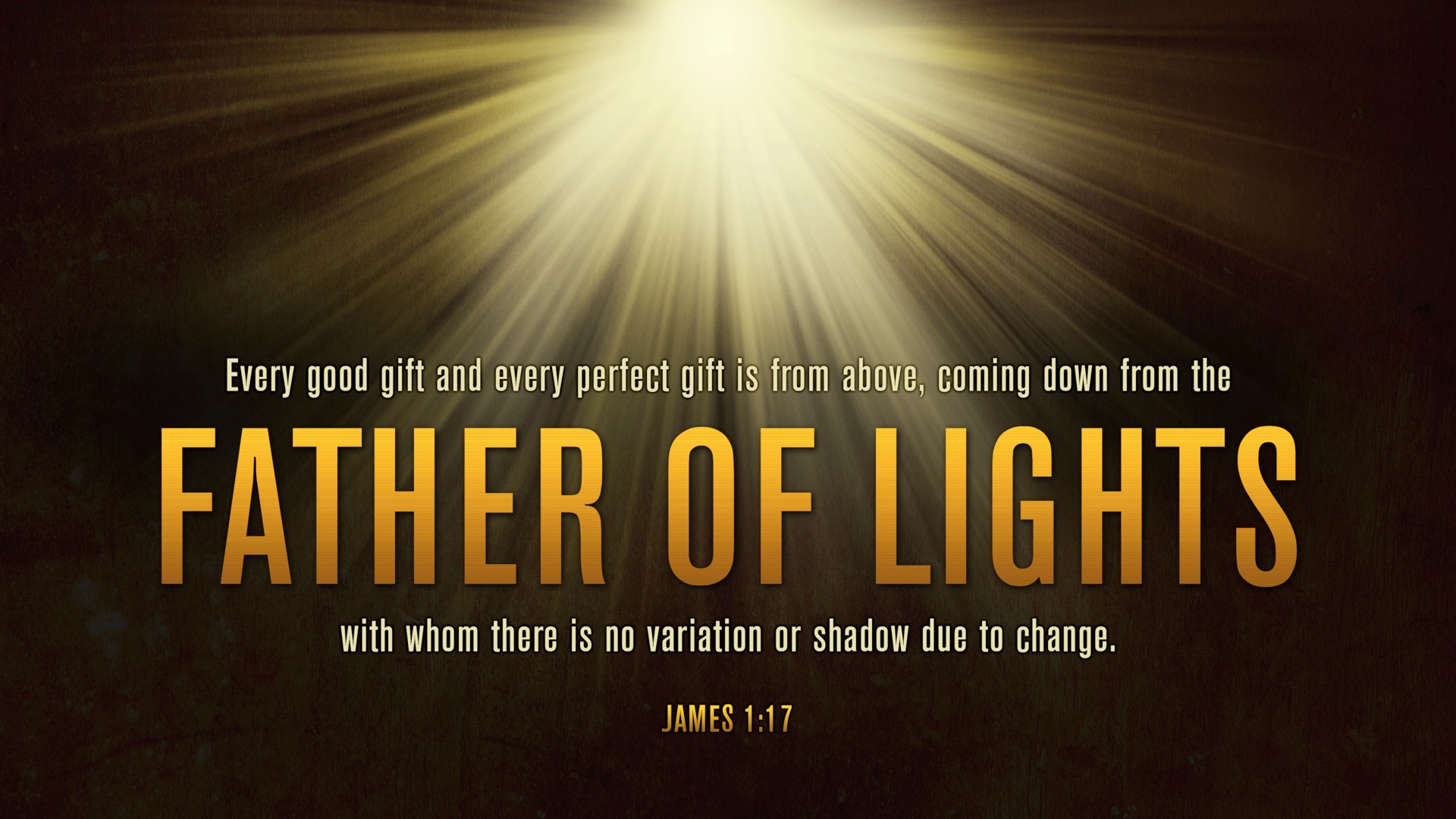
16 Do not be deceived, my beloved brothers. 17 Every good gift and every perfect gift is from above, coming down from the Father of lights, with whom there is no variation or shadow due to change. 18 Of his own will he brought us forth by the word of truth, that we should be a kind of firstfruits of his creatures. 

19 Know this, my beloved brothers: let every person be quick to hear, slow to speak, slow to anger; 20 for the anger of man does not produce the righteousness of God. 21 Therefore put away all filthiness and rampant wickedness and receive with meekness the implanted word, which is able to save your souls.

Alleluia! Christ is risen! He is risen indeed! Alleluia!

In the name of Jesus. Amen.

Even as we live in a broken and fallen world, God continues to shower His good gifts upon us. Everything good in your life – your family and friends, the air you breathe, the tasty food waiting for us downstairs, the green leaves on the trees, and the cushioned chairs under your posteriors – all of it comes from the Father of lights, the almighty Creator of the universe. And your heavenly Father isn’t stingy. His good gifts started immediately at the beginning of your life, the moment of your conception. He intricately weaved you together in your mother’s womb, and He has and will sustain you all the days of your life with His good gifts (Ps. 139:13-16). And God still gives more.

On top of His good gifts, God gives perfect, complete gifts that also come ‘from above.’ In these verses, James uses language that echoes what Jesus says in Jn. 3. That only those who are born again, or ‘from above,’ (same word) by water and the Spirit will see the kingdom of God. The greatest and perfectest [sic.] gift God has given you is the new, from-above birth that James mentions in v. 18. This new, spiritual birth is yours through faith. “Of [God’s] own will, He brought you forth.” And God didn’t even wait for you to begin living to give you this gift of new birth and salvation. Before God created all things, even before the foundation of the world He had inked your name in the Book of Life (Mt. 25:34Eph. 1:4-52 Tim. 1:9).

Dear saints, you didn’t earn your place in God’s family. God freely gave it. That’s how you were and are and remain saved. It isn’t your work; it’s God’s perfect gift. Period. In your Baptism, God gave you the gift of faith as He implanted His life-giving Word into you. And the Holy Spirit has watered and nurtured that Word so that it would grow, mature, and bear fruit. Micah and SidaLee, today you aren’t earning God’s gift or approval. Instead, you are simply publicly acknowledging the gift you have received from Him as you stand, rooted where God has planted you.

Micah, SidaLee, and all you saints, count on God continuing to give His good and perfect gifts to you. Don’t be deceived into thinking that you can reach out and grab those gifts before God gives them. Our reading starts, “Don’t be deceived.” It’s a good translation, but the word James uses has a nuance to it of following the wrong path.

You would be utterly and sinfully deceived to think that you can snatch God’s good gifts before God gives them. That is the path of filthiness and rampant wickedness where those gifts cease to be gifts. It is the path of darkness that only leads to more darkness. The devil, the world, and your own flesh will try to lure you down that path of darkness to your eternal death. Do not go down that path.

But that is not the path you are on, Christian. Your path is to recognize the good and perfect gifts for what they really are – gifts from your Heavenly Father, your merciful Savior, and your comforting Holy Spirit. Your path is illumined by the true, eternal, inerrant, infallible, Word of God that is a lamp to your feet and a light to your path (Ps. 119:105). And you can know without a doubt that Word will never fail you.

Christ Himself is that Word, and there is no shadow, no shiftiness, no variation in Him. The sun sets, and the moon goes down. But Christ does not. Even though Christ describes this path as narrow and difficult (Mt. 7:13-14), you can confidently and safely run down that path with your eyes fixed your eyes on Christ, the Author and Perfector of your faith (Heb. 12:1-2). That confidence comes because He has implanted His Word in you.

I have to apologize for mixing metaphors about going down a wrong path on the one hand and being planted on the other hand. But it’s what the Holy Spirit inspired James to do. So, I guess, I’ll do it too.

Receive the implanted Word. A tree doesn’t need go off on a journey to find more nourishment to grow taller and bear more fruit. Instead, it stretches wider – both with branches and roots. That stretching enables that tree to receive more and more. And the more it receives, the more fruit it bears.

By God’s will, you were brought forth, planted, and are continually nourished because your God is a giver. With a giver, you can receive or reject, but you can’t make a deal. The giving-God doesn’t play around with negotiations, and you cannot make a deal with Him because you have nothing to offer that isn’t His already.

Be comforted. God doesn’t tire of giving. He just gives more. He would have all of you open your hands wider to keep receiving His good and perfect gifts. And if you are worried that His gifts will get too big and overwhelm you, there is a simple solution: Join God in His giving game.

Because God continues to pour out His gifts and blessings on you, you know that you are free to bless others and join God in giving His gifts away. Your giver-God pours out His good and perfect gifts on you because He has made you His child. With each gift, He nudges you to open your hands wider to both to receive from Him and give to others as well.

So, Micah, SidaLee, all you saints, open your hands wide to receive God’s good and perfect gifts (Ps. 81:10). Always continue to receive the implanted Word which saves your soul and delivers the righteousness of God to you now and always. Amen.

Alleluia! Christ is risen! He is risen indeed! Alleluia!

The peace of God, which surpasses all understanding, will guard your hearts and minds in Christ Jesus. Amen.

Forsaken – Sermon on Mark 15:33-35 for Good Friday

Mark 15:33-35

33 And when the sixth hour had come, there was darkness over the whole land until the ninth hour. 34 And at the ninth hour Jesus cried with a loud voice, “Eloi, Eloi, lema sabachthani?” which means, “My God, my God, why have you forsaken me?” 35 And some of the bystanders hearing it said, “Behold, he is calling Elijah.”

In the name of Jesus. Amen.

On Good Friday, our Lord Jesus Christ suffered in three distinct ways. And it’s helpful to distinguish and contrast them. The three kinds of suffering are 1) physical suffering, 2) suffering the shame, and 3) the suffering of forsakenness.

We know what it is to have physical pain. We’ve all experienced it. Maybe not to the extent that Jesus did, but we’ve all had physical pain. You scrape your knee, get your finger caught in a door, or just sleep or sit wrong. Physical pain is something we naturally try to avoid. The physical pain of the cross was, without a doubt, excruciating for Jesus. But His physical pain was not what won your redemption and salvation. Physical pain was not the price that Jesus had to pay.

If Jesus’ physical pain won your salvation, then you and I have the same capacity to suffer physically as Jesus did. Plenty of people were beaten, whipped, and crucified in Jesus’ day, but their physical suffering didn’t save them.

We also know what it is to experience shame. The shame Jesus endures in His Passion is also horrible. He was spit on. The soldiers placed robes on Him, put a crown of thorns on Him, and bowed down to Him as they mocked, “Hail, King of the Jews.”

He was blindfolded and punched as people asked Him to prophesy, “Who was it that hit you?” People walked by the cross wagging their heads, saying, “You saved others. You don’t seem to be able to do anything now. You trusted in God, where is He now?” That’s the shame of the cross. And yet, the shame Jesus suffered is also not what wins your salvation. Other people have suffered similar shame.

But there’s that third suffering. It’s a hidden suffering, but it is the one that’s most profound of all. We get a glimpse of it in this fourth word of Jesus, “My God, My God, why have You forsaken Me?” That’s the greatest suffering of the cross.

In that moment, Jesus is suffering all the wrath of God over sin. He’s suffering all of God’s anger that you and I deserve. 2 Corinthians 5:21 says that Jesus, who knew no sin, was made to be sin for us, so that in Him we could become the righteousness of God.

In other words, all of the anger, all of the wrath, all of the punishment, and the separation from God that you and I deserve – it all falls on Jesus. He suffers all of that as our sins are laid on Him. In that moment, God is looking down at Jesus, and God does not see the Son whom He loves. Instead, God only sees sin and all the things that He hates and abhors.

In that moment, God the Father forsakes Jesus and pours out all of His wrath onto Christ. This why Isaiah says that Jesus is smitten, stricken by God, and afflicted (Is. 53:4). All of God’s righteous anger falls on Jesus. When Jesus says these words, “My God, My God, why have You forsaken Me?” that is what is taking place.

The most profound word of that prayer from Jesus’ lips is, “Why?”Christ doesn’t pray, “My God, My God, You have forsaken Me.” Instead, it’s, “Why? Why have You forsaken Me?” And this is a real, honest question. Several times throughout His life Jesus denies using His divine knowledge and omnipotence. This is one of those times. For those moments, even the purpose of Jesus’ suffering is hidden from Him.

This wasn’t always the case. When He was nailed to the cross, Jesus knew what He was doing there. That’s why He said, “Father, forgive them.” God can’t forgive without the cross. Jesus knew what He was doing on the cross when He told the thief, “Today you’ll be with Me in paradise.” And in just a few minutes Jesus shows that He knows again why He’s there when He says, “It is finished.”

But here, right in the middle of the crucifixion as Jesus cries out, “Why have You forsaken Me?” He temporarily denies His knowledge of what He is doing there. The point of it all is hidden from Him.

In that moment Jesus has nothing. Nothing to cling to. No hope. No comfort at all. He doesn’t have the comfort of knowing that He’ll be raised on the third day. He doesn’t have the comfort that this is happening for your salvation. In that moment, all Jesus knows is that He’s suffering all of God’s wrath against sin even though He’s done nothing wrong or sinful.

That is the suffering that wins your salvation. That suffering of being forsaken by God that Jesus is enduring here is beyond our comprehension.

We can see the beating and the whip. We can see the crown of thorns. We can see the shame and hear all the mockery. We can see the nails. But what you can’t see is the thing that matters most. The vengeance and wrath of God towards sinners is all poured out on Christ.

That’s the reason. That’s why Jesus goes to the cross. He goes there so that you will never see this wrath. So that you will never know this suffering under God’s righteous judgment. So that you will never know what it is to be forsaken by God. 

Jesus says, “My God, My God, why have You forsaken Me?” so that you never have to.

Dear saints, you will never have to say that because God will not forsake you. He has promised (Heb. 13:5-6). He will not leave you alone in your sin. He doesn’t let your sin and guilt remain because Jesus has taken it and has suffered for it in your place.

That’s the suffering that wins and accomplishes your salvation. It is a suffering that we can’t imagine. And, Christian, because of Jesus, you never will. Jesus is your substitute. He pushes you out of the way of God’s wrath so that wrath hits Him and not you.

“My God, My God, why have You forsaken Me?” As He said that, Jesus didn’t know. But, dear saints, you do. You know the answer. He was forsaken by God so that you will be not only accepted, but also loved as God’s redeemed child for all eternity. Amen.

The peace of God, which surpasses all understanding, will guard your hearts and minds in Christ Jesus. Amen. 

God of the Living – Sermon for the Vigil of Easter

Click here for the bulletin with the readings for tonight’s service.

Alleluia! Christ is risen!
He is risen indeed! Alleluia!

In the name of Jesus. Amen.

Now and always, our God is the God of the living (Lk. 20:38).

From the very beginning of Scripture (Gen. 1:1-2:3), God creates and gives life to everything that and lives and breathes. God forms Adam from the dust of the ground with His own hand and breathes into his nostrils the breath of life (Gen. 2:7) because He is the God of the living.

In the time of the Flood (Gen. 7:1-5, 11-18; 8:6-18; 9:8-13) when every intention of the thoughts of mankind’s heart was choosing death, God brings destruction to those who rejected Him as the God of life. But He would not make a complete end. He instructed Noah to build an ark to save Noah, his family, and the animals. God did this to preserve the life He had created because He is the God of the living.

When God heard the groaning of His people who were slaves in Egypt, He remembered His covenant with them. God saw their affliction, and God knew (Ex. 2:23-25). God did all those signs and wonders to bring His people out of that land of slavery and death. He opened a way through the waters of the Red Sea so His people could escape Pharaoh’s deadly soldiers, pass through the watery tomb on dry ground, and arrive safely on the other shore (Ex. 14:10-15:1). He did this because He is the God of the living.

When they were scattered and exiled, God promised to bring His people to their own land. He promised to sprinkle clean water on them to wash them from all their uncleanness. He would remove the sinful, dead hearts of stone and give them living hearts of flesh (Ezk. 36:24-28) because He is the God of the living.

When His people were dried up bones (Ezk. 37:1-14), God gave His prophet Ezekiel a promise to proclaim: “I will open your graves and raise you from your graves. I will bring you into the land, and you shall know that I am the Lord. I will put My Spirit within you, and you shall live.” God made that promise because He is the God of the living.

When Job was suffering, he knew that his Redeemer lives (Job 19:20-27). And Job had no doubt that his Redeemer would stand victorious on the earth. Job rightly confessed even after his body died and his flesh was destroyed that his own eyes would see God because Job knew that God is the God of the living.

Faced with a blazing execution, Shadrach, Meshach, and Abednego refused to worship the pagan image that Nebuchadnezzar had set up (Dan. 3:1-30). They knew that God was able to deliver them from the burning fiery furnace and out of the king’s hand. But even if God didn’t deliver them they would not worship that dead, golden image. Even though they were bound and thrown into that inferno, they were not burned or singed because the God of the living walked with them both through and out of that fire.

The God of the living brings life to every corner of creation where we bring sin and, with our sin, death. The God of the living took on flesh and blood to take your place on Golgotha, the Place of the Skull (Mt. 27:33). Out of love for you who choose death, He willingly went to death to utterly defeat it. And when God dies, He doesn’t stay dead. He is the God of the living.

Jesus, your Savior, has and will come into your grave and bring you out. By His death, He has swallowed up death. “O death, where is your victory? O death, where is your sting?” Death’s only answer is, “I lost them. The God of the living has taken them away.”

Dear saints, because of the crucified, dead, buried, resurrected, ascended, and living Jesus, you now look for the resurrection of the dead and for the life of the world to come. Amen.

Alleluia! Christ is risen!
He is risen indeed! Alleluia!

The peace of God, which surpasses all understanding, will guard your hearts and minds in Christ Jesus. Amen.

Innocent Blood – Sermon on Matthew 26:1-27:66 for Palm Sunday

Matthew 26:1-27:66

In the name of Jesus. Amen.

Matthew is the only one of the four Gospels that tells us what happened to Judas after Jesus was arrested and condemned (Mt. 27:3-10). Judas was overcome with regret and guilt because he knew that God had cursed anyone for taking a bribe to shed innocent blood (Dt. 27:25). Our translation says that Judas “changed his mind” (Mt. 27:3). In Greek, it’s one word (μεταμέλομαι) that is similar to the word for repentance (μετανοέω), but the change of mind Judas had was only one-sided. And here’s what the text conveys: Judas was very sorry. He wished that what he had done could be undone. He regretted his betrayal, but Judas did not repent the way Christians repent. Christian repentance has two parts. It includes the regret and change of mind Judas had. But saving repentance goes one step further. Christian repentance also trusts and believes in God’s grace and mercy given on account of Jesus’ death and resurrection (Mk. 1:15). Judas was lacking that faith and trust.

That lack of faith in God’s mercy is why Judas goes to the chief priests and elders. He doesn’t know where else to turn even though he had been taught better. Sadly, Judas brings his confession to the wrong place. Judas went to the Temple which had been the place of forgiveness (1 Kgs. 8:30), but the night before, Jesus had clearly told Judas and the rest of the disciples that He was instituting the New Covenant (Jer. 31:33-34) in His Blood for the forgiveness of sin (Mt. 26:26-29). The result was that Judas went to the very ones who had been seeking Jesus’ death (Mt. 26:14-15). Judas knew where he needed to go for forgiveness – he had been told just a few hours earlier. But instead of going to Jesus, he sought forgiveness where it could not be found.

Judas’ confession of sin and his action of returning the thirty pieces of silver were both right. He had betrayed innocent blood and returning the payment he received for his sin was what he should do. But his sorrow and penance could not undo what he had done; it could not remove the guilt of his sin. The chief priests and elders were supposed to be forgivers, absolvers, and ministers of atonement. Yet, after hearing Judas’ confession, they refuse to lift the burden of guilt from him. Instead, they bind Judas’ sin and betrayal on his head. “What is that to us? See to it yourself” (Mt. 27:4). What a chilling, horrific thing to say to someone who is crushed with guilt.

Throughout the Gospels, those religious leaders had tried to convict Jesus of sin. They would accuse Jesus and the disciples of eating with defiled hands (Mt. 15:1-20) and of eating and associating with tax collectors and sinners (Lk. 15:1-2). They were always trying to trap Jesus (Mt. 22:15-40). You would think that they would at least tell Judas something like, “Don’t worry, Jesus isn’t innocent. He’s a sinner. He’s dangerous. He’ll bring trouble to all of us with his teaching.” But they don’t. They don’t try to convince Judas that Jesus was guilty. They don’t even offer that little shred of comfort to Judas. It appears as though they also know that Jesus was innocent. Back in Mt. 23:2-4, Jesus rightly said of them, “They tie up heavy burdens, hard to bear, and lay them on people’s shoulders, but they themselves are not willing to move them with their finger.”

If the chief priests and elders had offered Judas forgiveness, it would have required them to admit their own guilt. Again, they were the ones who conspired with Judas to shed Jesus’ innocent blood. But instead of repenting, they insisted they were doing the right thing in condemning Jesus. So, they become absurdly hypocritical.

After Judas throws the pieces of silver in the Temple, they quickly work to get that money out of the Temple because it is blood money. They recognize they cannot put the bounty they had placed on Jesus’ head back in the holy treasury because it is unclean money (Dt. 23:18). But (here’s the hypocrisy) they were the ones who defiled that holy money. They were the ones who took it from the treasury. They were the ones who turned that silver into blood money using it to pay Judas for his betrayal (Mt. 26:15).

While it is tempting to despise the chief priests and Judas, in Christian humility we need to recognize that we do just as they did. Too often, we are filled with sinful desires and passions and make any excuse to attempt to justify them. Too often, we will do all sorts of horrific things and try to hide them under the guise of holiness while we ignore the carnage it wreaks on others. Too often, we are like Judas and don’t realize how destructive our behavior is until it’s too late. When we do, finally, realize the great harm we have done, it can lead us to despair. And despair is a dangerous place to walk. Judas despairs of all hope and kills himself. Judas is condemned, not because he kills himself, and not even because he betrayed Jesus. Jesus’ death covered even Judas’ sins of suicide and betrayal. Judas is condemned because he died outside of faith in Jesus’ grace and mercy. Jesus calls Judas the “son of destruction” (Jn. 17:12) and says that it would have been better for Judas if he had never been born (Mt. 26:24). Jesus never says anything like that about His sheep.

Please allow me a brief aside here: Suicide, self-murder, is not the unforgivable sin. Can people commit suicide and still be a Christian? Yes. To those of you who have lost someone to suicide, you can have comfort in the promises of Scripture. Christ Himself is the man of sorrows, acquainted with grief (Is. 53:3). When someone is walking in grief, depression, and even in the valley of the shadow of death, Jesus is with them (Ps. 23:4) and desires to save them (1 Tim. 2:4). In that deathly vale, Jesus calls to them, “Come to Me, all who labor and are heavy laden, and I will give you rest” (Mt. 11:28). All that being said, suicide is an evil death and is never the answer to despair.

The answer to all sin and despair is in the innocent Blood of Jesus which has been shed for you. His innocent Blood was shed to cleanse you of your guilty blood. Whenever you recognize your guilt and sin against God, bring those sins to Christ. Let Him deal with them because He has dealt with them in His death and resurrection. He is the Lamb of God who takes away the sin of the world (Jn. 1:29). 

The answer to sin is the innocent Blood of Jesus that He freely gives to you in Holy Communion. And now, Jesus invites you to His table to receive that Blood which He will put in your mouth. Here, Jesus’ innocent Blood becomes your blood. Dear saints, come, take, eat, and drink the perfect, innocent Blood of your Savior which He has shed for the forgiveness of all your sins. Amen.

The peace of God, which surpasses all understanding, will guard your hearts and minds in Christ Jesus. Amen.

Salvation unto Us Has Come – Sermon for Reformation Sunday (Observed) 2022

The Scripture readings for our service today were Revelation 14:6-7; Romans 3:19-28; and John 8:31-36.

A sheet with Scripture verses that were used to compose the hymn “Salvation unto Us Has Come” can be found here.

In the name of Jesus. Amen.

We are all slaves – every one of us. Romans 3:23 says, “all have sinned and fallen short of the glory of God.” And here in v. 34, Jesus says, “Everyone who practices sin is a slave to sin.” And don’t misunderstand the word ‘practice’ there. It is a fine translation, but we might get the wrong idea if we think the word ‘practice’ means someone who does something over and over to get better at it. I don’t think anyone here is actively trying to get better at lying, stealing, cheating, etc. The word Jesus uses here that gets translated as ‘practice’ is simply the word ‘do’ or ‘does.’ We will say that a doctor ‘practices’ medicine because medicine is simply what the doctor does. Literally, Jesus’ statement here could read, “All who do sin are slaves to sin.” And because “all have sinned,” (Ro. 3:23), we all are slaves to sin.

Slaves do not remain in the house. Only sons do. That is why you need Jesus – the eternal Son of God – to set you free. Christ sets you free through His Word because His Word delivers to you everything that He has done and accomplished on the cross. Through Jesus’ death and resurrection, you are delivered from your slavery, you are freed, you become God’s child, and, as God’s children, you remain in the house forever with Jesus.

Now, that’s a full sermon right there, but we’ve still got some time. So, I want to bring in a guest preacher to teach us the same thing. The name of the preacher is Pastor Paul Speratus. Pastor Speratus wrote the hymn that you have in your Scripture insert. This hymn, “Salvation unto Us Has Come,” ends up being a complete summary of the theology of the Reformation, and since today is Reformation Sunday, we’re going to sing it and let it preach to us. I know some of you will find this boring, but please give me just a minute to set the stage for how this hymn came to be written.

Speratus was a Catholic priest in Salzburg, Austria. You probably know Salzburg because of the movie The Sound of Music. Well, Speratus had read Luther’s writings that came after the 95 Thesis, and Speratus recognized how far the church had wandered from the teaching of the Scriptures. So, Speratus starts preaching Law and Gospel in Salzburg. Luther got condemned for his writings in 1521, but Luther was protected from that sentence of death – basically, by being kidnapped and hidden in a castle where he spends 300 days translating the Bible into German. Well, Speratus also ends up being sentenced to death for heresy in 1523 and was sentenced to be burned at the stake. Like Luther, Speratus gets rescued from execution. But during his time in prison, Speratus writes this hymn.

You might think that sitting in prison and waiting for execution, Speratus would write a hymn about God’s protection and provision. But no. Speratus writes a hymn about the theology of salvation. Speratus wrote this hymn because Luther had just started conducting services in German and called on German-speakers to write hymns that taught the truths of Scripture in the German language so the people would have good songs to use in worship. This hymn is one of those. Apparently, when Luther first heard it, he offered the singer all the money he had in his pocket for the lyrics. And the hymn ended up being included in the first German hymnal which only had eight songs in it. The history lesson on the hymn is now over.

Personally, I love how clearly this hymn teaches what the Bible teaches, and according to Scripture, that is what Christian songs should do (Col. 3:16). The nice thing about this hymn is that Speratus included the Scripture passages he had in mind when he wrote the hymn. Those passages are included on the insert in your bulletin. This hymn would be a good addition to your devotional time. If you don’t have a regular devotional, my suggestion would be to read the passages for the first verse then sing it. The next day sing the first verse, then read the passages for the second verse and sing it. The third day, sing the first two verses, then read the Scriptures for the third and sing it. Do that for ten days adding a new verse each day.

By the time you finish, you will be a great theologian because this hymn so clearly teaches Law, Gospel, and holy living. It clearly teaches how our good works don’t help or save us, which is what the church of Rome was falsely teaching. Instead, faith produces the fruit of good works which are good because they serve our neighbor.

So, we’re going to let the hymn preach to us. Because it’s a long hymn, we won’t sing all ten verses at once. I’ll give your voices a break and make brief comments here and there. Feel free to sing it from the insert, but if you would like to have the music, it is #410 in your hymnal. Let’s start with the first verse.

1. Salvation unto us has come
by God’s free grace and favor;
Good works cannot avert our doom,
they help and save us never.
Faith looks to Jesus Christ alone,
Who did for all the world atone;
He is our one Redeemer.

This verse summarizes everything that will come after it. God, by His free grace and favor given through Jesus, has set you free. Through faith in Jesus, you are a child of God. The last two lines of that verse tell us what Jesus has done. He made the payment for you. He is the one and only Redeemer.

Now, because the hymn was written in German then translated into English, some of the wording is slightly changed from the original to make the poetry work in English. But those last two lines in German say that Jesus, “has done enough for us all. He has become our Mediator.” Jesus has done everything you needed to be saved, and now He sits at God’s right hand interceding for you and governing all things for your good.

Now, the hymn goes on to elaborate what Jesus needed to do. Let’s sing verses 2-3.

2. What God did in His Law demand
and none to Him could render
Caused wrath and woe on ev’ry hand
for man, the vile offender,
Our flesh has not those pure desires
The spirit of the Law requires,
and lost is our condition.

3. It was a false, misleading dream
that God His Law had given
That sinners could themselves redeem
and by their works gain heaven.
The Law is but a mirror bright
To bring the inbred sin to light
that lurks within our nature.

Because of our sinful nature, we don’t even begin to do what God requires of us through the Law. And even though we falsely think that we’re better than others, the Law is a bright mirror that shows our desperately lost and sinful condition. Let’s sing verse 4.

4. From sin our flesh could not abstain,
sin held its sway unceasing;
The task was useless and in vain,
our guilt was e’er increasing.
None can remove sin’s poisoned dart
Or purify our guileful heart—
so deep is our corruption.

Apart from Jesus, we have no hope of salvation. The poison of sin continues to slowly kill and destroy us. The Law leaves us dead in sin. But that does not mean that we are without hope. We’ll sing verse 5.

5. Yet as the Law must be fulfilled
or we must die despairing,
Christ came and hath God’s anger stilled,
our human nature sharing.
He hath for us the Law obeyed
And thus, the Father’s vengeance stayed
which over us impended.

Jesus has fulfilled the Law for you. He is your substitute. The eternal Son of God took on your flesh to do all this for you. He perfectly obeyed the Law for you. He suffered the punishment your sins deserved. And because of that, God sees Jesus’ perfection when He looks at you, believer. God has no anger left for your sins because Jesus has taken it all. Verse 6.

6. Since Christ hath full atonement made
and brought to us salvation,
Each Christian therefore may be glad
and build on this foundation.
Thy grace alone, dear Lord, I plead,
Thy death is now my life indeed,
for Thou hast paid my ransom.

There is nothing left for you to do to be saved. Everything is done; it is finished (Jn. 19:30). The hymn takes a turn in that verse and addresses God directly. We ask God to apply everything Jesus has done to us. His death is your life. He has fully paid the ransom for your soul. Verses 7-8.

7. Let me not doubt, but trust in Thee,
Thy Word cannot be broken;
Thy call rings out, “Come unto Me!”
no falsehood hast Thou spoken.
Baptized into Thy precious name,
My faith cannot be put to shame,
and I shall never perish.

8. The Law reveals the guilt of sin
and makes men conscience-stricken;
The Gospel then doth enter in
the sinful soul to quicken.
Come to the cross, trust Christ, and live;
The Law no peace can ever give,
no comfort and no blessing.

Jesus calls to you, “Come to Me, all who labor and are heavy laden, and I will give you rest.” Trusting in that call, you will never ever be put to shame. Jesus has come so that you have eternal, abundant life. Verse 9.

9. Faith clings to Jesus’ cross alone
and rests in Him unceasing;
And by its fruits true faith is known.
with love and hope increasing.
Yet faith alone doth justify,
Works serve thy neighbor and supply
the proof that faith is living.

Faith in Jesus is the only thing that saves you, but faith is never alone. Christian, you do good works, but those works never save you. Those works are simply the fruit of the Spirit that serves your neighbor and shows that your faith is alive and well.

Now, the hymn closes with a doxology. We get swept up into the liturgy of heaven and join all the saints who have gone before us by praising God for what He has done for us in Christ. Let’s sing the final verse.

10. All blessing, honor, thanks, and praise
to Father, Son, and Spirit,
The God that saved us by His grace—
all glory to His merit!
O Triune God in heaven above,
Who hast revealed Thy saving love,
Thy blessed name be hallowed.

Amen.The peace of God, which surpasses all understanding, will guard your hearts and minds in Christ Jesus. Amen.

Reconsidering Repentance – Sermon on Luke 15:1-32 for the Third Sunday after Trinity

Luke 15:1-32

In the name of Jesus. Amen.

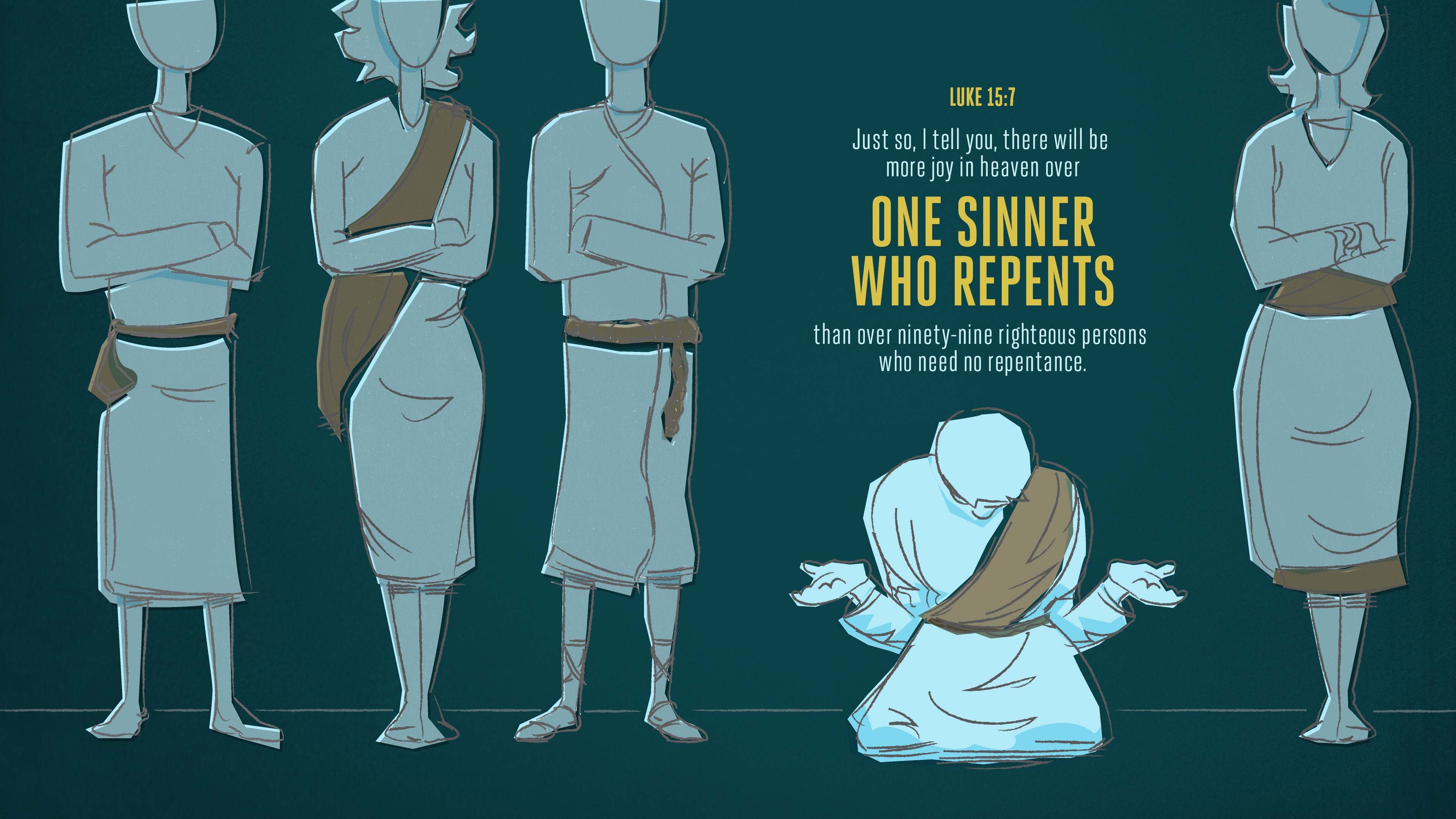
The night Jesus was born, shepherds were out in the field keeping watch over their flocks. A multitude of the heavenly host arrived praising God and saying, “Glory to God in the highest, and on earth peace among those with whom He is pleased.” Heaven was filled with rejoicing the night of Jesus’ birth because your Savior had come to rescue you from sin, death, and the devil. Now, in this Gospel lesson, Jesus says, “There will be more joy in heaven over one winner who repents than over ninety-nine righteous persons who need no repentance” (Lk. 15:7).

Well, there aren’t ninety-nine righteous persons who need no repentance; there has only ever been One righteous person who needed no repentance, Jesus Christ. This is probably a little ridiculous and silly, but should we imagine the joy of those angels the night of Jesus’ birth is multiplied by 99 plus a bit more when one sinner repents? Well, joy isn’t measured in units, so forget about attempting the math problem. But we can know from Jesus’ own lips that heaven rejoices more at the repentance and salvation of one sinner than it rejoiced over Christ’s birth.

Because Jesus brings the topic up in this text, the question for us today is: What is repentance? The word translated ‘repent’ or ‘repentance’ simply means “a change of mind,” but throughout the New Testament, you will find that repentance refers to a complete spiritual change. In fact, many of the times you come across the word ‘repent’ in Scripture it carries the whole idea of conversion.[1] The Bible does not teach that repentance is one step in some twelve-step salvation program. Salvation is instantaneous; just like in creation, God speaks, and it is. And salvation is always an act of God’s grace. “For by grace you have been saved through faith. And this is not your own doing; it is the gift of God, not a result of works, so that no one may boast” (Eph. 2:8-9). The Bible does teach that repentance is necessary for salvation, but if we see repentance as something we do, as our little contribution, then salvation is no longer a free gift. It would be dependent on you. 

So, let’s reconsider repentance, what it is and what it looks like from this parable Jesus teaches.

The Pharisees and scribes are complaining that Jesus receives sinners. Luke tells us that Jesus’ response to their grumbling is telling them “this parable” – singular. Luke could have said, “so He told them these three parables,” but he doesn’t. “This parable.” One parable. Three sections, parts, or chapters – it’s fine to think of it that way – but it’s one parable. And I’ve said it before, but I’ll say it again: we typically know these three sections or chapters of this one parable as the lost sheep, the lost coin, and the prodigal son. But it would be better if we referred to them as the seeking shepherd, the seeking woman, and the seeking father because that would help us keep the emphasis on the right syllable when it comes to seeing what Jesus teaches about repentance.

Now, in the first two sections of this parable, it’s a little hard to see where repentance comes into the stories. A sheep gets lost, the sheep gets found, and the shepherd throws a party. A coin gets lost, the coin gets found, and the woman throws a party. Just looking at the stories, we would probably conclude that Jesus isn’t teaching about repentance. He’s just talking about salvation. But Jesus concludes both of those sections by talking about heaven’s joy over repentance, so repentance has to be in there somewhere. According to those two parts of the parable, repentance is nothing more than the lost being found and restored by the owner. Then, the owner celebrates because of the joy of restoration.

Now, you might be saying, “Pastor there’s a lot more to repentance than the lost being found and restored. To repent, you have to feel bad about what you’ve done. You have to recognize the hurt and pain you have caused. You need to be scared because of the punishment that’s coming. You need to want to do better. That’s repentance.” To which I have to say, “Well, not according to this parable.” Guilt, shame, fear of punishment, and resolve to do better are all right responses when it comes to our sin, and all of those things may accompany repentance from time to time. But they aren’t necessary for repentance to be true or genuine.

A lost sheep might be scared. I don’t know enough about sheep to know if they feel remorse, but a lost sheep might wish it had never wandered away from the flock. A lost sheep might try to find its way back to the herd. But in the first section of this parable, the repentance of that sheep is somewhere in the shepherd’s finding and carrying this sheep back to the pen. In the second section of the parable, the coin doesn’t have any feelings or sorrow. A lost coin just sits in the crack gathering dust. And the repentance of that coin is nothing more than the woman picking it up and putting it back in her purse. So, these first two sections picture repentance as something God does to the lost.

Just so you know I’m not making this up: In Acts 10-11, we are told the story about how Peter went to preach at Cornelius’ house. Cornelius was a Gentile, so a lot more could be said about the whole story, but I’m going to keep it short. Peter arrives there and preaches about Jesus’ death and resurrection. Peter’s Pentecost sermon is very similar in it’s content, but unlike that Pentecost sermon, Peter doesn’t hammer everyone with heavy Law. He just says that Jesus died and rose again, and he announces that everyone who believes in Jesus receives the forgiveness of sins. The people who hear that sermon are filled with the Holy Spirit and are Baptized. All of that takes place in Acts 10. When you get into Acts 11, Peter is in Jerusalem and is being accused of hanging out with the wrong crowd (similar to Jesus here in Lk. 15). Peter simply relays the story of what happened. And the response is incredibly interesting. The Jerusalem church leaders respond, “Then to the Gentiles also God has granted repentance that leads to life” (Act. 11:18). Dear saints, repentance is a gift given by God.

Now, when we get to the third section of the parable, things are a little different. In the third chapter of the parable, it sure sounds like the younger son is repentant. But where does his repentance take place? Now, we have to set this up a little bit.

The third section of the parable has three main characters – a father and his two sons. The younger son tells his father to drop dead. That’s how you get an inheritance. Basically, the younger son tells his dad, “I want my share of your stuff, but I want it without you.” And the father gives it to him. Now, this would have meant public shame for the father because it would have involved selling off at least 1/3 of his estate to give the money to his little brat of a son. The son takes the cash and blows it all. He becomes so desperate in his effort to stay alive that he hires himself out to a pig farmer and is jealous of the slop the pigs are eating. 

Now, just a quick aside here. This also gives us a picture of what our sin does. Our sin isn’t just us getting lost. Sin is worse than a sheep aimlessly wandering away from the flock or a coin getting dropped. No, our sin makes us lower than and jealous of pigs.

Sitting there in the pigpen, the son starts crafting a speech. And that speech sounds like repentance, but it isn’t. Instead, the younger son realizes his father’s employees have plenty of food, and he’s dying of starvation. He plans to go to his father and say, and listen carefully, “Father, I have sinned against heaven and before you.” So far, completely true and right. “I am no longer worthy to be called your son.” No duh. “Treat me as one of your hired servants.” Now, all of this, again, sounds like repentance. He recognizes the stupidity of his actions and the ramifications of his rebellion. But it’s that last part that shows the brat’s real intention. He wants his dad to give him a job so he can have some food. The interesting thing that I had never noticed is the wording Jesus uses in this part of the parable.

Jesus doesn’t use the normal word for a servant which is doulos. A servant, a doulos, would live on the estate of the master and would even eat meals with the master’s family. But the younger son uses a different word here, misthios. A misthios is someone who would commute to work at the estate. A misthios would have no relationship with the master except when it was time to get paid for work done. His speech just shows how lost and unrepentant he still is. He still wants the benefits his dad can offer, but he doesn’t want anything to do with his dad. In his despair, he’s basically saying, “Dad, I screwed up big time. Can you just help me to stay alive? I won’t bother you and you won’t have to bother with me.” That’s his prepared speech.

He starts his walk home. But as he rounds the corner, his father comes running to him, embraces him, and kisses him. The son begins his speech, “Father, I have sinned against heaven and before you. I am no longer worthy to be called your son.” But the father, the father doesn’t care. He restores him to his rightful place as a son. “Bring the best robe and a ring and shoes; put them all on him. Kill the fattened calf and let’s throw a party. For this my son was dead, and is alive again; he was lost, and is found.” It is in that love and finding and restoration of the father that the son is granted repentance. 2 Corinthians 7:10 says, “Godly grief produces a repentance that leads to salvation without regret, whereas worldly grief produces death.” The son had a worldly grief that would have left him in the death of a lost relationship with his father. But the father here lets the godly grief of his lost son, that true and right realization of what he had done, produce a repentance that leads to salvation and complete restoration. The son doesn’t get to finish his speech. He doesn’t get to be misthios, a hireling. He gets to be a son again – nothing more, nothing less.

Now, I know this sermon is getting long, but I have one more thing, so please bear with me. I made a big deal about this chapter being one parable with three sections. Well, the third section has two parts. There is still the issue of the older son. The older son, who never left, was out working in the field. He comes home, hears the partying, learns what is going on, and is livid. He refuses to join the party. And even though this older son never left his father, he is just as lost as the younger son was back in the pig stye.

And here is why I bring this up. We wrongly think that God is happy when we are doing everything we are supposed to. We think God is happy with us when we are consistent, strong, and can show all the things we’ve accomplished. But that isn’t the case. Your heavenly Father is only happy when His children are forgiven and together with him at the feast. That is why the father leaves his own party and pleads with this older son to come back into the fold.

Dear saints, stop dwelling on your unfaithfulness and sin. Yes, you’ve been the rebellious younger son. But your heavenly Father has sought you out and heaven rejoices at your repentance and salvation. Stop dwelling on your obedience and work for God; don’t be the entitled older brother. Yes, go serve, love, and do your good works diligently, but don’t think that God is going to throw a party for your commandment-keeping.

Heaven rejoices with God when He brings you back into His grace and mercy where nothing is earned or deserved. Instead, it is all freely given for the sake of Jesus, your Savior. Amen.

The peace of God, which surpasses all understanding, will guard your hearts and minds in Christ Jesus. Amen.


[1] Clear examples would include Mt. 4:17; Lk. 5:32; 13:3; 16:30; 24:47; Act. 11:18; 2 Cor. 7:10.

Eden to Heaven – Sermon on Genesis 3:22-24 & Revelation 22:1-5

Genesis 3:22-24 & Revelation 22:1-5

In the name of Jesus. Amen.

God created you to live in perfection. In six days, God created everything in the universe. He created light and darkness. He placed the sun, moon, stars, and galaxies in their places. God established land, sea, and plants and filled the earth with birds, fish, and every kind of animal. And God planted the garden of Eden. Only after all that was completed did God create the crown of creation – man and woman. And Adam and Eve were placed in the Garden of Eden to work it and keep it.

But it wasn’t the kind of work that we experience – it was pure joy. There was no need to look at the forecast to see what the weather would be. No worries about gas prices and inflation. No crisis. No war. No disease or pandemic. Everything was in perfect harmony. In God’s own estimation, all that He created was good, in fact, very good (Gen. 1:21). Best of all was the perfect relationship that existed between God and man. God freely giving and man graciously receiving. Even the one command that God gave was gracious, “Of the tree of the knowledge of good and evil you shall not eat, for in the day you eat of it you shall surely die” (Gen. 2:17).

Now, some suggest that God put the tree of the knowledge of good and evil in the garden so Adam and Eve could choose to trust or reject God. But this is not the case. God’s prohibition to eat from that tree was a promise for Adam and Eve to believe. Just track with me for a minute here. Scripture repeatedly says, “The righteous shall live by faith” (Hab. 2:4; Ro. 2:17; Gal. 3:11; Heb. 10:38). In other words, to be righteous is to have faith. We know that for us sinners to be righteous is to have faith in Jesus as our Savior. But what kind of faith did Adam and Eve have before the Fall? They already knew the mercy, goodness, and graciousness of God because they constantly experienced it in everything that God had given and in everything God was to them. So, what is it that Adam and Eve believed before the Fall that made them righteous through faith?

Well, at some point in those first six days, God created the angels. Now, Scripture doesn’t tell us specifically when, but at some point in those days of creation the devil and demons rebelled and fell. In other words, evil existed. When God banned Adam and Eve from eating from the tree of knowledge of good and evil, God was giving a promise, “Evil exists, and I just want you to trust Me on this. When you find out what evil is, it won’t go well for you, in fact, you’ll die.” So, Adam and Eve could go to the tree of the knowledge of good and evil and know, “What a good God we have. He has given us everything and doesn’t want us to experience or even know what evil is.”

But, as you heard in Sunday’s Old Testament lesson (Gen. 3:1-21), Satan stirred up discontentment in Adam and Eve. The devil told Eve that she could become something more than God had created her to be. Satan said that she would become like God. So, deceived as she was (Gen. 3:13; 2 Cor. 11:3), Eve took the fruit. Adam was even worse; he wasn’t deceived and knew exactly what he was doing (1 Tim. 2:14). They both sinned and fell. They took. They ate. Their eyes were opened. They had become something more. You heard God say it Himself tonight, “Behold, the man has become like one of us in knowing good and evil” (Gen. 3:22).

But Adam and Eve knowing evil wasn’t better. Not even close. Now, because the head of creation had fallen into sin, creation fell with him (Ro. 8:20-21). And Adam and Eve were sent into exile – away from God’s presence, away from the Garden of Eden, and away from the tree of life which was now guarded by the cherubim and a flaming sword. But God sent them into this exile with a new promise to believe. A promise that paradise would be restored to them when the seed of the woman would come and crush the serpent’s head (Gen. 3:15). And it was through faith in that promise that God went with them.

Dear saints, you and I live in exile. We wander about sinfully trying to become like God by our own works, but all our effort is curved in upon itself. Instead of being like our giving God, we seek after our own comfort and desires. Unlike God who is generous and giving, we try to pile up riches for ourselves. We try to create our own little gardens of Eden in an attempt to regain the paradise we lost. But we never achieve the perfection we long for. The treasures we acquire quickly fade and fall apart in our hands.

We cannot return from this exile by our own reason or strength. Yet, God walks alongside us, calling us back unto Himself. Out of His great love for us, He continues to give us promise after promise. And God delivers on every one of His promises. He has sent Jesus into this world of exile to bring us back to paradise. He comes to us who are bent over in our sin and frees us. He delivers us from the bondage of Satan (Lk. 13:16) and gives us rest. He announces to us that because of what He has done by His death and resurrection, we will be eternally restored. While Jesus was on the cross, He told the thief next to Him, “Today, you will be with Me in paradise” (Lk. 23:43). That word ‘paradise’ means ‘an enclosed garden.’

In our reading from Rev. 22:1-5 tonight, we get a picture of that garden of paradise. And that is what lies ahead for you, dear saint. Through faith in Jesus, you are righteous. Your destination is the bright crystal river, the tree of life yielding its twelve kinds of fruit, and leaves for the healing of the nations. There you will see God’s face, and there will be no more night. You will need no light of lamp or sun, for you will be restored to God, and He will be your light. Your time in exile has an end. And there, in eternal bliss, you will reign forever and ever. Amen.

The peace of God, which surpasses all understanding, will guard your hearts and minds in Christ Jesus. Amen.

The Umbrella – Sermon on Matthew 4:1-11 for the First Sunday in Lent

Matthew 4:1-11

1 Then Jesus was led up by the Spirit into the wilderness to be tempted by the devil. 2 And after fasting forty days and forty nights, he was hungry. 3 And the tempter came and said to him, “If you are the Son of God, command these stones to become loaves of bread.” 4 But he answered, “It is written,

“‘Man shall not live by bread alone, 
but by every word that comes from the mouth of God.’”

5 Then the devil took him to the holy city and set him on the pinnacle of the temple 6 and said to him, “If you are the Son of God, throw yourself down, for it is written, 

“‘He will command his angels concerning you,’ 

and 

“‘On their hands they will bear you up, 
lest you strike your foot against a stone.’” 

7 Jesus said to him, “Again it is written, ‘You shall not put the Lord your God to the test.’”

8 Again, the devil took him to a very high mountain and showed him all the kingdoms of the world and their glory. 9 And he said to him, “All these I will give you, if you will fall down and worship me.” 10 Then Jesus said to him, “Be gone, Satan! For it is written,

“‘You shall worship the Lord your God 
and him only shall you serve.’”

11 Then the devil left him, and behold, angels came and were ministering to him.

In the name of Jesus. Amen.

Generally, there are two ways to approach preaching a sermon on Jesus’ temptation. The first is to point out the tactics that Jesus used to resist temptation and encourage the hearers to employ those same tactics because we are to fight and resist temptations (Jam. 1:144:7). Those sermons can make you much more prepared than Eve was in our Old Testament lesson (Gen. 3:1-21) when the devil came asking, “Did God really say?” Preaching Jesus’ temptation that way is helpful, beneficial, and Scriptural, and I’ve taken that approach several times in the past. 

That being said, those sermons are mostly oriented toward the Law and have the potential to be dangerous. They can leave you only hearing, “Jesus is your example. Here, use the same strategies and maneuvers that Jesus used. And if you follow this plan when you face temptation, you can resist sin like Jesus.”

But when – not ‘if’ but ‘when’ – you fail and fall into sin, it can be extremely discouraging. If you only hear sermons about how Jesus is your example, it can leave you thinking that the Bible is simply a self-help book. And when your life doesn’t get better, you can start to think that the Bible isn’t really all that helpful. The devil can take sermons like that and place all your sins and failures and in front of you to tempt you into abandoning the Word of God completely. So, I’m not taking that approach today. Maybe I will the next time, but not today.

Today, I’m taking the second common approach of preaching on Jesus’ temptation which is to see that Jesus is resisting temptation for you. He is doing for you what you cannot and could not do. As Christ resists and fights against the devil, He is trusting in God where you have not. And because Jesus has done all of this for you, God credits Jesus’ victory over sin and temptation to your account through faith.

To get a better understanding of this we need to see that these are real temptations for Jesus. Honestly, these temptations don’t sound all that difficult to us. Turning rocks into food, jumping off a building without a bungee cord or parachute, and bowing down at Satan’s feet are not the temptations you and I face. But the reason each of these temptations is difficult for Jesus is that in each of them the devil is tempting Jesus to abandon His mission to be your Savior. To get at this, we’ll need an analogy:

Imagine that the Ten Commandments are a giant umbrella, and God by creating you has put you under that umbrella of His Law. You and I and all humanity live under the Law, and we don’t have a choice of getting out from under it. That is not an option. The Law is always there directing, instructing, and accusing us because we are sinners.

Now, God isn’t under that umbrella of the Law. God is outside and above the Law. Whether you like it or not, God isn’t subject to the Commandments. He can’t be. Consider the 4th Commandment, “Honor thy father and thy mother.” How is God going to keep that Command? He doesn’t have a father or mother or any authorities above Him to honor. Or consider the 7th Commandment, “Thou shalt not steal,” and the 9th and 10thCommandments about coveting. God created all things, so He already owns all things. He can’t steal or covet anything because everything is His already. So, we live under the umbrella of the Law, and God doesn’t.

But when God saw your pitiful condition under the Law and how it always accuses you, He desired to save you, the only way to do that was for Him to come next to you under the umbrella. Jesus came in the flesh to live under the Commandments next to you. This is the picture we are given in Gal. 4:4-5a, “When the fullness of time had come, God sent forth His Son, burn of a woman, born under the Law to redeem [you] who were under the Law.” You see this?

So, when Satan initially comes to tempt Jesus here, he doesn’t tempt our Lord the same way he tempts us. The devil tempts us to break specific commandments – to disrespect those who have authority over us and break the 4th Commandment, to hate and harm our neighbor and break the 5th, to lust and break the 6th, to lie and break the 8th, and so on. But none of the temptations that the devil throws at Jesus here would lead Jesus to break one of the Commandments. Satan is doing something different here.

In each of these temptations, the devil is tempting Jesus to come out from under the umbrella of the Law. Basically, each of these temptations is Satan, that worm, saying to Jesus, “You created the umbrella! You don’t belong under the Commandments. Leave the people under there, they deserve it. They’ve earned all the punishment they get under there.”

Now with that picture in our minds, let’s consider each of the temptations. If you had gone forty days without eating, the devil would tempt you by simply putting some food in front of you. But when the devil tempts Jesus here, he doesn’t put food in front of our Lord; instead, he points to a pile of rocks. That wouldn’t be tempting for you or me, but this temptation is uniquely tailored for Christ. Jesus has the power, ability, and authority to change those stones into bread. He is God after all, so those stones are His creation. If He wanted to turn them into bread, He had every right to do so. But Jesus doesn’t. He responds by quoting Dt. 8:3, “Man shall not live by bread alone, but by every word that comes from the mouth of God.”

What that passage means is that we humans must trust that God will provide our food at the proper time (Ps. 145:15). So, this temptation to turn rocks into bread is the devil saying to Jesus, “You don’t have to wait for God to give You bread. Only the sons of Adam and daughters of Eve have to wait for God to feed them.” And the devil was right. Jesus didn’t have to wait. Because Jesus is God, if He had turned those stones into bread, God would have been providing. But because Jesus is your substitute and has willingly come next to you under the umbrella, He does wait. He waits for His heavenly Father to provide food. He chooses to be patient because you and I have to be patient and wait for food to come from our heavenly Father. So, by resisting this temptation, Jesus stays with you under the umbrella.

In the second temptation, Jesus is taken to the top of the Temple and is told to jump off. This temptation sounds really strange to us because I doubt you have ever been tempted to jump off the roof of the Alerus or the Ralph. How is this tempting? It wouldn’t be for you or me, but it is for Jesus. If Jesus had jumped off the pinnacle of the Temple, which was a very public place, people would see the angels catch Him, and they would know that He was God. Jesus could get all the glory, worship, and praise that is His due as God.

But Jesus’ glory doesn’t mainly come from doing amazing things. His main glory is staying with you under the umbrella and going to the cross to be your Savior. Just before He was arrested, Jesus began His high priestly prayer, “Father, the hour has come; glorify Your Son” (Jn. 17:1). Again, the devil’s temptation here is to get Jesus to come out of the umbrella and get the glory that Jesus rightly deserves. But Jesus won’t do it. He remains with you under the umbrella because it is much more glorious to be the Savior of mankind than to be a miracle-worker.

Finally, in the third temptation, the devil takes Jesus to a high mountain, shows Him all the kingdoms of the world, and says, “I’ll give You all this if You bow down and worship me.” Remember, Jesus had come to win all the kingdoms of the world for Himself. At the very end of the Gospel of Matthew, Jesus says, “All authority in heaven and on earth has been given to Me” (Mt. 28:18). In this temptation, the devil is saying, “I can give You the kingdoms of the world right now.”

But Jesus won’t do it. Again, He stays under the umbrella. Yes, Jesus has come to reclaim the kingdoms of the world, but only after He has redeemed you by shedding His blood and dying and rising again for you.

Dear saints, Jesus has resisted temptation for you. And we know Jesus faced more temptations than these three. When Luke records Jesus’ temptation, he ends it by saying, “The devil departed from Jesus until an opportune time” (Lk. 4:13). Jesus can sympathize with your weakness because He has been tempted in every way that you are but without sin (Heb. 4:15).

One more thing about Christ’s temptation today. Notice, that Jesus was led by the Holy Spirit into the wilderness in order to be tempted by the devil (v. 1). You can take comfort in the fact that the Holy Spirit will never ever lead you into temptation because Scripture promises (Jam. 1:13). But beyond that, you can know that by facing these temptations for you, Jesus is totally and completely determined and committed to be your Savior. He did not and will not ever come out of the umbrella with you. His desire is to give you His mercy. He has brought that mercy, grace, and forgiveness to you who live under the umbrella.

So today, right now, and always You can draw near to His throne of grace with complete confidence. Because at His throne of grace you will always find His mercy and grace to help in every time of need (Heb. 4:16). Amen.

The peace of God, which surpasses all understanding, will guard your hearts and minds in Christ Jesus. Amen.