
The Move – Sermon on Luke 10:23-37 for the Thirteenth Sunday after Trinity

Aimé Morot (1850-1913). “Le bon Samaritain”, 1880. Huile sur toile. Musée des Beaux-Arts de la Ville de Paris, Petit Palais.

Luke 10:23-37

23 Then turning to the disciples he said privately, “Blessed are the eyes that see what you see! 24 For I tell you that many prophets and kings desired to see what you see, and did not see it, and to hear what you hear, and did not hear it.”

25 And behold, a lawyer stood up to put him to the test, saying, “Teacher, what shall I do to inherit eternal life?” 26 He said to him, “What is written in the Law? How do you read it?” 27 And he answered, “You shall love the Lord your God with all your heart and with all your soul and with all your strength and with all your mind, and your neighbor as yourself.” 28 And he said to him, “You have answered correctly; do this, and you will live.”

29 But he, desiring to justify himself, said to Jesus, “And who is my neighbor?” 30 Jesus replied, “A man was going down from Jerusalem to Jericho, and he fell among robbers, who stripped him and beat him and departed, leaving him half dead. 31 Now by chance a priest was going down that road, and when he saw him he passed by on the other side. 32So likewise a Levite, when he came to the place and saw him, passed by on the other side. 33 But a Samaritan, as he journeyed, came to where he was, and when he saw him, he had compassion. 34 He went to him and bound up his wounds, pouring on oil and wine. Then he set him on his own animal and brought him to an inn and took care of him. 35And the next day he took out two denarii and gave them to the innkeeper, saying, ‘Take care of him, and whatever more you spend, I will repay you when I come back.’ 36 Which of these three, do you think, proved to be a neighbor to the man who fell among the robbers?” 37 He said, “The one who showed him mercy.” And Jesus said to him, “You go, and do likewise.”

In the name of Jesus. Amen.

Jesus didn’t say that the priest and Levite only passed by the half-dead man in the ditch. Christ added the fact that they passed by, “on the other side,” to even further distance them from him. They moved away. Both intentionally and deliberately ‘un-neighbored’ the guy. You’ve heard me say this before, but it’s worth repeating. The reason our English word ‘neighbor’ is spelled so weird is that it comes from the word ‘nigh’ as in ‘near’ and the word for ‘dweller.’ The same thing is true for the Greek word that gets translated ‘neighbor.’ The word means near, but it refers to an individual, so it means ‘close by person.’

In the parable, the priest and Levite aren’t dealing with a gray area. “I wonder if he really needs help?” There are times you might see a person begging for money on the street, and you don’t know that person. You don’t know if giving them money is just going to aid an addiction or be a type of soft theft where they take your money and use it for something different than you intended when you gave it. In this parable, there’s no ambiguity. The situation is black and white. It’s simple. He’s been robbed, stripped, beaten, and left dying in the ditch. If he doesn’t get help, he’s going to die. So, why do the priest and Levite not only pass by, but pass by “on the other side”?

They are trying to quiet their conscience. The more distance they can put between them and this guy in the ditch, the easier it is for them to not think about him. They make a move. They move away from the guy’s need toward their own comfort. Now, this is a parable, so we can’t ask them what they thought was more important than the guy’s need. Maybe it was their schedule. Maybe it was the fact that they knew it would cost them time and money to help the guy. Maybe they just wanted to be left alone so they could have some ‘me time.’ It doesn’t matter. They move away from need of their neighbor toward their own comfort and pass by on the other side.

Then comes the Samaritan. He sees the guy, and he also makes a move. But his move is in the complete opposite direction. He moves away from his comfort toward the guy’s need. And I’m sure he would have preferred comfort. The Samaritan has things going on. He’s got a schedule to keep and a family to feed. His time is limited and valuable. He has all the same reasons and excuses the priest and Levite have. But the Samaritan sees the man, and he moves toward the need.

Jesus makes it clear that the Samaritan has compassion. The way Jesus says it is that his guts were wrenched. The Samaritan went to the man; bound up his wounds; poured on the medicine of oil and wine that he had with him; he set the guy on his own animal; brought the man to the inn; cared for him through the night; gives the innkeeper two denarii (imagine a few hundred bucks); asks the innkeeper to take care of him; and promises to return and pay off any additional expenses. That’s nine things the Samaritan does. Nine ways he moves away from his own comfort toward the guy’s need. It’s absolutely beautiful and noble. Who doesn’t want to be as generous and loving as the Samaritan?

Primarily, this parable shows us a tiny fraction of what Christ has done for you. Jesus, the eternal Son of God, made the ultimate move away from comfort and toward you in your need. Though Jesus was in the form of God, He did not count equality with God a thing to be grasped. He emptied Himself by taking the form of a servant by being born in the likeness of men. And being found in human form, He humbled Himself by becoming obedient to the point of death – even death on a cross (Php. 2:6-8).

He did all that because you needed it. The eternal Son of God made the move from His comfort toward your need. And for that, God be praised! That’s the main point of the parable. But I want to spend the rest of this sermon focusing on what Jesus says before the parable.

After the lawyer correctly summarizes the whole Law with “Love the Lord your God with your soul, strength, and mind. And love your neighbor as yourself.” Jesus says, “Do this and you will live.”

Now, when Jesus said that, I do think it was partly to show the lawyer that he was the guy left for dead in the ditch because the Law robbed and stripped him of any self-righteousness (Gal. 3:19). But, at the same time, when Jesus says, “Do this and you will live,” He is being completely straightforward. Christian, do the Law. Do God’s will. The Law is how God created you to live. The Law is how Jesus wants you to live. It isn’t how you’re saved, but it is how Jesus wants you, believer, to live (Gal. 3:21-22). Jesus wants to motivate you to also be one who moves away from comfort and toward need.

This world is full of needs, but I’m going to focus on one very specific need today because it’s a need that everyone can meet, everyone can fulfill. And that is the need of speaking the truth in a broken and fallen world and that loves lies. The martyrdom and assassination of Charlie Kirk this week is a reminder of the lengths that the demonic forces will go to silence the truth.

Christian, do not be afraid to stand on the truth. Yes, speaking the truth can come with a cost. You might offend others. You might be ridiculed and called all sorts of names. You might lose your job or friends. But, dear saints, do not let that silence you. Silence in the face of lies is nothing other than bowing at the pagan altar of comfort.

Charlie was an amazing example of someone who loved others in a way that led him to move away from comfort toward need. He intentionally went to places to talk with people who suppress truth. He would shine the light of the truth in that darkness with logic and rhetoric that few have. But his example should teach us one simple lesson: the Truth always wins.

Jesus taught us that the devil is a liar and the father of lies (Jn. 8:44). That means wherever there is falsehood, the devil and his demonic forces are at work. Dear saints, don’t give an inch to what is false. Stand on the truth. Speak the truth and know that you are not alone. God doesn’t give many people a sphere of influence as large as Charlie had, but the numbers of people you can reach don’t matter.

Even though most of us (myself included) don’t have the rhetorical and debating skills that Charlie had, those are skills that can be nurtured and strengthened. So, strengthen yours. We’ve seen how one person can influence millions of people. That’s great; for that, God be praised. But imagine what God will do through thousands of people with smaller spheres of influence use that influence to speak the truth to the people around them. You don’t need a larger audience or bigger microphone. You can simply speak to the precious lives that God has placed around you.

And as you shine the light of truth, know that, ultimately, it doesn’t matter if you win people over. That might not happen. But it’s also not your job. That task solely belongs to the Holy Spirit who alone can – and does – change hearts. Leave the results to Him. The only thing that matters that you are faithful (1 Co. 4:2-5).

Our Christian faith requires us to love our enemies and pray for those who curse and persecute us. It does not require us to stand silently in the midst of chaos, evil, savagery, and violence. That would only be a move toward comfort. Dear saints, move toward need. This world needs to hear that sin is bad, and there is forgiveness for sin because of the death and resurrection of Christ. They need to hear that life is precious from womb to tomb; that a man and a woman should get married before they do things that create children; that God created people in His image with gifts and talents that should be nurtured, strengthened, and used for the benefit of others; that criminals should be justly punished; that men are men and women are women; and all sorts of other things. Saying those things in a loving way can be difficult, but it is the loving thing to do.

So, spread the name and light of Jesus every opportunity you have and everywhere you go. With your words and actions, point others to the beautiful, the good, the orderly, the unchanging, and the unending. Because, ultimately, all of that points people to the love of God that comes only through Christ.

As you do that, remember that light has no fellowship with darkness (2 Co. 6:14). Yes, absolutely, strive to rescue others from the darkness. But, if they love the darkness rather than the light (Jn. 3:19-20), shake the dust from your feet (Lk. 9:5).

Dear saints, Jesus is your Good Samaritan who moved from comfort toward your need. You, go and do likewise (Lk. 10:37). Move away from comfort and toward the needs of your neighbor – especially toward those who have believed the devil’s lies. And as you make that move, live in the Light that will never know dusk. Amen.

The peace of God, which surpasses all understanding, will guard your hearts and minds in Christ Jesus (Php. 4:7). Amen.

Nigh-Liver – Sermon on Luke 10:23-37 for the Thirteenth Sunday after Trinity

Luke 10:23–37

23 Then turning to the disciples he said privately, “Blessed are the eyes that see what you see! 24 For I tell you that many prophets and kings desired to see what you see, and did not see it, and to hear what you hear, and did not hear it.”

25 And behold, a lawyer stood up to put him to the test, saying, “Teacher, what shall I do to inherit eternal life?” 26 He said to him, “What is written in the Law? How do you read it?” 27 And he answered, “You shall love the Lord your God with all your heart and with all your soul and with all your strength and with all your mind, and your neighbor as yourself.” 28 And he said to him, “You have answered correctly; do this, and you will live.”

29 But he, desiring to justify himself, said to Jesus, “And who is my neighbor?” 30 Jesus replied, “A man was going down from Jerusalem to Jericho, and he fell among robbers, who stripped him and beat him and departed, leaving him half dead. 31 Now by chance a priest was going down that road, and when he saw him he passed by on the other side. 32So likewise a Levite, when he came to the place and saw him, passed by on the other side. 33 But a Samaritan, as he journeyed, came to where he was, and when he saw him, he had compassion. 34 He went to him and bound up his wounds, pouring on oil and wine. Then he set him on his own animal and brought him to an inn and took care of him. 35And the next day he took out two denarii and gave them to the innkeeper, saying, ‘Take care of him, and whatever more you spend, I will repay you when I come back.’ 36 Which of these three, do you think, proved to be a neighbor to the man who fell among the robbers?” 37 He said, “The one who showed him mercy.” And Jesus said to him, “You go, and do likewise.”

In the name of Jesus. Amen.

You need the right tool for the right job. If you need to fix your glasses, a hammer isn’t going to help you. Sure, you might need to insert a pointy piece of metal hardware into the frame of your glasses, but it’s going to be a screw and not a nail. In fact, when you’re trying to fix a pair of glasses, it isn’t even enough to have a screwdriver. You need the right kind of screwdriver – one that is tiny and difficult for my not-so-dexterous hands to manipulate. That’s why, for me, the right tool for fixing my glasses isn’t a tiny screwdriver; it’s an optician.

The lawyer who comes to Jesus is undertaking a worthy task – desiring to have eternal life, but he is using the wrong tool. Not only does he not have the right tool in his tool chest, he doesn’t even understand of what kind of tool he needs. He thinks salvation is something he can do and achieve for himself. That’s why his question is, “Teacher, what shall I do to inherit eternal life?” Jesus gives him perfect, correct instructions for earning eternal life by pointing him only to the Law. Love God perfectly and love your neighbor perfectly. Do this, and you will live (Lk. 10:26-28; see also Ps. 15).

The lawyer’s response to this is interesting. He doesn’t ask, “Who is God?” That would be ridiculous. He also doesn’t ask, “How do I love God?” Instead, he asks, “Why is my neighbor?” That question reveals something. Apparently, the lawyer thinks that already loves God perfectly. It’s only the second part of the equation that befuddles him. He is looking for an ‘out.’ He wants a limit on the extent of the command to love others. But there is no limit on this command. You cannot love God whom you have not seen if you don’t love your neighbor whom you have seen (1 Jn. 4:20).

In the context of this conversation between Jesus and the lawyer, that question is absurd. The word ‘neighbor’ defines itself. In at least Greek, Hebrew, Latin, German, and English, the word for ‘neighbor’ has more to do with location than anything else. In each of those languages (probably in others too), ‘neighbor’ means the person close to you. The English word neighbor is spelled so weird because it comes from two middle-English words smooshed together: nigh – as in ‘near,’ and gebur which means ‘dweller.’ Your neighbor is anyone who dwells near you. Or, to explain the title of the sermon, your neighbor is the one who lives nigh unto you – a nigh-liver.

Now, the lawyer asks the question because he’s trying to get out from under the command to love his neighbor as himself. He wants a limit to the love that is required of him because, presumably, he wants to keep lying to himself about being worthy of inheriting eternal life. But in general, the question, “Who is my neighbor?” is something we Christians should have in our minds constantly – not because we’re looking for information or identification of our neighbor. Rather, we should be asking that question so we recognize all of the targets of love that God places in front of us. Because we don’t get to pick and choose our neighbors. God gives them to us.

In the parable, God ‘neighbors’ the robbed, stripped, beaten, left-half-dead man to three people. God plops this needy guy in the path of the priest and the Levite. However, both of them intentionally and deliberately try to un-neighbor him. They move to the other side of the road to create distance between them and the wretch in the ditch.

Of course, if the situation had been reversed and either the priest or the Levite had been robbed, beaten, and left for dead, they would have desired help from anyone who passed by. Everyone who gets into trouble or danger is glad to receive help from anyone. That’s the most basic meaning of the command, “Love your neighbor as yourself.”

But the third guy, the Samaritan, is an outsider. Jews and Samaritans hated each other. But this Samaritan recognizes that God has neighbored this man to him, and he uses, what appears to be, unlimited resources to care for him. He binds up the man’s wounds and pours on oil and wine. He bears the burden of lifting the man onto his own animal and walking to town and cares for the man overnight. He pays for two more nights so the man can stay in the inn. And on top of that, he sets up an all-expenses paid account for any charges or costs the man would rack up between the time the Samaritan leaves and comes back. 

We misunderstand this parable if we think it is teaching us who our neighbor is. Sure, the lawyer had asked who his neighbor is, but Jesus uses the parable to show what it is to be a neighbor, a nigh-liver. To be a neighbor is to show mercy. The mercy of the Samaritan had no limits. And that is why the Samaritan is such a clear picture of Christ. Jesus proves to be a neighbor. The eternal Son of God descended from His heavenly throne, took on flesh, and dwelt among us in order to neighbor us and shower His mercy upon us.

Everyone gives you an opportunity to show love. But you aren’t called to love everyone the same way. If you try to feed every single person you come across (whether they need it or not) but that comes at the cost of feeding your own children, that’s a problem. 1 Timothy 5:8 says, “If anyone does not provide for his relatives, and especially for members of his household, he has denied the faith and is worse than an unbeliever.”

Other portions of Scripture are helpful in this as well. Galatians 6:10 says, “So then, as we have opportunity, let us do good to everyone, and especially to those who are of the household of faith.” Yes, you are to love everyone whom God puts along your path, but even in that there is a hierarchy. You are to care for those God puts closest to you first. And your closest neighbors are those in your immediate family – your spouse, your parents, your children. After that is the people in this congregation who have been made your brothers and sisters in Christ. Next come the people who live next to you on your block and your coworkers, boss, and friends. Finally, anyone else that God puts along your path and causes to live nigh to you.

When you think of those two great commands, “Love God with all your heart, soul, mind, and strength, and love your neighbor as yourself,” think of a dart board. What is the bullseye? You might think that God should be there, so you aim all your good works toward God. But that is wrong. God doesn’t need to be the center of your target. He doesn’t need anything from you, and you can’t give Him anything (Job 35:7, 41:11). Instead, it’s the people God places closest to you who are the center of your target. Think of God as being underneath the entire target. Christian, you love God by loving the neighbors that He has given you (1 Jn. 4:20).

Dear Banks, that brings me to you. Banks, in Jesus, God has neighbored you. Today, you are Baptized. Today, Jesus has joined you to Himself by placing His name upon you (Mt. 28:19) and clothed you in His righteousness (Gal. 3:27). Banks, you have been born of God; remain in the faith which overcomes the world (1 Jn. 5:4). Banks, God has neighbored you to us and us to you. As your brothers and sisters in Christ, we will share with you the mercy God has given us so that you can be filled with His mercy and share it with others as well.

Banks and all you saints, receive the mercy of Jesus who has neighbored you. He comes to your rescue. He binds up your wounds. He pours on the medicine of immortality. He sets up an all-expenses paid account for you in the inn of the Church. Everything you need is covered and paid for. So, let the mercy He has given you spill over to other nigh-livers that God places in your life. Amen.

The peace of God, which surpasses all understanding, will guard your hearts and minds in Christ Jesus. Amen.

On the Road Again – Sermon on Luke 17:11-19 for the Fourteenth Sunday after Trinity

Listen here.

Luke 17:11-19

11 On the way to Jerusalem he was passing along between Samaria and Galilee. 12 And as he entered a village, he was met by ten lepers, who stood at a distance 13 and lifted up their voices, saying, “Jesus, Master, have mercy on us.” 14 When he saw them he said to H-68 Trinity 14 (Lu 17.11-19)them, “Go and show yourselves to the priests.”And as they went they were cleansed. 15 Then one of them, when he saw that he was healed, turned back, praising God with a loud voice; 16 and he fell on his face at Jesus’ feet, giving him thanks. Now he was a Samaritan. 17 Then Jesus answered, “Were not ten cleansed? Where are the nine? 18 Was no one found to return and give praise to God except this foreigner?” 19 And he said to him, “Rise and go your way; your faith has made you well.”

In the name of Jesus. Amen.

This text is so full of movement, it’s like a carousel. Jesus is traveling on His way to Jerusalem between Samaria and Galilee. Jesus tells the ten lepers to hit the road and travel to the priests and the Temple. The Samaritan leper turns back interrupting his trip to the priest to make his way back to Jesus. And Jesus tells the thankful Samaritan to go his way in health and salvation (more on that later). This is a moving text in more than one way.

Now, the first verse of our text is what the commentators will call a “travel notice.” We tend to skip over these travel notices when we read because we aren’t that familiar with the geography of Israel in Jesus’ day, but they are important. However, describing where places are on a map doesn’t work well in a sermon. The important thing is this: Back at the end of Luke 9, Jesus foretells His death and resurrection (9:44-45) then Luke gives us an important turning point in his Gospel. Luke says, “When the days drew near for Him to be taken up, [Jesus] set His face to go to Jerusalem” (9:51). In other words, this miracle takes place while Jesus is on His way to the cross.

The interesting thing is that Jesus isn’t taking the direct route. Instead, Luke mentions is that Jesus is traveling between the regions of Samaria and Galilee which mainly east-west instead of from Galilee in the north directly south toward Jerusalem. Instead, He is taking His time to preach, heal, and minister to the needs of as many people as possible with His mercy and grace.

As Jesus enters a village, He is met by ten lepers. Now, leprosy still exists today, though it is commonly called ‘Hansen’s disease.’ There are actually cases of it in the US today, but it is treatable by modern medicine and not easily transferred anymore. But in Jesus day, leprosy was a terrible problem. The disease makes your skin rot away while you are still alive. Leprosy would make the nerve endings of the effected areas grow numb. A leper could have oozing blisters all over their feet, cut their arm, or burn their hand and they wouldn’t even now it. This is why, so often throughout the history of the church, sin is described as leprosy. Our sin makes us so sick, we don’t even realize how wounded we are.

Now, in Jesus’ day, leprosy was highly contagious. So, lepers had to live apart from everyone else. If you had leprosy and somebody got near you, you would have to yell out, “Unclean! Unclean!” so they wouldn’t get near you. Because of this, lepers would form their own communities to help take care of each other, and that is what we see in this text. These ten lepers have formed a little community and, because of their common disease, it was a very inclusive community. Most of these lepers are Jews, but at least one of them is a Samaritan. Normally, the Jews and Samaritans didn’t deal with each other at all (Jn. 4:9). For a Jew to eat with a Samaritan made the Jew unclean. But these ten lepers formed a little community of the desperate.

They cry out to Jesus, but instead of yelling, “Unclean! Unclean!” they cry out, “Jesus, Master, have mercy on us.” They pray the Kyrie just like do each week. But Jesus’ response to their cry for mercy isn’t to wave His hand over their bodies and speak them clean. He doesn’t make mud with His spit and put it on their diseased skin to heal them. Jesus simply tells them to go show themselves to the priest.

Now, as lepers, this is something they would have done when they first contracted their leprosy. Through Moses (Lev. 13:2ff), God commanded that people who had a problem with their skin to go to the priest. The priest would examine the effected area, and, if it was indeed leprosy, the priest would declare them to be unclean. Then, if the area would clear up, the person was to go back for a second appointment with the priest and be declared clean (Lev. 14:1-32) so they could go back and live with their family and return to work. But here, Jesus simply tells them to go show themselves to the priest.

Think of that for a minute. Before anything has changed, while their skin is still rotting, Jesus tells them to go to the priest. Now, they wouldn’t be let into the streets of Jerusalem let alone be allowed into the Temple. But in this command of Jesus, there is an implicit promise. And by leaving Jesus, they act in faith.

There is a little lesson here for us about prayer. Probably most of our lives as Christians, we are waiting for an answer to a prayer. How often do we pray for something and are left to wait? But, Christian, take heart, God will answer. As these lepers journey to the Temple, they are cleansed.

Now, presumably, the nine lepers do continue to Jerusalem. They make their way through the streets to the Temple. They find the priest and are declared to be cleansed of their disease and allowed back into their families and community once gain. But only one of them actually obeys Jesus.

ten-lepersThis Samaritan who returns to the true Temple and true High Priest. He returns to Jesus to give thanks. Did you catch what Jesus said there, “Was no one found to return and give praise to God except this foreigner?” In other words, the nine went onto the Temple and God’s house, but God wasn’t there. He was walking in the flesh between Samaria and Galilee where the Samaritan falls at His human feet giving Him thanks. Some people will read the Gospels and say that Jesus never claimed to be God. Well, sorry, they are wrong. He does right here.

And this Samaritan receives from God, from Jesus, not just a declaration of cleanliness from his flesh-eating disease, but from his leprosy of sin. Jesus’ final recorded words to this man are, “Rise and go your way, your faith has saved (σῴζω) you,” (not just ‘made you well’), “your faith has saved you.”

The Samaritan is more than just a cleansed man, he is now our Christian brother. In fact, he shows the fruits of the Spirit that we heard about in our Epistle lesson (Gal. 5:16-24). He has love for God, joy in his healing, and peace that only comes through faith in Christ. He exhibited patience as he walked away from Jesus with the promise of healing. We can imagine his kindness toward the other nine who might have thought he was silly to go back to Jesus instead of going to the Temple in Jerusalem. His goodness is visible. Jesus encourages his faith. His has gentleness and self-control can be seen in his thankfulness to God; let me quickly explain that.

The word that gets translated ‘gentleness’ is a noun and has the idea of being humble or meek. Jesus uses the same word as an adjective in the Beatitudes, “Blessed are the meek, for they shall inherit the earth” (Mt. 5:5). The Samaritan humbles himself in meekness before Jesus falling at His feet. And instead of running off to his restored life, the man exercises self-control to turn back and first give thanks to God, to Jesus.

As we, like this Samaritan, rise from here and go on our way, let us turn back to give thanks to Jesus. Thankfulness requires a turning back. If we are thinking of what is going to happen next, we can’t give thanks. If we are always thinking about the future, we cannot give thanks because there is nothing there to give thanks for – at least not yet. We don’t know what is going to happen tomorrow. Jesus could return before we get to our cars to leave. As long as we’re thinking about tomorrow, we can’t give thanks.Blessings from the Cross

Instead, turn back. Turn back to what Jesus has done for you. Most importantly, He has died and risen for you. Because of His blood shed for you, He has declared you free and forgiven of all your sins here and now. Dear saints, rise and go your way. Get on the road again in thankfulness for what Christ has done, your faith has saved you. Amen.

The peace of God, which surpasses all understanding, will guard your hearts and minds in Christ Jesus. Amen.

The One Who Shows You Mercy – Sermon on Luke 10:23-37 for the Thirteenth Sunday after Trinity

Listen here.

Luke 10:23-37

23 Then turning to the disciples he said privately, “Blessed are the eyes that see what you see! 24 For I tell you that many prophets and kings desired to see what you see, and did not see it, and to hear what you hear, and did not hear it.”

25 And behold, a lawyer stood up to put him to the test, saying, “Teacher, what shall I do to inherit eternal life?” 26 He said to him, “What is written in the Law? How do you read it?” 27 And he answered, “You shall love the Lord your God with all your heart and with all your soul and with all your strength and with all your mind, and your neighbor as yourself.” 28 And he said to him, “You have answered correctly; do this, and you will live.” 29 But he, desiring to justify himself, said to Jesus, “And who is my neighbor?”

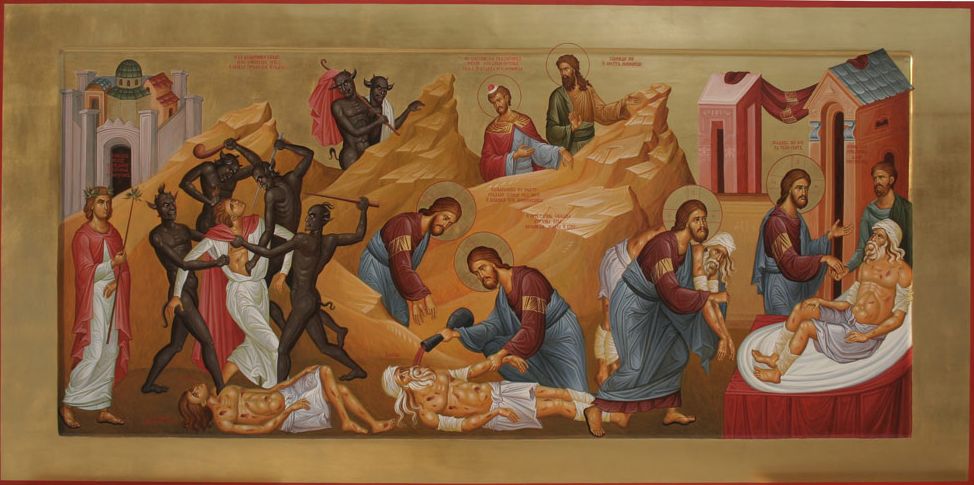
30 Jesus replied, “A man was going down from Jerusalem to Jericho, and he fell among robbers, who stripped him and beat him and departed, leaving him half dead. 31 Now by chance a priest was going down that road, and when he saw him he passed by on the other side. Jesus Good Samaritan Icon32 So likewise a Levite, when he came to the place and saw him, passed by on the other side. 33 But a Samaritan, as he journeyed, came to where he was, and when he saw him, he had compassion. 34 He went to him and bound up his wounds, pouring on oil and wine. Then he set him on his own animal and brought him to an inn and took care of him. 35 And the next day he took out two denarii and gave them to the innkeeper, saying, ‘Take care of him, and whatever more you spend, I will repay you when I come back.’ 36 Which of these three, do you think, proved to be a neighbor to the man who fell among the robbers?” 37 He said, “The one who showed him mercy.” And Jesus said to him, “You go, and do likewise.”

In the name of the Father and of the Son and of the Holy Spirit. Amen.

This parable is arguably the most well-known parable Jesus ever told. That being said, it is also one of the most misinterpreted and misused parables. Today, may your eyes and ears be blessed as Jesus tells you what many prophets and kings desired to see and hear but did not. Holy Spirit, open our eyes and unplug our ears to Christ’s mercy.

This lawyer, this guy who knows the Old Testament forwards and backwards, asks Jesus, “What must I do to inherit eternal life?” This is a stupid question. You don’t do something to gain an inheritance.

All Scripture shows that God’s people do not inherit eternal life by doing something. As our Epistle Text (Gal. 3:15-22) said, the inheritance of eternal life has always and will always come through the promise of God.

The lawyer knew exactly what he must do to have eternal life. He must do the Law, and his understanding of the Law is correct. Love God perfectly; love your neighbor perfectly. It’s exactly how Jesus sums up the Law elsewhere (Mt. 22:34-40). Jesus tells the lawyer, “Bingo! Do this, and you will live.”But Jesus might just as well have said, “Yup. Go to hell.”

And the lawyer gets it. He is stuck in his own death. The Law has exposed him for the wretched sinner that he is. The Law has left him scared and confused because he doesn’t know the Gospel; it’s completely foreign to him. He wants an out and clamors for a loophole. He asks, “Well, who is my neighbor? Whom should I love?”

But every Sunday school student knows the answer. “Who is my neighbor?” Everyone. “Whom should I love?” Everyone and without fail. But Jesus doesn’t tell the parable to answer the question, “Who is my neighbor?” Jesus tells the parable to change the question to get the answer He wants. The point of the parable is not to teach us to love everyone. Scripture teaches that all over the place but not in this parable.

Instead, Jesus tells the parable because He wants to show the lawyer and you hope. Jesus wants to show you what God mercifully does for you. He wants your eyes to see and your ears to hear the Gospel.

With all that in mind, consider the parable: The road from Jerusalem to Jericho is downhill the whole way. The man in the parable is constantly going down. And as he goes down, he falls among thieves who rob, strip, beat, and leave him for dead.

A priest happens to come across him, but when he sees the poor sap, he moves to the other side of the road. A Levite spots him as well and does the same. They don’t bind up his wounds. They don’t offer to find someone else to help. They don’t even stand a safe distance and speak comforting words to him as he dies. Instead, the two most respected religious people in Jesus’ day are unwilling to give a second look to the wretch in the ditch.

They know God’s Word, but they are able to justify leaving the guy in the mud and blood. “If God allowed this to happen to him, it must have been for a reason.” Or, “He must have been hanging out with the wrong crowd.” Or, “If I help this guy, I’ll be unclean and won’t be able to perform my duties in the Temple and people won’t have their spiritual needs met.” They won’t let this looser distract them from their calling.

This beaten, bloodied man is despised and rejected by his own people who turn their faces from him (Is. 52:14; 53:2-4).

But then comes the hero – the man of the hour. But he is a Samaritan. He’s a looser and outcast just like the man in the ditch. And this looser ministers to his fellow looser.

He goes down into the ditch. He binds up the wounds. He puts ointment, oil, and wine on the lacerations. He hefts the guy onto his own animal, giving up his own comfort. He is delayed and intruded upon. Whatever appointment or meeting he was journeying to doesn’t matter anymore. The only thing that matters is the stripped, bleeding man.

The Samaritan brings the guy to a hotel and watches over him through the night. In the morning, he makes his way to the front desk and books the room indefinitely.

He tells the staff, “Bill everything to my room. That bloodied guy I brought in here last night, whatever he needs Is on my tab. If he needs doctors or nurses, I’ll cover it. If he needs a ride, get an Uber on me. If he consumes the mini bar fifteen times, I’m good for it. I’ll be back to pay for it all.”

The parable completed, Jesus looks at the lawyer and asks, “Who proved to be a neighbor to the man who fell among the robbers?”

Again, if this parable is teaching us to love everyone, then Jesus is a bad teacher and is asking the wrong question. “Who proved to be a neighbor to the man who fell among the robbers?”

Jesus is setting the lawyer up. Christ is not calling the lawyer to be like the Samaritan. Jesus wants the lawyer to see that he is the man in the ditch. Jesus wants the lawyer to desire the care, compassion, reckless love, and mercy that the Samaritan shows in the parable because that is exactly what Jesus has come to do for him and for you. Jesus is the one who shows mercy.

Good Samaritan Jesus IconChrist has come to find you. He has bound up your wounds. Jesus has poured out His healing, life-giving blood for you. Jesus nurses you in your brokenness. He has ascended into heaven and has promised to come back and pay for everything you need.

In order to be saved, you don’t need to be merciful; you need mercy. You don’t need to love your neighbor; you need to be loved. You need to receive the Jesus who has come to give you every last bit of His mercy.

That is what the parable means. Our text ends with Jesus saying, “You, go and do likewise.”And Jesus means that too. What Jesus has poured into you, let it spill out and bless others. Amen.

The peace of God, which surpasses all understanding, will guard your hearts and minds in Christ Jesus. Amen.