
In the name of Jesus. Amen.
How did you become a Christian? I bet, if we gave everyone a chance to share their story, that we we’d be sitting here for a really long time – and not just because of the number of you here. The one thing this text makes clear is that you didn’tbecome a Christian because of your own doing. You are a Christian because you were both called and chosen by God. It’s because of God that you are in Christ Jesus (1 Co. 1:30). Salvation belongs to God (Jon. 2:9; Ps. 3:8; Rev. 7:10, 19:1). It is His work, His doing.
Today, let me slightly reword the question “How did you become a Christian” to this: How did you get onto God’s team? I’m rewording it that way because this text reminds me of a schoolyard pick where two captains chose their teams. I’m guessing that most of you, at some point in your lives, have been involved in a schoolyard pick. You awkwardly stand around waiting to be called and chosen by a captain so you can go join the team and give everyone high fives and celebrate your victory before the game even begins. Being the last one chosen in a schoolyard pick stinks.
At the beginning of my 8th grade year, a friend invited me to a back to school event at his church. The other kids who were there were, basically, all people who were in my class or the classes above and below me. We were going to divide into teams to play kickball. Kristen was one of the team captains, and I don’t remember who the other captain was. Kristen and the other captain alternated picking individuals. The first kids picked were strong, fast, and good athletes. They were the kind of people I would have picked first to assemble a good kickball team, but I just stood there in the pool of kids waiting for my name to be called.
As the pool of kids shrunk, some people were chosen before me who were slow and completely unathletic. And I knew that Kristen didn’t like me very much, so I comforted myself, “She’s just picking them because she hates me.” (I wasn’t very popular in Junior High.) Anyway, it ended up that I was the final kid left. I wasn’t chosen at all. So, I was automatically on Kristen’s team, and she was greatly annoyed by that. But it was her response that hurt the most. She realized that I would be on her team and said, “Great, we’re stuck with ‘String-Bean.’” It was a severe blow to my adolescent pride to be so unwanted.
Dear saints, in the eyes of the world, not many of you are wise or powerful or influential or noble. In the eyes of the world, there isn’t much that is appealing about us citizens of the kingdom of heaven. On top of that, if God were to measure us according to the standards of His Law, He wouldn’t pick any human to be on His team, except Jesus. But that is exactly why Christ has come.
Because of our sin, we are all in opposition to God. But Jesus came to be the Lamb of God who takes away the sin of the world (Jn. 1:29). He takes undesirable sinners who recognize their sinfulness and repent. He makes them His children and heirs. God chose the foolish, the weak, the low and despised – even things that are not (1 Co. 1:28). God calls, chooses, and puts them on His team. And He chooses them for a purpose. And that purpose is to remove any reason or cause of boasting.
Now, I need to pause for a second because whenever we talk about why some people are saved and some are not, we need to recognize that those must remain two, separate questions. On the one hand, people are saved because of God’s doing, God’s choosing (Tit. 3:5). Again, salvation belongs to God, and He freely gives that salvation by grace through faith, which is not of our doing (Eph. 2:8-9). On the other hand, people who are not saved, they are condemned because of their own hardness of heart. Because of their refusal to repent. Because of their rejection of what Jesus has done. Because of their unbelief.
So, with that analogy about a schoolyard pick, don’t imagine for one second that the other captain is the devil and that he picked some before God picked them. That’s not the case – not at all. Jesus died for the sins of the world (Jn. 1:29, 1 Jn. 2:2) and is the Savior of the world (1 Jn. 4:14).
The picture is this: When God chooses His team, the world laughs at every one of God’s selections because it looks like it’s going to be a losing team. But this is how God has always done His choosing.
In Dt. 7:7-8, God reminds His people through Moses that they are going to take over the Promised Land by saying, “It was not because you were more in number than any other people that the Lord set His love on you and chose you, for you were the fewest of all peoples, but it is because the Lord loves you,” that He chose you.
When God chose Gideon to defeat the Midianites, He chose Gideon because he was part of the weakest clan and the lowest son in his father’s house (Jdg. 6:11-16). And then, remember how God whittled down Gideon’s army before they fought against the enemy. Gideon started with 32,000 men, but God had him reduce it to the 300 soldiers who lapped water like dogs (Jdg. 7:1-25). God did that so His people wouldn’t dare to even imagine that their own strength had delivered them. All the glory for their victory would go to God alone.
Remember the people Jesus chose to be disciples and apostles. Most of them were fishermen and tax collectors, people who were viewed as normal, working-class laborers and people who were despised in their culture. Later, Jesus called Paul to be an apostle after he had persecuted the Church of Christ (1 Co. 15:9). The world sees these picks and laughs at God’s calling and choosing because it looks like a losing team.
Even Jesus Himself looked like a foolish pick to the world. He was a Man of griefs and acquainted with sorrows. He was despised and not esteemed (Is. 53:2). Even Nathanael, one of Jesus’ disciples, balked at the idea that Jesus could be the Messiah because He came from Nazareth, saying, “Can anything good could come from Nazareth?” (Jn. 1:46). God’s choosing always looks utterly foolish to the world. But that is so God can bring to nothing the things that are (1 Co. 1:28).
Dear saints, God has called and chosen you even though you are completely unattractive to the world. And He made His choosing sure and certain. He doesn’t leave that calling to chance or to your own efforts. No, He has placed you firmly in Christ (1 Co. 1:30) through the waters of your Baptism.
In Gal. 3:27, Scripture says, “For as many of you as were Baptized into Christ have put on Christ.” In those waters, God wrapped you in His Son. You were clothed with Jesus Himself – with His perfect life, His atoning death, His victorious resurrection. Baptism is not some symbolic thing. No! It is God’s doing; it is His choosing in action. There, He called you by name (Is. 43:1), washed away your sins (Act. 22:16), and chose you to be on His team – not because you were worthy, but because He is faithful (Tit. 3:5-8).
So, as you live each day in this reality of having been chosen and placed into Christ, God calls you to grow in this faith. Growing in faith is not to become stronger in yourself or more impressive to the world’s eyes. It’s the opposite. To grow in Christ is to become more and more dependent on Him because He promises to be your all in all. To grow in Christ is to trust more and more deeply in what He has done for you.
And yes, the world will see you as foolish, weak, low, and despised (1 Co. 1:26-27). But in Christ, you are none of those things because Jesus has become for you wisdom from God, righteousness and sanctification and redemption (1 Cor. 1:30). Jesus is your everything. He is your wisdom when the world calls you foolish. He is your righteousness when the Law accuses you. He is your sanctification when sin clings closely. He is your redemption when the grave opens its jaws to claim you. But it can’t because you, through faith, are in Jesus who is the Resurrection and the Life (Jn. 11:25).
This is why your worth, dear saints, is not found in your achievements or your status in the world’s eyes. No. Your worth is fixed and seen in the wounds of Christ.
God loves you. He loves you in such a way that He sent His beloved Son to take on your flesh and blood, to live under the Law in your place, to suffer your condemnation, and to shed His holy Blood for you on that cross (Jn. 3:16). In the wounds of Christ, God declared your value and shouted it into all creation. God determined that you are worth His own precious blood (Act. 20:28). The world may laugh at the fact that you are on God’s team, but heaven rejoices when you are chosen as a citizen of the kingdom of God (Lk. 15:7, 10).
So dear saints, go ahead and boast. Boast loudly and without shame. But boast only in the Lord (1 Cor. 1:31). Do not boast in anything in yourself – not in your wisdom, not in your strength, not in your goodness. Instead, boast that your value was fixed at Christ’s cross. Boast that the God who chose the weak things of the world to shame the strong has also chosen you. Boast that the One who called all things into existence by His almighty Word (Ps. 33:6, 9; Heb. 11:3) has called you His own child by that same Word. He has placed you in Christ. And He promised you eternal life.
This is the wisdom of God that the world will always consider foolish. This is the weakness that overcomes the world. This is the choosing that silences all boasting except in the cross of Christ. And because He chose you, you are His – now and forever. Amen.
The peace of God, which surpasses all understanding, will guard your hearts and minds in Christ Jesus (Php. 4:7). Amen.


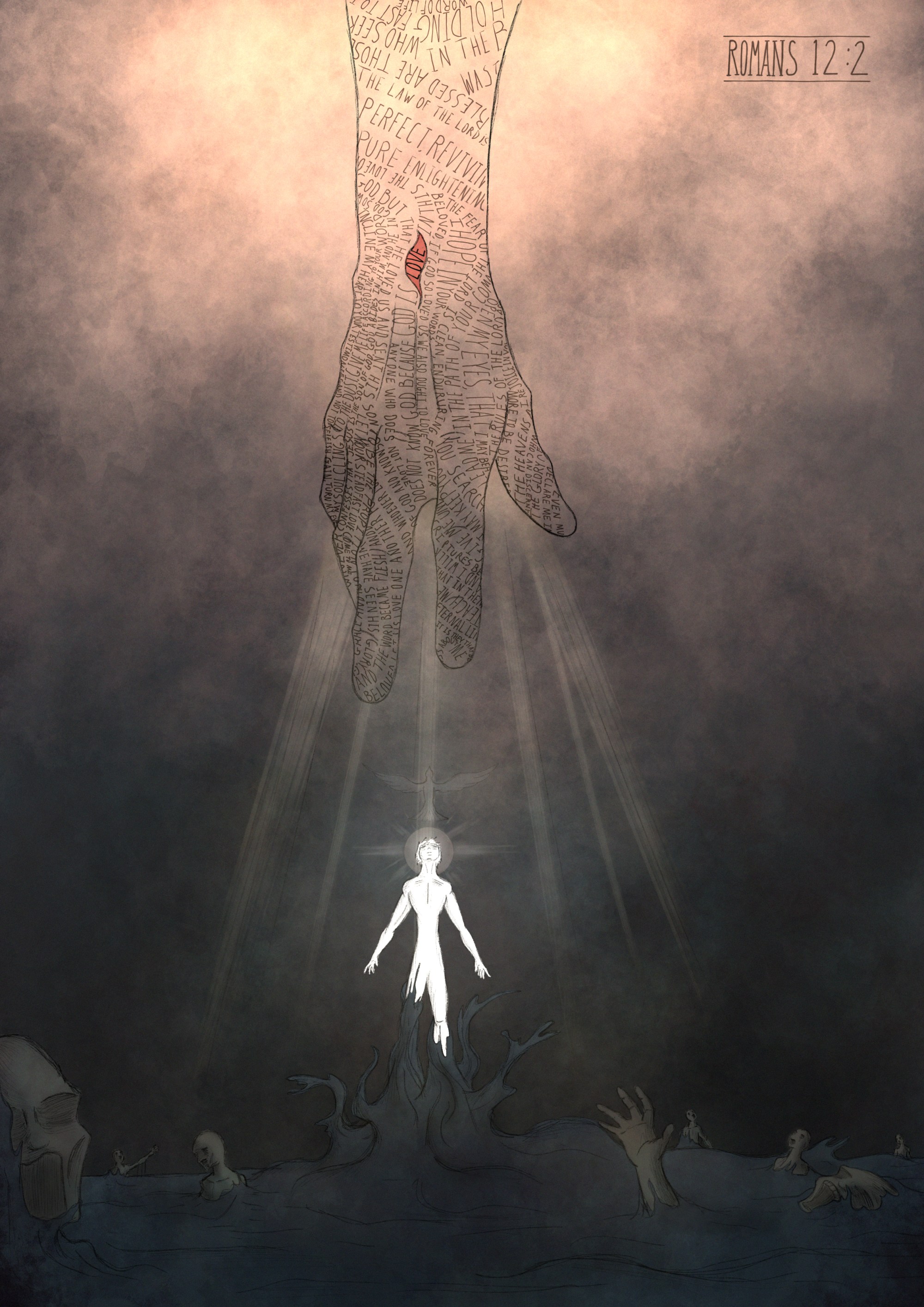
 I just have to run faster than you.” Well, guess what. When the bear of God’s Law is finished eating the guy who is slower to obey than you, it picks up your scent and resumes its pursuit of you because its appetite is never satisfied by eating up sinners.
 There’s a better way to understand these verses, and to get at that understanding, I’m going to connect this text to our theme for the year – “Sacred.” In Lev. 19:2, God speaks to His people, Israel, and says, “You shall be holy, for I the Lord your God am holy.” And Peter repeats those words for us Christians in 1 Pet. 1:16. In English, this sounds like a command because of the word ‘shall.’ But in both Hebrew and Greek it isn’t a command/imperative. A better translation for both is, “You will be holy.”
 likeness of sinful flesh and for sin, he condemned sin in the flesh, in order that the righteous requirement of the law might be fulfilled in us, who walk not according to the flesh but according to the Spirit.”
 They see a bear eyeing them and licking its chops. Sven looks over at Ole who is bent over tying his shoelaces. Sven says, “Ole, do you really think you can outrun a bear?” Ole pulls the laces tight, stands up, sniffles and says, “I don’t have to outrun the bear. I only have to outrun you.” Salvation is not like that. You aren’t saved because you are better than most people. You are saved by grace alone through faith alone by Christ alone.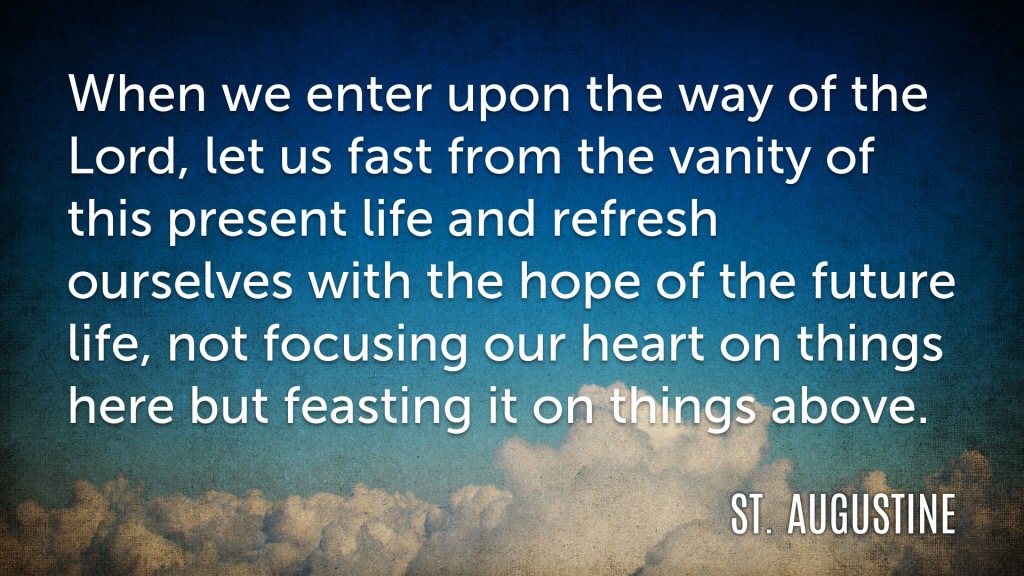
 And he came in the Spirit into the temple, and when the parents brought in the child Jesus, to do for him according to the custom of the Law, 28 he took him up in his arms and blessed God and said,
 This forty-day-old Jesus is going to bring a division between believers and unbelievers. Simeon, inspired by the Holy Spirit, says this division comes because what a person does with Jesus will reveal the thoughts of their heart. The division falls in one of two ways: many will oppose and reject Jesus to their fall, to their ruin, and to their damnation, and many will trust in Him to their resurrection and eternal life.
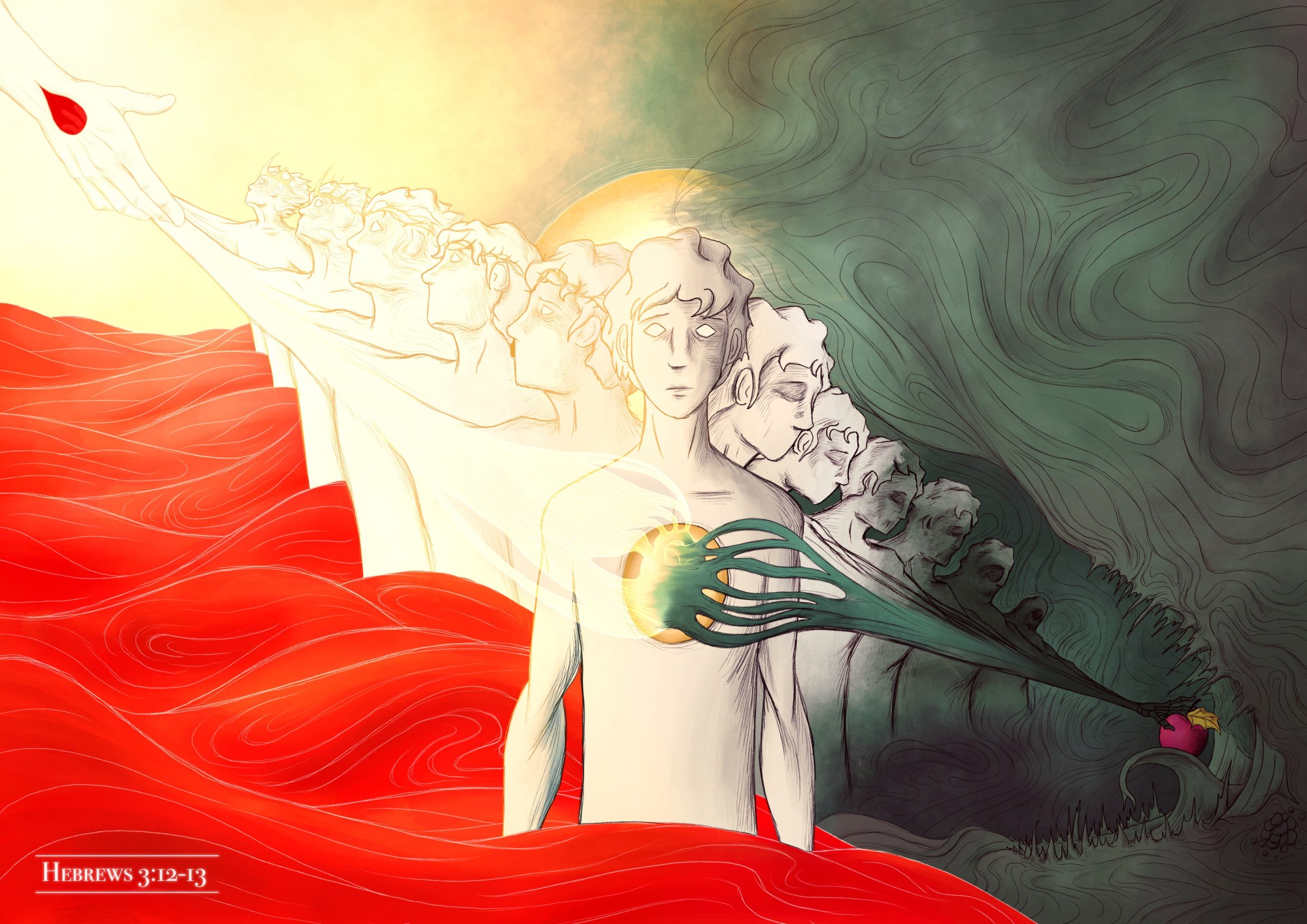 There can be, and often is, a conflict between how God sees you in your reborn spirit and how you see yourself in your soul – your thoughts, and emotions. You have probably experienced this. Part of you, your spirit, wants to live a certain way. You want to keep God’s commands, you want to live a God-pleasing life, you want to love your neighbor, etc. But part of you, your soul, doesn’t. Your soul would rather make sure you are comfortable and doesn’t really care about what God has commanded or what would benefit others. Paul talks about this conflict in Ro. 7(:7-25)where he wants to do good, but instead he keeps doing the sinful thing that he hates.
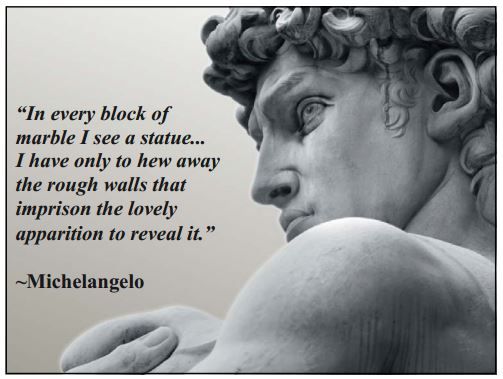 The artist Michelangelo (not the Ninja Turtle) used to say that when he looked at a hunk of marble, he didn’t see big rock. Instead, he saw the sculpture that he was going to free from the rest of the rock that he would eventually chip away. He would say that he wasn’t creating a sculpture, he was just getting rid of all the rock that wasn’t part of the sculpture. That is somewhat the idea in the verse from Hebrews about the Word of God doing the work of dividing soul and spirit.
 Pastorsamwise
You must be logged in to post a comment.