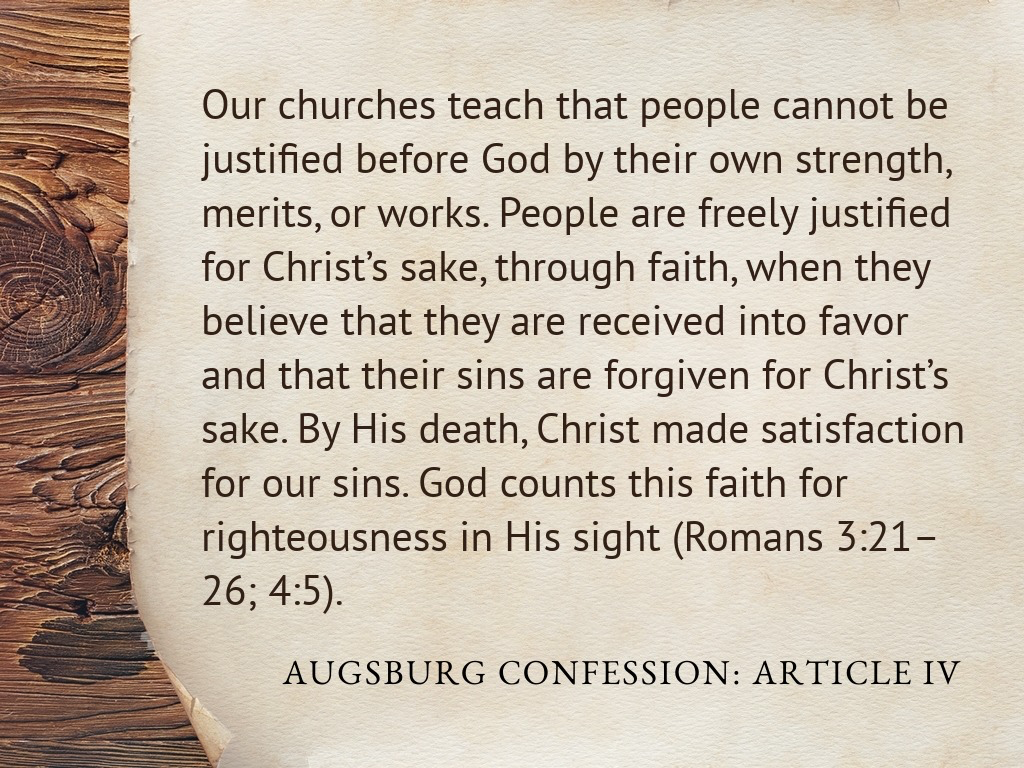
Slaves & Sons – Sermon on John 8:31-36 for Reformation Sunday

John 8:31–36

31 So Jesus said to the Jews who had believed him, “If you abide in my word, you are truly my disciples, 32 and you will know the truth, and the truth will set you free.” 33 They answered him, “We are offspring of Abraham and have never been enslaved to anyone. How is it that you say, ‘You will become free’?” 

34 Jesus answered them, “Truly, truly, I say to you, everyone who practices sin is a slave to sin. 35 The slave does not remain in the house forever; the son remains forever. 36 So if the Son sets you free, you will be free indeed.

In the name of Jesus. Amen.

Jesus says, “If you abide in My Word, you are truly My disciples, and you will know the truth, and the truth will set you free.” Those words of our Lord have been rolling around in my mind this past month. What Jesus says there has a lot of implications both for individuals and, by extension, for congregations. To be a disciple of Jesus – in other words to be a Christian – means abiding, remaining, and staying in Jesus’ Word. Those who are saved love to hear their Savior’s words. And that does not only refer to the red-letter words in our Bibles. It’s the whole thing. From the words, “In the beginning,” in Gen. 1:1 through the final, “Amen,” of Rev. 22:21 are all Jesus’ Words.

And notice to whom Jesus says this – this is so important. Jesus is speaking to “the Jews who had believed in Him.” In other words, Christ is speaking to Christians (Ro. 10:17) – people who believe His words. So, what Jesus is calling them to do is to continue abiding and remaining in His Words because if they do notremain in Jesus’ Words, they will not be His disciples, they will not know the truth, and they will not be free. Dear saints, your life as a Christian is to continue to learn and grow in your knowledge and understanding of the Bible. To be a Christian is to be a student of the Scriptures.

Now, all of that is important to ponder and consider, but there is something even more profound here that I want us to consider today. Again, as Jesus speaks to people who believe in Him, He calls them to abide in His Word so that they will (future tense) be set free. In other words, those who believe in Jesus are waiting for a freedom that is still to come. That freedom is promised, and that freedom is the hope of every Christian, but it is still in the future.

Today, as Jesus’ disciples, let’s abide in these words of Jesus here for a moment because many other passages in Scripture say that we are free when we believe. Romans 6:22 says that you, believer, have been set free from sin. A little later in Romans 8:2, Scripture says that the Spirit of Life has set you free in Christ Jesus. Galatians 5:1 says that it is for freedom that Christ has set us free.

Just like the people in this reading did, we might want to ask Jesus, “How is it that You say, ‘You will become free’? Aren’t we free already?” Well, Jesus is clear. “Truly, truly. Amen, amen, I say to you everyone who practices,” probably a better way to translate this would be ‘does,’ “everyone who does sin is a slave to sin.” To do sin is to be a slave to sin.

So, dear saints, consider this: Are you a Christian? Do you believe in Jesus? Do you believe His Word? Yes. Then Scripture is clear, you are free – right now.

But also consider this: Are you perfect? Do you do things that God forbids? Do you not do things that God demands? In other words, do you sin? Yes. Then, your Lord is also clear – you are a slave to sin. And you can’t wiggle out of this. It isn’t just that you make mistakes or that you are programmed to do things that aren’t quite right. No. All of us deliberately sin. We sin on purpose, with full knowledge, and repeatedly. And by sinning, we place ourselves under slavery to sin and put our faith in danger. Repent.

Jesus knows when He says that those who do sin are slaves to sin is a devastating judgment. That’s why He continues speaking and offers us hope saying that even though, “the slave does not remain in the house forever; the son does remain forever. So if the Son sets you free, you will be free indeed.”

Jesus doesn’t just leave you in slavery to sin. He is the Son who sets you free – both now and in the future. Romans 6 says that you have been joined to Jesus’ death and resurrection in your Baptism, and it goes on to say, “our old self was crucified with Him in order that the body of sin may be brought to nothing, so that,” and listen carefully here, “so that we would no longer be enslaved to sin. For one who has died has been set free from sin” (Ro. 6:6-7). 

Jesus tells us the truth. The one who does sin is a slave to sin, and He sets us free from the evil master of sin. These two clear truths from Scripture have to be one of the most difficult tensions in all the world. You are, for a time, both slaves (because you sin) and sons (because you believe and are redeemed). You are free, and at the same time you are a slave to sin. You aren’t one or the other or bounce back and forth. At the same time, you are sons of God and still slaves to sin. The last half of Romans 7 talks about this tension (Ro. 7:14-25).

You are simultaneously saint and sinner, or, as Jesus puts it here, simultaneously slaves and sons. The tension between those two teachings isn’t understandable or comprehensible. But that’s ok. The Bible teaches all sorts of things that are beyond our understanding like the Trinity; the two natures of Jesus, that He is both God and man; etc. We don’t hesitate to believe those things because Scripture clearly teaches them. Well, Scripture also teaches that you are a slave to sin and a redeemed son of God. 

This tension is what keeps you running back to Jesus. It isn’t your obedience or your consistency or the fact that you feel bad about being a sinner that sets you free. Yes, you should feel bad about being a sinner, but that isn’t what sets you free from your slavery to sin. It’s Jesus, the Son, and Him alone who sets you free now and will make you free forever.

Dear saints, when – not ‘if’ but ‘when’ – when you feel the weight of your slavery, when the shackles of your iniquities rub your wrists and ankles raw, when the whip of your transgressions has shredded your back, remember Jesus came for you. He came – not for the righteous because there aren’t any righteous – He came to call you, sinner, to repentance and faith (Mt. 9:13; Mk. 2:17; Lk. 5:32). Jesus sets you free, and if He sets you free, then you are free indeed.

Child of God, abide in Jesus’ Word, and you will remain in the house forever. Amen.

The peace of God, which surpasses all understanding, will guard your hearts and minds in Christ Jesus. Amen.
Humbled – Sermon on Luke 14:1-11 for the Seventeenth Sunday after Trinity

Luke 14:1-11

1 One Sabbath, when [Jesus] went to dine at the house of a ruler of the Pharisees, they were watching him carefully. 

2 And behold, there was a man before him who had dropsy. 3 And Jesus responded to the lawyers and Pharisees, saying, “Is it lawful to heal on the Sabbath, or not?” 4 But they remained silent. Then he took him and healed him and sent him away. 5 And he said to them, “Which of you, having a son or an ox that has fallen into a well on a Sabbath day, will not immediately pull him out?” 6 And they could not reply to these things. 

7 Now he told a parable to those who were invited, when he noticed how they chose the places of honor, saying to them, 8 “When you are invited by someone to a wedding feast, do not sit down in a place of honor, lest someone more distinguished than you be invited by him, 9 and he who invited you both will come and say to you, ‘Give your place to this person,’ and then you will begin with shame to take the lowest place. 10 But when you are invited, go and sit in the lowest place, so that when your host comes he may say to you, ‘Friend, move up higher.’ Then you will be honored in the presence of all who sit at table with you. 11 For everyone who exalts himself will be humbled, and he who humbles himself will be exalted.”

In the name of Jesus. Amen.

Jesus eats with all sorts of people. He eats at His friends’ house with Mary, Martha, and Lazarus (Lk. 10:38-42). He eats at His disciples’ houses. He eats in Peter’s house and Peter’s mother-in-law serves Him (Lk. 4:38-39). Jesus calls Matthew the tax collector to be His disciple and eats with him and other sinners. And you remember that the reason Jesus tells the parable of the Lost Sheep, Lost Coin, and Prodigal Son is the Pharisees accusing Jesus of welcoming and eating with sinners (Lk. 15:1-2).

We aren’t surprised that Jesus would eat with His friends and disciples. We do that too. And as Christians, we are comfortable with the fact that Jesus eats with sinners. But we might find it surprising that Jesus would even eat with Pharisees. The Pharisees were our Lord’s enemies. From the beginning of His ministry, the Pharisees were butting heads with Jesus (Lk. 5:21Jn. 5:18).

Think of the person in your class or at work that you most regularly butt heads with – no matter what you just can’t seem to get along. He takes everything you say and turns it into an accusation against you, so you’re always on your toes, always analyzing everything word out of your mouth. Being around a guy like that is exhausting. Now, if that person invited you over for dinner, you’re going to decline. (Unless they tell you that they are going to be serving dry-aged Wagyu steaks. Then, you probably go, you just don’t stay for dessert.) But as difficult as the person you are imagining is, he probably isn’t trying to find some way to get you the death sentence. That’s exactly what the Pharisees wanted for Jesus, but our Lord still repeatedly ate with the Pharisees.

Once, Jesus went to Simon the Pharisee’s house where He was anointed by the sinful woman who washed Jesus’ feet with her tears (Lk. 7:36-50). Another time, Jesus was invited to eat at a Pharisee’s house and didn’t wash His hands the way the Sabbath traditions requires (Lk. 11:37-54). When Luke finishes recording that meal, he notes that the scribes and Pharisees were lying in wait for Him, to catch Him in something He might say.

Now here, in our text, an important Pharisee has invited Jesus to his house for a Sabbath dinner. And, what d’ya know? Jesus goes. 

Now, we have to imagine this scene of everyone arriving for the fancy dinner. Luke here gives us enough details to sketch this out, but they are interspersed in the account. So, let’s bring them together into one picture. Jesus arrives at this ruling Pharisee’s swanky house. As the guests arrive, they might give a nod or a handshake to their friends, but each of them is more interested in positioning themselves to get the best seats. They are cutting in front of each other to get as close as possible to the head of the table. I don’t know how a Pharisee would save a seat – maybe he’d drink half of whatever was in the cup or lick the silverware. Who knows? But they are all claiming their spots and making sure their position is secure and no one else takes it from them. Then, their gaze turns towards Jesus.

When Jesus arrived, He wasn’t concerned with sitting in the high, prominent spots. So, we can assume that there was only one spot left at the table – the lowest. Jesus finds His place, and the eyes of all the Pharisees are on Him. If you were there and watching Jesus approach His seat, you wouldn’t notice the fine dining couch or the fancy china. The only thing that would catch your attention was this man.

Luke, the doctor, tells us that the man before Jesus has ‘dropsy.’ The term does appears in medical literature about 300 years before Jesus by a guy named Hippocrates (from whom, we get the Hippocratic oath). The word is actually two words mushed together – “water” and “appearance.” In other words, the guy was swollen, grossly bloated. It is not stretching the text at all to assume the Pharisees brought this man in so they could accuse Jesus of breaking the 3rd Commandment, “Remember the Sabbath day to keep it holy.”

Now, the Pharisees had lengthy discussions on what was and what wasn’t permitted on the Sabbath. They wrote all sorts of rules that defined what you could and couldn’t do on the day of rest. It went so far as to define where you could spit. Every other day of the week, you could spit wherever you wanted, but on the day of rest, you could only spit on rocks because spitting on soil might be watering a plant and considered work. Also in their discussions, they considered how much help you could give to a person who was sick or injured. For example, if someone had a cut you could apply a bandage to keep the wound from getting worse, but you couldn’t apply the bandage in a way that would help the person get better because that would be considered work.

These Pharisees are all closely watching as Jesus sees this man, ballooned up with disease. But Jesus turns the tables. Notice, they don’t ask Jesus a question, but He responds to the situation asking, “Is it lawful to heal on the Sabbath or not?” The Pharisees don’t say a word. Jesus heals the man. His swelling is gone. His features return to normal, and Jesus sends him away. Then, Jesus exposes the Pharisees’ hypocrisy. “Which of you, having a son or an ox that has fallen into a well on a Sabbath day, will not immediately pull him out?”After this question, the Pharisees aren’t just silent. They aren’t able to answer. With two pointed questions, Jesus humbles the Pharisees into deafening silence.

Then, our Lord throws the knock-out punch. They had been watching Jesus carefully as He approached the table, but He had been watching them too. They had been scrambling, shoving, jolting, and jockeying for the best places. It’s interesting: for all the discussion and debate the Pharisees had on what was and wasn’t considered work on the Sabbath, they didn’t debate about contending for prominent positions in their regulations. And Jesus echoes what we had in the first two verses of our Old Testament lesson (Pro. 25:6-14). Basically, if you put yourself forward as being important, you’re likely going to be humbled, and it’s going to be a public spectacle. Instead, be humble, and wait for your host to exalt you.

Now, of course, this is some solid, practical advice. Any motivational speaker could take what Jesus says here and teach a helpful lesson: Don’t strut around blowing smoke about how important you are. Instead, go about your business quietly, and your recognition will come in due time. But this isn’t a self-help seminar, and I’m not a motivational speaker.

Instead, notice what happened at this meal. Jesus, who was by far the most important person there, ended up in the lowest seat. And even though no one changed positions, Christ elevated His place back the peanut gallery to be the prominent place, and those who were at the head of the table end up in the bleachers.

Dear saints, as our Epistle lesson (Eph 4:1-6) said, “Walk in a manner worthy of your calling.” Humble. Gentle. Patient. Bearing with one another in love. Paul will say a similar thing in Php. 2:5-11, “Have this mind among yourselves, which is yours in Christ Jesus, who, though he was in the form of God, did not count equality with God a thing to be grasped, but emptied himself, by taking the form of a servant, being born in the likeness of men. And being found in human form, he humbled himself by becoming obedient to the point of death, even death on a cross.” But Jesus didn’t remain humbled and lowly in death. The text goes on, “Therefore God has highly exalted him and bestowed on him the name that is above every name, so that at the name of Jesus every knee should bow, in heaven and on earth and under the earth, and every tongue confess that Jesus Christ is Lord, to the glory of God the Father.”

Dear saints, this humbled mind is yours. You, Christian, are saved by God’s grace. Live that out. You were sinful and low, but Christ has invited you, by the cleansing of His blood, to sit at His table. He has given you the seat of honor next to Him. Through His death and resurrection, you have been raised with Him. Your life is even now hidden with Christ in God. And the day is coming when Christ who is your life appears, you also will appear with Him in glory (Col. 3:1-4). Christ will call to you, “Friend, move up higher.” And you, and all believers, will be honored in the presence of all creation. Amen.

The peace of God, which surpasses all understanding, will guard your hearts and minds in Christ Jesus. Amen.

Feasting with Sinners – Sermon on Luke 15:1-32 for the Third Sunday after Trinity

Listen here.

In the name of Jesus. Amen.

You can take each of these parables out of their context, and they will correctly teach you about the Kingdom of God and His grace and mercy. When these parables are taken out of context, they become nice stories about how Jesus seeks out you who are lost sheep, lost coins, and lost sons, and the angels in heaven rejoice at your being brought into the fold. To view yourself as the lost sheep, coin, or son is not entirely wrong, but neither is it entirely right.

So first, let’s consider the context of these parables. The reason Jesus tells them is the grumbling of the Pharisees when Jesus is eating with and welcoming sinners. So, the point of each of the parables is to pound into our heads the joy of heaven over one sinner who receives grace. The parables show us the ludicrous feasting and joy of God’s mercy, pardon, and steadfast love over sinners.

Lost Sheep from Luke 15.jpgIn each of these parables, what is lost – the sheep, the coin, and even the son – is not valuable. That is the point of the parables. This is most apparent in the parable of the lost coin. The party the woman throws costs more than the coin that she recovered. That one sheep was worth less than the cost of the party that the shepherd threw. Even that one son was not worth the cost of the party. And don’t pish-posh that statement.

The son had told his father to drop dead. The twerp demanded that his father sell off everything. The little brat went off, blew the inheritance, and returned only when he is tired of sharing swill with swine and thinks he has a chance at getting some bread. He came sauntering back to negotiate a job for himself. Had the father brought him on as a hired hand, it would have been gracious. Restoring him to sonship is merciful. Throwing a party about the whole business is unimaginable. No, the son is not worth a party.

But that is the point. The point is that God is like an obsessive and foolish shepherd, woman, and father who loves too much. God pays for work not performed and for merchandise not delivered.

If these parables give you a picture of a God who seems reasonable, then you are reading them wrong. Your heavenly Father turned His back on His perfectly good, entirely faithful, and completely obedient Son to purchase those who killed Him. Jesus laid down His precious life for sinners.

To paraphrase our Old Testament text (Mic. 7:18-20), “Who is a God like You, pardoning iniquity and passing over transgression? You do not retain Your anger forever, because You delight in steadfast love. You have compassion on us, and You will have compassion us again and again.”

ShadenfreudeBecause of our sin, we are broken. No one wants to admit it, but we are happy when our neighbor suffers and we are sad when he rejoices. The Germans created a word for this by combining their words for ‘harm’ and ‘joy’ into one word, Schadenfreude. The worst part is we justify our Schadenfreude. We enjoy others’ pain because we figure they deserved it. We want others to get what we think is justice. But this is the opposite of compassion and is from the devil.
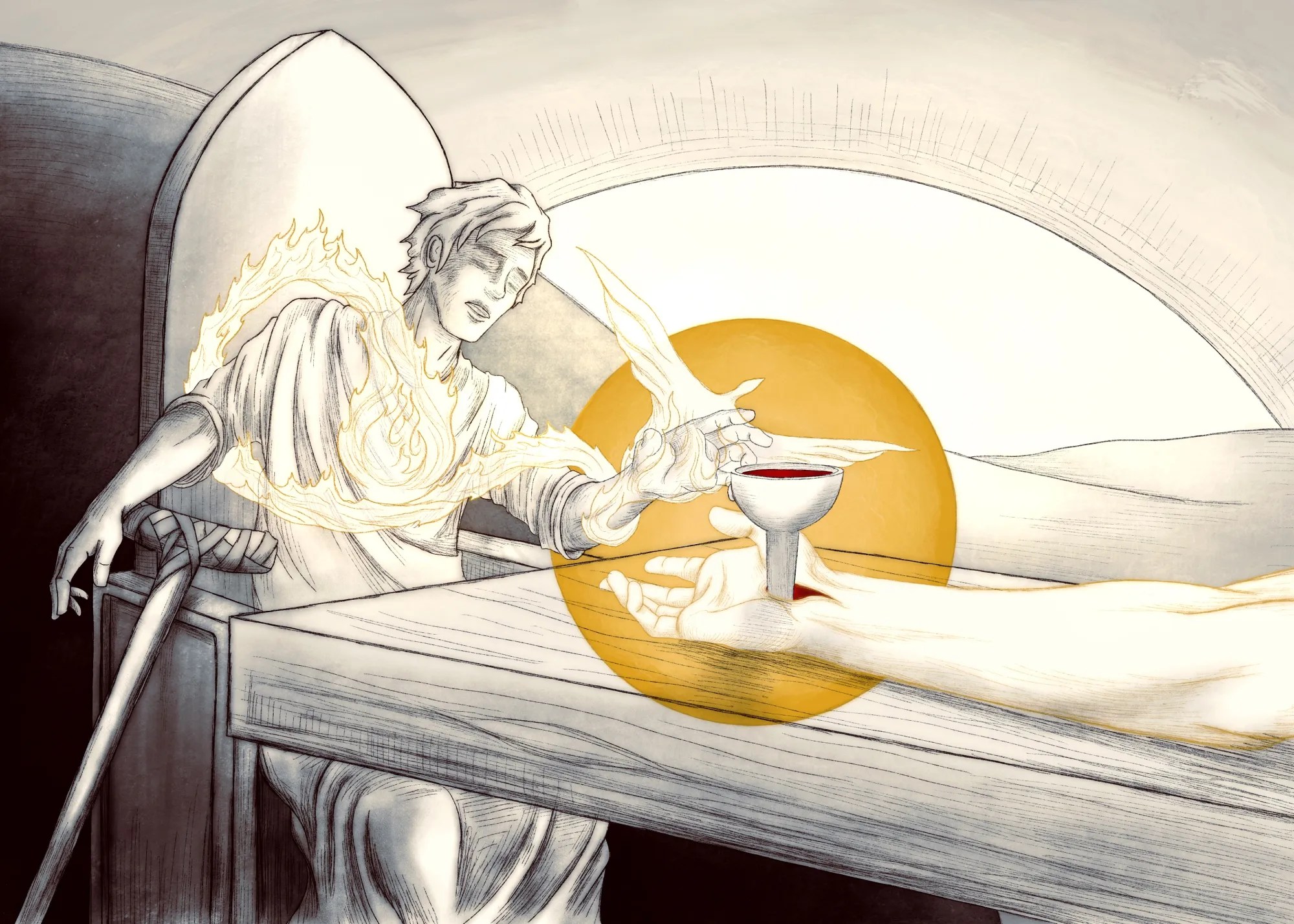
Satan wants justice for others. His desire is that you get the wages of your sin – death. And when we desire and demand justice, we join our voices to the serpent and receive nothing but hell and condemnation.

Like the Pharisees, we live good, respectable lives but only in an outward way. We mow our lawns and use our turn signals. We volunteer, pay our bills, and give to charities. And we think we deserve good, peaceful lives because of it. When we encounter any trouble or trial or cross, we conclude that God isn’t being fair. And worse than that, when God showers blessings on others, we figure God is rewarding bad behavior. And instead of repenting, we judge God to be unjust. We are entirely foolish for thinking so.

The Pharisees were angry at Jesus for receiving sinners, so they are damned and go home condemned. They refuse to repent. And they refuse to repent because they hate grace – even though they will never admit it. Irritation at God for accepting sinners through grace is the height of hubris and pride.

Instead of being encouraged that God forgives sinners whom we deem worse than us, we get jealous and think that God should simply accept us as we are because we are so much better than others. It is the same as saying, “I don’t need mercy, so others shouldn’t get mercy.”

Repent. The sheep, the coin, and the son are not worth the cost to restore them nor the party thrown afterwards. And, sinner, you are not worth the cost of your redemption. Let me repeat that and let it sink in: You are not worth the cost of your redemption.

But God does it anyway. How great is God’s steadfast love toward us and others?

No one is worthy of the banquet. No one is worthy to enter the feast. The feast is full of sinners accepted by God’s grace alone. Otherwise, what is Jesus doing on the cross?

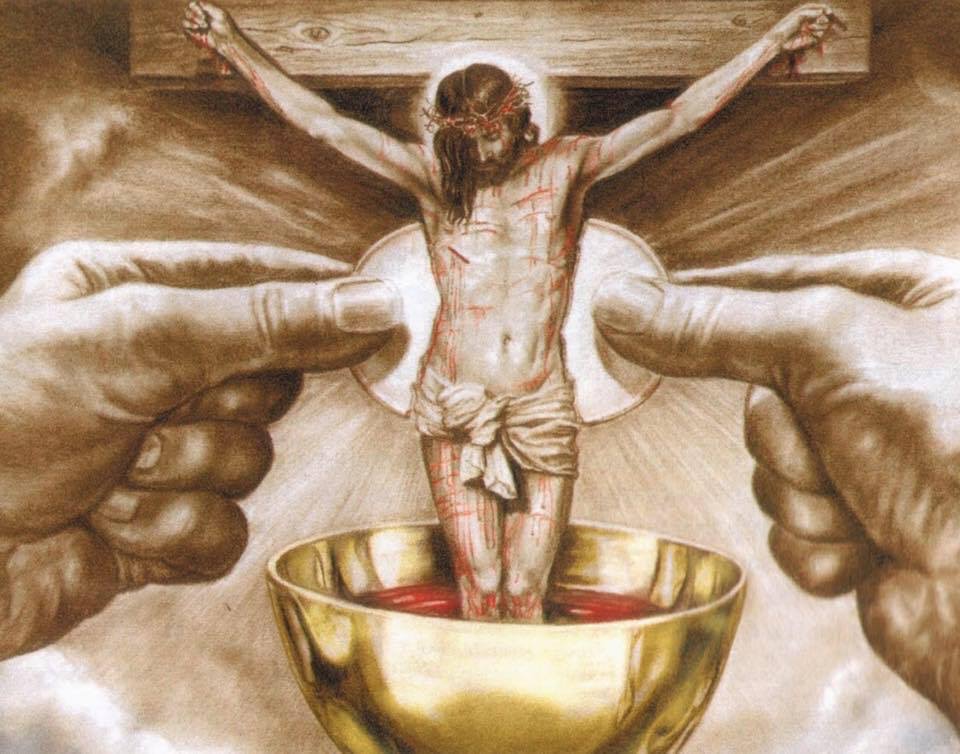
The father in the parable slaughtered the fattened calf in order to celebrate the fact that Cross and Communionhe restored and received his son back into the family. Sinner, your heavenly Father has fattened up Jesus, His faithful Son, to serve as food for you who are unworthy.
Come, you poor, lame, cripple, and blind. Come, you who have no other options or choice. You and I are sinners received entirely by God’s grace without any merit or worthiness of our own.

Heavenly Father, teach us to rejoice in this and in nothing else. Amen.

The peace of God, which surpasses all understanding, will guard your hearts and minds in Christ Jesus. Amen.

Yes, Lord – Sermon on Matthew 15:21-28 for the Second Sunday in Lent

Listen here.

Matthew 15:21-28

21 And Jesus went away from there and withdrew to the district of Tyre and Sidon. 22 And behold, a Canaanite woman from that region came out and was crying, “Have mercy on me, O Lord, Son of David; my daughter is severely oppressed by a demon.” 23 But he did not answer her a word. And his disciples came and begged him, saying, “Send her away, for she is crying out after us.” 24 He answered, “I was sent only to the lost sheep of the house of Israel.” 25 But she came and knelt before him, saying, “Lord, help me.” 26 And he answered, “It is not right to take the children’s bread and throw it to the dogs.” 27 She said, “Yes, Lord, yet even the dogs eat the crumbs that fall from their masters’ table. 28 Then Jesus answered her, “O woman, great is your faith! Be it done for you as you desire.” And her daughter was healed instantly.

In the name of the Father and of the Son and of the Holy Spirit. Amen.

I told you at the beginning of the service, but do you remember what this Sunday is called? Yes, Remember Sunday (in Latin it is called ‘Reminiscere’). In the Call to Worship (Introit) we asked God to remember His mercy and His steadfast love (Ps. 25:6), and we asked God to not remember our past sins (Ps. 25:7). This is the form and shape of prayer. We ask God to remember His good and gracious promises to us, and we ask God to not remember our sins so that He will not be angry with us and reject our prayers. As an example of prayer, we have before us this Canaanite woman.

The woman is not part of the people of God. She was a Canaanite, a pagan who was involved in occult worship, and this is likely why her daughter was severely demonized. James 4[:7], says, “Resist the devil and he will flee from you.” It isn’t stretching the text at all to connect this woman’s Canaanite identity to her daughter’s terrible, horrific situation. Canaanites weren’t resisting the devil; they were dabbling in demonic stuff.

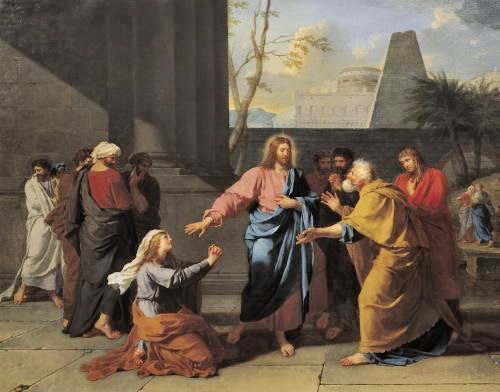
This woman knows that the demon oppressing her daughter is evil and that Jesus can help her. So, she prays. Jesus and the Syrophoenician WomanShe prays because she remembers that the God of Israel promised to deliver His people from the devil, which is why she addresses Jesus as the Son of David – to remind Him of His promises. And she remembers that she doesn’t deserve Jesus’ help because of her sins, so her prayer is, “Have mercy on me.”

She comes to Jesus in prayer, and what does your Savior do? He ignores her. He doesn’t answer her a word. But does she go away? Does she stop praying? No! She persists because she knows her trouble. She walks by faith and not by sight. She keeps praying because she knows that Jesus is the one who answers prayer. She prays so fervently that the disciples pray against her, “Send her away.”

So, Jesus answers the disciples, not this woman, “I was sent only to the lost sheep of Israel.” Now, at least this woman knows two things: First, she knows that Jesus has heard her prayer. And second, she knows that Jesus knows who she is – a Canaanite and not an Israelite, not part of God’s people. She continues to persist in prayer. She kneels down before Jesus and says, “Lord, help me.” And finally, she gets her own word from Jesus, “It isn’t right to take the children’s bread and throw it to the dogs.”Yes, Jesus called her a dog.

This looks to us like a terrible insult. It looks horrible, racist, and sexist. If you did this today, it would go ‘viral,’ and your reputation would likely be ruined. But in faith, this woman takes the insult. She says, “Yes, Lord.” In other words, “If You, Jesus, Son of David and Messiah, if You call me a dog, I’ll take it. I’ll be a dog. Go ahead and treat me like a dog. Just give me what the dogs get. I’m a dog, but dogs get crumbs. And a crumb is enough. Yes, Lord.”

Now, Jesus praises her faith. “O woman, great is your faith! Be it done for you as you desire.” And her daughter was healed instantly.

Here’s the thing. God insults you as well. The Bible calls you worse than a dog. God in His Word calls you a sinner. He says that you deserve His wrath and anger. God says that you don’t deserve anything good from Him because you have rebelled against Him and hate Him. But here is what faith does. Faith believes that word from God. Faith clings to God’s declaration that says you are a sinner.

Faith says, “Yes. Yes, Lord. I am a sinner.” But faith doesn’t stop there either. Faith says, “Yes, Lord. I am a sinner. But, Jesus, You have said, ‘I came not to call the righteous, but sinners’” (Mt. 9:13). Faith says, “Lord, treat me like you treat sinners.” In other words, “Remember Your mercy and steadfast love. Don’t remember my sin.”

Boone, today you are Baptized. Boone, though you were a sinner, Christ has died for you and risen for you. Today in your Baptism, Jesus has clothed you with Himself (Gal. 3:27). Christ connected His Word to water and washed you clean making you His child and heir (Gal. 3:7, 9). So, Boone, Jesus has given you a word to remember, a word to cling to. Always cling to that Word. Remember His love and mercy for you. When you sin, have the boldness to ask Jesus to be what He says He is, the Savior of sinners.

The Table of GodBoone, and all of you, be bold in your prayers. Even when it seems that God is distant and ignoring you, He hears you. He loves you. Jesus has died and risen for you and is even now interceding for you before His Father in heaven (1 Jn. 2:1).

Know also that Jesus doesn’t only let you have the crumbs that fall from His table. He has given you a seat at His table. He invites you now to come to His table to receive the Bread of Life from heaven – His very Body. Come and receive His Blood given and shed for you for the forgiveness of all your sins. Amen.

The peace of God, which surpasses all understanding, will guard your hearts and minds in Christ Jesus. Amen.