Slaves & Sons – Sermon on John 8:31-36 for Reformation Sunday

John 8:31–36

31 So Jesus said to the Jews who had believed him, “If you abide in my word, you are truly my disciples, 32 and you will know the truth, and the truth will set you free.” 33 They answered him, “We are offspring of Abraham and have never been enslaved to anyone. How is it that you say, ‘You will become free’?” 

34 Jesus answered them, “Truly, truly, I say to you, everyone who practices sin is a slave to sin. 35 The slave does not remain in the house forever; the son remains forever. 36 So if the Son sets you free, you will be free indeed.

In the name of Jesus. Amen.

Jesus says, “If you abide in My Word, you are truly My disciples, and you will know the truth, and the truth will set you free.” Those words of our Lord have been rolling around in my mind this past month. What Jesus says there has a lot of implications both for individuals and, by extension, for congregations. To be a disciple of Jesus – in other words to be a Christian – means abiding, remaining, and staying in Jesus’ Word. Those who are saved love to hear their Savior’s words. And that does not only refer to the red-letter words in our Bibles. It’s the whole thing. From the words, “In the beginning,” in Gen. 1:1 through the final, “Amen,” of Rev. 22:21 are all Jesus’ Words.

And notice to whom Jesus says this – this is so important. Jesus is speaking to “the Jews who had believed in Him.” In other words, Christ is speaking to Christians (Ro. 10:17) – people who believe His words. So, what Jesus is calling them to do is to continue abiding and remaining in His Words because if they do notremain in Jesus’ Words, they will not be His disciples, they will not know the truth, and they will not be free. Dear saints, your life as a Christian is to continue to learn and grow in your knowledge and understanding of the Bible. To be a Christian is to be a student of the Scriptures.

Now, all of that is important to ponder and consider, but there is something even more profound here that I want us to consider today. Again, as Jesus speaks to people who believe in Him, He calls them to abide in His Word so that they will (future tense) be set free. In other words, those who believe in Jesus are waiting for a freedom that is still to come. That freedom is promised, and that freedom is the hope of every Christian, but it is still in the future.

Today, as Jesus’ disciples, let’s abide in these words of Jesus here for a moment because many other passages in Scripture say that we are free when we believe. Romans 6:22 says that you, believer, have been set free from sin. A little later in Romans 8:2, Scripture says that the Spirit of Life has set you free in Christ Jesus. Galatians 5:1 says that it is for freedom that Christ has set us free.

Just like the people in this reading did, we might want to ask Jesus, “How is it that You say, ‘You will become free’? Aren’t we free already?” Well, Jesus is clear. “Truly, truly. Amen, amen, I say to you everyone who practices,” probably a better way to translate this would be ‘does,’ “everyone who does sin is a slave to sin.” To do sin is to be a slave to sin.

So, dear saints, consider this: Are you a Christian? Do you believe in Jesus? Do you believe His Word? Yes. Then Scripture is clear, you are free – right now.

But also consider this: Are you perfect? Do you do things that God forbids? Do you not do things that God demands? In other words, do you sin? Yes. Then, your Lord is also clear – you are a slave to sin. And you can’t wiggle out of this. It isn’t just that you make mistakes or that you are programmed to do things that aren’t quite right. No. All of us deliberately sin. We sin on purpose, with full knowledge, and repeatedly. And by sinning, we place ourselves under slavery to sin and put our faith in danger. Repent.

Jesus knows when He says that those who do sin are slaves to sin is a devastating judgment. That’s why He continues speaking and offers us hope saying that even though, “the slave does not remain in the house forever; the son does remain forever. So if the Son sets you free, you will be free indeed.”

Jesus doesn’t just leave you in slavery to sin. He is the Son who sets you free – both now and in the future. Romans 6 says that you have been joined to Jesus’ death and resurrection in your Baptism, and it goes on to say, “our old self was crucified with Him in order that the body of sin may be brought to nothing, so that,” and listen carefully here, “so that we would no longer be enslaved to sin. For one who has died has been set free from sin” (Ro. 6:6-7). 

Jesus tells us the truth. The one who does sin is a slave to sin, and He sets us free from the evil master of sin. These two clear truths from Scripture have to be one of the most difficult tensions in all the world. You are, for a time, both slaves (because you sin) and sons (because you believe and are redeemed). You are free, and at the same time you are a slave to sin. You aren’t one or the other or bounce back and forth. At the same time, you are sons of God and still slaves to sin. The last half of Romans 7 talks about this tension (Ro. 7:14-25).

You are simultaneously saint and sinner, or, as Jesus puts it here, simultaneously slaves and sons. The tension between those two teachings isn’t understandable or comprehensible. But that’s ok. The Bible teaches all sorts of things that are beyond our understanding like the Trinity; the two natures of Jesus, that He is both God and man; etc. We don’t hesitate to believe those things because Scripture clearly teaches them. Well, Scripture also teaches that you are a slave to sin and a redeemed son of God. 

This tension is what keeps you running back to Jesus. It isn’t your obedience or your consistency or the fact that you feel bad about being a sinner that sets you free. Yes, you should feel bad about being a sinner, but that isn’t what sets you free from your slavery to sin. It’s Jesus, the Son, and Him alone who sets you free now and will make you free forever.

Dear saints, when – not ‘if’ but ‘when’ – when you feel the weight of your slavery, when the shackles of your iniquities rub your wrists and ankles raw, when the whip of your transgressions has shredded your back, remember Jesus came for you. He came – not for the righteous because there aren’t any righteous – He came to call you, sinner, to repentance and faith (Mt. 9:13; Mk. 2:17; Lk. 5:32). Jesus sets you free, and if He sets you free, then you are free indeed.

Child of God, abide in Jesus’ Word, and you will remain in the house forever. Amen.

The peace of God, which surpasses all understanding, will guard your hearts and minds in Christ Jesus. Amen.

The Fruit & the Foundation – Sermon on Matthew 7:15-27 for the Eighth Sunday after Trinity

Matthew 7:15–27

15 “Beware of false prophets, who come to you in sheep’s clothing but inwardly are ravenous wolves. 16 You will recognize them by their fruits. Are grapes gathered from thornbushes, or figs from thistles? 17 So, every healthy tree bears good fruit, but the diseased tree bears bad fruit. 18 A healthy tree cannot bear bad fruit, nor can a diseased tree bear good fruit. 19 Every tree that does not bear good fruit is cut down and thrown into the fire. 20 Thus you will recognize them by their fruits.

21 “Not everyone who says to me, ‘Lord, Lord,’ will enter the kingdom of heaven, but the one who does the will of my Father who is in heaven. 22 On that day many will say to me, ‘Lord, Lord, did we not prophesy in your name, and cast out demons in your name, and do many mighty works in your name?’ 23 And then will I declare to them, ‘I never knew you; depart from me, you workers of lawlessness.’

24 “Everyone then who hears these words of mine and does them will be like a wise man who built his house on the rock. 25 And the rain fell, and the floods came, and the winds blew and beat on that house, but it did not fall, because it had been founded on the rock. 26 And everyone who hears these words of mine and does not do them will be like a foolish man who built his house on the sand. 27 And the rain fell, and the floods came, and the winds blew and beat against that house, and it fell, and great was the fall of it.”

In the name of Jesus. Amen.

I thought about beginning this sermon by yelling, “Look out!” But I have a mic, and I don’t want to hurt anyone’s ears or cause a heart attack. Jesus’ first word in this Gospel reading really sets the tone for everything else in it. “Beware.” It’s the kind of thing you shout when someone is in imminent, immediate danger. Throughout the Gospels, the thing Jesus regularly tells Christians to beware of is false teaching. In Jesus’ opinion – which, by the way, is the only opinion that matters – the thing you need to watch out for is false teaching and incorrect doctrine taught by ravenous wolves wearing sheep’s clothing.

One of the difficulties about these false teachers is spotting and recognizing them for what they are. False teachers don’t go around wearing t-shirts or name tags that say, “False teacher.” Instead, they are cleverly camouflaged. Under their soft, wooly exterior are jaws filled with fangs that are stained with the blood of sheep. They might bleat about Jesus and call Him, “Lord, Lord.” They might strut around like sheep, casting out demons in Jesus’ name, and doing many mighty works in Jesus’ name. But, on the Last Day, Jesus will say to them, “I never knew you; depart from Me you workers of lawlessness.”

So, how are you supposed to recognize these dangerous false prophets? Well, Jesus switches pictures and imagery. Now, it isn’t wolves and sheep; instead, it’s trees and fruit. Jesus says twice, “You will recognize [false prophets] by their fruits.” Now, we need to be clear here. Usually when the Bible uses a fruit analogy, it is talking about Christians’ service of love and good works, like the fruit of the Spirit. A false prophet, a false teacher, could very well appear to have all of those fruits. But here Jesus isn’t talking about the fruit of Christians in general; instead, He’s talking about the fruit of prophets.

So, think through this: What is the fruit of an apple tree? Apples. What is the fruit of a raspberry bush? Raspberries. You don’t go to a raspberry bush looking for apples, potatoes, or beets. Now, take that to different areas of work. What is the fruit of a baker? Bread, doughnuts, pastries, and cake. What is the fruit of an auto mechanic? A fixed car. You don’t go to a baker when you need your transmission fixed.

So, what is the fruit of a prophet? Their prophesizing, in other words, their teaching. In v. 16, when Jesus is talking about grapes and thornbushes and figs and thistles, He is saying that you must judge a prophet (which is just a teacher of God’s Word) by what he teaches. It doesn’t matter if they look good, are a nice person, or speak eloquently. What that person teaches is all that matters. A diseased apple tree is going to produce bad apples, but even if it produces nice shade, it isn’t really worth anything. When Jesus says you will know a prophet by his fruit, He means that you have to evaluate a prophet by the content of his teaching, by the doctrine. A false teacher will produce rotten, worthless, evil teaching. I know v. 18 talks about bad fruit and diseased trees, but ‘rotten, evil, and worthless’ are better translations of the words Jesus uses to describe the nature of those trees and their fruit. 

What that means, dear saints, is that you must, for the good of your soul, you must pay attention to and constantly evaluate what you are being taught. Don’t blindly trust whomever you hear on the radio, or who wrote a national best-seller, or who happens to be in your podcast playlist, or has a YouTube channel. Listen, and evaluate the fruit, evaluate the teaching – even if it’s a boring sermon or study on something you’ve heard a thousand times.

You have to do this because the most dangerous false teachers will be very subtle and deceptive. It might just be one little thing that slips in. But the more often you hear something, the more likely you are to believe it. In fact, it’s even possible that a false teaching might slip in without the person being aware of it. Some of the most important conversations I’ve had as a pastor have come about because I taught something that threw up a theological red flag. A person came to me, told me what they heard, and challenged me on it. Those conversations can give me a chance to clarify what I taught and go back to Scripture. They help me be more careful, clear, and thorough when I preach and teach.

So, this warning from Jesus about you needing to be on the lookout for false teaching definitely applies to me. It doesn’t matter how nice and good looking I am. It doesn’t matter how many sermons you’ve heard me eloquently preach. Don’t blindly trust me. You have to discern if what you are hearing from my lips lines up with the Bible; if it points you to Jesus as the incarnate, crucified, and risen Savior; if it calls you to repent of your sins; if it encourages you to believe in Christ; if it urges you toward love for God and your neighbor.

You have to beware because false teaching might make you feel good and give you the warm-fuzzies. But that doesn’t always mean that it is the teaching God wants you to hear. In our Old Testament lesson (Jer. 23:16-29), God says that the false prophets say things like, “It will be well with you,” and, “No disaster will come upon you.” Because of our sinful nature, false teaching is often right in line with what we want to hear. But you have to evaluate the fruit of every teacher and every teaching you encounter because when you stand before God on Judgment Day, you don’t get to claim ignorance and deception for following wrong theology. Eve didn’t get a pass in the Garden of Eden just because the serpent deceived her (Gen. 3:13; 2 Cor. 11:3; 1 Tim. 2:14).

And, I have to briefly add this: Theology is all round you. The nightly news has a theology. Gretta Thunberg and the whole climate change crowd have a theology. The commercials you see on TV, the songs you listen to, and the videos you watch all have a theology. Here, Jesus says that you must evaluate and discern the theology even of those things. I’m not necessarily saying you have to completely eliminate your intake of those things. That might be the case. But when those inputs cause you anxiety and despair, remind yourself of the true theology that Jesus is crucified, risen, has all authority in heaven and on earth, and is with you always even to the end of the age (Mt. 28:18-20).

Remember, false teaching is rotten, worthless, evil fruit. But it’s effects are more devastating than eating a bad orange. It is completely ruinous. False theology is like building a house with a foundation on sand. When the rains fall and the winds and the floods come, that house is going to have a catastrophic, disastrous fall.

But, God be praised, a house built on the foundation and rock of right, good, sound theology will withstand everything the devil and the world can throw at it. Dear saints, be wise. Eat the good fruit of sound theology. Build your house on the solid foundation of the rock of Christ. And you will never be moved. Amen.

The peace of God, which surpasses all understanding, will guard your hearts and minds in Christ Jesus. Amen.

Micro Sorrow, Macro Rejoicing – Sermon on John 16:16-22 for the Fourth Sunday of Easter

John 16:16–22

16 “A little while, and you will see me no longer; and again a little while, and you will see me.” 17 So some of his disciples said to one another, “What is this that he says to us, ‘A little while, and you will not see me, and again a little while, and you will see me’; and, ‘because I am going to the Father’?” 18 So they were saying, “What does he mean by ‘a little while’? We do not know what he is talking about.” 19 Jesus knew that they wanted to ask him, so he said to them, “Is this what you are asking yourselves, what I meant by saying, ‘A little while and you will not see me, and again a little while and you will see me’? 20 Truly, truly, I say to you, you will weep and lament, but the world will rejoice. You will be sorrowful, but your sorrow will turn into joy. 21 When a woman is giving birth, she has sorrow because her hour has come, but when she has delivered the baby, she no longer remembers the anguish, for joy that a human being has been born into the world. 22 So also you have sorrow now, but I will see you again, and your hearts will rejoice, and no one will take your joy from you.”

Alleluia! Christ is risen!
He is risen indeed! Alleluia!

In the name of Jesus. Amen.

Today, Jesus teaches us about sorrow and joy, and it is only through Jesus’ teaching that we can properly understand the sorrows we face in this world.

Jesus tells the disciples, “A little while, and you will see Me no longer; and again a little while, and you will see Me.” They are confused, but they don’t tell Jesus they are confused. Instead, they whisper to each other, “What’s He talking about?” You can almost picture it. Matthew asks Thomas, but Thomas doesn’t know. So, Matthew leans over a little further to ask Andrew while Thomas whispers to Nathaniel, but they don’t know. Maybe Peter, James, and John know since they get to go on special trips up mountains with Jesus (Mt. 17:1-9), but they don’t know either. The disciples are all asking each other, but notice whom they are not asking – Jesus! They are looking for the answer in all the wrong places. Maybe they are embarrassed about their ignorance.

But their ignorance isn’t hidden from Jesus, so He tells them, “Truly, truly, I say to you, you will weep and lament, but the world will rejoice. You will be sorrowful, but your sorrow will turn into joy.” Catch that because it’s really important. Jesus does not say, “Your sorrow will go away and then you will be happy later.” No! “Your sorrow will turn into joy.” To get this across, our Lord uses the analogy of a woman giving birth. I’ll be honest with you, I always get a little nervous preaching on these words. I am a man, so I have not, will not, and cannot give birth – no matter what politicians or celebrities say. But the analogy comes from the mouth of our Lord who created women and is the One who said women would have great pain in giving birth (Gen. 3:16), so He knows what He’s talking about. Deep breath, here we go.

To understand the analogy, we have to understand the most basic thing about it. When a woman is in labor, what is the cause of her pain, her anguish, and (to use the word Jesus uses here) her sorrow? The baby. The baby is causing the sorrow and pain. But once she has given birth, what is the cause of the mother’s joy? The baby. The pain caused by the baby gets transformed and converted into the joy of the newborn baby, but you could not have the joy without that initial sorrow.

This is why, when Jesus is teaching the disciples that their sorrow will turn into joy, He uses the analogy of a woman giving birth. Our Lord doesn’t use the analogy of passing a kidney stone. Now, I’ve never passed a kidney stone, but I’ve read and heard that the pain is similar. (Please don’t feel obligated to tell me your kidney stone stories after the service. I worked for a group of 16 urologists, so I’ve heard the stories.) If a person has a kidney stone, they are glad once it’s passed. They have joy, but that joy is only because the pain is gone. Their joy is because they have relief from the pain. The person who has the most joy is the one who passed the stone. Probably, those who are caring for the person rejoice too, but that’s it. You don’t bring a kidney stone into work and show it off. Your coworkers don’t throw you a party for passing a kidney stone. But you do bring a baby into work for a baby shower or party. I think I’m done talking about kidney stones now, so let’s get back to the text.

When Jesus is talking about the sorrow that the disciples will have, He’s talking about His death. But their Good Friday sorrow will turn into Easter joy. Easter turns sorrow into joy. Imagine if Jesus’ death and resurrection happened this way. Imagine Jesus told the disciples, “I’m going to go away for a few days, but then I’ll come back.” And imagine that is all that happened. Jesus was gone, He returned, and He told the disciples, “I’m back. While I was gone, I died for you. I suffered God’s wrath in your place, and I paid for all your sins.” Do you suppose the disciples would have had the same joy? Probably not. Their Easter joy is greater, deeper, and fuller because they endured the arrest, the trial, the beating, the cross, the suffering, the blood, and the tomb of Good Friday (Jn. 19:35). For the disciples to have the joy of Easter, they had to go through the sorrow of Good Friday.

Now, these words of Jesus aren’t only for the disciples. These words were recorded for you and for your comfort when you endure pain and sorrow (Jn. 20:30-31). To help us latch on to what Jesus says, we’re going to get a little philosophical. And I want to make something clear: Philosophy is a fine discipline and area of study. But philosophy is most helpful when it is guided by good theology. That’s what we’re going to do today because this will be beneficial when you face times of sorrow and help you navigate those feelings of sorrow in a good, godly way.

To understand what sorrow is, we have to start with an understanding of what evil is. At its most basic level, evil is a lack, it’s when something is missing, when the fullness of God’s good creation is disrupted leaving a hole or vacancy. So, death is evil on several levels because it causes a lack of life, a lack of a relationship, a loss that is horrible. When there is a death because of murder, it gets even more evil because there is also a lack of justice. Stealing is evil because it causes a lack of someone’s property that God had given them. With every evil, there is some sort of lack; something that should be there is missing. Poverty is a lack of resources. Hunger is a lack of nourishment. You get the picture?

Sorrow, then, is a recognition of evil and an awareness of that lack. I should add this: Something is still evil even if there is no sorrow or awareness of the evil. This is important today because so many people will say we shouldn’t care about many of the evils that exist in our culture. They will say, “It doesn’t affect you, so why do you care?” Evil does not have to directly affect us for it to be evil. Ultimately, all evil has ripple effects throughout creation. If someone steals an apple in Cairo that is evil, but you probably won’t have sorrow about it here in East Grand Forks. That evil, because it disrupts creation, still does affect you because that evil ripples through creation. There is a lot to explore there, but it falls outside the scope of this sermon.

Proper, legitimate sorrow will include, most importantly, sorrow over our sins. When we recognize our lack of righteousness it is good, right, and proper to have sorrow, but don’t only have sorrow. Keep going to repentance of those sins and faith that God forgives those sins for the sake of Jesus.

Sorrow over our sins isn’t the only proper sorrow. It is right to have sorrow in the face of death. Jesus had sorrow and wept when His friend, Lazarus, died (Jn. 11:35). The pain you have whenever you are sinned against is good, right, and proper. Also, it is proper to have sorrow when you see another person experiencing evil and lack. That is the sorrow of pity.

But you can also have improper, misplaced sorrow. Envy is a misplaced sorrow because envy is when we wrongly think it is evil for someone else to have something we don’t have. Anxiety and worry ends up being a misplaced sorrow because we think something evil will happen in the future even though it has not, and may not, happen. When you have a misplaced sorrow, recognize it as sin. Then, have genuine sorrow because of your lack of righteousness. And be filled with the righteousness Christ has won, purchased, and freely gives to you.

Dear saints, Jesus promises that the sorrows you face in this life will be transformed and converted into joy. Another pastor gave a great illustration about this, and the example he uses is boot camp. When a Marine is in the middle of boot camp, he doesn’t like it. It isn’t fun. He wants it to be over. He doesn’t lie in his bed at night and hope that the next day will be harder. He wants the drill sergeant to give them a day off. When he’s in the middle of it, he wants to quit. But once he graduates, he brags about how hard it was. The fact that he made it through is a great honor and joy. And afterward, he’s glad it was hard. It has made him a better soldier. He didn’t think that as he was going through it. The joy he has after making it through is built on the very hardship and sorrow he didn’t want to have while he was in the middle of it.

Dear saints, we live in the little while between Jesus’ ascension and His return on the last day. We are in boot camp that is filled with difficulties, hardship, and sorrow. We might want to know why God allows the sufferings we endure in this life. And we might search for answers in all the wrong places. But there are times when the only answer Jesus gives us is His promise to transform our sorrow into joy.

We want our sorrows to be over and be delivered from them. We might pray – and we should pray – that God would remove the sufferings and sorrows we face in this life. God could do that. God doesn’t always tell us why we have to go through the sorrows of this life, but Jesus teaches us that our sorrows are critical to our long-term, eternal joy in heaven.

If it would be to our benefit to remove the sorrows we endure, God would do it. He would do it. But if God doesn’t, it will be to your ultimate, eternal benefit. God works all things, even your sorrows, together for your good (Ro. 8:28). Dear saints, Romans 8 says that the sufferings of this present time are not worth comparing with the glory that is to be revealed to us (Ro. 8:18). 

Your sorrows and sufferings in this life are not trivial, but neither are they eternal. Jesus says, “You have sorrow, but your sorrow will turn into joy. And you will rejoice, and no one will take your joy from you” (Jn. 16:20, 22). That’s His promise. 

Alleluia! Christ is risen!
He is risen indeed! Alleluia!

Amen.

The peace of God, which surpasses all understanding, will guard your hearts and minds in Christ Jesus. Amen.

Salvation unto Us Has Come – Sermon for Reformation Sunday (Observed) 2022

The Scripture readings for our service today were Revelation 14:6-7; Romans 3:19-28; and John 8:31-36.

A sheet with Scripture verses that were used to compose the hymn “Salvation unto Us Has Come” can be found here.

In the name of Jesus. Amen.

We are all slaves – every one of us. Romans 3:23 says, “all have sinned and fallen short of the glory of God.” And here in v. 34, Jesus says, “Everyone who practices sin is a slave to sin.” And don’t misunderstand the word ‘practice’ there. It is a fine translation, but we might get the wrong idea if we think the word ‘practice’ means someone who does something over and over to get better at it. I don’t think anyone here is actively trying to get better at lying, stealing, cheating, etc. The word Jesus uses here that gets translated as ‘practice’ is simply the word ‘do’ or ‘does.’ We will say that a doctor ‘practices’ medicine because medicine is simply what the doctor does. Literally, Jesus’ statement here could read, “All who do sin are slaves to sin.” And because “all have sinned,” (Ro. 3:23), we all are slaves to sin.

Slaves do not remain in the house. Only sons do. That is why you need Jesus – the eternal Son of God – to set you free. Christ sets you free through His Word because His Word delivers to you everything that He has done and accomplished on the cross. Through Jesus’ death and resurrection, you are delivered from your slavery, you are freed, you become God’s child, and, as God’s children, you remain in the house forever with Jesus.

Now, that’s a full sermon right there, but we’ve still got some time. So, I want to bring in a guest preacher to teach us the same thing. The name of the preacher is Pastor Paul Speratus. Pastor Speratus wrote the hymn that you have in your Scripture insert. This hymn, “Salvation unto Us Has Come,” ends up being a complete summary of the theology of the Reformation, and since today is Reformation Sunday, we’re going to sing it and let it preach to us. I know some of you will find this boring, but please give me just a minute to set the stage for how this hymn came to be written.

Speratus was a Catholic priest in Salzburg, Austria. You probably know Salzburg because of the movie The Sound of Music. Well, Speratus had read Luther’s writings that came after the 95 Thesis, and Speratus recognized how far the church had wandered from the teaching of the Scriptures. So, Speratus starts preaching Law and Gospel in Salzburg. Luther got condemned for his writings in 1521, but Luther was protected from that sentence of death – basically, by being kidnapped and hidden in a castle where he spends 300 days translating the Bible into German. Well, Speratus also ends up being sentenced to death for heresy in 1523 and was sentenced to be burned at the stake. Like Luther, Speratus gets rescued from execution. But during his time in prison, Speratus writes this hymn.

You might think that sitting in prison and waiting for execution, Speratus would write a hymn about God’s protection and provision. But no. Speratus writes a hymn about the theology of salvation. Speratus wrote this hymn because Luther had just started conducting services in German and called on German-speakers to write hymns that taught the truths of Scripture in the German language so the people would have good songs to use in worship. This hymn is one of those. Apparently, when Luther first heard it, he offered the singer all the money he had in his pocket for the lyrics. And the hymn ended up being included in the first German hymnal which only had eight songs in it. The history lesson on the hymn is now over.

Personally, I love how clearly this hymn teaches what the Bible teaches, and according to Scripture, that is what Christian songs should do (Col. 3:16). The nice thing about this hymn is that Speratus included the Scripture passages he had in mind when he wrote the hymn. Those passages are included on the insert in your bulletin. This hymn would be a good addition to your devotional time. If you don’t have a regular devotional, my suggestion would be to read the passages for the first verse then sing it. The next day sing the first verse, then read the passages for the second verse and sing it. The third day, sing the first two verses, then read the Scriptures for the third and sing it. Do that for ten days adding a new verse each day.

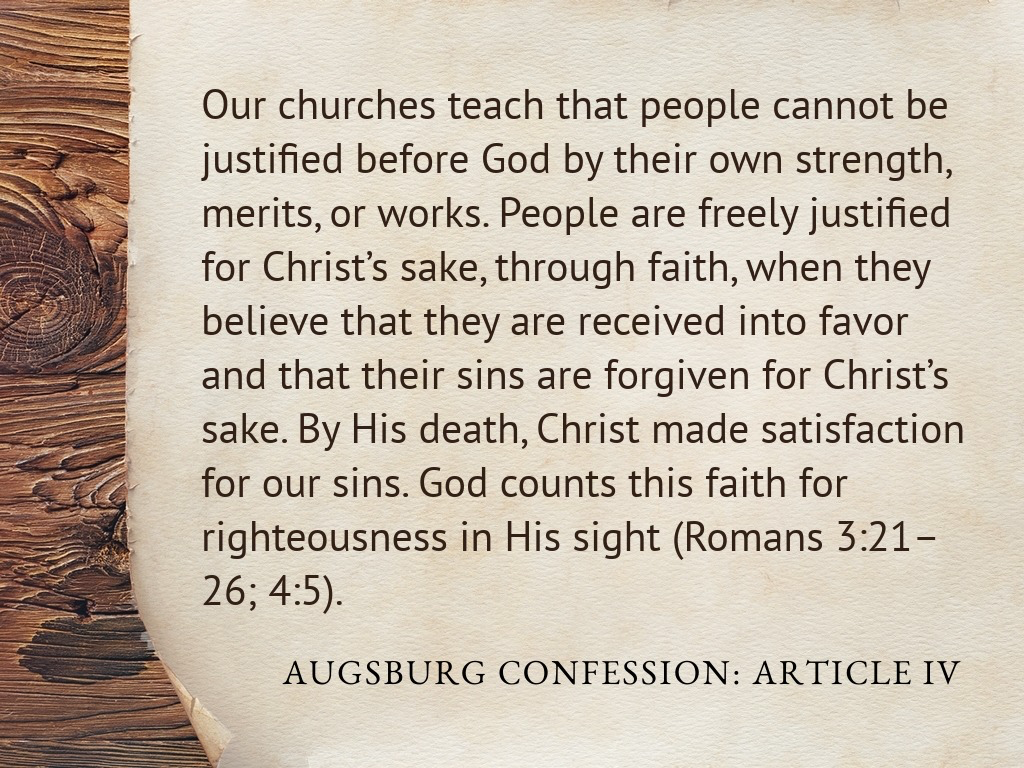
By the time you finish, you will be a great theologian because this hymn so clearly teaches Law, Gospel, and holy living. It clearly teaches how our good works don’t help or save us, which is what the church of Rome was falsely teaching. Instead, faith produces the fruit of good works which are good because they serve our neighbor.

So, we’re going to let the hymn preach to us. Because it’s a long hymn, we won’t sing all ten verses at once. I’ll give your voices a break and make brief comments here and there. Feel free to sing it from the insert, but if you would like to have the music, it is #410 in your hymnal. Let’s start with the first verse.

1. Salvation unto us has come
by God’s free grace and favor;
Good works cannot avert our doom,
they help and save us never.
Faith looks to Jesus Christ alone,
Who did for all the world atone;
He is our one Redeemer.

This verse summarizes everything that will come after it. God, by His free grace and favor given through Jesus, has set you free. Through faith in Jesus, you are a child of God. The last two lines of that verse tell us what Jesus has done. He made the payment for you. He is the one and only Redeemer.

Now, because the hymn was written in German then translated into English, some of the wording is slightly changed from the original to make the poetry work in English. But those last two lines in German say that Jesus, “has done enough for us all. He has become our Mediator.” Jesus has done everything you needed to be saved, and now He sits at God’s right hand interceding for you and governing all things for your good.

Now, the hymn goes on to elaborate what Jesus needed to do. Let’s sing verses 2-3.

2. What God did in His Law demand
and none to Him could render
Caused wrath and woe on ev’ry hand
for man, the vile offender,
Our flesh has not those pure desires
The spirit of the Law requires,
and lost is our condition.

3. It was a false, misleading dream
that God His Law had given
That sinners could themselves redeem
and by their works gain heaven.
The Law is but a mirror bright
To bring the inbred sin to light
that lurks within our nature.

Because of our sinful nature, we don’t even begin to do what God requires of us through the Law. And even though we falsely think that we’re better than others, the Law is a bright mirror that shows our desperately lost and sinful condition. Let’s sing verse 4.

4. From sin our flesh could not abstain,
sin held its sway unceasing;
The task was useless and in vain,
our guilt was e’er increasing.
None can remove sin’s poisoned dart
Or purify our guileful heart—
so deep is our corruption.

Apart from Jesus, we have no hope of salvation. The poison of sin continues to slowly kill and destroy us. The Law leaves us dead in sin. But that does not mean that we are without hope. We’ll sing verse 5.

5. Yet as the Law must be fulfilled
or we must die despairing,
Christ came and hath God’s anger stilled,
our human nature sharing.
He hath for us the Law obeyed
And thus, the Father’s vengeance stayed
which over us impended.

Jesus has fulfilled the Law for you. He is your substitute. The eternal Son of God took on your flesh to do all this for you. He perfectly obeyed the Law for you. He suffered the punishment your sins deserved. And because of that, God sees Jesus’ perfection when He looks at you, believer. God has no anger left for your sins because Jesus has taken it all. Verse 6.

6. Since Christ hath full atonement made
and brought to us salvation,
Each Christian therefore may be glad
and build on this foundation.
Thy grace alone, dear Lord, I plead,
Thy death is now my life indeed,
for Thou hast paid my ransom.

There is nothing left for you to do to be saved. Everything is done; it is finished (Jn. 19:30). The hymn takes a turn in that verse and addresses God directly. We ask God to apply everything Jesus has done to us. His death is your life. He has fully paid the ransom for your soul. Verses 7-8.

7. Let me not doubt, but trust in Thee,
Thy Word cannot be broken;
Thy call rings out, “Come unto Me!”
no falsehood hast Thou spoken.
Baptized into Thy precious name,
My faith cannot be put to shame,
and I shall never perish.

8. The Law reveals the guilt of sin
and makes men conscience-stricken;
The Gospel then doth enter in
the sinful soul to quicken.
Come to the cross, trust Christ, and live;
The Law no peace can ever give,
no comfort and no blessing.

Jesus calls to you, “Come to Me, all who labor and are heavy laden, and I will give you rest.” Trusting in that call, you will never ever be put to shame. Jesus has come so that you have eternal, abundant life. Verse 9.

9. Faith clings to Jesus’ cross alone
and rests in Him unceasing;
And by its fruits true faith is known.
with love and hope increasing.
Yet faith alone doth justify,
Works serve thy neighbor and supply
the proof that faith is living.

Faith in Jesus is the only thing that saves you, but faith is never alone. Christian, you do good works, but those works never save you. Those works are simply the fruit of the Spirit that serves your neighbor and shows that your faith is alive and well.

Now, the hymn closes with a doxology. We get swept up into the liturgy of heaven and join all the saints who have gone before us by praising God for what He has done for us in Christ. Let’s sing the final verse.

10. All blessing, honor, thanks, and praise
to Father, Son, and Spirit,
The God that saved us by His grace—
all glory to His merit!
O Triune God in heaven above,
Who hast revealed Thy saving love,
Thy blessed name be hallowed.

Amen.The peace of God, which surpasses all understanding, will guard your hearts and minds in Christ Jesus. Amen.