Feast & Famine – Sermon on Luke 16:19-31 for the First Sunday after Trinity

Luke 16:19–31

19 “There was a rich man who was clothed in purple and fine linen and who feasted sumptuously every day. 20 And at his gate was laid a poor man named Lazarus, covered with sores, 21 who desired to be fed with what fell from the rich man’s table. Moreover, even the dogs came and licked his sores. 22 The poor man died and was carried by the angels to Abraham’s side. The rich man also died and was buried, 23 and in Hades, being in torment, he lifted up his eyes and saw Abraham far off and Lazarus at his side. 24 And he called out, ‘Father Abraham, have mercy on me, and send Lazarus to dip the end of his finger in water and cool my tongue, for I am in anguish in this flame.’ 25 But Abraham said, ‘Child, remember that you in your lifetime received your good things, and Lazarus in like manner bad things; but now he is comforted here, and you are in anguish. 26 And besides all this, between us and you a great chasm has been fixed, in order that those who would pass from here to you may not be able, and none may cross from there to us.’ 27 And he said, ‘Then I beg you, father, to send him to my father’s house— 28 for I have five brothers—so that he may warn them, lest they also come into this place of torment.’ 29 But Abraham said, ‘They have Moses and the Prophets; let them hear them.’ 30 And he said, ‘No, father Abraham, but if someone goes to them from the dead, they will repent.’ 31 He said to him, ‘If they do not hear Moses and the Prophets, neither will they be convinced if someone should rise from the dead.’ ”

In the name of Jesus. Amen.

Psalm 37:16 says, “Better is the little that the righteous has than the abundance of many wicked” (see also Pro. 15:16).

Today, Jesus puts before us two men. One is fabulously rich, the other pitifully poor. One wears royal clothes, the other painful sores. One feasts sumptuously every day, the other craves crumbs. Jesus makes sure to highlight these major differences between the two men, but Jesus also makes sure that we know what they have in common.

First and most obviously, both die. Both face an eternal existence after death. And that existence is something that all the powers of this world have no influence to change or control. After his death, the rich man is no longer rich, and he is powerless to modify that. After his death, Lazarus is no longer poor. He has eternal riches and gifts that he didn’t earn and cannot be taken away.

But there is something else that these two men have in common with one another. Both men are passive. In other words, things happen to them. Now, this can be easy to miss, but once you see it you can’t ignore it.

To see it, let’s start with Lazarus. Jesus says that Lazarus is located at the rich man’s gate. But notice how Lazarus gets there. Jesus says that Lazarus is laid there. In other words, someone or something puts him there. Lazarus doesn’t intentionally go to the rich man’s gate day after day after day. If you were a destitute beggar but could move on your own, you’d go places where you would get help. And it would make sense to go to a rich man’s gate, but if you saw that rich dude feasting every day and he never gave you crumbs that fell from his table, you’d probably move somewhere else and hope to get noticed and helped in that new location. So, Jesus is clear that Lazarus is laid there (v. 20), but Jesus doesn’t say exactly who put Lazarus there, so let’s keep investigating.

Jesus says that the dogs came and licked Lazarus’ sores. Where did those dogs come from? They weren’t people’s personal pets that are sent to Lazarus. They were likely wild dogs. Psalm 50:10 says that every beast and the cattle on a thousand hills belong to God. Again, it isn’t directly stated that God sent the dogs. So, let’s keep looking.

When Lazarus dies, what happens? Jesus says that the angels are standing there, waiting to carry him to heaven. Now, there’s an important clue. Psalm 103:20 says that the angels are the mighty ones who obey God’s Word. Here, these angels are commanded to not only escort Lazarus to heaven, they are also the ones who carry him there. They wait for God’s command and direction. And in God’s timing, those angels carry Lazarus to heaven but not one moment before God decides.

Now, if God is in total, complete control of the end of Lazarus’ life, it would make sense that God was in control of everything leading up to that as well. No sparrow falls to the ground without God knowing it. Scripture promises that the hairs of your head are numbered (Mt. 10:29-31). The Bible is clear that God was in control of everything happening to Lazarus during his entire life (Ps. 139). God was governing all of his steps and movements. So, Lazarus, poor and sick though he was, was being taken care of by God throughout his entire life. God was the one who laid him at the rich man’s gate. God sent the dogs to comfort him by licking his sores. God sent the angels to carry him to heaven. And after he dies, God comforts Lazarus in paradise. Lazarus is passive. Things happen to him at God’s direction.

Now, consider the rich man. When Abraham is responding to the rich man’s request for Lazarus to give him a drop of water (more on that in a bit), Abraham says, “Remember that you in your lifetime received your good things” (Lk. 16:25). That tells us a lot about the rich man and his riches. All the things he enjoyed in his lifetime were given to him as gifts. His royal, purple clothes were a gift. His sumptuous feasts, a gift. His house and gate, a gift. Even the beggar Lazarus lying at his gate was a gift from God. Lazarus was a God-given opportunity for the rich man to share all the good things he received. But the rich man didn’t see any of his blessings as a gift. By all appearances, the rich man imagined those gifts were all things that he had earned, and he saw Lazarus as an inconvenient nuisance. But from heaven’s perspective, they were all gifts that were given.

That doesn’t mean that the rich man wasn’t a hard worker or a savvy investor. What it means is that He was a recipient of all the good things he enjoyed during his life. God gave it all. Everything he had – even the things he had earned – was given to him by God. But this rich man didn’t receive them as God’s good gifts. Instead, he saw everything revolving around him. If it was good, it was for his own pleasure and use. If it was inconvenient – like a beggar at his gate, it was a hurdle to his pleasure. He never gave thanks to God for the gifts, so he never thought to share the gifts God had given to him with others. He was foolish in his thinking and life (Ro. 1:21-22). All of this meant that he couldn’t enjoy the gifts he had been given. Even his feasting was a famine because he received it in isolation. He didn’t share his bounty with others.

In the end, it didn’t matter how little Lazarus had, and it didn’t matter how much the rich man had. What mattered was faith. Lazarus had faith that was credited to him as righteousness (Gen. 15:6). The rich man didn’t have faith, and when he stood before God to be judged (Heb. 9:27), he lacked the righteousness God demands (Mt. 5:20).

Now, we might feel sorry for the rich man as he’s suffering in hell. It is a pitiful thing to see someone think that a drop of water is merciful. And we certainly don’t want anyone to go to eternal condemnation. But the rich man’s torment doesn’t lead him to repentance. Look at how the rich man acts in hell. It doesn’t seem like the rich man has changed at all. He doesn’t ask to leave hell. He’d rather have Lazarus leave his comfort. Even in torment, the rich man is bossing people around. He still doesn’t talk to Lazarus; instead, he tries to tell Abraham what to do. The rich man thinks it is unfair that he is in hell. Underlying his desire to have Lazarus rise from the dead and warn his brothers is an attitude that arrogantly says that he knows better how to evangelize unbelievers. The rich man is basically saying, “If someone rises from the dead, then there will be a lot more people in heaven and fewer in hell. If I had seen someone rise from the dead, I wouldn’t be here.”

But in the end, the rich man hadn’t listened to the Scriptures. He hadn’t believed God’s Word. He hadn’t repented. He hadn’t believed in God’s mercy. Instead, he neglected God’s Word, and because of that, he was poor. On the other hand, Lazarus had the eternal treasure of God’s Word which made him rich – even in his earthly poverty. In Lazarus, we see the truth of what Pro. 15:15 says, “All the days of the afflicted are evil, but the cheerful of heart has a continual feast.”

Now, where does this leave us? We aren’t as wealthy as the rich man, and we aren’t as poor and destitute as Lazarus. All of us are somewhere in the middle, but that doesn’t change the fact that everything we have – whether it is a feast or a famine – is given to us from the hand of God.

God has given you two hands with two palms which are created to receive the things that God gives. And those hands have five fingers with space between them, which allows the good gifts of God fall through your hands to others. Because He is the Creator of all things, God has an infinite supply of gifts to give to you. He gives you everything freely, and He desires that you receive it as a gift so you don’t clutch at it and try to keep it for yourself. You, dear saints, are a conduit that receives from God and passes His bounty on to others. Proverbs 19:17 says, “Whoever is generous to the poor lends to the Lord, and he will repay him for his deed.”

Most importantly, you were poor miserable sinners. But Jesus saw you in your poverty. He left His feasting and became poor for your sake so you, through His poverty, would become rich (2 Cor. 8:9). Christ has come to give His own Body and Blood unto death for your sake. Now, He is risen forever and invites you not to have just some crumbs that fall from His plate. He invites you to have a seat at His table. Leave the famine of your sin and greed. Come and feast in His presence. Amen.

The peace of God, which surpasses all understanding, will guard your hearts and minds in Christ Jesus. Amen.

Your Good Things – Sermon on Luke 16:19-31 for the First Sunday after Trinity

Luke 16:19–31

19 “There was a rich man who was clothed in purple and fine linen and who feasted sumptuously every day. 20 And at his gate was laid a poor man named Lazarus, covered with sores, 21 who desired to be fed with what fell from the rich man’s table. Moreover, even the dogs came and licked his sores. 22 The poor man died and was carried by the angels to Abraham’s side. The rich man also died and was buried, 23 and in Hades, being in torment, he lifted up his eyes and saw Abraham far off and Lazarus at his side. 24 And he called out, ‘Father Abraham, have mercy on me, and send Lazarus to dip the end of his finger in water and cool my tongue, for I am in anguish in this flame.’ 25 But Abraham said, ‘Child, remember that you in your lifetime received your good things, and Lazarus in like manner bad things; but now he is comforted here, and you are in anguish. 26 And besides all this, between us and you a great chasm has been fixed, in order that those who would pass from here to you may not be able, and none may cross from there to us.’ 27 And he said, ‘Then I beg you, father, to send him to my father’s house— 28 for I have five brothers—so that he may warn them, lest they also come into this place of torment.’ 29 But Abraham said, ‘They have Moses and the Prophets; let them hear them.’ 30 And he said, ‘No, father Abraham, but if someone goes to them from the dead, they will repent.’ 31 He said to him, ‘If they do not hear Moses and the Prophets, neither will they be convinced if someone should rise from the dead.’ ”

In the name of Jesus. Amen.

If you had to choose, which character in this parable would you rather be? The rich man is clothed like royalty and has daily feasts. Sounds like a pretty good life. Lazarus has nothing. He apparently can’t walk; he has to be laid at the rich man’s gate. He’s poor and diseased. He’s so hungry he wants to the garbage that falls from the rich man’s table. And he can’t even fend off the dogs who come and lick his sores. But then, both of them die, and everything changes. Lazarus is escorted by the holy angels to paradise and bliss. The rich man dies, is buried, and goes to hell and eternal torment. So, which character would you rather be?

Most of you are probably thinking Lazarus. No one would choose to be the rich man. But a few of you smarties out there would say, “I’ll be Abraham. He was rich during his earthly life, and he went to heaven.” Very clever of you.

Today, we are going to focus on v. 25 of the parable where Abraham says to the rich man, “Child, remember that you in your lifetime received your good things, and Lazarus in like manner bad things, but now he is comforted here, and you are in anguish.”

That response is a little surprising to the eternal torment of the rich man. We expect that Abraham would tell the rich man, “You didn’t believe in Jesus,” or, “You didn’t love the Bible,” or even, “You received good things.” But Abraham doesn’t say any of that; instead, he says, “You received your good things.” It’s almost a little sarcastic as though Abraham is saying that the rich man received things that he thought were good – the clothes, the feasts, the expensive house, etc. All of those are good things and are gifts from God’s hand, but those aren’t God’s best things.

The rich man didn’t receive God’s steadfast love and salvation (Ps. 13:5-6); he didn’t receive God’s mercy and forgiveness. The rich man didn’t care about those things during his life, and he didn’t even care about them while suffering in hell. In hell, the rich man only desired relief from his suffering, and, when he couldn’t get that, he wanted his brothers to avoid the suffering. The rich man’s problem is that during his life and even in hell he rejected the means to avoid that suffering which is God’s mercy, steadfast love, and salvation which is delivered through the Bible – through the word of Moses, the prophets, and the apostles.

The devil wants to twist this parable so we think that we have to choose between two different existences. On the one hand, we could love God and go to heaven, or, on the other hand, we could love money and stuff and go to hell. So, we suppose, “I guess I’ll pick God” and go grumbling through this life. But the idea that you can only have either riches and hell or poverty and heaven is a false dichotomy.

God is the One who gave you the desire for nice things. The Scriptures even teach that God promises to fulfill the longings you have. Psalm 37:4 says, “Delight yourself in the Lord, and He will give you the desires of your heart.”

So, Christian, do you care about living in a fancy house? Yes, you do. Don’t lie. Remember Jesus promised, “In My Father’s house are many mansions, and I’m going to prepare a place for you” (Jn. 14:2). When you go to heaven and Jesus shows you the mansion He prepared for you, are you going to tell Him, “Meh. I don’t really care about that”? No!

Christian, do you care about good food and feasting? Yes, you do. How many times does the Bible talk about eternal life as a lavish feast (Is. 25:6; Mt. 22:1-10; Rev. 19:9)? God promises that feast because He knows that it is appealing to you. It’s something you want from His hand.

Christian, do you care about nice clothes? Yes, you do. The Bible promises that you will have extravagant, dazzling robes that are washed white in the blood of the lamb (Eph. 5:26-27; Rev. 7:13-14).

Christian, do you care about living a pain-free life? If you don’t now, just wait a few years and you will. You care about a life without pain, and God has promised that one day your body will be raised incorruptible, glorified, imperishable (1 Cor. 15:42-44) and you will have no more pain (Rev. 21:4).

Being a Christian doesn’t mean you have to give up your desire for nice things. You don’t have to have some Buddhist or monastic attitude toward the blessings that God gives you. Instead, you can and should give thanks and praise to God who gives every blessing. The Bible talks about the mansions, feasting, spectacular clothing, and escape from pain and suffering because God knows that it is a draw for you – it’s something you desire. You long for those things, and that isn’t a problem – not by itself anyway.

What is a problem is trying to get those things apart from God’s giving of those things. When you’re narrowly focused on living a comfortable earthly life, it becomes easy to forget about eternity. When you are focused on temporal mercies, you quickly forget about eternal mercies. Do you want your enjoyment of all those nice things now for the fleeting moments of this life? Or would you rather have them just a little bit later and retain them forever?

I know this sounds like some of the prosperity preaching you might hear on TV. To be clear, the health and wealth preachers are heretics, and I’m not becoming one of them. Those preachers are wrong – not because they promise health and wealth – but because of when they promise it. They promise it now when God makes no such promise in the Scriptures, but God does promise you will have it for eternity. 

The point of the parable is that the rich man loved those blessings more than he loved God and His Word. The rich man found his joy in the God’s gifts more than in the God who gives those gifts. The parable wants us to consider this question: What are my good things? Are your good things the temporal, fleeting pleasures of this life? Or are your good things the steadfast love, mercy, and salvation of God?

No one here is as destitute as Lazarus, and no one here is as wealthy as the rich man. You are all somewhere in between. The point of the parable is not for you to make yourself poor like Lazarus was, and the point is certainly not to make yourself like the rich man. The point of the parable is to get you to take your eyes off of the earthly things you either have or don’t have and focus on the eternal things that God gives you in His mercy which cannot be taken away. Remember, where your treasure is, there your heart will be also (Mt. 6:21).

Our call to worship helps us have the right focus. Psalm 13:5-6 says, “I have trusted in Your steadfast love; my heart shall rejoice in Your salvation. I will sing to the Lord, because He has dealt bountifully with me.” Christian, you have God’s steadfast love; you have His salvation. God be praised! That is more than enough. God has dealt bountifully with you because of what Jesus has done. Through Christ’s death and resurrection, you have an eternal inheritance that surpasses anything that the richest person could even dream of having.

Recognizing that you have the riches of Christ’s death and resurrection is the main point of the parable. And the parable has something to say about the riches you have in this life.

All of us are richer than we know. Even the poorest in our country would be the envy of most kings throughout history. Again, you aren’t the wealthy like the rich man, but you aren’t destitute like Lazarus. You’re somewhere between.

Don’t think to yourself, “If I were a little wealthier and closer to the rich man, I would be more generous with my things.” Don’t let the perfect be the enemy of the good. Jesus praised the two small copper coins that the widow gave, and not the fat checks of the rest (Lk. 21:1-4). Even though that widow’s gift was nothing in earthly comparison to the large sums put in by others, it was much more in Jesus’ eyes than all the other offerings combined. And remember, Lazarus didn’t want the rich man’s house, fancy clothes, or lavish feast. Lazarus only wanted what fell from the rich man’s table.

So, no; you probably can’t set up a trust fund that would cover the annual expenses of our congregation. Fine. But you can give your tithe. You probably can’t give a donation to pay for a new addition of a fellowship hall. Fine. But you can come and vacuum the sanctuary and scrub the toilets.

Dear saints, share your crumbs. They are more valuable than you know, and God will bless you as you give them away.

Hebrews 10:34 says, “You [Christians] joyfully accepted the plundering of your property, since you knew that you yourselves had a better possession and an abiding one.” In other words, whatever blessings you might lose in this life, they pale in comparison to the eternal blessings and treasures God has in store for you. So, if you lose something here, don’t worry about it. Your eternal inheritance cannot be taken from you.

Dear saints, seek first the kingdom of God and His righteousness – which God freely gives through His Word – and every other blessing will be added unto you (Mt. 6:33). Amen.

The peace of God, which surpasses all understanding, will guard your hearts and minds in Christ Jesus. Amen.
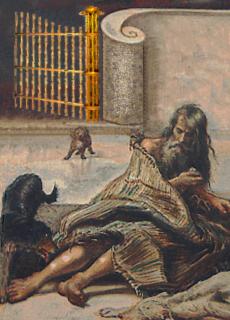
Carried – Sermon on Luke 16:19-31 for the First Sunday after Trinity

Luke 16:19-31

19 “There was a rich man who was clothed in purple and fine linen and who feasted sumptuously every day. 20 And at his gate was laid a poor man named Lazarus, covered with sores, 21 who desired to be fed with what fell from the rich man’s table. Moreover, even the dogs came and licked his sores. 22 The poor man died and was carried by the angels to Abraham’s side. The rich man also died and was buried, 23 and in Hades, being in torment, he lifted up his eyes and saw Abraham far off and Lazarus at his side. 24 And he called out, ‘Father Abraham, have mercy on me, and send Lazarus to dip the end of his finger in water and cool my tongue, for I am in anguish in this flame.’ 25 But Abraham said, ‘Child, remember that you in your lifetime received your good things, and Lazarus in like manner bad things; but now he is comforted here, and you are in anguish. 26 And besides all this, between us and you a great chasm has been fixed, in order that those who would pass from here to you may not be able, and none may cross from there to us.’ 27 And he said, ‘Then I beg you, father, to send him to my father’s house— 28 for I have five brothers—so that he may warn them, lest they also come into this place of torment.’ 29 But Abraham said, ‘They have Moses and the Prophets; let them hear them.’ 30 And he said, ‘No, father Abraham, but if someone goes to them from the dead, they will repent.’ 31 He said to him, ‘If they do not hear Moses and the Prophets, neither will they be convinced if someone should rise from the dead.’”

In the name of Jesus. Amen.

Right off the bat, this text confirms that there are things much worse than being poor, hungry, covered with sores, and having dogs as your only friends and caretakers. There is eternal life after this life, and after you die, there are only two destinations. Heaven and hell are real. You will spend eternity either in bliss with God your Creator, Redeemer, and Sanctifier, or in eternal damnation and torment.

Because that truth stares you in the face when hearing this text, I want us to focus for a moment on a rich man in this text.

There was a rich man who was adorned with the finest garb. This man daily feasted on the best food. Wherever he went, he was chauffeured around in decadence. This rich man had the most precious things in all creation and was truly blessed. And this rich man’s name was… Lazarus.

Now, I can hear what you’re thinking: “Pastor, Lazarus didn’t have anything good in this life. Abraham even said that Lazarus received bad things in his lifetime.” Absolutely, I’ll concede that point. But with this parable, Jesus is trying to fix our hearts where true joys are found. Both in this life and the next, true joy is to be found in the promises of God’s Word.

Too often, we Christians are tempted to think that if things aren’t going a certain way that God is mad at us. I often hear testimonies of Christians who will say things like, “I thought I was saved, but…” Then, they’ll recount some difficulty or hardship they have gone through. Then they will continue, “But then, I truly gave my life to Jesus, and everything got so much better. And now I’m really saved.” Honestly, that is sad to hear.

Dear saints, beware that kind of thinking and mentality. The devil wants us to tie our assurance of salvation to how things are going in this life. Honestly, that type of thinking is precisely what the book of Job is teaching against. God says that Job is righteous and upright (Job 1:8, 2:3), but the devil says, “Hey God, let me have a crack at him. Let me take everything from him – his wealth, family, possessions, and health. And Job will curse You to Your face, God” (Job 1:9-11, 2:4-5). And even when Job’s friends try to get Job to confess that he must have done something sinful to cause all the evil he endured, Job clung to faith in God’s promises.

Considering our life and judging what God thinks of us based on our blessings or lack of blessings is a dangerous place to be. Jesus Himself says that the life of faith is going to be difficult. Remember, Jesus promises that if the world persecuted Him, believers will be persecuted too (Jn. 15:20). Jesus calls Christians to follow Him which means picking up a cross – not a lazy boy (Lk. 9:23). If we are always stuck looking at how our lives are going, we’ll never be at rest as Christians. In fact, we will easily fall away. All the devil will have to do is keep bouncing us between highs and lows, and eventually, we will break.

Now, there are all sorts of ways we can go wrong when we consider this parable about Lazarus and the rich man unless we understand Jesus when He says, “Blessed are those who hear the Word of God and keep it” (Lk. 11:28). Those who hear God’s Word and believe it live blessed lives despite all appearances to the contrary. And that is the main difference between Lazarus and the rich man.

So, back to the idea that Lazarus was the truly rich man in this parable: Yes, absolutely. Lazarus was poor in this life, but when we consider what God’s Word says, we see that Lazarus was rich. In the parable, Jesus doesn’t say what kind of rags Lazarus wore, but Scripture does say that all believers are clothed with Christ (Gal. 3:27). In fact, Ephesians 5:25-27 says that Christ loved the Church and gave Himself up for her, that He might sanctify her and cleanse her by the washing of water with the Word, so that He might present the Church to Himself in splendor, without spot or wrinkle or any such thing, holy and without blemish. Because Lazarus was a Christian, that is how he was clothed – despite the appearance of his beggarly clothes.

In the parable, Jesus says that Lazarus was hungry and desired to be fed with what fell from the rich man’s table. But because Lazarus was a Christian, he did not live on bread alone, but on every Word that proceeds from the mouth of God (Mt. 4:4). Lazarus knew the mercy of Christ, the Word made flesh (Jn. 1:14), who is the living bread that comes down from heaven (Jn. 6:50-51). That Word of God was sweet to Lazarus’ taste, sweeter than honey (Ps. 119:103).

And Lazarus had the finest chauffeurs who, when he died, carried him to Abraham’s side. The angels took care of all his transportation needs. Yes, despite all the suffering Lazarus had in this life, he was truly blessed.

And when we consider the rich man in the parable, we see the opposite. For all the temporal blessings the rich man had in this life, he did not have the most important thing – faith in God’s Word. Even as he is tormented in hell, the rich man continues to reject God’s Word. In damnation, he has the audacity to tell Abraham that God’s Word isn’t enough to warn his five living brothers about the peril of their sins. He demands that Lazarus be raised from the dead and warn them. But Abraham responds, “If they do not hear Moses and the Prophets (in other words, the Scriptures), neither will they be convinced if someone should rise from the dead.” In other words, to hold fast to God’s Word is to be truly rich through faith in Christ. Blessed are those who hear the Work of God and keep it.

Don’t trip up on v. 25 where Abraham says, “Child, remember that you in your lifetime received your good things, and Lazarus in like manner bad things.” Some will say that statement teaches that the poor in this life go to heaven and the rich in this life go hell. That can’t be the case. Instead that again teaches us to not look at our blessings in this life, whether they be many or few.

Just think about the other rich man you heard about today in our Old Testament lesson (Gen. 15:1-6) – Abraham himself. In his day, Abraham was one of the wealthiest men in the world. One night, the Lord promised Abraham that His reward would be very great. But when Abraham looked at himself, he saw an old, wrinkled man. When Abraham looked at his wife, he saw an old woman who was past the age of bearing children. Abraham looked over at his servant Eliezer who was going to get all Abraham’s stuff when he died because Abraham had no heir. So God took Abraham outside, told him to look at the stars and try to number them. And God promised, “So shall your offspring be.” And Abraham stopped looking at his temporal blessings, and he looked past the limitations that seemed to contradict God’s promise. Instead, Abraham believed the Lord, and God counted it to him as righteousness.

Lazarus had that same faith. The name “Lazarus” means “one whom God helps.” Even with his beggarly status in life, Lazarus rested on the promises of God for forgiveness, life, and salvation despite all appearances to the contrary. Those promises carried Lazarus throughout his life, so when he died, the angels carried Lazarus to paradise. Yes, the rich man had earthly treasures in this life, but once he died, those treasures were gone forever. Because he didn’t have faith in God’s Word, he had nothing and was truly poor.

So, parents, this is mainly directed at you, but it is also for all of us Christians: We need to reconsider how we encourage our children and young people. Too often, we urge kids to grow up to be like the unnamed rich man in the parable. Obviously, he was wildly successful financially. He was a family man who cared about his siblings. He was probably a very generous man. Why else would Lazarus be begging at this man’s gate each day? The unnamed rich man was independent, successful, and a model, upstanding citizen. But he lacked the faith and fear of God. And without that, he had nothing.

And don’t get me wrong here. It is good to teach, instruct, and encourage our children to work hard, be independent, earn an honest living, and take pride in their accomplishments. It is important to do that. But never to the neglect of faith in God’s Word. Above all else, let us train our children and encourage one another to be dependent upon God and rest in His promises.

Those promises of God’s love, mercy, and forgiveness carry us through this life. And when our time comes, may we be found faithful to Christ and like Lazarus be carried by the angels to the side of our crucified, risen, and ascended Savior, Jesus Christ. Amen.

The peace of God, which surpasses all understanding, will guard your hearts and minds in Christ Jesus. Amen.

Differences – Sermon on Luke 16:19-31 for the First Sunday after Trinity

Listen here.

Luke 16:19–31

19 “There was a rich man who was clothed in purple and fine linen and who feasted sumptuously every day. 20 And at his gate was laid a poor man named Lazarus, covered with sores, 21 who desired to be fed with what fell from the rich man’s table. Moreover, even the dogs came and licked his sores.Lazarus and the Rich Man Graphic 22 The poor man died and was carried by the angels to Abraham’s side. The rich man also died and was buried, 23 and in Hades, being in torment, he lifted up his eyes and saw Abraham far off and Lazarus at his side. 24 And he called out, ‘Father Abraham, have mercy on me, and send Lazarus to dip the end of his finger in water and cool my tongue, for I am in anguish in this flame.’ 25 But Abraham said, ‘Child, remember that you in your lifetime received your good things, and Lazarus in like manner bad things; but now he is comforted here, and you are in anguish. 26 And besides all this, between us and you a great chasm has been fixed, in order that those who would pass from here to you may not be able, and none may cross from there to us.’ 27 And he said, ‘Then I beg you, father, to send him to my father’s house— 28 for I have five brothers—so that he may warn them, lest they also come into this place of torment.’ 29 But Abraham said, ‘They have Moses and the Prophets; let them hear them.’ 30 And he said, ‘No, father Abraham, but if someone goes to them from the dead, they will repent.’ 31 He said to him, ‘If they do not hear Moses and the Prophets, neither will they be convinced if someone should rise from the dead.’”

In the name of Jesus. Amen.

We’re all familiar with the phrase, “Don’t judge a book by its cover.” Well, the same could be said about characters in a parable. Jesus tells this parable with two main characters. On the one hand there is a rich man who is clothed in royal purple linens and ate the best food and on the other hand is the beggar Lazarus who was poor and had dogs licking his sores. The two men die. The rich man ends up tormented in Hades while Lazarus is comforted in heaven. The only thing these two men have in common is that they both die, so the differences between the two couldn’t be more stark. But we run into a danger if we only focus on the different economic statuses of these two. Does the rich man end up in hell because he got to enjoy blessings during his earthly life and Lazarus end up in heaven because he didn’t? Nope!

In the parable, Abraham says to the suffering rich man, “Remember that you in your lifetime received your good things, and Lazarus bad things; but now he is comforted here, and you are in anguish.” With this parable, is Jesus trying to teach us that blessings in this life mean torment for eternity? Are people saved because of their poor status in this life? Na ah.

So, we have to dig a little further to find the real difference between these two. And if we pay attention to the whole parable, the difference is as clear as the air in this sanctuary.

Nothing in the parable says the rich man is an evil, greedy glutton. There is no indication that he is a jerk who fires people all the time and is always looking for a way to maximize his profits without any consideration for others. The parable doesn’t say that. Jesus doesn’t say that that the rich man is selfish or uncharitable.

And, on the same note, nothing in the parable says that poor Lazarus was humble and virtuous. The text just says that he is poor. There are plenty of causes of poverty. Some people are poor because of an addiction. And, yes, of course, sometimes people are poor because of things outside of their control like sickness, disease, or disability. But none of those things earn eternal life for a person.

lazarus-dogsNow in the parable, Jesus does say that Lazarus is there at the man’s gate begging and desiring to be fed with what fell from the rich man’s table. Absolutely, I’ll give you that. Maybe, the rich man should be helping more and being more generous. But, why do you think Lazarus chooses to beg at this man’s gate? Could it be that Lazarus knows he has a better chance to receive something at that gate than if he went to a different gate? And let’s be brutally honest here. If you had a Lazarus camped outside your house begging day after day wouldn’t you find a way to make them move on? How long before you’d be embarrassed about that poor person asking for money when visitors came to your house?

The main point is simply this: Don’t be deceived into thinking that the reason the rich man ends up in hell and poor Lazarus in heaven is economic status. Don’t ignore your sin of coveting by thinking, “That rich jerk got what he deserved.” Being rich, having blessings, and enjoying the good things God has given you is not a sin. Whatever you have is a gift from God, and God wants you to have it. That is why God gave the 7thCommandment, “Thou shalt not steal.” God gave that commandment to protect the blessings that He has given to you.

Yes, of course, some people get rich because they are evil and wicked and greedy. But being rich is not in and of itself a sin. Don’t fall into the trap – which is so common today – don’t fall into the trap of condemning the rich simply because they are rich and praising the poor simply because they are poor. Remember, Abraham was one of, if not the, wealthiest man in the world in his day. And where does he end up in the parable? In heaven.

Now, I’ve spent a significant amount of time on this today because we are all quick to make decisions about a person by looking only at the outward aspects of individuals. The social unrest and problems we are currently seeing in our society and country are exacerbated (and please note I’m saying ‘exacerbated’) because we will look at a person outwardly – their wealth, their poverty, their skin color, their job – we look at those external things and decide what that person is worth and how we should interact with them. That needs to stop.

How we treat someone should not depend on our perception of that person. No one’s virtue or worth or value is based on their economic status, their race, their occupation, or anything like that.

Listen carefully. Everything has a price – even people. All of us are slaves to sin. In John 8:34, Jesus says, “Everyone who practices sin is a slave to sin,” and Romans 3:23 says, “All have sinned.” Lamb of God who takes away the sins of the wolrdSo, put two and two together and that means everyone is a slave to sin. But you and every person that you will ever meet, every person that has been or ever will be, every individual has been bought from slavery to sin. Every individual has been deemed and valued by God to be worth the blood of His own Son, Jesus. So, whether someone is rich or poor; whether someone is white, black, yellow, or brown; whether someone is a police officer or a rioter; whether someone is a capitalist or a Marxist; whether someone is conservative, liberal, Republican, or Democrat, remember God has paid the blood of Jesus to redeem that person from his or her slavery to sin. Amen?

I’ve taken this angle on the parable to make that point, and it is an important point for all of us to remember. But that is not the most important point for us today – not even close.

The most important point is to see the real difference between the rich man and Lazarus. The real difference is only revealed after they have both died. The rich man is over there in hell and Lazarus is over there in heaven. The rich man asks Abraham to have Lazarus raised from the dead to warn his five brothers. And Abraham says, “They have Moses and the Prophets, let them hear them.” In other words, Abraham says, “Listen rich dude, your brothers have the Bible. They don’t need someone to rise from the dead to warn them about the pain and torment you are suffering.”

And here is where the difference, the real difference between the rich man and Lazarus, comes out. The rich man says, “No, father Abraham, but if someone goes to them from the dead, they will repent.” In other words, the rich man is saying, “The active, effective, powerful, living, life-giving, life-creating Word of God isn’t good enough.”

The rich man rejected the Scriptures. He did it during his earthly life, and he continues to reject the Scriptures in eternal damnation. Even in hell, he has no remorse or repentance. By rejecting the Scriptures, the rich man had rejected and continued to reject the Savior who is revealed in the Scriptures.

The rich man had a lot of things in his earthly life, but the one thing he didn’t have was Jesus. So, please reconsider, who was more blessed in their earthly life? Was it the rich man or Lazarus? When Abraham says that all the five brothers need is the Bible, by default, what does that mean that Lazarus had in his poor, miserable life? Lazarus had the Word of God. Lazarus had true riches because he has faith if Christ. It doesn’t matter what things he did or didn’t have on earth because Lazarus had Jesus.

That is the real difference between these two.

Dear saints, you have the Scriptures. You have the true, eternal treasure that cannot be taken from you. If you have more than that (and all of us do), we can, of course, be generous with those things because we already have what is most important. We have Jesus.

In light of that, because you have Jesus, dear saints, go and be different. In a world full of fear because of pandemic, racism, riots, and anarchy, be different. Have no fear. No one and nothing can take from you what is most important.

So, live without fear. Live generously. Live with outrageous love, gratuitous generosity, and reckless compassion for those around you. Because neither death nor life, nor angels nor rulers, nor things present nor things to come, nor powers, nor height nor depth, nor anything else in all creation will be able to separate you from God’s love for you in Christ Jesus your Lord (Ro. 8:38-39). Amen.

The peace of God, which surpasses all understanding, will guard your hearts and minds in Christ Jesus. Amen.

The Gift of a Name – Sermon on Luke 16:19-31 for the First Sunday after Trinity

Listen here.

Luke 16:19-31

19 “There was a rich man who was clothed in purple and fine linen and who feasted sumptuously every day. 20 And at his gate was laid a poor man named Lazarus, covered with sores, 21 who desired to be fed with what fell from the rich man’s table. Moreover, even the dogs came and licked his sores. Lazarus and the Rich Man Graphic22 The poor man died and was carried by the angels to Abraham’s side. The rich man also died and was buried, 23 and in Hades, being in torment, he lifted up his eyes and saw Abraham far off and Lazarus at his side. 24 And he called out, ‘Father Abraham, have mercy on me, and send Lazarus to dip the end of his finger in water and cool my tongue, for I am in anguish in this flame.’ 25 But Abraham said, ‘Child, remember that you in your lifetime received your good things, and Lazarus in like manner bad things; but now he is comforted here, and you are in anguish. 26 And besides all this, between us and you a great chasm has been fixed, in order that those who would pass from here to you may not be able, and none may cross from there to us.’ 27 And he said, ‘Then I beg you, father, to send him to my father’s house— 28 for I have five brothers—so that he may warn them, lest they also come into this place of torment.’ 29 But Abraham said, ‘They have Moses and the Prophets; let them hear them.’ 30 And he said, ‘No, father Abraham, but if someone goes to them from the dead, they will repent.’ 31 He said to him, ‘If they do not hear Moses and the Prophets, neither will they be convinced if someone should rise from the dead.’”

In the name of Jesus. Amen.

Being rich is not a sin. Money can, of course, be very dangerous to faith in Christ. Jesus plainly teaches that it is difficult for the rich to enter the kingdom of heaven (Mt. 19:23-24). But the rich man does not go to hell because he was wealthy. Instead, the rich man goes to hell because he does not love God.

GreedEven though the parable doesn’t explicitly say it, we know the rich man does not love God. As our Epistle text (1 Jn. 4:16-21) says, “he who does not love his brother whom he has seen cannot love God whom he has not seen…. Whoever loves God must also love his brother” (1 Jn. 20-21). The rich man’s lack of love for Lazarus makes his lack of love for God as plain as the nose on your face.

We can go even farther and say that the rich man is put to shame by the dogs. By licking his wounds, those dogs are more compassionate toward Lazarus than the rich man who can’t even be bothered to send one of his servants to give Lazarus a crumb from his table. Again, it is not a sin to be rich – not at all. But you cannot be saved and live as unlovingly and hard-heartedly as the rich man in this parable.

The Scriptural command to love your neighbor as yourself (Lev. 19:18; Mt. 22:39) is something that everyone, even pagans, know they should do. Everyone has the duty to love and serve their neighbor – but Christians especially have this duty.

God has given you abundant blessings so that you can use your wealth to help and be generous to others. Too often when we hear exhortations to assist the poor and needy – and I include myself in this rebuke – we over-generalize and turn the poor into a category or a nameless group of people that are difficult to identify. And once we have done that, we come up with all sorts of excuses to get out of helping our neighbor.

We know we can’t feed and clothe everybody so we don’t even start. Or we think to ourselves, “Jesus said that we will always have the poor among us (Mt. 26:11), so what good can I do?” But by doing this, we make the poor merely a concept, a demographic, or an abstraction. Once we have done this, we easily dismiss God’s call to help them.

So, don’t fall into the trap. Christian, God has called you to help your neighbor, and don’t forget that your neighbor has a name. In this parable, the rich man had a poor person put into his life by God, and that poor man had a name – Lazarus. And without question, the rich man knew who Lazarus was.

As the rich man was in torment, he doesn’t say, “Abraham, can you send that guy next to you to give me a drop of water?” No. The rich man sees Lazarus’ face, knows his name, and begs, “Send Lazarus.” And more than that, the rich man has five brothers who also knew Lazarus by name. The rich man knows that, if Lazarus could go to his brothers, they would recognize Lazarus, and they would know that he had risen from the dead to warn them about his torments in hell. From those two details, we know that Lazarus was a familiar family acquaintance for the rich man and his brothers.

Here’s the point: God hasn’t commanded you to feed and provide for the whole world. You aren’t God, and, quite frankly, you can’t do that. God hasn’t called you to provide for everyone, but God has called you to provide for Lazarus. God has put you into relationships with people who have a name. And God has called you to provide for them.

Crying to GodSo, when your conscience is pricked and you feel guilt for your lack of love, first repent. Repent of your lack of love. Then, make a list of the people God has placed in your life to help, to care for, and to love starting with the people closest to you.

Take out a piece of paper and draw a circle in the middle and write down the names of your family members who live with you in that circle. God has called you to care for them first. Be faithful in your care for them. Then draw another circle around the first and list your family members who need help – maybe a grandparent or an aged parent or aunt, uncle, or cousin. Those are the first two groups of neighbors God has called you to serve and care for. 1 Timothy 5:8 says, “[I]f anyone does not provide for his relatives, and especially for members of his household, he has denied the faith and is worse than an unbeliever.”

Then draw another circle around the first two, and write down the names of the people from our congregation that need your care and support. After your family, your fellow believers, your brothers and sisters in Christ are the closest neighbors that God has put into your life to care for. Galatians 6:10 says, “[A]s we have opportunity, let us do good to everyone, and especially to those who are of the household of faith.” Your brothers and sisters in Christ need your love and care. They need you to contribute to this congregation so that they can hear the Gospel and receive God’s gifts in His Word and Sacraments. They need you to help them when they fall into hard times. So be faithful in your giving to our congregation, and God will bless those efforts. Proverbs 19:17 says, “Whoever is generous to the poor lends to the Lord, and he will repay him for his deed.”

If you still have more to give, draw another circle. Write the names of your neighbors, coworkers, and friends who also have needs. And be faithful in helping them. Then you can draw another circle and write the names of others you know who need help. Or you can write the names of organizations that help those in need – the Women’s Pregnancy Center, Northlands Rescue Mission, the food shelf, etc. Get their newsletters or go to the websites and read the names and stories of the individuals who have been helped by those efforts as well. You get the idea?

With all those names, you might be overwhelmed. So, pray for wisdom. Ask God to give you the wisdom to know when you are equipped to help and when you are not. And remember that the closer to the middle of the circle those names are, God has called you to help those individuals first. And trust that God knows how to order your life and the lives of others as well.

Now, maybe you are a Lazarus. You might be the one who needs to be cared for, and if you aren’t now, you may be in the future. If that is the case, you might wonder, “How can I show love for my neighbor? How can I provide for others when I am in need?” The answer is surprisingly simple.

In Jesus’ day, beggars were seen as offering service to God be being needy. The generous cannot be generous if there is no one to be generous to. God may call you into His service by being the one who needs to receive the generosity of others who have the means to give. So, if you have needs, let us know.

Baptism 2And never forget, Christian, that you have been given a name. Through the waters of your Baptism, God gave you your name. He has adopted you into His family. You are His child and part of the household of Jesus. The love you fail to show to those God has placed in your life is forgiven and covered by the blood of Jesus, your Savior. And God does not forget to pour out His love, mercy, forgiveness, and provision for you.

This is what the Scriptures teach. The Scriptures point you to Jesus, your Savior. It is the same Scriptures that this parable says the rich man’s brothers should look to so that they do not come to the place of eternal torment that the rich man did. Those very Scriptures all point you to the Jesus who shed His blood, died, and rose again for you.

Sinner, you are not some nameless, faceless person to God. He knows you by name. He has called you by that name, and you are His (Is. 43:1). And, dear saints, your name is written in the Lamb’s Book of Life (Rev. 3:5; 13:8). Amen.

The peace of God, which surpasses all understanding, will guard your hearts and minds in Christ Jesus. Amen.