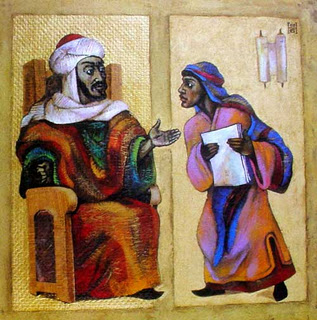
The Untaming of the Shrewd – Sermon on Luke 16:1-13 for the Ninth Sunday after Trinity

Luke 16:1-13

In the name of Jesus. Amen.

We’ll get to the parable, but we’ll start with a little congregational participation. Ready? Pick one hand and hold it in front of you. Point your thumb toward your face and line your other fingers straight behind it like you’re going to do a karate chop. Keep your hand like that and look at me for a moment.

Imagine you’re at the grocery store to buy a snack for yourself. It could be a bag of chips, a box of cookies, or a pint of ice cream, whatever you fancy right now. No self-checkout today. You’ve handed the cashier a $20 bill, and she’s about to hand you your change. Without looking at your hand, move it into position to receive the change. Now, look at your hand. I’m guessing your palm is toward the ceiling, fingers slightly open, ready to close around the change. We’ll call that the ‘receptive’ hand.

Put your hand back in the karate chop position and keep it there again. Imagine you spot a $100 bill on a shelf in the store. No one else is around. Forget about what you would do with it. Just move your hand as if you’re reaching to take it. Look again—that’s the grasping and taking hand.

Everyone knows that hand. It is the hand of a child who snatches a toy and yells, “Mine!” It is the hand that treats everything as something to control rather than receive. That grasping hand is not new. It is as old as the Fall.

God created our hands to be the hands of a steward with open palms. First, receiving from Him; then, offering to Him. God created us in His Own image and gave us dominion over the fish of the sea, the birds of the air, the animals, and all the earth. He gave every plant for food (Gen. 1:28-30). That dominion wasn’t permission to beat creation into submission. It was entrusted to us as image-bearers, so that we would reflect the heart of our all-giving Creator.

Not only did God give all of creation to be under our dominion, He also gave us a home. He put Adam and the woman in the Garden of Eden and gave them a clear purpose, “to work it and keep it” (Gen. 2:15). The two Hebrew verbs there are the same words God used when He established the priests who were to ‘serve’ and ‘guard’ the Tabernacle (Num. 3:7-88:2618:5-6). In short, Adam wasn’t only created to be a gardener. He was created to be a priestly guardian of the sacred space of Eden. There was only one vocation in Eden, and that was the vocation of steward. God created us to receive everything from His open hand—palms up, receiving every gift of creation from His generosity. That open, receptive hand is the original stewardship hand.

Sadly, the hand rolled over. In Gen. 3, the devil suggested that God was holding out. Out of all creation, God said that one tree was off-limits. The devil lied to the woman and said that things would be better if she would eat the forbidden fruit. Suddenly, that is all her eye could see. The woman sees that the tree is good for food, a delight to the eyes, and desirable to make one wise (Gen 3:6). That desire and covetousness twisted her vision. The hands of the woman and Adam—hands that had been open to receive—those hands turned over to reach, grasp, and take.

That single motion—palm down, fingers closing around what wasn’t theirs—was the tipping point. The stewards presumed to be owners. But God never transferred ownership. Instead, they took and grasped what didn’t belong to them. They became thieves. In a sense, they stole the fruit. But the deeper theft was their attempt to take God’s place. The closing, grasping hand was the first act of original sin. It showed that they no longer trusted God, and whatever does not proceed from faith is sin (Ro. 14:23). That hand turning over and grasping what God hadn’t given was a violation of at least the 1st, 3rd, 4th, 5th, 7th, 9th, and 10th Commandments.

Now, bring that picture into the parable Jesus tells today.

There is a rich man whose hand was always open, always giving. He entrusted his possessions to a manager. The manager’s hand was supposed to stay palm up so he could receive the master’s wealth, manage it, and return it to the owner. But the manager’s hand has already rolled over. He has been wasting what was never his. Some commentators suggest that this manager was scamming the tenants by collecting more than he was supposed to and keeping the extra for himself.

When the master calls for an accounting of the books, the manager’s closed fist is exposed, and he will be removed from his position. The manager knows himself well enough to admit that he isn’t strong enough to dig, and he’s too proud to beg. So, what does he do? He acts shrewdly and hatches a plan. He probably worked harder that afternoon than he had in years.

He calls in the debtors one by one and reduces what they actually owe without the master’s permission or authorization. The unrighteous manager is still living off the master’s open-handed generosity, still using the master’s resources. He keeps his hand turned over so he can cleverly take more—this time, from the master himself. He is using his boss’s generosity as his own personal safety net. He knows that these debtors will be singing the praises of the rich man. But they will also associate him with their debt being slashed.

Notice that when the rich man figures the whole thing out, he still doesn’t close his hand. Instead, the master commends and praises the manager—not for his theft, but for his shrewdness. The manager knew the giving nature of the rich man and bet everything on it. That’s what Jesus is praising.

Jesus is not holding him up as a moral example. The man is unrighteous. His motivation is purely self-preservation. He’s a thief, but he’s a shrewd thief. Look at the energy this little scoundrel pours into securing a few friends who will toss him bread when he’s finally out of his job. Look at how he plots, stays up late, and reworks the books for his own benefit.

What Jesus praises is the shrewd use of what belongs to another. The manager did it only for his own benefit. Jesus wants us to do it for the benefit of others. In short, Christ wants us to use what God gives and entrusts to us in shrewd ways that reveal the generosity of our heavenly Father. That’s why Jesus says, “The sons of this world are more shrewd in dealing with their own generation than the sons of light” (Lk. 16:8).

Dear saints, you have infinite treasures. You have the Gospel, the forgiveness of sins, the hope of the resurrection and the life of the world to come. You have all of that because of the open hand of our God who gives and gives and gives. He promises that you don’t have to worry about any of your needs for tomorrow because He will provide (Mt. 6:31-34). But still, we are careful, cautious, and stingy. In our selfishness we have tamed ourselves to be close-fisted. Repent.

That is the rebuke Jesus has for us today. Our closed hands are greedy and lazy. The 7th Commandment forbids both. Greed selfishly grabs. Laziness selfishly refuses to work. The virtue the Holy Spirit is after in us today is generosity. He wants us to open our hands to both freely receive and freely give. Jesus presses the point: “Make friends for yourselves by means of unrighteous wealth, so that when it fails they may receive you into the eternal dwellings”(Lk. 16:9). Eventually, money will fail. The day is coming when our hands can’t hold anything. So today, use what is already the Lord’s to make eternal friends—people who will stand with you in the Resurrection because the Gospel reached them through the resources you have stewarded.

David recognized this in our Old Testament reading (1 Chr. 29:10-15). When the people freely gave and poured out their gifts so the Temple could be built, David prayed, “All things come from You, and of Your own have we given You” (1 Chron. 29:14). Whenever and whatever we give, we are only returning what the open hand of God first placed in our hands. There is no such thing as ‘my money’ or ‘my stuff’ in the kingdom of heaven. There is only the Lord’s money and the Lord’s stuff temporarily in our care. That fact frees the fist that desires to grasp. That truth untames us and makes us shrewd. Closed hands always end in idolatry by making a (little ‘g’) god of the self and of the stuff we think we can control.

Repent and always know that Christ is the perfect Steward. His hands stayed open. Though He was rich, yet for your sake He became poor, so that you by His poverty might become rich (2 Co. 8:9). He emptied Himself. He stretched out His hands on the cross and let everything be taken. His blood, His life, His whole Self—He gave it all as pure gift. You are not just a failed steward left to dig yourself out of sin. Instead, you are a redeemed steward who has been washed, forgiven, and claimed. The Holy Spirit is still at work to turn our hands back over, palm up, open again.

Jesus wants us to have the same energy that the unjust steward showed. He wants to untame us so we shrewdly use that same intensity, that same foresight, that same willingness to stay up late and work hard for His kingdom.

You have a mind. Use it to find new ways to love your neighbor. You have a body. Use it to serve others. You have resources that are already His. Use them to make friends who will welcome you into the eternal dwellings.

Dear saints, your Master’s hand is always open. He has already given you everything that matters. You are free. Be shrewd with His gifts, and rejoice in His goodness. Amen.

The peace of God, which surpasses all understanding, will guard your hearts and minds in Christ Jesus (Php. 4:7). Amen.
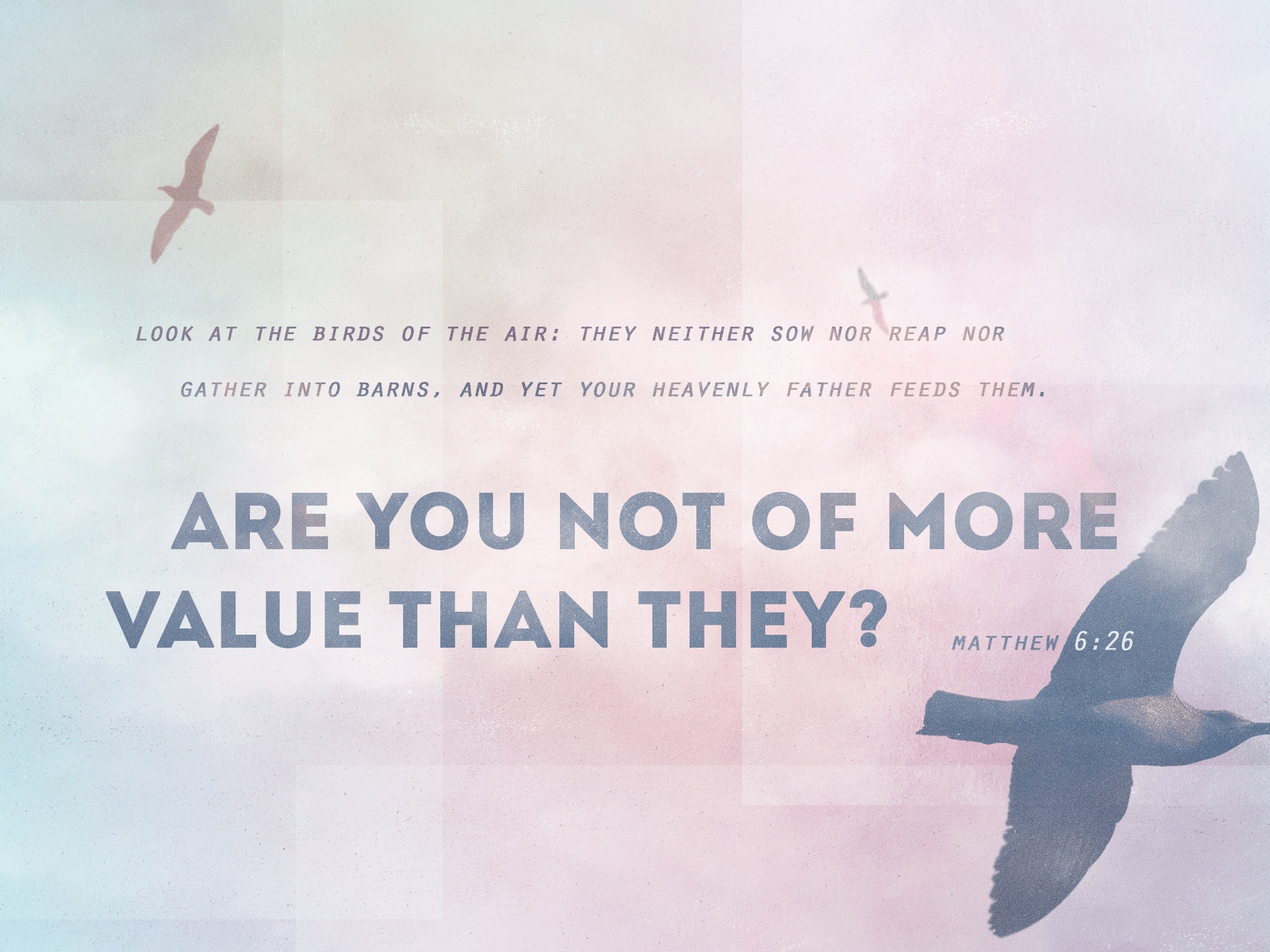
The Malicious Master of Mammon – Sermon on Matthew 6:24-34 for the Fifteenth Sunday after Trinity

Matthew 6:24–34

24 “No one can serve two masters, for either he will hate the one and love the other, or he will be devoted to the one and despise the other. You cannot serve God and money.

25 “Therefore I tell you, do not be anxious about your life, what you will eat or what you will drink, nor about your body, what you will put on. Is not life more than food, and the body more than clothing? 26 Look at the birds of the air: they neither sow nor reap nor gather into barns, and yet your heavenly Father feeds them. Are you not of more value than they? 27 And which of you by being anxious can add a single hour to his span of life? 28 And why are you anxious about clothing? Consider the lilies of the field, how they grow: they neither toil nor spin, 29 yet I tell you, even Solomon in all his glory was not arrayed like one of these. 30 But if God so clothes the grass of the field, which today is alive and tomorrow is thrown into the oven, will he not much more clothe you, O you of little faith? 31 Therefore do not be anxious, saying, ‘What shall we eat?’ or ‘What shall we drink?’ or ‘What shall we wear?’ 32 For the Gentiles seek after all these things, and your heavenly Father knows that you need them all. 33 But seek first the kingdom of God and his righteousness, and all these things will be added to you.

34 “Therefore do not be anxious about tomorrow, for tomorrow will be anxious for itself. Sufficient for the day is its own trouble.”

In the name of Jesus. Amen.

When we are anxious and full of worry, we are serving the false god of mammon. Jesus says, “You cannot serve two masters. You cannot serve God and mammon.” I know our translation says ‘money,’ but the word there is mammon. It includes money, but it also refers to all our stuff. Worry and anxiety is the worship we give to the stuff of this world. When we worry, we are living out the future before it has even gotten here. That’s the opposite of faith. Faith simply trusts that when the future becomes the present, our heavenly Father will be there to give us what we need because He promises to do so.

This is how and why mammon is such a malicious master. Mammon cannot promise you anything in the future because all the money and stuff of this life is temporary and fleeting. Money and things come and go. One moment you have plenty, the next you have little. That is why, when mammon is your god, the one command is to try to possess more in the false hope of finding pleasure or security. But there is no pleasure or security in the things of creation apart from God’s giving of those things. And because we aren’t ever satisfied with what we have, we think the answer is to get more. But that turns into a vicious cycle. If we do, somehow, get more, we find that we aren’t satisfied with the more we’ve gotten. Repent.

Jesus wants you to listen to the preaching of the lilies. The lilies Jesus speaks about here aren’t the large lilies we know from Eastertime. Those don’t grow in Galilee. The lilies Jesus refers to here are tiny flowers that grow along the grass in the fields.

It isn’t quite true to say that the lilies grow. Saying it that way gives the impression that their growth has to do with their achievement. Instead, it is more accurate to say that God grows the lilies. All a lily can do is wait on God to give it the strength and resources it needs to grow. A lily can’t go out and get any more nourishment than what God gives to it. It can’t try to find soil that is better fertilized, and it can’t dig irrigation ditches to get more water. Every aspect of the lily’s life is in God’s hand. That’s why lilies aren’t impatient, and they don’t try to grow up to be trees. Instead, God grows the lily slowly, steadily, and quietly to be what He designed it to be. And the lily is content to receive what God has given it.

The same is true for the birds. When was the last time you saw a bird driving a tractor or operating a combine? A bird cannot plant and harvest like we can, but God didn’t design birds to do that. He designed us to do that. Birds simply do what God designed them to do: have chicks, raise them, and sing.

A bird wakes up, finds a branch, and sings the song God puts into its beak. While that little bird sings, it isn’t worried about food even though it has more reason to be worried than we do because that bird doesn’t know where its food is going to come from. It can’t go to the store to buy food. The bird just sits there and sings for a while. Then, when it is hungry, it flies off and finds the food God has set out for it.

Now, to be clear, Jesus isn’t telling you to not work in this text. The lily isn’t preaching to you that you should sit down, do nothing, and expect God to drop your clothing from the sky. God didn’t create you to be a lily. The birds aren’t preaching that you should just fly around and make music and serenate the rest of creation for free. God didn’t create you to be a bird.

We humans were created to work. Jesus’ whole life was hard work, and He has given you work to do that calls for energy, effort, and diligence. But because we rebelled against God’s design, we bear the curse of sin and our work, which should be happy and creative, has become a toil and burden. What Jesus wants for you is to have your work and, now, even the burden of work be free of anxiety and worry.

The pagans go around full of anxiety asking, “What are we going to eat and drink? How are going to get clothes?” Here, Jesus wants you to know, to be confident, and to be content in the fact that you are not your own maker. You don’t live by your own hand. The food you eat isn’t just the nourishment you have earned. No, it’s the food that God has given you. The house you live in, isn’t just a bunch of wood, sheetrock, wiring, and plumbing; it’s the combination of all those things that God has given to you.

Dear saints, you live by everything that proceeds from God’s hand. You live by Him and because of Him.

In 1 Timothy 6:6-10, Paul writes what basically serves as a commentary what Jesus says in this text: “Godliness with contentment is great gain, for we brought nothing into the world, and we cannot take anything out of the world. But if we have food and clothing, with these we will be content. But those who desire to be rich fall into temptation, into a snare, into many senseless and harmful desires that plunge people into ruin and destruction. For the love of money is a root of all kinds of evils. It is through this craving that some have wandered away from the faith and pierced themselves with many pangs.”

When Paul says, “Godliness with contentment is great gain,” the word Paul uses for ‘godliness’ does not mean to be like God. In English, when we talk about godliness, it can mean that, and there is a right place to do that. But the word there means “right reverence.” It means to have a right and proper attitude and response toward God. To have the right attitude and reverence toward God is to recognize that He is the Giver of all good things, and when we recognize that, we can be content.

So rather than wasting your time and energy by worrying and living in the unknown future (which you can’t do anyway, all that does is drain you in the present), you can work diligently in the present knowing that God promises to give what you need in the future. Yes, it will mean more work and toil for you, but God promises to give you the strength to do that as well. Live your life in the present knowing that God holds the future in His omnipotent hand.

Philippians 4:6 says, “Do not be anxious about anything, but in everything with prayer and supplication with thanksgiving let your requests be made known to God.” So, when you worry, take that worry and turn it around. Don’t let it be the slavish worship you offer to the malicious master of mammon. Instead, when you are worried about anything, make it your prayer. Pray, “God, You have told me not to be anxious. You have told me not to worry. Well, I’m worried about ______. You take care of that. Help me. Provide for me. Protect me.” Then your worry is transformed into true service to God.

Dear saints, God loves you. He has already provided you with everything you need for your eternal future. In His mercy, He sent His only-begotten Son to shed His blood on the cross to make you His own so that you will live forever in His kingdom. There is no reason for you to doubt His provision of the things you need today or tomorrow (Ro. 8:32).

And then, be free. Free to seek first the kingdom of God and His righteousness – the righteousness He freely delivers to you in His Word and the righteousness He gives you now in His Body and Blood given and shed for the forgiveness of all your sins. Seek that first because you know where to find it – here at His altar. And He clearly promises that all other things will be added to you as well. Amen.[1]The peace of God, which surpasses all understanding, will guard your hearts and minds in Christ Jesus. Amen.


[1] Portions of this sermon – especially regarding lilies – were adapted from a sermon by Rev. Dr. Norman Nagel.

Your Good Things – Sermon on Luke 16:19-31 for the First Sunday after Trinity

Luke 16:19–31

19 “There was a rich man who was clothed in purple and fine linen and who feasted sumptuously every day. 20 And at his gate was laid a poor man named Lazarus, covered with sores, 21 who desired to be fed with what fell from the rich man’s table. Moreover, even the dogs came and licked his sores. 22 The poor man died and was carried by the angels to Abraham’s side. The rich man also died and was buried, 23 and in Hades, being in torment, he lifted up his eyes and saw Abraham far off and Lazarus at his side. 24 And he called out, ‘Father Abraham, have mercy on me, and send Lazarus to dip the end of his finger in water and cool my tongue, for I am in anguish in this flame.’ 25 But Abraham said, ‘Child, remember that you in your lifetime received your good things, and Lazarus in like manner bad things; but now he is comforted here, and you are in anguish. 26 And besides all this, between us and you a great chasm has been fixed, in order that those who would pass from here to you may not be able, and none may cross from there to us.’ 27 And he said, ‘Then I beg you, father, to send him to my father’s house— 28 for I have five brothers—so that he may warn them, lest they also come into this place of torment.’ 29 But Abraham said, ‘They have Moses and the Prophets; let them hear them.’ 30 And he said, ‘No, father Abraham, but if someone goes to them from the dead, they will repent.’ 31 He said to him, ‘If they do not hear Moses and the Prophets, neither will they be convinced if someone should rise from the dead.’ ”

In the name of Jesus. Amen.

If you had to choose, which character in this parable would you rather be? The rich man is clothed like royalty and has daily feasts. Sounds like a pretty good life. Lazarus has nothing. He apparently can’t walk; he has to be laid at the rich man’s gate. He’s poor and diseased. He’s so hungry he wants to the garbage that falls from the rich man’s table. And he can’t even fend off the dogs who come and lick his sores. But then, both of them die, and everything changes. Lazarus is escorted by the holy angels to paradise and bliss. The rich man dies, is buried, and goes to hell and eternal torment. So, which character would you rather be?

Most of you are probably thinking Lazarus. No one would choose to be the rich man. But a few of you smarties out there would say, “I’ll be Abraham. He was rich during his earthly life, and he went to heaven.” Very clever of you.

Today, we are going to focus on v. 25 of the parable where Abraham says to the rich man, “Child, remember that you in your lifetime received your good things, and Lazarus in like manner bad things, but now he is comforted here, and you are in anguish.”

That response is a little surprising to the eternal torment of the rich man. We expect that Abraham would tell the rich man, “You didn’t believe in Jesus,” or, “You didn’t love the Bible,” or even, “You received good things.” But Abraham doesn’t say any of that; instead, he says, “You received your good things.” It’s almost a little sarcastic as though Abraham is saying that the rich man received things that he thought were good – the clothes, the feasts, the expensive house, etc. All of those are good things and are gifts from God’s hand, but those aren’t God’s best things.

The rich man didn’t receive God’s steadfast love and salvation (Ps. 13:5-6); he didn’t receive God’s mercy and forgiveness. The rich man didn’t care about those things during his life, and he didn’t even care about them while suffering in hell. In hell, the rich man only desired relief from his suffering, and, when he couldn’t get that, he wanted his brothers to avoid the suffering. The rich man’s problem is that during his life and even in hell he rejected the means to avoid that suffering which is God’s mercy, steadfast love, and salvation which is delivered through the Bible – through the word of Moses, the prophets, and the apostles.

The devil wants to twist this parable so we think that we have to choose between two different existences. On the one hand, we could love God and go to heaven, or, on the other hand, we could love money and stuff and go to hell. So, we suppose, “I guess I’ll pick God” and go grumbling through this life. But the idea that you can only have either riches and hell or poverty and heaven is a false dichotomy.

God is the One who gave you the desire for nice things. The Scriptures even teach that God promises to fulfill the longings you have. Psalm 37:4 says, “Delight yourself in the Lord, and He will give you the desires of your heart.”

So, Christian, do you care about living in a fancy house? Yes, you do. Don’t lie. Remember Jesus promised, “In My Father’s house are many mansions, and I’m going to prepare a place for you” (Jn. 14:2). When you go to heaven and Jesus shows you the mansion He prepared for you, are you going to tell Him, “Meh. I don’t really care about that”? No!

Christian, do you care about good food and feasting? Yes, you do. How many times does the Bible talk about eternal life as a lavish feast (Is. 25:6; Mt. 22:1-10; Rev. 19:9)? God promises that feast because He knows that it is appealing to you. It’s something you want from His hand.

Christian, do you care about nice clothes? Yes, you do. The Bible promises that you will have extravagant, dazzling robes that are washed white in the blood of the lamb (Eph. 5:26-27; Rev. 7:13-14).

Christian, do you care about living a pain-free life? If you don’t now, just wait a few years and you will. You care about a life without pain, and God has promised that one day your body will be raised incorruptible, glorified, imperishable (1 Cor. 15:42-44) and you will have no more pain (Rev. 21:4).

Being a Christian doesn’t mean you have to give up your desire for nice things. You don’t have to have some Buddhist or monastic attitude toward the blessings that God gives you. Instead, you can and should give thanks and praise to God who gives every blessing. The Bible talks about the mansions, feasting, spectacular clothing, and escape from pain and suffering because God knows that it is a draw for you – it’s something you desire. You long for those things, and that isn’t a problem – not by itself anyway.

What is a problem is trying to get those things apart from God’s giving of those things. When you’re narrowly focused on living a comfortable earthly life, it becomes easy to forget about eternity. When you are focused on temporal mercies, you quickly forget about eternal mercies. Do you want your enjoyment of all those nice things now for the fleeting moments of this life? Or would you rather have them just a little bit later and retain them forever?

I know this sounds like some of the prosperity preaching you might hear on TV. To be clear, the health and wealth preachers are heretics, and I’m not becoming one of them. Those preachers are wrong – not because they promise health and wealth – but because of when they promise it. They promise it now when God makes no such promise in the Scriptures, but God does promise you will have it for eternity. 

The point of the parable is that the rich man loved those blessings more than he loved God and His Word. The rich man found his joy in the God’s gifts more than in the God who gives those gifts. The parable wants us to consider this question: What are my good things? Are your good things the temporal, fleeting pleasures of this life? Or are your good things the steadfast love, mercy, and salvation of God?

No one here is as destitute as Lazarus, and no one here is as wealthy as the rich man. You are all somewhere in between. The point of the parable is not for you to make yourself poor like Lazarus was, and the point is certainly not to make yourself like the rich man. The point of the parable is to get you to take your eyes off of the earthly things you either have or don’t have and focus on the eternal things that God gives you in His mercy which cannot be taken away. Remember, where your treasure is, there your heart will be also (Mt. 6:21).

Our call to worship helps us have the right focus. Psalm 13:5-6 says, “I have trusted in Your steadfast love; my heart shall rejoice in Your salvation. I will sing to the Lord, because He has dealt bountifully with me.” Christian, you have God’s steadfast love; you have His salvation. God be praised! That is more than enough. God has dealt bountifully with you because of what Jesus has done. Through Christ’s death and resurrection, you have an eternal inheritance that surpasses anything that the richest person could even dream of having.

Recognizing that you have the riches of Christ’s death and resurrection is the main point of the parable. And the parable has something to say about the riches you have in this life.

All of us are richer than we know. Even the poorest in our country would be the envy of most kings throughout history. Again, you aren’t the wealthy like the rich man, but you aren’t destitute like Lazarus. You’re somewhere between.

Don’t think to yourself, “If I were a little wealthier and closer to the rich man, I would be more generous with my things.” Don’t let the perfect be the enemy of the good. Jesus praised the two small copper coins that the widow gave, and not the fat checks of the rest (Lk. 21:1-4). Even though that widow’s gift was nothing in earthly comparison to the large sums put in by others, it was much more in Jesus’ eyes than all the other offerings combined. And remember, Lazarus didn’t want the rich man’s house, fancy clothes, or lavish feast. Lazarus only wanted what fell from the rich man’s table.

So, no; you probably can’t set up a trust fund that would cover the annual expenses of our congregation. Fine. But you can give your tithe. You probably can’t give a donation to pay for a new addition of a fellowship hall. Fine. But you can come and vacuum the sanctuary and scrub the toilets.

Dear saints, share your crumbs. They are more valuable than you know, and God will bless you as you give them away.

Hebrews 10:34 says, “You [Christians] joyfully accepted the plundering of your property, since you knew that you yourselves had a better possession and an abiding one.” In other words, whatever blessings you might lose in this life, they pale in comparison to the eternal blessings and treasures God has in store for you. So, if you lose something here, don’t worry about it. Your eternal inheritance cannot be taken from you.

Dear saints, seek first the kingdom of God and His righteousness – which God freely gives through His Word – and every other blessing will be added unto you (Mt. 6:33). Amen.

The peace of God, which surpasses all understanding, will guard your hearts and minds in Christ Jesus. Amen.