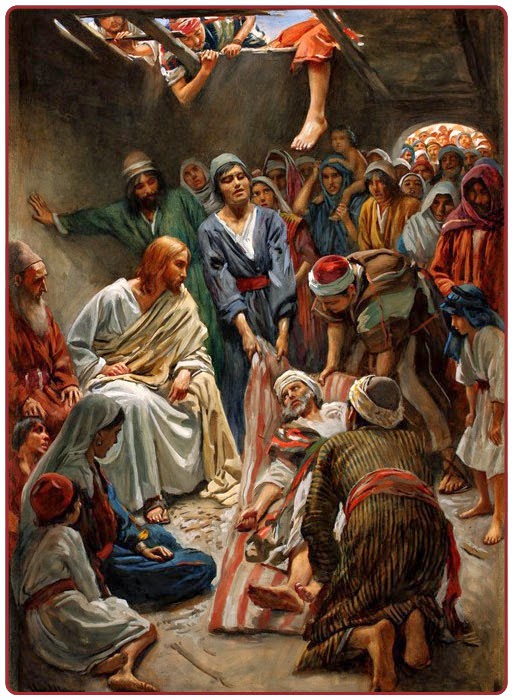
Help – Sermon on Matthew 9:1-8 for the Nineteenth Sunday after Trinity

Matthew 9:1–8

1 And getting into a boat he crossed over and came to his own city. 2 And behold, some people brought to him a paralytic, lying on a bed. And when Jesus saw their faith, he said to the paralytic, “Take heart, my son; your sins are forgiven.” 3And behold, some of the scribes said to themselves, “This man is blaspheming.” 4 But Jesus, knowing their thoughts, said, “Why do you think evil in your hearts? 5 For which is easier, to say, ‘Your sins are forgiven,’ or to say, ‘Rise and walk’? 6But that you may know that the Son of Man has authority on earth to forgive sins”—he then said to the paralytic—“Rise, pick up your bed and go home.” 7 And he rose and went home. 8 When the crowds saw it, they were afraid, and they glorified God, who had given such authority to men.

In the name of Jesus. Amen.

What do you suppose the friends of this paralyzed man thought when they heard Jesus? They had gone to a lot of trouble to bring him to Jesus. They had heard Jesus was at home (Mt. 9:1; Mk. 2:1), and people from all around knew that the power of God was with Jesus to heal (Lk. 5:17). We can imagine these friends going to the paralyzed man’s house and telling him, “Hey, Charles,” (he probably wasn’t named ‘Charles’ but go with me on this), “Hey Charles, Jesus is in town. We’re going to take you to Him and get you healed.”

They lift up Charles’ bed and lug him through the city streets. But when they get to where Jesus was, they find that too many people are there, and they can’t even get to the door (Mk. 2:2; Lk. 5:19). So, they take desperate measures. They lug Charles and his bed to the top of the house, tear open the roof, tie ropes on the corners of Charles’ bed, and lower him so he is before Jesus (Mk. 2:4). Charles’ friends are trying to catch their breath, wiping the sweat off of their foreheads, and giving each other tired fist bumps as they surround that gaping hole, thinking, “We did it. Jesus is going to heal our buddy so he can walk.”

But then, down in the house with dust swirling around them, Jesus looks at Charles, and Charles looks up at Jesus. And Jesus says those words, “Take heart, My son; your sins are forgiven.” I imagine those friends were thinking to themselves, “You’ve gotta be kidding me, Jesus. We brought Charles here so You could fix his body!”

We don’t actually know what the paralytics’ friends thought, but we do know what the scribes and Pharisees thought, “Jesus is a blasphemer. Only God can forgive sins” (Mk. 2:7; Lk. 5:21). They grumble. They scoff. They doubt. But Jesus knows their thoughts and hearts, just as He knew the faith and believing hearts of this man’s friends. And because Jesus knows both the faith of these friends and the grumbling of the scribes, we also know that Jesus knew the paralytic’s thoughts.

Maybe, the paralytic was initially excited at the prospect of being healed and using his limbs. But based on Jesus words to him, there is little doubt that Jesus told him exactly what he needed to hear. The first word Jesus says, “Take heart,” is the same command Jesus will give to the disciples when they are out in a huge storm in the middle of the sea. They are being beaten by the waves and wind. Jesus appears, and they think He’s a ghost. But Jesus calms them, “Take heart; it is I. Do not be afraid” (Mt. 14:27).

This paralytic man hears from Jesus the exact words he needed to hear as he was battered by legs that didn’t work and arms that couldn’t move. “Take heart, My son; your sins are forgiven.” As he was lying there before Jesus, maybe he figured Jesus would tell him how awful he had been and that his paralysis was punishment for his sin. But that’s not what Jesus says. Jesus tells him that in the midst of his suffering and horrible situation that he can be of good courage because his sins are forgiven.

Now, of course, Jesus ends up healing the man too. To silence the grumbling scribes and prove that He actually does have the authority to forgive sins, Christ heals the man.

That’s the main teaching of this text. Jesus proves that He has the authority on earth to forgive sins by healing the paralytic. And the crowds respond with fear and glorified God (notice how the text ends) who had given such authority to men. It’s plural. To men. Not just to the man, Jesus. To men.

That was true here, but it is even more evident on the evening of the Resurrection. Then, Jesus tells the disciples, “If you forgive the sins of any, they are forgiven them” (Jn. 20:23). Jesus, the One who has authority to forgive sins, delegates that authority to His Church, to all Christians. Because you have called me to be your pastor, I get to do that each Sunday morning. God uses my voice to proclaim His forgiveness to you. I get to be ‘the Absolution guy.’ It’s pretty cool. And please, don’t think I’m bragging. Believe me, I wouldn’t have the guts to say that if the Bible didn’t teach it. Forgiveness and absolution is the main point of this text.

But today, I want to draw special attention to this guy’s friends and their tenacity to help him by bringing him to Jesus. They know their friend’s need. They know Jesus is where he can get help. So, they do everything in their power to help him by bringing him to Christ.

Dear saints, you do this too. I know you do. But I’d like to point out three specific, concrete ways you do this because these things are easy to overlook. And when we overlook them, it’s easier to neglect doing them. Here are the three ways you help others by bringing them before Jesus, and they are in no particular order.

First, you help people by inviting them to church. Jesus promises to be here as we gather each and every week when He says, “Where two or three are gathered together in My name, there am I among them”(Mt. 18:20). You are eternally helping others when you bring them here, to God’s house and to the gate of heaven (Gen. 28:17) where Jesus meets them with His Word and forgiveness.

Second, you help people by praying for them. When you have an unbelieving family member or coworker who has some need. Help them by praying for them. As you lift others up in prayer, you are bringing them to and laying them before the feet of Christ. Don’t forget that. When someone is suffering, lift them up to Jesus in your prayers. Maybe Jesus won’t answer your prayers in precisely the way you expect. But He knows best how to help.

James 5:13-16 says that your prayers have great power. You don’t even have to tell the person you are praying for them. (Usually, I think letting them know you are praying for them is a good idea. But there might be times [e.g. if they are really deep in unbelief and hatred of God] you don’t. Use your God-given wisdom.) Even if they don’t share their problems with you, pray for them anyway. They might not share their struggles, but they probably tell you the ways they have been blessed. That same section of James 5 says that when someone is cheerful, you can give a prayer of thanks to God for the blessings He has provided.

Third, you help people by forgiving them. The forgiveness you have received from God frees you to forgive others when they sin against you. Christian, your gracious disposition toward them and toward the world is a way that the light of Christ shines through you (Mt. 5:14-16).

All of that brings me to you, Cooper. Cooper, today you are Baptized. Today, your parents have helped you by bringing you to Jesus who also says to you, “Take heart, My son; your sins are forgiven. I have joined you to My death and resurrection (Ro. 6:3-8). I have clothed you in My righteousness (Gal. 3:27), given you the new birth of water and the Holy Spirit (Jn. 3:3, 5) and made you My child.”

Cooper, and all you saints, you are before Jesus right now. He invites you to His Table where He feeds you with His Body and Blood for the forgiveness of all your sins. As you walk out of here today, remember that you have new life in Christ. Use your freshly given strength to help and serve your neighbor. Amen.

The peace of God, which surpasses all understanding, will guard your hearts and minds in Christ Jesus. Amen.

Old Man, New Man – Sermon on Ephesians 4:17-28 for the Nineteenth Sunday after Trinity

Ephesians 4:17–28

17 Now this I say and testify in the Lord, that you must no longer walk as the Gentiles do, in the futility of their minds. 18 They are darkened in their understanding, alienated from the life of God because of the ignorance that is in them, due to their hardness of heart. 19 They have become callous and have given themselves up to sensuality, greedy to practice every kind of impurity. 20 But that is not the way you learned Christ!— 21 assuming that you have heard about him and were taught in him, as the truth is in Jesus, 22 to put off your old self, which belongs to your former manner of life and is corrupt through deceitful desires, 23 and to be renewed in the spirit of your minds, 24 and to put on the new self, created after the likeness of God in true righteousness and holiness. 

25 Therefore, having put away falsehood, let each one of you speak the truth with his neighbor, for we are members one of another. 26 Be angry and do not sin; do not let the sun go down on your anger, 27 and give no opportunity to the devil. 28 Let the thief no longer steal, but rather let him labor, doing honest work with his own hands, so that he may have something to share with anyone in need.

In the name of Jesus. Amen.

The first four verses of this text are intense. Paul tells the Christians at his former congregation in Ephesus that they are to no longer walk like the Gentiles. Then, his description of the Gentiles is where things liven up. They have futile minds and a darkened understanding. They are alienated from the life of God. They are ignorant, hard-hearted, callous, licentious, and pursue every kind of impurity. Paul isn’t beat around the bush. He is blunt and to the point, not an ounce of “Minnesota Nice” in this description. It’s no wonder that we repeatedly see in the book of Acts that, when Paul goes and preaches in a new place, he gets chased out of the city, beaten with rods, arrested, or pummeled with rocks. 

But, now, this needs to be abundantly clear. When Paul is speaking about the Gentiles in this text, he’s referring to unbelievers, people who aren’t Christians. These Gentiles are not identified either by their blood or ancestry, rather they are identified by what they do. Their actions, their darkened understanding, their futile minds, and their sins have alienated them from God.  Back in Eph. 2:3, Paul says that all mankind was just like this in their unbelief. Paul even described himself in a similar way when he was a persecutor of the church before he was converted (Gal. 1:13-14). Inspired by the Holy Spirit, Paul is diagnosing the disease in all of us – sin. Left to ourselves, this cancer of idolatry will destroy all of us sons of Adam and daughters of Eve. And there is nothing you or I can do to rescue ourselves from this alienation. There must be a transformation. There must be a complete, radical change.

That change comes only through learning Christ. Christ Himself is the school, the teacher, and the lesson. Through learning Christ, which is nothing more than hearing His life-giving Word and believing in Him as the Savior of sinners, something wonderful happens.

Look again at v. 22-24. Our translation can give a wrong impression. The way it is worded might make it sound like we are commanded to do several things: put off the old self (the word there is ‘man’), be renewed in the spirit of your minds, and put on the new self (again, the word there is ‘man’). It might sound like those are commands – things we must do. There are a lot of sermons floating around on the internet that say this putting off and putting on is our work, and those sermons give tips, steps, and instructions on how to do it. That is notwhat those verses are saying. These are not things we have to do; these are things that have happened toyou, Christian!

The grammar is clear. What Paul is saying there is that you have put off the old man. The renewing of your mind happened when you believed and ‘learned’ Christ. You have put on the new man who has been created according to God’s likeness in true righteousness and holiness. What Paul is saying here is similar to what the Holy Spirit inspired him to say in Gal. 3:27, “As many of you as were Baptized into Christ have put on Christ.” Jesus is the New Man, the New Adam, the Second Adam (1 Co. 15:45), who is the likeness of God in true righteousness and holiness, and you have put on Christ through faith. Now, when God looks at you, Christian, He doesn’t see your sin. No, He sees Jesus’ righteousness and holiness.

In short, what these verses are saying is that you are to be and remain who God has made you to be by His grace through faith. This is not and cannot be a result of works lest you should boast (Eph. 2:8-9). God has done this to you and for you, believer. This is all so beautiful.

Only after this is firmly established – the fact that by God’s grace given through the working of the Holy Spirit, your old man has been replaced by your new man – only then does Paul go on to give a series of commands. They come in v. 25-28, and each of them could be their own sermon, but I’ll be brief. But, again, notice the introduction to these commands: “Therefore, having [already] put away falsehood…” do these three things:

The first command is that each one of you speak truth with your neighbor. A Christian loves the truth and hates what is false. Christians tell the truth even when it is tough, even when it isn’t nice. The easiest way to be nice all the time is simply to never speak. But God wants you to speak; He wants you to speak the truth in love. Sometimes, this means saying uncomfortable things. Christians call sin ‘sin’ because it is the loving thing to do. Don’t let your fear of what others might think about you stop you from speaking the truth – either about their sin or, even more importantly, about Jesus, the Savior from sin. How many moments and opportunities to share the Gospel have passed you by because you were afraid to simply speak the truth? Even as a pastor, I can say I’ve let too many go. Lord, have mercy upon me, the sinner.

The second command is, “Be angry and do not sin; do not let the sun go down on your anger, and give no opportunity to the devil.” Remember that Jesus says that being angry with your neighbor is the same as murder (Mt. 5:21-22), and many places in Scripture anger is right up there at the top of the list of harmful sins (2 Cor. 12:2; Gal. 5:20; Col. 3:8; etc.). In fact, just a couple verses after our text, Paul says, “Let all bitterness and wrath and anger… be put way from you” (Eph. 4:31). He doesn’t just say, “Don’t let the sun go down on your anger.” He says get rid of it – all of it. So, how are we to understand this?

Get rid of your anger quickly. Getting rid of anger doesn’t mean that you are a pushover. Christians aren’t weak people; remember we speak the truth even when it is hard. But part of our strength is to not give in to our anger, to not be frustrated, irritated, or whatever other synonyms you might replace with the word ‘anger.’ It’s easy to get mad. Toddlers get mad and throw temper-tantrums because they don’t have the strength and discipline to overcome their emotions. Putting away anger takes strength, work, and discipline. Christians are strong people who stay calm even in the face of evil. They control their temper. Remember, Jesus used His strength to patently endure beating, mocking, insults, and even an unjust execution.

The third command is, “Let the thief no longer steal, rather let him labor, doing honest work with his own hands, so that he may have something to share with anyone in need.” Christians who have put off the old man and put on the new man don’t steal. And don’t be quick to fool yourself into thinking that you’ve never stolen. Sure, maybe you’ve never taken something from someone’s house, robbed a bank, or shoplifted. If you haven’t done that, that’s good, but be honest, you’ve stolen.

Have you ever done a job on the side and asked the person to pay you in cash so you don’t have to report it as income? Yes, that’s stealing. Romans 13:7 says that we are to pay our taxes, and Jesus says to render unto Caesar what is Caesar’s (Mt. 22:21). Have you found out something you own is about to break so you quickly sold it? You probably aren’t going to get arrested or sued for that, but that is another form of stealing. Have you ever slacked off at work? That’s stealing too.

Christians are to work. We don’t avoid working, and God cares about the motivation we have for working. The reason we work is so we can be generous and have something to give. Our motivation to work is so that we can give to others who have needs. Christians are conduits of God’s own giving. Work so you can give. This doesn’t come naturally, but it is something God can, and does, cultivate in us.

Dear saints, you stand before God righteous, holy, and blameless. Live that way. Continue to be truth-tellers, beat back your anger, and be generous. God has put off your old man and put on the new Man, Christ. And this God now invites you to His table where He will put in you His Body and Blood given and shed for the forgiveness of all your sins. And when you go from here, be what God has made you to be. Amen.

The peace of God, which surpasses all understanding, will guard your hearts and minds in Christ Jesus. Amen.

Diagnosed – Sermon on Matthew 9:1-8 for the Nineteenth Sunday after Trinity

Matthew 9:1-8

1 And getting into a boat he crossed over and came to his own city. 2 And behold, some people brought to him a paralytic, lying on a bed. And when Jesus saw their faith, he said to the paralytic, “Take heart, my son; your sins are forgiven.” 3 And behold, some of the scribes said to themselves, “This man is blaspheming.” 4But Jesus, knowing their thoughts, said, “Why do you think evil in your hearts? 5 For which is easier, to say, ‘Your sins are forgiven,’ or to say, ‘Rise and walk’? 6 But that you may know that the Son of Man has authority on earth to forgive sins” – he then said to the paralytic – “Rise, pick up your bed and go home.” 7 And he rose and went home. 8 When the crowds saw it, they were afraid, and they glorified God, who had given such authority to men.

In the name of Jesus. Amen.

When you go to the doctor, you have certain expectations of what is going to happen. You know that you will fill out forms and provide information about your health history and habits. You expect to have your weight, heart, lungs, blood pressure, and reflexes checked. Depending on the reason for your visit, you also anticipate other tests – bloodwork or other lab work; an x-ray, ultrasound, or MRI; maybe a stress test or sleep study. Depending on the results of all of that, you expect more tests might get ordered. Only after all those results are studied and considered will the doctor call you in to present a diagnosis and offer a treatment plan.

Well, in our Gospel text today, this paralytic is brought to Jesus, and by all appearances, Jesus skips right over the testing and diagnosis process and goes straight to the treatment saying, “Take heart, My son; your sins are forgiven.”

For a moment, use your sanctified imagination to consider this from the perspective of the paralytic’s friends. Matthew has condensed the story in his Gospel. Here in v. 2, he tells us that ‘some people’ brought this paralytic to Jesus. But Mark and Luke give a fuller picture of this event, filling in some of the details (Mk. 2:1-12; Lk. 5:17-26). They let us know that it was four men (Mk. 2:3) who carried this paralytic to Jesus, and they had a difficult time getting their friend there. People from the whole region had heard that Jesus was in town, and so many people had gathered to hear Him preach (Lk. 5:17) that there was no room to even get in the door (Mk. 2:2). So, these four friends lug their paralyzed buddy on top of the house, punch a hole in the roof, and lower him down to get him in front of Jesus (Mk. 2:4).

Now, this is just an aside. As a preacher, I have, what I hope is, a godly and pious curiosity about this. At what point does Jesus stop preaching? Is it when He hears the scuffle of eight feet on the roof above Him? I think that would distract me enough that I’d stop preaching, but, please, don’t test that hypothesis. Is it when the pounding starts or until bits of dirt and debris start falling from the ceiling? Maybe, Jesus preached straight through all of that until the paralytic was being lowered through the new skylight above Him. I guess I’ll just have to go rent the video at heaven’s Blockbuster. Maybe all of heaven’s Blockbusters have closed and everything is available through streaming services. Anyway…

These four friends go through all that work and effort knowing that they would have more work later to fix the hole they made. They had brought their paralyzed friend to Jesus to be healed (Lk. 5:17-18). But, to their perspective, Jesus skips right over the diagnosis and says, “Take heart, My son; your sins are forgiven.”The worst thing is that it looks like the wrong treatment! Imagine you had a friend with a badly sprained ankle, so you bring him to a new doctor in town. The doctor watches your friend limp in, but before your friend even says why he is there, and before asking any questions or doing any tests, the doctor says to your friend, “Here is a prescription for Lipitor for your high cholesterol.” You’d probably report the doctor to have his license revoked. Well, that is essentially what Jesus does.

We might think that the healing of this paralytic is a lesson that the most important thing we need is the forgiveness of sins. Above money, security, food, house, or health we need forgiveness. Once Jesus forgives this paralytic of his sins, he has everything he needs. If the text had stopped there and Jesus hadn’t miraculously given this man the ability to walk, it wouldn’t be too bad. He could have lived the rest of his life paralyzed because he had everything he needed for eternal life. In fact, the physical healing seems to take the back seat in this text. Jesus only heals him after the grumbling of the scribes. You could even conclude that Jesus never intended to heal the guy and only does so as an afterthought.

Now, to be sure, the most important thing that everyone needs is the forgiveness of sins. But if the main thing you take away from this text is that physical healing isn’t important, you’re wrong. This isn’t Jesus’ first miracle. There were many others that He healed before and after this. Just before this, Jesus healed a leper (Mt. 8:1-4), but Jesus didn’t forgive him before He healed him. Right after that, a centurion asks Jesus to heal his paralyzed servant (Mt. 8:5-13), but no absolution. Then, Matthew records that Jesus heals Peter’s mother-in-law who had a fever, Christ heals a whole slew of other people and casts out demons (Mt. 8:14-17), but no mention of Jesus proclaiming forgiveness there either. All over the Gospels, Jesus will heal people, but there is no mention of absolution. In fact, most of the time when Jesus mentions forgiveness and salvation, it’s only after He heals. We don’t take those instances to mean that Jesus cares more about physical healing more than forgiveness.

Now, where am I going with all of this? Jesus is a Pastor – in fact Jesus is the Pastor. The word ‘pastor’ simply means ‘shepherd.’ Jesus is the Good Shepherd (Jn. 10:11), the Good Pastor. Christ knows when His sheep need to be fed by green pastures or led beside still waters, and He knows when His sheep need to have their soul restored with forgiveness and mercy (Ps. 23:1-3). Jesus doesn’t need to run a bunch of diagnostic tests to figure out what His sheep need. He always knows and gives the right treatment, and He always perfectly gives what His sheep need. Jesus, the Good Pastor, so intimately knows you and all your actions, thoughts, and ways that you are always diagnosed and receive the care you need.

The reason Jesus forgives this paralytic before healing his paralysis is that is what the man needed. The man’s friends – maybe even the man himself – figured what he needed most was to be able to use his limbs again. But Jesus, the Good Shepherd and Pastor, knows best. So, Christ forgives the man. “Take heart, My son; your sins are forgiven.” And those words deliver to the paralytic exactly what he needed.

I’m going to change gears here for just a minute. It’s October, and I’m aware that October, among other things, is Pastor Appreciation month. First of all, I want to thank you all for how good you’ve been to me, your pastor, for the past twelve years and ten plus months. I can’t imagine being called by God to shepherd a better flock. Last week, I preached about stewardship and tithing and mentioned how I don’t particularly like to preach about that. Well, preaching about the duties of a pastor is low on my preference list as well. But Scripture teaches about the duties of pastors, so preaching the full council of God requires me to preach about what I’m supposed to do as a pastor. So, here we go.

Every pastor is an under-shepherd of Jesus, the Good Shepherd. And I confess to you that I am a very flawed shepherd. Jesus shepherded this paralytic man exactly as he needed. But I know that there are times where I have not shepherded rightly. I don’t always know what is needed in any given situation.

God has given pastors one tool to use and apply to the flocks entrusted to their care – His Word of Law and Gospel. There have been times where I have given Law when you needed comfort and forgiveness, which results in you being further discouraged and dismayed. And there are times when I gave the Gospel of comfort and forgiveness when the Law should have been proclaimed, and that can lead to a boldness to continue in sin. This is a long way around for me to say, “I’m not as good of a pastor as Jesus is.”

First of all, please forgive me for my shortcomings as your pastor. And second, please pray for me that God would give me the wisdom and words that are needed in each interaction I have as your pastor. But I take great comfort in God’s promise that whenever His Word goes forth it always accomplishes the purpose for which God sends it (Is. 55:10-11). I am also comforted by the fact that God can always shut my mouth if I am doing more harm than good. But again, please pray for me.

I want to close by pointing you back to Jesus, my Boss, and your perfect Shepherd. Notice how Christ is always perfectly in tune with His sheep. Jesus sees the faith of the people who brought the paralytic to Him, so He immediately applies the Gospel of forgiveness. He knows the grumbling of the scribes after He absolves the paralytic and applies the Law to them. And notice how Jesus’ perfect diagnosing and shepherding results in the crowds glorifying God.

Those crowds glorify God because God had given authority to forgive sins to men (Mt. 9:8). That line struck me this week. Notice, it’s plural – to men, not to ‘a man,’ not just to Jesus, but to men. Dear saints, as those who have been redeemed, restored, and forgiven by Jesus’ death and resurrection, Jesus has given you the authority to forgive the sins of others. Jesus says in John 20:23, “If you forgive the sins of any, they are forgiven.”

My fellow Christians, Jesus invites you to join with Him in proclaiming to a broken creation the forgiveness and eternal life He has won by His death and resurrection. May we carry that treatment and soul-saving medicine to a hurting world. Amen.

The peace of God, which surpasses all understanding, will guard your hearts and minds in Christ Jesus. Amen.

The Fear of a Fraud – Sermon on Genesis 28:10-17 for the Nineteenth Sunday after Trinity

Genesis 28:10-17

10 Jacob left Beersheba and went toward Haran. 11 And he came to a certain place and stayed there that night, because the sun had set. Taking one of the stones of the place, he put it under his head and lay down in that place to sleep. 12 And he dreamed, and behold, there was a ladder set up on the earth, and the top of it reached to heaven. And behold, the angels of God were ascending and descending on it! 13 And behold, the Lord stood above it and said, “I am the Lord, the God of Abraham your father and the God of Isaac. The land on which you lie I will give to you and to your offspring. 14 Your offspring shall be like the dust of the earth, and you shall spread abroad to the west and to the east and to the north and to the south, and in you and your offspring shall all the families of the earth be blessed. 15 Behold, I am with you and will keep you wherever you go, and will bring you back to this land. For I will not leave you until I have done what I have promised you.” 16 Then Jacob awoke from his sleep and said, “Surely the Lord is in this place, and I did not know it.” 17 And he was afraid and said, “How awesome is this place! This is none other than the house of God, and this is the gate of heaven.”

In the name of Jesus. Amen.

With a stone under his head, imagine what was going through Jacob’s mind as he lay down to sleep. We have to track what has happened in Jacob’s life up to this point. The name ‘Jacob’ name means ‘deceiver,’ and he had certainly lived up (or down) to his name (Gen. 27:36). Jacob was the younger twin of Isaac and Rebekah. Esau was the older brother by a foot (Gen. 25:25-26) because Jacob was born clinging to Esau’s heel. As the younger sibling, Jacob wasn’t in line to receive either the birthright or the blessing that God had first given to Abraham who passed it on to Isaac. Now, Esau was supposed to get them.

These two brothers grew up, and, one day, Jacob was cooking a pot of stew when Esau came home exhausted from working in the field. Esau asked Jacob for some of the soup, but Jacob didn’t act in a brotherly way. Instead, Jacob pulled off the biggest case of price-gouging in history and sold a single cup of that stew for Esau’s birthright (Gen. 25:29-34). Of course, Esau was a fool to agree to this sale (Heb. 12:16-17), but that doesn’t let Jacob off the hook for being a total jerk.

Later, when their father was old, blind, and thought he was near death, Isaac asked Esau to prepare a meal for him so he could pass God’s blessing on to Esau. Jacob’s mother, Rebekah, heard about this and told Jacob to pull a fast one over on his dad so he would get the blessing. Initially, Jacob was hesitant, but ultimately, he went along with his mom’s plan. Jacob dressed up in Esau’s clothes so he would smell like Esau. He even put animal skins on his arms so he would feel hairy like Esau in case his blind father touched him. The plan worked pretty well. At first, Isaac was skeptical because he recognized Jacob’s voice. But after Jacob lied several times, insisting he really was Esau, Isaac gave Jacob the blessing that the Messiah would come from Jacob’s descendants (Gen. 27:1-29).

After this, Esau decided he’d had enough and planned to kill Jacob after their father died. Rebekah heard about Esau’s murder plot, so she sends Jacob from their home in Beersheba to Haran (which is about 450 miles away as the crow flies) to find a wife. Our text here picks up about 50 miles into the trip, maybe two days into the journey.

So, again, imagine all the fear Jacob must have faced as he lay down. He had reason to fear because, for the first time in his life, he is away from his parents. He had reason to fear because his brother has plans to kill him. He had reason to fear because he is going to an unfamiliar land where his mother wants him to get a wife. His past is full of fraud, and his future fat with fear. And now, as the sun goes down, he has nothing to lay his head on but that rock.

Yes, the rock would have been an uncomfortable pillow, but what really made Jacob uncomfortable is his rightly guilty conscience telling him how big of a fraud he had been. Sure, in the eyes of men Jacob had gotten both the birthright and the blessing, but what about in the eyes of God? Would God honor the blessing that had been passed down to him?

Well, God came to Jacob that night and gave him the comfort he wasn’t expecting. In a dream, Jacob saw a ladder set up between heaven and earth. That ladder was the connection between the two as the angels of God ascended and descended on it. And God said to Jacob, “I am Yahweh, the God of Abraham and the God of Isaac. The land on which you lie I will give to you and to your offspring. Your offspring will spread abroad to the west, east, north, and south. And in your offspring all the families of the earth will be blessed. Jacob, I am with you and will keep you wherever you go and will bring you back to this land. For I will not leave you until I have done what I have promised you.”

In other words, God is saying, “Jacob do not be afraid. You may be a fraud, but I am not. I’m going to keep My promises. Yes, you took advantage of your brother to get the birthright, but I’m still going to give you the offspring and land I promised to give to Abraham and Isaac. Yes, you fooled your father into giving you the blessing, but he still spoke the words that I put into his mouth. So, I’m going to give you what was promised even though you received that promise deceptively and impurely. The Messiah that I swore to give to Abraham and to your father is going to come from your own body. And when the Messiah dwells in this land that I promised to give to you, heaven is going to touch earth. The Messiah, who will be your descendant, is going to unite heaven and earth, unite God and mankind, and bring my forgiveness and blessing to all the families of the earth. With His forgiveness, all mankind will have the right to ascend to the throne of God. Jacob, don’t think for one second that your fraud and deceit will make My promises void and go away. My promises are My promises. Your sin, deceit, and trickery cannot change what I have promised.”

Do you ever find yourself having similar fears as Jacob had? Do you ever worry that God’s promises aren’t really for you because you are unworthy? Do you think His blessings aren’t for you because you have too much sin and baggage? Do you see all your unfaithfulness think His mercy cannot be yours? You have confessed to have faith in Jesus in the past, but do you question if you’ve really meant it? You recognize that the sins you speak against publicly are the same sins that you privately love. You are surrounded by all sorts of evidence that you are a fake Christian and a complete fraud. You know that God can see through your façade, so you figure His promises aren’t for you.

Dear saints, do not fear. Even though you are a fraud, God is not. When you are filled with that doubt and fear, close your eyes and look for Jacob’s ladder, and you find that ladder in Christ. Jesus is the One who unites heaven and earth (Jn. 1:51). The eternal Son of God took on your flesh and blood and shed His blood which cleanses you from all your sin. This Jesus is the one who has given you the right to become children of God (Jn. 1:12). A right that you have not earned or deserved, but God Himself has stamped His seal of approval on your adoption papers with the very blood of Jesus.

It is absolutely true that those who do not believe in Jesus will be eternally condemned. But know this, the sincerity of your faith does not and cannot change the fact that Jesus died on the cross and rose again for you (1 Jn. 2:2). Your faith is not what causes your salvation. Faith is what receives that salvation. God doesn’t save you because you believed His promises purely. God saves you because He sent Jesus to be Jacob’s ladder connecting heaven and earth and reuniting God to the sinners of this world. Look to the cross. Look to the perfect work of Jesus alone.

Notice Jacob’s reaction after this vision. Notice how, in the last verse, we are told that Jacob was afraid and said, “How awesome is this place! This is none other than the house of God, and this is the gate of heaven.” All of Jacob’s fears of leaving his family, the threats of his brother, even the fear of himself because of his doubt is all removed. The only fear Jacob has left is God alone. The multitude of God’s grace promised to him brings Jacob a holy and right fear of God.

I’m going to change gears a bit here because we might find it surprising that Jacob would fear after hearing all these wonderful promises. The thing is: fear and service go together. Hebrews 2:15 teaches us that our fear of death actually causes us to become slaves of the devil. We don’t like to think about it this way, but the truth is that we end up serving what we fear. For example, if you are afraid of public shame and humiliation, you might be hesitant to share about your faith in Christ and end up serving your reputation instead of God. But there is a right fear – the fear of God. Luther’s explanation to the 1st Commandment, “Thou shalt have no other gods before Me,” is, “We should fear, love, and trust in God above all things.” And Scripture repeatedly says, “The fear of the Lord is the beginning of wisdom,” (Pr. 1:7Pr. 9:1015:33; and Mic. 6:9).

Even though we live in the safest time in all of history, there is a lot of fear today. The best explanation for why that is is that we fear things that are not worthy of our fear (Lk. 12:4-7) and we end up serving them instead of fearing and serving God alone. But when we fear God alone, He casts out all other fears (1 Jn. 4:18).

I’ll close here with a few verses that are so interesting. (I printed them on the back of the Scripture insert for you.) It’s Jer. 33:7-9 where God gives all these wonderful promises. He promises there that He will bring Judah and Israel home from their captivity. He promises to cleanse them from their sin and rebellion. He promises that their city will be a name of joy, a praise and a glory before all the nations of the earth who hear about all the good God will do for them. And here is God’s conclusion to all those promises: “they shall fear and tremble because of all the good and prosperity I will provide for them.”

Dear saints, like He did for Jacob in our text, God has a multitude of promises to love you, forgive you, care for you, deliver you, and rescue you out of every trouble. Let Him alone be your fear, and He will cast out every other fear with His love and mercy. Amen.

The peace of God, which surpasses all understanding, will guard your hearts and minds in Christ Jesus. Amen.

Authorized to Forgive – Sermon on Matthew 9:1-8 for the Nineteenth Sunday after Trinity

Listen here.

Matthew 9:1-8

1 And getting into a boat [Jesus] crossed over and came to his own city.

2 And behold, some people brought to him a paralytic, lying on a bed. And when Jesus saw their faith, he said to the paralytic, “Take heart, my son; your sins are forgiven.” 3 And behold, some of the scribes said to themselves, “This man is blaspheming.” 4 But Jesus, knowing their thoughts, said, “Why do you think evil in your hearts? 5 For which is easier, to say, ‘Your sins are forgiven,’ or to say, ‘Rise and walk’? 6 But that you may know that the Son of Man has authority on earth to forgive sins” – he then said to the paralytic – a “Rise, pick up your bed and go home.” 7 And he rose and went home. 8 When the crowds saw it, they were afraid, and they glorified God, who had given such authority to men.

In the name of Jesus. Amen.

What is the main thing in this text? Matthew tells us about this wonderful healing of a paralyzed man by a simple statement from Jesus. As amazing as that is, it isn’t what Matthew focuses on as he tells this story under the inspiration of the Holy Spirit. The healing actually takes second fiddle because it only takes up the last half of v. 6. Instead, the Holy Spirit would have us notice and focus on the absolution, the forgiveness of sins. God wants all sinners on earth to regularly hear the declaration that our sins are forgiven through Christ. So, as we consider this text, may our reaction be the same as the crowds. May we glorify God that He has given authority to all people to forgive sins.

This paralyzed man was brought to Jesus by his friends. Both Mark [2:3-12] and Luke [5:18-26] also tell this story, and they let us know that this man’s friends tore a hole in the roof where Jesus was teaching in order to lower the paralytic in front of Christ. After all this demolition and careful lowering of the man on his bed, there is the man before Jesus unable to move. Jesus sees the friends looking through the hole above him, He sees the shock of those who were listening to His teaching, and He sees the eyes of this man’s face. But most importantly, Christ sees the troubled conscience of this paralyzed man. So, Jesus says to him, “Take heart, my son; your sins are forgiven.”

This is an amazing thing for Jesus to say under the conditions. It was obvious to everyone in the room what this man needs. He can’t move. His limbs don’t work. Everyone in that house, and probably even us, expect Jesus to say, “Be healed.” But it doesn’t happen – at least not right away. Instead, Jesus speaks the absolution. Christ speaks first not to the man’s limbs but to his soul.

We know how the scribes responded. They concluded that Jesus was blaspheming. It would be interesting to hear what everyone else, especially this man’s friends, thought. They had to lug him up to the roof, tear open the ceiling, and carefully lower him down. I would love to know what they thought. They were probably wondering if all their efforts and all the risks they took to get their friend before Jesus had been worth it. But I wonder even more what the man thought.

Now, this is simply me speculating, but I think this man was more comforted hearing the absolution than being healed. I don’t know about you, but I find it easy to think that God is angry with me whenever something bad happens to me. I would guess you are similar. And I would also guess the same is true for this paralytic man, and he got to hear what he needed most. Jesus says to him, “Dear man, God isn’t mad at you. Your sins are no problem. They will be covered by My blood and by My death. You will have problems in this life, but your eternal life is absolutely, completely secure. And I will bring you to the resurrection where you will have a perfected body in eternal bliss.”

I have little doubt that these words that Jesus speaks are the sweetest, most life-giving words that the paralyzed man could have heard from Jesus.

Now, before we move on, let’s all agree on this – forgiving sins is an act of God. Right? Only God can declare what is sinful, only God can judge, and only God can forgive sins. In Psalm 51[:4] David confesses to God, “Against You, You only have I sinned and done what is evil in Your sight.” Remember, David is speaking this after he sinned against Bathsheba and after he killed Uriah. But David rightly recognizes that, while his sin has and will affect many others, David recognizes that his sin is against God. So, if any and every sin is against God, only God can forgive sin.

So, while the scribes are grumbling about Jesus forgiving sins, Jesus says, “That you may know that the Son of Man has authority on earth to forgive sins, rise pick up your bed and go home.” And the man goes home – forgiven and healed. It is clearly demonstrated that Jesus can and, most importantly, does forgive sins. And there is enough there to cause us to rejoice all our days. Jesus can heal broken bodies, and even better, Jesus can heal broken souls. Jesus has the authority to and does forgive sins here on earth. But Matthew gives us something more that we need to consider today.

Matthew tells us that when the crowds see all of this, “they glorified God who had given such authority to men.” Notice, Matthew doesn’t way that they glorified God who had given such authority to ‘a man.’ That authority is given to men – plural. Forgiveness belongs to Jesus, but Jesus also passes that authority on to others, in fact to all, as well. Jesus gives the authority to forgive sins to His entire church.

Dear saints, you have Jesus’ authority to announce the absolution. In John 20:22-23, Jesus breathes on the disciples giving them the Holy Spirit and says, “If you forgive the sins of any, they are forgiven.” So, please notice, Jesus, the One who proves that He has authority to forgive sins, passes that authority on to you, Christian.

The best analogy for this is one I have used before. Imagine someone in prison. He is guilty and locked up for his crime and is in jail. Across town, the governor decrees that he is pardoned. His guilt and punishment is gone. But that act alone doesn’t do him any good. As far as the law is concerned, he is free. But he is still in his cell. So, the governor’s pardon has to be communicated to the prison warden. And even that doesn’t do the prisoner any good unless the warden sends a guard to the man’s cell who opens the door and lets the man out. Each of those steps must happen for the man to be truly free.

If the governor doesn’t pardon and the guard simply opens the cell, that guard is breaking the law. The guy may be out of prison, but he is still guilty, and he will always be looking behind him waiting for the authorities to arrest him again. And if the man is pardoned, but the guard never comes to open the cell, that pardon doesn’t do the prisoner any good either. Dear saints, that is the picture of the absolution.

God has heard the case against you. And the evidence of Jesus’ death and resurrection means that God declares you to be holy, righteous, pure, free, and pardoned. Then, God sends others with the keys to open your cell and let you out of prison.

This has already been done here today. After we confessed our sins, God sent your pastor with the keys to your cell to open it by saying, “By Christ’s command and authority you have the entire forgiveness of all your sins.” I love my job! Thank you for calling me here to do that.

But know, dear saints, that this isn’t just for pastors to do. It is good and right for there to be someone appointed to do that in a congregation where things should be done in an orderly way (1 Cor. 14:40), but that does not mean that the absolution should only be spoken by a pastor in a church service. You can also forgive sins because Jesus died for sinners. Christians are the fellowship of those who have been set free and absolved of all our sins. And we are the fellowship of those who are deputized to declare to others that their sins are forgiven as well.

So, when you talk to others, do that! It’s one thing to rejoice in the forgiveness you have, and we should, we absolutely should, do that. But do you declare this forgiveness to others? Hopefully, you forgive others when they have harmed and sinned against you. Christians should be the quickest to do that. But have you declared forgiveness to someone whose conscience is troubled by sins that don’t involve you? You can!

According to Scripture, every Christian has this authority. Again, Jesus says to you, “If you forgive the sins of any, they are forgiven” (Jn. 20:23). You have been absolved and set free from your sins. You have also been authorized by Jesus to set others free from their sins. God has put the same declaration of the Gospel into your mouth. Look for sins to forgive. Look for people who feel the guilt and bondage of their sin. Say to them something like this, “Dear friend, Jesus died for you. In Jesus’ name, your sins are forgiven.” Speak these words with authority.

These words are life, freedom, and joy. These words of Jesus, “Your sins are forgiven,” are words for your ears, and they are words for your tongue. May those words be in your ears, engrained on your hearts, and freely spoken from your lips. Dear saints, you are forgiven, and you are authorized to forgive others as well. Amen.

The peace of God, which surpasses all understanding, will guard your hearts and minds in Christ Jesus. Amen.

What’s Wrong with You? – Sermon on Matthew 9:1-8 for the Nineteenth Sunday after Trinity

Listen here.

Matthew 9:1-8

And getting into a boat he crossed over and came to his own city.

Jesus Heals the Paralytic Lowered from the RoofAnd behold, some people brought to him a paralytic, lying on a bed. And when Jesus saw their faith, he said to the paralytic, “Take heart, my son; your sins are forgiven.” And behold, some of the scribes said to themselves, “This man is blaspheming.” But Jesus, knowing their thoughts, said, “Why do you think evil in your hearts? For which is easier, to say, ‘Your sins are forgiven,’ or to say, ‘Rise and walk’? But that you may know that the Son of Man has authority on earth to forgive sins”– he then said to the paralytic – a “Rise, pick up your bed and go home.” And he rose and went home. When the crowds saw it, they were afraid, and they glorified God, who had given such authority to men.

In the name of the Father and of the Son and of the Holy Spirit. Amen.

What’s wrong with you? Self-diagnosis is one thing. But if someone were to follow you for a week, see everywhere you went, hear everything you say, and know your every thought, what would they say is your biggest problem?

Maybe, they would say you spent too much time on your phone and not enough time paying attention to your kids. Maybe, they would say that you spread rumors about people when you don’t really know the facts. Maybe, they would sayyou get angry too easily and quickly.Maybe, they would say that you are lazy and waste time at your job. Or maybe, they would say that your schedule is too full and you are neglecting more important things.

Getting an outside, impartial observer can be helpful in diagnosing your problem. But even people who have total access to your life might not correctly diagnose your biggest, most central flaw.

Now, imagine the scene in this house. Jesus is in His hometown. Mark tells us (Mk. 2:1-12) that Jesus is in His own house preaching the Word of God to the people gathered there. So many people come to hear Him that there isn’t any more room inside the house. But imagine that you are one of the people who are blessed to be inside.

As Jesus preaches, you notice sounds of footsteps coming from the roof. Then you start to hear faint sounds of scraping and pounding making the walls shake slightly. Some sprinkles of dust fall from the ceiling. A few blows later, and a thin beam of light hits the floor. You look up toward that hole and you can just barely make out the shape of fingers reaching through the hole. Suddenly,the hole expands as a bunch of rubble falls to the floor. Dust and straw fill the room. You turn your head away for a moment so that the dust doesn’t fall into your eyes. And then, when it sounds as though the debris has settled, you look up once again and notice a huge bundle being slowly lowered by four ropes.

The bundle finally reaches the floor, and the sheets fall flat revealing a man. He lies there. One arm is bent over his chest and the other lies motionless stretched out at his side. His legs are crossed, but in the most unnatural way. You wait to see him maneuver himself into a more comfortable position, but he doesn’t. In fact, the only sign of life is his eyes darting back and forth and his chest rising as he breathes a little frantically. You diagnose the problem: this man is paralyzed. And you think to yourself, “Well, whoever brought him here did the right thing. If anyone can help this man, it’s Jesus.”

Jesus looks up at the hole in the roof. He sees the faces of the people who have safely lowered their friend down. Then, Christ looks at the man and says, “Take heart, my son; your sins are forgiven.”

Think about this for a moment. This man’s biggest problem seems to be apparent to everyone but Jesus. The friends are probably up on the roof thinking to themselves, “Wait, what? We didn’t lug him up here, rip off the roof knowing that we’ll have to fix it ourselves, and lower him down to get forgiveness. What gives?”

But Jesus knows what this man’s biggest problem is. Christ knows what this man needs most. But don’t run too quickly with this either. Yes, the forgiveness of sins is what we need for our eternal welfare. Forgiveness is more important than food, clothes, shelter, and the ability to walk. But Jesus doesn’t always forgive people before He heals them.

In fact, in all the previous healings in Matthew, Jesus doesn’t follow this order. Chapter 8 contains Jesus’ first healing in Matthew. Jesus heals a leper and doesn’t absolve him. Then, He heals the centurion’s servant, but Jesus doesn’t announce forgiveness there. He heals Peter’s mother-in-law and large crowds with no mention of forgiveness. He casts out demons from two men, no absolution. And as chapter 9 continues, Jesus keeps healing, but He’ll tell people that they are healed because of their faith in Him. And we can’t (at least we shouldn’t) conclude that in those instances Jesus cared more about their physical well-being than forgiveness.

Put that on the back-burner for a moment because Jesus isn’t done diagnosing people’s problems.

Ministry of Word and Sacrament, Keys IconAfter telling the paralytic, “Take heart, your sins are forgiven,”Jesus diagnoses the scribes’ problem. They were grumbling in their minds thinking, “Just who does this guy think he is? Forgiving sins is God’s job.” But Jesus, knowing their thoughts, said, “Why do you think evil in your hearts?”

Notice that. Jesus says that doubting that He, a man, has the authority to forgive sins is evil. He doesn’t beat around the bush. Jesus calls out their evil. And He proves that He has the authority to forgive sins. He tells the paralytic, “Rise, pick up your bed and go home,”and the paralytic does, which proves that Jesus does indeed have the authority to forgive sins.

What’s your problem? I hope you see that it doesn’t matter so much what your problem is when you see that Jesus knows what it is (He does), and Jesus fixes the problem (whatever it is).

See Jesus’ pastoral heart. Jesus calls Himself the Good Shepherd, and ‘shepherd’ is what ‘pastor’ means. Jesus, the Good Shepherd, knows the needs of His flock, His sheep. Answering the question, “What’s your problem?” isn’t so important because Jesus knows what your problem is. He correctly diagnoses it and fixes it.

While everyone in that house – the listeners, the scribes, and the friends who lowered that man down from the roof – might have been scratching their heads when Jesus tells this paralytic that his sins are forgiven, the paralytic lying there heard the exact words he needed to hear. He needed to hear that his sins had been removed from him as far as the east is from the west, so that is precisely what Jesus gave him.

The scribes needed to hear Jesus call out their evil. And the crowds needed to see that God had given men (plural [foreshadowing Jesus giving the authority to forgive sins to all Christians]) the authority to forgive sins on earth (Mk. 2:10). Jesus gives each person exactly what they needed.

So, you here today, what’s your problem? Well, Jesus, the Good Shepherd, is here today. Surely, the Lord is in this place even if you, like Jacob in our Old Testament text, didn’t know it. This is the gate of heaven (Gen. 28:10-17), right here in this sanctuary. Jesus is here to give you exactly what you need. Jesus is here to give you His Word, Law and Gospel. Jesus has called you to put off your old sinful self, to put away your sin, and to be renewed in your minds (Eph. 4:22-28).

Communion Cross with JesusJesus is here, here to give you exactly what you need. He comes to give you His Body which was hung on a cross to endure the wrath of God for your sins. He comes to give you His Blood which He shed for the forgiveness of your sins. Whatever your problem is – even if you are unclear what it is – Jesus is here to deliver you from it. Amen.

The peace of God, which surpasses all understanding, will guard your hearts and minds in Christ Jesus. Amen.