At Your Strongest – Sermon on Ephesians 6:10-20 for the Twenty-first Sunday after Trinity

Ephesians 6:10-20

10 Finally, be strong in the Lord and in the strength of his might. 11 Put on the whole armor of God, that you may be able to stand against the schemes of the devil. 12 For we do not wrestle against flesh and blood, but against the rulers, against the authorities, against the cosmic powers over this present darkness, against the spiritual forces of evil in the heavenly places. 13 Therefore take up the whole armor of God, that you may be able to withstand in the evil day, and having done all, to stand firm. 14 Stand therefore, having fastened on the belt of truth, and having put on the breastplate of righteousness, 15 and, as shoes for your feet, having put on the readiness given by the gospel of peace. 16 In all circumstances take up the shield of faith, with which you can extinguish all the flaming darts of the evil one; 17 and take the helmet of salvation, and the sword of the Spirit, which is the word of God, 18 praying at all times in the Spirit, with all prayer and supplication. To that end, keep alert with all perseverance, making supplication for all the saints, 19 and also for me, that words may be given to me in opening my mouth boldly to proclaim the mystery of the gospel, 20 for which I am an ambassador in chains, that I may declare it boldly, as I ought to speak.

In the name of Jesus. Amen.

I love this text. I’ve always loved this text, but younger me really loved this text – however, for the wrong reasons. All this talk about strength, might, armor, wrestling, and facing powerful, cosmic enemies – it gets a guy’s juices flowing. It brings out the fighter and warrior in a man. Sorry if that doesn’t resonate as much with you ladies and mothers here. Maybe, you gals will need to calm down and restrain your husbands and sons and brothers after the service, so they don’t march off to conquer Manitoba or something.

The passage tells us about a war that surrounds us every moment of every day. And it’s good that it does because we would be completely unaware of this war unless Scripture told us about it. Being oblivious to a war that surrounds you is not good. The reason we would be ignorant of this war is that it isn’t a war that we can see. As we confessed in the creed earlier, we “believe in God the Father Almighty, maker of heaven and earth, and [maker] of all things visible and invisible.”

Today, we heard how in six days God created everything we can see (Gen. 1:1-2:3), but God also created things we cannot see (Col. 1:16). And, dear saints, the enemy in the war that surrounds you is in that invisible part of God’s creation. In fact, none of your enemies exist in the visible part of creation. You do not – I repeat you do not – wrestle against flesh and blood. Instead, you wrestle against the rulers, the authorities, the cosmic powers over this present darkness, and the spiritual forces of evil in the heavenly places (Eph. 6:12). And some of you men out there are thinking, “Cool, an invisible enemy! That’ll make our victory even more impressive!”

Calm down, guys. And take heart, ladies. Because, while this text is about fighting in an invisible war against an unseeable enemy, the battle plan is straightforward and simple.

Before we can even dive into that battle plan, we have to understand where this invisible war is taking place. To be ready for battle, you have to know the battlefield. And one of the ways our enemy has made us unprepared for battle is taking this text out of its context. You might be very familiar with this text, but do you know what comes immediately before it? Maybe. But, I’ll admit, that even as your pastor and as someone who gets paid to study and teach the Scriptures, I find it easy to forget the context.

The context starts back in Eph. 5:22. Paul has been laying out the callings and duties for Christians in their vocations. Christian wives are to submit to their husbands. Christian husbands are to love their wives as Christ loved the Church. Christian children are to obey their parents. Christian parents are do bring up their children in the discipline and instruction of the Lord. And so on. It’s in that context that this passage about spiritual warfare falls.

In other words, you, Christian, need recognize that the battle described here is occurring in your everyday callings, vocations, and relationships. It’s there that you need God’s strength. It’s there that you need God’s armor because that’s where the devil and demons are attacking. They are attacking both you and those around you. Your daily life is the battlefield.

You husbands, wives, parents, and grandparents. The war is happening as you earn a living, as you keep the house, as you shuttle kids around. You kids, as you go to school, as you do your homework and chores, as you interact with your friends, the battle is taking place there.

There are two points I want to make sure you take away from this sermon, and this is the first. So, listen up: There is a spiritual war raging all around you every moment of every day, and you need to be strong and aware all the time. And that leads to right into the second point: You are at your strongest and are completely prepared for this war when you stand in the Lord’s strength and in the armor that He provides.

Right off the bat (Eph. 6:10), you are told, “be strong in the Lord.” Almost all of the popular versions of the Bible will read that way, and I understand why it’s translated that way. It’s a fine translation. But the verb there “be strong” is passive. When it’s only translated, “be strong,” you might start wondering how you go about becoming or making yourself strong.

I wish our translations read, “be strengthened in the Lord, in His mighty strength.” The text is clear. God is the One who makes you strong (Php. 4:13). Earlier in Eph. 3:16-17, Paul says that, according to the riches of His glory, God Himself grants you to be strengthened with power through the Holy Spirit so that Christ dwells in your heart through faith.

Not only does God make you strong, He also clothes you in His armor. You have the belt of truth, the breastplate of righteousness, the boots of the Gospel, the shield of faith, the helmet of salvation, and the sword of the Spirit which is the Word of God. All of that, God’s strength and God’s armor, it all comes from God’s Word. God’s Word is truth (Jn. 17:17). Christ’s righteousness is given through the Word (2 Tim. 3:16-17). The Gospel is only revealed in the Bible. Faith is given through God’s Word (Ro. 10:17). The Scriptures are what make you wise to salvation (2 Tim. 3:15Jam. 1:21).

Strengthened by God and armed with and by His Word, you are prepared for this war. But you still might wonder, “Am I properly trained for the war? What are my duties?” Well, you aren’t told to march off to war. You also aren’t told to retreat. Instead, four times in this text, you are told what your assignment is in the battle. You are to stand (Eph. 6:1113-14). The picture Paul is giving is that you are a particular kind of soldier – a sentry, who stands guard over the kingdom.

The picture of this passage is this: Christian, you are God’s soldier. As God’s soldier, your responsibilities are simple. You are a sentry who guards the holy ground of God’s kingdom. And God has placed you in a particular place – where no one else is stationed. You are there to watch and to pray. In other words, when the enemy attacks, you are not supposed to go off and fight alone. No. Instead, you stay in your post. You stand in God’s strength and in the protection of His armor. And you pray. With that prayer, you call in the reinforcements of the Lord’s army.

When you see the war raging around your spouse, your children, your parents, or any neighbor – stand your ground, man your post, and pray. You, dear saints, stand in the Lord’s strength and protection. And when the battle gets in close, take up the sword of the Spirit, the Word of God. Wield that sword against the devil, and he will flee.

Psalm 35 opens with a beautiful prayer for you to use in the battle. “Contend, O Lord, with those who contend with me; fight against those who fight against me! O Lord, take hold of shield and buckler and rise for my help! Draw the spear and javelin against my pursuers! Say to my soul, ‘I am your salvation!’” Christ Himself is the One leads the charge against your enemies, and He turns over His shoulder to remind you that He is your salvation. Amen.

The peace of God, which surpasses all understanding, will guard your hearts and minds in Christ Jesus (Php. 4:7). Amen.

Very Good – Sermon on Genesis 1:1-2:3 for the Twenty-first Sunday after Trinity

Genesis 1:1-2:3

1 In the beginning, God created the heavens and the earth. 2 The earth was without form and void, and darkness was over the face of the deep. And the Spirit of God was hovering over the face of the waters. 

3 And God said, “Let there be light,” and there was light. 4 And God saw that the light was good. And God separated the light from the darkness. 5 God called the light Day, and the darkness he called Night. And there was evening and there was morning, the first day. 

6 And God said, “Let there be an expanse in the midst of the waters, and let it separate the waters from the waters.” 7 And God made the expanse and separated the waters that were under the expanse from the waters that were above the expanse. And it was so. 8 And God called the expanse Heaven. And there was evening and there was morning, the second day. 

9 And God said, “Let the waters under the heavens be gathered together into one place, and let the dry land appear.” And it was so. 10 God called the dry land Earth, and the waters that were gathered together he called Seas. And God saw that it was good.

11 And God said, “Let the earth sprout vegetation, plants yielding seed, and fruit trees bearing fruit in which is their seed, each according to its kind, on the earth.” And it was so. 12 The earth brought forth vegetation, plants yielding seed according to their own kinds, and trees bearing fruit in which is their seed, each according to its kind. And God saw that it was good. 13 And there was evening and there was morning, the third day. 

14 And God said, “Let there be lights in the expanse of the heavens to separate the day from the night. And let them be for signs and for seasons, and for days and years, 15 and let them be lights in the expanse of the heavens to give light upon the earth.” And it was so. 16 And God made the two great lights—the greater light to rule the day and the lesser light to rule the night—and the stars. 17 And God set them in the expanse of the heavens to give light on the earth, 18 to rule over the day and over the night, and to separate the light from the darkness. And God saw that it was good. 19 And there was evening and there was morning, the fourth day. 

20 And God said, “Let the waters swarm with swarms of living creatures, and let birds fly above the earth across the expanse of the heavens.” 21 So God created the great sea creatures and every living creature that moves, with which the waters swarm, according to their kinds, and every winged bird according to its kind. And God saw that it was good. 22 And God blessed them, saying, “Be fruitful and multiply and fill the waters in the seas, and let birds multiply on the earth.” 23 And there was evening and there was morning, the fifth day. 

24 And God said, “Let the earth bring forth living creatures according to their kinds—livestock and creeping things and beasts of the earth according to their kinds.” And it was so. 25 And God made the beasts of the earth according to their kinds and the livestock according to their kinds, and everything that creeps on the ground according to its kind. And God saw that it was good. 

26 Then God said, “Let us make man in our image, after our likeness. And let them have dominion over the fish of the sea and over the birds of the heavens and over the livestock and over all the earth and over every creeping thing that creeps on the earth.” 

27 So God created man in his own image, 
in the image of God he created him; 
male and female he created them. 

28 And God blessed them. And God said to them, “Be fruitful and multiply and fill the earth and subdue it, and have dominion over the fish of the sea and over the birds of the heavens and over every living thing that moves on the earth.” 29 And God said, “Behold, I have given you every plant yielding seed that is on the face of all the earth, and every tree with seed in its fruit. You shall have them for food. 30 And to every beast of the earth and to every bird of the heavens and to everything that creeps on the earth, everything that has the breath of life, I have given every green plant for food.” And it was so. 31 And God saw everything that he had made, and behold, it was very good. And there was evening and there was morning, the sixth day. 

1 Thus the heavens and the earth were finished, and all the host of them. 2 And on the seventh day God finished his work that he had done, and he rested on the seventh day from all his work that he had done. 3 So God blessed the seventh day and made it holy, because on it God rested from all his work that he had done in creation.

In the name of Jesus. Amen.

An overture is a medley that opens an opera, suite, or play, and it introduces the different songs you will hear through the whole work. Movies used to do this often. Most of you are probably familiar with The Sound of Music. The movie begins with scenes of the mountains and fields surrounding Salzburg, Austria, and after Julie Andrews frolics through the grass singing “The Hills Are Alive,” the overture begins. The overture continues several more measures of “The Hills Are Alive,” but then transitions into “Do-Re-Mi,” followed by, “A Few of My Favorite Things,” which morphs into “Something Good,” and closes with a brief hint to “Climb Every Mountain.” There aren’t any lyrics in the overture, so you don’t know that part of the song, but you get to hear the melody so it sticks in your mind and you are able to recognize it when the actual song enters the movie. Not every song gets into the overture, but it gives you an idea of the significant events that are coming up in the film.

Well, the text we just heard is the overture of all of Scripture. So much of what the Bible teaches is introduced in these verses, but too often we miss them because we’re so familiar with the account of creation. So, we’re going to do our best to open our ears to hear the themes that are introduced in this text. We will catch some of the melodies presented to us, so that when the rest of Scripture gives us the lyrics, we can recognize the music behind the song. Just so you know, because there is so much packed into these verses, we aren’t going to be able to hit everything. Sorry.

Right off the bat, we are introduced to one of the great, mysterious theological truths of Scripture – we serve a triune God. In Hebrew, the third and fourth words are ‘God’ and ‘created.’ The interesting thing is that the word for ‘God’ is Elohim, which is a plural word, but the verb for ‘created’ is singular. This would sound really weird to a Hebrew-speaker reading it. Imagine if you read, “The painters (pl.) cleans (sg.) their brushes.” It’s a little jarring.

On top of that, in v. 2-3, you are introduced to each of the three Persons of the Trinity (especially if you know the rest of your Bible). You see the Spirit of God hovering over the waters. (The Holy Spirit’s connection to water is a whole theme of Scripture by itself, but we’re not going to dive into that today.) The Holy Spirit is over the water. God the Father speaks. And the Word that is spoken is Jesus who was in the beginning with God through whom all things were made (Jn. 1:3).

We see a return to this theme of the Trinity in v. 26 where God says, “Let us make man in our (pl.) image (sg.) after our (pl.) likeness (sg.).” Then, v. 27 says with poetic beauty, “So God (pl.) created (sg.) man (sg.) in His (sg.) own image, in the image of God (pl.) He created (sg.) him (sg.); male and female He created (sg.) them (pl.).” Just briefly, as a sidenote, part of us being created in the image of God is that we share with God a plurality. Our one God has a plurality of three, one mankind has a plurality of two. This is why I would encourage you to not use someone’s “preferred pronouns” – especially if those pronouns are the plural, they/them. That is a demonic attempt to twist and mangle God’s creation and to make an individual more than he or she actually is. Moving on.

The second part of the overture I’ll point out today is that God is a God of order (1 Cor. 14:33). And we see this in the details of what is created each day. In v. 2, we are told that the earth is without form and void. In days 1-3, God creates defined spaces that give form and order, and in days 4-6, God fills those spaces. You can think of it as God creating a shelf on days 1-3 and God filling those shelves days 4-6. Day one, God creates light and time; then on day four, God fills it with sun, moon, and stars. Day two, God creates the atmosphere and waters; then on day five, God fills those spaces with birds and fish. Day three, God creates land and plants; then on day six, God fills the space with animals and mankind. 

This is so beautiful. God doesn’t just build the house of creation. He also fills and decorates it. Because God creates with this order, we can say that wherever and whenever we see disorder, there are evil forces working against God. Satan brought that disordering when he tempted Adam to fall into sin, and we see that continued work of the devil and demons wherever there are attempts to bring anarchy, chaos, and confusion. After the Fall in Gen. 3, the rest of the Bible is about God bringing order back into a sin-sick, chaotic creation.

The third movement of this overture we will highlight is the movement from darkness to light. Verse 2tells us that before God spoke over the formlessness and void, there was darkness over the face of the deep. Before God creates, there is darkness, but then God speaks, “Let there be light,” and there was light. And notice how each of the first six days end with the refrain, “and there was evening and there was morning the ___ day.” So, each day of the creation account begins with darkness and moves toward light.

In our culture today, we mark the beginning of a day at midnight, and this is totally fine. We’re just using the way the Roman empire counted time. The Hebrew culture considers the start of the next day to be right around sunset, which would be about 6 PM because they are closer to the equator than we are. So, they have kept that theme of a day moving from darkness to light. And in the Church, we do this as well. Christmas begins in the “eve.” When it is dark, we celebrate the birth of Christ, and the day moves toward the light.

The interesting thing is that when we get to the seventh day, the pattern “there was evening and morning” that we have heard six times, is broken. There is only mention of the fact that there is a seventh day. So, this entire account moves from chaos and darkness to order and eternal, never-ending light. The book of Revelation shows the conclusion and culmination of this beautiful movement from darkness to light. Rev. 21:23-25 tells us that the eternal city of God will have no sun or moon for the glory of God gives it light and there will be no night there.

Since we’re talking about this seventh day with no darkness, we’ll move to the next beautiful piece of this overture – the eternal day of rest. The seventh day is totally unique in three ways. First, God doesn’t speak a single word on the seventh day. God is silent because the heavens and the earth were finished, completed. God has said all that needed to be said, and His creative Word continues to work to this day as it echoes through His creation. All of creation continues to run and exist because of the Word of God.

The second way the seventh day is unique is that it is blessed. On day five, God blessed the sea creatures and birds to be fruitful and multiply, filling the waters and the air. On day six, God blesses mankind to be fruitful and multiply filling, subduing, and having dominion over the earth. it. (Many people today are calling for population control. They say there are too many people on the planet. Dear saints, this is a demonic thought. God created the world to be filled with people, and He blesses us for the purpose of filling the world.) But then, God finishes creation by blessing a day. It is God’s intention to use the blessed seventh day to bless His people – both physically with rest from work, and spiritually with His holiness being conveyed from God to people.

The third way the seventh day is unique is that it doesn’t have an end in the text. The text makes the seventh day eternal and open. Even though we have fallen into sin, God has given us access to the seventh day of eternal rest until Jesus comes again in glory on the Last Day. Hebrews 3-4 encourages us to listen to God’s Word and enter God’s rest. Hebrews 4:9–10 says, “So then, there remains a Sabbath rest for the people of God, for whoever has entered God’s rest has also rested from his works as God did from His.”

Dear saints, there are so many wonderful themes here in the account of creation, but the one that tops them all is the power of the Word of God. Through His Word, God created all things in six days, and since sin entered the world, God has used His Word to bring the sin-induced chaotic creation back into order and rest. So, God sent His Son, Jesus, the Word made flesh, into the world. Colossians 1:19-20 says, “In [Christ Jesus] all the fullness of God was pleased to dwell, and through Him to reconcile to Himself all things, whether on earth or in heaven, making peace by the blood of His cross.”

The God who says, “Let there be ____,” and that which does not exist obeys, He now says to you, “Your sins are removed from you as far as the east is from the west” (Ps. 103:12), and they are. He says to you, “I am the resurrection and the life. Whoever lives and believes in Me shall never die” (Jn. 11:25-26), and it is true. He says to you, “Come to Me, all you who labor and are heavy laden, and I will rest you” (Mt. 11:28), and you find peace.

Dear saints, this is very good indeed. God has created, redeemed, and sanctified you. Trust in what Christ has done, and you will find your eternal rest with God and will all His saints. Amen.

The peace of God, which surpasses all understanding, will guard your hearts and minds in Christ Jesus. Amen.

When Gifts Become Idols – Sermon on John 4:46-54 for the Twenty-First Sunday after Trinity

Listen here.

John 4:46-54

46 So he came again to Cana in Galilee, where he had made the water wine. And at Capernaum there was an official whose son was ill. 47 When this man heard that Jesus had come from Judea to Galilee, he went to him and asked him to come down and heal his son, for he was at the point of death. 48 So Jesus said to him, “Unless you see signs and wonders you will not believe.” 49 The official said to him, “Sir, come down before my child dies.” 50 Jesus said to him, “Go; your son lives.” The man believed the word that Jesus spoke to him and went on his way. 51 As he was going down, his servants met him and told him that his son was recovering. 52 So he asked them the hour when he began to get better, and they said to him, “Yesterday at the seventh hour the fever left him.” 53 The father knew that was the hour when Jesus had said to him, “Your son lives.” And he himself believed, and all his household. 54 This was now the second sign that Jesus did when he had come from Judea to Galilee.

In the name of Jesus. Amen.

God loves to give us gifts. He has given us life. He has given us our families, our homes, our jobs, our cars, our money, our talents, everything. God graciously and happily gives us these things because He loves us and wants us to have good things.

Where Your Treasure IsHowever, because we are sinful and corrupt to our core, we have a tendency to turn God’s good gifts into idols. This happens all over in the Scriptures. God has given beautiful trees and precious metals and stones, but people would take those things and make images out of them into false gods and bow down and worship them. In Isaiah 44[:9-20], God mocks the people for the foolishness of idols. God says, “You foolish people will cut down a tree and take some of the wood and make a bonfire to warm yourself and bake bread. Then, you take other parts of that same tree and carve it into an idol, bow down to it, and worship it saying, ‘Deliver me, for you are my god!’” What folly to say to a hunk of wood, “You are my god.”

Well, we fallen, sinful humans do this with more than just wood and gold and jewels. We do this with our careers, our homes, our bank accounts. And – I’m going to step on some toes here – we can even do this with our family and children. That is what seems to be going on in this text before us today.

To set this all up, I need to give a summary of what has been going on from John 2 up to our text, so please stay with me (I promise it’ll be quick). This text ends with John telling us that this is the second sign recorded for us in his Gospel. The first sign was Jesus turning water into wine. After that miracle, Jesus went to Jerusalem for the Passover, and while He was there, Jesus did other signs. But John doesn’t tell us what those miracles were. John simply says that many people believed in Jesus’ name when they saw those signs (Jn. 2:23). While He is in Jerusalem, Jesus talks with Nicodemus (Jn. 3:1-21). Then, He goes out to where John had been baptizing (Jn. 3:22-36). Jesus travels into Samaria where He talks with the woman at the well, and she believes in Him because of what He says to her (Jn. 4:26, 29). And, even though Jesus doesn’t do any miracles there, the Samaritans also believe in Jesus because they heard His teaching and believed that He is the Savior of the world (Jn. 4:42). They heard Jesus teach and believed in Him as the Messiah without seeing any miracles.

Finally, in the three verses leading up to our text, John tells us that Jesus returns to Galilee, and the people welcome Him because they had seen the signs that He had done in Jerusalem. Through all of this, John is setting up two different responses to the miracles Jesus is doing. On the one hand, you have people who see the signs and recognize that those miracles of Jesus point to the fact that He is the Savior of the world. And, on the other hand, you have people who see the signs but just want the miracle worker to do something for them. For this second group, Jesus is nothing more than a good luck charm. That context is the only way Jesus’ response to this official makes sense. Now, to our text.

Jesus returns to Cana in Galilee and an official, a nobleman – he is likely some higher-up bureaucrat in Herod’s court – he comes to Jesus because his son is desperately sick and at the point of death. The official asks Jesus to come and heal his son. But, again, John’s Gospel has set us up to see that this official is part of that second group. The official sees Jesus only as a means to an end – a way to save his son from death. This official has taken God’s good gift of a child and turned that gift into an idol. The official doesn’t care one lick about Jesus except that Christ might be able to heal his son. Once Jesus heals his son, sure he might be thankful, but that’s all. His son is everything and Jesus is nothing more than a magic pill to preserve his son’s life.

Again, I think that’s the only way Jesus’ response there in v. 48 makes any sense. Our Lord says, “Unless you people,” the pronoun there is plural. It’s directed to this nobleman, but also to the other people there who want a miracle worker instead of a Savior from their sins. Jesus says, “Unless you people see signs and wonders you will not believe.”

The conversation gets more heated and confrontational from there. The official isn’t happy with what Jesus said. He commands Jesus, “Sir, come down before my child dies.” His words don’t appear to be begging and pleading; instead, they are firm and demanding. Stop and ponder that for a minute. This official was used to giving orders and having people obey. And here he has the audacity, pride, and hubris to give Jesus, God in the flesh, a command.

I’m embarrassed to admit it, but I’ve done this too. Most of you, maybe all of you, know that I was born blind in my left eye. Two years ago, I needed cataract surgery for my right eye which meant the only vision I had left was in jeopardy. When I was praying for a successful cataract surgery, my prayers were just as demanding as this official’s request. They were basically, “God, You’ve taken half my sight, and I still trust You. Now, I’m having this procedure done, and You’d better guide the surgeon so I can watch my children grow up because if I lose my sight completely…” And I’d guess you have made similar demands of God as well. Repent.

Jesus doesn’t bow to our idols and demands. If He did, it would do nothing more than reinforce our false faith in those idols. Our heart would keep going after something that can’t save us and is, in fact, harming us. God wants us to have good things, but when His gifts become idols, God has no other course of action than to bash those idols into dust to turn us back to Him. C.S. Lewis Pain QuoteThere is a quote from C. S. Lewis in your Scripture insert from his book The Problem of Pain, which I’d encourage you to read. Here’s the quote, “God whispers to us in our pleasures, speaks in our conscience, but shouts in our pain; [pain] is His megaphone to rouse a deaf world.” In other words, in His mercy, God gets our attention by allowing pain to bring us back to Him for mercy and grace.

And that is precisely what Jesus does here. He doesn’t obey or meet the official’s demands. Instead, Jesus commands him, “Go.” It’s not quite so harsh as though Jesus is saying, “Get outa here,” but Jesus makes it clear that He isn’t going to be ordered around by this man. Jesus is saying, “Listen, I’m not going to bow to your commands. You, go. Your son lives,” present tense, and it is intentionally ambiguous. Jesus says, “Your son is living; he is alive right now.” The official could interpret this as though Jesus is saying, “Go home and spend the final hours of your son’s life with him.” But John tells us that the official interprets this in a different way. He sees this as a promise. He believed the word that Jesus spoke to him and went on his way (Jn. 4:50).

Here’s the point: the official initially had his son, his own flesh and blood, as an idol. And Jesus won’t and can’t condone that official’s worship of his son. But Jesus deeply loves both the official and his son. Christ will be crucified and shed His blood for the official and that boy. So, Jesus doesn’t endorse the idolatry that the official has for his son, but neither does Jesus take away the good gift of his son. Instead, Jesus restores all things.

He heals the official’s son without bowing to the official’s demands to protect his idol. Christ removes the idol, gives a promise for faith to the official. This promise even gives the official’s entire family faith that Jesus is the Messiah. In other words, Jesus removes the idol even as He restores His gift of the son. The official has his family in a new and better way than the he had ever had before. Jesus gives the official his son as a good gift and as a brother in faith.

So, what does this mean for you? Well, a few things to take note of today:

First, always remember that Jesus can help from a distance. Yes, Christ has ascended into heaven and sits at God’s right hand with all authority in heaven and on earth given to Him. And Scripture promises that all things work together for good for those who love Him (Ro. 8:28). Christ knows your troubles and trials, and He sends His love, mercy, and forgiveness. He still saves you, forgives you, and gives you His mercy. And on the last day, He will give you everlasting life.

easte-jesus-brings-us-out-of-deathSecond, God will not leave you alone with your idols. Know that, even when you make an idol of God’s good gifts, God wants you to have what He has given you in a way that is better than you deserve or know. Even in those moments when your pain is acute and severe, God is good and is working all things together for good for those who love and trust Him. So, trust Him because He is completely worthy of your trust.
Finally, the son lives. This official’s son lives today, because his Savior, Jesus, the Son of God, lives. Dear saints, Jesus, the Son, lives, and because He lives, you do to – now and forever. Amen.

The peace of God, which surpasses all understanding, will guard your hearts and minds in Christ Jesus. Amen.

The War – Sermon on Ephesians 6:10-20 for the Twenty-First Sunday after Trinity

Listen here.

Ephesians 6:10-20

10 Finally, be strong in the Lord and in the strength of his might. 11 Put on the whole Ephesians 6_10-18 - Armor of God Full of Eyesarmor of God, that you may be able to stand against the schemes of the devil. 12 For we do not wrestle against flesh and blood, but against the rulers, against the authorities, against the cosmic powers over this present darkness, against the spiritual forces of evil in the heavenly places. 13 Therefore take up the whole armor of God, that you may be able to withstand in the evil day, and having done all, to stand firm. 14 Stand therefore, having fastened on the belt of truth, and having put on the breastplate of righteousness, 15 and, as shoes for your feet, having put on the readiness given by the gospel of peace. 16 In all circumstances take up the shield of faith, with which you can extinguish all the flaming darts of the evil one; 17 and take the helmet of salvation, and the sword of the Spirit, which is the word of God, 18 praying at all times in the Spirit, with all prayer and supplication. To that end, keep alert with all perseverance, making supplication for all the saints 19 and also for me, that words may be given to me in opening my mouth boldly to proclaim the mystery of the gospel, 20 for which I am an ambassador in chains, that I may declare it boldly, as I ought to speak.
In the name of the Father and of the Son and of the Holy Spirit. Amen.

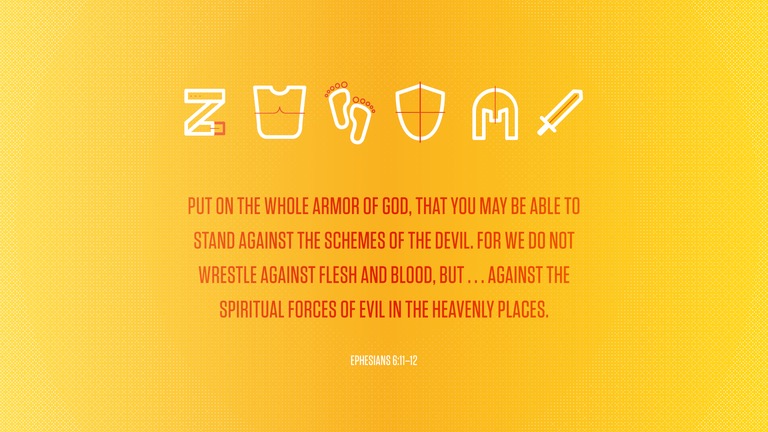
Christian, the Bible does not call you a ballerina. You aren’t called to dance and twirl gracefully. The Bible does not say that you are a construction worker using tools and machines to build a temple. And the Bible does not identify you as a nobleman and ruling in a castle.

Instead, Scripture says that you, Christian, are a soldier. But you are not fighting against people. Politicians, mobs, or anyone who disagrees with you is not your enemy. You are fighting the spiritual forces of evil in the heavenly places. The war is a spiritual war. The battle is an unseen battle, and we wouldn’t know about it unless the Scriptures told us. Thankfully, God has told us that the attacks on us, our families, our church come from our enemy, the devil. And even better, God has told us how we, as His soldiers, are to engage in the fight.

So, Paul is going to answer several questions in this text. If we are soldiers, where is the battle? What is our role? What is our protection? And what weapons are we given for battle, and how do we use them?

Ephesians 6_11–12 Armor of GodWhere is the battle? It’s not in the Middle East. It’s not in Washington D.C. It’s not in the media. It’s not even in the schools and universities. The devil brings the battle to the church. The devil attacks here, this congregation, and he attacks you.

Jesus has come. By His death and resurrection, Christ has delivered you from sin, death, and the devil. He has delivered you from the domain of darkness and transferred you to His kingdom (Col. 1:13). And Jesus places you in His church so that you are continually reminded of His work, deliverance, grace, mercy, and forgiveness. And the devil hates this. So, Satan comes and attacks our congregation. He attacks me as your pastor. The devil loves to whisper in my ear, “Everything you are doing is all in vain. Things aren’t going well at Christ the King. There are fewer people here now than there were last year. You don’t have the resources you used to have. The people don’t seem to care about the Scriptures.”

And the devil loves to attack you. But he doesn’t come straight on. Instead, he comes like a thief in the night. He attacks you by trying to weaken your love for the Scriptures. He tries to get you to focus on yourself which takes your focus off of Christ. The devil tries to lull you to sleep so you forget that because of Jesus you can stand before God with a clean conscience now and on the day of judgment. The devil brings the battle to you. This means that you are not called to be a soldier marching off to war. No, the battle comes to you.

What is our role? Stand. Did you hear how often this text told you to stand? Four times in three verses you are told to stand. Verse 11, “Put on the whole armor of God that you may be able to stand against the schemes of the devil.” Verse 13, “Take up the whole armor of God, that you may be able to withstand in the evil day, and having done all, to stand firm.” Verse 14, “Stand therefore.”

You are not told to attack (neither are you told to retreat). Stand. This is your duty. This means that you are a particular type of soldier. You are a sentry. You are a soldier who is commanded to keep guard, and you guard holy ground.

When Paul was writing this letter, one of the most important jobs a solder could have in the Roman Empire was sentry duty. All around the border of the empire were placed sentries who would be on guard through the night listening for an attacking army. This duty was so important that a sentry could be immediately executed for one of two failures in his duty.

The first offense he could be executed for was leaving the post either by retreating or attacking. If a sentry saw the enemy approaching and left his post to attack by himself, he would be killed (though, he’d probably die in the attack). The sentry wasn’t there to fight; he was there to call in reinforcements, battalions who were stationed behind the border at various intervals. The sentry would call in these troops so they could defeat the invading army.

And the second offense he could be executed for is if he fell asleep. If the sentry fell asleep while on duty, he’d lose his head. The sentry had to always be ready to call in the troops to defend the border.

Open Prayer HandsSo you, Christian, are to be praying at all times (v. 18), and keep alert with all perseverance, making supplication for all the saints. Now, that doesn’t mean that you shouldn’t ever sleep at night. And it doesn’t mean that you will be executed if you fall asleep during the sermon. Instead, you are to be spiritually aware and ready. Be watchful in your prayers.
So, here is the picture. You, believer, are a soldier who has been stationed at the border guarding the holy kingdom of Christ’s Church. You have a particular post. God has placed you in particular places where no one else has been placed and no one else has charge over. When you see the devil attacking, you don’t leave your post and fight. Instead, you pray and call in the reinforcements. When the devil attacks your spouse or kids, pray and call in the reinforcements. When you see the devil attacking your pastor and this congregation, pray. When you hear the enemy advancing on your friends and coworkers, pray. Those are the places God has called you to watch over, and He hasn’t called anyone else to that post. Do your duty. Stand. Watch. Pray. So that the devil may not find a way in. Your job is to stand, guard, watch, and pray. This is dangerous work, so…

What is our protection? God’s armor. You are not protected by your own might. You aren’t safe with your own ninja skills. Instead, you are clothed with the armor of Christ. God’s truth and Christ’s righteousness are your protection. The Gospel guards and makes your feet swift. The shield of faith in Christ protects you. And the helmet of salvation protects your head and mind. It doesn’t matter which direction the devil shoots his arrows at you, you are covered in God’s armor. The devil takes aim at you with a barrage his flaming darts trying to condemn you and attack your faith, “You said this. You did that. You fell into temptation here. You sinned against your neighbor.” But the armor of God stops every one of them leaving you unharmed.

The armor of God protects you. But there is one more thing you are given, the sword of the spirit, which brings us to the last question.

What weapons are you given for battle? Verse 17, take up the sword of the Spirit which is the Word of God. How are you to use this sword? Verse 18, pray. Praying at all times in the Spirit with all prayer and supplication. Use God’s Word to pray.

Jesus Crushes the Serpent's HeadThe promises given to you in God’s Word are the very things you are to pray. When the fighting comes near you and you have to fight toe to toe with the devil, use God’s Word. It is what Jesus used when He was tempted by the devil. And when you pray, you are calling in the reinforcements, you are calling in Christ Himself. The Champion who defeated the devil. It looked like the devil won when Jesus was in the grave. But Jesus stood up. He vanquished Satan and crushed the serpent’s head. And you, dear Christian, you stand with Him. Amen.

The peace of God, which surpasses all understanding, will guard your hearts and minds in Christ Jesus. Amen.