Life in the Vineyard – Sermon on Matthew 20:1-16 for Septuagesima Sunday

Matthew 20:1–16

1 “For the kingdom of heaven is like a master of a house who went out early in the morning to hire laborers for his vineyard. 2 After agreeing with the laborers for a denarius a day, he sent them into his vineyard. 3 And going out about the third hour he saw others standing idle in the marketplace, 4 and to them he said, ‘You go into the vineyard too, and whatever is right I will give you.’ 5 So they went. Going out again about the sixth hour and the ninth hour, he did the same. 6 And about the eleventh hour he went out and found others standing. And he said to them, ‘Why do you stand here idle all day?’ 7 They said to him, ‘Because no one has hired us.’ He said to them, ‘You go into the vineyard too.’ 8 And when evening came, the owner of the vineyard said to his foreman, ‘Call the laborers and pay them their wages, beginning with the last, up to the first.’ 9 And when those hired about the eleventh hour came, each of them received a denarius. 10 Now when those hired first came, they thought they would receive more, but each of them also received a denarius. 11 And on receiving it they grumbled at the master of the house, 12 saying, ‘These last worked only one hour, and you have made them equal to us who have borne the burden of the day and the scorching heat.’ 13 But he replied to one of them, ‘Friend, I am doing you no wrong. Did you not agree with me for a denarius? 14 Take what belongs to you and go. I choose to give to this last worker as I give to you. 15 Am I not allowed to do what I choose with what belongs to me? Or do you begrudge my generosity?’ 16 So the last will be first, and the first last.”

In the name of Jesus. Amen.

The Bible refers to Christians as many things. Christians are God’s sons (Ro. 8:14; Gal. 3:26), daughters (2 Cor. 6:18), children (Mt. 6:9; Ro. 8:16; 1 Jn. 3:1), and heirs (Ro. 8:17; Gal. 4:7). All Christians are called the bride of Christ (Eph 5:25-27) and the body of Christ (Ro. 12:4-5; 1 Cor. 12:27). The Bible will refer to you Christians as sheep with Jesus as your Shepherd (Jn. 10:1ff). There are all sorts of other things I could mention, but in this parable, Jesus calls you workers or laborers in God’s vineyard, and that is what we are going to focus on.

In the parable, the vineyard is the kingdom of God or the Church, the master is Jesus, and, Christian, you are in this parable as a worker who was brought into the vineyard by Jesus. Some of you were brought in early and some later, but you were all brought in by the invitation of Christ. You were brought in to the kingdom of God for a purpose.

Christ has called you into His kingdom not just to lounge around and dangle your toes in the pool while you get a tan. No, He has work for you to do. Husbands and fathers; wives and mothers; children; students; employees with a boss or business owners with staff; citizens of cities, states, and countries – all of these are tasks put in front of you as you work for God in His kingdom. There are times when the work Jesus puts in front of you is hard, difficult, and requires more strength than you can muster on your own. There are times when that work is easier. But it doesn’t matter how challenging or easy the work is, it is work in God’s kingdom.

And this parable harkens back to our origins, back to what God created us to be. Remember how it was at the beginning of creation and before the Fall? God creates everything, plants a garden, and puts Adam and Eve there so they could work it and keep it (Gen. 2:15). Those of you who have been attending our adult class Sunday mornings will, hopefully, remember this. Those two responsibilities – to work and to keep the Garden of Eden – are the same duties that God gives to the priests who served in the Tabernacle and Temple (Num. 3:7-8, 8:26, 18:5-6); the Hebrew words are the same. God didn’t just create Adam and Eve to be gardeners, they were guardians of sacred space. So, this parable refers to how God calls you to be guardians of the sacred space of His kingdom.

This vineyard, the kingdom of God, is a blessed place. Yes, there’s work to do. You have tasks and responsibilities to faithfully carry out, and at times you will struggle and even fail in those responsibilities as laborers in the vineyard. But remember, Scripture doesn’t only call you a laborer; again, you are also a child of God. As a laborer in God’s vineyard and as a child of God, you are part of the family business. Now, please know that I’m going to push past the boundaries of the parable a bit here (i.e. this goes a bit past the scope of the parable), but it is still in line with what the Scriptures teach.

In a family business, the children get all sorts of perks, freedom, and leeway that regular employees, who aren’t part of the family, don’t get. Now, I don’t know enough about vineyards to know if they regularly use tractors, but sick with me on this for a minute. Imagine a normal vineyard with a worker who crashes the tractor because he’s being careless or reckless. That guy is probably going to get fired. But if one of the vineyard owner’s own children makes the same mistake, sure he might get a lecture or not be allowed to drive the new tractor that replaces the one he broke, but he’s still going to be in the business because he’s family.

Now, what might that look like for you as a laborer in God’s vineyard? Again, as a Christian, you are working in God’s vineyard no matter what you are doing. You adults – in your job, whatever it is; in your home with your spouse and children; or in your town, state, and country – every responsibility is vineyard work that God gives you to do. You kids – at home, you empty the dishwasher, make your bed, brush your teeth; in your school, whatever subject you are studying or even being a friend to others at recess – all of that is vineyard work.

There are times you are going to mess up in that vineyard work. You’re going to burn the supper. You’re going to bomb the spelling, math, or science test. But you’re family, so there is forgiveness and mercy extended. You’re still going to be in the vineyard. Sure, you’ll have lessons to learn (and, sometimes, those lessons won’t be pleasant). You might be relegated to different tasks that better fit your abilities (see 1 Cor. 12:21-26). But you’re still in the vineyard because you’re family. Ultimately, the only failure is not learning from your mistakes and doing better the next time.

According to the parable, the thing that gets you thrown out of the vineyard is being angry with the master because of his generosity and goodness toward others (Mt. 20:13-15). But now, I have to add this just briefly: None of that is an excuse to be lazy or reckless with your labor in the vineyard. Remember, the better you work in the vineyard, the more you will benefit. So, take your work in the vineyard of God’s kingdom seriously, but also know that your place in the vineyard is safe and secure.

Ok, back inside the boundaries of the parable and to the elephant in the room – the wages. 

In the parable, the only place outside of the vineyard is the marketplace. Markets are where goods and money are exchanged. This thing costs so much, and if you don’t have enough, tough cookies. The marketplace operates only in justice. Now don’t get me wrong, justice is a good thing. We need justice, but because we are sinners, justice is a terrifying thing. God be praised that we have a God who is merciful andjust (Ro. 3:26; 1 Jn. 1:9). The marketplace is where the master of the vineyard finds his laborers and calls them out of it. Notice how the master says to the eleventh-hour workers, “Why do you stand here idle all day?” They don’t respond, “Well, we like it here.” No. The marketplace is a terrible place to be as it is presented in this parable. When the master says, “You go into the vineyard too,” they don’t respond, “Aw man, now we have to work.” They willingly and joyfully go into the vineyard.

Again, notice how the judgment in this parable is being tossed out of the vineyard because the grumblers didn’t like the master’s pay scale based on mercy and generosity. Dear saints, we want to remain in the vineyard where we are benefactors of Jesus’ death and resurrection. Because of what Jesus has done, we are in the vineyard where we get better than our sins deserve.

The parable is not just a description of the last day and final judgment. The parable is also about the life of faith. Some of you have said something like this to me, “Pastor, I don’t really like this parable. I’ve been a Christian my whole life and worked in God’s kingdom. And Jesus is saying that all I’ve done as a worker in His kingdom doesn’t really matter because anyone who converts on their deathbed or in a foxhole gets treated the same way I will. I know this is a wrong attitude, but I still don’t like what the parable teaches.” 

I’ve done my best to address that in the past, but after studying this week, I’ve got an answer that is better than what I remember sharing in the past. If you look back to the end of Mt. 19, the context of when Jesus tells this parable is also recorded in Lk. 18:18-30. Luke doesn’t record this parable, but Jesus tells this parable in the context of Peter’s little brag and question, “Jesus, we disciples have left our homes and everything and followed you. What are we going to get?” (see Mt. 19:27 & Lk. 18:28). And in Lk. 18:29-30, Jesus promises, “Truly, I say to you, there is no one who has left house or wife or brothers or parents or children, for the sake of the kingdom of God, who will not receive many times more in this time, and in the age to come eternal life.”

Did you catch that? Jesus promises eternal blessings and rewards to you in the life to come, but you also get blessings and rewards in this life for your labor in His kingdom. That’s what Jesus says. And He wouldn’t say it if it weren’t meant to be enticing to you to do the work that He has for you in His kingdom. Plus, consider this: you know what those eleventh-hour workers, who got paid the same denarius as those who worked the whole day, you know they did the next day? They got up and worked a full day in the vineyard. They got more strength, more endurance, more experience, and did what they could for the benefit of the vineyard.

Finally, and I’ll leave you with this: Remember your Christian life is work and labor in the vineyard. Jesus doesn’t tell the parable about the owner of a factory that produces sweatpants or sneakers or frozen French fries. No. It’s about a vineyard. Vineyards exist to produce wine which God gives to make glad the heart of man (Ps. 104:15). The work you do in Christ’s kingdom brings joy, rest, and feasting to you and to those around you. May we all be diligent and faithful and joyful as we live out our faith in the life of the vineyard. Amen.

The peace of God, which surpasses all understanding, will guard your hearts and minds in Christ Jesus. Amen.

Love & Respect – Sermon on Ephesians 5:22-33 for the Second Sunday after Epiphany

Ephesians 5:22–33

22 Wives, submit to your own husbands, as to the Lord. 23 For the husband is the head of the wife even as Christ is the head of the church, his body, and is himself its Savior. 24 Now as the church submits to Christ, so also wives should submit in everything to their husbands. 

25 Husbands, love your wives, as Christ loved the church and gave himself up for her, 26 that he might sanctify her, having cleansed her by the washing of water with the word, 27 so that he might present the church to himself in splendor, without spot or wrinkle or any such thing, that she might be holy and without blemish. 28 In the same way husbands should love their wives as their own bodies. He who loves his wife loves himself. 29 For no one ever hated his own flesh, but nourishes and cherishes it, just as Christ does the church, 30 because we are members of his body. 31 “Therefore a man shall leave his father and mother and hold fast to his wife, and the two shall become one flesh.” 32 This mystery is profound, and I am saying that it refers to Christ and the church. 33 However, let each one of you love his wife as himself, and let the wife see that she respects her husband.

Working with Jesus – Sermon on Matthew 3:13-17 for the Baptism of Our Lord

Matthew 3:13–17

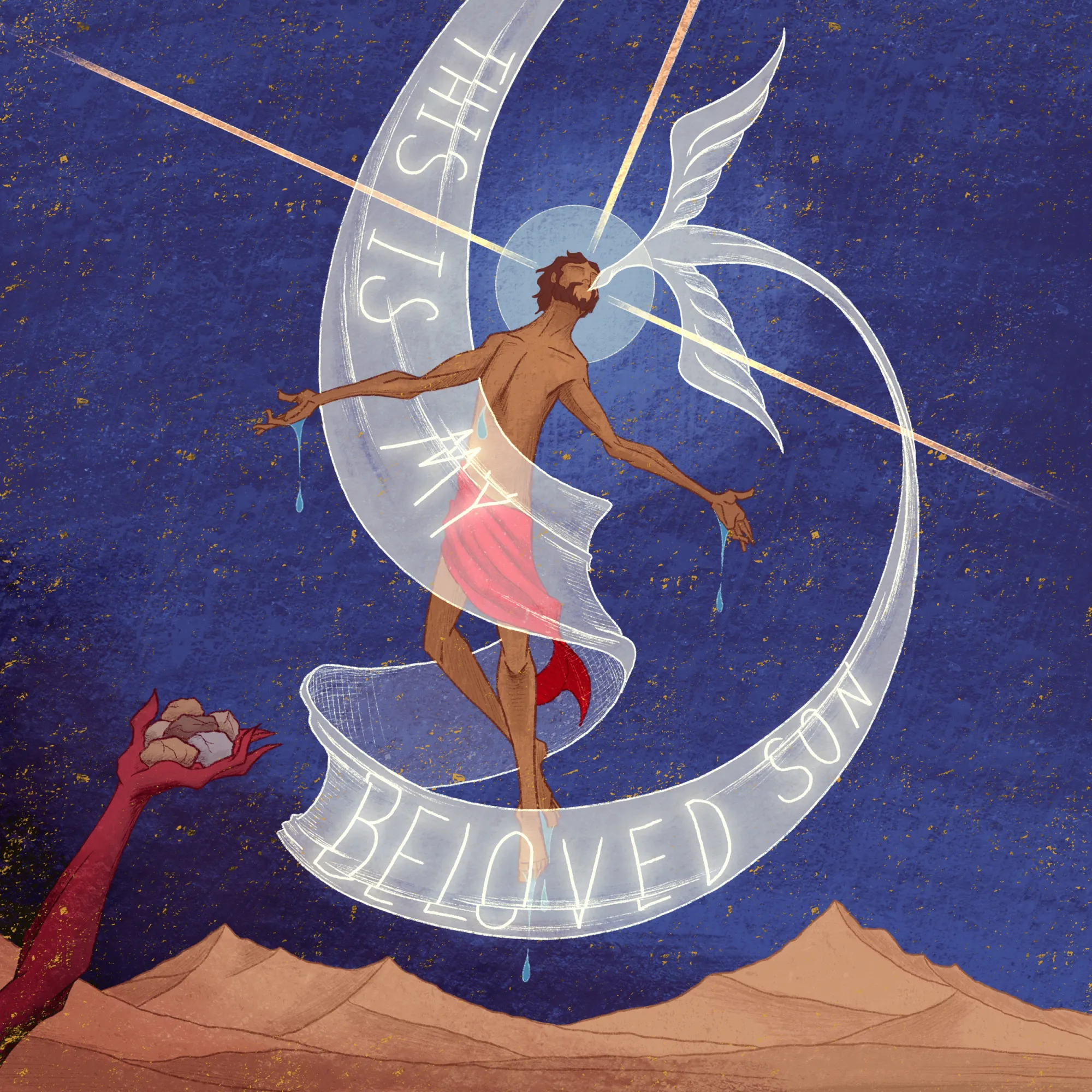
13 Then Jesus came from Galilee to the Jordan to John, to be baptized by him. 14 John would have prevented him, saying, “I need to be baptized by you, and do you come to me?” 15 But Jesus answered him, “Let it be so now, for thus it is fitting for us to fulfill all righteousness.” Then he consented. 16 And when Jesus was baptized, immediately he went up from the water, and behold, the heavens were opened to him, and he saw the Spirit of God descending like a dove and coming to rest on him; 17 and behold, a voice from heaven said, “This is my beloved Son, with whom I am well pleased.”

In the name of Jesus. Amen.

At Christmas, we celebrate the fact that the eternal God the Son came down to us so He could bring us up to Him. God, who is spirit (Jn. 4:24), became flesh and dwelt among us (Jn. 1:14). This is the wonder of wonders and deserves our eternal contemplation, thanks, and praise. That being said, God simply becoming flesh wouldn’t have done us any good unless He did more than simply have a body. God came in the flesh and used that body to be your Savior from sin, and that is what we see happening at Jesus’ Baptism.

Today, we’re mainly going to focus on how Jesus responds to John’s objection, but before we do that, we need to consider for a minute what Jesus’ Baptism accomplishes. John said the reason he was preaching and Baptizing in the wilderness is for repentance (Mt. 3:11), and Lk. 3:3 says John’s baptism was for the forgiveness of sins. But Jesus doesn’t have any sin, so He doesn’t need either repentance or forgiveness. That is why John objects and would have prevented Jesus from being Baptized (Mt. 3:14). Jesus isn’t Baptized because of His sins because, again, He didn’t have any. Instead, Jesus is Baptized to be anointed with the sin of the world. In His Baptism, Jesus steps into the office of being the Messiah or the Christ, both of those titles mean ‘the Anointed One.’

Imagine what was happening as John was Baptizing. People who recognized how they had sinned against God by idolatry, profaning God’s name, and breaking the Sabbath; people who were convicted of how rebellious they were toward their parents, murderers, adulterers, thieves, liars, and coveters; they were all coming to John repenting and to have those sins washed away in the waters of the Jordan River. So, imagine all the sins of all those sinners floating around in the water, making it filthy.

But then, Jesus steps into those repugnant waters. Since Jesus didn’t have any sin to wash away, He soaks up all those sins into Himself like a sponge leaving the waters clean again. This is why, the next time John sees Jesus, he says, “Behold the Lamb of God who takes away the sin of the world” (Jn. 1:29). It is at His Baptism that Jesus, at least, begins to fulfill what was prophesied about Him back in Isaiah 53 – that He would be numbered with the transgressors (Is. 53:12), and that God would lay on Him the iniquity of us all (Is. 53:4-6).

One of my favorite verses is 2 Cor. 5:21, which could be viewed as an interpretation of or teaching about what happens at Jesus’ Baptism, “For our sake, [God] made [Jesus], who knew no sin, to be sin.” And I’d encourage you to personalize that verse: “For my sake, God made pure, perfect, sinless Jesus to be sin. God did that for me.” And the verse doesn’t stop there. It also tells you why God did this. He did it so that in Jesus, you “might become the righteousness of God.” Because of Jesus, believer, you are pure as God is pure (1 Jn. 3:3). Because of Jesus, dear saints, you are holy as God is holy (1 Pet. 1:16). Because of Jesus, Christian, you are righteous as God is righteous (2 Cor. 5:21).

Now, that brings us back to Jesus’ response to John’s objection. John doesn’t want to Baptize Jesus because John is the sinner who needs to be Baptized and have his sins washed away by Jesus. But Jesus replies, “Let it be so now, for thus it is fitting for us to fulfill all righteousness” (Mt. 3:15). Notice that, Jesus doesn’t tell John that He needs to be Baptized so He can fulfill all righteousness by Himself. No. He tells John that John has a role to play in fulfilling all righteousness, “It is fitting for us to fulfill all righteousness.”

John had a role and works to do with Jesus in Christ’s work fulfilling all righteousness. John’s role was to prepare the way of the Lord (Jn. 1:23), to proclaim a Baptism of repentance for the forgiveness of sins (Lk. 3:3), to point people to Jesus (Jn. 1:29) and finally, to Baptize Jesus. That was God’s purpose for John. God put John into that specific office and vocation, and God did that long before John was born. 

The Old Testament closes with the prophet Malachi, which was written about 430 years before Jesus was born saying that God would send Elijah before the “great and awesome day of the Lord comes” (Mal. 4:5). And Jesus says that John is the fulfillment of that prophecy (Mt. 11:13-14). All four Gospels say (Mt. 3:3; Mk. 1:2-3; Lk. 3:4; Jn. 1:23) that John the Baptizer was the fulfillment of what God said in Is. 40:3 about the voice crying in the wilderness to prepare the way of the Lord, which was promised about 750 years before John was born. For at least three-quarters of a millennia, God had planned that John would work with Jesus to fulfill all righteousness. John’s identity and purpose is completely bound up to Jesus’ identity and purpose as the Savior of the world.

Dear saints, the same is true for you. Jesus has also called you to work with Him to fulfill all righteousness. Christ calls you into particular offices and vocations to work with Him in fulfilling all righteousness. Sure, you weren’t called to do the things that John the Baptizer did, but you are called to work with Jesus – even from before the foundation of the world (Mt. 25:34). You’re familiar with Eph. 2:8-9 which says, “By grace you have been saved through faith. And this is not your own doing; it is the gift of God, not a result of works, so that no one may boast.” And don’t forget what the next verse (Eph. 2:10) says, “For we are his workmanship, created in Christ Jesus for good works, which God prepared beforehand, that we should walk in them.”

God places you into different offices in which you work with Jesus to fulfill all righteousness. You kids here, from the moment you were conceived, God put you in the office of being a child so you can work with Jesus to fulfill all righteousness by honoring and obeying your parents. You who are married, at your wedding, God put you into the office of husband or wife to work with Jesus to fulfill all righteousness. As God blesses you with children, He places you into the office of parent where you fulfill all righteousness by raising your children, training them in the way they should go, and teaching them the faith. The same is true in your job, in your extended family, and with your friends. In each and every relationship you have, God is placing you into an office and giving you good works to do in order to fulfill all righteousness.

Whenever you do what God gives you to do in the different offices He places you in, you are serving God by loving your neighbor, and as you do that, you are working with Jesus to fulfill all righteousness. In every good work you do, God’s light shines through you, others see your good deeds, and they will glorify their Father in heaven (Mt. 5:16). Dear saints, you are God’s fellow workers (1 Cor. 3:9) and your deeds follow you (Rev. 14:13).

Now, to strengthen you in those tasks and to give you what you need, your heavenly Father invites you to His table where He will fill you with Jesus’ Body and Blood given and shed for the forgiveness of your sins. Through this meal, He fills you cup so it runs over with His righteousness (Ps. 23:5) and spills over to those around you. Amen.

The peace of God, which surpasses all understanding, will guard your hearts and minds in Christ Jesus. Amen.
A Great and Mighty Wonder – Sermon on Luke 2:1-20 for Christmas Eve 2023

Luke 2:1–20

1 In those days a decree went out from Caesar Augustus that all the world should be registered. 2 This was the first registration when Quirinius was governor of Syria. 3 And all went to be registered, each to his own town. 4 And Joseph also went up from Galilee, from the town of Nazareth, to Judea, to the city of David, which is called Bethlehem, because he was of the house and lineage of David, 5 to be registered with Mary, his betrothed, who was with child. 6 And while they were there, the time came for her to give birth. 7 And she gave birth to her firstborn son and wrapped him in swaddling cloths and laid him in a manger, because there was no place for them in the inn. 

8 And in the same region there were shepherds out in the field, keeping watch over their flock by night. 9 And an angel of the Lord appeared to them, and the glory of the Lord shone around them, and they were filled with great fear. 10 And the angel said to them, “Fear not, for behold, I bring you good news of great joy that will be for all the people. 11 For unto you is born this day in the city of David a Savior, who is Christ the Lord. 12 And this will be a sign for you: you will find a baby wrapped in swaddling cloths and lying in a manger.” 13 And suddenly there was with the angel a multitude of the heavenly host praising God and saying, 

14 “Glory to God in the highest, 

and on earth peace among those with whom he is pleased!” 

15 When the angels went away from them into heaven, the shepherds said to one another, “Let us go over to Bethlehem and see this thing that has happened, which the Lord has made known to us.” 16 And they went with haste and found Mary and Joseph, and the baby lying in a manger. 17 And when they saw it, they made known the saying that had been told them concerning this child. 18 And all who heard it wondered at what the shepherds told them. 19 But Mary treasured up all these things, pondering them in her heart. 20 And the shepherds returned, glorifying and praising God for all they had heard and seen, as it had been told them.

In the name of Jesus. Amen.

Life is often repetitive and mundane. It fills up with schedules, to-do lists, and errands. You make plans to get everything done as efficiently as possible. You get up, get ready, and get yourself to work or to school or to that appointment. You do what is required of you. Then, you go to bed and sleep only so you can get up tomorrow and do it all over again.

In your efforts to be efficient, organized, and keep it all together, you get into a grove – or, sometimes, a rut. Like a horse pulling a carriage, you put blinders on yourself so you can focus squarely on the next task at work, planning the week’s meals, finishing that big assignment, whatever it is that needs to get done. 

But from time to time, something wonderful happens. Your professor cancels the final. Your adult kid surprises you by coming home. The doctor tells you that the cancer is gone, and you don’t need any further treatments. These wonderful things pull us out of our monotonous lives. And those wonderful things remain wonderful. Five minutes after it happens, it’s still wonderful. If an hour passes, it’s still just as amazing as when it happened. A week, a month, a year, later still has zero effect on the wonder of the thing. Sure, the memory of exactly how it happened might fade, but the wonder stays.

When Sarah and I were dating, I remember meeting her grandma, Hazel. I don’t remember the context of our conversation, but she told me a story of when her kids were young. The family was having serious financial troubles. Hazel didn’t know how she should put supper on the table. There was no food in the house and no money to buy anything. She bumped into one her friends that afternoon who stopped her and asked, “Have you come down from cloud 9 yet?” Hazel didn’t have any idea what her friend was referring to, so her friend told her she had won a drawing at the local grocery store. The prize was a used car that was full of groceries. Suddenly, supper was covered – as well as the next several days of meals. She packed up her kids and picked up the prize. And Hazel told how my father-in-law rode home in the back seat of that car eating cookies and chips that were part of the prize.

When Hazel told that story to me, her voice was excited and filled with wonder. I could see the tears of joy welling up in her eyes. It didn’t matter at all that the food was long gone and the car in the junk yard because it had happened decades before. The wonder of that event hadn’t faded one bit. Hazel would retell that story to me many more times. It wasn’t as though she had forgotten that she had already told the story to me. She just loved telling it, and every time she shared that memory, the joy and wonder the whole thing was still as fresh as though it had happened yesterday because time is irrelevant to the wonder of a thing.

Now, you can probably see where I’m going with this. Jesus was born two-thousand-twenty-some years ago. But the wonder of God entering creation and taking on a human body is still as wonderful and amazing as it was when it happened.

Now, the devil wants to steal that wonder and awe because it was by the birth of Jesus that Satan’s head was crushed (Gen. 3:15). For the Son of God to die and rise again for the forgiveness of your sin, He first had to be born. But Satan thinks you’re stupid. He wants you to adopt an apathetic attitude toward Jesus’ birth and Christmas for the simple reason that it happened a long time ago. He wants to put all sorts of convoluted ideas about the meaning of Christmas into your head so you start to think, “Why should I be happy or joyful about something that happened in the distant past?” If that is the case for you tonight, or any night, you can tell the devil that he’s stupid for thinking you’re that stupid.

Once, a manger had something in it that was bigger than the whole world (C.S. Lewis). The Creator of the universe, who made all things by simply speaking, squeezed Himself into the 8 lb. (give or take) body of an infant boy, and yet He wasn’t cramped. Or more accurately, God became a baby – who couldn’t feed Himself or even lift His own head. And He did this for you.

Tonight, in an effort to regain some sense of the great and mighty wonder of Christmas, put yourself into the account Luke has given us (Lk. 2:1-20). Imagine it from the perspective of Joseph and Mary. Imagine being there among the animals. Jesus has just been born, so they wrap Him up and put Him in the manger because there was simply nowhere else to put Him.

Every parent should have a sense of awe and amazement when a child is born because every birth is a divine gift and miracle. But Joseph and Mary both knew that this particular birth was especially unique. Mary had been told by the angel Gabriel that, though she was a virgin, she would conceive the Son of God (Lk. 1:35). Joseph was also told that the Child in Mary’s womb was the fulfillment of the prophecy we heard from Isaiah 7. Joseph was told that this Child is Immanuel which means “God with us” and that His name was to be Jesus because Yahweh had come to save His people from their sins (Mt. 1:18-25). They knew all of this, so that song, “Mary Did You Know?” the answer to the title of that song is, “Yes.” Maybe she didn’t know all the details about some of the specific questions that song asks, but by and large, the answers to the questions in that song are a resounding, “Yes. Mary knew.”

And yet, the way the Scriptures record the moment of the birth of Jesus, we get left with the impression that it wasn’t any more wondrous than the birth of any other child. In fact, Jesus’ birth was probably a bit of a letdown. Here in Lk. 2, the actual birth of Jesus gets only a verse and a half of ink (v. 6b-7), “the time came for [Mary] to give birth. And she gave birth to her firstborn Son, wrapped Him swaddling cloths, and laid him in a manger.” In Mt. 1:25, Jesus’ birth is even more understated; it’s just, “[Mary] gave birth to a Son.” It’s as though we are to imagine Joseph and Mary looking at this Child, whom they know is God in the flesh, but they look around at the animals and their surroundings and say to each other, “Huh. There’s no glowing. No halo over His head. He’s supposed to be God, but He’s just a baby. So this is it?”

But then, shortly after, some shepherds arrive, and one of them pokes his head from around the corner and asks, “Excuse me. I know this is a barn, but does there happen to be a baby in here?” Joseph or Mary (you can pick which one responds) says, “Well, um, yes there is.” 

The shepherd responds, “I really don’t mean to bother you, but is that baby swaddled?” 

“Yeah. That’s kind of what you do with babies.” 

“Was He just born today?” 

“That’s right, just a few hours ago.” 

“Sorry. I just have one more question. It’s a bit dark in there, and I just have to know – is the baby lying in that manger there?” 

“How did you know?” 

And the shepherds just bow down to the ground and worshipped.

You have probably gotten so used to hearing Lk. 2 on this night each year. It’s good to hear and read it again and again. But it’s so wonderful. Take your time considering all of it. Slow down, look at the details, and meditate on the fact that God became flesh and blood for you.

Imagine it from the angles’ perspective. Imagine how confused the angels must have been that night. They had gotten a break from their regular patrol and angelic duties and sent to this field where the shepherds are. Those angels look up, and there is God on the throne of all creation. So, they sing, “Glory to God in the highest.” But then they look down into that manger and see God is there too. So, they keep singing, “And on earth peace among men with whom He is pleased.”

Luke tells us that those shepherds made known the saying that had been told them concerning this Child and, “all who heard it wondered at what the shepherds told them.” That includes Joseph and Mary. They heard about the angel who announced it, and they heard about the song that the multitude of the heavenly host sang. And they were filled with wonder.

Dear friends, it doesn’t matter how old the story of the birth of God is, Christmas is wonderful. Treasure this great and mighty wonder. Jesus has come, and He has come for you. Tonight and always, ponder in your heart that unto you is born a Savior who is Christ the Lord. Merry Christmas! Amen.

The peace of God, which surpasses all understanding, will guard your hearts and minds in Christ Jesus. Amen.

Coming Soon – Sermon on John 1:19-29 for the Fourth Sunday of Advent

John 1:19–29

19 And this is the testimony of John, when the Jews sent priests and Levites from Jerusalem to ask him, “Who are you?” 20 He confessed, and did not deny, but confessed, “I am not the Christ.” 21 And they asked him, “What then? Are you Elijah?” He said, “I am not.” “Are you the Prophet?” And he answered, “No.” 22 So they said to him, “Who are you? We need to give an answer to those who sent us. What do you say about yourself?” 23 He said, “I am the voice of one crying out in the wilderness, ‘Make straight the way of the Lord,’ as the prophet Isaiah said.” 

24 (Now they had been sent from the Pharisees.) 25 They asked him, “Then why are you baptizing, if you are neither the Christ, nor Elijah, nor the Prophet?” 26 John answered them, “I baptize with water, but among you stands one you do not know, 27 even he who comes after me, the strap of whose sandal I am not worthy to untie.” 28 These things took place in Bethany across the Jordan, where John was baptizing. 

29 The next day he saw Jesus coming toward him, and said, “Behold, the Lamb of God, who takes away the sin of the world!

In the name of Jesus. Amen.

My college buddies and I try to get together every year. We typically meet at a lake cabin that belongs to the family of one of the guys in our group. Sometimes, we’ll joke that the only reason we invite him is that we meet at his cabin. (He’s actually a great guy.) The majority of our time is spent sitting around a campfire. Since there are at least three eagle scouts and one borderline pyromaniac in that group, building and maintaining the fire is no problem.

We sit around those huge, burning logs sharing stories late into the night, but over the years, I’ve ended up being one of the first to go to sleep. Because I’m one of the first to bed, I’m also one of the first up and get back to the firepit in the morning. When I look at the place that was a roaring fire when I went to bed, all I can see is a pile of ash. The flames are all gone. But when I get down close to that gray ash heap, I can fell there are still hot embers underneath. All it takes to get the fire going again is a paper plate, a few twigs, and a little blowing.

Throughout the Old Testament, God had made promise after promise that the Messiah and Savior would come. Like a huge bonfire, the prophetic promises burned bright and hot. But then, God stopped sending the prophets, and the flames died down. For some 400 years, there was no word from God. By all appearances, there was nothing more than an ash heap, but under those ashes were glowing embers ready to ignite anything placed on them.

Those hot coals were detected with the old priest, Zechariah. The people of Jerusalem had heard the story of how he had seen a vision while he was serving in the Temple, and after that vision he wasn’t able to speak for nine months. The strange thing is that vision and silence coincided with his old wife, Elizabeth, getting miraculously pregnant and having a son. Zechariah was only able to speak again after his son was named John, which was reportedly the name given to him in that vision (Lk. 1:2-25, 57-80). And this John grew up to be a peculiar fellow. He lived out in the desert eating grasshoppers and wild honey.

Then, the breeze started to blow on the embers. John was out in the wilderness preaching and baptizing. He would say things that others were too shy to speak. John was calling soldiers, tax collectors, and everyone to repent (Lk. 3:7-17). The religious leaders didn’t have a problem with that call to repentance. The curious thing about this call to repent was the reason John gave, “for the kingdom of God is near.” Where did John get that idea?

John’s preaching had gotten the embers glowing from beneath the ashes, and now huge crowds of people were migrating from Jerusalem, Judea, and all around the Jordan to hear this preaching and to be baptized by John (Mt. 3:5-6). Just like sticks thrown on hot embers, flames were starting to flicker once again. And that is what got the attention of the religious big wigs in Jerusalem. So, they sent a delegation to John to ask him, “Who are you?”

John confessed, “I am not the Christ. No, I’m not Elijah. No, I’m not the prophet. I am the voice of one crying out in the wilderness, ‘Make straight the way of the Lord,’ as the prophet Isaiah said.” And John goes on to say, “There is One standing among you that you don’t know, and I’m not worthy to stoop down and untie His sandals.” The flames were growing higher and hotter.

Now, Scripture doesn’t say this for sure, but I like the idea that Jesus was present in that crowd when John says, “among you stands One you do not know,” because it was the very next day that John points to Jesus and says, “Behold the Lamb of God who takes away the sin of the world.” With that preaching, the log was thrown on the flames and a new bonfire ignited.

That new fire of Jesus’ ministry brought miracles, healing, and powerful teaching. It burned brightly scattering and dispersing the darkness of demons. But after three years of Jesus’ ministry, something happened. It looked like the fire completely collapsed and the flames appeared to go out as Jesus died on the cross, but they ignited again in His glorious resurrection. By His death and resurrection, Jesus, the Lamb of God, has taken away the sin of the world. Everyone quickly check. Are you part of this world? Ok. Then Jesus has taken away your sin.

This same Jesus is now ascended into heaven where He sits at God’s right hand interceding for you and pleading your case before God the Father. There, Christ your Savior continually reminds God the Father that the wrath and punishment you deserve has been fully paid by His holy and precious blood. With His nail-scarred hands, Jesus now points to you who trust in Him and says, “That one’s sins are removed as far as the east is from the west” (Ps. 103:12).

Yes, you live some 2,000 years after Jesus died and rose again. Sure, it might look like the light of the fire of Jesus’ ministry has been reduced to nothing more than a pile of ashes. But it’s looked like that before. And our perception can be deceiving. The embers are still there and hot. Christ is not as far away as He may seems to be. He is here. Jesus stands among you. He has promised, “Where two or three are gathered in My name, there I am among them” (Mt. 18:20). He declares to you, believer, “I am with you always, to the end of the age” (Mt. 28:20). 

Jesus has come once – born in a barn in Bethlehem. He is coming again in glory and power. And He is come now. It doesn’t matter how gray the ashes appear to be in this sinful world. The embers are glowing hot and bright underneath, ready to ignite at any moment.

Lord willing (Jam. 4:15), we will gather here again tonight to celebrate and remember the birth of our Savior, the Lamb of God who takes away the sin of the world. Celebrating the birth of Jesus helps to prepare us for His second coming. Believer, He came meek and humble when He was born in Bethlehem to be the Savior. That is why the angels could sing, “Glory to God in the highest, and on earth peace among men with whom He is pleased” (Lk. 2:14). That faith prepares you to welcome Him when He comes again in glory on the Last Day.

For those who do not have faith, Jesus’ second coming will be terrifying. There will be no angel to tell you, “Fear not for I bring you tidings of great joy” (Lk. 2:10). Because, when He comes again, He will come to judge the earth (Ps. 96:13, 98:9). You who have faith, you already know the outcome of that judgment. Jesus Himself will be your defense lawyer (1 Jn. 2:1) and judge who will declare you not guilty.

For anyone here who does not have faith in Christ, I love you too much to not tell you that – if you persist in your unbelief and sin – the outcome of your judgment on that day is certain. Jesus will say to you, “Depart from Me, you cursed, into the eternal fire prepared for the devil and his angels” (Mt. 25:41). So, quit your stubborn, self-centered, self-righteous ways. Repent of your sin, and believe in Jesus. He loves you and wants you for his own.

And for you, dear saints, Jesus is here now, and He is with you always. The day of His return is coming soon. The embers are still hot and ready to ignite. Come, Lord Jesus. Amen.

The peace of God, which surpasses all understanding, will guard your hearts and minds in Christ Jesus. Amen.

The Word of Yahweh – Sermon on Jeremiah 1:4-19 and Revelation 19:6-16 for Midweek Advent 3

Jeremiah 1:4-19 & Revelation 19:6-16

In the name of Jesus. Amen.

Through this Advent sermon series, we have seen Jesus, the eternal Son of God, in the Old Testament before He became Yahweh incarnate. The first week, we saw how Jesus appeared to Moses in the burning bush as the Angel/Messenger of Yahweh calling Moses to deliver His people out of slavery in Egypt. Last week, we heard how Yahweh defines His name, “I am,” to Moses through the book of Exodus. Tonight, we are fast-forwarding just over 800 years (806 to be exact) to the call of Jeremiah where we see how Jesus, the Word of Yahweh, is active in and through His people.

In that Old Testament reading tonight (Jer. 1:4-19), Jeremiah recounts God calling him to be a prophet. Jeremiah tells us, “The Word of Yahweh came to me” (Jer. 1:4). Now, right off the bat, we don’t want to get the wrong impression about this encounter. When Jeremiah says, “the Word of Yahweh came to me,” it isn’t just some voice in Jeremiah’s head or even something Jeremiah merely hears with his ears. No. Look at v. 9. The Word of Yahweh that comes to Jeremiah has a hand that reaches out and touches Jeremiah’s mouth.

Lord willing (Jam. 4:15), we will gather again this Sunday night and hear from Jn. 1:14 that the Word became flesh and dwelt among us. In other words, the God who created all things took upon Himself a body. Now, because of Christmas, being human is part of God’s identity. But here, long before Jesus was born, this Word of Yahweh comes to Jeremiah, stretches out His hand, and touches Jeremiah’s mouth because had a plan for Jeremiah. A plan which had been in place for a long, long time.

The Word of Yahweh didn’t wait for the right person to come along, get all the right education, and amass five years of experience before calling him. Nope! Even before Jeremiah was born or formed in the womb, Yahweh had appointed Jeremiah to be a prophet to the nations (Jer. 1:5). But Jeremiah isn’t too keen on the idea because he’s only a youth (probably under 20 years old), so Yahweh gives Jeremiah this wonderful calling and promise, “Wherever I send you, go. Whatever I command you, speak. You don’t need to be afraid. I’ll be with you.” And that with divine hand, the Word of Yahweh reaches out and places His words in Jeremiah’s mouth. And those words set Jeremiah over nations and kingdoms to pluck up, break down, destroy, and overthrow. And those words also enable Jeremiah to build and plant. In other words, God is going to use Jeremiah to speak His words of Law and Gospel.

Jeremiah served in the twilight of his nation, Judah. Jeremiah’s culture, like our culture today, had drifted far from God’s Commandments. That is why four stated purposes of his preaching are related to judgment – to pluck up, to tear down, to destroy, and to overthrow.

But Jeremiah will also build and plant by preaching beautiful Gospel. He would preach about healing and restoration (Jer. 3:22, 30:17). Jeremiah would preach that even though the people would go into exile, a remnant would return (Jer. 23:3, 50:20). He announced that Yahweh would raise up for David the righteous Branch and make His people righteous (Jer. 23:5-6). Through Jeremiah, God foretold the New Covenant Jesus would institute in Holy Communion where Yahweh would forgive iniquity and remember sin no more (Jer. 31:31-34).

In our text, the Word of Yahweh comes to Jeremiah two more times with these visions of an almond branch and boiling pot. For the sake of brevity, I’m not going to go into too much detail about the significance of why God shows those two particular things to Jeremiah. But we should notice the comfort those visions bring. In the vision of the almond branch, the Word of Yahweh promises that He is watching over His Word to perform it. Through the Word of Yahweh, God announces what is going to do (Am. 3:7), and He follows through. God says what He does, and He does what He says.

And with the vision of the boiling pot, the Word of Yahweh declares that His judgment is about to boil over against the sin of His people. That’s why Jeremiah is to dress himself for work and not hold back the preaching of the Law (Jer. 1:16-17). Even though Jeremiah’s audience isn’t going to like what God says through him, the Word of Yahweh promises that He will make Jeremiah a fortified city, an iron pillar, and bronze walls (Jer. 1:18). And even though everyone fights against Jeremiah, God promises to be with him to deliver him (Jer. 1:19). And if God promises to do that for Jeremiah, He can also do it for and to you.

But, we need to change gears here because you and I are not Jeremiah. And yet Jesus, the Word of Yahweh, has called us to proclaim His Word to the people He puts in our lives. The world needs to hear what God has to say. In Mt. 10:27, Christ says, “What I tell you in the dark, say in the light, and what you hear whispered, proclaim on the housetops.” That, at times is a daunting call. But dear saints, we cannot shrink back from saying what God has clearly said in His Word. The world has turned upside down because we who bear Christ’s name have been either afraid or ashamed to simply say what the Bible says. Repent.

In Mk. 8:38, Jesus warns, “Whoever is ashamed of Me and My words in this adulterous and sinful generation, of him will the Son of Man be ashamed when He comes in the glory of His Father.” The opinions of evil, sinful men do not change the truth of what God says. Don’t ever be ashamed or afraid of confessing what God has said in His Word. You, like Jeremiah, can speak the Word of Yahweh before kings and not be put to shame (Ps. 119:46). God is with you and will strengthen you like forged metal upon which the forces of this world will break. Jesus promises that when you are dragged before the authorities of this world to bear witness, you don’t need to be anxious or worried about what to say because the Holy Spirit will give you the very words that need to be spoken, and God will speak through you (Mt. 10:18-20). So speak.

I want to close these Advent sermons with the picture we were given in our Epistle reading (Rev. 19:6-16). There, John sees Jesus, the Word of Yahweh, riding on a white horse. His eyes are like a flame of fire, and He wears many crowns on His head. The armies of heaven follow Him, and from His mouth comes a sharp sword which will strike down the nations that He will rule over with a rod of iron.

That picture is how your Savior is today. Jesus has all authority in heaven and on earth (Mt. 28:18). Throughout human history, earthly rulers have and will continue to be in rebellion against Christ, and their treachery has brought harm to creation. But, ultimately, those authorities have no power. Jesus, the Word of Yahweh, has more power than all the forces of the world and all their machines of war combined. This Jesus has come once, and He is coming again.

But there is more to that picture. The first half of that reading shows you – the Church and Bride of Christ. You, believer, are part of that great multitude singing the praises of Christ. Because Jesus came in your flesh, suffered, bled, died, and rose again for you, God has granted you to be clothed in fine, bright, and pure clothes. You stand, clothed in the good works and righteous deeds that God has prepared beforehand for you to walk in (Eph 2:10).

Christ – the Lamb and Bridegroom, the Word of Yahweh – has come. This fact brings terror to the faithless, but that isn’t you. You are His beloved. And He is coming to bring you to to Himself and to eternal life, joy, and peace. Hallelujah! Come, Lord Jesus. Amen.

The peace of God, which surpasses all understanding, will guard your hearts and minds in Christ Jesus. Amen.

Coming Joy – Sermon on Matthew 11:2-11 for the Third Sunday of Advent

Matthew 11:2–11

2 Now when John heard in prison about the deeds of the Christ, he sent word by his disciples 3 and said to him, “Are you the one who is to come, or shall we look for another?” 4 And Jesus answered them, “Go and tell John what you hear and see: 5 the blind receive their sight and the lame walk, lepers are cleansed and the deaf hear, and the dead are raised up, and the poor have good news preached to them. 6 And blessed is the one who is not offended by me.”

7 As they went away, Jesus began to speak to the crowds concerning John: “What did you go out into the wilderness to see? A reed shaken by the wind? 8 What then did you go out to see? A man dressed in soft clothing? Behold, those who wear soft clothing are in kings’ houses. 9 What then did you go out to see? A prophet? Yes, I tell you, and more than a prophet. 10 This is he of whom it is written,

“‘Behold, I send my messenger before your face, 
who will prepare your way before you.’

11 “Truly, I say to you, among those born of women there has arisen no one greater than John the Baptist. Yet the one who is least in the kingdom of heaven is greater than he.”

In the name of Jesus. Amen.

What do you do when it appears as though God isn’t interested in what’s happening in the world? What do you do when God doesn’t act the way you expect Him to or just doesn’t seem to care? Today’s Gospel text helps us in the midst of those kinds of questions.

John the Baptizer – that camel hair wearing, locust eating, outspoken prophet in the wilderness – is a combination of a biker gang member, wilderness survivalist, and street-corner preacher. Even before he was born, John was excited about Jesus, leaping in his mother’s womb (Lk. 1:39-44). From the time of his birth, John’s parents knew that he was the one who would prepare the way of the Messiah (Lk. 1:76), and that’s what he did. He pointed people to Jesus as the Lamb of God who takes away the sin of the world. He baptized hordes from Jerusalem, all Judea, and all the region around the Jordan (Mt. 3:5). John comforted with the Gospel, but he also boldly called people to repent for the kingdom of heaven is at hand (Mt. 3:5). He rightly called the religious leaders of his day a brood of vipers (Mt. 3:7). Like a good preacher of God’s Word, John rebuked political leaders like Herod who had married his brother’s wife (Lk. 3:19-20). And that is why John is in prison when we meet him here. For his whole life, John had been a faithful steward of the mysteries of God’s Word (1 Cor. 4:1-2).

In our Gospel reading (Mt. 11:2-22), John will soon be executed. He sits in a dank, dark prison cell. In that solitary, lonely dungeon, the devil does to John what he often does to those in isolation. He whispers lies and tries to cast doubt. John’s mind begins to wonder if his whole life’s work had been a sham. John knew the Scriptures taught that the Messiah would give sight to the blind, mobility to the lame, cleansing to the lepers, hearing to the deaf, and life to the dead, and Jesus certainly was doing that. But John also knew that the Messiah would bring prisoners out from the dungeon (Is. 42:7), that bonds would be loosed (Is. 52:2), that captives would be set free (Is. 49:9).

Because of the devil’s whispering and his current situation John starts to question: “Jesus, You’re checking all of the boxes except the one that matters most to me right now. What gives? Why am I here, stuck in this prison? Do You even know I’m in this situation?” No matter how many times God proves faithful in keeping His promises, it can feel as though God has abandoned you when some of His promises to you still lie in the future.

Instead of letting those questions fester and cause more and more doubt, John does exactly the right thing. He goes to God’s Word. John sends two of his disciples to ask Jesus, who is the Word made flesh (Jn. 1:14). “Are You the One who is to come, or should we look for another?” And Jesus, in typical Jesus fashion, doesn’t give a simple, “Yes,” or, “No.” Instead, Jesus responds: “Go and tell John what you hear and see: the blind receive their sight and the lame walk, lepers are cleansed and the deaf hear, and the dead are raised up, and the poor have good news preached to them. And blessed is the one who is not offended by Me.”

It’s easy for us to fall into the temptation of thinking that God isn’t active in creation when we experience trials and tribulations like John is. Even when God is making good on all of His other promises, if only one of our own boxes is still unchecked, we start to think that something is off. In those moments, it is easy to forget that God is active in and through our suffering. It’s easy to forget that even your suffering has a holy purpose (2 Cor. 1:8-9).

All the evil that the devil and the world tries to throw at you is turned into good by God. You are not at the whim of a god who may or may not care about you. You do not face a devil who is equal in power with God leaving your outcome in question. Joseph, who was sold into slavery by his brothers, told his brothers, “You meant evil against me, but God used it for good” (Gen. 50:19-20). Just as lifting weights is good exercise and builds up the muscles of your body, the suffering you endure in this world is good for your soul and faith, making it stronger.

The fact that Jesus suffered, died, and rose again is proof that God uses even the wickedness of this world and the suffering caused by evil men for your salvation. I’m not saying that it is an easy thing to believe. What I am saying is that Scripture is clear that suffering is not opposed to the Gospel. When God became a creature, He endured suffering so you can live with Him forever. Jesus saved you through His suffering, and He can and does use your suffering to bring about good because God is still active in His creation.

Jesus is the head of the Church, and you, believer, are His body (Eph. 1:22; Col. 1:18). Among other things, that means whatever you do in this world, Christ, the Head, is acting through you, His body. When you do what your boss tells you, you are God’s body being active in creation, and God blesses what you do. Kids, when you do your homework, you are God’s body being active in creation and preparing for the tasks God has for you in your future. As you are faithful in the things God puts in front of you to do, God is acting in you and through you to benefit your neighbor and creation. Be faithful in those things. Our Epistle lesson (1 Cor. 4:1-5) is an important reminder that the most important measure of what we do isn’t success or numbers that can be measured by others. We stewards shouldn’t care what others think. We shouldn’t even try to judge our own success. We are simply called to be faithful (1 Cor. 4:2-3).

But even as you are faithful, you will face suffering like John did. So, instead of falling into despair when you face suffering, God would have you rejoice in your suffering because suffering produces endurance, which produces character, which produces hope (Ro. 5:3-5). When you suffer, go back to God’s Word. Hear His promises. Hold on to those because God has not and will not fail in delivering you from suffering in this fallen and broken world.

Jesus is coming. He is not just coming sometime in the future. He is the constantly coming One. He has come once, He is coming still, and He will come again in the future. So, be bold and confident that the coming One is still active in His creation. Believer, you can have joy because Jesus has come and saved you.

Joy is not the same as happiness. Happiness and sadness cannot coexist, but joy and sadness can. Joy is not the absence of sadness. Instead, joy is confidence and contentment that God is in control and is taking care of things. Even when everything in this world seems dark and fading, God is in control. He has come. He is coming again. And He comes now to give you His Body and Blood which He gave and shed for the forgiveness of all your sins.

Christian, rejoice in the Lord always. Your Lord is coming. In fact, He is at hand now. Amen.

The peace of God, which surpasses all understanding, will guard your hearts and minds in Christ Jesus. Amen.

The Name of Yahweh – Sermon on Exodus 34:1-10 and Philippians 2:5-11 for Midweek Advent 2

Exodus 34:1-10 & Philippians 2:5-11

In the name of Jesus. Amen.

Last week, we considered how God appeared to Moses at the burning bush with a veiled power and enticing grace. Tonight, we are going to consider a little more on who Yahweh is based on His name. Yahweh means “I Am who I Am” or “I Will Be who I Will Be.” The Hebrew language makes it difficult to know if we should translate this as a present or future tense in English. Either way is legitimate.

Now, way back at the end of Genesis 4, after Seth becomes a father, we are told, “At that time, people began to call on the name of Yahweh” (Gen. 4:26). And throughout the rest of Genesis, people will use ‘Yahweh’ as God’s name. Last week, we heard from Ex. 3:13-15 that Yahweh is the name God gives to Moses so he can verify that is the ‘real deal’ and has come to lead God’s people out of slavery in Egypt. God’s people know Him by that name, but throughout the book of Exodus, Yahweh reveals what kind of God He is in several instances where He talks about His name. Tonight’s reading from Ex. 34:1-10 is the climax. But it is good to also consider those earlier passages so we can see who Yahweh is. And that’s what we’ll do tonight.

Back in Ex. 3:13-15 when God gives that name to Moses, you could almost see it as a slap in the face, as though God is saying, “Listen, Moses, you can’t pin Me down. I’ll be whatever I want to be.” And there is a sense of that. God is free and has the prerogative to be whatever He wants to be. But there is also a sense there that God is about to make Himself known as Yahweh. It’s almost like God is saying, “Moses, I’m about to show you what Yahweh means. I’ll make clear to you, to My people, and to the world who I am.” To Moses in Ex. 3, Yahweh shows that He is the God who remembers His promises to Abraham, Isaac, and Jacob, and He is coming to rescue His people from Egypt.

The next time God speaks His name in this prominent way is in Ex. 6:2-8 which is after Moses has arrived in Egypt and everything has ‘gone south.’ Moses gets to Egypt and tells the elders of Israel that Yahweh is going to lead them out of Egypt (Ex. 4:29-31), and the people believed and worshipped. So far, so good. But then, Moses and Aaron go to Pharaoh and tell him, “Yahweh says, ‘Let My people go,’” but Pharaoh responds, “Who is Yahweh that I should obey His voice? I don’t know Yahweh, and I will not let the people go” (Ex. 5:2). Those were dangerous words for Pharaoh to speak. Instead of letting the people go, Pharaoh makes the Israelites’ slavery more burdensome (Ex. 5:6-19). Now, they have to gather their own straw to make bricks and keep producing the same number of bricks each day. After hearing this, the Israelite leaders leave Pharaoh’s chambers and turn to Moses saying, “Yahweh is going to judge you because you have made us a stench in Pharaoh’s nostrils” (Ex. 5:21).

But God reassures Moses (to paraphrase Ex. 6:2-8), “I am Yahweh who appeared to Abraham, Isaac, and Jacob, but I didn’t show them what Yahweh means. But now, I’m going to enter history and show My people what Yahweh means. I’m going to bring them out of their slavery with a mighty hand and outstretched arm. I’m going to bring them into the land of Canaan. I’m Yahweh.” Notice, though, God isn’t really saying anything new – not yet. Yahweh just keeps repeating His promises, “I am coming to deliver all of My promises to you.”

The next statement that reveals Yahweh’s identity comes after God delivers His people out of Egypt in Ex. 20:2-6 where Yahweh gives the Ten Commandments. Yahweh tells His people at Sinai, “I am Yahweh, your God who brought you out of the land of Egypt, out of the house of slavery. Have no other gods before Me.” In other words, God says, “Trust Me to be your God, and see how it goes for you.” He goes on to say, “I, Yahweh, your God am a jealous God, visiting the iniquity of the fathers on the children to the third and the fourth generation of those who hate me, but showing steadfast love to thousands of those who love me and keep my commandments.”

Now, up to this point in Exodus, who have been the enemies of Yahweh? Pharaoh and his taskmasters. They have had their iniquities visited upon them. And Yahweh has shown His steadfast love to His people. But the people’s grumbling has been growing along the journey, and their wickedness is about to be on full display.

But before we get to the epitome of that wickedness, Yahweh further defines who He is. Yahweh gives His people instructions to build the Tabernacle. He tells them all the things that they have to do to make this tent. Then, In Ex. 29:45-46, Yahweh says about the Tabernacle, “I will dwell among the people of Israel and will be their God. And they shall know that I am Yahweh their God who brought them out of the land of Egypt that I might dwell among them. I am Yahweh their God.” Here, Yahweh says that He is a God who wants to dwell among His people.

So, to quickly recap who Yahweh has shown Himself to be through Exodus: Yahweh is the God of Abraham, Isaac, and Jacob. He has been faithful to His people and delivered them from slavery. Yahweh is the God who fought for His people with a mighty hand and outstretched arm. Yahweh is their God who visits the iniquity of the fathers on the children to the third and fourth generation, but He shows steadfast love and mercy to thousands of those who love Him and keep His commandments. And Yahweh is the God who desires to dwell among His people.

But then, we get to the episode of the golden calf (Ex. 32) where God’s own people show themselves to be His enemies who don’t love Him and keep His commandments. They reject Him and His kingship and replace Him with a god their own hands have made. They ascribe to this golden calf the very things Yahweh has done for them. Now, the enemy of God’s people isn’t external. It isn’t Pharaoh or taskmasters. It isn’t hunger, thirst, or other nations. Yahweh has already shown Himself to be powerful enough to overcome those external threats. What will this mighty, powerful Yahweh do now that the enemy of His people is His people? 

First, Yahweh tells Moses, “Get away from this people so I can destroy them.” But Moses prays to Yahweh to have mercy on the people (Ex. 32:11-14), and God does. And that brings us to our text (Ex. 34:1-10). God passes before Moses and defines Yahweh, “Yahweh a God merciful and gracious, slow to anger, and abounding in steadfast love and faithfulness, keeping steadfast love for thousands, forgiving iniquity and transgression and sin.” Yahweh is the God of power and forgiveness, mercy, grace, and faithfulness.

Throughout the Genesis, there are plenty of places where Yahweh is patient with His people and clearly forgives them. But this is the first time in Scripture where God is said to forgive sin. And notice who it is that declares that Yahweh forgives sin – it’s Yahweh Himself. Forgiveness defines Yahweh. He says so in the face of the sin of His very Own people.

And, yes, Yahweh is also the God who, “will by no means clear the guilty, visiting the iniquity of the fathers on the children and the children’s children, to the third and the fourth generation.” Yahweh is just. He will not tolerate those who repeatedly and continually rebel against Him. But even before that, Yahweh declares what defines Him – mercy, grace, love, faithfulness, and forgiveness.

And notice how Moses responds. He bows his head, worships, and prays, “If now I have found favor in Your sight, O Lord, please let the Lord go in the midst of us, for it is a stiff-necked people, and pardon our iniquity and our sin, and take us for Your inheritance” (Ex. 34:9).

Dear saints, Yahweh has answered that prayer. He has come to pardon your iniquity and sin. Jesus, Yahweh in the flesh, has come to claim you as His inheritance. John 1:16-18 says that from Christ’s fullness you receive grace on top of grace. Jesus – the Savior of the world who has come, died, and risen again for you – He has made God known. At His name every knee will bow in heaven and on earth and under the earth, and every tongue will confess that Jesus Christ is Yahweh (Php. 2:10-11)

‘Jesus’ means ‘Yahweh saves.’ He is a God merciful and gracious, slow to anger, and abounding in steadfast love and faithfulness, keeping steadfast love for thousands, forgiving your iniquity and transgression and sin. This is who your God is. Amen.

The peace of God, which surpasses all understanding, will guard your hearts and minds in Christ Jesus. Amen.

Coming Redemption – Sermon on Luke 21:25-36 for the Second Sunday of Advent

Luke 21:25–36

25 “And there will be signs in sun and moon and stars, and on the earth distress of nations in perplexity because of the roaring of the sea and the waves, 26 people fainting with fear and with foreboding of what is coming on the world. For the powers of the heavens will be shaken. 27 And then they will see the Son of Man coming in a cloud with power and great glory. 28 Now when these things begin to take place, straighten up and raise your heads, because your redemption is drawing near.”

29 And he told them a parable: “Look at the fig tree, and all the trees. 30 As soon as they come out in leaf, you see for yourselves and know that the summer is already near. 31 So also, when you see these things taking place, you know that the kingdom of God is near. 32 Truly, I say to you, this generation will not pass away until all has taken place. 33 Heaven and earth will pass away, but my words will not pass away.

34 “But watch yourselves lest your hearts be weighed down with dissipation and drunkenness and cares of this life, and that day come upon you suddenly like a trap. 35 For it will come upon all who dwell on the face of the whole earth. 36 But stay awake at all times, praying that you may have strength to escape all these things that are going to take place, and to stand before the Son of Man.”

In the name of Jesus. Amen.

I love this text. That might sound strange because of all the heavy warnings in it. Our Lord is talking about His second Advent, His second coming, which will be marked by signs in the sun, moon, and stars. Distress of nations in perplexity. The roaring of the sea and waves. People fainting with fear and foreboding as the powers of the heavens are shaken. Then, Jesus says that all of us need to watch ourselves so those signs don’t get us weighed down with dissipation, drunkenness, and the cares of this life. And He urges us to pray that we may have strength to escape all the things that are going to take place.

Now, I don’t love this text because I’m sadistic. I love this text because in the middle of all those signs and warnings, your Savior says, “When these things begin to take place, straighten up and raise your heads, because your redemption is drawing near.” It is so comforting, and the thing that cranks up the volume on that comfort is the distressing things that surround it.

Comfort is for those who are in the midst of pain, peril, and distress. Imagine arriving at a big family reunion and you see your grandma surrounded by her kids, grandkids, nieces, and nephews. She’s talking, laughing, hugging people. She sees you, and her eyes light up. The first thing you say to her isn’t going to be, “Grandma, it’ll be ok,” because that would make her mind start racing wondering what’s happened, what went wrong, who got hurt. You don’t comfort someone who is already happy unless you are about to give them distressing news. Comfort is for the distressed.

That is why Jesus doesn’t sugarcoat the terrible signs that will coincide with His return. If He had, the fact that those signs point to your redemption drawing near wouldn’t be nearly as comforting. So, in the midst of the anarchy, theft, riots, hatred, wars, and natural disasters we see in our day, straighten up and raise your heads because it all points to your coming redemption. And it is coming.

Throughout the week as I was praying, studying the text, and preparing for this sermon, my plan for how I was going to preach it took a really abrupt turn. Jesus spoke these words to the disciples, so in the past, I’ve preached this text in such a way as to get you Christians to focus on v. 28, “When these things begin to take place, straighten up and raise your heads, because your redemption is drawing near.” I still want to do that, but this time I want to take that one step further and talk about what these verses have to say about evangelizing and sharing the Gospel with others.

 2 Cor. 1:4 says, “[The God of comfort] comforts us in all our affliction, so that we may be able to comfort those who are in any affliction, with the [same] comfort with which we ourselves are comforted by God.” The comfort Jesus gives in this text is for you, Christian. And that comfort is meant to be shared with everyone who is troubled by the cares of this life.

The Advent season is a good time to meditate on the fact that we are waiting for Jesus’ return in glory to judge the living and the dead. What do you do while you wait for things? A lot of the time, what we do when we wait has nothing to do with what we are waiting for. You sit in your car waiting for your kid to come out of school or practice and check your email, send that text message you’ve been avoiding, whatever. (By that way, that isn’t meant to be an indictment. Sometimes, that’s just being efficient with your time.) By the way, I’d suggest using that time of waiting in prayer for your kid. As we consider this text, it is good to ask yourself, “What can I do with my time while I wait for Jesus to return? While I am surrounded by all the evil of this world, what would God have me do?” Dear saints, look around you.

Jesus says that the nations will be in distress and perplexity, fainting with fear and foreboding because of these signs, and He warns against focusing on the cares of this life. How many people do you interact with that are caught up fretting and worrying about the cares of this life? How many of them would be comforted with the fact that all the evil that surrounds them points to Jesus’ return and the day of redemption for those who believe in Him? 

Jesus says that the day of His return will come upon all who dwell on the face of the earth, and for unbelievers, that day will come suddenly like a trap that snaps shut. In other words, the people around you who aren’t Christians either are seeing or will see these signs and rightly fear what is going on in the world. So, believer, use those signs to point others to the fact that Jesus, the Lamb of God who takes away the sin of the world and the Redeemer of all mankind, is coming back to gather His elect sheep to dwell with Him forever (Mt. 25:33-34).

Let me try an analogy on you. And this analogy comes with a warning. All the signs Jesus mentions point you to your redemption. So these signs should cause you to get excited in anticipation of your Savior’s return. But for those who don’t have faith, these signs will cause fear and foreboding. This analogy is meant to encourage you to use that fear and foreboding as a tool to point people to the coming redemption. Here’s the analogy:

Imagine you are on a ship in the middle of the ocean that has struck an iceberg and is sinking. The bow of the ship is already under water. There are fires because the stoves in the kitchen have tipped over. People are running around screaming. The ship and all the passengers are in complete chaos. But you’ve heard the captain on the radio talking with another ship that is coming to rescue every passenger on board. You can even see it off on the horizon. You know it’s coming full speed to save everyone onboard, but you also know that it’s going to be a while before it arrives at your location. Others on your ship either can’t see it, or, if they do see it, they’re convinced that it isn’t coming to rescue them. What would you be doing?

Well, you would do everything you could to encourage everyone, “Just hang on. Our rescue is on its way! They’re coming. Stay calm. Act reasonably.” You’d be helping people into the lifeboats. You’d break things that would float that people could use after your ship sinks to the bottom of the ocean. Everything you do and say would be driven and motivated by the fact that your rescue is soon to come.

Dear saints, that’s your calling as a Christian. Encouraging people to persevere because the rescue ship is on the way with Jesus, the Savior, at the helm. When someone is weighed down by the cares of this life – whether it’s things they see on the news; problems with their health, family, or job; natural disasters; whatever – all of that is an opportunity to confess your hope and confidence that Jesus is returning, and your redemption is drawing near.

The cares of this life are certainly real and ominous, but they completely pale in comparison to the redemption that is coming and drawing near. The ship of this world is sinking below the waves, and the more you encourage others and point them to Christ, the more firmly you will believe it. And the more firmly you believe it, the more you will tell others too.

Dear saints, in the midst of the evil of this broken world, straighten up. Raise your heads. Your redemption is coming and drawing near. Amen.

The peace of God, which surpasses all understanding, will guard your hearts and minds in Christ Jesus. Amen.

The Angel of Yahweh – Sermon on Exodus 3:1-15; Hebrews 1:1-14; and Psalm 34 for Midweek Advent 1

Exodus 3:1-15; Hebrews 1:1-14; Psalm 34

In the name of Jesus. Amen.

Both of those Scripture readings you heard tonight (Ex. 3:1-15; Heb. 1:1-14) are so rich and so dense that we could have months of sermons on either and still not exhaust them. The same is true for tonight’s Psalm (Ps. 34) too. But, since it’s the season of Advent, we’re going to consider all three of them under one umbrella, so to speak, and that is the theme of how God comes to us in veiled power and enticing grace. We’ll begin with that reading from Ex. 3 with a little context, go to Heb. 1, and circle all the way back to Ps. 34.

To quickly summarize Ex. 1-2, you’ll remember, Moses was an Israelite slave who was born in Egypt but ended up being raised in Pharaoh’s palace. When he was forty years old (Act. 7:23f), he left the palace and saw a fellow Israelite being beaten by an Egyptian. Thinking no one was watching, Moses killed that Egyptian (Ex. 2:11-12) to save his kindred. But his homicide had a witness, and when Pharaoh found out about it, he planned to kill Moses (Ex. 2:15).

So, Moses fled Egypt, married a Midianite woman, and became a shepherd. Exodus 2 then closes like a cliffhanger. The Pharaoh who wanted to kill Moses died, and the people of Israel were left groaning in Egypt because of their slavery and cried to God for help. Then, and listen carefully to how Scripture narrows the gap between the Israelites and God: “Their cry for rescue from slavery came up to God. And God heard their groaning, and God remembered his covenant with Abraham, with Isaac, and with Jacob. God saw the people of Israel—and God knew” (Ex. 2:23-25). It’s like those words want you to imagine God sitting up somewhere in heaven and hearing those cries for help. The pleas for mercy got God’s head swiveling around to find exactly where those cries are coming from. Then, He sees and knows something needs to be done.

Now, of course, God saw the suffering of His people. He sees all things and knows all things. He is omnipresent and omnipotent. But I think the text is written this way to encourage us to pray in our times of trouble to get God’s attention so He will act. And He does. God hears, He sees, and He acts.

When Moses was eighty years old, God comes down and has this conversation with Moses at the burning bush (Act. 7:30). Initially, the text identifies the Being in the bush as “the angel of the Lord.” When you see ‘Lord’ (or ‘Lord God’) with all capital letters, the translation is indicating that God’s personal, divine name, “Yahweh,” is there in the Hebrew. And ‘Yahweh’ is that “I am who I am” name that God gives to Moses which we will consider more fully next week.

Now, about this ‘angel of Yahweh’ that appears to Moses: The word translated as ‘angel’ means ‘messenger.’ There are places in Scripture where the ‘angel/messenger of Yahweh’ is a created being. The prophet Haggai is called the “angel/messenger of Yahweh” (Hag. 1:13). In Malachi 2:3, a priest is titled the “angel/messenger of Yahweh.” But here, this particular ‘angel/messenger of Yahweh’ isn’t a human or one of the myriads of angels that God created. Notice that this angel of Yahweh speaks as God Himself saying, “I am the God of your father, the God of Abraham, the God of Isaac, and the God of Jacob.” And Moses appropriately responds to this angel of Yahweh, who is God Himself, by hiding his face (Ex. 3:6).

Consistently, the church has taught and held that this ‘angel of Yahweh’ who appears to Moses in the burning bush is Jesus. I won’t go into all the proof texts tonight; you can ask me for more later. For now, I’ll just give two passages to corroborate. The first one: Jn. 1:18 says, “No one has ever seen God; the only God, who is at the Father’s side, He,” referring to Jesus, “He has made Him known.” And second, Jesus is the Word of God that created all things (Jn. 1:1-3) who was made flesh (Jn. 1:14), appeared, and spoke to God’s people throughout the Old Testament.

So, to summarize our reading from Ex. 3, God hears the prayers of His people from heaven as they groan under slavery on earth. He sees how they are oppressed. And He comes to them. He comes to act, but He is going to act through Moses. And notice that when the Son of God comes in power and grace, He appears to Moses in a way that entices Moses and draws him in, closer to God. The burning bush that isn’t consumed makes Moses extremely curious, so Moses gets closer to see this odd thing. God draws near to Moses in an approachable way as the ‘angel of Yahweh’ in the burning bush. Then, Jesus, the Son of God and angel of Yahweh, makes it clear that He is God who has come to deliver His people by working through Moses, sending him back to Egypt, and doing all sorts of signs through him, which brings us to Heb. 1.

Jesus, appearing to Moses as the ‘angel of Yahweh’ in the burning bush is one of the “many ways God spoke” to His people of old (Heb. 1:1). In a similar way, Jesus spoke to Joshua as the commander of Yahweh’s armies who had come to lead God’s people into the Promised Land (Jos. 5:13-15). Jesus appears to Isaiah as the holy, holy, holy Lord of hosts in Is. 6 (see Jn. 12:41). In each of those places and many more, God veils Himself just enough so the person He reveals Himself to isn’t completely destroyed. God needs to do this because no one can see the face of God and live (Ex. 33:20).

The rest of Heb. 1 tells us how Jesus is no mere angel. He is God’s only-begotten Son (Heb. 1:5). All the other angels worship Him (Heb. 1:6). He has a throne that will stand forever (Heb. 1:8-9), and all His enemies will be subjected under His feet (Heb. 1:13).

Dear saints, this is the same Jesus who has come to you. He has heard your cries for help, He has come to save you by dying and rising for you, and He is coming again so you will live forever with Him.

The epitome of God’s coming in a way that is unintimidating and accessible is the incarnation and birth of Jesus. For you, the eternal, almighty, all-powerful Son of God has come to earth. He heard your cries, saw your suffering, and delivered you. “Veiled in flesh, the God-head see. Hail th’ Incarnate Deity.” He is “pleased as man with man to dwell, Jesus our Immanuel.” 

And this is true for you every day of your life, believer. As our Psalm (Ps. 34) said, Jesus “the angel of Yahweh encamps around [you] who fear Him, and delivers [you]” (Ps. 34:7) In Him, you find your refuge and have no lack. He delivers you from all your troubles because He redeems your life. And you find your refuge in Him. Amen.

The peace of God, which surpasses all understanding, will guard your hearts and minds in Christ Jesus. Amen.