Micro Sorrow, Macro Rejoicing – Sermon on John 16:16-22 for the Fourth Sunday of Easter

John 16:16–22

16 “A little while, and you will see me no longer; and again a little while, and you will see me.” 17 So some of his disciples said to one another, “What is this that he says to us, ‘A little while, and you will not see me, and again a little while, and you will see me’; and, ‘because I am going to the Father’?” 18 So they were saying, “What does he mean by ‘a little while’? We do not know what he is talking about.” 19 Jesus knew that they wanted to ask him, so he said to them, “Is this what you are asking yourselves, what I meant by saying, ‘A little while and you will not see me, and again a little while and you will see me’? 20 Truly, truly, I say to you, you will weep and lament, but the world will rejoice. You will be sorrowful, but your sorrow will turn into joy. 21 When a woman is giving birth, she has sorrow because her hour has come, but when she has delivered the baby, she no longer remembers the anguish, for joy that a human being has been born into the world. 22 So also you have sorrow now, but I will see you again, and your hearts will rejoice, and no one will take your joy from you.”

Alleluia! Christ is risen!
He is risen indeed! Alleluia!

In the name of Jesus. Amen.

Today, Jesus teaches us about sorrow and joy, and it is only through Jesus’ teaching that we can properly understand the sorrows we face in this world.

Jesus tells the disciples, “A little while, and you will see Me no longer; and again a little while, and you will see Me.” They are confused, but they don’t tell Jesus they are confused. Instead, they whisper to each other, “What’s He talking about?” You can almost picture it. Matthew asks Thomas, but Thomas doesn’t know. So, Matthew leans over a little further to ask Andrew while Thomas whispers to Nathaniel, but they don’t know. Maybe Peter, James, and John know since they get to go on special trips up mountains with Jesus (Mt. 17:1-9), but they don’t know either. The disciples are all asking each other, but notice whom they are not asking – Jesus! They are looking for the answer in all the wrong places. Maybe they are embarrassed about their ignorance.

But their ignorance isn’t hidden from Jesus, so He tells them, “Truly, truly, I say to you, you will weep and lament, but the world will rejoice. You will be sorrowful, but your sorrow will turn into joy.” Catch that because it’s really important. Jesus does not say, “Your sorrow will go away and then you will be happy later.” No! “Your sorrow will turn into joy.” To get this across, our Lord uses the analogy of a woman giving birth. I’ll be honest with you, I always get a little nervous preaching on these words. I am a man, so I have not, will not, and cannot give birth – no matter what politicians or celebrities say. But the analogy comes from the mouth of our Lord who created women and is the One who said women would have great pain in giving birth (Gen. 3:16), so He knows what He’s talking about. Deep breath, here we go.

To understand the analogy, we have to understand the most basic thing about it. When a woman is in labor, what is the cause of her pain, her anguish, and (to use the word Jesus uses here) her sorrow? The baby. The baby is causing the sorrow and pain. But once she has given birth, what is the cause of the mother’s joy? The baby. The pain caused by the baby gets transformed and converted into the joy of the newborn baby, but you could not have the joy without that initial sorrow.

This is why, when Jesus is teaching the disciples that their sorrow will turn into joy, He uses the analogy of a woman giving birth. Our Lord doesn’t use the analogy of passing a kidney stone. Now, I’ve never passed a kidney stone, but I’ve read and heard that the pain is similar. (Please don’t feel obligated to tell me your kidney stone stories after the service. I worked for a group of 16 urologists, so I’ve heard the stories.) If a person has a kidney stone, they are glad once it’s passed. They have joy, but that joy is only because the pain is gone. Their joy is because they have relief from the pain. The person who has the most joy is the one who passed the stone. Probably, those who are caring for the person rejoice too, but that’s it. You don’t bring a kidney stone into work and show it off. Your coworkers don’t throw you a party for passing a kidney stone. But you do bring a baby into work for a baby shower or party. I think I’m done talking about kidney stones now, so let’s get back to the text.

When Jesus is talking about the sorrow that the disciples will have, He’s talking about His death. But their Good Friday sorrow will turn into Easter joy. Easter turns sorrow into joy. Imagine if Jesus’ death and resurrection happened this way. Imagine Jesus told the disciples, “I’m going to go away for a few days, but then I’ll come back.” And imagine that is all that happened. Jesus was gone, He returned, and He told the disciples, “I’m back. While I was gone, I died for you. I suffered God’s wrath in your place, and I paid for all your sins.” Do you suppose the disciples would have had the same joy? Probably not. Their Easter joy is greater, deeper, and fuller because they endured the arrest, the trial, the beating, the cross, the suffering, the blood, and the tomb of Good Friday (Jn. 19:35). For the disciples to have the joy of Easter, they had to go through the sorrow of Good Friday.

Now, these words of Jesus aren’t only for the disciples. These words were recorded for you and for your comfort when you endure pain and sorrow (Jn. 20:30-31). To help us latch on to what Jesus says, we’re going to get a little philosophical. And I want to make something clear: Philosophy is a fine discipline and area of study. But philosophy is most helpful when it is guided by good theology. That’s what we’re going to do today because this will be beneficial when you face times of sorrow and help you navigate those feelings of sorrow in a good, godly way.

To understand what sorrow is, we have to start with an understanding of what evil is. At its most basic level, evil is a lack, it’s when something is missing, when the fullness of God’s good creation is disrupted leaving a hole or vacancy. So, death is evil on several levels because it causes a lack of life, a lack of a relationship, a loss that is horrible. When there is a death because of murder, it gets even more evil because there is also a lack of justice. Stealing is evil because it causes a lack of someone’s property that God had given them. With every evil, there is some sort of lack; something that should be there is missing. Poverty is a lack of resources. Hunger is a lack of nourishment. You get the picture?

Sorrow, then, is a recognition of evil and an awareness of that lack. I should add this: Something is still evil even if there is no sorrow or awareness of the evil. This is important today because so many people will say we shouldn’t care about many of the evils that exist in our culture. They will say, “It doesn’t affect you, so why do you care?” Evil does not have to directly affect us for it to be evil. Ultimately, all evil has ripple effects throughout creation. If someone steals an apple in Cairo that is evil, but you probably won’t have sorrow about it here in East Grand Forks. That evil, because it disrupts creation, still does affect you because that evil ripples through creation. There is a lot to explore there, but it falls outside the scope of this sermon.

Proper, legitimate sorrow will include, most importantly, sorrow over our sins. When we recognize our lack of righteousness it is good, right, and proper to have sorrow, but don’t only have sorrow. Keep going to repentance of those sins and faith that God forgives those sins for the sake of Jesus.

Sorrow over our sins isn’t the only proper sorrow. It is right to have sorrow in the face of death. Jesus had sorrow and wept when His friend, Lazarus, died (Jn. 11:35). The pain you have whenever you are sinned against is good, right, and proper. Also, it is proper to have sorrow when you see another person experiencing evil and lack. That is the sorrow of pity.

But you can also have improper, misplaced sorrow. Envy is a misplaced sorrow because envy is when we wrongly think it is evil for someone else to have something we don’t have. Anxiety and worry ends up being a misplaced sorrow because we think something evil will happen in the future even though it has not, and may not, happen. When you have a misplaced sorrow, recognize it as sin. Then, have genuine sorrow because of your lack of righteousness. And be filled with the righteousness Christ has won, purchased, and freely gives to you.

Dear saints, Jesus promises that the sorrows you face in this life will be transformed and converted into joy. Another pastor gave a great illustration about this, and the example he uses is boot camp. When a Marine is in the middle of boot camp, he doesn’t like it. It isn’t fun. He wants it to be over. He doesn’t lie in his bed at night and hope that the next day will be harder. He wants the drill sergeant to give them a day off. When he’s in the middle of it, he wants to quit. But once he graduates, he brags about how hard it was. The fact that he made it through is a great honor and joy. And afterward, he’s glad it was hard. It has made him a better soldier. He didn’t think that as he was going through it. The joy he has after making it through is built on the very hardship and sorrow he didn’t want to have while he was in the middle of it.

Dear saints, we live in the little while between Jesus’ ascension and His return on the last day. We are in boot camp that is filled with difficulties, hardship, and sorrow. We might want to know why God allows the sufferings we endure in this life. And we might search for answers in all the wrong places. But there are times when the only answer Jesus gives us is His promise to transform our sorrow into joy.

We want our sorrows to be over and be delivered from them. We might pray – and we should pray – that God would remove the sufferings and sorrows we face in this life. God could do that. God doesn’t always tell us why we have to go through the sorrows of this life, but Jesus teaches us that our sorrows are critical to our long-term, eternal joy in heaven.

If it would be to our benefit to remove the sorrows we endure, God would do it. He would do it. But if God doesn’t, it will be to your ultimate, eternal benefit. God works all things, even your sorrows, together for your good (Ro. 8:28). Dear saints, Romans 8 says that the sufferings of this present time are not worth comparing with the glory that is to be revealed to us (Ro. 8:18). 

Your sorrows and sufferings in this life are not trivial, but neither are they eternal. Jesus says, “You have sorrow, but your sorrow will turn into joy. And you will rejoice, and no one will take your joy from you” (Jn. 16:20, 22). That’s His promise. 

Alleluia! Christ is risen!
He is risen indeed! Alleluia!

Amen.

The peace of God, which surpasses all understanding, will guard your hearts and minds in Christ Jesus. Amen.

Hirelings – Sermon on John 10:11-18 for the Third Sunday of Easter

John 10:11–18

11 “I am the good shepherd. The good shepherd lays down his life for the sheep. 12 He who is a hired hand and not a shepherd, who does not own the sheep, sees the wolf coming and leaves the sheep and flees, and the wolf snatches them and scatters them. 13 He flees because he is a hired hand and cares nothing for the sheep. 14 I am the good shepherd. I know my own and my own know me, 15 just as the Father knows me and I know the Father; and I lay down my life for the sheep. 16 And I have other sheep that are not of this fold. I must bring them also, and they will listen to my voice. So there will be one flock, one shepherd. 17 For this reason the Father loves me, because I lay down my life that I may take it up again. 18 No one takes it from me, but I lay it down of my own accord. I have authority to lay it down, and I have authority to take it up again. This charge I have received from my Father.”

Alleluia! Christ is risen!
He is risen indeed! Alleluia!

In the name of Jesus. Amen.

When Jesus calls Himself the Good Shepherd it means more than how we use the term ‘good’ today. We often use the word ‘good’ in such a subjective or comparative way. A six-year-old might be a ‘good’ baseball player because he can field a ground ball four out of ten times, but he’s only ‘good’ when you compare him to other six-year-olds who let nine out of every ten grounders roll between their legs. That six-year-old is not ‘good’ when you compare him to some high school players, who can field +90% of the ground balls that come their way. Jesus is not the good shepherd because He is better than other shepherds.

Another misconception we have about Jesus being the Good Shepherd is that we think Jesus means He is the nice shepherd. When Jesus says He is the Good Shepherd, He doesn’t simply mean that He is the nice shepherd. Of course, Jesus is nice, and there is a sort of sentimental comfort of God being our Shepherd. A lot of the imagery of Psalm 23 as well as the parable in Luke 15:3-7 of the shepherd who seeks out his lost sheep offers that comfort. But when Jesus calls Himself the Good Shepherd here in John 10, He is offering another comfort, a deeper comfort.

Throughout human history, shepherds have kept sheep for their wool and their meat. The first shepherd in Scripture was Abel. At least one of the reasons Abel kept sheep was to offer them as a sacrifice to God (Gen. 4:2-5). Today, shepherds keep sheep to put food on the table and a roof over the heads of their family by sheering sheep and slaughtering them for food. So, a “good shepherd” is someone who is successful in making money off of his sheep. We can be thankful that Jesus is not a good shepherd in that way.

When Jesus says that He is the Good Shepherd, He defines what makes Him the Good Shepherd. The Good Shepherd lays down His life for the sheep. Imagine if a cattle rancher said, “I am the good rancher, and I will die for my cows.” You would not call that rancher ‘good.’ You’d call him a lunatic and fool. In fact, that is the response of the crowd who heard Jesus call Himself the Good Shepherd. Their initial reaction, which comes just after our text ends, is that Jesus is insane and has a demon (Jn. 10:20). That’s a double whammy.

Jesus is the Good Shepherd because He is uniquely qualified to be the Shepherd of sinful sheep. It is perfectly legitimate to translate the word Jesus uses there as ‘good,’ but it means more than that. The word means, “right, fitting, true, beautiful, and competent.” I think one of the best ways to get the idea across is, actually, to consider the creation account in Genesis 1-2. Throughout the days of creation, God would look at what He had made and would see that it was “good.” Then, at the end of the sixth day, God looks at everything that He created and sees that it is “very good” (Gen. 1:31).

In creation, God orders everything by His Word. Days 1-3 God creates spaces by His Word, and days 4-6 God fills those spaces by His Word. You can think of it as God creating shelves on days 1-3, and God filling those shelves days 4-6. Day one, God creates light and time; then on day four, God fills it with sun, moon, and stars. Day two, God creates the atmosphere and waters; then on day five, God fills those spaces with birds and fish. Day three, God creates land and plants; then on day six, God fills the space with animals and mankind. And through all this, God creates things that are distinct from each other. God separates the seas from the land (Gen. 1:9-10). God put the sun, moon, and stars into the sky. And each of those are designed to do the same thing but for different purposes. The sun rules the day and the moon and stars rule the night (Gen. 1:16). He created the birds to fill the skies, the fish to fill the waters, and the animals to fill the land (Gen. 1:20-23). Everything had its place and purpose according to God’s Word and design.

Genesis 2:4-25 circles back to the sixth day and zooms in on the creation of Adam and the woman to give us a fuller picture. After God breathed into Adam’s nostrils and made him a living creature but before God created the woman, God says something important, “It is not good that the man should be alone” (Gen. 2:18). Adam was not complete without a wife. Adam could not be what God created him to be without the woman. So, God takes Adam’s side and forms the woman. This was good for Adam, for the woman, for us as their offspring, and for all creation.

After this, creation is complete, and God looks at everything He created and says it is all, “very good,” which is the same word[1] Jesus to describe Himself as the Good Shepherd. All of this is to say that goodness, according to the Scriptures, is to be well ordered according to the Word of God.

Bring all of that to Jesus calling Himself the Good Shepherd. Jesus is the Good Shepherd because He restores the order and relationship between Him and the sheep as well as the relationship His sheep have with the rest of creation. Christ, the Good Shepherd and the Word who became flesh, fixes the chaos and disorder that sin introduced into creation and brings order and peace back into creation, and He does this by His death and resurrection.

Now, all of that was to set this up: Jesus talks about the “hired hand.” Christ saw a problem with those hirelings. They were fleeing when they saw the wolf because they didn’t care for the sheep (Jn. 10:12-13).  The verses before our Old Testament reading (Ezk. 34:11-16) tell us more about the environment under those hirelings and the problems they created (see Ezk. 34:1-10). There, the shepherds are the spiritual and political leaders who failed in their function because they didn’t take care of the sheep. Instead of feeding them, they were eating the sheep. They were not seeking the strayed or binding up the injured which meant that God’s sheep were scattered over the face of the earth.

Because of that, God promised that He Himself will be the Shepherd of His sheep. And that is precisely what Jesus does. He seeks out His flock, rescues them, brings them into their own land. He feeds them with good pasture, binds up the injured, and strengthens the weak. Jesus is the Good Shepherd who restores the proper order for His sheep. That is the main point of this text. Jesus, the Good Shepherd, restores the order that was broken because of sin and the hirelings who cared nothing for the sheep.

Today, though, we are going to go a step further. The hirelings Jesus talks about here aren’t bad merely for the fact that they are hirelings. No. Those hirelings were bad because they were fallen, sinful, and cared about themselves in such a way that they could not and did not care about the sheep. Those hirelings were out of step with how God had ordered creation. But Jesus has come to restore that order by making you right with Him and right with creation.

Dear saints, just as God created the woman to be a helper fit for Adam, God calls you to your proper place in His creation. Our Epistle reading (1 Pet. 2:21-25) points to this. It says that we are under the Good Shepherd and Overseer of our souls, and we are to follow His example (1 Pet. 2:21) and in His steps in the places He has set us.

We are all hirelings. As your pastor, I’m a hireling. The word “pastor” means “shepherd.” Jesus is your Good Shepherd, your Good Pastor, and Christ has called me here to be a good, faithful under-shepherd. If I fail to be that, God will remove me for your sake.

But the roles of hirelings go further than pastors and their congregations. Parents, you are hirelings too. You aren’t the Source of food and shelter for your family – God is. But you, as a hireling, are to do what God has called you to do in your work, in our society, and in your home to join with God in feeding, protecting, and providing for your family. The same is true for you kids. You are to listen to your parents. Learn from them. Obey them and make their job easier. In other words, honor your father and mother (Ex. 20:12). In every interaction and every relationship you have with others, God has called you to be His hirelings assisting Him as He shepherds His flock. You have your proper place and function within creation because you, as Jesus’ sheep, have been redeemed and restored by the Good Shepherd.

Dear saints, you are hirelings, so be good, right, fitting, competent hirelings. In a world full of evil wicked hirelings who care nothing for the sheep, faithfully do what God puts in front of you to do.

Christ, the Good Shepherd, has laid down His life and has taken it up again. He invites you to join Him in His work of shepherding those entrusted to your care. And always remember that He Himself has finished the work of redeeming you. He Himself bore your sins in His body on the cross, that you might die to sin and live to righteousness (1 Pet. 2:24), so that you would resume your proper place in creation. By Jesus’ wounds you have been healed both now and forever.

Alleluia! Christ is risen!
He is risen indeed! Alleluia!

Amen.

The peace of God, which surpasses all understanding, will guard your hearts and minds in Christ Jesus. Amen.


[1] When it is translated from Hebrew to Greek.

The Sidewalk of Faith – Sermon on John 20:19-31 for the Second Sunday of Easter

John 20:19–31

19 On the evening of that day, the first day of the week, the doors being locked where the disciples were for fear of the Jews, Jesus came and stood among them and said to them, “Peace be with you.” 20 When he had said this, he showed them his hands and his side. Then the disciples were glad when they saw the Lord. 21 Jesus said to them again, “Peace be with you. As the Father has sent me, even so I am sending you.” 22 And when he had said this, he breathed on them and said to them, “Receive the Holy Spirit. 23 If you forgive the sins of any, they are forgiven them; if you withhold forgiveness from any, it is withheld.”

24 Now Thomas, one of the twelve, called the Twin, was not with them when Jesus came. 25 So the other disciples told him, “We have seen the Lord.” But he said to them, “Unless I see in his hands the mark of the nails, and place my finger into the mark of the nails, and place my hand into his side, I will never believe.” 

26 Eight days later, his disciples were inside again, and Thomas was with them. Although the doors were locked, Jesus came and stood among them and said, “Peace be with you.” 27 Then he said to Thomas, “Put your finger here, and see my hands; and put out your hand, and place it in my side. Do not disbelieve, but believe.” 28 Thomas answered him, “My Lord and my God!” 29 Jesus said to him, “Have you believed because you have seen me? Blessed are those who have not seen and yet have believed.”

30 Now Jesus did many other signs in the presence of the disciples, which are not written in this book; 31 but these are written so that you may believe that Jesus is the Christ, the Son of God, and that by believing you may have life in his name.

Alleluia! Christ is risen!
He is risen indeed! Alleluia!

In the name of Jesus. Amen.

The Bible says our faith depends on Jesus’ resurrection. If it was proven that Jesus did not rise from the dead, Scripture says that you can forget everything else in the Bible. In 1 Cor. 15:14, Paul writes, “If Christ has not been raised, then our preaching is in vain and your faith is in vain.”

The work of the Holy Spirit is not to convert reasonable, sensible people to believe wild stories. Instead, the Holy Spirit converts stubborn, obstinate hearts to believe reasonable things. The resurrection of Jesus is completely reasonable and historical. If you find it reasonable that Shakespeare wrote Romeo and Juliet – even though you didn’t see him write it with your own eyes – there is just as much evidence that Jesus rose from the dead. If Jesus rose from the dead, which He did, then you have to take Him seriously. And if you take Jesus seriously, you have to take the entire Bible seriously because Jesus took the Bible seriously.

To demonstrate that the Holy Spirit works on stubborn hearts to believe reasonable things, consider Thomas here. Our text starts the evening of Jesus’ resurrection. The ten disciples (minus Thomas) are sitting in a locked room in Jerusalem because they were afraid (Jn. 20:19), and Jesus appears to them. He forgives them of their sinful fear by saying, “Peace be with you.” And Christ restores them by sending them out with the authority to forgive sins. Then, Jesus leaves. Thomas arrives and hears the ten tell him about seeing Jesus, but he refuses to believe. There is no reason whatsoever for the ten to lie about this, and yet Thomas refuses to believe what they tell him. Unless he can thrust his fingers and hand in Jesus’ hands and side, he’s not going to believe. Thomas was being stubborn – sinfully, hard-heartedly stubborn. He doesn’t believe what is perfectly reasonable to believe.

The same can be said about those who refuse to believe in Jesus’ resurrection today. Christ’s resurrection is one of the most verifiable historical facts. Still, some make excuses to not believe. They will say the disciples just wanted to become rich and famous. Sure, they’re famous today, but they weren’t during their lives. The disciples had nothing to gain from lying about the resurrection. In fact, their lives would have been better if they had gone back to their fishing businesses or tax collecting. Through their entire lives, they were poor, arrested, persecuted, beaten, and all of them, except John, died for preaching that Jesus had risen. You don’t die for something you know is a lie. A modern atheist philosopher has said that when you consider the disciples’ lives after the resurrection, something must have happened for them to live the way they did. I don’t know what his conclusion ultimately is, but he admits there is no doubt that they had nothing to gain for what they preached.

Some doubters will say that the Gospel accounts are too different to be reliable. One gospel says two angels are at the tomb, another only has one, another doesn’t mention any. The number and names of the women vary between the Gospels. Well, the response to that is that each Gospel was written by different individuals to different audiences for different reasons. Certain details are more important to each writer, and each author doesn’t have to mention every detail. When you consider the resurrection accounts of the four Gospels, the details all fit together. And the differences are, actually, further evidence that the accounts are not made up or fabricated. A doctor of law, who teaches lawyers how to evaluate witness testimony, says that slight differences between the four Gospels are actually further evidence to their reliability. Perfectly harmonized testimony indicates that witnesses are trying to hide or distort something. But that is not what we have in the Gospels. We have varied but consistent, compatible testimony to the resurrection.

Beyond all that, there is evidence outside the Bible that points to the resurrection. A Roman emperor talks about how surprised he is that the first Christians all testified to Jesus’ resurrection and would rather die than deny it. A reliable Jewish historian, who wasn’t a Christian that lived shortly after Christ’s resurrection, says the same. All of this is to say that believing in the resurrection of Jesus is perfectly reasonable and sensible. Again, Christianity is not believing in myths or fairy tales. Christianity is believing that the Son of God came into human history to save and forgive sinners. If someone doesn’t believe that, it is only because of their own stubborn hard-heartedness, and the Holy Spirit must come and remove that heart of stone.

Faith in Jesus is always a work of the Holy Spirit. But what we believe is completely reasonable. The Christian faith isn’t a thoughtless dependence on something unknowable. Faith is grounded in Jesus’ death and resurrection. Another thing about this is that the Holy Spirit uses the fact of Christ’s resurrection to help us fight against sin because sin is nothing more than unbelief. Romans 14:23 says, “whatever does not proceed from faith is sin.”

Let’s use an analogy to get this across. When was the last time you had to concentrate to walk on a sidewalk? A normal sidewalk – clear, clean, flat, straight, no cracks or bumps. It’s three feet across – maybe wider – so it isn’t like walking on a tightrope. You’ve probably never had to think about it. You just walk straight. Almost everyone can do that successfully. Congratulations, you can all pat yourselves on the back. 

 Now, let’s change one thing. What if that sidewalk was suspended between two skyscrapers hundreds of feet in the air.[1] Everything else about that sidewalk is exactly the same. Completely firm, straight, and level. There’s no wind. (I know that’s hard to imagine living here in the Red River Valley, but the air is perfectly still.) There are still no guardrails, and you don’t have a harness that connects you to anything. If you fall off that sidewalk, you will plummet to your death. In that situation, you’d probably be stressed about taking that stroll. Your pace might be cut in half. You might be crawling on your belly. You might not be willing to take one step out on that sidewalk – even though you know you’re perfectly capable of doing it. You can walk straight, but being way up in the air like that is going to make it a completely different, terrifying experience. You would have to fight your doubts to believe you can do it because the consequences of not doing it right are fatal.

This is how it is living the Christian faith. The Holy Spirit persuades you about the truth of Jesus’ resurrection, and because Jesus is risen from the dead, everything He says is true – both Law and Gospel. What He says is sinful is sinful and separates you from God. What He promises is also true – that His death delivers you from sin, that He forgives you, that He is coming back for you. And because Jesus’ resurrection is so historically verifiable, none of that hard to believe intellectually. It’s as simple as walking on a normal sidewalk on the ground. But some still refuse to do it because the stakes are high. There are times when believing in Jesus is like walking on that sidewalk hung hundreds of feet in the air. There’s no question we can do it, but we have to fight against our fears and actually do it.

For example, you are tempted to twist the truth so your reputation isn’t ruined. You are tempted to get something without working for it and earning it. You are tempted to have an inappropriate relationship with someone who isn’t your spouse. Whatever sin it is, it doesn’t matter. In each of those moments, it’s like the sidewalk has been suspended between those skyscrapers and faith begins to waver and falter. In those moments of temptation, you realize that what the Bible says is inconvenient to what your sinful nature wants to do. You just need to keep walking straight and stay on the sidewalk. And it is precisely in those moments you need to remember that Jesus is risen, and everything He has said and done matters. And your faith needs to fight against those sinful urges and desires.

It isn’t that you need to be stronger in your own discipline and strength. Instead, you need to be stronger in your faith that Christ is risen, and the fact that Christ is risen changes everything. When you face temptations, ask yourself, “Is Jesus risen?” Because the answer is, “Yes,” you need to fight against those temptations and continue to believe that Jesus forgives you even though it is difficult. That’s when the Holy Spirit will come and continue to strengthen and encourage you to resist falling into those sins, whatever they are.

Like Thomas in this text, you have no good reason to disbelieve. Yet, our faith is often weak and shallow. To you, Jesus says what He said to Thomas, “Do not be unbelieving, but believe.” Get over yourself and believe what is obviously true. Jesus is risen from the dead and loves you. He has forgiven you of your sins and will return to bring you to Himself. And be encouraged because Jesus was thinking of you when He blessed you and spoke of you one week after His resurrection. You are in the Bible from Jesus’ own lips. Jesus says of you, “Blessed are those who have not seen,” and that’s you, “Blessed are those who have not seen and yet have believed.”

You have everything you need to fight against the temptations that you face (1 Cor. 10:13). The Holy Spirit continues to work on you, strengthening your faith about the facts of Jesus’ resurrection. And when you sin and fail and falter, Jesus’ death and resurrection has you covered. Because of what Jesus has done, you are forgiven, redeemed, and equipped to live in a fallen, broken world. And, dear saints, through that Holy Spirit-wrought faith, you overcome the world (1 Jn. 5:4).

Alleluia! Christ is risen!
He is risen indeed! Alleluia!

Amen.

The peace of God, which surpasses all understanding, will guard your hearts and minds in Christ Jesus. Amen.


[1] This analogy is borrowed and adapted from Pr. Jared Melius from Denver, CO.

Authority & Service – Sermon on John 13:1-15, 34-35 for Maundy Thursday

John 13:1–15, 34-35

1 Now before the Feast of the Passover, when Jesus knew that his hour had come to depart out of this world to the Father, having loved his own who were in the world, he loved them to the end. 2 During supper, when the devil had already put it into the heart of Judas Iscariot, Simon’s son, to betray him, 3 Jesus, knowing that the Father had given all things into his hands, and that he had come from God and was going back to God, 4 rose from supper. He laid aside his outer garments, and taking a towel, tied it around his waist. 5 Then he poured water into a basin and began to wash the disciples’ feet and to wipe them with the towel that was wrapped around him. 6 He came to Simon Peter, who said to him, “Lord, do you wash my feet?” 7 Jesus answered him, “What I am doing you do not understand now, but afterward you will understand.”8 Peter said to him, “You shall never wash my feet.” Jesus answered him, “If I do not wash you, you have no share with me.” 9 Simon Peter said to him, “Lord, not my feet only but also my hands and my head!” 10 Jesus said to him, “The one who has bathed does not need to wash, except for his feet, but is completely clean. And you are clean, but not every one of you.” 11 For he knew who was to betray him; that was why he said, “Not all of you are clean.”

12 When he had washed their feet and put on his outer garments and resumed his place, he said to them, “Do you understand what I have done to you? 13 You call me Teacher and Lord, and you are right, for so I am. 14 If I then, your Lord and Teacher, have washed your feet, you also ought to wash one another’s feet. 15 For I have given you an example, that you also should do just as I have done to you.

34 A new commandment I give to you, that you love one another: just as I have loved you, you also are to love one another. 35 By this all people will know that you are my disciples, if you have love for one another.”

In the name of Jesus. Amen.[1]

On Sunday, we heard the account of Jesus’ Passion from Mt. 26-27. With all the horrible things that happen to Jesus – the betrayal, the denial, the arrest, trial, beating, mocking, and crucifixion – it is hard to read and listen to. Again, don’t forget that Jesus endured all of that for you because He wanted to. For that joy that was set before Him, Jesus endured the cross, despising the shame (Heb. 12:2). But even knowing that Jesus did it all for the joy of purchasing you, it can seem like everything and everyone in creation conspired against Jesus and that He was a helpless victim. But that is not the case. Jesus was in complete control of everything that happened.

When you consider everything that happens after Jesus entered Jerusalem on Palm Sunday, you can see that He is the one running the show.

Palm Sunday and the following Monday and Tuesday, the Gospels record how Jesus would enter Jerusalem to preach and teach in the Temple. On Tuesday, Judas conspired with the chief priests and put the thirty pieces of silver in his pocket (Mt. 26:14-16). None of the Gospels record Jesus entering Jerusalem on Wednesday of Holy Week. The reason for this was Jesus knew Judas was seeking to betray Him (Jn. 6:70-71). Going into Jerusalem would have given Judas an opportunity to get Jesus arrested too soon. This is also why it appeared as though Jesus didn’t to have a plan on where He and the disciples would celebrate the Passover. But that isn’t the case. His plan was to keep the plan secret. Jesus carefully and deliberately orchestrated everything so that Judas can’t betray Jesus until Jesus is ready.

On Thursday, Jesus sent only Peter and John to find a certain man and follow him to a house, and the owner of that house would show them the upper room where they would prepare the Passover meal (Lk. 22:7-13). So, when Jesus and the twelve disciples get to the upper room, only Jesus, Peter, and John knew where they would be that night. Judas doesn’t betray Jesus until Jesus dismisses him to do it which happens in some of the verses we didn’t read tonight (Jn. 13:21-30). Again, Jesus is in complete control. Even though the events of the Passion seem to be chaotic, Jesus is exercising His authority. 

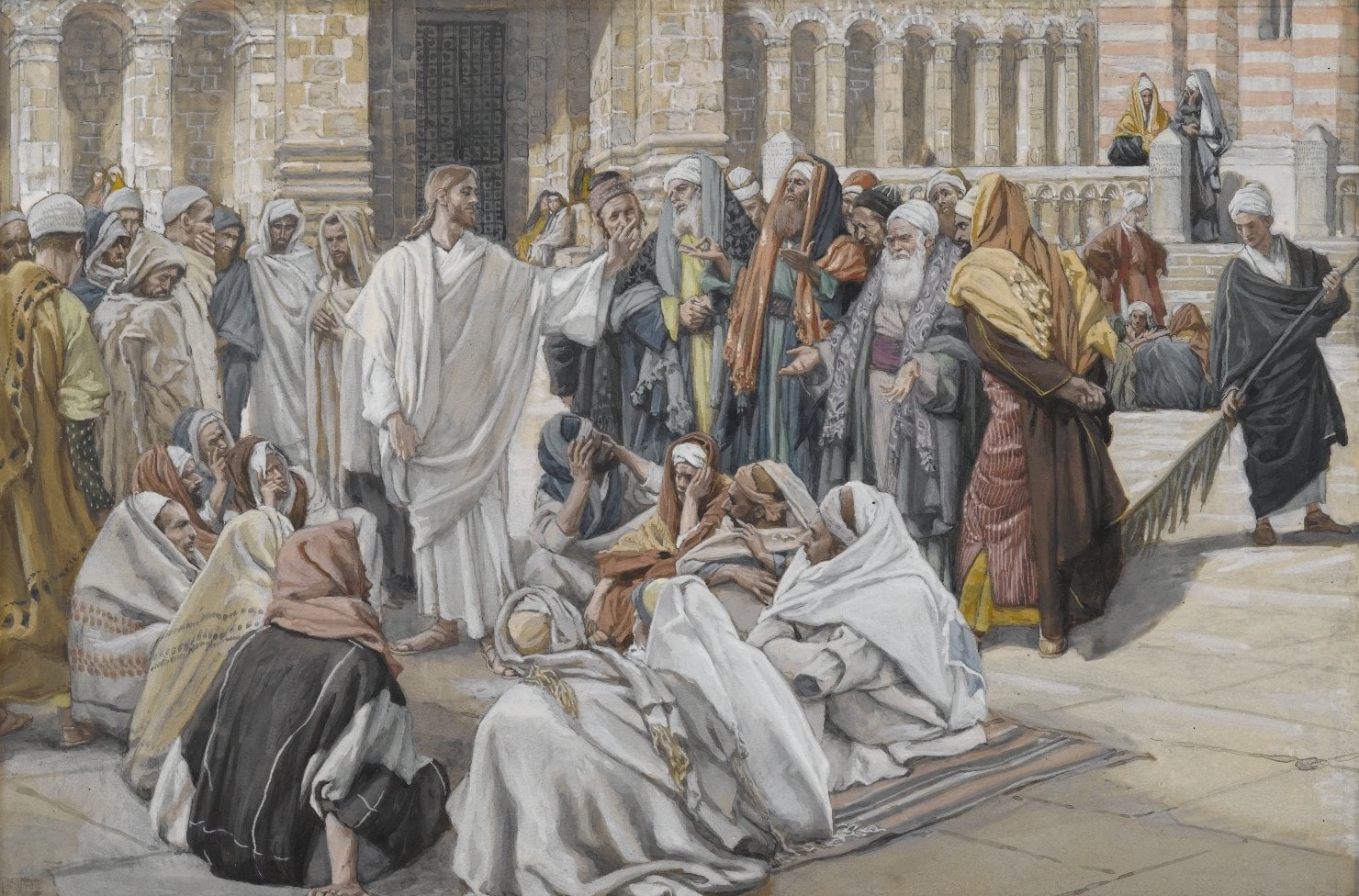
But look at how Jesus uses that authority. He uses it to serve the disciples by washing their feet. This washing was, in a sense, a parable acted out. By serving His disciples in this way, Jesus is showing how He wants them and us to serve and love one another.

Having someone was your feet was common in Jesus’ day. Anyone who was going to be a guest at a banquet would have their feet washed even if they had just bathed. The walk from one house to another would make a person’s feet dirty enough to need another washing. But the task of foot washing was always reserved for the lowest servants. It was normal for a disciple to do many different chores for the rabbi he was following, but foot washing was never one of them. But here, in a beautiful reversal, Jesus – the Rabbi, the Teacher sent from God, and, in fact, God in the flesh with all authority – humbles Himself to serve His disciples by doing the lowest task for them. This foot washing was an act of vulnerability and intimacy.

When Jesus washes their feet, Judas had not yet left to betray Jesus. Judas was still there. Our Lord washed Judas’ feet and served His betrayer in this way. Judas does not benefit from this, but Jesus still does it for him.

With this foot washing, Jesus gives us an example that teaches us a very important lesson: Love isn’t always easy or clean. Love can often be one-sided and unanswered. Just because you love someone and do selfless acts for them does not mean they will love you in return. Remember, you aren’t greater than Jesus. If His love was rejected and repaid with betrayal, yours will be too.

Yet, still Jesus would have you, His disciples, His Christians, love your enemies just as you have been loved by Him. Bear one another’s burdens. Forgive and serve one another. That is this new commandment, this new mandate, that Jesus gives.

But because you do and will fail in this mandate that Jesus gives, Maundy Thursday is more than Jesus giving a new commandment. It is the night that Jesus also mandates and gives you a meal. Tonight is the night in which Jesus was betrayed, and Judas isn’t the only culprit. Even the disciples who love Jesus fail Him, but He does not fail them. That is why Jesus gives the disciples more than a mandate. He also leaves them the enduring, continual gift and meal of His living Body and Blood.

The two Sacraments Jesus has given us are both precious and give salvation and forgiveness, but they are different. Baptism defines who we are as Christians. In Baptism, we are given God’s name (Mt. 28:19), we are begotten as His children (Jn. 3:3-8), and we are clothed in Christ (Gal 3:27). Baptism defines who we are.

And the Lord’s Supper is what we, the Baptized, do because it is what Jesus has given us to do. We are to eat and drink in remembrance of Jesus (1 Cor. 11:23-25) and whenever we celebrate the Lord’s Supper, according to Scripture, we proclaim His death until He comes (1 Cor. 11:26). In the Lord’s Supper, Jesus promises that we receive the forgiveness of sins. And most Christian thing you can do is receive Christ’s forgiveness.

When Jesus calls us to eat and drink in remembrance of Him, He doesn’t mean, “Do this while you think fondly about Me and what I did for you a long time ago.” Instead, this remembrance is about faith. Faith recalls and clings to what Jesus did and still does with this Bread and Cup. According to what Jesus says, this Bread is His Body which was broken upon the cross for you, and this Cup is His Blood which was shed for you. In faith, we celebrate the Lord’s Supper believing that all of this pertains to us and to our salvation.

Jesus’ death happened nearly 2,000 years ago on a cross outside Jerusalem, but the fruits of His redeeming death are given both before and after. Jesus gives His disciples His Body and Blood even before He makes the sacrifice. And He continues to give the same gifts in every congregation where two or three are gathered. His gift is not bound by time or place.

Both the mandate to love one another and the meal of the Lord’s Supper go together. They are faith and love in action. With the sacrifice of His Body and Blood, Jesus loved the disciples. And when He washed their feet, Christ showed them how to love each other as they place their trust in Him.

So, dear saints, follow Christ’s example and do as He has done to and for you (Jn. 13:15). Your Savior, who has all authority, came to serve you.

And know that when you come to this altar, to this table, you come as royal children of Christ the King and are serving the world. The world benefits from you receiving what Jesus gives in Holy Communion. This Sacrament drives back the forces of darkness because in this meal, Jesus’ death in the place of sinners is proclaimed (1 Cor. 11:26). Jesus puts His Body and Blood into you to crucify you to the world and the world to you (Gal. 6:14). As you receive this meal and do this in remembrance of Him, you celebrate His victory over sin, death, and the devil. Of course, you benefit from this, but so does your neighbor. As you are fed and strengthened in your faith, you will go back into the world knowing that God has forgiven you for the sake of Christ.

And when you fail to be the servant Jesus calls you to be, when you fail to love as you have been loved, run back to Jesus. He is always ready to give you another washing and another serving.

Dear saint, you are declared by Jesus to be clean. Your Lord and Savior is here to be your Servant and cleanse you again. Come and receive what He gives you for your cleaning, for your comfort, for your strengthening. Amen.The peace of God, which surpasses all understanding, will guard your hearts and minds in Christ Jesus. Amen.

[1] Reworked from 2021.

Innocent Blood – Sermon on Matthew 26:1-27:66 for Palm Sunday

Matthew 26:1-27:66

In the name of Jesus. Amen.

Matthew is the only one of the four Gospels that tells us what happened to Judas after Jesus was arrested and condemned (Mt. 27:3-10). Judas was overcome with regret and guilt because he knew that God had cursed anyone for taking a bribe to shed innocent blood (Dt. 27:25). Our translation says that Judas “changed his mind” (Mt. 27:3). In Greek, it’s one word (μεταμέλομαι) that is similar to the word for repentance (μετανοέω), but the change of mind Judas had was only one-sided. And here’s what the text conveys: Judas was very sorry. He wished that what he had done could be undone. He regretted his betrayal, but Judas did not repent the way Christians repent. Christian repentance has two parts. It includes the regret and change of mind Judas had. But saving repentance goes one step further. Christian repentance also trusts and believes in God’s grace and mercy given on account of Jesus’ death and resurrection (Mk. 1:15). Judas was lacking that faith and trust.

That lack of faith in God’s mercy is why Judas goes to the chief priests and elders. He doesn’t know where else to turn even though he had been taught better. Sadly, Judas brings his confession to the wrong place. Judas went to the Temple which had been the place of forgiveness (1 Kgs. 8:30), but the night before, Jesus had clearly told Judas and the rest of the disciples that He was instituting the New Covenant (Jer. 31:33-34) in His Blood for the forgiveness of sin (Mt. 26:26-29). The result was that Judas went to the very ones who had been seeking Jesus’ death (Mt. 26:14-15). Judas knew where he needed to go for forgiveness – he had been told just a few hours earlier. But instead of going to Jesus, he sought forgiveness where it could not be found.

Judas’ confession of sin and his action of returning the thirty pieces of silver were both right. He had betrayed innocent blood and returning the payment he received for his sin was what he should do. But his sorrow and penance could not undo what he had done; it could not remove the guilt of his sin. The chief priests and elders were supposed to be forgivers, absolvers, and ministers of atonement. Yet, after hearing Judas’ confession, they refuse to lift the burden of guilt from him. Instead, they bind Judas’ sin and betrayal on his head. “What is that to us? See to it yourself” (Mt. 27:4). What a chilling, horrific thing to say to someone who is crushed with guilt.

Throughout the Gospels, those religious leaders had tried to convict Jesus of sin. They would accuse Jesus and the disciples of eating with defiled hands (Mt. 15:1-20) and of eating and associating with tax collectors and sinners (Lk. 15:1-2). They were always trying to trap Jesus (Mt. 22:15-40). You would think that they would at least tell Judas something like, “Don’t worry, Jesus isn’t innocent. He’s a sinner. He’s dangerous. He’ll bring trouble to all of us with his teaching.” But they don’t. They don’t try to convince Judas that Jesus was guilty. They don’t even offer that little shred of comfort to Judas. It appears as though they also know that Jesus was innocent. Back in Mt. 23:2-4, Jesus rightly said of them, “They tie up heavy burdens, hard to bear, and lay them on people’s shoulders, but they themselves are not willing to move them with their finger.”

If the chief priests and elders had offered Judas forgiveness, it would have required them to admit their own guilt. Again, they were the ones who conspired with Judas to shed Jesus’ innocent blood. But instead of repenting, they insisted they were doing the right thing in condemning Jesus. So, they become absurdly hypocritical.

After Judas throws the pieces of silver in the Temple, they quickly work to get that money out of the Temple because it is blood money. They recognize they cannot put the bounty they had placed on Jesus’ head back in the holy treasury because it is unclean money (Dt. 23:18). But (here’s the hypocrisy) they were the ones who defiled that holy money. They were the ones who took it from the treasury. They were the ones who turned that silver into blood money using it to pay Judas for his betrayal (Mt. 26:15).

While it is tempting to despise the chief priests and Judas, in Christian humility we need to recognize that we do just as they did. Too often, we are filled with sinful desires and passions and make any excuse to attempt to justify them. Too often, we will do all sorts of horrific things and try to hide them under the guise of holiness while we ignore the carnage it wreaks on others. Too often, we are like Judas and don’t realize how destructive our behavior is until it’s too late. When we do, finally, realize the great harm we have done, it can lead us to despair. And despair is a dangerous place to walk. Judas despairs of all hope and kills himself. Judas is condemned, not because he kills himself, and not even because he betrayed Jesus. Jesus’ death covered even Judas’ sins of suicide and betrayal. Judas is condemned because he died outside of faith in Jesus’ grace and mercy. Jesus calls Judas the “son of destruction” (Jn. 17:12) and says that it would have been better for Judas if he had never been born (Mt. 26:24). Jesus never says anything like that about His sheep.

Please allow me a brief aside here: Suicide, self-murder, is not the unforgivable sin. Can people commit suicide and still be a Christian? Yes. To those of you who have lost someone to suicide, you can have comfort in the promises of Scripture. Christ Himself is the man of sorrows, acquainted with grief (Is. 53:3). When someone is walking in grief, depression, and even in the valley of the shadow of death, Jesus is with them (Ps. 23:4) and desires to save them (1 Tim. 2:4). In that deathly vale, Jesus calls to them, “Come to Me, all who labor and are heavy laden, and I will give you rest” (Mt. 11:28). All that being said, suicide is an evil death and is never the answer to despair.

The answer to all sin and despair is in the innocent Blood of Jesus which has been shed for you. His innocent Blood was shed to cleanse you of your guilty blood. Whenever you recognize your guilt and sin against God, bring those sins to Christ. Let Him deal with them because He has dealt with them in His death and resurrection. He is the Lamb of God who takes away the sin of the world (Jn. 1:29). 

The answer to sin is the innocent Blood of Jesus that He freely gives to you in Holy Communion. And now, Jesus invites you to His table to receive that Blood which He will put in your mouth. Here, Jesus’ innocent Blood becomes your blood. Dear saints, come, take, eat, and drink the perfect, innocent Blood of your Savior which He has shed for the forgiveness of all your sins. Amen.

The peace of God, which surpasses all understanding, will guard your hearts and minds in Christ Jesus. Amen.

See No Death, Taste No Death – Sermon on John 8:42-59 for the Fifth Sunday of Lent

John 8:42–59

42 Jesus said to them, “If God were your Father, you would love me, for I came from God and I am here. I came not of my own accord, but he sent me. 43 Why do you not understand what I say? It is because you cannot bear to hear my word. 44You are of your father the devil, and your will is to do your father’s desires. He was a murderer from the beginning, and does not stand in the truth, because there is no truth in him. When he lies, he speaks out of his own character, for he is a liar and the father of lies. 45 But because I tell the truth, you do not believe me. 46 Which one of you convicts me of sin? If I tell the truth, why do you not believe me? 47 Whoever is of God hears the words of God. The reason why you do not hear them is that you are not of God.”

48 The Jews answered him, “Are we not right in saying that you are a Samaritan and have a demon?” 49 Jesus answered, “I do not have a demon, but I honor my Father, and you dishonor me. 50 Yet I do not seek my own glory; there is One who seeks it, and he is the judge. 51 Truly, truly, I say to you, if anyone keeps my word, he will never see death.”52 The Jews said to him, “Now we know that you have a demon! Abraham died, as did the prophets, yet you say, ‘If anyone keeps my word, he will never taste death.’ 53 Are you greater than our father Abraham, who died? And the prophets died! Who do you make yourself out to be?” 54 Jesus answered, “If I glorify myself, my glory is nothing. It is my Father who glorifies me, of whom you say, ‘He is our God.’ 55 But you have not known him. I know him. If I were to say that I do not know him, I would be a liar like you, but I do know him and I keep his word. 56 Your father Abraham rejoiced that he would see my day. He saw it and was glad.” 57 So the Jews said to him, “You are not yet fifty years old, and have you seen Abraham?” 58 Jesus said to them, “Truly, truly, I say to you, before Abraham was, I am.” 59 So they picked up stones to throw at him, but Jesus hid himself and went out of the temple.

In the name of Jesus. Amen.

Today we hear Jesus give one of the clearest, most comforting promises He ever spoke. “Truly, truly I say to you, if anyone keeps My Word, he will never see death.” As comforting as this already is, it is even more comforting when we consider the context of when Jesus says this. Jesus is having an argument with some of the Jews in the Temple (Jn. 8:20, 24), and this argument is heated.

Earlier, in part of the argument that isn’t in our text, Jesus told them, “You will die in your sin.” He calls them slaves to sin (Jn. 8:31-34). In this reading, you heard Jesus call these hostile people children of the devil (Jn. 8:44) who do not listen to the voice of God (Jn. 8:47).

Now, these are not tactics you will hear in an evangelism class, but it is all true. Of course, Jesus is telling them the truth. Everything He says is absolutely true, clear, and direct. Jesus isn’t beating around the bush or sugarcoating anything. He isn’t worried about tiptoeing around touchy topics in order to maintain His relationship with them just in case they eventually come around to see things His way. Christ tells them what they need to hear even though it is offensive.

Dear saints, there are times when you simply tell someone the truth, and they will get mad. But the truth remains the truth no matter how people respond to it. Yes, speak the truth in love (Eph. 4:15), but remember that the truth is always loving. And know that there are times people will get angry when they hear the truth. And it isn’t a matter of you needing to speak the truth in a better way or be more loving. You are not smarter, gentler, or more loving than Jesus. Even though He speaks the hard truth to them, Jesus loves these people. About six months after this argument, Jesus will go the cross and be their substitute under God’s wrath, but here they get angry with Him. And if people got angry with Jesus for telling the truth, then, Christian, there are times when people will be angry with you for telling the truth. Sometimes, showing love will get people angry with you.

That’s all important to know, but we are trying to see how great a promise Jesus makes to these people who are arguing with Him when He tells them that if they keep His Word they will never see or taste death. He starts with the hard but loving truth, but listen to how they respond. They throw two accusations at Jesus, “Are we not right is saying that You are a Samaritan and have a demon?” Now, calling Jesus a Samaritan was, at least, a racial slur. Today, people’s lives get ruined if they use this type of language. But this might have been more than just a racial slur.

Remember, Jesus had just called them children of the devil (Jn. 8:42), and when they call Jesus a Samaritan, it appears that they are responding to Jesus calling them Satan’s spawn. They are saying that Jesus’ mom was adulterous and promiscuous. They are calling Jesus is an illegitimate child.

They also accuse Jesus of having a demon. Here is God in the flesh warning people and calling them to repentance and faith, and they accuse Him of trying to pull them down into hell. If I were in Jesus’ sandals and had to listen to people saying awful things like this, the best I could hope to do is walk away from them. But Jesus doesn’t walk away. Instead, this is the context where He gives them the promise, “Truly, truly, I say to you, if anyone keeps My Word, He will never see death.” He is calling them to faith and life. Despite their horrific statements, Jesus still loves them and wants to rescue them from death. That Jesus would give this promise to these people – in fact, that He is even speaking to them at all – is tremendous, remarkable mercy. Jesus had come to rescue them.

But, again, they respond to this promise, “Now we know you have a demon!” They are hearing are the very words of God, but they think it is the voice of Satan. Jesus had come to His own, but they did not receive Him (Jn. 1:11); they loved the darkness rather than the light (Jn. 3:19).

So, what does Jesus mean when He says, “Truly, truly, I say to you, if anyone keeps My Word, He will never see death”? First, what does it mean to keep His Word?

To keep Jesus’ Word is to believe what He says. Keeping Jesus’ Word does mean to do the things He commands, but it also means that when you fail to obey what He says, you also keep Jesus’ promises. It means believing that because of what God has done for you in Christ, you are forgiven (Jn. 6:28-29). Keeping Jesus’ Word means to believe what He says when He calls you a sinner, and keeping Jesus’ Word means believing what He says when He declares that you are forgiven.

Anyone who keeps Jesus’ Word will never see death. And what does that mean? Well, most of you have heard me preach at a funeral, so this is something you have heard before. But even if we heard this a thousand times, we still need to be reminded of it – even if it isn’t at a funeral.

To the one who keeps Jesus’ Word, to anyone who believes the Gospel, in other words you, Christian, you will never see death. You won’t die. And this isn’t the only time Jesus says something like this. In John 10:28, Jesus says that His sheep will never perish. In John 11:26, Jesus plainly says, “Everyone who lives and believes in Me shall never die.”

It is true that one day you will breathe your last and your heart will stop beating – unless Jesus comes first. Christ might return before that happens (1 Thess. 4:15). Let’s imagine that Jesus does come back before you die, you are simply given your new body and are eternally with the Lord. If you went and found your loved ones who did die and asked them, “What was that like? What happened when you died?”

Their response would be, “I don’t know. I didn’t die. Jesus was simply with me the entire time.”

“Even though I walk through the valley of the shadow of death, I will fear no evil, for You are with me” (Ps. 23:4) – all the way through. Jesus has died for you. Christ has taken away your sin, your guilt, your shame, and even your death.

That is why Scripture will regularly use different terms when a believer dies. Abraham didn’t die, he was “gathered to his people (Gen. 25:8). Simeon, after he sees forty-day-old Jesus in the Temple says that now he can depart in peace (Lk. 2:29). The Bible talks about death being sleep (Mt. 9:24; Jn. 11:11, 13-14; 1 Thess. 4:13) from which Jesus will simply wake us. Paul talks about death as “departing and being with Christ” (Php. 1:23), being “delivered from evil” (2 Tim. 4:18), and even death being gain (Php. 1:21).

Dear saints, Jesus is the God of the living (Lk. 20:38) and He promises that, “neither death nor life, nor angels nor rulers, nor things present nor things to come, nor powers, nor height nor depth, nor anything else in all creation, will be able to separate [you] from the love of God in Christ Jesus [your] Lord” (Ro. 8:38-39). Dear saints, keep Jesus’ Word, believe, and you will never see and never taste death. Amen.

The peace of God, which surpasses all understanding, will guard your hearts and minds in Christ Jesus. Amen.

The King’s Test – Sermon on John 6:1-15 for the Fourth Sunday of Lent

John 6:1-15

1 After this Jesus went away to the other side of the Sea of Galilee, which is the Sea of Tiberias. 2 And a large crowd was following him, because they saw the signs that he was doing on the sick. 3 Jesus went up on the mountain, and there he sat down with his disciples. 4 Now the Passover, the feast of the Jews, was at hand. 5 Lifting up his eyes, then, and seeing that a large crowd was coming toward him, Jesus said to Philip, “Where are we to buy bread, so that these people may eat?” 6He said this to test him, for he himself knew what he would do. 7 Philip answered him, “Two hundred denarii worth of bread would not be enough for each of them to get a little.” 8 One of his disciples, Andrew, Simon Peter’s brother, said to him, 9 “There is a boy here who has five barley loaves and two fish, but what are they for so many?” 10 Jesus said, “Have the people sit down.” Now there was much grass in the place. So the men sat down, about five thousand in number. 11Jesus then took the loaves, and when he had given thanks, he distributed them to those who were seated. So also the fish, as much as they wanted. 12 And when they had eaten their fill, he told his disciples, “Gather up the leftover fragments, that nothing may be lost.” 13 So they gathered them up and filled twelve baskets with fragments from the five barley loaves left by those who had eaten. 14 When the people saw the sign that he had done, they said, “This is indeed the Prophet who is to come into the world!” 

15 Perceiving then that they were about to come and take him by force to make him king, Jesus withdrew again to the mountain by himself.

In the name of Jesus. Amen.

Jesus asks Philip, “Where are we to buy bread, so that these people may eat?” And John gives us insight as to why Jesus asks the question. It was to test Philip. Now, Jesus didn’t just find Himself in the midst of the wilderness surrounded 5,000 men plus women and children – in all likelihood a crowd of ten to twenty thousand people – with no food and sees an opportunity for a test. No, Christ sets the entire thing up.

The feeding of the 5,000 is one of the few events recorded in all four Gospels (Mt. 14:13-21; Mk. 6:30-44; Lk. 9:10-17; and Jn. 6:1-15). The picture the texts collectively paint is that Jesus intentionally draws this crowd out into the wilderness (Mk. 6:31). He takes the time to heal many of them (Mt. 14:14) and preaches late into the evening (Mk. 6:34-35). In other words, Jesus means to bring them to that desolate place where there is no food, but food is needed. On top of that, He is the King who created everything (Jn. 1:1-2, 14). Jesus can cause rain to fall in one place but not another (Am. 4:7). Throughout the entire world, Jesus was the One providing bread and food for all mankind (Ps. 145:15-16), but Christ brought this massive crowd out into the wilderness to this particular mountain in order to set this test up for Philip. And the test has one question, “Where are we to buy bread, so that these people may eat?” Jesus isn’t looking for information. He’s not asking Philip to devise a plan or order something through Door Dash. The text tells us, “[Jesus] knew what He would do” (Jn. 6:6).

Now, put yourself in Philip’s position. It isn’t hard to imagine. When was the last time you were in a seemingly impossible situation? Your bank account got low, and suddenly your car needs significant, expensive repairs. You wonder, “Where’s the money going to come from?” Your kid or your spouse gets sick, and while you are doing everything you can to care for them, you get sick too. You don’t know where you will get the strength care for yourself much less your kid. You’re in a really busy time at work, then there is a blizzard, so you have to dig yourself out and help your aging parents clear out their driveway too. You don’t know where you will find the time to do everything that needs to be done. How often do you look at your calendar or think through all the things you need to accomplish and have no idea how you are going to make it through the week? Whether it is resources and money, strength and endurance, time and skills, there are moments in your life where you are buried under the expenses, responsibilities, and tasks, and all you can see is what you don’t have.

That is why Philip fails Jesus’ test. He sees what they have, and he concludes it isn’t enough. His response is, basically, “You’re jumping the gun, Jesus. Look around. We’re in the wilderness, not the marketplace. Even if we were surrounded by stores fully stocked with bread, we don’t have enough money. Two-hundred denarii wouldn’t be enough for all of them to even get a bite.”

The test was for Philip, but Andrew, Peter’s brother, takes a shot at the exam. This is just an aside, but this text really shows how similar Andrew and Peter are. Peter will jump into situations like a madman (Mt. 14:28-29) and will speak when he should just be silent (Mk. 9:5-6). Andrew does the same when he says, “This boy has five barley loaves and two fish, but that’s not going to cut it with this crowd.”

Both Philip and Andrew fail the test even though they knew the answer. The correct answer was, “I don’t know where we will buy bread, Jesus. But I do know You are here. You have provided food in bleaker situations than this, so You’ve got it all under control.” Philip and Andrew knew that Jesus was the Messiah (Jn. 1:41). They knew He was the fulfillment of what Moses and the prophets wrote (Jn. 1:45). In other words, they both knew that Jesus was the one who rained bread from heaven and sent quail in abundance for His people in the wilderness (Ex. 16:4, 13). They knew Jesus was the one who sent the ravens to feed Elijah by the brook (1 Kgs. 17:3-7) and through the widow’s jars of oil and flour that never ran out during the drought (1 Kgs. 17:14-16). They know that God promises in Psalm 34:10 which says, “Those who seek the Lord lack no good thing.”

Both Philip and Andrew know all of this, but they still fail the test, just like you and I do. They fail, notbecause they don’t know enough, weren’t taught well, or needed to go back to Sunday School. They fail for the same reasons we do – because we are sinners. All of us sinners fail to trust God’s promises to provide everything we need. Instead, we fall into despair, weakness, unbelief, and a ‘woe-is-me’ attitude.

Dear saints, repent and then rejoice.

When God brings tests and trials your way, remember that He is with you. And because He is with you, it doesn’t matter what you have or don’t have. Jesus doesn’t need soil and seed and rain and time and the right weather conditions and combines and grain elevators and flour mills and factories and bakers and truck drivers and grocers to give people bread. Jesus doesn’t need boats and bait and poles and nets and processing plants or even water to feed people fish. Just because those are the normal methods God delivers bread and meat to us, that doesn’t mean that is the only way He does it. Jesus is always free and able to cut all of that out and give exactly what is needed when it is needed – just like He does here.

Christ provides what Philip, Andrew, and all the disciples could not buy, bake, grow, earn, catch, or deserve. He provides this meal to the crowds and enough to last His flunked disciples for days afterward.

But most importantly, Jesus lavishly pours out His mercy and grace on His sinful disciples. We see it here as He doesn’t scold them for their unbelief and sin. In fact after this, Jesus will feed another crowd – four thousand that time (Mk. 8:1-10). And right after that the disciples are with Jesus in a boat, and they realize they only have one loaf of bread, and they will worry about their lack of food again (Mk. 8:14-21).

Jesus is always in control of every situation. The crowds here are about to try and take Christ by force to make Him king, but Jesus simply withdraws. And one year later, at the next Passover, the crowds will come with force to arrest Jesus, but He will not withdraw. They will put a royal purple robe on Him, crown Him with thorns (Jn. 19:2-3), crucify Him, and place a placard above His head that says, “Jesus of Nazareth, King of the Jews” (Jn. 19:19). There, on the cross, He will give and shed His blood for the forgiveness of sinners who fail the tests.

But the cross is no test. Instead, it is where Jesus, your Savior and King, demonstrated and proved His love and mercy for you, and for all us failures. Here and now, He delivers that mercy to you as He gives you His kingly Body and His royal Blood given and shed for the forgiveness of all your sins and failures.

Dear saints, come and receive. Amen.

The peace of God, which surpasses all understanding, will guard your hearts and minds in Christ Jesus. Amen.

Unmuted – Sermon on Luke 11:14-28 for the Third Sunday of Lent

Luke 11:14–28

14 Now he was casting out a demon that was mute. When the demon had gone out, the mute man spoke, and the people marveled. 15 But some of them said, “He casts out demons by Beelzebul, the prince of demons,” 16 while others, to test him, kept seeking from him a sign from heaven. 17 But he, knowing their thoughts, said to them, “Every kingdom divided against itself is laid waste, and a divided household falls. 18 And if Satan also is divided against himself, how will his kingdom stand? For you say that I cast out demons by Beelzebul. 19 And if I cast out demons by Beelzebul, by whom do your sons cast them out? Therefore they will be your judges. 20 But if it is by the finger of God that I cast out demons, then the kingdom of God has come upon you. 21 When a strong man, fully armed, guards his own palace, his goods are safe; 22 but when one stronger than he attacks him and overcomes him, he takes away his armor in which he trusted and divides his spoil. 23 Whoever is not with me is against me, and whoever does not gather with me scatters.

24 “When the unclean spirit has gone out of a person, it passes through waterless places seeking rest, and finding none it says, ‘I will return to my house from which I came.’ 25 And when it comes, it finds the house swept and put in order. 26Then it goes and brings seven other spirits more evil than itself, and they enter and dwell there. And the last state of that person is worse than the first.”

27 As he said these things, a woman in the crowd raised her voice and said to him, “Blessed is the womb that bore you, and the breasts at which you nursed!” 28 But he said, “Blessed rather are those who hear the word of God and keep it!”

In the name of Jesus. Amen.

The past few weeks including today, the Scripture readings have had us considering temptation, the devil’s work, and demons. Even though we might prefer to think about other things, Jesus wants us to know about and beware of the devil and the demons. Christ takes demons seriously. Our Lord doesn’t spend a lot of time warning us about our finances, sickness, or wars. But Jesus regularly and repeatedly warns against false doctrine and against demons. So, demons will be part of our focus today because that is what the text has for us.

Almost everything we know about demons comes from the New Testament. Demons are creatures; they are fallen angels. They, just like everything else, were created by God, and we know that they were initially created good because when God looked over everything He created, He saw that it was good (Gen. 1:31). Satan, who is nothing more than the chief demon, led the rest of the demons in rebellion against God. Demons are real, powerful, malicious, and malevolent. Scripture calls them the “cosmic powers over this present darkness” and the “spiritual entities of evil” (Eph. 6:12). But even if they all worked together, they would not have more power than God. They all flee from and melt before God’s Word.

Now, I want to clear something up from the sermon last week, but I want to preface it with this: If you ever have a question about anything I preach, please feel free to talk with me about it. I am not immune from preaching incorrectly. So, if you ever hear anything from my mouth as I preach or teach that doesn’t line up with Scripture, please point it out to me. And I’ve said this before, and it’s time to say it again. If you find that I am preaching contrary to Scripture and won’t receive correction, run me out of here for the sake of your soul.

In last week’s sermon I went off script for a bit and said that the demons, “are God’s demons.” I was very politely asked about that statement, and I want to make sure that statement isn’t misunderstood. God does not direct the demons to torment us. God tempts no one with evil (Jam. 1:13). To anyone who got that impression, please forgive me. That is not what I was trying to convey, and I should have been clearer than I was. What was meant by that is that the demons are completely under God’s control, and they cannot do anything unless God allows it. We know this because even Satan had to get God’s permission to torment Job (Job 1:6-12, 2:1-6). The other thing we should see is that God can even use the attacks and assaults of demons to bring about good. God causes all things to work together for good for those who love Him and are called according to His purpose (Ro. 8:28) – even the work of demons.

Now, to this Gospel text. We don’t learn about the tactics of demons here, but we do learn about one of their objectives or goals. A demon has made a man mute. Other places in the Gospels, demons will make people throw their bodies around (Mk. 5:1-5, 9:25-27) and speak through their voices (compare Mk. 5:7, 9). Demons seem to want to influence people in certain ways. Again, here the issue is this man is unable to speak. One of the reasons demons want us to be mute is that with the heart one believes and with the mouth he confesses and is saved (Ro. 10:10).

The demons do not want us to confess or praise Christ. They want us to be silent – especially when it comes to God’s Word. Demons do not want us to speak up for the unborn, about marriage existing only between a man and a woman, or even about the God-created differences between men and women. None of those are things are “political.” If you think those are only political issues, it shows that the demons are gaining ground over your thinking about those things. Satan and the demons want us to think that moral issues are merely political issues. Dear saints, Scripture and theology should be used in all aspects of life. Abortion, marriage, and gender issues are not political issues. Not even climate change is a political issue. God promised that until Christ returns to make all things new, “seedtime and harvest, cold and heat, summer and winter, day and night, shall not cease” (Gen. 8:22). God does call us to take good care of the creation He has given us, but we cannot destroy it. We aren’t that powerful, and thinking we are is a form of idolatry. But the demons want to make us mute on a whole host of topics so they can deceive the whole world.

All of us, at times, have fallen into the demonic temptation of being mute. Instead of speaking the truth in love, we fear losing friends, offending family members, or missing out on a promotion. Instead of fearing God, we fear being called judgmental, bigoted, sexist, homophobic, etc. The world needs Christians to speak the truth out loud now more than ever.

And, dear saints, here is why you can be bold when it comes to the truth. The demons are real, terrible, malicious, and dangerous, but they are also utterly defeated. Jesus says that He casts out demons by the finger of God. By His death and resurrection, Christ has disarmed the demons and put them to open shame (Col. 2:15). Jesus is the stronger man who has defeated Satan and all of the demons. And because Christ has won the victory over them, we can easily defeat them too. James 4:7 says, “Submit yourself to God. Resist the devil and he will flee from you.”

To see how defeated the demons are, pay attention to the little parable Jesus tells in this text. He says that when a strong man (and there Jesus is referring to the devil), who is fully armed guards (and keep that word ‘guards’ in the back of your mind because it comes up again in a little bit) his house (which is the world), his goods (I.e. sinners) are safely under his lordship. But Jesus says that when one stronger than him (and Jesus is referring to Himself) comes and attacks him, Christ takes away his armor, and divides the spoil (and that is you).

Just think about that. Jesus says that He has come to rob the devil’s house and you are the spoils, the treasure, the plunder that Jesus wants to rescue out of the devil’s cellar. Christ has won, redeemed, purchased, and grabbed you from the devil’s clutches. All by the power of His finger. And Christ opens your lips to declare His praise (Ps. 51:15) and the truth. He has pulled you out of darkness and into His marvelous light.

So how do you know if you are in the kingdom of God or in the kingdom of the devil? Well, Jesus answers that. A woman says to Jesus, “Blessed is the womb that bore you, and the breasts that nursed you.” Now, Mary was certainly blessed. She is the mother of our Lord. But Jesus says, even better than being His mother is to hear the Word of God and keep it. Though you were guarded by Satan, Jesus has come and rescued you with His finger transferring you into His kingdom. Now, you keep – which is the same word Jesus used to describe what Satan, the strong man, did with his goods he guarded and kept them. Now, you keep and guard the Word that Jesus used to deliver you from Satan.

With His little finger, Jesus destroys the stronghold and armor of the devil and claims you as His own. And He will never leave you or forsake you. Instead, Christ guards and keeps you now and for all eternity. This is why keeping, guarding, confessing, being unmuted when it comes to God’s Word is so important. With the shield of faith, you are able to quench all the flaming darts of the evil one (Eph. 6:16). Your voice unmuted and you open your lips so that you can boldly proclaim the excellences of Him who called you out of darkness into His marvelous light (1 Pet. 2:9). May God grant us the boldness to speak the truth in love. Amen.

The peace of God, which surpasses all understanding, will guard your hearts and minds in Christ Jesus. Amen.
When Crumbs Become a Feast – Sermon on Matthew 15:21-28 for the Second Sunday of Lent

Matthew 15:21–28

21 And Jesus went away from there and withdrew to the district of Tyre and Sidon. 22 And behold, a Canaanite woman from that region came out and was crying, “Have mercy on me, O Lord, Son of David; my daughter is severely oppressed by a demon.” 23 But he did not answer her a word. And his disciples came and begged him, saying, “Send her away, for she is crying out after us.” 24 He answered, “I was sent only to the lost sheep of the house of Israel.” 25 But she came and knelt before him, saying, “Lord, help me.” 26 And he answered, “It is not right to take the children’s bread and throw it to the dogs.” 27 She said, “Yes, Lord, yet even the dogs eat the crumbs that fall from their masters’ table.” 28 Then Jesus answered her, “O woman, great is your faith! Be it done for you as you desire.” And her daughter was healed instantly.

In the name of Jesus. Amen.

Whenever you are reading Scripture, look for the surprises. To see the surprises in this particular text, we first have to recognize some things that are not surprising. This Canaanite mother cries out to Jesus because her daughter is severely oppressed by a demon. As harsh as this sounds, it is no surprise at all that her daughter is suffering at the hands of demons.

Jesus is in the district of Tyre and Sidon, and that region was the center of Baal worship. Baal worship, among other horrible things, included child sacrifice. Obviously, this Canaanite woman hadn’t killed her daughter as a sacrifice to Baal. But in that pagan culture, it was common to engage in occult practices and make deals with demons in order to make your fields more fruitful, to get revenge on someone, to make a person fall in love with you, and all sorts of other things. While we don’t know exactly what caused the girl to be demonized, both this woman’s background and what she says suggest that she does know, and it is very possible that it was because of something she had done. If she and her daughter were innocent regarding this demonic possession, the woman would be crying out for justice, but that isn’t what she cries out for. She cries out to Jesus for mercy. She sees her daughter’s suffering and feels guilt.

Let’s bring this to us today. Dear saints, be aware. Demons have not gone away. If you ignore their existence, it is to your own peril. Demons are real, and they are active. Even if you don’t read horoscopes, call psychic hotlines, use healing crystals or ouija boards – and don’t do those things, they are demonic and evil – but even if you don’t do those things, that doesn’t mean you aren’t opening up yourself to demons. Pornography can be a portal for demons. Getting drunk, giving in to your anger, or being lazy also opens you up to their influence (Col. 3:5-8; 2 Thess. 3:6, 11). In fact, all pet sins dabble in the demonic. We want to imagine that our sins are no big deal or excusable. They aren’t. Sin hurts both the sinner and the sinner’s immediate family. Repent. Know that Christ has defeated the demons and protects you from them. But engaging in pet sins is like dangling your bleeding foot in shark-infested waters. Don’t invite the demons into your life by continuing in those sins.

Now, that brings us to the first surprise in the text which comes in the woman’s initial prayer. She addresses Jesus as the Son of David, and that is a loaded term – especially from her. She’s a foreigner. King David never ruled over her people or her homeland. And yet there are all sorts of promises that a descendent of David would sit on the throne forever and save even the inhabitants of the pagan nations (Is. 11:10-16). And this woman believes Jesus is the Son of David who can help her and her daughter. Jesus is her last hope.

And that brings us to the second surprise. Jesus doesn’t answer her a word. Jesus is usually so quick to have mercy when called upon, but not here. More on that surprise in a minute.

First, we have to consider the disciples’ reaction to her. They pray and ask Jesus to send her away. Unfortunately, this isn’t surprising. It’s disappointing, callous, and sinful, but not surprising. They were tired of hearing her shrieking for mercy. They probably speculated that she is suffering because of her own wickedness. Their attitude and thinking toward her seems to be along the lines of, “Well of course your daughter has a demon. You’ve brought this on yourself. Jesus, if You’re not going to help her, at least tell her to take a hike.” But even though this speculation was probably correct, the disciples failed to have compassion.

Dear saints, too often we are like the disciples. We fail to have compassion on those who are suffering around us. When people are groaning under their suffering, that isn’t the time to be like Job’s ‘friend’ Zophar and say, “You’re getting what you deserve. In fact, your sins deserve even worse punishment” (see Job 11:6). Now, we cannot excuse sin or say that sin doesn’t really matter. Downplaying sin is also unmerciful. Don’t do that! There are times where we have to correct and rebuke, but when someone is crying out for mercy, rebuke is not appropriate. Point the suffering to Jesus, the Source of mercy. Comfort them with God’s promises of forgiveness and mercy in the midst their suffering. And pray that God will give you wisdom to know when to comfort and when to rebuke and correct (Jam. 1:5).

Back to Jesus’ surprisingly slow response in giving this woman mercy. First, Jesus ignores her. Then, Jesus says that He came only for the lost sheep of Israel. And finally, He calls her a dog. Yes, it’s surprising, but it shouldn’t be too surprising. Because He is God, Jesus knows this woman; He knows her daughter; He knows the struggles she and her daughter have had with this demon; and, most importantly, Jesus knows this woman’s great faith. There is no question that Jesus is putting her through the ringer, but what He is doing here is strengthening and purifying her faith.

Even though Jesus ignores her, dismisses her, and calls her a dog, she continues to dig her roots of faith deeper and deeper. You heard in our Epistle text (Ro. 5:1-5) that we can rejoice in our suffering because suffering produces endurance which produces character which produces hope. Jesus is using this woman’s suffering to strengthen her faith. Christ knows how much suffering this woman can take, and through that suffering her faith grows, matures, and gets stronger. Jesus uses her suffering for her good. That doesn’t mean that the suffering is good, but Jesus uses it to bring about good.

That leads us to the next surprise. The demon who is causing the suffering wants to destroy this woman and her daughter, but the demon utterly fails because he ends up driving her to Jesus. And Christ draws this woman in even closer to Himself.

Dear saints, when – not if but when – you suffer, flee to Christ. When you are suffering because of your sinful actions, because of the sin of others, or because God doesn’t immediately deliver you, dig your heels into God’s promises. In your prayers, remind God of what He has promised to do and hold Him to those promises. That is faith. Faith is trusting that what God has promised He will do, despite your experience.

That brings us to the final surprise. The woman says that she will be content with crumbs from Jesus table. Even though Jesus calls this woman a dog, she says, “Ok, Jesus. I’ll be a dog so long as I’m Your dog. It isn’t right for You to give me Your children’s bread. I don’t need bread. Crumbs from Your hand are all I need.” She’s content with crumbs, but here’s the surprise – she gets more than crumbs. She gets a full feast.

Jesus says, “O woman, great is your faith! Be it done for you as you desire.” This woman is one of only two people whose faith is praised by Jesus (Mt. 8:10). Jesus is the Bread of Life (Jn. 6:35). Even the crumbs that fall from Jesus’ table deliver mercy, life, and salvation. This woman gets the very thing she desired and more. Her daughter is delivered, and she receives everything Jesus came to give to sinners.

God’s mercy is of such a nature that it never falls in crumbs. God’s mercy is directly and precisely delivered to give exactly what is needed in every situation.

Right now, your Lord invites you to His table. Not to sit under it like a dog waiting for some crumbs to fall from a careless child. No, you are Jesus’ guest of honor. What you receive might look like crumbs to those who do not know what is being given. But through faith, you know that Jesus gives you a full feast of forgiveness, life, and salvation as He gives you His Body and Blood for the forgiveness of all your sins. Welcome to the feast. Amen.

The peace of God, which surpasses all understanding, will guard your hearts and minds in Christ Jesus. Amen.

The Devil’s Playbook – Sermon on Matthew 4:1-11 for the First Sunday of Lent

Matthew 4:1–11

1 Then Jesus was led up by the Spirit into the wilderness to be tempted by the devil. 2 And after fasting forty days and forty nights, he was hungry. 3 And the tempter came and said to him, “If you are the Son of God, command these stones to become loaves of bread.” 4 But he answered, “It is written,

“‘Man shall not live by bread alone, 
but by every word that comes from the mouth of God.’ ”

5 Then the devil took him to the holy city and set him on the pinnacle of the temple 6 and said to him, “If you are the Son of God, throw yourself down, for it is written, 

“‘He will command his angels concerning you,’ 

and 

“‘On their hands they will bear you up, 
lest you strike your foot against a stone.’” 

7 Jesus said to him, “Again it is written, ‘You shall not put the Lord your God to the test.’ ” 8 Again, the devil took him to a very high mountain and showed him all the kingdoms of the world and their glory. 9 And he said to him, “All these I will give you, if you will fall down and worship me.” 10 Then Jesus said to him, “Be gone, Satan! For it is written,

“‘You shall worship the Lord your God 
and him only shall you serve.’”

11 Then the devil left him, and behold, angels came and were ministering to him.

In the name of Jesus. Amen.

For years now, you’ve heard me say that the devil has one trick up his sleeve and that is to get you to doubt God’s Word. In the luscious perfection of the Garden of Eden, the devil began his temptation by asking the woman, “Did God really say?” And in the temptation of Jesus, the devil takes the exact same approach. He begins the first two temptations with, “If you are the Son of God…” Remember, this came immediately after God the Father declared at Jesus’ Baptism, “You are My beloved Son, in whom I am well pleased” (Mk. 1:11; Mt. 3:17). So, when Satan begins, “If you are the Son of God,” he’s trying the exact same tactic he used in the Garden, “Did God really say?” Trying to cast doubt on God’s Word is the only play in the devil’s playbook, and this is helpful to know. But we need to consider this scheme of the devil more closely because he is so skilled at running this play.

Enough of you enjoy football that I’m going to try this analogy. Even if you don’t care about football, I think the analogy is still helpful, so please stick with me. Some teams will primarily use just one play called an ‘option.’ In this play, the quarterback sees where the defense is and how they move at the beginning of the play, and that will determine what he does with the ball – pass, hand it off, or keep it himself. It’s one play that has several options for success, and a skilled quarterback simply choses the best option available. This one play can be extremely effective. So, when we understand how Satan runs his one play to utilize the options he has before him, we can better defend against each of those options.

When the devil tempts us with his, “Did God really say?” he wants us to start speculating, “Why doesn’t God want me to have this thing?” whatever that thing is. There are three main answers to that speculation. One, God doesn’t actually know what I need. Two, God doesn’t want me to be happy. And three, God doesn’t have the power or ability to give that thing to me.

If any of those things are true (which, of course, they aren’t), then God isn’t worthy of our obedience or worship. And when we start speculating on those false possibilities, we begin to think that God either can’t or won’t help us. Then, we assume that we have to help ourselves, but doing that put us in the place of God which means that we fall into idolatry and sin. So, when we recognize what those temptations are doing, we can better defend against the temptation. Because the truth is: God does know what you need. He knows what you need before you ask Him (Mt. 6:8). And He promises to give it to you (Mt. 6:32). God does want you to be happy – happier than you can possibly imagine – just not necessarily in the way or in the timing you might have in mind. He doesn’t withhold any good thing from those who walk uprightly (Ps. 84:11), and He knows how to give good gifts to His children (Mt. 7:11; Ps. 85:12). And God is able and pleased to give you everything that is good for you (Lk. 12:32).

Our problem is that we don’t always recognize how simple and shortsighted we are. We don’t always know what is and isn’t good for us. Too often, we are like spoiled children who think things that are harmful to us would make us happy. God knows better than we do, and He won’t ever hold back when it comes to giving us things that are beneficial for us (1 Cor. 1:7).

With all of that in mind, let’s consider these three temptations. Jesus is starving because He hasn’t eaten for forty days. The devil runs his play, “If you are the Son of God, command these stones to become loaves of bread.” Notice how insidious this is. The devil wants Jesus to speculate, “Why doesn’t God want Me to have bread?” At that very moment, the heavenly Father was providing bread for everyone in the world. Christ is the only one who actually loves and obeys God. So, why is He starving? The devil is tempting Jesus to think that His heavenly Father either: 1) doesn’t know what He needs; 2) doesn’t want to give Jesus what He needs; or 3) isn’t able to give Jesus what He needs. Again, all of those things are false.

But Jesus doesn’t fall for the play; He doesn’t speculate. He simply responds, “Man shall not live by bread alone, but by every word that proceeds from the mouth of God” (Dt. 8:3). Jesus trusts that God can and will provide what is needed when it is needed. He doesn’t fall into the temptation.

If we stick with the football analogy, it’s second down, and the devil goes back to his same play. He takes Jesus to the pinnacle of the Temple and says, “If you are the Son of God, jump off. God has promised to send the angels to protect you.” Satan wants Jesus to test God’s ability to keep Him safe. The devil is, basically, saying, “Let’s see if God will notice when you are in danger and if he can help you when you need it.” But Jesus doesn’t need to test drive God’s protection. God has promised He will care for Him, and that is enough. So, our Lord responds, “You shall not put the Lord your God to the test” (Dt. 6:16).

Now, it’s third down, and the devil is in a bad spot. But he still runs the same play trying to get Jesus to think that God is holding out on Him. Satan shows Jesus all the kingdoms of the world and all their glory and offers them to Jesus if He will worship him. Jesus will, and does, receive all the kingdoms of the world but only after He has redeemed them by dying and rising again. But the devil wants Jesus to take that authority early. But our Lord doesn’t fall for the trick. Jesus quickly responds with Scripture again, “Be gone, Satan! For it is written, ‘You shall worship the Lord your God, and Him only shall you serve’” (Dt. 6:13). Now that He is ascended to the throne of all creation, Christ has all authority in heaven and on earth (Mt. 28:18) with all things placed under His feet (Eph. 1:21-22).

Now, let’s bring this to you. Again, the one play in the devil’s playbook is for the devil to get you to question God’s Word which leads you to speculate that God is holding out on you. Dear saints, God does not and will not ever deny you anything that is good for you. Psalm 84:11 says, “The Lord God is a sun and shield; the Lord bestows favor and honor. No good thing does He withhold from those who walk uprightly.”

Recognizing that God promises to provide and care for us is the best weapon we have to defend against temptation. The last verse of this text is so important for our fight against temptation because it clearly shows us that God wasn’t withholding anything from Jesus. At the right and proper time, God did give Jesus the bread, protection, and authority He needed and desired. “The devil left [Jesus], and behold, angels came and were ministering to Him.” And don’t think for one second that God only does this for Jesus because He does it for us sinners too.

We saw God do the same thing for Adam and Eve in our Old Testament text (Gen. 3:1-24) even after they had fallen into temptation and sinned. God gave them chance after chance to repent. Every question God asks in Gen. 3:9-13 is a merciful call to repentance because God knows that they need confession and absolution. Even when they don’t repent and confess their sins, God still gives them what they need. He gives them a promise that He will send Jesus, the Seed of the woman, to crush the head of the serpent (Gen. 3:15). Then, God instructs both the woman and Adam what life will be like now that they have brought sin into the world (Gen. 3:16-19) which will help them face the challenges ahead. There, God still promises to provide food for them. After that, God covers their nakedness and shame with animal skins (Gen. 3:21). And finally, God sends His cherubim with a flaming sword, to protect them from the horror of eating from the tree of life and living forever in sin (Gen. 3:22-24).

In all of that, God is protecting them, providing for them, loving them, and giving them everything they need for life and salvation. Dear saints, if God will do that for Adam and Eve immediately after they sinned, how much more will God do for you now that He has sent Jesus to die and rise again to redeem and purchase you?

Because of what Christ has done, you are His beloved children. Jesus, your great High Priest has been tempted in every way as you are, yet without sin. Christ knows the difficulty of facing the temptations the devil throws at you, so He has sympathy for you. And even when you fall into temptation and sin, you can draw near to His throne where you will find mercy and grace to help in time of need (Heb. 4:14-16). Amen.

The peace of God, which surpasses all understanding, will guard your hearts and minds in Christ Jesus. Amen.