1 Kings 19:11-21
11 And [the Lord] said, “Go out and stand on the mount before the Lord.” And behold, the Lordpassed by, and a great and strong wind tore the mountains and broke in pieces the rocks before the Lord, but the Lordwas not in the wind. And after the wind an earthquake, but the Lordwas not in the earthquake. 12 And after the earthquake a fire, but the Lordwas not in the fire. And after the fire the sound of a low whisper. 13 And when Elijah heard it, he wrapped his face in his cloak and went out and stood at the entrance of the cave. 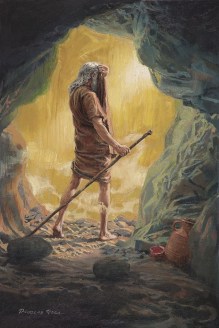 And behold, there came a voice to him and said, “What are you doing here, Elijah?” 14 He said, “I have been very jealous for the Lord, the God of hosts. For the people of Israel have forsaken your covenant, thrown down your altars, and killed your prophets with the sword, and I, even I only, am left, and they seek my life, to take it away.” 15 And the Lord said to him, “Go, return on your way to the wilderness of Damascus. And when you arrive, you shall anoint Hazael to be king over Syria. 16 And Jehu the son of Nimshi you shall anoint to be king over Israel, and Elisha the son of Shaphat of Abel-meholah you shall anoint to be prophet in your place. 17 And the one who escapes from the sword of Hazael shall Jehu put to death, and the one who escapes from the sword of Jehu shall Elisha put to death. 18 Yet I will leave seven thousand in Israel, all the knees that have not bowed to Baal, and every mouth that has not kissed him.”
19 So he departed from there and found Elisha the son of Shaphat, who was plowing with twelve yoke of oxen in front of him, and he was with the twelfth. Elijah passed by him and cast his cloak upon him. 20 And he left the oxen and ran after Elijah and said, “Let me kiss my father and my mother, and then I will follow you.” And he said to him, “Go back again, for what have I done to you?” 21 And he returned from following him and took the yoke of oxen and sacrificed them and boiled their flesh with the yokes of the oxen and gave it to the people, and they ate. Then he arose and went after Elijah and assisted him.
In the name of Jesus. Amen.
When was the last time you felt like a total failure? You labored and worked and toiled and strived to complete that one monumental task. All your effort comes to an end, and the task is finished. But before you can pat yourself on the back, you look around and there is still so much to do. More to accomplish. More things that need your attention. And all you want to do is crawl into a cave and give up.
That’s where we find Elijah this morning. Fleeing, alone, scared, and hiding in a cave at Mt. Horeb (which is the same as Mt. Sinai) God asks in a low whisper, “What are you doing here, Elijah?”
Elijah had had a busy month. But even before we consider what had just happened, we have to go back even further.
Elijah first came on the scene while Ahab was king in Israel. Ahab’s wife, Queen Jezebel, had introduced worship of Baal to God’s people. They were sacrificing their own children to Baal and praising themselves for it. The people were tearing down the true God’s altars and replacing them with temple prostitutes, and they would worship their false god by fornicating with them. All the while Jezebel was ruthlessly persecuting Yahweh’s faithful prophets by murdering them.
So, God sends the prophet Elijah to King Ahab to tell him that there would be neither dew nor rain (1 Kgs. 17:1). And for three and a half years (Jam. 5:17-18), Israel had no precipitation. Finally, God sent Elijah back to Ahab and the people of Israel saying, “How long will you go limping between two different opinions? If Yahweh is God, follow Him; but if Baal is god, follow him.”
After this, Elijah challenges Baal’s prophets to a duel – mano-e-450-manos. The 450 prophets of Baal would sacrifice a bull, lay it on an altar, and call down fire from heaven, and Elijah would do the same. The prophets of Baal call out all morning to their pagan god while Elijah taunts them because there was, of course, no answer (1 Kgs. 18:27-29). Elijah prepares his bull, places it on the altar, and Yahweh, the true God, answers by completely consuming the sacrifice. Afterward, the people of Israel confess, “Yahweh is God.” Elijah took the 450 pagan prophets and slaughters them, and God, sent rain once again.
However, Queen Jezebel wasn’t pleased. She sends a messenger to Elijah swearing by her defeated, pagan gods that she will kill Elijah by the same time tomorrow (1 Kgs. 19:2). That is why Elijah is on the run here in our text. God sends an angel to give Elijah food and water. That meal provided Elijah with the strength to travel forty days to Horeb (1 Kgs. 19:3-8) where he crawls into a cave.
So, after this great victory over the pagan prophets, after God’s provision of rain, after God’s provision of food, there is Elijah standing in a cave feeling very alone and very abandoned. God rightly asks, “What are you doing here, Elijah?”
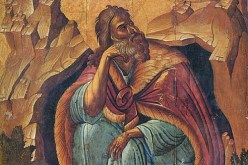 Listen again to Elijah’s response, “Listen God, I’ve been very jealous for You. I’ve done what You have commanded. But Your people have forsaken Your covenant. They have thrown down Your altars. And they have killed Your prophets with the sword. I’m the only faithful one left, and they are out to kill me as well.” Elijah’s response makes it sound like God had lost and that Baal had won. His answer makes it seem like no rain had fallen, and as though God had failed.
God won’t have it. Yahweh patiently but sternly whispers in Elijah’s ear, “What are you doing here, Elijah?” He sends Elijah back with work to do. “Go anoint two kings and your successor as prophet.” And God promises that He will keep and preserve not just Elijah but another seven thousand faithful people for God who have neither bowed down nor kissed Baal. And Elijah goes.
Our society isn’t so different than Israel was in the days of Elijah. We live in a society that sacrifices our children on the altars of convenience and choice. Instead of cult prostitutes, we have every deviant sexual practice imaginable being tolerated and even promoted in our schools. Jezebel isn’t threatening our lives, but we have political leaders who might as well be Jezebel. They say that if we speak out against any of the prevailing sins in our culture, we are backwards and old-fashioned Bible thumpers. They threaten that our morals and the Scripture that teaches them will be forgotten and thrown in the corner of history to gather dust.
With all those voices against us, we might be tempted to be like Elijah and flee to our cave. But what is happening in our nation now is nothing new. We are saddened that the world is driving us to the cave, but, by our silence and fear of speaking out against sin, we have voluntarily walked halfway there in the first place.
Dear Christians, repent. We cannot retreat. We cannot have the defeatist attitude that Elijah had. God still has work for us to do. God has called you to be His salt and light in this world. He desires that you be His faithful witnesses proclaiming that Christ Jesus is the Savior of the world. The world does genuinely want to destroy us, but never forget that God is faithful.
Even if it looks like the Jezebels of our day have won, they haven’t. God defeats Jezebel both physically and spiritually. God told Elijah to anoint Jehu to be king of Israel in place of Ahab and his sons. A little while later Jehu overthrows Ahab’s son who was king. Then, Jehu marches into the city and has Jezebel thrown out of a window where the dogs tear her apart and eat her flesh (2 Kgs. 9:30-37). In her life Jezebel loses in spectacular fashion physically. But even more importantly, Jezebel loses spiritually.
Jezebel had a daughter named Athaliah who married Jehoram, king of Judah. Athaliah and her husband had a son, who had a son, who had a son, and so on and so forth, who eventually a boy named Jesus was born in Bethlehem. Despite Jezebel’s hatred and animosity of Yahweh, God made her the many times over great-grandmother of Christ Jesus, the Savior of the world.
Jezebel tried to defeat God by hating Him. But God defeated Jezebel by loving her. With Jezebel’s blood coursing through His veins, Christ shed His holy and precious blood to forgive even the sins of Jezebel. On the cross, Jesus’ foot, which was formed from Jezebel’s genetic material, crushed the head of the devil and of Baal.
So, stop worrying about how things are going in this world. God is able, and has already, defeated your enemies because they are also His enemies.
“What are you doing here, Elijah?” With words that are stern yet compassionate, God calls Elijah out of his cave and gives him work to do for the kingdom of God. And today, God calls you out of your cave because He has work for you to do as well.
God hasn’t called you to go anoint kings and prophets. But He has called you to raise up your children in the faith. God has called you to proclaim and confess that He has called you out of the darkness of your caves and into His marvelous light.
And when you do crawl into your cave, God calls you through His Word, “What are you doing here?” 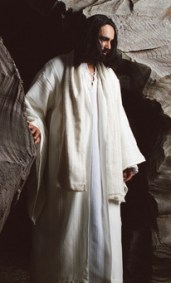 God will continue to defeat His enemies by raising up faithful believers from the offspring of His enemies. Scripture doesn’t promise that the Jezebels of our day will fall before our eyes. In fact, it is very likely that the voices of Jezebel will continue to grow stronger in our culture and society.
But Scripture does promise that Baal is dead and Christ is living. Jezebel has lost, and you have already won. And, you, Christian, are called to remain faithful.
“What are you doing here?” Come out of your cave, and do the work that God has called you to do. Amen.
The peace of God, which surpasses all understanding, will guard your hearts and minds inChrist Jesus. Amen.
 To get an understanding of this, we are going to start by considering what happened in our Old Testament text (Gen 50:15-21) where we heard about what happened between Joseph and his brothers after their father has died. Joseph’s brothers were afraid that Joseph would punish them because of all the wrong things they had done.
 But, Christian, this passage of Scripture is telling you that there is something even better in store for you than the end of your suffering – whatever has caused it. Paul writes in 1 Cor. 15:19, “If in Christ we have hope in this life only, we are of all people most to be pitied.” Dear saint, when you suffer, you do not simply look to the end of your pain. Instead, you are to look to the glory that is to be revealed to you. And, in fact, all of creation is groaning for this as well.
 Dear saints, the same is true of you. In Christ, God has done all the work required to give you your glory. And the day is coming when you will hear your heavenly Father’s voice, praising you for the work He has done in you (Mt. 25:21).
 In each of these parables, what is lost – the sheep, the coin, and even the son – is not valuable. That is the point of the parables. This is most apparent in the parable of the lost coin. The party the woman throws costs more than the coin that she recovered. That one sheep was worth less than the cost of the party that the shepherd threw. Even that one son was not worth the cost of the party. And don’t pish-posh that statement.
 Because of our sin, we are broken. No one wants to admit it, but we are happy when our neighbor suffers and we are sad when he rejoices. The Germans created a word for this by combining their words for ‘harm’ and ‘joy’ into one word, Schadenfreude. The worst part is we justify our Schadenfreude. We enjoy others’ pain because we figure they deserved it. We want others to get what we think is justice. But this is the opposite of compassion and is from the devil.
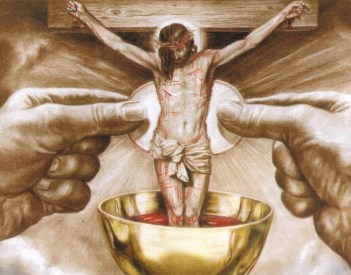 he restored and received his son back into the family. Sinner, your heavenly Father has fattened up Jesus, His faithful Son, to serve as food for you who are unworthy.
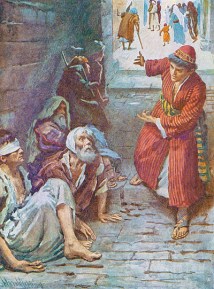 Then the master of the house became angry and said to his servant, ‘Go out quickly to the streets and lanes of the city, and bring in the poor and crippled and blind and lame.’ 22 And the servant said, ‘Sir, what you commanded has been done, and still there is room.’ 23 And the master said to the servant, ‘Go out to the highways and hedges and compel people to come in, that my house may be filled. 24 For I tell you, none of those men who were invited shall taste my banquet.’”
 So, the man has sent out this invitation without saying exactly when the banquet would begin. Then in v. 17, the preparations are finished – the food is cooked, the table is set, the decorations are hung, the wine is poured, everything is ready. The man sends his servant to tell all those who were invited, “Come, for everything is now ready.” But they all make excuses, and their excuses are lame and stupid.
 Christian, God has ushered you into His paradise. You receive the benefit of the sacrifice of Christ’s death. You are promised the resurrection. And, now, in this feast you are about to receive, God nourishes you and declares you to be the object of His love and His perfect bride.
 22 The poor man died and was carried by the angels to Abraham’s side. The rich man also died and was buried, 23 and in Hades, being in torment, he lifted up his eyes and saw Abraham far off and Lazarus at his side. 24 And he called out, ‘Father Abraham, have mercy on me, and send Lazarus to dip the end of his finger in water and cool my tongue, for I am in anguish in this flame.’ 25 But Abraham said, ‘Child, remember that you in your lifetime received your good things, and Lazarus in like manner bad things; but now he is comforted here, and you are in anguish. 26 And besides all this, between us and you a great chasm has been fixed, in order that those who would pass from here to you may not be able, and none may cross from there to us.’ 27 And he said, ‘Then I beg you, father, to send him to my father’s house— 28 for I have five brothers—so that he may warn them, lest they also come into this place of torment.’ 29 But Abraham said, ‘They have Moses and the Prophets; let them hear them.’ 30 And he said, ‘No, father Abraham, but if someone goes to them from the dead, they will repent.’ 31 He said to him, ‘If they do not hear Moses and the Prophets, neither will they be convinced if someone should rise from the dead.’”
 Even though the parable doesn’t explicitly say it, we know the rich man does not love God. As our Epistle text (1 Jn. 4:16-21) says, “he who does not love his brother whom he has seen cannot love God whom he has not seen…. Whoever loves God must also love his brother” (1 Jn. 20-21). The rich man’s lack of love for Lazarus makes his lack of love for God as plain as the nose on your face.
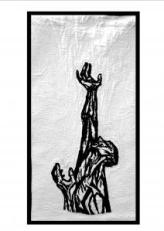 So, when your conscience is pricked and you feel guilt for your lack of love, first repent. Repent of your lack of love. Then, make a list of the people God has placed in your life to help, to care for, and to love starting with the people closest to you.
 And never forget, Christian, that you have been given a name. Through the waters of your Baptism, God gave you your name. He has adopted you into His family. You are His child and part of the household of Jesus. The love you fail to show to those God has placed in your life is forgiven and covered by the blood of Jesus, your Savior. And God does not forget to pour out His love, mercy, forgiveness, and provision for you.
 1 When the day of Pentecost arrived, they were all together in one place. 2 And suddenly there came from heaven a sound like a mighty rushing wind, and it filled the entire house where they were sitting. 3 And divided tongues as of fire appeared to them and rested on each one of them. 4 And they were all filled with the Holy Spirit and began to speak in other tongues as the Spirit gave them utterance.
 We didn’t hear Peter’s whole sermon. It goes on for another fifteen verses, but I want you to hear the highlights of the whole thing. In the part of Peter’s sermon that we did hear, Peter tells the people that, if they had read their Bible, wouldn’t have been surprised at what they are hearing because it had been foretold in the prophet Joel. Then, Peter goes on to proclaim Jesus to the people.
 So you, when the Law comes and points its finger at you and declares you to be a sinner, don’t make excuses. Don’t try to turn the accusations away. Don’t try to put your own spin on it and say that at least you aren’t as bad as so-and-so. Instead, repent. Repent because the Holy Spirit wants you to know that Jesus came to save you who are lost in sin. That means that Jesus has come to save you and me.
 God given you a new heart and a new spirit. God has put His Holy Spirit within you, and He has caused you to walk in His statutes and rules. Again, God promised to do this for the sake of His name, His reputation, and your benefit because you are His.
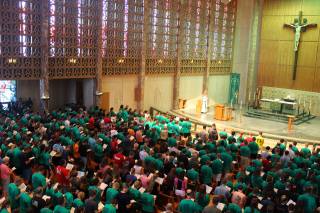 So, “Sing praises to the Lord, for He has done gloriously. Shout, and sing for joy, O inhabitant of Zion, for great in your midst is the Holy One of Israel.” The Scripture readings today have called you – in fact, they have commanded you – to sing to God five times (Ps. 98:1, 4, Is. 12:5, 6).
 Now, why does God command us to sing; isn’t speaking good enough? Apparently, no. There is a great passage in everyone’s favorite Old Testament book, Zephaniah 3:17. Listen to this, “The Lordyour God is in your midst, a mighty one who will save; he will rejoice over you with gladness; he will quiet you by his love; he will exult over you with loud singing.” It is an absolutely beautiful picture. But the reason I bring this up is that this is the one place in all the Scriptures where God sings, and the reason He sings is His joy over you.
 And Jehoshaphat appoints the front line to be – guess who – the Kohathites and the Korahites, the choir. The Lordwould fight for them, so why not have the singers be the first into battle? The army marches out behind the choir and listen to this, it’s from 2 Chron. 20:22, “And when they began to sing and praise, the Lordset an ambush against the men of Ammon [and] Moab… who had come against Judah, so that they were routed.” Through their singing, God defeated the enemies of His people.
 This ‘little while’ has lasted nearly two thousand years and counting. Yet, two thousand years is nothing when you compare it to everything that lies ahead for you in eternity. And it is even more miniscule when you realize that it will only be a few short years before you meet Jesus face-to-face – even if you live to be one-hundred-twenty. But we still have a problem. During our pain and anguish, our difficulties and seasons of tribulation, time seems to stand still while we suffer. But we can take heart and be encouraged. Jesus says it will only be ‘a little while.’
 Now, there is no denying that your suffering is real. Some of you are currently enduring that suffering in severe ways right now. We pray that your relief will be soon and swift. But know this: God is working through those sorrows. He is using your trials to keep you close to Himself, to work virtue in you, to teach you to trust in Him. This does not mean that you should rejoice because of trials and tribulations. Instead, it is a reminder that you can rejoice in spite of and in the midst of that suffering. Like buds on a tree indicate that full blossom is coming, those troubles, trials, sorrows, and crosses are harbingers of the joy that is to come.
 For our great comfort, Scripture gives many images of God shepherding His people. Psalm 23, of course, comes to mind. We have a picture in the entry of our church of Jesus walking through green pastures and still waters leading a flock of good-looking sheep. Jesus tells the parable of the shepherd who goes out seeking his one lost sheep, hefts it on his shoulders, and brings it home. All of that imagery is Scriptural and comforting and good.
 Yes, it does mean ‘good’ but not in a subjective sense, not in a way that is open to anyone’s interpretation. Jesus is uniquely qualified to be the Shepherd of sinful sheep. Christ is the ‘good for you’ Shepherd. Kalos also means ‘right, fitting, true, beautiful, and competent.’ And Jesus Himself defines exactly what makes Him the kalos Shepherd. His the kalos Shepherd because of the fact that He lays down His life for the sheep.
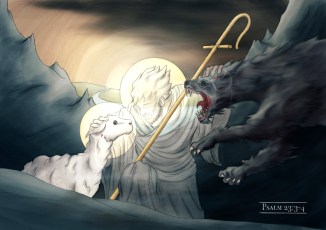 My dear fellow sheep: Jesus is the kalos Shepherd; you are the sheep. You are not called to stand toe-to-toe with the devil. Satan, sin, and death are the wolves, and you are the sheep. Hide behind Jesus. Christ, your kalos Shepherd, places Himself in danger to rescue you from every threat. But even as you hide behind your kalos Shepherd, you do not cower in fear. Hide behind Jesus confidently knowing that He has overcome the wolf, won the victory, and His victory is your victory because you are His.
 Pastorsamwise
You must be logged in to post a comment.