Listen here.
Matthew 4:1-11
1 Then Jesus was led up by the Spirit into the wilderness to be tempted by the devil. 2 And after fasting forty days and forty nights, he was hungry. 3 And the tempter came and said to him, “If you are the Son of God, command these stones to become loaves of bread.” 4 But he answered, “It is written, ‘Man shall not live by bread alone, but by every word that comes from the mouth of God.’”
5 Then the devil took him to the holy city and set him on the pinnacle of the temple 6 and said to him, “If you are the Son of God, throw yourself down, for it is written,
“‘He will command his angels concerning you,’ and
“‘On their hands they will bear you up,
lest you strike your foot against a stone.’”
7 Jesus said to him, “Again it is written, ‘You shall not put the Lord your God to the test.’”
8 Again, the devil took him to a very high mountain and showed him all the kingdoms of the world and their glory. 9 And he said to him, “All these I will give you, if you will fall down and worship me.” 10 Then Jesus said to him, “Be gone, Satan! For it is written, “‘You shall worship the Lord your God and him only shall you serve.’”
11 Then the devil left him, and behold, angels came and were ministering to him.
In the name of Jesus. Amen.
In any sport, a good coach will watch tape of the opponent or will notice how the other team is playing. The coach will use his skill and knowledge to figure out how to minimize the opponent’s strengths and take advantage of and exploit their weaknesses. That is what we are going to do today.
The devil is our enemy who will tempt us to sin. But just getting us to sin is not his ultimate goal. Satan’s ultimate goal is to get us to hate the God who loves us, who created us, who shed His blood and died to forgive us, and who desires to sanctify us and make us sacred.
Look at the back of your Scripture insert because I printed James 1:13–15 for you there: “Let no one say when he is tempted, ‘I am being tempted by God,’ for God cannot be tempted with evil, and He Himself tempts no one.” Now, pay very close attention, “But each person is tempted when he is lured and enticed by his own desire. Then desire when it has conceived gives birth to sin, and sin when it is fully grown brings forth death.” This is how sin goes – this is the anatomy of sin. 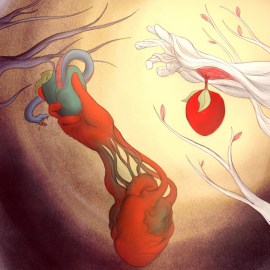 Your heart has a wrong desire, and that false desire is conceived and eventually gives birth to sin. Then, when sin grows up, it brings forth death. Knowing this, we know Satan’s game plan. But it is helpful for us to see how the devil’s game plan plays out in real time, and we saw it in our Old Testament text (Gen. 3:1-21).
Satan asked Eve, “Did God really say, ‘You shouldn’t eat from any of the trees of the garden’?” Notice what Satan is doing. He is trying to put Eve above God’s Word so that she thinks she can be the judge of what God said. Satan, that liar and deceiver, is trying to get Eve and Adam to think that God doesn’t want them to have something that is good and is holding out on them.
When Eve responds to the devil’s question, she adds to God’s Word. She repeats the command to not eat of the tree but she also wrongly puts an additional command in God’s mouth to not touch the tree.
There’s a whole sermon right there, but let me say this just briefly. It is true that if Adam and Eve never touched the tree they wouldn’t eat the fruit of the tree. You would have to touch the fruit that is on the tree and pluck it in order to eat it. But adding to God’s command didn’t keep Adam and Eve from sinning. It didn’t work for them in the perfection and bliss of Eden, and it won’t work for us in this fallen, broken world. We could consider all sorts of examples, but try this one: The 8th Commandment tells us to not lie, but it does notcommand us to never speak. If we add to God’s command against lying an additional prohibition against speaking, what happens then? I know this example is absurd, but play it out. If you never speak, you might not lie with your tongue, but you also can’t confess Jesus’ name, can’t declare God’s praise, can’t love your neighbor by saying, “I love you.” And if you never speak, you would likely think, “I’m keeping the 8thCommandment,” and that thought would be lying to yourself by saying you have no 8th Commandment sin (1 Jn. 1:8). See? You still sin!
Anyway, back to observing the devil’s tactics. Eve adds to God’s command, and the devil knows she’s added to God’s Word. Satan sees that his attack is working, and he presses on by telling her a bold-faced lie, “You will not surely die!” Catch that – the devil, while lying, calls God a liar. Then, that snake accuses God of false motives, “For God knows that when you eat of it your eyes will be opened.” He says the reason God is lying is to keep them blind to something. Finally, he entices Eve by saying, “You will be like God, knowing good and evil.” And that, right there, is the essence, the anatomy, of temptation and sin. Satan sees where your desires are different than God’s desires for you. And the devil arouses those desires and tries to get you to bridge the gap between what you want and what God wants. Satan tempts you to be the judge of God.
 When Eve looked at that fruit, she should have recognized, “That fruit is death.” Instead, she wrongly sees that it is to be desired to make one wise. This is the danger for us. There are things that are put in front of us and God says, “That’s bad, and it leads to death.” But instead of regarding those things according to God’s Word, we regard them according to how we see and think. We put ourselves over and above God and judge Him to be wrong. The devil entices us to think that God is the bad guy who is holding out on us, keeping us from having our heart’s desires. Then, we think we know better than God, and we fall for the temptation and into sin.
Now, not all of these steps play out every time you sin. The more you fall into a particular sin, the more you silence your conscience. Think again of the 8th Commandment about lying. Whenever you lie, gossip, spread rumors, or stretch the truth, you are putting yourself in the place of God. You want reality to match up with what makes you look good or better than others. When you go behind someone’s back to complain about a situation instead of addressing the problem directly with the person, you are putting yourself in the place of God. If you have a problem with an individual, do not talk about those problems with anyone else. The more you do that, the more you open yourself to sin. Repent.
My fellow sons of Adam and daughters of Eve, be wise. The devil attacks you. He comes to whisper lies in your head that God is not good and that you know better than God does. The devil’s game plan worked in the bliss of the Garden of Eden when he tempted our first parents. How much easier is it for him to attack you now when your desires are already stained with original sin? But, now, let us watch the devil use the same tactics but fail when he tempted our Savior and our Brother, Jesus, the Son of God.
The context of Jesus’ temptation is immediately after He is Baptized by John in the Jordan (Mk. 1:9-13). There is no forbidden tree anymore, so the devil is going to attack a different Word from God. With the first two temptations, the devil begins by saying to Jesus, “If you are the Son of God…” (Mt. 4:3, 6). Remember what God said about Jesus just as He was Baptized, “This is My beloved Son, with whom I am well pleased” (Mt. 3:17). It’s in the verse immediately before this Gospel text.
 Jesus has been fasting forty days and nights. I remember as a kid being hungry forty minutes after dinner. Jesus is famished. He is weakened by this fast. So, this temptation to turn stones into bread is a real temptation. The tempter again tries to exploit the gap between Jesus’ desires and what God has given. Jesus wanted food. Because He is man just like you and me, His stomach and His brain would have been screaming at Him, “Feed us!” But God has not yet given Jesus food. So Satan tries to get Jesus to take for Himself what God has not given.
But Jesus responds beautifully. He responds with God’s Word, “Man shall not live by bread alone, but by every word that comes from the mouth of God.” Now, this does not mean that we don’t have to eat. It does not mean that every time you get hungry you just take out your Bible and read. Instead, it is a reminder that there is more to our life than bread. Listen to the whole verse from Dt. 8:3 – Moses is preaching his farewell sermon to God’s people who had been led through the wilderness for forty years saying – “[The Lord] humbled you and let you hunger and fed you with manna, which you did not know, nor did your fathers know, that He might make you know that man does not live by bread alone, but by every word that comes from the mouth of the Lord.” In short, God might withhold something from you so that He can provide for you in a way that increases your faith in Him. While you wait for God to provide, don’t fall for the temptation to reach out and take what God hasn’t given. Jesus resists the temptation to take for Himself what God had not yet provided.
So, the devil comes with a second temptation. The tempter puts Jesus on the pinnacle of the Temple and tries to use Scripture against Jesus. Basically, Satan says, “Throw Yourself down. God has promised to protect You.” From Ps. 91:11, the devil quotes, “He will command His angels concerning you,” but Satan leaves out a phrase. The rest of the verse reads, 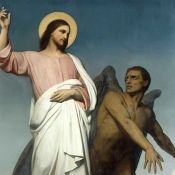 “to guard you in all your ways.” God the Father will protect Jesus in all His ways. But God didn’t send Jesus to earth to be some X-Games-temple-pinnacle jumper.
And there is great comfort for you in this as well. God will protect you in all the ways and paths and vocations to which He has called you. No harm will come to you until God is ready to receive you into His heavenly kingdom. Everything you do, you can do without fear because God will protect you.
Jesus knows this and responds again from the book of Deuteronomy (6:16), “You shall not put the Lord your God to the text.” The devil’s temptation fails again.
So, the devil tries one more. The tempter shows Jesus all the kingdoms of the world and all their glory in one moment (Lk. 4:5) and says, “All these I will give You, if You fall down and worship me.”
This offer of Satan is absurd. The earth already belongs to Jesus. Psalm 24:1 says, “The earth is the Lord’s and the fullness thereof, the world and those who dwell therein.” But the devil isn’t offering Jesus creation and the universe because he can’t – it doesn’t belong to him. Instead, the devil is offering Jesus the dominion of fallen mankind. Remember, that God told Adam and Eve, “Be fruitful and multiply and fill the earth and subdue it, and have dominion over… every living thing that moves on the earth” (Gen. 1:28). But when Adam and Eve fell, their dominion also fell. And that is what Jesus has come to restore and recover. He came to be the New Adam who has perfect dominion over creation.
Again, Jesus resists the temptation saying, “Be gone Satan,” and quotes from Deuteronomy. Maybe we should be reading Deuteronomy more. If you’re reading through Scripture, don’t stop if Deuteronomy seems sluggish. But, most importantly, know and love God’s Word. The promises of Scripture are your best weapon against temptation and sin. God’s Word is the Sword of the Spirit (Eph. 6:17). Anyway Jesus quotes Dt. 6:13, “You shall worship the Lord your God and Him only shall you serve.” And the devil is beaten back and defeated.
 So, dear saints, be wise. Know the devil’s attacks and tactics. The devil is going to use those tactics against you, but God has given you weapons against the devil, your flesh, and the world (1 Jn. 2:15-16). When the devil comes to tempt you, take up the weapon of prayer. Pray God’s Word and watch the devils flee. When your flesh tempts you, take up the weapon of fasting. If you are tempted to certain desires of your flesh, fast from those things. Tell your body, “Body, you aren’t in control.” And when the world tempts you with its vain riches, give. Be generous to the point that it makes you unable to afford falling into the temptations of this world.
And when you are tempted, find comfort in this and in nothing else: Our Epistle lesson (Heb. 4:14-16) invites us who fall into temptation and sin to come confidently as we approach the throne of grace. Come to Jesus because He is our great High Priest who knows our weakness and gives us His mercy and grace to help in time of need.
Now, what does Jesus, the Son of God, say to you? He says, “Come back to the Garden. Be guiltless again. Here, eat this. To undo the curse of sin and the curse of the Fall, take, eat. This is My Body given unto death for you. Take, drink. This is My Blood shed for you for the forgiveness of your sins.” Amen.
The peace of God, which surpasses all understanding, will guard your hearts and minds in Christ Jesus. Amen.
 In fact, if you go back to Hebrews 8[:5], we are told that all the instructions that Moses received about the services, sacrifices, and festivals even the Tabernacle itself all served as copies and shadows of the heavenly things. A few verses after our text here (Heb. 9:23), we are told that the earthly copies of the heavenly things were given by God, but they needed to be purified with all those rites and rituals that God gave to Moses and Aaron.
 And now that Jesus, our Savior and Great High Priest, has come, all the shadows and copies are done away with. Now, because of Christ’s death and resurrection, we know that our prayers are acceptable and rise up to God. Now, when we don’t know how to pray as we ought, the Holy Spirit intercedes for us with groanings too deep for words (Ro. 8:26). Now that Jesus has come, we don’t need the bread of the presence because the Holy Spirit has taken up residence and dwells in your heart (1 Cor. 6:19). Now that Christ has come and shed His blood and brought His blood into the heavenly Holy of Holies, your conscience has been cleansed and purified to serve the living God (Heb. 9:14).
 The CPAP means that a hose dictates how I can move when I turn at night. It means that, when I lie on my side, I have to adjust how the mask fits on my face and doesn’t get moved off my nose by my pillow. It means that I can’t fall asleep having a conversation with my wife. There are mornings that I wake up and have to unwrap the hose from around my neck. But in the six years since I started using that machine, there have only been just over a handful of nights that I have slept without that mask blasting air into my nostrils. I still don’t always like to use it. I wish there were some sort of medicine or a shot I could take, but such a thing doesn’t exist. Sometimes, I wish I could use the machine one night a month or one night a week and be fine, but it doesn’t work that way. I know that if I don’t use that mask and machine each night, I won’t rest or be able to function like I should.
 When this happens, your last state is worse than your first because as Jesus says, the demons come, it finds the house (you) swept and put in order. Then that evil spirit brings seven other spirits more evil than itself.
 Right now, we Christians need one another. Those who do not have faith in Christ need us as well. They need us to comfort them with the very same that we have in Christ. They need to know there is something more than this life. They need to know that Christ is coming back. They need to know that the One who is returning is the very one who shed His holy and precious blood for them. That very blood of Christ is the medicine they need to be freed from the devil’s tyranny over the house of their heart. They need to know that Jesus is the Lamb of God who takes away their sin.
 35 As he drew near to Jericho, a blind man was sitting by the roadside begging. 36 And hearing a crowd going by, he inquired what this meant. 37 They told him, “Jesus of Nazareth is passing by.” 38 And he cried out, “Jesus, Son of David, have mercy on me!” 39 And those who were in front rebuked him, telling him to be silent. But he cried out all the more, “Son of David, have mercy on me!” 40 And Jesus stopped and commanded him to be brought to him. And when he came near, he asked him, 41 “What do you want me to do for you?” He said, “Lord, let me recover my sight.” 42 And Jesus said to him, “Recover your sight; your faith has made you well.” 43 And immediately he recovered his sight and followed him, glorifying God. And all the people, when they saw it, gave praise to God.
 Joshua lead God’s people marching around those thick, fortified walls for six days, and on the seventh day, the people shouted and “the walls came a-tumbilin’ down.” Afterward, they burned the fallen rubble and reduced the city to ashes.
 On the cross, Jesus did everything for your salvation. On the cross, Jesus won the victory over sin, death, and the devil. But God delivers what Jesus did on the cross to you here and now. God delivers the mercy, grace, life, and salvation of Jesus through the preaching of His Word (Ro. 10:17), through your Baptism (Ro. 6:3-11), and through the Lord’s Supper (Lk. 22:14-20). God brings His holy deliverance to you through all those things, and as you receive those gifts of God through faith, you are saved.
 Striving means that you work hard because you aren’t sure if you are going to make it. That’s why you strive. And rest? Well, rest is rest. It’s the opposite of striving. Typically, striving and rest only go together when the later follows the former. People strive so they can go home and rest for the evening or the weekend, or they work for decades so that eventually they can retire and rest. But that is only how things are in this fallen world.
 Christian, you have entered into the rest of God. You find your rest as you simply allow God’s Word to do its work in your heart as it pierces to the division of soul and spirit and discerns the thoughts and intentions of your heart. That Word of God convicts you of your sin revealing that your thoughts, words, and deeds are sinful in God’s sight. And that same Word invites you to faith in Christ who says, “Come to Me, all who labor and are heavy laden, and I will give you rest,” or better translated, “I will rest you” Mt. 11:28).
 And on a Friday, the sixth day from the cross, Jesus cried out as He died, “It is finished” (Jn. 19:30). His striving for your salvation was done. Jesus was laid to rest in a tomb on the Sabbath, the seventh day because all His work to redeem you was complete. And Christ rises on the first day of the week, the first day of the new creation.
 Bella, and all you saints, because you and I are always tempted to think there is something left for us to do to be saved, God desires that you continue to be pointed to the holy, eternal rest that Christ has given you. Here, assembled in God’s presence with your brothers and sisters in Christ, God reminds you of the holy rest you have now. There is nothing left for you to do. Every time you come here, you receive that rest by listening to God’s life-giving Word and letting that Word do God’s work in you.
 Dear saints, welcome to the kingdom of heaven. In the kingdom of heaven, you are never rewarded based on your works or efforts because, if you received what you deserved, you would be sent straight to hell. In the kingdom of heaven, there are no formulas or set, hourly wages. You are given to based solely on the merits of Christ’s work for you. He is the only one who can say that He bore the burden of the day and the scorching heat. His atonement, His mercy, His grace is what you get, nothing less. Because of God’s unmerited, unearned, undeserved, unconditional love freely given to you for the sake of Christ, you are an heir of the kingdom of heaven. God be praised!
 Each of them was called, and each of them was called at the precise time the owner called them. He went and retrieved them.
 God had a reason for bringing you in when He did. Trust His timing. He brought you into His vineyard exactly when He wanted you.
 And it isn’t just their work. Your work, done as a Christian, is holy work. Fathers and mothers, the work you do day in and day out will reap results in the lives in your children, grandchildren, and great-great-great-great grandchildren if Christ tarries. But it will also reap results in the lives of others whom you will never meet because you have shined the light of Christ to those you have met, and they will shine that light elsewhere. You Sunday school teachers, you who are praying for and encouraging our youth, you trustees who are caring for our facility, and everyone who is here encouraging another person is offering holy work that will be used by God until Christ returns. Everyone has a story of being impacted by someone else long after that person has entered into glory. So, take heart, and keep working. The labor that God has called you to is fruitful, holy work. It is holy work that God will multiply and expand. For that, God be praised. Amen.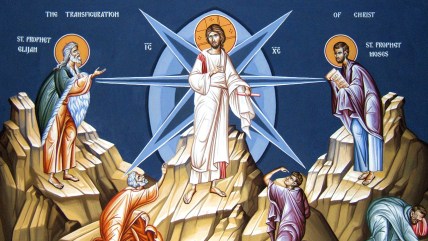
 And from this point, things get a little crazy and awkward. It is almost as though Peter didn’t hear Jesus say that He would rise from the dead because Peter rebukes Jesus – the very one he just confessed is the Son of the living God. Peter says, “Far be it from You, Lord! This shall never happen to You.” It would be easy to sling mud at Peter here for telling God that what He says is going to happen won’t ever happen. But you do it all the time – more on that in a bit.
 But here is where all of this is leading: Jesus comes to Peter, James, and John cowering in their sins and touches them. And notice what He says. He doesn’t continue to rebuke Peter. Jesus doesn’t say, “See I told you so.” Instead, Jesus says, “Rise,” the same word Jesus used when He spoke about His resurrection.“Rise, and have no fear.” Of all the things our Lord could have said, He says, “Rise, and have no fear.” Jesus is resurrecting Peter from his sin.
 5 When he had entered Capernaum, a centurion came forward to him, appealing to him, 6 “Lord, my servant is lying paralyzed at home, suffering terribly.” 7 And he said to him, “I will come and heal him.” 8 But the centurion replied, “Lord, I am not worthy to have you come under my roof, but only say the word, and my servant will be healed. 9 For I too am a man under authority, with soldiers under me. And I say to one, ‘Go,’ and he goes, and to another, ‘Come,’ and he comes, and to my servant, ‘Do this,’ and he does it.” 10 When Jesus heard this, he marveled and said to those who followed him, “Truly, I tell you, with no one in Israel have I found such faith. 11 I tell you, many will come from east and west and recline at table with Abraham, Isaac, and Jacob in the kingdom of heaven, 12 while the sons of the kingdom will be thrown into the outer darkness. In that place there will be weeping and gnashing of teeth.” 13 And to the centurion Jesus said, “Go; let it be done for you as you have believed.” And the servant was healed at that very moment.
 “Centurion” was his title and meant he was a commander over one-hundred soldiers. Centurions wore impressive armor including a helmet with all the feathers sticking out of the top, a shiny breastplate, a metal skirt, and a huge shield. Like a leper, a centurion’s command was also obeyed, but not to avoid becoming one of them. A centurion could say, “Go,” and the soldier would go. “Destroy,” and they would destroy. “Kill,” and they would kill.
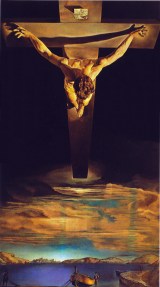 Repent, but do not despair. Jesus, God in the flesh, comes down from the mountain in order to save us. He is a God of mercy and grace. He comes to make the unworthy worthy and the unholy sacred. Jesus willingly approaches the untouchable leper to touch and heal. And Christ has compassion upon a centurion who appeared to have everything, but in reality, had nothing.

You must be logged in to post a comment.