Luke 17:11-19
11 On the way to Jerusalem he was passing along between Samaria and Galilee. 12 And as he entered a village, he was met by ten lepers, who stood at a distance 13 and lifted up their voices, saying, “Jesus, Master, have mercy on us.” 14 When he saw them he said to  them, “Go and show yourselves to the priests.”And as they went they were cleansed. 15 Then one of them, when he saw that he was healed, turned back, praising God with a loud voice; 16 and he fell on his face at Jesus’ feet, giving him thanks. Now he was a Samaritan. 17 Then Jesus answered, “Were not ten cleansed? Where are the nine? 18 Was no one found to return and give praise to God except this foreigner?” 19 And he said to him, “Rise and go your way; your faith has made you well.”
In the name of Jesus. Amen.
This text is so full of movement, it’s like a carousel. Jesus is traveling on His way to Jerusalem between Samaria and Galilee. Jesus tells the ten lepers to hit the road and travel to the priests and the Temple. The Samaritan leper turns back interrupting his trip to the priest to make his way back to Jesus. And Jesus tells the thankful Samaritan to go his way in health and salvation (more on that later). This is a moving text in more than one way.
Now, the first verse of our text is what the commentators will call a “travel notice.” We tend to skip over these travel notices when we read because we aren’t that familiar with the geography of Israel in Jesus’ day, but they are important. However, describing where places are on a map doesn’t work well in a sermon. The important thing is this: Back at the end of Luke 9, Jesus foretells His death and resurrection (9:44-45) then Luke gives us an important turning point in his Gospel. Luke says, “When the days drew near for Him to be taken up, [Jesus] set His face to go to Jerusalem” (9:51). In other words, this miracle takes place while Jesus is on His way to the cross.
The interesting thing is that Jesus isn’t taking the direct route. Instead, Luke mentions is that Jesus is traveling between the regions of Samaria and Galilee which mainly east-west instead of from Galilee in the north directly south toward Jerusalem. Instead, He is taking His time to preach, heal, and minister to the needs of as many people as possible with His mercy and grace.
As Jesus enters a village, He is met by ten lepers. Now, leprosy still exists today, though it is commonly called ‘Hansen’s disease.’ There are actually cases of it in the US today, but it is treatable by modern medicine and not easily transferred anymore. But in Jesus day, leprosy was a terrible problem. The disease makes your skin rot away while you are still alive. Leprosy would make the nerve endings of the effected areas grow numb. A leper could have oozing blisters all over their feet, cut their arm, or burn their hand and they wouldn’t even now it. This is why, so often throughout the history of the church, sin is described as leprosy. Our sin makes us so sick, we don’t even realize how wounded we are.
Now, in Jesus’ day, leprosy was highly contagious. So, lepers had to live apart from everyone else. If you had leprosy and somebody got near you, you would have to yell out, “Unclean! Unclean!” so they wouldn’t get near you. Because of this, lepers would form their own communities to help take care of each other, and that is what we see in this text. These ten lepers have formed a little community and, because of their common disease, it was a very inclusive community. Most of these lepers are Jews, but at least one of them is a Samaritan. Normally, the Jews and Samaritans didn’t deal with each other at all (Jn. 4:9). For a Jew to eat with a Samaritan made the Jew unclean. But these ten lepers formed a little community of the desperate.
They cry out to Jesus, but instead of yelling, “Unclean! Unclean!” they cry out, “Jesus, Master, have mercy on us.” They pray the Kyrie just like do each week. But Jesus’ response to their cry for mercy isn’t to wave His hand over their bodies and speak them clean. He doesn’t make mud with His spit and put it on their diseased skin to heal them. Jesus simply tells them to go show themselves to the priest.
Now, as lepers, this is something they would have done when they first contracted their leprosy. Through Moses (Lev. 13:2ff), God commanded that people who had a problem with their skin to go to the priest. The priest would examine the effected area, and, if it was indeed leprosy, the priest would declare them to be unclean. Then, if the area would clear up, the person was to go back for a second appointment with the priest and be declared clean (Lev. 14:1-32) so they could go back and live with their family and return to work. But here, Jesus simply tells them to go show themselves to the priest.
Think of that for a minute. Before anything has changed, while their skin is still rotting, Jesus tells them to go to the priest. Now, they wouldn’t be let into the streets of Jerusalem let alone be allowed into the Temple. But in this command of Jesus, there is an implicit promise. And by leaving Jesus, they act in faith.
There is a little lesson here for us about prayer. Probably most of our lives as Christians, we are waiting for an answer to a prayer. How often do we pray for something and are left to wait? But, Christian, take heart, God will answer. As these lepers journey to the Temple, they are cleansed.
Now, presumably, the nine lepers do continue to Jerusalem. They make their way through the streets to the Temple. They find the priest and are declared to be cleansed of their disease and allowed back into their families and community once gain. But only one of them actually obeys Jesus.
 This Samaritan who returns to the true Temple and true High Priest. He returns to Jesus to give thanks. Did you catch what Jesus said there, “Was no one found to return and give praise to God except this foreigner?” In other words, the nine went onto the Temple and God’s house, but God wasn’t there. He was walking in the flesh between Samaria and Galilee where the Samaritan falls at His human feet giving Him thanks. Some people will read the Gospels and say that Jesus never claimed to be God. Well, sorry, they are wrong. He does right here.
And this Samaritan receives from God, from Jesus, not just a declaration of cleanliness from his flesh-eating disease, but from his leprosy of sin. Jesus’ final recorded words to this man are, “Rise and go your way, your faith has saved (σῴζω) you,” (not just ‘made you well’), “your faith has saved you.”
The Samaritan is more than just a cleansed man, he is now our Christian brother. In fact, he shows the fruits of the Spirit that we heard about in our Epistle lesson (Gal. 5:16-24). He has love for God, joy in his healing, and peace that only comes through faith in Christ. He exhibited patience as he walked away from Jesus with the promise of healing. We can imagine his kindness toward the other nine who might have thought he was silly to go back to Jesus instead of going to the Temple in Jerusalem. His goodness is visible. Jesus encourages his faith. His has gentleness and self-control can be seen in his thankfulness to God; let me quickly explain that.
The word that gets translated ‘gentleness’ is a noun and has the idea of being humble or meek. Jesus uses the same word as an adjective in the Beatitudes, “Blessed are the meek, for they shall inherit the earth” (Mt. 5:5). The Samaritan humbles himself in meekness before Jesus falling at His feet. And instead of running off to his restored life, the man exercises self-control to turn back and first give thanks to God, to Jesus.
As we, like this Samaritan, rise from here and go on our way, let us turn back to give thanks to Jesus. Thankfulness requires a turning back. If we are thinking of what is going to happen next, we can’t give thanks. If we are always thinking about the future, we cannot give thanks because there is nothing there to give thanks for – at least not yet. We don’t know what is going to happen tomorrow. Jesus could return before we get to our cars to leave. As long as we’re thinking about tomorrow, we can’t give thanks.
Instead, turn back. Turn back to what Jesus has done for you. Most importantly, He has died and risen for you. Because of His blood shed for you, He has declared you free and forgiven of all your sins here and now. Dear saints, rise and go your way. Get on the road again in thankfulness for what Christ has done, your faith has saved you. Amen.
The peace of God, which surpasses all understanding, will guard your hearts and minds in Christ Jesus. Amen.

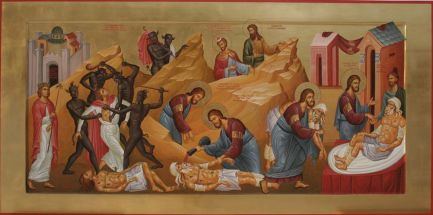 Because, first and foremost, the parable of the Good Samaritan is a picture of what Jesus has done for you. Jesus, and Jesus alone, is the Good Samaritan who has compassion. He left His throne in the glory of heaven to become your neighbor. He risks His own safety while scoundrels and robbers are roaming about. He stops to give you aid. He pours on you oil and wine. He gives up His own comfort and convenience to bring you to the inn of the holy Christian Church. And Jesus sets up an all-expenses-paid stay there promising to return. Jesus is the one who has and continues to show you mercy. Amen.
 32 And they brought to him a man who was deaf and had a speech impediment, and they begged him to lay his hand on him. 33 And taking him aside from the crowd privately, he put his fingers into his ears, and after spitting touched his tongue. 34 And looking up to heaven, he sighed and said to him, “Ephphatha,”that is, “Be opened.” 35 And his ears were opened, his tongue was released, and he spoke plainly. 36 And Jesus charged them to tell no one. But the more he charged them, the more zealously they proclaimed it. 37 And they were astonished beyond measure, saying, “He has done all things well. He even makes the deaf hear and the mute speak.”
 Groaning, however, is an involuntary response to being hurt or wounded. Every time the New Testament uses this word ‘groan’ it is from sorrow or suffering because of sin. And, in the New Testament, only four things groan – creation groans, believers groan, the Holy Spirit groans, and Jesus groans twice.
 And He no longer groans in pain when He does it. The price has been paid. Your forgiveness has been purchased and won on the cross.
 10 “Two men went up into the temple to pray, one a Pharisee and the other a tax collector. 11 The Pharisee, standing by himself, prayed thus: ‘God, I thank you that I am not like other men, extortioners, unjust, adulterers, or even like this tax collector. 12 I fast twice a week; I give tithes of all that I get.’ 13 But the tax collector, standing far off, would not even lift up his eyes to heaven, but beat his breast, saying, ‘God, be merciful to me, a sinner!’ 14 I tell you, this man went down to his house justified, rather than the other. For everyone who exalts himself will be humbled, but the one who humbles himself will be exalted.”
 The parable does teach that the worst of sinners can go to heaven. We know this, but unfortunately, we can grow a little numb to this. But the main reason Jesus tells this parable is to destroy any self-righteousness and contempt we would have against other sinners.
 Dear saint, you look there too. Look to the cross. Look to the blood of Jesus shed for you on Calvary. Look to His death. Look to His resurrection. Look to His ascension. And know that Jesus promises that all of that is for you.
 Three times the English word ‘gifts’ came up in this text, but in Greek, Paul uses two different words that get translated as ‘gifts.’ Twice the Greek word is χάρισμα (which is singular and the plural is χαρίσματα – I’m going to try to be grammatically correct through the sermon). Χάρισμα is where we get our word ‘charismatic.’ Inv. 4, “there are varieties of gifts/χαρίσματα,” and in v. 9, he mentions the “gifts/χαρίσματα of healing…” But in v. 1, Paul uses a different word that gets translated as ‘spiritual gifts’ or ‘spiritual things.’
 According to our text (v. 4-7), these various gifts are given through the Holy Spirit, but the Holy Spirit doesn’t ever work alone; instead, the entire Trinity is involved. These various gifts are given by the Spirit; the varieties of service are given by the same Lord, Jesus Christ, the Son; and the varieties of activities are empowered by the same God (think Father) who empowers them all in everyone. We don’t determine what gift we receive, it’s up to our Triune God. And God will provide whatever we need to fulfill our Christian duty to our neighbor.
 Do you believe in Christ’s death and resurrection for the forgiveness of your sins? Do you trust that His blood has covered all your iniquities and transgressions? If so, praise God! Then ask, “What is my vocation/station in life? What am I called to do right now?” “What do I need now as a mother?” “What do I need now as a husband?” “As a child?” “A student?” “A customer?” “A citizen?” God has called you to those vocations and He won’t leave you in a lurch. He will give you the gifts you need. In every moment of every day, you have a particular relationship to someone else, so you are called to be God’s representative in that moment. So, ask God to give you what you need to fulfill that vocation.
 This reduction was, of course, not legally binding. The rich man could have simply said, “Hang on everyone. I fired that guy before he lowered your debt. You still owe the original amount.” But that isn’t the character of the rich man. Instead, the whole town is singing the praises of the rich man because he is so generous. And the rich man isn’t willing to harm his reputation as a merciful guy. So, what does the rich man do in the parable? He tells the fired, scoundrel of a manager, “Dude, you’re shrewd. You knew I’d rather be known as a merciful person rather than hold on to my wealth. And by your shrewdness, you’ve helped yourself.”
 Now, Jesus is absolutely clear, “You cannot serve God and money.”It can’t be done. If you trust in money, you do not trust God. So, repent of your love of money.
 The only thing that matters for your salvation is what Christ has done and completed for you upon the cross. Even when you are stingy and fail to be generous with what God has given to you, God was not. He gave what was most valuable to Him for your salvation. God, in His mercy, gave Jesus to die upon the cross for you. Don’t trust in your stewardship of what God has given you. Instead, trust in Christ’s giving of Himself completely for you and for others. Amen.
 Out of that conversation came creation, and most importantly, out of that conversation came the creation of humanity. We get to hear that conversation in Gen. 1:26 where the Triune God says, “Let Us make man in Our image, after Our likeness.” It was so, and it was good – very good.
 One of the most amazing things is that God even gives His prophets a seat and a voice in this council. You remember when God was going to destroy Sodom and Gomorrah, and Abraham speaks up and gets God to agree to not destroy the cities if ten righteous people are found there (Gen. 18:22-33). Or, when God is going to destroy the Israelites for making the golden calf, Moses speaks up in the council and says, “God, if You go down and destroy them, the Egyptians will say that You only brought them out of slavery to destroy them.” And God relents of the disaster He had said He would bring on the people (Gen. 32:1-14).
 Now, Jesus has ascended to the right hand of the Father. Today, your Savior is talking with the Father, your Creator, and with the Holy Spirit, your Sanctifier. And do you know what they are talking about? They are talking about you and the cross. They are talking about how Jesus won your salvation there. How His blood shed there made a place in heaven for you forever. And the Holy Spirit is there, translating your prayers and interceding for you with groanings too deep for words (Ro. 8:26). The Holy Spirit whispers into your ear that you are an adopted child of God and heir with Christ. And you respond by crying, “Abba, Father” (Ro. 8:12-17).
 Our English word ‘desolation’ contains the word ‘solo,’ and that gives a sense of what ‘desolation’ means. Adam and Eve went solo. Rather than trusting God, they went solo and trusted the devil’s lie bringing sin, death, condemnation, and desolation into the world.
 Look at what Jesus, God in the flesh does – notice the verbs. He calls the disciples. Jesus directs the crowd to sit down. He takes the bread. Christ gives thanks for the bread. He breaks the bread. He gives the bread to the disciples to set before the people. Jesus blesses the fish. He gives the fish to the disciples to set before the people. And Jesus watches them all eat until every last one of them is satisfied. Jesus continues to do this for us today.
 19 Therefore whoever relaxes one of the least of these commandments and teaches others to do the same will be called least in the kingdom of heaven, but whoever does them and teaches them will be called great in the kingdom of heaven. 20 For I tell you, unless your righteousness exceeds that of the scribes and Pharisees, you will never enter the kingdom of heaven.
 Sure, you aren’t Lady Macbeth yelling at the blood of Duncan to wash off your hands, but you are guilty of murder before God. You have been angry with others. You have called others, “Fool.” You have held grudges. You have refused to ask your neighbor for forgiveness. And Jesus goes on to the other Commandments as well – lust is adultery and fornication, gossip is perjury, etc.
 The Law should never be allowed to access into your ‘How do I stand before God?’ room, your ‘Am I good enough to go to heaven?’ room, your ‘Does God love me?’ room, your ‘Does God think I am a good person?’ room, or your ‘assurance of salvation’ room. The Law should never be allowed to enter those rooms because Jesus has made you as good and as righteous and as perfect as He is.
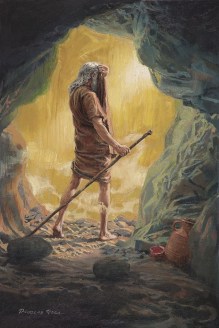 And behold, there came a voice to him and said, “What are you doing here, Elijah?” 14 He said, “I have been very jealous for the Lord, the God of hosts. For the people of Israel have forsaken your covenant, thrown down your altars, and killed your prophets with the sword, and I, even I only, am left, and they seek my life, to take it away.” 15 And the Lord said to him, “Go, return on your way to the wilderness of Damascus. And when you arrive, you shall anoint Hazael to be king over Syria. 16 And Jehu the son of Nimshi you shall anoint to be king over Israel, and Elisha the son of Shaphat of Abel-meholah you shall anoint to be prophet in your place. 17 And the one who escapes from the sword of Hazael shall Jehu put to death, and the one who escapes from the sword of Jehu shall Elisha put to death. 18 Yet I will leave seven thousand in Israel, all the knees that have not bowed to Baal, and every mouth that has not kissed him.”
 Listen again to Elijah’s response, “Listen God, I’ve been very jealous for You. I’ve done what You have commanded. But Your people have forsaken Your covenant. They have thrown down Your altars. And they have killed Your prophets with the sword. I’m the only faithful one left, and they are out to kill me as well.” Elijah’s response makes it sound like God had lost and that Baal had won. His answer makes it seem like no rain had fallen, and as though God had failed.
 God will continue to defeat His enemies by raising up faithful believers from the offspring of His enemies. Scripture doesn’t promise that the Jezebels of our day will fall before our eyes. In fact, it is very likely that the voices of Jezebel will continue to grow stronger in our culture and society.
 Pastorsamwise
You must be logged in to post a comment.