Romans 12:6-16
6 Having gifts that differ according to the grace given to us, let us use them: if prophecy, in proportion to our faith; 7 if service, in our serving; the one who teaches, in his teaching; 8 the one who exhorts, in his exhortation; the one who contributes, in generosity; the one who leads, with zeal; the one who does acts of mercy, with cheerfulness.
9 Let love be genuine. Abhor what is evil; hold fast to what is good. 10 Love one another with brotherly affection. Outdo one another in showing honor. 11 Do not be slothful in zeal, be fervent in spirit, serve the Lord. 12 Rejoice in hope, be patient in tribulation, be constant in prayer. 13 Contribute to the needs of the saints and seek to show hospitality. 14 Bless those who persecute you; bless and do not curse them. 15 Rejoice with those who rejoice, weep with those who weep. 16 Live in harmony with one another. Do not be haughty, but associate with the lowly. Never be wise in your own sight.
In the name of Jesus. Amen.
How do you know if someone is really a Christian? I mean reeeeally a Christian. Well, according to the ESV’s heading on this text (which the translation we are using), this is it. The ESV adds its own title to v. 9 and following “Marks of the True Christian.”
In fact, do this: Take out one of the pew Bibles and turn to Romans 12. The ESV has this text falling under two headings. The first comes before v. 3 and is “Gifts of Grace” which is used for v. 3-8. I think that is an accurate heading for those verses. But then you get to v. 9 and all the way to the end of the chapter, all of that falls under the heading “Marks of the True Christian.” Those headings are not part of the Scriptures. The translators and editors of the various translations added them. Sometimes, they are fine introductions to what is going to come. But I would encourage you to ignore them more often than not because they influence the way you read the text.
From the heading there before v. 9 and the way the ESV reads here, I counted twenty-two commands/imperatives that follow in the translation. Twenty-two things that Christians are commanded to do if they, at least according to that heading, are true Christians. With that understanding, it would be easy for a sermon on this text to turn into a stern lecture on what you should be doing; how you are not doing it; and how you would be blessed if you actually got around to doing it. But here’s the problem.
First, there is no Gospel in the translation of those verses. And, second, if true Christians have genuine love; abhor evil; hold fast to the good; love with brotherly affection; outdo one another in showing honor; are never slothful in zeal; fervent in spirit; serve the Lord; rejoice in hope, etc. If these are the marks of the true Christian and you take an honest assessment of yourself, how are you doing so far?
Speaking for myself, I would have to conclude that I’m not a true Christian because I’m missing a lot of those marks most of the time. And, when I don’t have those marks but still confess that I am a Christian, I need to find some comfort for myself. So, the easiest thing for me to do is to start comparing myself to others. I look at myself, and then I look at you and you and you. Then, I figure, “Well, at least I’m better than that person at obeying these ‘Christian’ laws.”
You have maybe heard the joke about when Sven and Ole were out walking in the forest and see a bear. Ole bends down and starts tightening his shoelaces, and Sven says, “Ole, you don’t think you can outrun a bear, do you?” And Ole responds, “I don’t have to run faster than the bear, Sven.  I just have to run faster than you.” Well, guess what. When the bear of God’s Law is finished eating the guy who is slower to obey than you, it picks up your scent and resumes its pursuit of you because its appetite is never satisfied by eating up sinners.
Lord, have mercy. If our response to our failures and shortcomings is to compare ourselves to others, we are not doing what this text wants to inspire in us. We are not showing brotherly affection. We are not associating with the lowly. Instead, we are being haughty and wise in our own sight. Lord, have mercy. Comparing ourselves to others is not what the Holy Spirit intended when He inspired these words of Scripture. Only Jesus can satisfy the Law’s appetite. And, God be praised, by His death and resurrection He has done exactly that.
In reality, there are only four commands in this text. Three of them are in v. 14: Bless those who persecute you, bless and do not curse them. And one at the very end in v. 16: Never be wise in your own sight.
In reality, to be a Christian is not to keep twenty-some commands. Instead, Paul here is holding up a picture of what genuine love looks like (similar to how he does in 1 Cor. 13). Listen to this translation of v. 9-12. “Love is genuine/without hypocrisy, abhorring the evil and clinging to the good. [Genuine love] is showing brotherly affection for one another, in honor leading the way for one another, in zeal not [being] lazy, in the Spirit fervent, serving the Lord, rejoicing in hope, enduring persecution, holding fast to prayer.”
These verses are, in fact, perfectly describing Christ. Remember, that God is love (1 Jn. 4:8, 16), and that means that Jesus is love embodied. And, yes, as Christians – which means ‘little Christs’ – we should be like Christ. But because we are sinners, we fail to live up to God’s Law. God’s Law always accuses us.
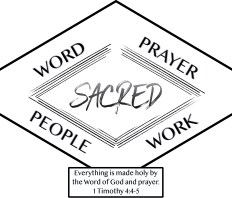 There’s a better way to understand these verses, and to get at that understanding, I’m going to connect this text to our theme for the year – “Sacred.” In Lev. 19:2, God speaks to His people, Israel, and says, “You shall be holy, for I the Lord your God am holy.” And Peter repeats those words for us Christians in 1 Pet. 1:16. In English, this sounds like a command because of the word ‘shall.’ But in both Hebrew and Greek it isn’t a command/imperative. A better translation for both is, “You will be holy.”
When the original people (both Old and New Testament) heard that, they would hear three things at the same time. First, it is an unfinished action – something like, “You will become holy.” Second, and closely related, it can be a future promise, “You will be holy.” And third, it is a soft command/imperative, “You are called to be holy.”
Yes, God wants our behavior to be consistent with His holiness. God is your heavenly Father, and He wants you to be chips off the old block. But it is also a process that God has begun in your Baptism, and He will be faithful to bring it to completion (Php. 1:6). God will continue to make and shape you after the image of Christ.
Dear saints, the genuine love that is pictured here is what God has called you to be. When you don’t measure up to your sacred calling as Christians, when you don’t have the marks of a true Christian, run in faith to Christ. Romans 8:3-4 says, “For God has done what the law, weakened by the flesh, could not do. By sending his own Son in the  likeness of sinful flesh and for sin, he condemned sin in the flesh, in order that the righteous requirement of the law might be fulfilled in us, who walk not according to the flesh but according to the Spirit.”
In the arms of Jesus’ love and mercy, you will find forgiveness for your failure and love despite your lack. Receive what God gives to you. He gives you Jesus. Because He has died and risen again, Jesus delivers the very mercy and forgiveness that you need.
“Are you really a Christian?” Well, do you trust in Christ for the forgiveness of your sins? That is the mark you need. Yes, you fail in your calling. But faith in Christ, and faith alone by grace alone, makes you a genuine child of God. Amen.
The peace of God, which surpasses all understanding, will guard your hearts and minds in Christ Jesus. Amen.
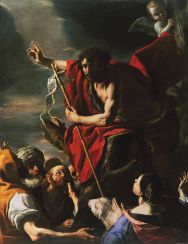 “You brood of vipers! Who warned you to flee from the wrath to come? Bear fruit in keeping with repentance.” The text doesn’t explicitly say it, but it appears as though John refused to baptize at least some of the Pharisees and Sadducees. But why? Why do they get a tongue-lashing and no baptism?
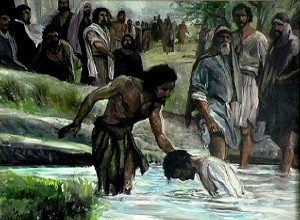 Now we come to our text. John is baptizing all these people. A thief comes confessing his stealing, an adulterer confesses his adultery, a liar confesses her sin, and John absolves and baptizes them. But then to the front of the line comes Jesus, and John knows Him (Lk. 1:39-45). They’re related to each other. John knows what the angel Gabriel told Mary, that this Jesus would be Son of the Most High, that He would reign over the house of God, and that His kingdom would have no end (Lk. 1:26-38). John knows the angel Gabriel told Joseph that Jesus would be the One to save His people from their sins (Mt. 1:18-25). John knows that Jesus is the sinless God in the flesh. And here He is coming to be baptized unto repentance for the forgiveness of sins? This shouldn’t be!
 But also, the same thing that happens to Jesus in his Baptism happens to you in yours. In your Baptism, you are given the gift of the Holy Spirit and are made God’s beloved child. In your Baptism, God intimately joins you to Jesus, and to His death and resurrection (Ro. 6:3-6).
 In your Baptism, God has given you the new birth of water and the Spirit (Jn. 3:5). In your Baptism, God has promised to wash away your sins (Act. 2:38-39), save you (1 Pet. 3:21), make you His child (Mt. 3:17), connect you to Jesus’ death and resurrection (Ro. 6:3-6), clothe you with Christ (Gal. 3:27), and fill you with the Holy Spirit (Tit. 3:5). So now, whenever wash your hands or take a shower, you can remember that God Himself has washed you clean and made you holy and sacred. Whenever you take a drink, you can remember that, in your Baptism, Jesus has given you to drink of the living water that wells up to eternal life (Jn. 4:10, 14).
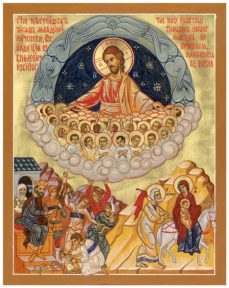 16 Then Herod, when he saw that he had been tricked by the wise men, became furious, and he sent and killed all the male children in Bethlehem and in all that region who were two years old or under, according to the time that he had ascertained from the wise men. 17 Then was fulfilled what was spoken by the prophet Jeremiah:
 The guy who didn’t even want his own children to be king after him hears that someone else has been born to be King of the Jews. Well, Herod isn’t going to let that stand. And when Herod is troubled about this, the rest of Jerusalem is also quaking as they wonder what will happen next.
 In the incarnation, the eternal Son of God shares in the life of every man, woman, and child – born and unborn. We human beings are all taken out of the flesh of Adam which means that we are all part of one another. But even more importantly, by His conception, the eternal Son of God has permeated all of humanity. This is why the devil loves abortion. Satan loves abortion because every unborn child reminds him of the fact that the Son of God came in the flesh, took up residence in His mother’s womb, and defeated him. The fact that your Savior was once a pre-born child is primary the reason Christians oppose abortion.
 Tonight, and all the days of your life, you can celebrate the fact that Jesus is born. God has taken on your flesh to save you. He has come in your likeness, born of a woman, in order to deliver you from your sin.
 Luke tells us that those shepherds, who were minding their own business, suddenly found themselves surrounded by the shining, dazzling glory of the Lord. The surprising, unexpected thing is not the existence of God’s glory. God’s glory shining is something that happens throughout the Scriptures.
 This went on for centuries until the King Solomon finished construction of the Temple. When the Ark of the Covenant was brought into the Temple, the cloud descended into the most Holy Place, and the priests had to leave because God’s glory filled the Temple (1 Kgs. 8:10-11; 2 Chron. 5:13-14). God no longer dwelt in the tent of the Tabernacle; now, He dwelled in the house of the Temple which was where heaven and earth intersected. And still, year after year, the high priest would enter the most holy place be the representative of the people and meet with God behind the smoke made by the incense and the cloud that subdued God’s glory (Ex. 25:21-22).
 He is there so He can grow up and walk among us in the towns and streets of Galilee, Judea, and Jerusalem. He is there so He can be betrayed, arrested, beaten, tried, crucified, loaded up with your sin, die, and rise again.
 29 The next day he saw Jesus coming toward him, and said, “Behold, the Lamb of God, who takes away the sin of the world!”
 God sends the angel of death to go through the land of Egypt. But God’s people were to take a lamb. They were to slaughter that lamb and smear some of the lamb’s blood on the door of their house and eat the rest of the lamb roasted that night. And when the angel would see the blood on the door, he would pass by.
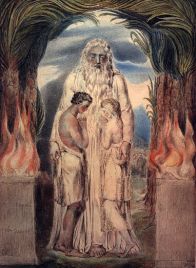 God hung that animal up and stripped the skin from its lifeless body as blood stained the ground. And God wraps that skin around the shameful, sinful bodies of Adam and Eve.
 Dear Lincoln, today you are Baptized. Today, God has given you the new birth of water and the Spirit (Jn. 3:5). Today in your Baptism, you have been joined to Jesus’ death and resurrection (Ro. 6:3-5) and have been clothed with Christ (Gal. 3:27). And Lincoln, Derek, Brittney, and all you saints, that means that today is a day to rejoice. Even as we see the grass wither, the flower fade, and creation crumble, we know that the Word of our God will stand forever. God continues to shower His blessings upon us through that Word. And His Word to us today, and every day of our Christian walk, is the Word of the Gospel which causes us to rejoice.
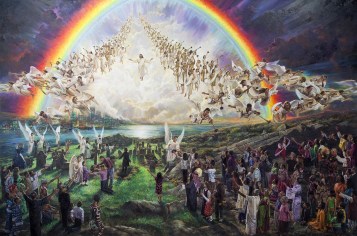 In Advent we are watching and waiting for the coming of our Savior and the end of our exile in this fallen, sinful world. Advent is the Christian life in a nutshell. We watch and we wait for the coming of our Lord. And as we wait, we are reminded that, whatever may happen to us in this veil of tears, the end is a joyful day for you whose citizenship is in heaven. As we wait, we remember that all the cares and sorrows of this world are temporary.
 God’s holiness creates three interlocking spheres which I’ve tried to show with this figure.
 offered himself without blemish to God, purify our conscience from dead works to serve the living God.”
 In Jesus, God has come into this common world and brought His holiness to you. Because of what Christ has done, God has claimed you as His own so that you can live with Him in His kingdom and serve Him in everlasting righteousness. He placed His holy name upon you when you were Baptized. In your Baptism, you were marked with the name of the Father, Son, and Holy Spirit (Mt. 28:18-20). That holiness, given to you in your Baptism, is now continually delivered to you when you hear and believe God’s holy Word. As you hear the word of truth, the gospel of your salvation, you are sealed with the promised Holy Spirit (Eph. 1:13). God continues to place His name on you as He blesses you, keeps you, makes His face shine upon you, and be gracious to you (Num. 6:22-27). Bearing His holy name, you are brought into His holy presence, and radiate His holiness to those around you.
 Our texts today seem to have conflicting messages. This text from Romans 15 has a lot to say about endurance, encouragement, hope, harmony, joy, and peace. It’s nice. But in our Gospel lesson, when Jesus talks about the day of His return, He speaks of signs in the sun and moon and stars. He mentions the distress of nations in perplexity, the roaring of the sea and waves, and people fainting with fear and foreboding because of what is coming on the world. Our Lord declares that the powers of the heavens will be shaken.
 The castle doors and the walls are shaking. Boulders are hurled against the fortress. Windows are shattering and dust is falling from the ceiling. The floor you are standing on is rocked by the sounds of battle all around you.
 What was defiled was made holy. What was dead was raised. Where there were sinners, Christ brought forgiveness. And all of that was just the beginning. All of this was written to give us encouragement to endure in the hope that the healing Christ brought to the broken of this world would be ushered into the entire creation – into the new creation.
 In our Old Testament lesson tonight (Ex. 3:1-5), Moses found himself standing on holy ground when God appeared in a bush. That bush was burning because of God’s holy presence, and Moses’ curiosity was piqued when he noticed that though the bush was aflame it was not consumed; it didn’t burn up. In the same way, when God’s holiness comes to us, it burns but God does not want us to be consumed by the fire of His holiness. Instead, He wants us to be changed by it.
 So, the second thing God’s holiness does to Isaiah is rub off on him. God sent one of the seraphs to fetch a burning coal, take it to Isaiah, and touch his lips with it and give a word of promise, “Behold, this has touched your lips; your guilt is taken away, and your sin atoned for.”
 Pastorsamwise
You must be logged in to post a comment.