Hebrews 9:11–15
11 But when Christ appeared as a high priest of the good things that have come, then through the greater and more perfect tent (not made with hands, that is, not of this creation) 12 he entered once for all into the holy places, not by means of the blood of goats and calves but by means of his own blood, thus securing an eternal redemption. 13 For if the blood of goats and bulls, and the sprinkling of defiled persons with the ashes of a heifer, sanctify for the purification of the flesh, 14 how much more will the blood of Christ, who through the eternal Spirit offered himself without blemish to God, purify our conscience from dead works to serve the living God. 15 Therefore he is the mediator of a new covenant, so that those who are called may receive the promised eternal inheritance, since a death has occurred that redeems them from the transgressions committed under the first covenant.
In the name of Jesus, our great High Priest. Amen.
In the name of Jesus, our great High Priest. Amen.
Jesus has shed His blood for you. He offered Himself without blemish to the Father to purify your conscience from dead works to serve the living God. Because Christ has shed His blood for you, you have been called to be God’s children and receive the promised eternal inheritance. God be praised!
Imagine for a moment that you made plans to take your family to Great Wolf Lodge in Bloomington. (In case you don’t know, that’s a hotel with a huge indoor water park similar to what we have at the CanAd Inn and Splashers, but many, many times bigger.) You show your kids the pictures of the water park and all the waterslides and splash pads, and your kids are raring to go. But then, when you arrive, instead of wanting to go to the water park, your kids say they would rather splash around in the bathtub of your hotel room. You plead and urge them to put on their swimsuits, try the waterslides, the lazy river, and all the different attractions. But your kids insist they would rather sit in the tub with their rubber duck.
Well, there was a similar thing going on when this text was written.
The letter of Hebrews was basically a sermon written to a largely Jewish congregation. The way that the book is written, it seems as though some of these Jewish believers were beginning to wonder if they had made a mistake by becoming Christians. It appears as though they were wondering if they should return to their old, Jewish religion with the high priest, the Temple, the altar overlaid with gold, the festivals, the sacrifices, and the blood of goats and bulls. They were wondering if they had left the true worship of God for a much humbler, simpler religion of Christianity.
The whole book of Hebrews, but especially these verses and the surrounding context, serves as a resounding, “No! Don’t do it!” Throughout the book of Hebrews, these Christians are pointed to the fact that what they had in Jesus, and what we have today is better, greater, and more perfect.
 In fact, if you go back to Hebrews 8[:5], we are told that all the instructions that Moses received about the services, sacrifices, and festivals even the Tabernacle itself all served as copies and shadows of the heavenly things. A few verses after our text here (Heb. 9:23), we are told that the earthly copies of the heavenly things were given by God, but they needed to be purified with all those rites and rituals that God gave to Moses and Aaron.
So, here’s the picture this text is painting for us. The purpose of all the Old Testament ritual and ceremony – the daily sacrifices, the buildings, the furniture, the washings – all of it served, for a time, as a copy and shadow of the heavenly things. The earthly tabernacle was given to God’s people as a picture of what is going on in heaven. God’s people could see the details going on before them, but they were to know that it was just a shadow of the reality of what is going on in heaven before God.
And now, because of Jesus, the shadow of the Tabernacle and Temple is no longer needed. Still today, we Christians, we people of God, have the reality. I hope and pray that this results in two things for you.
First, I hope that when you read those passages from Exodus and Leviticus, when you read about the construction of the Tabernacle with the vessels and different colors of fine twined linen, when you read about the priests and their vestments and their activities, when you read about the feasts and the sacrifices, I hope that you now read them with a little more interest because, again, they are copies and shadows of the heavenly reality.
But second, and more importantly, I hope you see that all of it points you to what Jesus, your Savior and Great High Priest, has done and accomplished once for all and once for you! Because now the reality in heaven has been perfected by the blood of Jesus, your Savior.
In the Tabernacle, the altar of incense served as a copy. The people were to look at the smoke of the incense rising into heaven and know that the prayers they made on earth were also rising up to God. In the Tabernacle, the bread of the presence served as an earthly shadow reminding the people that God was present with them. In the Tabernacle, the curtain that separated the Holy of Holies served as an earthly copy and shadow that preached to the people 364 days each year that access to the holy God was closed. And on the Day of Atonement, when the high priest could enter into the Holy of Holies, that curtain preached that access to God was possible when the blood of atonement was sprinkled there.
 And now that Jesus, our Savior and Great High Priest, has come, all the shadows and copies are done away with. Now, because of Christ’s death and resurrection, we know that our prayers are acceptable and rise up to God. Now, when we don’t know how to pray as we ought, the Holy Spirit intercedes for us with groanings too deep for words (Ro. 8:26). Now that Jesus has come, we don’t need the bread of the presence because the Holy Spirit has taken up residence and dwells in your heart (1 Cor. 6:19). Now that Christ has come and shed His blood and brought His blood into the heavenly Holy of Holies, your conscience has been cleansed and purified to serve the living God (Heb. 9:14).
This book of Hebrews is telling the people who are tempted to go back to the earthly copy of the heavenly reality to forget shadow and look at Jesus, who is the real thing! To go back to the Tabernacle and priests and sacrifices would be like choosing to play in the hotel bathtub instead of spending the afternoon at the water park. Brady and Leah, I know you’re watching, you wouldn’t do that, would you? Of course not! It would be foolish! It would be like driving to visit the Grand Canyon, but instead of looking around at the beautiful scenery and take it all in, you look at a couple pictures of the Grand Canyon. Sure, the pictures may be wonderful and beautiful, but you’re there at the real thing! Experience it! Take it in!
So, dear saints, I have two closing thoughts.
First, as we gather together at church (and even as we gather together virtually), we have the fulfillment. We have the purification and holiness that God delivers through Christ. Yes, it is best when we can gather together and receive the blessings of God’s purifying Word and Sacrament in person together, but we can still receive it now in this way. This is also why we use the liturgy (the order of our service). All of it is taken from Scripture to deliver to you the promises that Christ has won and given. And I am so excited for the time when we can again receive those things in this house of God together.
And second, know that everything Christ has done as your High Priest is to deliver to you His redemption from your sins. Because of Jesus, you have a pure conscience.
So, pay attention. Look at me because I want to ask you something right now:
What is troubling your conscience? Is it something you have done in the past? Is it some new sin? Is it your fears? Is it your worry about the future? Is it some sin against God or against your neighbor? What is troubling your conscience right now?
Whatever it is, know that Jesus has carried that sin that is bothering your conscience to the cross. He suffered. He bled. He died for that sin. And He has risen again to present His atoning blood in the courtroom of heaven as the unassailable, unquestionable evidence of your innocence. And in that courtroom of heaven, the verdict has been spoken. You have been declared by God, the righteous Judge in heaven, to be not guilty because of Jesus.
So, what has been spoken by God in heaven, I speak to you now on earth. You have, right now, an eternal redemption. Your guilt is taken away, and your sin atoned for (Is. 6:7) by Jesus. Christ has removed your sin from you as far as the east is from the west (Ps. 103:12). Because of Christ, your Greater and more Perfect High Priest, you have the entire forgiveness of all your sins. Amen.
The peace of God, which surpasses all understanding, will guard your hearts and minds in Christ Jesus. Amen.
 He lifts up His hands and blesses them. And while He is blessing them, He is carried up into heaven. The last time Jesus was seen on earth, He is lifting up His hands in blessing. And Jesus continues to lift up His nail-pierced hands in blessing over you, dear saints.
 The CPAP means that a hose dictates how I can move when I turn at night. It means that, when I lie on my side, I have to adjust how the mask fits on my face and doesn’t get moved off my nose by my pillow. It means that I can’t fall asleep having a conversation with my wife. There are mornings that I wake up and have to unwrap the hose from around my neck. But in the six years since I started using that machine, there have only been just over a handful of nights that I have slept without that mask blasting air into my nostrils. I still don’t always like to use it. I wish there were some sort of medicine or a shot I could take, but such a thing doesn’t exist. Sometimes, I wish I could use the machine one night a month or one night a week and be fine, but it doesn’t work that way. I know that if I don’t use that mask and machine each night, I won’t rest or be able to function like I should.
 When this happens, your last state is worse than your first because as Jesus says, the demons come, it finds the house (you) swept and put in order. Then that evil spirit brings seven other spirits more evil than itself.
 Right now, we Christians need one another. Those who do not have faith in Christ need us as well. They need us to comfort them with the very same that we have in Christ. They need to know there is something more than this life. They need to know that Christ is coming back. They need to know that the One who is returning is the very one who shed His holy and precious blood for them. That very blood of Christ is the medicine they need to be freed from the devil’s tyranny over the house of their heart. They need to know that Jesus is the Lamb of God who takes away their sin.
 A lord is not simply someone who has the final say or ultimate authority over a situation. A lord is anyone who exercises power over someone at any time. For example, you are a lord when you get into your car and drive 32 mph instead of the posted 30 mph because your time is more important than the safety of others. By the way, you are also a lord when you slow down to 27 mph in a 30 mph in order to teach a lesson to that guy driving 40 mph behind you. You are a lord when you sit down after a long day and your spouse or kids ask you for something, but you don’t feel like giving them the time or attention they desire. You are a lord when you go to the store or click your mouse to spend your money on yourself or family while ignoring the hungry and needy. Kids, you are a lord when you decide that your sibling has done something you don’t like, so you turn around and do something to them that they don’t like. Yes, there are too many lords today.
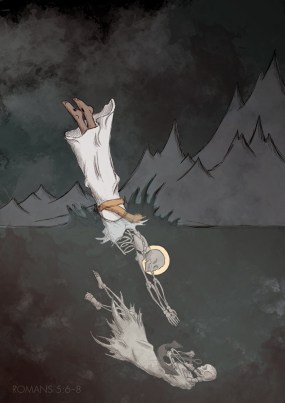 Jesus, the Son of God, emptied Himself by taking the form of a servant. He was formed and woven together in His mother’s womb, just like you were. Jesus was born just as you were born, but in a stable. The shepherds and wise men saw Him as an infant. As a helpless infant, Jesus entrusted Himself to the care of His parents who had to flee the violent, wicked hands of Herod, the lord of Jesus’ land. Jesus learned to walk, talk, and eat in Egypt. He was even potty trained there. He learned His letters and how to read after His parents moved Him to their hometown of Nazareth. Jesus grew up learning carpentry, the trade of His (earthly) father, Joseph. Lord Jesus made friends with the neighborhood kids, and He had siblings who didn’t always treat Him with kindness (Mk. 3:31-32, Jn. 7:1-5).
 survival of the fittest. But the more scientists discover and learn, the more it becomes impossible to believe that we are the product of a series of random events.
 From the moment you were conceived, the information in your DNA would fill 600,000 pages with information. And right now, in each of the 35 trillion cells of your body, biological “machines” are copying the volumes of information in your DNA into amino acids which are taken by other machines and folded in specific and precise ways into proteins. (So, don’t let anyone tell you that you are lazy.) But with all those minute details, you believe in an intricate, sophisticated, wise Maker.
 Your heavenly Father created and gives you everything. Your body and soul, your eyes and ears, all your members, your reason and senses – everything you have is a good gift from God your Father who daily provides for all the needs of your life. And He promises to continue to provide those things for you without any merit or worthiness in you. So, you don’t have to go running around worrying about what you will eat or drink or wear. God makes the sun to shine on the evil and the good, and He sends rain to the just and the unjust (Mt. 5:45). Everything that God provides for your life in His creation continues to be given as His good gift. The theological shorthand for all these things needed for life in God’s creation is called “1st Article gifts.” So, if you don’t mind, I’ll use that term again in a bit.
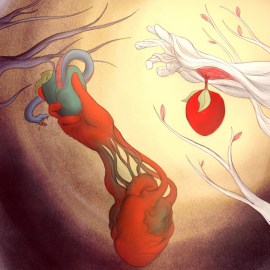 Your heart has a wrong desire, and that false desire is conceived and eventually gives birth to sin. Then, when sin grows up, it brings forth death. Knowing this, we know Satan’s game plan. But it is helpful for us to see how the devil’s game plan plays out in real time, and we saw it in our Old Testament text (Gen. 3:1-21).
 When Eve looked at that fruit, she should have recognized, “That fruit is death.” Instead, she wrongly sees that it is to be desired to make one wise. This is the danger for us. There are things that are put in front of us and God says, “That’s bad, and it leads to death.” But instead of regarding those things according to God’s Word, we regard them according to how we see and think. We put ourselves over and above God and judge Him to be wrong. The devil entices us to think that God is the bad guy who is holding out on us, keeping us from having our heart’s desires. Then, we think we know better than God, and we fall for the temptation and into sin.
 Jesus has been fasting forty days and nights. I remember as a kid being hungry forty minutes after dinner. Jesus is famished. He is weakened by this fast. So, this temptation to turn stones into bread is a real temptation. The tempter again tries to exploit the gap between Jesus’ desires and what God has given. Jesus wanted food. Because He is man just like you and me, His stomach and His brain would have been screaming at Him, “Feed us!” But God has not yet given Jesus food. So Satan tries to get Jesus to take for Himself what God has not given.
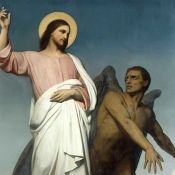 “to guard you in all your ways.” God the Father will protect Jesus in all His ways. But God didn’t send Jesus to earth to be some X-Games-temple-pinnacle jumper.
 So, dear saints, be wise. Know the devil’s attacks and tactics. The devil is going to use those tactics against you, but God has given you weapons against the devil, your flesh, and the world (1 Jn. 2:15-16). When the devil comes to tempt you, take up the weapon of prayer. Pray God’s Word and watch the devils flee. When your flesh tempts you, take up the weapon of fasting. If you are tempted to certain desires of your flesh, fast from those things. Tell your body, “Body, you aren’t in control.” And when the world tempts you with its vain riches, give. Be generous to the point that it makes you unable to afford falling into the temptations of this world.
 When Jonah preached to the sinners of Nineveh in our Old Testament lesson (Jon. 3:1-10), they repented from their evil, violent ways. And for them, it was as crazy an idea as closing their eyes to enable invisibility mode. The king says in his proclamation, “Who knows? God may turn aside from His fierce anger, so that we may not perish.” In other words, “Let’s try repenting. It might work.” Dear saints, we do not have to wonder how God will respond to humble, contrite sinners. Our Epistle Lesson (1 Jn. 1:5-10) says, “If we confess our sins, God is faithful and just to forgive our sins and to cleanse us from all unrighteousness.”
 35 As he drew near to Jericho, a blind man was sitting by the roadside begging. 36 And hearing a crowd going by, he inquired what this meant. 37 They told him, “Jesus of Nazareth is passing by.” 38 And he cried out, “Jesus, Son of David, have mercy on me!” 39 And those who were in front rebuked him, telling him to be silent. But he cried out all the more, “Son of David, have mercy on me!” 40 And Jesus stopped and commanded him to be brought to him. And when he came near, he asked him, 41 “What do you want me to do for you?” He said, “Lord, let me recover my sight.” 42 And Jesus said to him, “Recover your sight; your faith has made you well.” 43 And immediately he recovered his sight and followed him, glorifying God. And all the people, when they saw it, gave praise to God.
 Joshua lead God’s people marching around those thick, fortified walls for six days, and on the seventh day, the people shouted and “the walls came a-tumbilin’ down.” Afterward, they burned the fallen rubble and reduced the city to ashes.
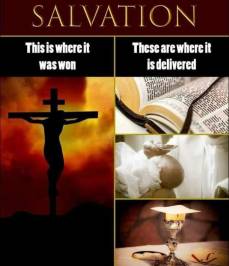 On the cross, Jesus did everything for your salvation. On the cross, Jesus won the victory over sin, death, and the devil. But God delivers what Jesus did on the cross to you here and now. God delivers the mercy, grace, life, and salvation of Jesus through the preaching of His Word (Ro. 10:17), through your Baptism (Ro. 6:3-11), and through the Lord’s Supper (Lk. 22:14-20). God brings His holy deliverance to you through all those things, and as you receive those gifts of God through faith, you are saved.

You must be logged in to post a comment.