John 16:5-15
5 “But now I am going to him who sent me, and none of you asks me, ‘Where are you going?’ 6 But because I have said these things to you, sorrow has filled your heart. 7 Nevertheless, I tell you the truth: it is to your advantage that I go away, for if I do not go away, the Helper will not come to you. But if I go, I will send him to you. 8 And when he comes, he will convict the world concerning sin and righteousness and judgment: 9 concerning sin, because they do not believe in me; 10 concerning righteousness, because I go to the Father, and you will see me no longer; 11 concerning judgment, because the ruler of this world is judged.
 12 “I still have many things to say to you, but you cannot bear them now. 13 When the Spirit of truth comes, he will guide you into all the truth, for he will not speak on his own authority, but whatever he hears he will speak, and he will declare to you the things that are to come. 14 He will glorify me, for he will take what is mine and declare it to you. 15 All that the Father has is mine; therefore I said that he will take what is mine and declare it to you.”
Alleluia, Christ is risen!
He is risen indeed! Alleluia!
In the name of the Father and of the Son and of the Holy Spirit. Amen.
Jesus tells the disciples that it is to their advantage that He is going away. Because of that, I was tempted to title this sermon, “Go away, Jesus.”
This ‘going away’ that Jesus is talking about is His death on the cross. Jesus goes to the cross and to His Father so that first Easter evening He can breathe on His disciples giving them the Holy Spirit and sending them with the proclamation of Christ’s forgiveness (Jn. 20:22-23).
Right off the bat, it is probably important to address something. Sometimes, Lutherans are accused of not talking about the Holy Spirit enough. People today think the Holy Spirit is at work when they get a particular feeling or emotion because of the things going on around them during the service. Scripture is very clear that feelings are not a good gauge to determine whether or not the Holy Spirit is at work.
Now, maybe it is a fair assessment to say Lutherans don’t talk about the Holy Spirit enough. But it should be noted that the Holy Spirit is very content not being talked about. In fact, the work of the Holy Spirit is to point us to Jesus. Just a few verses before our text today, which we will hear in next weeks’ Gospel lesson, Jesus says that when the Holy Spirit comes, “He will bear witness about Me” (Jn. 15:26).
In other words, whenever you hear about Jesus death and resurrection for the forgiveness of your sins, the Holy Spirit doing His primary work of creating faith. That is why Jesus calls the Holy Spirit, as our translation puts it, the ‘Helper.’
The word Jesus uses means ‘advocate, intercessor, or mediator.’ And Jesus focuses on three convictions of the Holy Spirit. He convicts us – He brings out into the open, or convinces us – concerning sin, righteousness, and judgement. And we need to consider each of these.
First, Jesus says the Holy Spirit convicts the world concerning sin “because the world does not believe in Me.”Notice that Jesus doesn’t say that the Holy Spirit convicts the world of sin because they are so horrible.
 We think that the opposite of sin is good works. So, we wrongly think our sin is something we can manage on our own. We imagine we can hide our stains by being kind to those around us. We think we can distract God from our lust, anger, pride, and selfishness with a few good works.
But the opposite of sin is notgood works. The opposite of sin is faith in Jesus, the Lamb of God who takes away the sin of the world. Romans 14[:23] says, “Whatever does not proceed from faith is sin.”
So, the Holy Spirit shows us the depths of our sin. He points us to Jesus who has taken all the punishment. The Holy Spirit shows us that we are fools if we think our sin can be taken away by anything other than the blood of Jesus shed on the cross. The Holy Spirit convicts us of our sin showing us that we need Savior Jesus.
But even when the Holy Spirit has convicted us of our sin, He isn’t done. There is still more Spirit convicting to do.
Second, Jesus says the Holy Spirit convicts the world concerning righteousness “because I go to the Father.”
The Holy Spirit speaks through the Scriptures to convict you that because Jesus has died, you are completely freed from those sins which should separate you from God for eternity.
Satan, the accuser, comes along and tries to tell you that God doesn’t love you. He lies saying that Jesus’ death and resurrection isn’t enough. He comes along and tries to tell you have been lying to yourself and that you really aren’t a Christian. Or if you call yourself a Christian you aren’t a ‘true Christian’ or a ‘committed Christian’ or an ‘on-fire Christian. Hogwash.
Listen to what the Spirit says in the Scriptures: You have been made perfect as your heavenly Father is perfect (1 Pet. 1:16). The Holy Spirit says Jesus became sin for you so that you would become the righteousness of God (2 Cor. 5:21). The Holy Spirit promises that there is no condemnation for you who are in Christ Jesus (Ro. 8:1).
The Holy Spirit shows you that the righteousness you needed has been totally and completely provided for you by Jesus who went to His Father saying, “It is finished.”
And the Holy Spirit still isn’t done.
Jesus says the Holy Spirit convicts the world concerning judgment. Now, you might be thinking that Jesus is going back to Law. But notice that the Holy Spirit convicts the world concerning judgment not because you are judged, rather “because the ruler of this world is judged.”
Christian, when you suffer, when bad things happen to you, you might think that God is judging you. But the Holy Spirit comes and says to you that you are not the target of God’s judgment. Satan is, and he always has been.
When God confronted Adam and Eve in the Garden, the first judgment He gave was to the devil. God promised that He would send Jesus to crush the serpent’s head. Jesus has come and done just that.
The Holy Spirit’s work is to bring all this out into the open. Because of what Christ has done for you, you are not God’s enemy. God demonstrates His love for you that while you were still a sinner, Christ died for you (Ro. 5:8). And even when you were God’s enemy, here’s how He treated you – He reconciled you to Himself by the death of Jesus (Ro. 5:10). The Holy Spirit points you to Jesus’ own words where He says that hell was designed not for you but for the devil and his angels (Mt. 25:41).
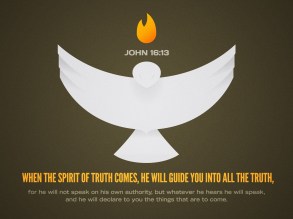 This is the Holy Spirit’s work. The Holy Spirit convicts you of sin, righteousness and judgment. The Holy Spirit takes all the work of Jesus and declares it to you. He is your Helper, Comforter, Advocate. Through Spirit’s working, He opens the Scriptures creating, sustaining, and strengthening faith and guiding you into all the truth.
So, believe. Your sin is paid in full by Christ’s shed blood. Christ’s righteousness covers you. And you are judged worthy of eternal life because of Jesus. All that the Father has belongs to Jesus. And the Holy Spirit takes all that Jesus has and declares it to you.
Alleluia, Christ is risen!
He is risen indeed! Alleluia! Amen.
The peace of God, which surpasses all understanding, will guard your hearts and minds inChrist Jesus. Amen.
 You are God’s children. “See what sort of love the Father has given to us, that we should be called children of God.”
 So, Blair: Today, God has Baptized you. Today, God has connected His Word to water and joined you to Christ’s death and resurrection (Ro. 6:3-11). God has clothed you with Christ (Gal. 3:27). God has given you the washing of regeneration and renewal of the Holy Spirit and saved you (Tit. 3:5-7). Today, you are born again, and God has made you His beloved child.
 When Christ appears, you will be like Him because you will see Him as He is.
 And now, you have angel’s work to do. Go. Tell others. Tell them that because Jesus is their brother, they are God’s children. Tell them they are forgiven because of Jesus. Tell them they are made holy because of Jesus. Tell them because everything is finished just as He told you.
 The first words of Scripture you heard in today’s service told how Jesus rode into Jerusalem. Matthew tells us that it happened this way to fulfill what was spoken by the prophet, “Behold, your king is coming to you, humble, and mounted on a donkey” (Zech. 9:9 quoted in Mt. 21:5). That word that gets translated as ‘humble’ means ‘of no importance.’
 King Jesus didn’t come to sit as judge. Instead, He came to be judged. He didn’t have subjects who shout, “Long live the king!” Instead, they holler, “Crucify Him!” He didn’t come to command armies. Instead, He came to be beaten by soldiers. He didn’t come to be clothed in the finest garments and crowned with gold and jewels. Instead, He came to have a robe ripped from Him and be thorns pressed into His head. He didn’t come to drink fine wine from a golden chalice. Instead, He came to be offered wine mixed with gall. He didn’t come to sit in a fine hall with nobles surrounding Him. Instead, He came to hang on a splintered cross between two thieves. He didn’t come to execute justice. Instead, He came to die an unjust death.
 But Christian, by God’s grace, you know better. You know that those are the very things that God has given and uses to complete the good work of faith that He began in you.
 12 And when they had eaten their fill, he told his disciples, “Gather up the leftover fragments, that nothing may be lost.” 13 So they gathered them up and filled twelve baskets with fragments from the five barley loaves left by those who had eaten. 14 When the people saw the sign that he had done, they said, “This is indeed the Prophet who is to come into the world!”
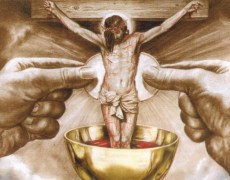 Jesus came to have His back torn by a whip and His forehead sliced open by the crown of thorns. Jesus came to have His body broken. Jesus came to have His hands and feet nailed to the cross, His side run through with a spear. Jesus came to give you every last drop of His forgiving blood. Jesus came to give you eternal mercy, forgiveness, and life.
 15 But some of them said, “He casts out demons by Beelzebul, the prince of demons,” 16 while others, to test him, kept seeking from him a sign from heaven. 17 But he, knowing their thoughts, said to them, “Every kingdom divided against itself is laid waste, and a divided household falls. 18 And if Satan also is divided against himself, how will his kingdom stand? For you say that I cast out demons by Beelzebul. 19 And if I cast out demons by Beelzebul, by whom do your sons cast them out? Therefore they will be your judges. 20 But if it is by the finger of God that I cast out demons, then the kingdom of God has come upon you. 21 When a strong man, fully armed, guards his own palace, his goods are safe; 22 but when one stronger than he attacks him and overcomes him, he takes away his armor in which he trusted and divides his spoil. 23 Whoever is not with me is against me, and whoever does not gather with me scatters.
 Guard it. Keep it. Take it. Eat and drink it. Because Jesus joins that Word of deliverance and forgiveness of sins to bread and wine. With His little finger, He destroyers the stronghold and armor of the devil. He claims you as His own. And He guards and keeps you now and for all eternity. Amen.
 22 The same night [Jacob] arose and took his two wives, his two female servants, and his eleven children, and crossed the ford of the Jabbok. 23 He took them and sent them across the stream, and everything else that he had. 24 And Jacob was left alone. And a man wrestled with him until the breaking of the day. 25 When [he] saw that he did not prevail against [him], he touched his hip socket, and Jacob’s hip was put out of joint as he wrestled with him. 26 Then he said, “Let me go, for the day has broken.” But [he] said, “I will not let you go unless you bless me.” 27 And he said to him, “What is your name?” And he said, “Jacob.” 28 Then he said, “Your name shall no longer be called Jacob, but Israel, for you have striven with God and with men, and have prevailed.” 29 Then Jacob asked him, “Please tell me your name.” But he said, “Why is it that you ask my name?” And there he blessed him. 30 So Jacob called the name of the place Peniel, saying, “For I have seen God face to face, and yet my life has been delivered.” 31 The sun rose upon him as he passed Penuel, limping because of his hip. 32 Therefore to this day the people of Israel do not eat the sinew of the thigh that is on the hip socket, because he touched the socket of Jacob’s hip on the sinew of the thigh.
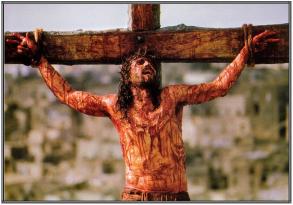 Loaded with your sin and the sin of the whole world, He fights to the very end, to the last breath. And the fight looked lost. Jesus looked like a loser – dead, lifeless, buried. But, even in that apparent defeat, He rose victorious.
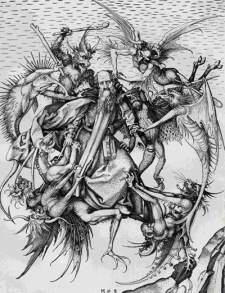 But this also means that, in this life, you are in the devil’s crosshairs. Satan hates you and will tempt you to doubt that God is truly your Father who gives you all things. The devil tempts you to sin by putting God’s promises in front of you, but he wants you to lay hold of those promises in your own way and timing. But Satan’s way never brings the joy that God wants to give you.
 The second temptation of the devil is for Jesus to throw Himself down from the pinnacle of the Temple. The devil says, “God will protect you by sending angels to make sure you don’t even hurt your foot.”
 Instead, rejoice in Jesus’ temptation. Rejoice because Jesus has endured where you have fallen and obeyed where you rebelled. Rejoice because Jesus knows the temptations you face, and He will always provide a way of escape (1 Cor. 10:13).
 The road to the cross passes through Jericho. In the city where the walls had come-a-tumblin’ down, lived a blind man. Mark tells us that his name is Bartimeaus (Mk. 10:46). Bartimeaus heard all sorts of commotion and asked what it was all about. He is told nothing more than that Jesus of Nazareth is passing through. As blind as he is, Bartimeaus sees his opportunity and cries out, “Jesus, Son of David, have mercy on me.” And don’t miss this.
 Dear Charlie. Today, you are Baptized. Today, your God and Lord has had mercy upon you. Today, God joined all His promises of forgiveness, life, and salvation to water and poured out all His love upon you. The perfect, Divine love we heard in our Epistle lesson (1 Cor. 13) has been given to you and to all your brothers and sisters in Christ.

You must be logged in to post a comment.