John 2:1-11
1 On the third day there was a wedding at Cana in Galilee, and the mother of Jesus was there. 2 Jesus also was invited to the wedding with his disciples. 3 When the wine ran out, the mother of Jesus said to him, “They have no wine.” 4 And Jesus said to her, “Woman, what does this have to do with me? My hour has not yet come.”  5 His mother said to the servants, “Do whatever he tells you.” 6 Now there were six stone water jars there for the Jewish rites of purification, each holding twenty or thirty gallons. 7 Jesus said to the servants, “Fill the jars with water.” And they filled them up to the brim. 8 And he said to them, “Now draw some out and take it to the master of the feast.” So they took it. 9 When the master of the feast tasted the water now become wine, and did not know where it came from (though the servants who had drawn the water knew), the master of the feast called the bridegroom 10 and said to him, “Everyone serves the good wine first, and when people have become drunk, then the poor wine. But you have kept the good wine until now.” 11 This, the first of his signs, Jesus did at Cana in Galilee, and manifested his glory. And his disciples believed in him.
Grace, mercy, and peace be to you from God our Father and from our Lord and Savior, Jesus Christ. Amen.
When you think through all the miracles of Jesus, turning water into wine is probably the miracle you think is least significant. Jesus did so many other, more important, miracles. He fed the masses and healed diseases. He made the lame to walk, the blind to see, and the deaf to hear. He cast out demons and raised the dead. Turning water into wine just seems like a nifty party trick especially when you consider that Jesus did this for people who are drunk. (The word that the master of the feast uses in v. 10 is the drunkenness that Scripture warns about [1 Cor. 6:9-11; Eph. 5:18]). And yet, Scripture says this was the first sign Jesus does to manifest His glory.
Jesus, Mary, and the first few disciples are all at a wedding, and the wine runs out. Either the guests were enjoying the wine quicker than respectable people should, or the bride and groom didn’t plan well enough. Mary informs Jesus, “They have no wine.” Notice that she doesn’t ask for anything in particular. She doesn’t offer a solution. She doesn’t ask Jesus to rebuke the drunks. She gives no stipulations and doesn’t tell Jesus how to act. She simply puts the situation in front of Him, “They have no wine.”
But Jesus doesn’t seem too interested. “Woman, what does this have to do with Me? My hour has not yet come.”
But Mary doesn’t give up hope. She tells the servants, “Do whatever He tells you.” She leaves every option to Jesus believing that Jesus knows and will do what is good and right. And this is a beautiful expression of faith.
Mary has no idea what Jesus will tell them. Jesus might not tell them anything, or He might tell everyone, “Go home. The party is over.” When Jesus does tell the servants to fill the jars, He might be setting up a purification station. He might start dunking their heads in hot and cold water to sober them up like Fezzik does to Inigo in “The Princess Bride.”
Mary doesn’t know what Jesus will do, but she trusts. She believes that Jesus is compassionate. She knows that God loves weddings, celebrations, and joy. Whatever Jesus tells them to do will be good – even if it is uncomfortable and unpleasant.
This is faith. Faith expects good things from God. Faith trusts God to keep His promises, to be a loving heavenly Father. But faith also recognizes that God has options.
 When you or a loved one is plagued with sickness and disease you pray for healing. You pray for a clean scan. You pray that the next doctor appointment will show that everything is normal. You pray for a miracle. These are all good things to pray for.
But remember, God has options. Yes, God can heal you instantaneously. But He can also allow the disease to spread. He can allow the sickness to remain. God can even use that disease to be your death or the death of your loved one.
Does that mean that God hasn’t heard your prayer? Does that mean that God is angry with you? Does that mean that God has abandoned or failed you? Does that mean God doesn’t love you? No. Absolutely no!
You look around and see a world filled with injustice. You see people starving. You see nations at war. You see corrupt governments and politicians. So, you pray. You pray that this person would get elected or that policy will be enacted.
But if God doesn’t submit to your solution, if the wicked continue to prosper and the world stays evil, you are tempted to doubt. You start to wonder if God really cares. But does He care? Does God still love justice and hate wickedness? Yes. Absolutely, yes!
Now, should you pray for things you want? Of course. God already knows the desires of your heart. But also, be ready to accept what God gives you because it will be, it absolutely will be, a good beyond comprehension. He is your loving heavenly Father, and He withholds no good thing from His children (Ps. 84:11; Mt. 7:11).
Remember, just before He was arrested, Jesus prayed three times, “Father, let this cup pass from Me” (Mt. 26:39-44). Never in the history of mankind was there a more futile petition prayed to God. Jesus Himself said that it was necessary for Him to suffer and die (Lk. 9:22). Yet, each time He prayed to be delivered from the crucifixion, Jesus also prayed, “Your will be done.”
Let God have His options. He will always do what is good, right, and best. Don’t let Satan fill your head with his lies that God is holding out on you. Remember that God delights in your prayers. And remember that He has answered all the sickness, pain, suffering, and  sin of this world. He has answered them by sending His Own, beloved Son to die and rise again. He has glory for you that is unspeakable and unimaginable.
Remember, you will never suffer anything that the Resurrection cannot fix. Look for that. God has promised it. He who has promised is faithful (Heb. 10:23), and He will surely do it. Amen.
The peace of God, which surpasses all understanding, will guard your hearts and minds in Christ Jesus. Amen.
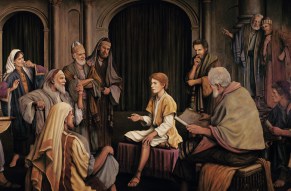 46 After three days they found him in the temple, sitting among the teachers, listening to them and asking them questions. 47 And all who heard him were amazed at his understanding and his answers. 48 And when his parents saw him, they were astonished. And his mother said to him, “Son, why have you treated us so? Behold, your father and I have been searching for you in great distress.” 49 And he said to them, “Why were you looking for me? Did you not know that I must be in my Father’s house?” 50 And they did not understand the saying that he spoke to them. 51 And he went down with them and came to Nazareth and was submissive to them. And his mother treasured up all these things in her heart. 52 And Jesus increased in wisdom and in stature and in favor with God and man.
 But as sinners, we never want to own our sin. Instead, we offer excuses and expect others to justify us in our sin. That is why, when someone offends you, you are more likely to tell someone else how mad you are rather than speak to the person you are angry with. Sometimes, we do get approval for our sinful actions from others. But we do ourselves no favors finding approval from others because when we do, we start to think that we can play the same game with God.
 If you’ve ever played hide and seek with a little child, you don’t have difficulty finding her. She will hide in the same three or four spots every time. Behind a door. Under a lumpy, moving blanket on the floor with her legs sticking out. Or lying face-down on the couch with her eyes shut because if she can’t see you then you can’t see her, obviously.
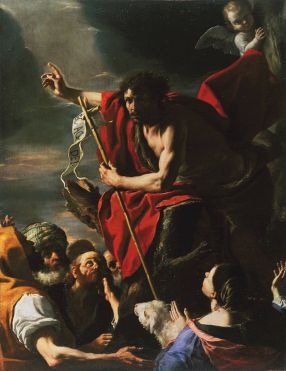 “What then? Are you Elijah?” He said, “I am not.” “Are you the Prophet?” And he answered, “No.” 22 So they said to him, “Who are you? We need to give an answer to those who sent us. What do you say about yourself?” 23 He said,
 And they ask this because of what we heard in our Old Testament lesson (Dt. 18:15-19). In that text, Moses told the people that God would raise up a prophet for His people from among them. And Moses made it very clear, “To Him you shall listen.”
 Finally, take a page out of John’s playbook and point people to Jesus. John has a laser-like focus on Jesus and isn’t interested in talking to people unless he is pointing them to Christ. Point others to the One who delivers them from sin. Point them to Jesus, the Lamb of God who takes away the sin of the world. Tell them that they don’t need to save themselves. Jesus saves them.
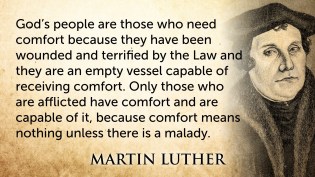 The only people who can be comforted are those who are troubled, afflicted, and uncomfortable. And God says, “Give them a double dose. Give them two shots of comfort.”
 God’s anger is but for a moment, and His favor is for a lifetime. Weeping may tarry for the night, but joy comes with the morning (Ps. 30:5). And even before the suffering begins God preaches comfort to His people.
 Here is your hope, Christian. You have God’s comfort in all things. Heaven is on your side. Your warfare is ended. Your iniquity pardoned. And no one, not even God Himself, can charge you for your sins because His Word of comfort stands forever.
 Remember also that this world is not all that there is. There is more. There is still the eternal wedding feast of the Lamb in His kingdom. That is why Jesus tells us to not be afraid when these things draw near. He says, “When these things begin to take place, straighten up and raise your heads, because your redemption is drawing near.”
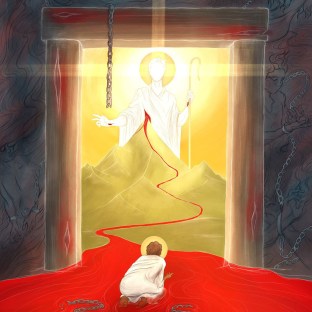 So, the castle of this world crumbles, but your redemption draws near. Though the earth gives way, though the mountains tremble and are moved into the heart of the sea (Ps. 46:2-3), according to His promise you are waiting for the new heavens and new earth in which righteousness dwells (2 Pet. 3:13).
 securely. And this is the name by which he will be called: ‘The Lord is our righteousness.’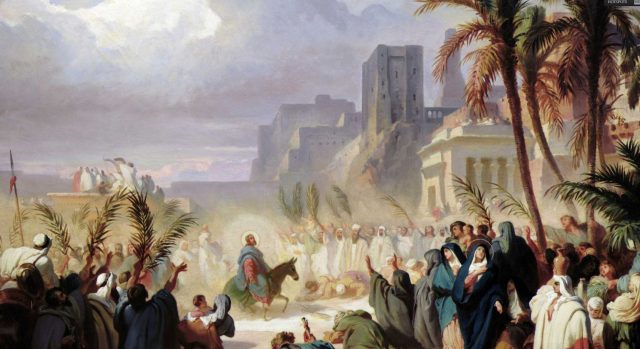
 for us by the saints who have come before us. Today, this first Sunday in Advent, is the beginning of a new Church year.
 34 Then the King will say to those on his right, ‘Come, you who are blessed by my Father, inherit the kingdom prepared for you from the foundation of the world. 35 For I was hungry and you gave me food, I was thirsty and you gave me drink, I was a stranger and you welcomed me, 36 I was naked and you clothed me, I was sick and you visited me, I was in prison and you came to me.’ 37 Then the righteous will answer him, saying, ‘Lord, when did we see you hungry and feed you, or thirsty and give you drink? 38 And when did we see you a stranger and welcome you, or naked and clothe you? 39 And when did we see you sick or in prison and visit you?’ 40 And the King will answer them, ‘Truly, I say to you, as you did it to one of the least of these my brothers, you did it to me.’
 They are sheep for one reason – God has done it. God makes them sheep. God makes them righteous. And then, these sheep live like His sheep.
 When you don’t even notice because that work seems so inconsequential and insignificant.
 19 Now after a long time the master of those servants came and settled accounts with them. 20 And he who had received the five talents came forward, bringing five talents more, saying, ‘Master, you delivered to me five talents; here, I have made five talents more.’ 21 His master said to him, ‘Well done, good and faithful servant. You have been faithful over a little; I will set you over much. Enter into the joy of your master.’ 22 And he also who had the two talents came forward, saying, ‘Master, you delivered to me two talents; here, I have made two talents more.’ 23 His master said to him, ‘Well done, good and faithful servant. You have been faithful over a little; I will set you over much. Enter into the joy of your master.’ 24 He also who had received the one talent came forward, saying, ‘Master, I knew you to be a hard man, reaping where you did not sow, and gathering where you scattered no seed, 25 so I was afraid, and I went and hid your talent in the ground. Here, you have what is yours.’ 26 But his master answered him, ‘You wicked and slothful servant! You knew that I reap where I have not sown and gather where I scattered no seed? 27 Then you ought to have invested my money with the bankers, and at my coming I should have received what was my own with interest. 28 So take the talent from him and give it to him who has the ten talents. 29 For to everyone who has will more be given, and he will have an abundance. But from the one who has not, even what he has will be taken away. 30 And cast the worthless servant into the outer darkness. In that place there will be weeping and gnashing of teeth.’”
 Here is the point of the parable. However you believe God to be is how He is to you. If you believe God to be a deity who demands that you work and slave to get back into His good graces, that is how He will be to you. But if you believe God to be merciful, forgiving, gracious, patient, loving, and kind, that is how He will be to you. So, how is your God? How is your Master?
 Jesus is your gracious master who takes of His own property, that which is His, that which He earned, and gives it to you. And then, in the end, allows you to keep it not only as stewards, but as a dear beloved child.
 7 Then all those virgins rose and trimmed their lamps. 8 And the foolish said to the wise, ‘Give us some of your oil, for our lamps are going out.’ 9 But the wise answered, saying, ‘Since there will not be enough for us and for you, go rather to the dealers and buy for yourselves.’ 10 And while they were going to buy, the bridegroom came, and those who were ready went in with him to the marriage feast, and the door was shut. 11 Afterward the other virgins came also, saying, ‘Lord, lord, open to us.’ 12 But he answered, ‘Truly, I say to you, I do not know you.’ 13 Watch therefore, for you know neither the day nor the hour.”
 Notice, all ten virgins – both the wise and the foolish – they all fall asleep. But also notice, that when the Bridegroom comes, He washes away the sins of those five wise virgins who fell asleep. He doesn’t hold their slumber against them. The Bridegroom is the one who died for their sins, so their sins aren’t going to stop Him from welcoming them to the wedding feast (Rev. David H. Pedersen).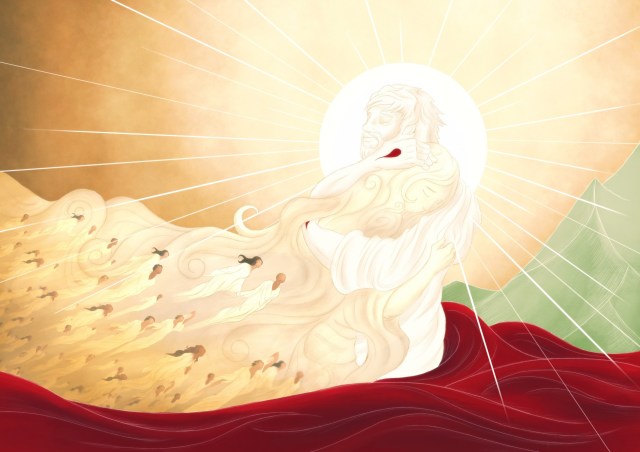
 but we know that when he appears we shall be like him, because we shall see him as he is. 3 And everyone who thus hopes in him purifies himself as he is pure.
 In all likelihood, John wrote this epistle before he wrote the book of Revelation. In that first reading today (Rev. 7:9-17), John got a glimpse of what we will be. John saw an innumerable multitude, “from every nation, from all tribes and peoples and languages.” That means John saw you who speak a language that didn’t even exist in his day. John saw you “standing before the throne and before the Lamb, clothed in white robes, with palm branches in [your] hands, and crying out with a loud voice, ‘Salvation belongs to our God who sits on the throne, and to the Lamb!’”

You must be logged in to post a comment.