1 Peter 3:13-22
13 Now who is there to harm you if you are zealous for what is good? 14 But even if you should suffer for righteousness’ sake, you will be blessed. Have no fear of them, nor be troubled, 15 but in your hearts honor Christ the Lord as holy, always being prepared to make a defense to anyone who asks you for a reason for the hope that is in you; yet do it with gentleness and respect, 16 having a good conscience, so that, when you are slandered, those who revile your good behavior in Christ may be put to shame. 17 For it is better to suffer for doing good, if that should be God’s will, than for doing evil.
18 For Christ also suffered once for sins, the righteous for the unrighteous, that he might bring us to God, being put to death in the flesh but made alive in the spirit, 19 in which he went and proclaimed to the spirits in prison, 20 because they formerly did not obey, when God’s patience waited in the days of Noah, while the ark was being prepared, in which a few, that is, eight persons, were brought safely through water. 21 Baptism, which corresponds to this, now saves you, not as a removal of dirt from the body but as an appeal to God for a good conscience, through the resurrection of Jesus Christ, 22 who has gone into heaven and is at the right hand of God, with angels, authorities, and powers having been subjected to him.
In the name of Jesus. Amen.
Alleluia! Christ is risen!
He is risen indeed! Alleluia!
Writing a sermon on this text is no easy task. Believe me. I know, I’ve tried.
 Peter begins today by telling us Christians to be zealous for what is good. And Peter doesn’t hide the fact that even when we do good, when we do the right thing, we will suffer, we will be reviled and slandered. And yet in the midst of our suffering, we should always be ready to give an answer, a gentle and respectful answer, for the hope that is in us. Peter reminds us that if we suffer for righteousness’ sake, we are blessed.
Peter points out that even Jesus suffered for doing good. Christ, the righteous One, suffered for sins He didn’t commit. Instead, Jesus suffered for your sins and for my sins. The Righteous One suffered for all us unrighteous ones that He might bring us to God. He was crucified. Killed. Put to death in the flesh but made alive in the spirit.
Finally, Peter talks about Jesus preaching to the spirits in prison. He tells us about Noah, the ark, and the deliverance that God granted through water. Peter connects Noah and the ark and the Flood to Baptism clearly saying, “Baptism now saves you through the resurrection of Jesus Christ.” And Peter concludes saying that Jesus has now gone into heaven, is at the right hand of God, and angels, authorities, and powers are subjected to Him.
It is a hard text. Doing good. Suffering. Jesus’ death and resurrection. Noah. Water. Baptism. The Ascension. There is a lot here. And how is it all tied together?
Like Peter tells us to, let’s consider Noah and the flood. Usually, when we think of the Flood we think mostly of God’s judgment upon sin, and it is certainly right to do that. Noah lived in an evil time. The world was so full of sin and wickedness that God regretted that He had created mankind at all. So, God determined to blot out man from the face of the earth.
But the Flood is also about God’s deliverance and salvation because “Noah found favor (lit. grace) in the eyes of the Lord” (Gen. 6:8).
Though God determined to condemn the world through the Flood, God also determined to save Noah and his family. To save Noah, God told Noah to build an ark, to bring his family and the animals in, and to be delivered from the coming judgment.
For 120 years, Noah suffered as he built the ark. Can you imagine? Day after day, week after week, year after year, decade after decade people saying, “There’s crazy Noah building a big ol’ box. Hey, Noah, what did you say you are building that for?”
“God told me to.”
He was ridiculed by everyone else, but he persisted in doing good through his suffering. And Noah’s persistence was his preaching to those who did not listen to God’s voice. In fact, in 2 Peter (2:5), Noah is called a “herald (lit. preacher) of righteousness.” Once the ark was completed, God shut Noah and his family into the ark (Gen. 7:16).
The Flood came, and the waters drowned and doomed everything outside the ark.
Peter says that this is what God has done for you in your Baptism. God has drowned and destroyed all the sin and evil that surrounded you, condemning it in a watery death. And God has put you safely into the ark of His Church.
Remember, the flood waters condemned and drowned, but the Flood also delivered. it was those same waters that lifted the ark and everyone inside to safety.
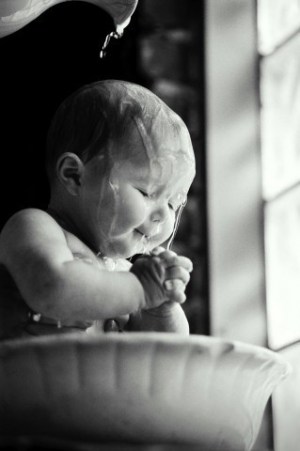 Believer, everything that Christ has done for you – His perfect, sinless life; His death; His resurrection – it is all delivered to you in your Baptism. In your Baptism, God has united you with Christ’s death and resurrection (Ro. 6:3-11). In your Baptism, God has clothed you with Christ (Gal. 3:27).
So, when you suffer for doing good, have no fear. In your Baptism, in that flood of righteousness, God has delivered you from all sin and evil and delivered to you all that Christ has done for you.
Alleluia! Christ is risen!
He is risen indeed! Alleluia! Amen.
The peace of God which surpasses all understanding will guard your hearts and minds in Christ Jesus. Amen.
 If your goal in life is to make a lot of money or have lots of power over others, the easiest way to do it is to stir up fear and manufacture a crisis. The first step in creating fear and crisis is to point out how things are changing and convince everyone that change is bad. Once people convinced this change is scary and terrible, you can keep dipping your hand in their wallet and controlling their behavior.
 But this same thing happens even in the church. Change is turned into fear in order gain control. The church is aging and shrinking, so we need to do something to draw in young people. The church needs to get more with the times. Giving is down, and the church is struggling to survive. So buy this book, come to this seminar, employ these methods, or your church will die.
 Believe because Jesus has rescued you. Jesus has ransomed you. Jesus has gone to the cross and prepared a place for you with Him forever. Jesus has put His name upon you in your Baptism and claimed you as His own. Jesus has given you His Body and Blood for the forgiveness of sins, life, and salvation. Jesus has absolved you of all your sins.
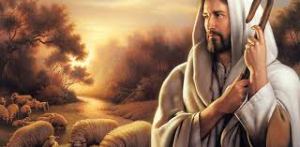 11 “I am the good shepherd. The good shepherd lays down his life for the sheep. 12 He who is a hired hand and not a shepherd, who does not own the sheep, sees the wolf coming and leaves the sheep and flees, and the wolf snatches them and scatters them. 13 He flees because he is a hired hand and cares nothing for the sheep.
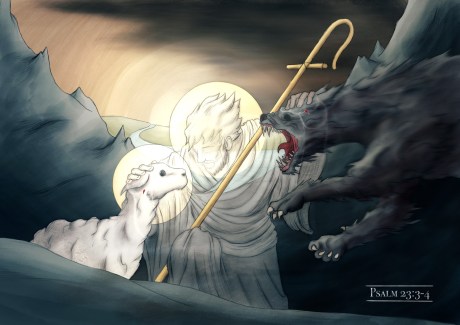 Jesus says, “The thief comes only to steal and kill and destroy.” And by listening to the voices of thieves, you are damned.
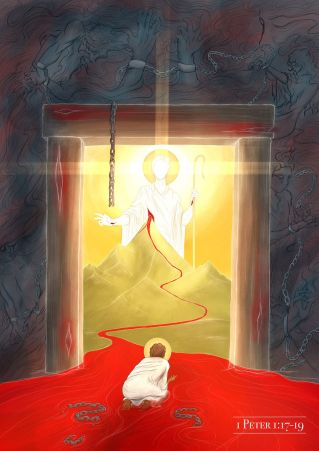 19 but with the precious blood of Christ, like that of a lamb without blemish or spot. 20 He was foreknown before the foundation of the world but was made manifest in the last times for the sake of you 21 who through him are believers in God, who raised him from the dead and gave him glory, so that your faith and hope are in God.
 Jesus appears to these two as they walked on the road that first Easter afternoon. The two disciples talk about how glorious following Jesus had been. Jesus was mighty in deed and word before God and all the people. He was healing the sick, giving sight to the blind, feeding the hungry, and raising the dead. Good stuff. They figured that He was going to be the one to redeem Israel, and since they were following Him, their pendulum had swung to a place of pride.
 This Jesus was foreknown before the foundation of the world. That means even before Adam and Eve believed the devil’s lies and fell into sin, even before God created this world, God had determined to save you, to ransom you, to purchase you from sin by sending His own beloved Son.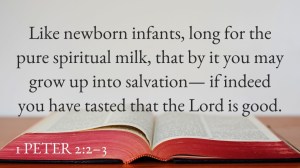
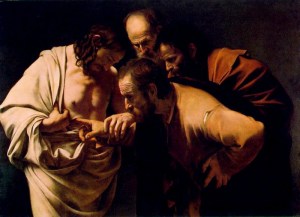 Thomas had not been there the first time, and because of that, he gets his (unwarranted) surname, doubting. You rarely hear him called ‘Apostle Thomas.’ Sometimes, you might hear him called ‘St. Thomas.’ Most of the time you hear him called ‘Doubting Thomas.’ Yes, of course, Thomas should have believed the testimony of his friends. He should have. But his vow of unbelief until he could see for himself is simply Thomas wanting to have the same blessed experience as the other disciples – nothing more, nothing less.
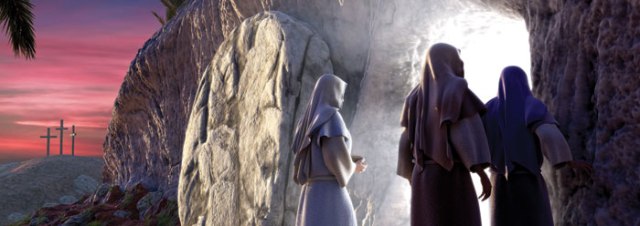

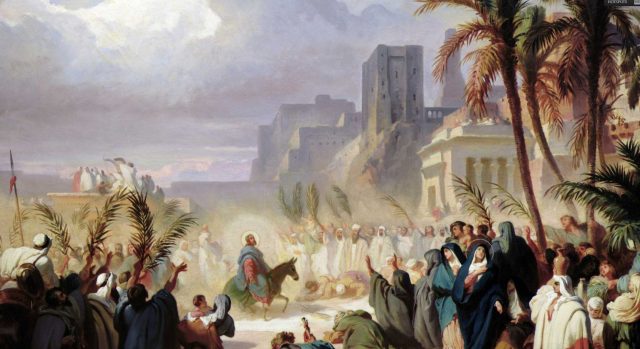 Who is this King of Glory?
 Who is this King of Glory? He is Jesus. Delivered up to be crucified. Betrayed by Judas’ kiss. Giving His Body and Blood for the forgiveness of sin. Denied by one of His closest friends. Arrested by soldiers. Seized. Spat upon all for you.
 38 Then Jesus, deeply moved again, came to the tomb. It was a cave, and a stone lay against it. 39 Jesus said, “Take away the stone.” Martha, the sister of the dead man, said to him, “Lord, by this time there will be an odor, for he has been dead four days.” 40 Jesus said to her, “Did I not tell you that if you believed you would see the glory of God?” 41 So they took away the stone. And Jesus lifted up his eyes and said, “Father, I thank you that you have heard me. 42 I knew that you always hear me, but I said this on account of the people standing around, that they may believe that you sent me.” 43 When he had said these things, he cried out with a loud voice, “Lazarus, come out.” 44 The man who had died came out, his hands and feet bound with linen strips, and his face wrapped with a cloth. Jesus said to them, “Unbind him, and let him go.”
 You see what kind here and in our Old Testament lesson (Ezk. 37:1-14). Ezekiel sees the valley full or bones. There were many, and they were dry. They weren’t full of love for God or love for their neighbor. They weren’t even able to muster up a stink – not any more.
 6 Having said these things, he spit on the ground and made mud with the saliva. Then he anointed the man’s eyes with the mud 7 and said to him, “Go, wash in the pool of Siloam” (which means Sent). So he went and washed and came back seeing.
 Repent and listen to Jesus’ answer. “It was not that this man sinned, or his parents, but that the works of God might be displayed in him.”
 In Christ’s death and resurrection, your eyes are opened to a greater love. See His beautiful grace which has turned you, sinner, from being His enemy to being His child.
 11 The woman said to him, “Sir, you have nothing to draw water with, and the well is deep. Where do you get that living water? 12 Are you greater than our father Jacob? He gave us the well and drank from it himself, as did his sons and his livestock.” 13 Jesus said to her, “Everyone who drinks of this water will be thirsty again, 14 but whoever drinks of the water that I will give him will never be thirsty again. The water that I will give him will become in him a spring of water welling up to eternal life.” 15 The woman said to him, “Sir, give me this water, so that I will not be thirsty or have to come here to draw water.”

You must be logged in to post a comment.