Matthew 15:21-28—21 And Jesus went away from there and withdrew to the district of Tyre and Sidon. 22 And behold, a Canaanite woman from that region came out and was crying, “Have mercy on me, O Lord, Son of David; my daughter is severely oppressed by a demon.” 23 But he did not answer her a word. And his disciples came and begged him, saying, “Send her away, for she is crying out after us.” 24 He answered, “I was sent only to the lost sheep of the house of Israel.” 25 But she came and knelt before him, saying, “Lord, help me.” 26 And he answered, “It is not right to take the children’s bread and throw it to the dogs.” 27 She said, “Yes, Lord, for even the dogs eat the crumbs that fall from their masters’ table.” 28 Then Jesus answered her, “O woman, great is your faith! Be it done for you as you desire.” And her daughter was healed instantly.
In the name of Jesus. Amen.
Several places in the Gospels, Jesus does or says things that make us uncomfortable. Matthew 13:58 is one: “[Jesus] could not do many mighty works [in Nazareth], because of their unbelief.” Mark 8:22-26 is another; Jesus lays His hands on a blind man to restore his sight. But when Jesus asks the blind man if he can see, he responds, “I see people, but they look like trees walking.”
Today’s text is a big one. You can’t get around the fact that in this text, Jesus is rude, racist, and just downright mean and insulting. This is one of those texts that can make us uncomfortable in a society where “tolerance” is the chief virtue. If you will allow me a baseball analogy, Jesus strikes this woman out on three pitches.
This Canaanite woman comes to Jesus for help – and not for herself. She cries out, “Kyrie Eleison! Have mercy on me, O Lord, Son of David; my daughter is severely oppressed by a demon.” What problem could she have that is more compelling? She’s not coming for her husband or even for her son; she is making a request on behalf of her poor daughter. Her daughter doesn’t need help because she’s done something wrong. A demon is oppressing her and oppressing her wickedly.
But what does Jesus do? Jesus gives her the silent treatment. “He did not answer her a word.”
Strike one.
The disciples come to Jesus, “Send her away, for she is crying out after us.” The disciples seem to want Jesus to give this Canaanite woman what she wants so they can get rid of her. Jesus responds with a quick response that, frankly, sounds racist. “I was sent only to the lost sheep of the house of Israel.” In other words, Jesus directly tells the disciples (and indirectly tells the woman), “I’m not here to help the likes of her.”
Strike two.
Down in the count, the woman falls on her knees before Jesus. “Lord, help me.” If Jesus sounded apathetic before, His next words are downright mean. Jesus winds up and throws a killer screwball, “It is not right to take the children’s bread and throw it to the dogs.” You heard it right. Jesus just called her a dog – a dog unworthy of His help. Ok, it’s time to be offended. Time to slap Jesus in the face. Time to get on social media and ruin Jesus’ reputation.
It’s strike three, and she’s out in humiliating fashion.
But notice, she’s not offended. In fact, she agrees with Jesus. She says, “Yes, Lord. It is not right to take the children’s bread and throw it to the dogs. Give the bread to Your children. But when the children eat, they get sloppy. And their sloppiness means we dogs eat too. Your bread is so good that even the crumbs are more than enough for me and my daughter. I’m not asking for their bread, all I need is one of their crumbs that carelessly falls on the floor.”
Not many things impress Jesus in the Gospels, but listen to what Jesus says, “O woman, great is your faith!” Great faith. What makes this woman’s faith great? There are two things about this woman’s faith that are a lesson for us.[1]
First, great faith knows who Jesus is. This woman is a foreigner – she is a Canaanite. As a Canaanite, she is outside of the promise God made through David’s Son. Jesus is Israel’s Messiah whom God had promised to send through David’s line. You see, “God doesn’t keep every promise [you] can think of. He only keeps the promises that He has made” (Gibbs). And, through faith, this woman knows that Jesus was sent to the lost sheep of Israel. It is not right to interrupt God’s plan by taking the children’s bread and throw it to the dogs. But she doesn’t ask Jesus to do that. Because she knows who He is, she says, “Yes, Lord. For even the dogs eat the crumbs,” which brings us to the second thing that makes faith great.
Great faith knows that Jesus has something for you. That doesn’t mean that God will give you whatever you want. In fact, God may give you something you don’t want. Jesus is Lord, and you are not. Jesus has something for you, but it may not be what you want. If presented with the choice between bread and crumbs which would you chose? Yeah, bread every time.
Who here would chose to be saved by a God who sacrifices Himself in weakness and shame by dying on a cross? That way of salvation is silly; it is foolish. But, believer, that is the only salvation there is. That is the only salvation from sin, death, and the devil available to anyone.
You see, Jesus is Lord, and He does have something for you. He has given Himself, all of Himself, His body crucified and His blood shed – for you. To believe this is saving faith, and saving faith is always a gift of God.
And remember what Scripture says about faith – what this faith does for you – it makes you a child of God. John 1:12–13 12 But to all who did receive Him, who believed in His name, He gave the right to become children of God, 13 who were born, not of blood nor of the will of the flesh nor of the will of man, but of God.
Remember who Jesus is. Remember that you were separated from Christ, alienated from the commonwealth of Israel and strangers to the covenants of promise, having no hope and without God in the world. But remember that He has something for you. Christ Jesus, the Son of David, has brought, even you who were far off, He has brought you near by His blood. You are no longer strangers and aliens, but fellow citizens with the saints and members of the household of God (Eph. 2:12-13, 19). Amen.
The peace of God, which surpasses all understanding, will guard your hearts and minds in Christ Jesus. Amen.
[1] For these two things that faith believes, I am indebted to Dr. Jeffrey Gibbs’ commentary and a sermon he preached on this text.
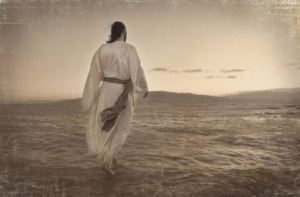 Notice, though, that even though they are having trouble, there is no mention of the disciples being afraid. The disciples are not scared – until they see Jesus. Jesus advances towards them, but all they see is a phantasm. They see a figure emerging from the darkness walking on top of the very same waves that are inhibiting their progress.
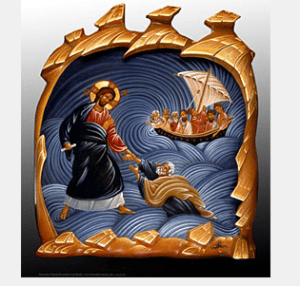 Anyway, Peter cries out, “Lord, save me.” If I were Jesus, I’d have lost my patience. I would have let Peter sink down to the bottom of the sea. But how long does Jesus wait to rescue this braggadocios disciple? He doesn’t wait one second. “Immediately, Jesus reached out His hand and took hold of [Peter] saying to him, ‘O you of little faith, why did you doubt?’”
 Most importantly, God keeps giving you His forgiveness for your failure and sin. He has given it to you already today through the Absolution. And if you doubt that that forgiveness proclaimed through your pastor is really for you, He gives you forgiveness that cannot miss in Communion, in Bread and Wine, in His very body and blood given unto death on the cross for the forgiveness of your sins. Strengthened by this food, this little meal, God gives you a lot to chew on. Your God equips you and sends you back out into this broken world with sins forgiven and hearts full of joy. Amen.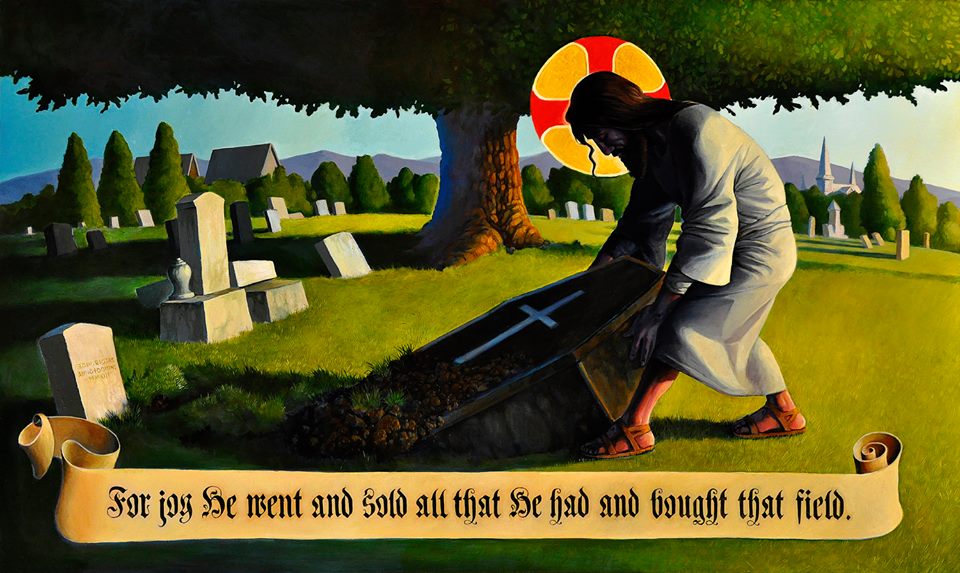
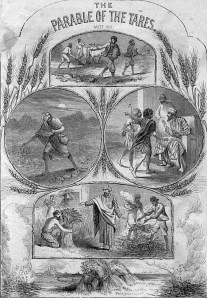 The reign of heaven may be compared to a man who sowed good seed in his field, but in the night an enemy comes and sows weeds. The weeds Jesus speaks about look identical to wheat as they grow, but at harvest time the grains of this weed are a different color than the wheat. The servants of the master ask if they should go and go and gather the weeds, but take careful note of what the master says:
 But Jesus teaches with the parable of the Sower and the Seed, and the disciples don’t like this. They are disappointed. “Why do You speak to them in parables?” they ask (13:10). It is as if the disciples are saying, “Jesus, don’t You see how much trouble You’ve stirred up today. People are rejecting Your message. The Pharisees hate You, and You are separating us from the crowds and even Your own family. Now, You are teaching in parables? Come on, clear things up! Teach them plainly so they can understand.”
 But God did reveal (lit. “apocalypsed”) His salvation to those who had no wisdom of their own – to the “little children.” All sinners, that includes you, are without understanding. Like Paul in our epistle text (Ro. 7:14-25), you too are a slave to sin. You carry the burden of knowing what is right and good, but you don’t do it. Like Paul, you practice the very things you hate and know to be evil. You reject and deny God’s authority over you.
 at might be St. Augustin’s most famous quote he says to God, “Thou hast formed us for Thyself, and our hearts are restless till they find rest in Thee.” The rest that Jesus gives is completely foreign and alien to our normal, everyday existence. The rest Christ delivers is the forgiveness of sins and the end striving against God. That rest is what God wanted us to have so He gave us the third Commandment, “Remember the Sabbath day to keep it holy.” God wanted us to set apart a whole day when we could find rest in being fed with His Word. Jesus is offering the eternal Sabbath rest that only comes from God.
 Matthew 10:34-42—34 “Do not think that I have come to bring peace to the earth. I have not come to bring peace, but a sword. 35 For I have come to set a man against his father, and a daughter against her mother, and a daughter-in-law against her mother-in-law. 36 And a person’s enemies will be those of his own household.
 The Prince of Peace says, “Do not think that I have come to bring peace to the earth. I have not come to bring peace, but a sword.” Strange words from Jesus especially when we remember that, at His birth, the angels sang, “Peace on earth,” (Lk. 2:14). Such an odd saying from Jesus who, the night before He dies proclaims, “Peace I leave with you; My peace I give to you” (Jn. 14:27).
 In Junior High and early High School, my favorite article of clothing was a sweatshirt which had a little logo embroidered over my heart which said, “No fear.” That sweatshirt was my favorite. It was forest green with a plaid hood. I felt super cool wearing it, so I probably wore it more often than I should have. I would don that bold and defiant statement, “No fear.” However, underneath that sweatshirt was the skin and bone frame of a timid, dorky adolescent. In reality, I feared lots of things. I feared the mean kids. I feared being left out and rejected. I feared that no girl would ever like me.
 In the face of persecution and death, Jesus tells His disciples – and you – do not fear, but acknowledge (lit. ‘confess’) Christ. Jesus solemnly urges you to make your confession of salvation through Christ. He has redeemed you and everyone you meet with His holy and precious blood and with His innocent sufferings and death.

You must be logged in to post a comment.