Matthew 5:1-12
1 Seeing the crowds, he went up on the mountain, and when he sat down, his disciples came to him.
2 And he opened his mouth and taught them, saying:
3 “Blessed are the poor in spirit,
for theirs is the kingdom of heaven.
4 “Blessed are those who mourn,
for they shall be comforted.
5 “Blessed are the meek,
for they shall inherit the earth.
6 “Blessed are those who hunger and thirst for righteousness,
for they shall be satisfied.
7 “Blessed are the merciful,
for they shall receive mercy.
8 “Blessed are the pure in heart,
for they shall see God.
9 “Blessed are the peacemakers,
for they shall be called sons of God.
10 “Blessed are those who are persecuted for righteousness’ sake,
for theirs is the kingdom of heaven.
11 “Blessed are you when others revile you and persecute you and utter all kinds of evil against you falsely on my account. 12 Rejoice and be glad, for your reward is great in heaven, for so they persecuted the prophets who were before you.
In the name of Jesus. Amen.
I’m tired. Despite the extra hour of sleep last night, I’m tired. I’m tired of all the wars and fighting that go on in this world. I’m tired of the persecution that Muslim terrorists are inflicting on our brothers and sisters in Christ. I’m tired of seeing how people dismember and slaughter their children and call it ‘choice.’ I’m tired of worrying about Ebola. I’m tired of all the campaign ads and lofty promises of politicians who won’t deliver what they promise. I’m tired.
I’m tired, and I would venture to guess that you are tired too. And maybe you could add to this list. Maybe you’re tired of struggling to make ends meet. Maybe you are tired of your hard work going unrecognized by your family or your boss. Maybe you are tired of trying to hold your marriage together. Maybe you are tired of watching a friend or family member who is destroying his or her life with drugs or alcohol. Maybe you are tired of caring for a family member who is sick or dying.
We are all tired. We are tired of the tribulation that is life in this world of sin. Our sin has brought about the great tribulation. We are tired because we are cursed. Cursed by our own thoughts, cursed by our own words, and cursed by our own deeds.
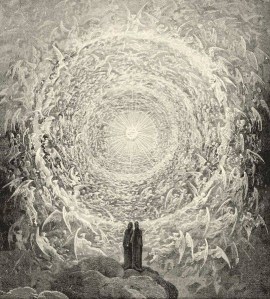 Then this text comes along, and Jesus says, over and over, “Blessed. Blessed. Blessed” Nine times in this text, Jesus announces present blessing upon you, believer – not just some future blessing that you get someday after next Tuesday. “You are blessed now.”
Yesterday, November 1st, is the day the Church celebrated All Saints’ Day. It is a day to remember the believers who have died and are now with their God and Savior. But it is also a day to remember that you too, believer, are a saint. You are one who has been made holy by Christ. In baptism, you have washed your robe white in the blood of the Lamb. You are even now part of that multitude before the throne of God. Each Sunday we gather together as believers to receive God’s blessings. Therefore, each Sunday becomes a foretaste of what is ours when Christ returns and raises us to eternal life.
We’re not going to go through all the Beatitudes today because that would take too long. But consider, please, the first two:
“Blessed are the poor in spirit, for theirs is the reign of heaven.”
The poor in spirit are those who wait on God. The poor in spirit are sinners who have nothing to give, nothing to offer God. The poor in spirit are you who are tired and lost in sin, you who are cursed by sin. Jesus says, “Blessed are you who are poor in spirit.” Why are you blessed? Because you have nothing to offer. You have nothing in your hands. There is nothing you have to barter and trade with to get something out of God. He simply wants to give to you. He gives you forgiveness, life, and salvation. He gives you Jesus – crucified and risen. He gives you the reign of heaven. “Blessed now are the poor in spirit, for there is, now, the reign of heaven.”
“Blessed are those who mourn, for they shall be comforted.”
When we think of mourning, we think of death. “The sting of death is sin, and the power of sin is the Law. But! But thanks be to God who gives us the victory through our Lord Jesus Christ” (1 Cor. 15:56-57). Your Lord, your Savior gives you the victory now. Jesus is the Lamb who was slain. Jesus walked through death and came out even more glorious than He was before He went to death. Jesus’ resurrection means that the resurrection of the dead has already begun. So, when your loved ones die, mourn – be sad. As James 4:9 says, be wretched and mourn and weep. But even in mourning, you are blessed. You are blessed because you know that death, as final as it is, is not the final fact. “Blessed now are those who mourn, for they shall be comforted.”
 Jesus says, “Rejoice and be glad, for your reward is – not will someday be – your reward is now great in heaven.”
Beloved and blessed saints, though you are tired of living under the curse of sin, your Savior calls you blessed. Look around at what you have. See what Christ has given you. You have the presence of God in your midst. He is here to shelter you with His presence. Your hungering and thirsting is gone because Jesus gives you His body and blood for the forgiveness of your sins.
1 John 3:2-3 2 Beloved, we are God’s children now, and what we will be has not yet appeared; but we know that when he appears we shall be like him, because we shall see him as he is. 3 And everyone who thus hopes in him purifies himself as he is pure. Amen.
The peace of God, which surpasses all understanding, will guard your hearts and minds in Christ Jesus. Amen.
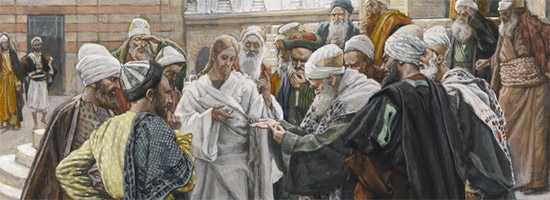
 But, fast-forward a couple of days. These hypocrites will do exactly what Jesus says. They will render to God the things that are God’s. They will render to God Jesus. Desperate to get rid of Him, the hypocrites will arrest Jesus and bring Him before Pilate saying, “This Man is forbidding us to give tribute to Caesar, and saying that He Himself is Christ, a king” (Lk. 23:2). They make sure that Jesus gets placed on the cross, and in doing so, they render to God Jesus, the Son of God.
 However, God has given you the icon of Christ (1 Cor. 15:49). When you were baptized into Christ, you put on Christ (Gal. 3:27). When you were baptized in the name of the Father, Son, and Holy Spirit, God put His words, His name, on you.
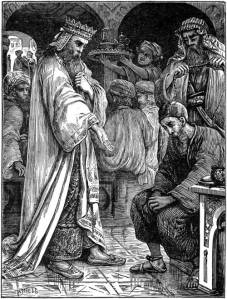 8 Then he says to his servants, ‘The wedding feast is ready, but those who had been called were not worthy. 9 Go therefore to the main roads and call to the wedding feast as many as you find.’ 10 And those servants went out into the roads and gathered all whom they found, both bad and good. So the wedding hall was filled with guests. 11 But when the king came in to look at the guests, he saw there a man who had no wedding garment. 12 And he says to him, ‘Friend, how did you get in here even though you do not have a wedding garment?’ And he was speechless. 13 Then the king said to the attendants, ‘Bind him hand and foot and cast him into the outer darkness. In that place there will be weeping and gnashing of teeth.’ 14 For many are called, but few are chosen.”
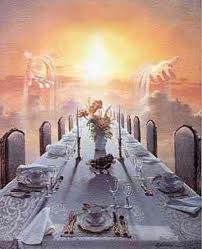 You see, God has prepared a table for you. He accepts you. He accepts you not because of who you are or what you have done. He accepts you because of what Jesus Christ has done. God simply wants you at His party. He has laid it all out with the best food, the most expensive china, and the finest wine. He will dress you in the righteousness of His Son.
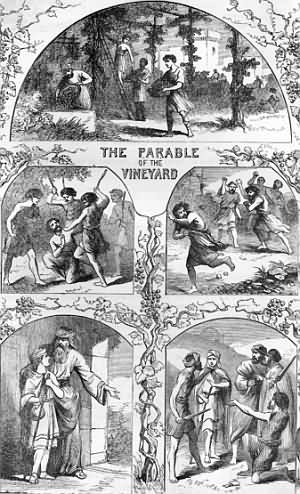 “If you want it done right, you have to do it yourself,” we say. But that is not God’s way. He doesn’t set Himself up in the watchtower and manage the vineyard Himself. He lets the tenants figure it out for themselves. When the harvest is over and the wine is made, He expects those tenants to give Him His portion so that He and His tenants can eat, drink, and be merry together.
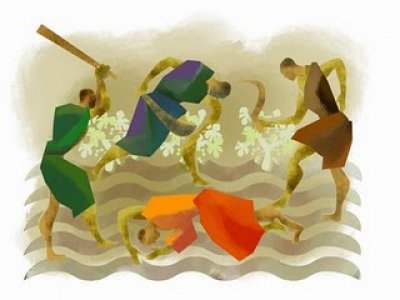 By acting with evil towards the vineyard Owner, His servants, and His Son, the tenants show that they viewed the Owner as evil.
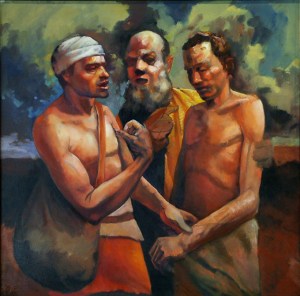 28 “What do you think? A man had two sons. And he went to the first and said, ‘Son, go and work in the vineyard today.’ 29 And he answered, ‘I will not,’ but afterward he changed his mind and went. 30 And he went to the other son and said the same. And he answered, ‘I go, sir,’ but did not go. 31 Which of the two did the will of his father?” They said, “The first.” Jesus said to them, “Truly, I say to you, the tax collectors and the prostitutes go into the kingdom of God before you. 32 For John came to you in the way of righteousness, and you did not believe him, but the tax collectors and the prostitutes believed him. And even when you saw it, you did not afterward change your minds and believe him.
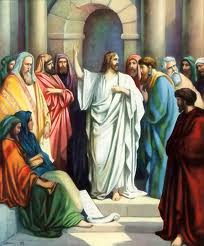 Now our text picks up on Tuesday. Jesus is in the Temple again. The chief priests and elders of the people, the spiritual leaders, walk up to Jesus and ask Him, “What gives Jesus? Who do You think You are? Why are You doing all these things? This is our turf. We get to say how things are supposed to be done here. We told the money changers and sellers they could be here. Why do You think you can drive them out and change how we do things? By what authority do You do all this?”
 Who do the characters in the parable represent? The father is God, the two sons are believers and unbelievers. To work in the vineyard is to do the will of God. That doesn’t mean to fly straight and obey all of God’s commandments. To do the will of God is to repent of everything you do because what you do always falls short of God’s command. God sent John and Jesus preaching telling people what His will was – “Repent.” Jesus said that God’s will is that everyone look to Jesus and believe in Him for eternal life (Jn. 6:40). Without repentance and faith you will never do the will of the Father. Instead, you will watch as tax collectors and prostitutes, as all sinners, enter the reign of heaven ahead of you.
 Jesus depicts God as the Master (lit. ‘despot’) of a vineyard. The Despot needs workers in His vineyard, so He goes out early in the morning to the marketplace to hire laborers. Notice how He goes about hiring: The first workers agreed (lit. ‘symphonized’) with the Despot for one denarius (a denarius = 1 day’s wage; let’s call it $120). But notice, the workers hired at the third hour, the sixth hour, and the ninth hour are only given the Master’s promise, “Whatever is (lit.) just, I will give you.” They go out to work trusting the Master.
 They are outraged. All they can think about is their hard work and how hot the day was. They march up to the Despot and give their little speech, “Hey, those punks only worked one hour while we worked all day long. How dare you make them equal to us?”
 You see, you have already received God’s mercy. Jesus worked a full day under the heat and wrath of God’s fury over your sin. He dug in the muck and mire of sin pulling out the weeds of sickness and disease. He watered the whole field with forgiveness and life. If anyone could complain that God’s method of payment is unfair, it is Jesus. He lived the perfect life under God’s commandments, and what did He get? A beating. A whip-scarred back. A crown of thorns. Nails driven through His hands and feet. And a spear-torn gash in His side. He got a cross and a tomb.
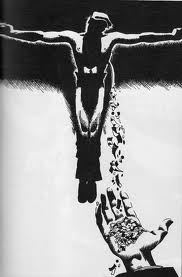 Mercy is two things. Mercy is both not getting what you deserve and getting what you don’t deserve. Vinnie got mercy. He didn’t get the punishment that he deserved, and he got his debt forgiven which he didn’t deserve. But Vinnie showed that he refused the king’s mercy because Vinnie demanded what he deserved from Chuck. By demanding his rights from Chuck, Vinnie was refusing his undeserved gift from the king.

 Brothers and sisters, we are in a great place because Jesus is here among us. Here we are, a small little flock of sheep gathered at our Shepherd’s feet. We have all gone astray. This past week we have all sinned and wandered from our Shepherd’s pen. And yet He has gathered us together once again. And heaven rejoices. Heaven rejoices as our Savior throws us a feast in His Supper giving us His body to eat and His blood to drink. In this meal, Jesus is present with us, forgiving our sins. Amen.
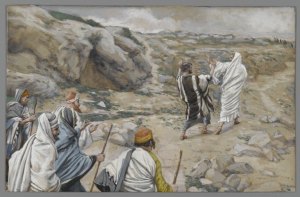 But what does Jesus say? “Get behind me, Satan!” Jesus certainly doesn’t beat around the bush.
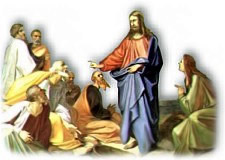 Jesus asks the disciples, “Who do you say that I am?” Peter answers for the disciples and, ultimately, for the whole Christian Church, “You are the Christ, the Son of the living God.” If Peter is right (and he is), notice what this means. It means that Jesus is the fulfillment of the promise Adam and Eve heard from God, that the seed of the woman will crush Satan’s head (Gen. 3:15). It means that Jesus is the fulfillment of God’s promise to Abraham, “I will bless you. And your seed will possess the gate of his enemies, and in your seed shall all the nations of the earth be blessed” (Gen. 22:17-18). Jesus is the fulfillment of all the promises God gave to Moses, Isaiah, Ezekiel, and Daniel.
 Jesus makes three promises to those who confess this. Jesus promises first to build His Church upon this confession. “On this rock I will build My church.” God builds the Church. I know many of you here put your hands to the very hammers and saws that built this building. You have your own blood, sweat, and tears in this building. But someday this building will fall. It will crumble. But the holy Christian Church is not a building. And some of you, many of you, have brought others into this building to hear the Gospel of Christ, and that Gospel has been heard and believed. But you still have not built this Church. God has. You are the living stones which “are being built up as a spiritual house, to be a holy priesthood, to offer spiritual sacrifices acceptable to God through Jesus Christ” (1 Pet. 2:5).
 However, other commentators view this in the opposite direction, as offensive. Gates don’t move – they protect. Rocks can be loaded into catapults and hurled against gates. As Jesus ministered, He fought against the devil and his kingdom, and Jesus, the Son of the living God, prevailed. Casting out demons, healing diseases, and overcoming the fallen creation was Jesus’ cup of tea. Jesus’ Church is still on the offensive side of the ball. Sins are forgiven and the rule of Satan is overthrown through Jesus’ continued ministry in the Church. The Church, which stands on the solid rock of the confession that Jesus is the Messiah, demolishes hell’s gates every time.
 Yes. God is so reckless that He will entrust the opening and closing of the reign of heaven to His Church. He has given His Church the authority to forgive sins because of what Jesus has done on the cross. Jesus Himself told the Church to disciple all nations opening the reign of heaven to them so that all can enter. However, those who stubbornly refuse Jesus’ call to enter into the reign of heaven through His sacrifice are to be shut out. The Church is to make it clear that they are outside of God’s love – in order that they desire to receive the love of God already poured out for them in Christ’s blood.

You must be logged in to post a comment.