
In the name of Jesus. Amen.
In your lowest moments – and even before those lowest moments arrive – God is there tenderly speaking, “Comfort, comfort,” to you, His people. He speaks that comfort to remove the burden of the debt of sin, and this changes everything for us sinners.
Just before our text, in Isaiah 39, Hezekiah, the king of Judah, welcomes an envoy of ambassadors from the king of Babylon. That empire was growing in strength and power, and Hezekiah wanted to have Babylon as an ally in case the Assyrian Empire attacked Judah. While those ambassadors were there, Hezekiah does what kings often do. He shows off. He gives the ambassadors a tour of his palace and shows them all of his treasure. He flaunted his silver, gold, and spices. Hezekiah displayed all the weapons of his armory – his entire treasury. He left nothing hidden. Basically, Hezekiah was boasting about himself and the greatness of his kingdom, but he doesn’t boast about his Lord and God who had given it all to him.
After the Babylonian delegation leaves, the prophet Isaiah visits the palace to confront Hezekiah about all this. Isaiah rebukes him for being so foolish and prophesies that the Babylonians will come again in a hundred years to strip the palace and the Temple of everything. All the gold and wealth and treasure and weaponry of Hezekiah’s kingdom – it will all be taken by the Babylonians because Hezekiah’s pride did nothing more than make himself a target by showing off. Isaiah says that Hezekiah’s descendants would pay the price of his foolish actions.
And Hezekiah’s response is, frankly, disgusting. Basically, he says, “Let me get this straight, Isaiah. You’re saying that I get to keep the treasure? Babylon isn’t going to come and ransack and pillage as long as I’m alive?” And Isaiah says, “Yeah, but listen. It’s going to happen to your descendants.” But Hezekiah doesn’t care. Instead, he says, “Cool. Everything will be safe and secure in my days.” That, of course, is the wrong response.
Hezekiah should have fallen to his knees and begged for God to forgive him or, at least, ask that the payment of his foolishness not fall upon his children and grandchildren. Instead, Hezekiah callously says, “This is great. I don’t have to deal with it.”
Just over 100 years later, the price of Hezekiah’s foolishness and pride was paid. Babylon came. They destroyed the Temple. Men, women, and children were slaughtered in the streets. The nation was torn apart. People were ripped from their country, their lands, and their homes. And they were taken into exile in Babylon (2 Kgs. 25:1-21; 2 Ch. 36:17-21; Jer. 52:1-30).
Imagine enduring all of that. Imagine being part of that generation who paid the debt of Hezekiah’s pride. They watched as all these things happened, and because they were familiar with the book of Isaiah, they knew that they were paying Hezekiah’s debt because he was totally fine with passing that debt of his sin off to a future generation.
If you were part of that generation who endured that destruction, how would you handle and process that? How could you be anything but bitter and resentful that your forefather had been totally willing to pass the punishment of his sin off to you? How would you cope? Where would you find comfort?
Well, you would find it here in these verses that come immediately after Isaiah recorded Hezekiah’s foolish and callous actions. And dear saints, these verses aren’t only for the people who were carried into exile in Babylon. They are also for you today. Now. “Comfort, comfort My people, says your God. Speak tenderly to Jerusalem.” And that phrase, ‘speak tenderly,’ is a lot stronger in Hebrew. It’s an idiom that is literally translated, “speak to the heart.” God isn’t just speaking cliché platitudes from a far, distant place. No. Your God leans in close to speak comforting words directly into the heart of you, His people.
These words of comfort here in Isaiah 40 are for you because you are God’s people through faith in Christ. And these words cut through the noise and chaos of sin and suffering to touch you where your ache is sharpest and deepest. In the midst of the pain that has come to you because of sin – both your sin and the sins of others – God speaks tenderly, He speaks directly to your heart, “Be comforted. Be comforted. [Your] warfare and hardship is ended; [your] iniquity is pardoned.”
This whole text is beautiful, and dozens sermons could be preached on each line of the text. We could focus on the lines concerning John the Baptizer who would proceed Jesus and make a straight, level highway in the wilderness for the coming of the God who brings this comfort. We could ponder the arrival of God’s glory that will be seen by all flesh for eternity.
Earlier this week, I considered focusing this sermon on the lines about all flesh being like grass. Remember how Adam and Eve – who, after the Fall, became like the grass that withers and fades – they tried to cover themselves with foliage when they heard the sound of God walking in the Garden of Eden (Gen. 3:7-8). But God had come to give them the comfort that He would send the Seed of the woman to crush the serpent’s head (Gen. 3:15). And that Word of promise endures forever. Maybe, I’ll preach that sermon sometime in the future. Anyway, there’s an eternity of sermons that could be preached from these nine verses.
But the thing I want to focus on today is that phrase from the last line of v. 2 about receiving, “from the Lord’s hand double for all [your] sins.” And I want to focus on it because, even though it sounds like Law, it is sweet, sweet Gospel spoken from God’s mouth directly into your heart. But we need to do a little groundwork first.
In Is. 40:2, Isaiah uses two of the three most common Hebrew words for breaking God’s Law – ‘iniquity’ and ‘sin.’ The third word that Isaiah doesn’t use here is ‘transgression.’ And each of these words give a slightly different picture of what sin is.
The Hebrew word that regularly gets translated ‘transgression’ means to cross a boundary. In each Commandment, God sets a line and crossing over that line is a ‘transgression’ or a ‘trespass.’ The Hebrew word that most often gets translated as ‘sin’ means to miss the mark. God has a standard for us, but we keep missing it. Think of an archer who never hits the target, let alone the bullseye. Finally, the Hebrew word that gets translated ‘iniquity’ refers to the guilt and shame caused by sin. Think of the weight and indebtedness you feel when you’ve wronged someone – that’s the iniquity. All three words deal with the same thing (our sin), but each one focuses on a different aspect of that sin.
Well, here God says that your iniquity, that debt and weight of sin, is pardoned and that you have received from His hand double for all your sins. Again, this should be comforting. God isn’t saying that He’s giving you double punishment for your sin. No!
Instead, God has taken that debt of sin. He pays for it. Imagine your sin as a pile debt on your account. Because of Jesus, the billions of debt that you owe because of your sin is all paid off. But God doesn’t stop and just get you to an even balance. In place of that massive debt, God credits your account with the righteous deeds and the perfect obedience of Jesus.
You can imagine a chalkboard where all your sins are written down. Through faith, Jesus comes and wipes every last speck of that chalk and dust off. But He doesn’t stop once your slate is wiped clean. He writes over that chalkboard all of the holy, righteous, and perfect works that He has done (see Mt. 25:31-40).
God knows the full debt of your sin down to the last penny. And when Jesus pours out His forgiveness, mercy, and salvation on you, it is in double measure of your debt.
In Jer. 31:34, God says that He forgives your iniquity and remembers your sin no more. Dear saints, be comforted. God doesn’t remember the kind or type of sins you have committed. He doesn’t remember the specific ways you have transgressed against Him and against your neighbor. The only thing that He remembers about your sin is the amount of debt you owe. And the only reason God remembers that is so He can give you a double portion of His grace and mercy (Jn. 1:16).
That is the comfort He gives to you. That is the comfort He speaks to directly into your heart today and every day. Your Redeemer will continue to speak that comfort to you, and His Word of grace, mercy, and comfort endures forever. Amen.
The peace of God, which surpasses all understanding, will guard your hearts and minds in Christ Jesus (Php. 4:7). Amen.


 Dear Lincoln, today you are Baptized. Today, God has given you the new birth of water and the Spirit (Jn. 3:5). Today in your Baptism, you have been joined to Jesus’ death and resurrection (Ro. 6:3-5) and have been clothed with Christ (Gal. 3:27). And Lincoln, Derek, Brittney, and all you saints, that means that today is a day to rejoice. Even as we see the grass wither, the flower fade, and creation crumble, we know that the Word of our God will stand forever. God continues to shower His blessings upon us through that Word. And His Word to us today, and every day of our Christian walk, is the Word of the Gospel which causes us to rejoice.
 In Advent we are watching and waiting for the coming of our Savior and the end of our exile in this fallen, sinful world. Advent is the Christian life in a nutshell. We watch and we wait for the coming of our Lord. And as we wait, we are reminded that, whatever may happen to us in this veil of tears, the end is a joyful day for you whose citizenship is in heaven. As we wait, we remember that all the cares and sorrows of this world are temporary.
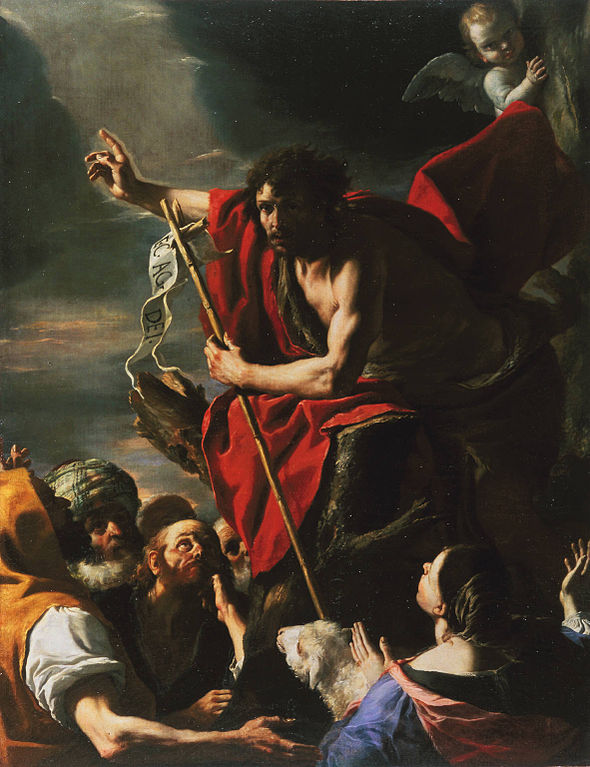 John was born and grew up as a Nazarite, so his hair was never cut. Imagine his big, bushy beard and his long, tattered hair. John preached out in the wilderness wearing clothes made of camel hair and leather belt. He had a peculiar diet of locusts and wild honey (Mk. 1:6). Imagine having locust breath – probably even worse than coffee breath. Matthew summarizes John’s preaching as this message: “Repent for the kingdom of heaven is at hand” (Mt. 3:2). People would come out to the wilderness to hear him preach, and when he saw them he said, “You brood of vipers! Who warned you to flee from the wrath to come?” (Mt. 3:7). He would preach about the axe that was laid to the root of every tree that would cut down each tree that didn’t bear fruit and throw it into the fire (Mt. 3:10). So, John was a preacher of the Law. But still all the country of Judea and Jerusalem was going out to John and being baptized and confessing their sins (Mk. 1:4-5).
 John was anxious in prison knowing he was probably going to be executed for what he had preached. Probably, John was wondering if he had preached rightly. And Jesus’ response points John and you to the Scriptures. In particular, Jesus points John to Isaiah 35:4-6, and you have to hear the context of those verses because it shows how beautifully Jesus answers John’s question, “Are you the One who is to come?” Here it is Isaiah 35:4-6, “Say to those who have an anxious heart, ‘Be strong; fear not! Behold, your God will come with vengeance, with the recompense of God. He will come and save you.’ Then the eyes of the blind shall be opened, and the ears of the deaf unstopped; then shall the lame man leap like a deer, and the tongue of the mute sing for joy….”
 He opened the eyes of the blind. Christ made the deaf hear, the lame walk, and the mute to sing. All of that means that salvation has come to you who are anxious and poor in spirit. Rejoice.
 The only people who can be comforted are those who are troubled, afflicted, and uncomfortable. And God says, “Give them a double dose. Give them two shots of comfort.”
 God’s anger is but for a moment, and His favor is for a lifetime. Weeping may tarry for the night, but joy comes with the morning (Ps. 30:5). And even before the suffering begins God preaches comfort to His people.
 Here is your hope, Christian. You have God’s comfort in all things. Heaven is on your side. Your warfare is ended. Your iniquity pardoned. And no one, not even God Himself, can charge you for your sins because His Word of comfort stands forever.
 Pastorsamwise
You must be logged in to post a comment.