The Word & Children of God – Sermon on John 1:6-13 for Midweek Advent 2

John 1:6-13

In the name of Jesus. Amen.

These verses make the Advent and Christmas seasons feel like the coming of Spring. And I know we just had our first major snowstorm. We’re currently in meteorological Winter, but astronomical Winter is still eleven days away. Daylight keeps getting shorter. I get it. But even though the coldest days of winter are, probably, still ahead of us, this text fills our sanctuary with a hint of Spring. Can you smell it?

Jesus, the Eternal Word, was there at the beginning of creation with God and as God. All things were created through Christ. In Jesus was Life, and the Life was the Light of men. That Light shines in the darkness, and the darkness has not overcome it. Jesus, the true Light has arrived, not as a conqueror from a far, distant country, but to rescue you from the darkness of death. The winter of sin is passing. Jesus, the Word made flesh, has come. And the Life that Christ brings is budding all around you even now. Dear saints, because Jesus has come, you now live in the never-ending Spring of the new creation (2 Co. 5:7).

John the Baptizer came as a herald to point to Christ, the Light. John was there calling everyone into Jesus’ Light. But then, when the Light burst through the darkness to shine on everyone, many sank further into the shadows (Jn. 1:10-11). And sadly, this is still too often the case. The Light can be rejected. In Jn. 3:19-20, we learn why it is rejected, “Light has come into the world, and people loved the darkness rather than the Light because their works were evil. For everyone who does wicked things hates the Light and does not come to the Light, lest his works should be exposed.”

Light reveals the things hidden in darkness. That’s why, when Jesus came as Light, it seemed to many as though judgment had come. But Jesus was not sent into the world to judge the world. No. He came in order that the world would be saved through Him (Jn. 3:17). Jesus came to give Light to the world, to take away sin, and to give eternal life. But His coming felt like judgment because His presence exposes the darkness and filthiness of sinners. In the Light of Christ, there is no hiding. So, the Light is a threat to the will and the way of every sinner. That’s why sinners hate and reject the Light. Even though the darkness cannot overcome the Light (Jn. 1:5), people can love and choose the darkness instead of receiving the Light (Jn. 1:11).

But to all who did receive the Light, to all who believed in His Name, He gave the right and the authority to become children of God (Jn. 1:12). That’s you, dear saints. You, believer. You are rightfully children of God through faith in Christ. And this idea of being God’s child here in Jn. 1 is so rich and unique. But first, we need to recognize what that phrase ‘children of God’ doesn’t mean – at least not in these verses.

The Bible does talk about all humanity being children of God by virtue of our creation. Because Adam was created in God’s image (Gen. 1:27), he is called the son of God – lowercase ‘s’ (Lk. 3:38). Since your first ancestor is God’s son, you also are a child of God. Malachi 2:10 says that since God created us, He is everyone’s Father. In Act. 17:28-29, Paul says that all people are God’s offspring. So, yes, we are God’s children by virtue of creation. The Bible does teach that. But we have a severe problem if that’s the only kind of childhood we have because our sin has totally and completely alienated us from God. It isn’t a stretch to say that we divorced ourselves from Him by our sin. So, being God’s child by virtue of creation is not the childhood John has in mind here.

Better than the childhood that comes by virtue of your creation is the fact that the eternal Son of God took on flesh and became one of you. So, Moses in our Old Testament reading (Dt. 18:15-19) could rightly prophesy that God would raise up a prophet like him “from among you, from your brothers.” By virtue of Jesus’ incarnation, He has become your Brother. Since Jesus is your brother, you share a Father with Him, which means that you are a child of God. And this is amazing news that we will be pondering for all eternity. But even as wonderful as that is, it still isn’t the kind of childhood that John talks about here.

Dear saints, here John says that you are a child of God by virtue of a birth. None of us here can say that we chose to be born. You didn’t cause your birth or make it happen. In the same way, it isn’t your will, or the will of any other human, that causes you to be born of God. James 1:18 says this plainly, “Of [God’s] own will He brought us forth by the Word of Truth, that we should be a kind of firstfruits of His creatures” (also 1 Pet. 1:23).

So, John is not talking here about a physical birth. It wasn’t anything that nature can accomplish. It’s a miraculous birth that God Himself brings about by the means that He has established. And Jesus teaches about this birth in Jn. 3 when He sheds His Light as He talks with Nicodemus at night. It is a birth that comes from above (Jn. 3:3). It is a birth of water and the Spirit (Jn. 3:5). It is your birth that God has given you through your Baptism. That kind of birth from and of God is solid and sure. God Himself caused it. It’s His action, His working, His doing (Jn. 15:1619) that has made you His child.

The Light, which gives light to everyone was coming into the world, and because of what Jesus has done by His death and resurrection, you are born as God’s own child.

Dear saints, again, can you smell it? The winter of sin and death is passing away. The never-ending Spring of the new creation has dawned in Christ. As His Light shines on you now, receive it again. Let it expose and scatter the shadows in and around you. Always cling to the sonship that you have been given. You are God’s child. And in the Spring of Light that He has brought, you will bloom forever in His unending grace and mercy. Amen.

The peace of God, which surpasses all understanding, will guard your hearts and minds in Christ Jesus (Php. 4:7). Amen.

Loved Ones – Sermon on 1 John 3:1-3 for All Saints’ Sunday

1 John 3:1-3

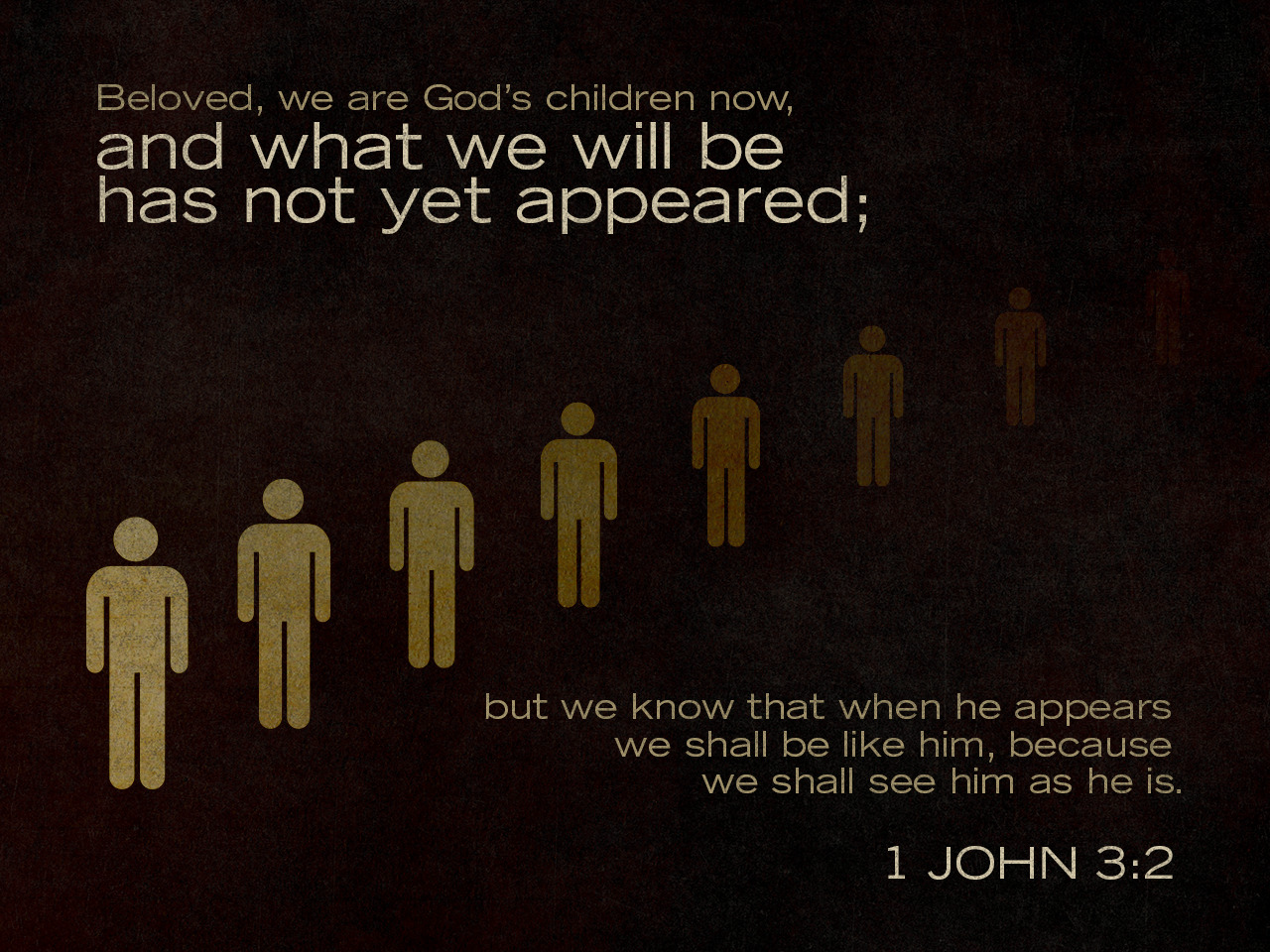
1 See what kind of love the Father has given to us, that we should be called children of God; and so we are. The reason why the world does not know us is that it did not know him. 2 Beloved, we are God’s children now, and what we will be has not yet appeared; but we know that when he appears we shall be like him, because we shall see him as he is. 3 And everyone who thus hopes in him purifies himself as he is pure.

In the name of Jesus. Amen.

Typically, names are given. When you’re born, you’re given a name. Whether or not you like your name, doesn’t matter. The name your parents gave you is your name. Sometimes, you are given a nickname, which you may like or dislike.

In junior high, my schoolmates called me ‘string-bean.’ I didn’t like it so much. But being over 6 ft. tall and weighing maybe 120 lbs. soaking wet, it fit. When I made the varsity swim team, I thought, “This is my chance for a cool nickname,” because no one else from my school was a swimmer. So, I tried to give myself a nickname. The movie Rudy had just come out, and the story of that weak, little football player who finally got a chance and proved himself on the field was so inspirational that I told my teammates to call me ‘Rudy.’ I even had it printed on my first varsity swimming t-shirt. Long story short, ‘Rudy’ didn’t stick, sadly. Even worse was that one of the other swimmers was dating a girl from my school. As soon as he found out that I was called ‘string bean,’ the name followed me into the pool.

The Bible has lots of names and titles for people who are saved by grace through faith in Christ – Christian (Act. 11:26), believer (Act. 5:14), child of God (Jn. 1:12-13), people of God (1 Pet. 2:9Rev. 21:3), citizens of the kingdom of heaven/God (Php. 3:20), people belonging to the Way (Act. 9:2). I could go on and on. All of those names and titles have a different focus, and you are probably comfortable with some of those titles and names for yourself. But the Bible has another name for you. Even though it’s a name that you might not like, even though it’s a title that you wouldn’t claim for yourself, it’s a name that is true and accurate. You, Christian, are a ‘saint.’

A saint is not someone who does a lot of good works, has witnesses who can verify two miracles, and gets recognized by people wearing funny hats at the Vatican. No! To be a saint literally means to be a ‘holy one.’ And no; you aren’t holy by your own works or efforts. You aren’t holy when it comes to keeping God’s commands. You aren’t holy because of your obedience. Instead, you are made holy by grace through faith in Jesus. Christ is the Lamb of God who takes away the sin of the world (Jn. 1:29). That means Jesus takes all your sin and shame and guilt and bares it to the cross. In exchange, Jesus gives you His perfect obedience, His total righteousness, His pure holiness. Because of Christ, God makes you holy. The fact that you are a saint is God’s work – not yours.

Here in chapter 3, John wants you to see, to behold, to recognize that you are a saint. Even though the word ‘saint’ doesn’t come up in the text, there are three other terms or titles in this text that point to the fact that you are a ‘saint.’

First, you are God’s child, and John wants you to bask in the fact that God has made you His child. “See what kind of love the Father has given to us, that we…” we who are sinful and unclean, we who rebel against God, we who by nature are enemies of God, “See the love God the Father has given to us that we should be called children of God.” And John drives the point home, “And so we are” (1 Jn. 3:1).

You, dear saints, are God’s children. Jesus Himself said so. The morning of the Resurrection, shortly after Jesus finished tidying up His grave, folding up His burial cloths, and making the bed, He tells Mary Magdelene to tell the disciples, “Go to My brothers and say to them, ‘I am ascending to My Father and your Father, to My God and your God’” (Jn. 20:17).

In Hebrews 2:10, Jesus is referred to as the Founder of your salvation who brings “many sons to glory.” Then, Hebrews goes on to say, “He who sanctifies,” (in other words ‘makes holy’), “and those who are sanctified,” (in other words, ‘who are made saints’), “all have one source. That is why [Jesus] is not ashamed to call [you who are made holy] ‘brothers’” (Heb. 2:11). Since Jesus, the Son of God, is not ashamed to call you ‘brothers,’ then you also are children of God. And children inherit characteristics from their parents. Since God is holy, holy, holy (Is. 6:3) – you also are holy. You, children of God, are saints.

John goes on to acknowledge that the world doesn’t recognize you as the children of God. People can’t look at you and say, “Oh, I see you’re a Christian. You look just like your heavenly Father.” You and I don’t bear that divine resemblance because even though we are children of God, we still sin and fall short of the glory of God (Ro. 3:23). In the eyes of the world, we look like sinners, so the world doesn’t see us as children of God. But the fact that the world doesn’t recognize that we are children of God shouldn’t surprise us. The world doesn’t recognize us as children of God because it didn’t recognize Jesus as the Son of God when He came to earth.

The second term John uses to point to the fact that we are saints is “beloved” or lit. ‘loved ones.’ God has poured His love into you. And by His love, He has given you the right to be His children who are born of God (Jn. 1:12-133:5). And in that love you receive grace on top of grace (Jn. 1:16). Because of Jesus, God’s love washes over you. His love makes you clean, forgiven, and sanctified, i.e. holy and sainted (1 Co. 6:11). That is what it is to be God’s beloved. As God’s loved one, you also have His promise that the day is coming when you will be like Jesus because you will see Him as He is (1 Jn. 3:2).

And it’s a good thing that we need to wait for that transformation before we look like Jesus. Can you imagine if you already had the glory of being God’s beloved child? Imagine if as soon as you were Baptized and given the gift of faith that you started to radiate like Jesus did in the Transfiguration. You face shines like the sun (Mt. 17:2), and your clothes become radiant and intensely white (Mk. 9:3). You’d probably get pulled over all the time, and the police would demand that you have more tint on your windows.

The third term John uses to ‘saint’ you is in this text is in v. 3. As you have this hope of being like Jesus when you see Him John says, “Everyone who thus hopes in Him purifies himself as He is pure.” The root of the word for ‘purifies’ and ‘pure’ is the same as ‘holy’ and ‘saint.’

This purification doesn’t happen by you doing good works and no longer sinning. This purification comes through faith and the hope you have of being like Jesus – which is, again, only by God’s love and grace. To live by grace through faith is to have this hope. The picture here is that, through faith and hope, Jesus’ purity is given and poured into you. The Old Testament had all those regular sacrifices that delivered this same purity by pointing people forward to the cleansing that comes only through Jesus’ sacrifice on the cross. Now, you have the fullness of what those were pointing to. Faith in Christ continually purifies you as Jesus Himself is pure.

Since the last time we celebrated All Saints’ Day, one of our sisters in Christ became like Jesus. On Tuesday, March 25th, Ros, who was already a saint in this life, saw Jesus as He is. She entered that great multitude around the throne of Jesus. She exited this great tribulation and got her white robe. She is now sheltered in God’s presence where Jesus will shepherd her to springs of living water (Rev. 7:9-17). Now Ros and every other believer who has gone to be with Christ surrounds us and cheers us on as we look to Jesus, the Founder and Perfector of our faith (Heb. 12:1-2).

Dear saints, behold what manner of love the Father has given unto you, that you should be called children of God – and so you are. God your Father now invites you to His Supper. God the Son comes to serve you. And God the Holy Spirit comes to continually purify you by grace through faith. This is God’s promise, and this is our hope. Amen.

The peace of God, which surpasses all understanding, will guard your hearts and minds in Christ Jesus (Php. 4:7). Amen.

Children of Light – Sermon on Ephesians 5:1-9 for the Third Sunday of Lent

Ephesians 5:1-9

1 Therefore be imitators of God, as beloved children. 2 And walk in love, as Christ loved us and gave himself up for us, a fragrant offering and sacrifice to God. 

3 But sexual immorality and all impurity or covetousness must not even be named among you, as is proper among saints. 4 Let there be no filthiness nor foolish talk nor crude joking, which are out of place, but instead let there be thanksgiving. 5 For you may be sure of this, that everyone who is sexually immoral or impure, or who is covetous (that is, an idolater), has no inheritance in the kingdom of Christ and God. 6 Let no one deceive you with empty words, for because of these things the wrath of God comes upon the sons of disobedience. 7 Therefore do not become partners with them; 8 for at one time you were darkness, but now you are light in the Lord. Walk as children of light 9 (for the fruit of light is found in all that is good and right and true),

In the name of Jesus. Amen.

You’ve probably all heard the phrase, “Nothing good happens after ___ o’clock.” If a news anchor said it, the time might have been midnight or 2 AM. If it was one of your parents, it was probably 10:00. Kids, if you ever hear that phrase from your parents or grandparents, they know what they’re talking about. When darkness falls, it is a lot more likely that evil things are going to happen.

Darkness is the favorite blanket of evil, and we know this instinctively. It’s why kids go into their parents’ room in the middle of the night and cry about monsters under the bed or whatever other impossible things kids imagine. Everyone has a keen sense of vulnerability in the dark. Even adults often have their bleakest thoughts when the world is dark. The thoughts that wake me up at 3 AM are never the best, brightest, or most hopeful ones.

In a wonderful way, Scripture repeatedly gives a picture of the Savior as the bright Morning Star (Is. 60:1-3; Mal. 4:2; 2 Pet. 1:19; Rev. 2:28, 22:16). Or, in a similar vein, Scripture says that, when Jesus comes, a new day dawns (Ps. 84:11; Ro. 13:12). In the first chapter of Luke’s Gospel, the coming of Jesus is described as the “sunrise from on high” that “give[s] light to those who sit in darkness and in the shadow of death,” and His coming, “guide[s] our feet into the way of peace” (Lk. 1:78-79).

Dear saints, the picture Scripture gives us is that all of creation has changed because Christ has come. The darkness has been dispelled, put to flight, and broken up. Jesus hints at this in our Gospel reading (Lk. 11:14-28). Christ says that He casts out demons by the finger of God, and His power to do that is proof that the kingdom of God has come upon us (Lk. 11:20).

Because of Jesus’ resurrection, there is a new day – the day that the Lord has made. Because He has made it, we rejoice and are glad in it (Ps. 118:24). And this new day will never end. Believer, this changes you, and it changes how you think about the world. The fact that today and every other day of your life is the day that the Lord has made, the things in front of you that are ominous, scary, and threatening are all less intimidating. Yes, they are still threats, but you know that they are all defeated threats.

All three of our readings today are about spiritual warfare, about the battle between the kingdom of darkness and Christ’s kingdom of light. It’s obvious in both the Old Testament (Ex. 8:16-24) and Gospel (Lk. 11:14-28). In our Gospel reading, Jesus tells us know how the kingdom of Satan operates, and our Lord comforts us because He tells us how He, our Savior and Champion, has defeated sin, death, and the devil.

And in the Old Testament reading, we heard how Pharaoh’s magicians recognized that the finger of God was at work when they couldn’t replicate the gnats that swarmed throughout Egypt (Ex. 8:18-19). Those evil, demonic sorcerers were able to duplicate the sign God did through Moses of turning his staff into a serpent (Ex. 7:11-12), but they failed to do the smaller thing of reproducing gnats.

The last time these texts came up, I had fully intended to preach about the folly of the kingdom of darkness because that folly is on full display through Pharaoh and his magicians. Their whole country is completely overrun with gnats, but they still try to duplicate the sign done through Moses. That text shows how self-destructive the kingdom of Satan is. “Our whole nation is filled with these gnats.” “I know what we should do; let’s try to make more of them.”

But today, rather than seeing how the kingdom of darkness works or how self-destructive it is, I decided to preach on this Epistle reading because it gives us the strategy of how to fight back against the forces of darkness. Throughout Scripture you are given several ways to fight evil, but this text gives you one simple weapon – thankfulness and thanksgiving.

Notice that v. 3 gives us a list of things we are to not only avoid we aren’t even to name them. That list is sexual immorality, impurity, and covetousness. Then in v. 5, that list is repeated when we’re told that the sexually immoral, the impure, and those who are covetous have no inheritance in the kingdom of Christ and God.

To contrast that twice-repeated list, Paul mentions only one thing here – thanksgiving. The beloved children of God who walk in love as children of light have thanksgiving on their lips, not filthiness or foolish talk or crude joking.

Thanksgiving is one of the fruits of the Spirit (Gal. 5:22-23). And thanksgiving is one of your best weapons against the darkness from which you have been rescued. When thanksgiving is on your lips, the temptations and sins you face are much easier to fight because those things become revolting.

Think back to the Garden of Eden and how the devil tempted our first parents to fall into sin. “Can’t you eat from any tree? If you eat from this one that God told you not to eat from, you will be like God. Don’t you want to be like Him?” (Gen. 3:1, 5). Instead of being thankful that God had given all the other trees for food, instead of being thankful that God had already made created them in His image (Gen. 1:27), Adam and Eve coveted (Gen. 3:6). The fruit of the forbidden tree looked good, and it was desirable. Because of that coveting, because of that wrong desire to be more than God had already made them to be, they took of the fruit and ate and plunged all of creation into the darkness of sin and death.

Coveting is a sin, but it is a sin that rarely registers in our conscience. We pass off coveting as nothing because we think it doesn’t hurt anyone else. That is so wrong. Here coveting is equated with idolatry (Eph. 5:5). Coveting is the first step into sin. To put it another way, every time you sin, you first covet and idolize yourself. Coveting is basically saying, “God, you got it wrong. You messed up. That thing over there,” whatever it is, “should be here. It should be mine.”

Whenever you sin, you break at least three commandments. Every time you sin, you first covet which is nothing less than idolizing yourself. Then you commit adultery, steal, lie, take the Lord’s name in vain, etc. The way to fight against this is to give thanks instead of coveting and having those false desires.

Imagine for just a minute if thankfulness had replaced Adam and Eve’s coveting. They would have realized, “We aren’t hungry; the entire world is our pantry! Thank you, God. We are already created in God’s image and are exactly what God wants us to be. Thank you, God, that we are created in Your image and that you have declared that we are ‘very good’” (Gen. 1:31).

Dear saints, Scripture gives you several ways to fight against the devil and the darkness. But today, you children of light, this text gives you one simple, specific weapon to fight back against the forces of evil, and that is thanksgiving.

You husbands, the next time you are tempted with lust, pause. Take a moment to give thanks to God for your wife. Thank God for uniting the two of you in the bond of holy marriage (Mt. 19:6). You wives, the next time you are tempted to complain to someone about your husband, take a moment to give thanks to God for him and all the ways he cares for you and your family. Children, the next time you are tempted to disobey your parents, take a moment to give thanks to God for all that your parents provide to you and how they protect you.

Dear saints, the light of Christ has shined upon you, and because of that you are now children of the light. You used to be darkness, and notice the way Eph. 5:8 says that. It isn’t just that you were in darkness. No. You were darkness itself. But now that you are God’s children, you are light in the Lord, so now you walk as children of the light. And as children of the light, you produce the fruit of light which is found in all that is good and right and true.

You give thanks to God for all the good He has given you. You give thanks to God, and it is right to do so because He has truly blessed you because He has given Himself up for you as a fragrant offering and sacrifice.

God has forgiven you (Eph 4:32). He has made this new day of light and has shined His light into you. So, rejoice, be glad in this day, and give thanks. And as you give thanks, the darkness flees. Amen.

The peace of God, which surpasses all understanding, will guard your hearts and minds in Christ Jesus. Amen.

Return to Comfort – Sermon on Isaiah 51:9-16 for the Twenty-fourth Sunday after Trinity

Isaiah 51:9–16

9 Awake, awake, put on strength,
O arm of the Lord; 
awake, as in days of old, 
the generations of long ago. 
Was it not you who cut Rahab in pieces, 
who pierced the dragon? 
10 Was it not you who dried up the sea, 
the waters of the great deep, 
who made the depths of the sea a way 
for the redeemed to pass over? 
11 And the ransomed of the Lord shall return 
and come to Zion with singing; 
everlasting joy shall be upon their heads; 
they shall obtain gladness and joy, 
and sorrow and sighing shall flee away. 

12 “I, I am he who comforts you; 
who are you that you are afraid of man who dies, 
of the son of man who is made like grass,
13 and have forgotten the Lord, your Maker, 
who stretched out the heavens 
and laid the foundations of the earth, 
and you fear continually all the day 
because of the wrath of the oppressor, 
when he sets himself to destroy? 
And where is the wrath of the oppressor? 
14 He who is bowed down shall speedily be released; 
he shall not die and go down to the pit, 
neither shall his bread be lacking. 
15 I am the Lord your God, 
who stirs up the sea so that its waves roar— 
the Lord of hosts is his name. 
16 And I have put my words in your mouth 
and covered you in the shadow of my hand, 
establishing the heavens 
and laying the foundations of the earth, 
and saying to Zion, ‘You are my people.’ ”

In the name of Jesus. Amen.

When a little girl wakes up in the middle of the night because she’s scared, worried, or thirsty, it’s completely natural for her to wake up her parents. Tired as those parents might be, one of them – in our house it’s usually the mom (Thanks, hon!) – one of them will get up to help that child with whatever she needs. It doesn’t matter if that girl’s need is silly, like the fear of a monster under her bed, and it doesn’t matter if her need is justified like a dirty diaper or a horrible cough. That parent will go and help.

The parent will reassure the child, “No, I looked and there isn’t a monster under your bed.” “Yes, ants are strong, but you don’t have to worry about them carrying our house away.” “Even though you’re perfectly capable of getting your own drink, I know you’re scared to go into the dark bathroom, so I’ll get a cup of water for you.” “I’ll steam up the bathroom to help you with your croupy cough.” If a child doesn’t ask his or her parents for help in that moment of fear and need, it’s strange. Something is wrong or off. Parents are able and willing to help their children. That’s part of the job description.

As kids grow and mature, they become capable of doing things on their own so they need their parents’ help less often. And that is a good thing. Parents want that for their children, so parents teach their children to zip their coat, tie their shoes, and pour a bowl of cereal for themselves. To be a functioning person, you need to be able to do those sorts of things. But there is a sadness that comes along with children becoming more capable and independent. One day, you’re walking your son into his first day of pre-school. Then, what feels like two seconds later, he’s able to drive himself everywhere. But that independence comes with a cost. It means that, instead of being home, he’ll be at practice or work or going out with friends. And when you do see him and ask how his day was, all you get is a quick, “Fine.” Part of a parent’s job is to get their kids to the point where they don’t need parents to do things for them.

Again, this independence isn’t a bad thing, but it comes with a danger. The danger is that it can lead to becoming disconnected from others. We don’t ask others to help us even though they are able and willing to. And this goes beyond asking mom or dad or whomever to help us. It also extends to asking our heavenly Father for help.

As we become more independent and capable, we also get better at lying to ourselves. We wrongly think that we reach a point where we don’t need God’s help with the little things in life, like tying our shoes or driving to work. And those lies tend to snowball.

The lie starts with thinking, “I’m mature enough that I don’t need God’s help to tie my shoes,” which leads to, “God doesn’t help me tie my shoes.” Then, that leads to thinking that God doesn’t help as we go about all the other business of our day, whether it’s commuting, studying, working, eating, and all the other daily things that make up our life.

Of course, none of that is actually true. God does help us in all of those things. He has given us brains that send messages through the nerves He has given us so the muscles and tendons He has also given us so we can tie our shoes. God is the One who created the laws of physics and gravity that cause our shoelaces to move in consistent, repeatable ways. In reality, it’s not an overstatement to say that God tied your shoes this morning. Sure, He did it through you, but God did it. It is sad how we so quickly and easily forget God’s care for us over the entirety of our lives and actions.

Another thing that causes us to forget God’s care for us is fear. Usually, we think danger causes either a fight or flight instinct in us, but what might be even more common than fight or flight is for us to freeze and do nothing. When our brain can’t calculate if it’s better to fight or flee from the danger, we freeze. And when we freeze in the face of fear, we are the most vulnerable. It’s better if that fear causes us to flee toward God, our heavenly Father, just like a child going to her parents in the middle of the night.

The reason a children wake up their parents at night is they have a fear and instinctively flee to their parents to get the help they need. And it doesn’t matter if the fear is reasonable or not. That child’s fear drives him to his parents who love, care for, and help him because he either can’t or won’t fight the monster under his bed.

It’s that kind of good and right, childlike fleeing that is going on here in Isaiah. Isaiah is running back to God his Father in the middle of the night because God is the only One who can help him. Isaiah is saying, “Wake up, God. Wake up. I need Your help. You slew the dragon before and made a highway through the sea. Wake up and help me now.”

There is a beautiful honesty in Isaiah’s prayer here. He knows what he needs, and he’s asking his heavenly Father to give it. But even as Isaiah makes this request, he doesn’t know exactly what God is going to do. None of us mortals know what God is going to do. But Isaiah honest enough to pray to God and say that he wants God to do more than He’s currently doing. Isaiah wants God to do mighty things. He is like that little kid waking up his dad, and he is confident enough to know that God is his loving Father who will take care of him and give him exactly what he needs.

Dear saints, we need to become like children again, as Isaiah does here.

It’s easy for us to spot danger. For example, we think about the future and all of the unknown things the future holds and we are filled with fear and anxiety. Stop doing that.

Scripture would have you do the opposite. Throughout Scripture, people look back to the past and think about what God has already done for them. Those mighty things God did in the past help them trust in the present that God will do similar things in the future. And that is a much better approach than thinking we have to help ourselves by molding and shaping the future on our own.

To put all this into the words Isaiah uses here: If God made everything in the beginning, can He take care of everything now and in the future? Yes, He can. If God stretched out the heavens and laid the foundations of the earth, can He do something about your life next week? Of course He can! He who made all things throughout all creation simply by speaking can certainly take care of the small fraction of creation that effects your life today, tomorrow, and sixteen years from now. In fact, He promises to. Hear again what your heavenly Father says, “I, I am He who comforts you.”

So, you children of God, return to Him. God wants you to be childlike in your trust in Him (Mt. 19:14). Because He is your heavenly Father, He is able and willing to take away both your stupid fears and your justified fears. God wants you to have that simple faith like the child who runs to his parents in the middle of the night with whatever is causing you trouble. Just like a parent’s job is to check for monsters under the bed and get a drink for her child in the middle of the night, it’s God’s job to care for every big or small, justified or silly thing that troubles you.

You are God’s children. You can be fearless in your prayers. God isn’t going to be surprised at any of them. You aren’t going to ask for something He’s never heard. You aren’t going to confess some sin that He hasn’t already forgiven for someone else. God knows how to do it, so wake Him up and ask Him for what you need.

You don’t have to be like the woman in our Gospel reading (Mt. 9:18-26) who tries to sneak something good from God. You can be much bolder than that. He is the Lord, your Maker, who stretched out the heavens and laid the foundations of the earth. None of the things that cause you worry or fear are greater than the one who comforts you, so return to Him.

In the Small Catechism, Luther offers us two prayers, one for the morning and one for the evening. Both of those prayers include the following statement that fit so well with this passage from Isaiah. The statement is this, “Into Your hands I commend myself, my body and soul, and all things.” Our family uses those prayers during our drive to school and in our devotions in the evening, and those words have been rolling around in my brain this past week. And I would encourage you to consider using those prayers as well.

You can confidently place everything about yourself and all the things around you into God’s hands. Because God is your loving Father, He’ll take care of it all. And you can do this boldly. Your heavenly Father has already given you His only begotten Son to forgive you of all your sin, what other good thing would He ever withhold from you? Nothing.

As Ro. 8;31b-32 says, “If God is for us,” and He is, “who can be against us? He who did not spare His own Son but gave Him up for us all, how will He not also with [His Son] graciously give us all things?”

Children of God, return to Him, and He will comfort you. Amen.

The peace of God, which surpasses all understanding, will guard your hearts and minds in Christ Jesus. Amen.

The Host – Sermon on Revelation 7:9-17 for All Saints’ Day (Observed)

Revelation 7:9–17

9 After this I looked, and behold, a great multitude that no one could number, from every nation, from all tribes and peoples and languages, standing before the throne and before the Lamb, clothed in white robes, with palm branches in their hands, 10 and crying out with a loud voice, “Salvation belongs to our God who sits on the throne, and to the Lamb!” 11 And all the angels were standing around the throne and around the elders and the four living creatures, and they fell on their faces before the throne and worshiped God, 12 saying, “Amen! Blessing and glory and wisdom and thanksgiving and honor and power and might be to our God forever and ever! Amen.” 

13 Then one of the elders addressed me, saying, “Who are these, clothed in white robes, and from where have they come?” 14 I said to him, “Sir, you know.” And he said to me, “These are the ones coming out of the great tribulation. They have washed their robes and made them white in the blood of the Lamb. 

15 “Therefore they are before the throne of God, 
and serve him day and night in his temple; 
and he who sits on the throne will shelter them with his presence. 
16 They shall hunger no more, neither thirst anymore; 
the sun shall not strike them, 
nor any scorching heat. 
17 For the Lamb in the midst of the throne will be their shepherd, 
and he will guide them to springs of living water, 
and God will wipe away every tear from their eyes.”

In the name of Jesus. Amen.

Dear saints of God. Has anyone ever shown you a photo and said, “That’s a picture of me when I was younger”? The snarky, obvious reply would be, “Isn’t every picture of you a picture of when you were younger?” It doesn’t matter if the picture is almost immediately available on the screen of your phone or if the picture has been sitting in some dusty photo album for years. They’re all a picture of you when you were younger.

Photos are a great way to preserve memories and pass along the stories of our lives and the lives of our loved ones. Even though those pictures captured just one moment in time, they remind us of so much more than the fraction of a second that it took for the shutter to open and close. They are a window into the lives of people in them, some of whom are no longer with us. Those pictures of the past have tremendous value.

When you take the time to look at old photos with family, you learn more about the people you love and can connect with them in a deeper way. You might find out that your quiet, tough, deer-hunting grandpa played the clarinet his freshman year of high school. You get the opportunity to tell your kids about the time you visited Mt. Rushmore as a kid just like they did. But when you went in 3rd grade, Aunt Jane got carsick on the drive up there. Two years ago at Thanksgiving, I learned that a pastor friend of mine has an uncle who was a groomsman for my father-in-law. Without looking through a photo album, I never would have known that my family was already tied to his.

With Thanksgiving coming up, I’d encourage you to do this. I know some of you kids might think it’ll be boring, but maybe you can make a game of it. See if grandma says, “That’s a picture of me when I was younger.” Just don’t make fun of her if she does.

In our text today we get to see an old picture, nearly 2,000 years old. But it is still a vivid, vibrant picture. It’s especially magnificent and spectacular because, even though it’s an old picture, it’s a picture of you in the future. The Apostle John sees the entire church – every Christian being welcomed into God’s presence. It’s a picture of the Church triumphant.

Now, before we look at the details of this picture, something needs to be crystal clear. This is not something in a galaxy far, far away. Nope! What is contained in this picture is right here and all around us. Hebrews 12:22-24a says that when you are here at church, “[Y]ou have come to Mount Zion and to the city of the living God, the heavenly Jerusalem, and to innumerable angels in festal gathering, and to the assembly of the firstborn who are enrolled in heaven, and to God, the Judge of all, and to the spirits of the righteous made perfect, and to Jesus, the mediator of a new covenant.” Can you see it? No. But does that mean it is any less real? Not at all!

Now, to the picture. The major details of the picture are a great multitude – more than anyone could count. People from every nation, tribe, and language. They stand before the Lamb who is on the throne. They wear white robes, wave palm branches, and sing, “Salvation belongs to our God who sits on the throne and to the Lamb.” That’s what you see with a quick glance at the picture.

Next, our text gives the caption that’s under the picture which lets us know the identity of this multitude. One of the elders asks John, “Who are these people clothed in white robes, and from where have they come?” Maybe John could have mustered up a good guess. Already in Revelation, John has seen a lot of awesome, amazing, wonderful things. But he’d rather hear the elder say who they are, so he punts the question back to him, “Sir, you know.” And the elder gives the caption, “These are the ones coming out of the great tribulation.” 

Now, that’s a good, accurate translation so long as we see that this is a present, ongoing thing – a continual process. To get the idea gets across, it could be translated, “These are the ones who are coming out of the great tribulation.” In other words, this already massive crowd keeps growing bigger and bigger all the time as believers leave this life and enter the next, and they are leaving the great tribulation.

Now, there are some very smart Christians who disagree with me on this, but because of how Scripture uses the word for ‘tribulation,’ I do not think this is some future thing. In the opening verses of Revelation, John writes that he is our brother and partner of the tribulation and the kingdom (Rev. 1:9). Jesus, in Jn. 16:33, says, “In this world you have tribulation.” The word for ‘tribulation’ is θλῖψις (thlipsis) and it can be translated tribulation, affliction, trouble, and suffering. Different translations will tend to favor using one of those words more often than others. But when you look at all the different places the word is used, you can see that it is a description of our life in this broken, fallen world. It is to be in this veil of tears. The people in this picture John puts before us are coming out of this tribulation.

If you look back at the previous chapter (Rev. 6), you see that this multitude has come out of war, famine, sickness, economic hardship, persecution, and political turmoil. But now they are standing before the Lamb and singing His praise. What this means is that all the believers we love but have died, they are still singing God’s praise. They are all there in the great host. They made it.

They’re holding the palm branches, singing the songs, standing in the presence of Jesus, the Lamb who shed His blood and was slaughtered to forgive them all of their sins. Jesus, the Lamb who died and rose again is now their Shepherd. All of them are in this picture because they are the saints who have gone before us. God be praised.

But, dear saints, remember that this is All Saints’ Sunday. You are part of that host too. You are also coming out of the great tribulation. Yes, you’re still in it, but you are in the process of coming out of it as you hold to faith in Christ. It is a picture of you when you are older, and because you have this picture, your life in this great tribulation becomes a little more bearable.

The troubles and trials of this world that leave your robes tattered, torn, stained, and defiled, they will all be plunged into the blood of the Lamb and come out dazzling white. The afflictions and persecutions you endure now will go away because you will be sheltered by and in His presence. You know that your hunger and thirst for peace and security will be satisfied. The tribulations that make your pillow wet with tears, they will all be wiped away.

Yes, you, dear saint, are part of this endless, uncountable crowd, but you aren’t lost in the host. For you, for each and every one of you, God will wipe away every last tear. The whole host is there. Not one is missing. Yet, every individual is intimately cared for by the Lamb.

This is true because Jesus, your Savior, has come and made you His saint. He has and will make everything sad come untrue. Everything that has been broken because of sin will be all the more beautiful because it has been redeemed and made new by the blood of Christ. 

You, believer, are part of that host. Come quickly, Lord Jesus. Amen.

The peace of God, which surpasses all understanding, will guard your hearts and minds in Christ Jesus. Amen.

Now & Not Yet – Sermon on 1 John 3:1-3 for the Fourth Sunday of Easter and Confirmation Sunday

1 John 3:1–3

1 See what kind of love the Father has given to us, that we should be called children of God; and so we are. The reason why the world does not know us is that it did not know him. 2 Beloved, we are God’s children now, and what we will be has not yet appeared; but we know that when he appears we shall be like him, because we shall see him as he is. 3 And everyone who thus hopes in him purifies himself as he is pure.

Alleluia! Christ is risen!
He is risen indeed! Alleluia!

In the name of Jesus. Amen.

We live in a noisy world. On any given day, all sorts of things are constantly trying to grab your attention. We get dings and vibrations and taps that let us know who sent a message, what news story is breaking, or who liked that thing you posted. If you have to spend even ten minutes in a waiting room or a restaurant, you’ll find televisions turned to a game or news channel with the constant crawl of information that isn’t important enough, at least at that moment, to be on the main part of the screen. You’re watching the news about what’s going on in the Middle East and get the latest OJ Simpson’s death. Or you’re watching the NBA playoffs and learn about some guy’s hot take on what the Vikings are going to do in the first round of the NFL draft. And on and on it goes.

Now, this isn’t a sermon about how pointless and exhausting this barrage of information is. It’s just an acknowledgement of the conditions in which we live. Our attention is being constantly pulled in a myriad of directions, and all sorts of things shout at you, “Pay attention to me!” Well, this epistle reading (1 Jn. 3:1-3) is calling for your attention. In fact, it’s commanding you to pay attention. So, for the next few minutes, don’t be distracted, don’t be pulled, don’t be thinking about what’s going to happen this afternoon or this week or next summer. Right now, God, through His holy Word, calls you to focus and see. See this.

See the kind of love the Father has given to us. It is the kind of love that calls you, believer, a child of God. It is a love that calls all y’all, Christians, children of God. That is who you are – a child of God. Look around at the believers surrounding you here today, people whom you love and who love you, see that they through faith are also children of God.

See the kind of love that turns sinners and enemies of God into children. See the kind of love that isn’t earned or deserved. See God’s love for you that is demonstrated in that while we were still sinners, Christ died for us (Ro. 5:8). This is the purest kind of love. It’s God’s love that is not based on the lovableness of the individual. It’s a love that is freely given because, in spite of our unloveliness, God determined to seek your highest good and make you His child.

God’s own child, that is what you are, believer. That is what God has called you, and what God says creates reality. Everything in this world – including your own thoughts, opinions, and experiences – will try to convince you otherwise. It will attempt to get you to believe this isn’t true. Don’t listen to any of that. See. Behold. God’s love has made you His child.

Christian, God’s love has given you a new birth. In his Gospel, John says this explicitly. To all who did receive Jesus, those who believe in His name, He gives the right to become children of God (Jn. 1:12), and this right came when you were born again of water and the Spirit (Jn. 3:3, 5-6).

You confirmands, you have this new birth as a child of God. Logan, you received this new birth when you were Baptized on July 3rd, 2011 at Bigwoods Lutheran Church in Bigwoods, MN. Brayden, you were born again as God connected His Word to water on November 16th, 2013 at St. Henry’s in Perham, MN. Maddie, same place, but for you on April 16th, 2011 that was when and where you were born as a child of God. Brady, July 7th, 2013 right there at that font, you became a child of God. And Asher, same font, on November 25th2012, God declared that you are His child. The rest of you here, I’m sorry, but I don’t have your exact information in front of me.

This command to see this kind of love is in the present tense. That means it is a command that you always and continually see this kind of love. That love is to color everything else in your life. Keep holding on to that love because it is the most precious thing you could ever have. That love makes you God’s children now. Right now. What will we children of God be when we grow up? We don’t know, not yet.

John admits that even he doesn’t know exactly what glorious things are in store for us children of God. Think of that. John had seen some glorious things. He saw Jesus’ miracles and transfiguration. John saw the empty tomb. It was so glorious that he kept bragging about the fact that he outran Peter and was the first disciple to see it (Jn. 20:2-5, 8). The evening of Jesus’ resurrection, John had seen Jesus’ resurrected hands, feet, and side (Jn. 20:19-20; Lk. 24:36-43). As best as we can tell, John wrote this epistle after he had seen the vision of recorded in Revelation. That means John had seen Jesus clothed in a robe with a golden sash. He saw Christ’s eyes like a glorious flame of fire. John saw Jesus’ face shining like the sun in full strength (Rev. 1:13-16). And still John says here, “I don’t know what we children of God will grow up to be. I haven’t seen it yet because it hasn’t appeared” (1 Jn. 3:2). “But,” John says, “But we know that when Jesus appears we will be like Him, because we shall see Him as He is.” 

You confirmands and everyone here today, it can be dangerous to look to the past. And it can be troubling to think about the future. If you do look to the past, look at it through the lens of being God’s beloved child. When you consider your present, keep this command and see the constant love God has for you. When you look to the future, have in mind that you, through faith, are a child of God. And keep longing and hoping for that moment when Christ, your Savior, returns knowing that then you will be like Jesus.

That faith, that hope is what makes you pure – pure as Jesus is pure. God wants to orient you to the present reality that you are His child. Because of His love, you have a seat at His table where He gives you His Body to eat and His Blood to drink for the forgiveness of all your sin. You have a seat at His table. Child of God, as you wander through this world, know that you belong among God’s family. Welcome home, children of God. Amen.

Alleluia! Christ is risen!
He is risen indeed! Alleluia!

The peace of God, which surpasses all understanding, will guard your hearts and minds in Christ Jesus. Amen.
The Ten Words – Sermon on Exodus 20:1-17 for the Sixth Sunday after Trinity

Exodus 20:1-17

1 And God spoke all these words, saying, 

2 “I am the Lord your God, who brought you out of the land of Egypt, out of the house of slavery. 

3 “You shall have no other gods before me. 4 You shall not make for yourself a carved image, or any likeness of anything that is in heaven above, or that is in the earth beneath, or that is in the water under the earth. 5 You shall not bow down to them or serve them, for I the Lord your God am a jealous God, visiting the iniquity of the fathers on the children to the third and the fourth generation of those who hate me, 6 but showing steadfast love to thousands of those who love me and keep my commandments. 

7 “You shall not take the name of the Lord your God in vain, for the Lord will not hold him guiltless who takes his name in vain. 

8 “Remember the Sabbath day, to keep it holy. 9 Six days you shall labor, and do all your work, 10 but the seventh day is a Sabbath to the Lord your God. On it you shall not do any work, you, or your son, or your daughter, your male servant, or your female servant, or your livestock, or the sojourner who is within your gates. 11 For in six days the Lord made heaven and earth, the sea, and all that is in them, and rested on the seventh day. Therefore the Lord blessed the Sabbath day and made it holy. 

12 “Honor your father and your mother, that your days may be long in the land that the Lord your God is giving you. 

13 “You shall not murder. 

14 “You shall not commit adultery. 

15 “You shall not steal. 

16 “You shall not bear false witness against your neighbor. 

17 “You shall not covet your neighbor’s house.“You shall not covet your neighbor’s wife, or his male servant, or his female servant, or his ox, or his donkey, or anything that is your neighbor’s.”

In the name of Jesus. Amen.

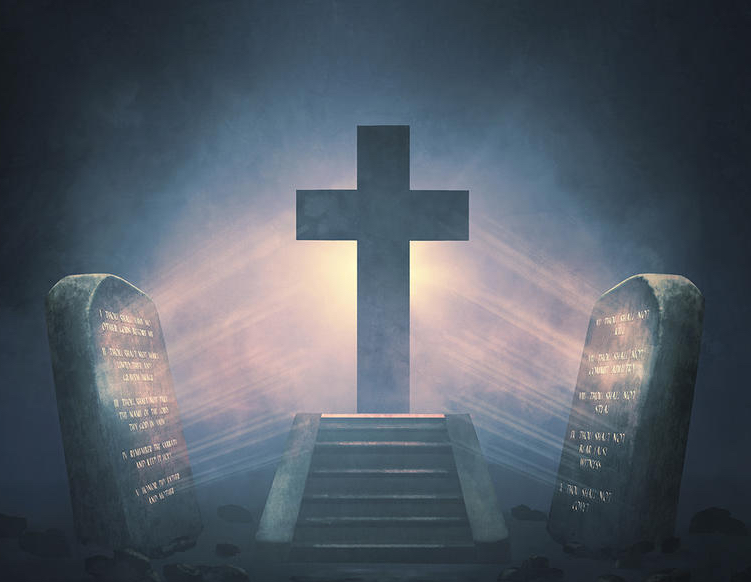
Dear saints, you are familiar with this text – or, at least, you should be. We know these verses as “the Ten Commandments” – even though Scripture itself never refers to them as the Ten Commandments. (More on that in just a bit.)

We have grown used to thinking that God only gave the Ten Commandments to show us our sin so that we repent and believe in Jesus for the forgiveness of our sin. Saying that isn’t wrong – not in the least! Scripture says that one of the reasons God gave us the Law is to tell us what we must and have failed to do (Ro. 7:7-12). That’s how Luther uses them in his Small Catechism, and in his hymn on the Ten Commandments that we just sang, he does the same thing, “You have this Law to see therein / that you have not been free from sin, / but also that you clearly see / how pure toward God your life should be.” But God gave the Ten Commandments to do more than simply show us our sin.

Scripture calls this text “the Ten Words” (Ex. 34:28; Dt. 4:13, 10:4). The Bible refers to them as “the Ten Words” because only one of them is actually an imperative (command) – “Honor your father and mother.” All the rest are indicative (statements). A perfectly legitimate – and, admittedly, shorthand – way to understand these verses would be, “You will have no other gods before Me…. You will not misuse My Name…. You will keep the Sabbath holy…. Honor your parents. You will not murder, commit adultery, steal, lie, covet.”

As God’s people heard these words at the base of Mt. Sinai, they would have understood three distinct things at the same time. First, they would have understood that this is what God demands they do, which is how we normally understand them. Second, they would have heard them as a description of who they are and how God sees them. Third, they would have heard these as God’s promise to work in them to make them all these things (Php. 1:6).

Think of it this way: A boy might be pestered and bullied by a girl at school so much that he finally retaliates and shoves her to the ground. (You boys, don’t do that because that’s wrong.) They boy’s parents get called to the principal’s office and learn about the altercation. When they get home, the parents send the boy to his room as punishment. Afterwards, the father goes into his son’s room for ‘the talk’ and says, “We do not shove, hit, or be mean to girls.”

Notice what that speech from the father does. First, by saying, “we,” the father is still showing his son that they are in a relationship. The son hasn’t been abandoned or disowned; they belong together and are identified together as a unit. Second, the father is also saying that as a unit, they act and behave a certain way – they don’t use physical force against girls. Also, the boy knows that his dad is forbidding him to use physical force against a girl. All three of those things get communicated at the same time. The Ten Words here work just like that.

Let’s stick with that analogy about the boy and the girl bully to get one more thing about the Ten Words across. As soon as the boy pushed the girl to the ground and saw that she was dirty, dusty, and hurt, the boy’s conscience kicked in because he knew what he had done was wrong even before he pushed her. That rule or command, “Don’t hurt girls,” was already known by the boy even if he had never been taught it. The girl’s pain simply awakened his conscience. The same thing is true for these Ten Words (Ro. 7:7-8).

Cain knew it was wrong to kill Abel (Gen. 4:1-9) even though God hadn’t given the commandment, “Thou shalt not murder,” yet. Joseph knew not lie with Potiphar’s wife (Gen. 39:7-9) even though God hadn’t given the command, “Thou shalt not commit adultery.” Esau accused Jacob of cheating him (Gen. 27:36), and Jacob accused his father-in-law, Laban, of cheating him (Gen. 31:7) even though God hadn’t given the commandment, “Thou shalt not steal.” Abraham knew it was wrong to lie about Sarah being his sister (Gen. 12:11-20, 20:1-14) even though God hadn’t given the commandment, “Thou shalt not bear false witness.”

Everyone knows to not break the commandments because God has written them into the fabric of creation and on the heart of every person (Ro. 2:15). Everyone, even atheists (Ro. 1:21-25), know that we should love God with all our heart, soul, mind, and strength (Mt. 22:37). Everyone knows that we should love our neighbor as ourselves (Mt. 22:39).

God didn’t give the Ten Words so that we would know right from wrong. People knew (and still know) right from wrong already. Some think God gave the Ten Words to limit our freedom. Not at all. They are given in the context of God having set His people free, bringing them out of Egypt and slavery (Ex. 20:2). Instead, the Ten Words show God’s people what it looks like to be the free people He has created us to be. In the world that God has made, we aren’t free to do or be anything we please. We are free when we become what we are. A caterpillar is free to become a butterfly not a walrus. The Ten Words guide us to grow up to be what we are, and what we are is the very children of God (1 Jn. 3:2; Gal. 4:1-7).

Now, in an effort to assist with that growth, here’s some advice from Luther. Take each of the Ten Words with you into prayer and ask yourself these four questions: 1. What does this teach me? 2. What does this give me? 3. What does this show me to confess? And 4. What does this teach me to pray for?

For the first, “You shall have no other gods before Me,” you could pray something like this: “Father, thank you that You teach me that You are my God. Thank you that, as my God, You give me all good things. Forgive me for the times I do not trust You to be my God. Grant me Your Holy Spirit so I would love You with all my heart, soul, mind, and strength.”

For the seventh, “Thou shalt not steal,” you could pray: “Heavenly Father thank You for giving me so many good things. Everything I have is a gift from You. Forgive me for loving and pursuing stuff more than You. Help me to use what You have given me to serve my neighbor.”

Now, all of this is to say that what is most important with regard to the Ten Words is to believe them. Romans 14:23 says, “Whatever does not proceed from faith is sin.” As you believe the Ten Words, you see that God demands that you avoid certain sins and that you do certain good works. But you also see that God is accomplishing these things in you through faith. He has begun that good work in you when you were joined to Jesus’ death and resurrection in your Baptism (Ro. 6:1-11), and, again, He will complete that good work in you (Php. 1:6).

Dear saints, God promises that He is your God who has brought you out of slavery to sin by sending Jesus, who did not abolish the Law but fulfilled it. Through faith in Him, you have a righteousness that exceeds that of the scribes and Pharisees. Because of Him and His work, you will enter the kingdom of heaven, and He invites you now to a seat at His table. Amen.

The peace of God, which surpasses all understanding, will guard your hearts and minds in Christ Jesus. Amen.
Infant Baptism – Sermon for Midweek Lent 5

Listen here.

Do children also believe? Are they rightly Baptized?

The Baptism of infants is pleasing to Christ, as is proved well enough from His own work. For God sanctifies many of those who have been baptized as infants and has given them the Holy Spirit. There are still many people even today in whom we perceive that they have the Holy Spirit both because of their doctrine and life. It is also given to us by God’s grace that we can explain the Scriptures and come to the knowledge of Christ, which is impossible without the Holy Spirit [1 Cor. 12:3].

For this reason let everyone value his Baptism as a daily dress [Gal. 3:27] in which he is to walk constantly. Then he may ever be found in the faith and its fruit, so that he may suppress the old man and grow up in the new…. [I]f anyone falls away from the Christian life, let him again come into it. For just as Christ, the Mercy Seat [Ro. 3:25], does not draw back from us or forbid us to come to Him again, even though we sin, so all His treasure and gifts also remain. Therefore, if we have received forgiveness of sin once in Baptism, it will remain every day, as long as we live. Baptism will remain as long as we carry the old man about our neck.

Martin Luther’s Large Catechism

In the name of Jesus. Amen.

Many times, we Lutherans (along with Roman Catholics and others) are accused of doing something that is not biblical when we Baptize infants. Some well-meaning Christians will say, “The Bible never records an infant being Baptized.” And I have to admit that is correct. There is no verse that says, “Little two-week-old Bobby was Baptized,” or, “Timmy was Baptized as an infant.” The snarky side of me would like to point out that nowhere in Scripture does a woman explicitly receive the Lord’s Supper. If we would deny a child the gifts that God gives in Baptism just because there is no explicit mention of an infant being Baptized in Scripture, should we deny women the Body and Blood of Jesus? No!

Even though the Bible does not have a record of an infant being Baptized, the Scriptures certainly do imply that babies were Baptized. Look again at our first lesson (Act. 2:37-41). Peter has preached his great Pentecost sermon and closes with the horrific words of the Law, “Know for certain that God has made [Jesus] both Lord and Christ, whom you crucified.” The people are terrified, cut to the heart, and ask, “Brothers, what shall we do?” Peter answers, “Repent and be baptized every one of you in the name of Jesus Christ for the forgiveness of your sins, and you will receive the gift of the Holy Spirit,” now listen closely, “for the promise is for you and for your children.” In other words, the gift of forgiveness and the Holy Spirit is for the people there and for their children. That doesn’t mean that their children get the promise eventually when they grow up. The natural reading of that text is that Baptism is for the people there and for their children and babies. Peter could have limited it to people who were of a certain age, but he didn’t.

Later, in Act. 16, there are two entire households that are Baptized. First the household of Lydia (Act. 16:11-15), and later the household of the Philippian jailor (Act. 16:25-34 esp. v. 31-33). Remember that in the time of the New Testament, the life expectancy wasn’t that much longer than normal, child-bearing years, and they didn’t have the methods of birth control that we do. Also, children were much more valued back then. It is highly unlikely that neither Lydia, who was a seller of purple goods (Act. 16:14), nor the Philippian jailor had households without any children.

And remember, when Jesus gives the gift of Baptism to the church as the method of making disciples, He says, “Make disciples of all nations (ἔθνος, ‘ethnicities,’ ‘all types of people’) by Baptizing them in the name of the Father, Son, and Holy Spirit” (Mt. 28:19). If Jesus wanted to limit who is eligible to be Baptized, He would have made a limit there, but He didn’t.

Now, very briefly (I don’t want to spend much time on this because it is an absurd thought process): We know that “all have sinned and fall short of the glory of God” (Ro. 3:23). Our Psalm tonight (Ps. 51) teaches us that we are brought forth in iniquity and in sin did our mothers conceive us (Ps. 51:5). Still, some people teach that God does not hold babies accountable for their sins until they reach some sort of ‘age of accountability’ (which isn’t a biblical term anyway). But just use a little logic: If God isn’t going to punish young children for their sins until they reach a certain level of understanding of their sins, then abortion and infanticide would be evangelistic tools. God forbit it! Enough on that thought.

Back to what Peter says in Act. 2:38-39, some will say that Peter requires things to be done sequentially. First, you have to repent, then you can be Baptized. Or first you have to believe and only after you believe then you can be baptized. First of all, salvation isn’t a three-step program. But also notice that argument implies that babies cannot believe, which is not in line with what Scripture teaches – not at all. The overwhelming teaching of Scripture is that babies can and do believe.

I included an insert in your bulletin tonight titled, “Infant Faith in the Scriptures.” For anyone watching or listening, I’ll include links to it in the description (click here). And I would like us to quickly walk through it.

First, let’s start with Ps. 71:5-6. “For you, O Lord, are my hope, my trust, O Lord, from my youth. Upon you I have leaned from before my birth; you are he who took me from my mother’s womb. My praise is continually of you.”

One of the reasons this is such a great place to start is the variety of vocabulary used to describe a child. The verses start by saying that the Lord is my hope and trust ‘from my youth.’ In English, we use the word ‘youth’ for a very wide range of ages. Sometimes, churches have ‘youth group’ for middle-school through high school. East Grand Forks has ‘youth soccer’ for preschool through sixth grade. The Hebrew word translated as ‘youth’ here has a wide range of meaning too. One of the nice things about Hebrew poetry is that it’s very repetitive, and the repetition helps us see how expansive the term is. So, in v. 5 God is the object of hope and trust for the psalmist from his youth, and notice in v. 6 how it gets specific. The psalmist has leaned on God from before his birth. He recognizes that God was the one who brought him from his mother’s womb, and he continually (i.e. from before his birth and throughout his youth) praises God.

Those verses are very instructive, but let’s turn to the New Testament, and specifically what Jesus teaches about the faith of children. To do that, we need to understand some of the vocabulary of the Greek New Testament. In English, we have lots of words for a kid: infant, baby, toddler, tyke, little one, child, youth. Greek does the same. I’ve included five words (there are more) that deal with children. And I put them in different colors so they pop out in the verses that follow. Let’s quickly go through and define them:

βρέφος (brephos) – very small child; baby; infant; unborn baby in the womb

παιδίον (paidion) – a child below the age of puberty; it’s maybe the most basic words for ‘child,’ but it has a wide range of ages that it can apply to.

μικρός (mikros) – ‘little one’; one who is small; it’s even used to describe Zacchaeus

νήπιος (nēpios) – a very young child; infant; a minor not yet of legal age

θηλάζω (thēlazō) – v. ‘to nurse’; can also be used as a noun meaning ‘one who nurses’

So, let’s go through the verses on that sheet. First, Luke 18:15-17 which is the same account as our Gospel lesson tonight (Mk. 10:13-16). Now, to be fair, Mark only uses the word παιδίον when he records this, but that’s why I used Luke’s account here. According to Luke, the doctor, people are bringing even their βρέφος (infants) to Jesus to be blessed by His touch. The disciples didn’t like it, but Jesus says, “Let the children (παιδίον) come to me, and do not hinder them, for to such belongs the kingdom of God. Truly, I say to you, whoever does not receive the kingdom of God like a child (παιδίον) shall not enter it.” Jesus here plainly says that the kingdom of God belongs to children to παιδίον – and notice that includes infants, βρέφος. And if we say that the kingdom belongs to children apart from faith, we are going to end up in a very bad place theologically.

Next passage, Matthew 18:1-6: The disciples want to know who is the greatest in the kingdom of heaven. Jesus brings a child (a παιδίον) into their circle and says, “Truly, I say to you, unless you turn and become like children (παιδίον), you will never enter the kingdom of heaven. Whoever humbles himself like this child (παιδίον) is the greatest in the kingdom of heaven. Whoever receives one such child (παιδίον) in my name receives me, but whoever causes one of these little ones (μικρός ‘little guys’ and notice what Jesus says next) who believe in me to sin, it would be better for him to have a great millstone fastened around his neck and to be drowned in the depth of the sea.” According to Jesus, children, even little ones believe in Him.

Next verse, Matthew 21:15-16: This is after Jesus has entered into Jerusalem on Palm Sunday to the shouts of “Hosanna!” The chief priests and scribes get furious when they see all the things Jesus is doing, and they see children (παιδίον again) crying out, “Hosanna to the Son of David!” They want Jesus to get them to quiet down by asking, “Do you hear what these are saying?” And Jesus responds, “Yup! Have you never read,(then He quotes Ps. 8:2) “‘Out of the mouth of infants (νήπιος) and nursing babies (θηλάζω) you have prepared praise’?” Right praise of God is only possible through faith (Ro. 14:23b).

Chugging right along, Matthew 11:25-27: Jesus praises His heavenly Father, “I thank you, Father, Lord of heaven and earth, that you have hidden these things from the wise and understanding and revealed them to little children (νήπιος infants); yes, Father, for such was your gracious will. All things have been handed over to me by my Father, and no one knows the Son except the Father, and no one knows the Father except the Son and anyone to whom the Son chooses to reveal him.” God is more than capable of hiding things from the wise and understanding and able to reveal the things of faith to the infants.

Two more, 2 Timothy 3:14-15: Paul tells pastor Timothy, “Continue in what you have learned and have firmly believed, knowing from whom you learned it.” Pause for a second: remember from the previous verse, who does the teaching and revealing? God does. Continue at v. 15 “and how from childhood (βρέφος from ‘infancy’) you have been acquainted with the sacred writings, which are able to make you wise for salvation through faith in Christ Jesus.” Since his infancy, and maybe even before his birth (as we’ll see in a minute), Timothy was acquainted with the sacred writings, the Scriptures, through which God makes even infants wise for salvation through faith in Christ Jesus.

Finally, we see this actually happen in our final passage, Lk. 1:1541: This is about John the Baptizer. In v. 15, the angel Gabriel announces to Zechariah that he will have a son, that’s John. And that John will, according to v. 15, “be filled with the Holy Spirit even from his mother’s womb.” Later on in v. 41, Mary visits Elizabeth, John’s mother and Mary’s relative. When Mary got to her house and greeted Elizabeth, the baby (βρέφος the pre-born baby, John) leaped in her womb. Elizabeth goes on to say that pre-born John leaped precisely at the sound of Mary’s greeting, which, if I remember rightly, was shalom, ‘peace.’

With that text in particular, we see that babies can hear in the womb. But even more importantly, that the Word of God, that proclamation and greeting of God’s peace, is effective to give the Holy Spirit and create faith even for pre-born babies. So, all you dads and moms, take note. Read the Scriptures to all your children, even before they are born. God works through His Word.

So, Scripture teaches that children, infants, and even pre-born babies can have faith. So, if someone objects to infant baptism based on the idea that infants can’t believe, they are arguing against Scripture.

And we can admit that it’s difficult to know how babies believe. How can infants who can’t talk or express themselves believe? But that’s the miracle of faith. How can any sinner, dead in their sin believe? Faith is always a gracious, life-giving gift of God (Eph. 2:8-9).

Think back to what we’ve covered the past five weeks and see what Scripture says that Baptism does: Baptism saves (1 Pe. 3:21). It forgives sins (Act. 2:38). Baptism delivers from death and the devil (Col. 1:13). It gives the new begetting from above (Jn. 3:35-6). In Baptism, God joins you to Jesus’ death and resurrection (Ro. 6:3-11) and clothes you with Christ (Gal. 3:27). And nowhere does Scripture limit that work. All sinners, even infants, need God to do those things. And, God be praised, God promises that Baptism does all of these things, and God cannot and does not lie. So, continue believing what God has done for you in your Baptism.

I want to close with the second paragraph from the Large Catechism in your bulletin:

“For this reason let everyone value his Baptism as a daily dress [Gal. 3:27] in which he is to walk constantly. Then he may ever be found in the faith and its fruit, so that he may suppress the old man and grow up in the new. [I]f anyone falls away from the Christian life, let him again come into it. For just as Christ, the Mercy Seat [Ro. 3:25], does not draw back from us or forbid us to come to Him again, even though we sin, so all His treasure and gifts also remain. Therefore, if we have received forgiveness of sin once in Baptism, it will remain every day, as long as we live. Baptism will remain as long as we carry the old man about our neck.”

Even though we can (and, sadly, some do) walk away from the faith and deny the benefits of their Baptism, God remains faithful to His promises (2 Tim. 2:13). Those promises are always there for you to return to. Live in those promises trusting what God has done for you through your Savior, Jesus Christ. Amen.

The peace of God, which surpasses all understanding, will guard your hearts and minds in Christ Jesus. Amen.
Children of God – Sermon for Easter 4 on 1 John 3:1-3

Listen here.

1 John 3:1–3

1See what kind of love the Father has given to us, that we should be called children of God; and so we are. The reason why the world does not know us is that it did not know him. 2Beloved, we are God’s children now, and what we will be has not yet appeared; but we know that when he appears we shall be like him, because we shall see him as he is. 3And everyone who thus hopes in him purifies himself as he is pure.

In the name of the Father and of the Son and of the Holy Spirit. Amen.

Alleluia, Christ is risen!
He is risen indeed! Alleluia!

One question repeatedly comes up in life. And though the form of the question changes, it really is the same. When you are young, the question is, “What do you want to be when you grow up?” As you grow, the question changes, “What are you going to study in college?” Later, the question gets dumbed down, “What do you do?” Eventually, it becomes, “When are your plans for retirement?” Then, when you do retire, “What do you do with all your free time?”

Can I just be honest? I hate this question. Today, when I get asked, “What do you do?” I’m tempted to tell people I’m a plumber. It wouldn’t be a lie per se because I am in the business of dealing with people’s… stuff. All kidding aside, I do love to be able to do what I do.

Anyway, this question, in its various forms, is continually asked because you are someone who is somewhere, and you will be someone doing something different somewhere else later. It’s a question of identity which is continually changing.

Well, today, this text gives an answer to the question of your identity. And it’s not just any answer – it is God’s answer.

Child PrayingYou are God’s children. “See what sort of love the Father has given to us, that we should be called children of God.”
Generally, children resemble their parents. And you, Christian, know your sin. You aren’t as loving or forgiving as you should be. And you certainly aren’t perfect as your heavenly Father is perfect. So, it is easy to doubt the truth of what John says here. Maybe, it was an exceptionally windy day when that apple fell from the tree.

It’s hard to believe that you are children of God, but it’s true. Hear it again because John doesn’t want you to miss it – he emphasizes it, “See the kind of love the Father has given to us, that we should be called children of God – and so we are.”

It wasn’t easy – God making us to be His children. And yet, God, out of His great love for us, sent His only begotten Son. Jesus went to a Good Friday death on the cross and was raised that Easter morning all so that you could be God’s children. Nothing less.

Now, the world looks at you and scoffs at the idea that you are children of God. The world doesn’t know you as a child of God because, frankly, they don’t know who God is. Some think He is a type of Santa Claus who rewards those who are good and punishes those who are bad. Others think God is just an old man in the sky with old-fashioned ideas and is spiteful and full of vengeance. Their perceptions of God are wrong. And because their ideas about God are wrong, their ideas about you are wrong.

Because they do not know God as He has chosen to reveal Himself in Christ, they do not recognize you who are in Christ as the children of God.

Baptism 2So, Blair: Today, God has Baptized you. Today, God has connected His Word to water and joined you to Christ’s death and resurrection (Ro. 6:3-11). God has clothed you with Christ (Gal. 3:27). God has given you the washing of regeneration and renewal of the Holy Spirit and saved you (Tit. 3:5-7). Today, you are born again, and God has made you His beloved child.
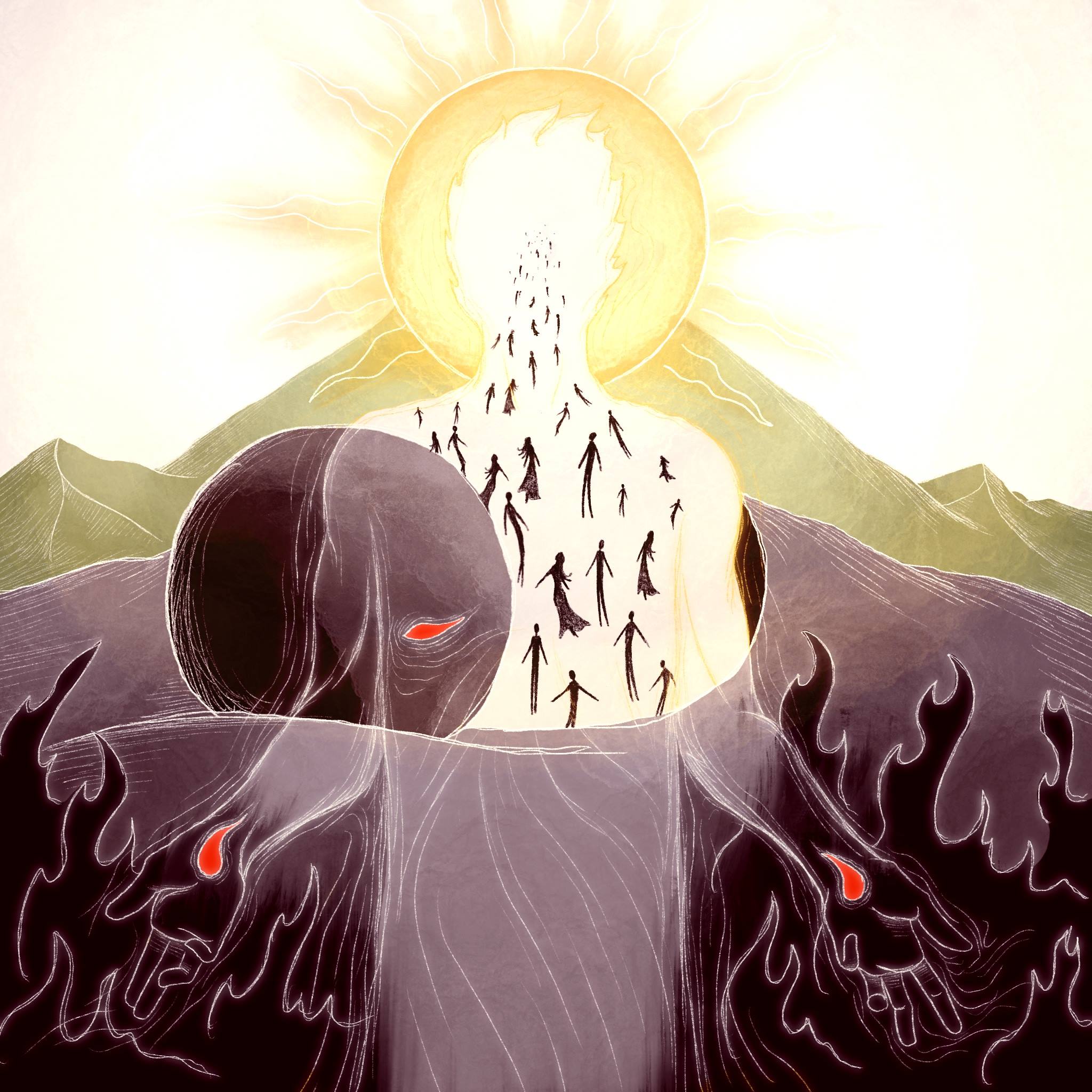
Blair, and all of you here, God has brought you out of darkness into His light. God has caused you to be reborn. You were living a lie and have been brought into the truth. So, John says it again. “Beloved, we are God’s children now.”

So, you children of God, what do you want to be when you grow up? Different questions rise from there. All sorts of specifics we would like answered. “What will I do this summer?” “Where will I be enrolled next semester?” “Will my business grow or hold steady?” “Will I get married, and to whom and when?” And some of you might even be wondering, “How much longer do I have left in this life?”

Sorry, but God doesn’t answer to those specifics. And, honestly, it is foolish to search for those answers because God hasn’t given them. But God does give the answer, the final and ultimate answer to what you, child of God, will be when you grow up.

Children of GodWhen Christ appears, you will be like Him because you will see Him as He is.

You will be like Jesus. On that day, it will be enough to see Jesus as He is. It will change you. You will be pure, perfect, and loving – just as Jesus is.

Until then, purify yourself. When you see that you are sinning and living like a child of the devil, purify yourself. Turn away from that sin. Turn away from your anger, your apathy, your self-centeredness, your gossiping, your coveting, your lust. Repent. Give that all over to the cleansing blood of Jesus and trust His forgiveness.

Instead, honor and love one another. Let us, as this little band of God’s children here at Christ the King, radiate God’s love and light in our relationships, in our homes, in our workplaces, in our community, and throughout the world.

Live as you are. Live as God’s forgiven, beloved children. Amen.

Alleluia, Christ is risen!
He is risen indeed! Alleluia!

The peace of God, which surpasses all understanding, will guard your hearts and minds inChrist Jesus. Amen.