1 In the beginning was the Word, and the Word was with God, and the Word was God. 2 He was in the beginning with God. 3 All things were made through him, and without him was not any thing made that was made. 4 In him was life, and the life was the light of men. 5 The light shines in the darkness, and the darkness has not overcome it.
In the name of Jesus. Amen.
Texts like this are one of many reasons why I’ll never attempt to create a chronological Bible reading plan. I’m familiar with several of those plans, but none of the ones I’ve seen have these verses from the opening of John’s Gospel anywhere near Genesis 1. And they should be. Parts of these verses are chronologically before the beginning. But I don’t know how exactly how a person could decide where to put them. You have Gen. 1:1, “In the beginning, God created the heavens and the earth,” and Jn. 1:1-2, “In the beginning was the Word, and the Word was with God, and the Word was God. He was in the beginning with God.” Which of those should come first? How do you order those? Would you put them parallel to each other? I don’t know. There are valid arguments to go either way.
Then, what do you do with v. 3-5? I suppose you could put v. 3-4 after the, “and there was evening and there was morning, the sixth day” (Gen. 1:31). But then, what do you do with v. 5, “The light shines in the darkness”? You might consider putting that back on the first day of creation when God creates light and separates light from dark. But ‘the Light’ there doesn’t refer to light as we know it. There, ‘Light’ refers to Jesus Himself, and He existed even before God said, “Let there be light” (Gen. 1:3). On top of that, “The light shines in the darkness,” is present tense and is always true. Jesus constantly, continually, always shines into and pierces the darkness, and He will never be overcome. So, maybe you’d need to put v. 5 running down the margin of every single page from Genesis to Revelation.
John 1:5 is so comforting. It’s a verse that I would recommend that you tuck in your back pocket so you can contemplate and meditate on it whenever you get the sense that the darkness of this world is gaining the upper hand. It isn’t. Not now. Not ever. The darkness will never win. It can’t. Use Jn. 1:5 to constantly remind yourself, “Jesus is my Life and Light. No darkness will ever overcome Him, so no darkness will overcome me. The darkness simply isn’t strong enough.” Isn’t that a wonderful, comforting thought?
The reason no darkness can overcome Jesus is that He is eternal. There was never a time when He was not. In fact, time itself exists through and because of Him. He created time and everything else that has been made. Scripture clearly teaches that Jesus’ birth in Bethlehem was not His beginning. He always is. Notice it’s not, “He always was” but is (Jn. 8:58; Ex. 3:14).
Look again at our Old Testament reading (Pr. 8:22-31). Jesus, the Word and Wisdom God, is there before the beginning of the earth (Pr. 8:22-23). He was there before the depths were carved. He was there before the mountains were stretched into the sky. He was there before the stars were placed into their orbits and before the foundations of the earth were laid (Pr. 8:24-29). Jesus was right there beside God the Father like a master craftsman (Pr. 8:30). Jesus Himself was the Word that God that the Father spoke and which gave shape and order and beauty to all of creation. And notice the joyful exchange between God the Father and God the Son at the end of that text. God the Son says, “I was daily [the Father’s] delight,” and, “[I was] always rejoicing before [the Father]” (Pr. 8:30).
Jesus delighted in all of God’s creation. But He especially found delight in the crown of God’s creation – the children of man (Pr. 8:31). Just stop and think of that. Do you ever think of yourself as Jesus’ delight and source of joy? You should! Imagine Jesus watching over God the Father’s shoulder as Adam is being formed from the dust of the ground. He stares in amazed joy as God shapes him and uses Adam’s rib to make Eve. And even now, Jesus delights as God knits together every subsequent human who has ever been born – including you (Ps. 139:13-15).
Jesus, the eternal Son of God and God’s life-giving Word, delights in you to the extent that He can’t stand the thought of you being severed from Him. Whenever we sin, we start walking away from God’s Light and into darkness. That is why the Word became flesh and dwelt among us (Jn. 1:14). (We’ll cover that verse in a couple weeks. And I hope I’m not preaching myself into a corner here.) God became flesh for you.
Jesus’ delight in you is so great that even though He was God, He became one of you. He took on your flesh. Now, because of the incarnation, part of God’s nature is that He has a human body. Even though Jesus is true God, He doesn’t refuse to endure the same things that you experience as a human. Jesus got hungry and thirsty. He became tired and weary. Jesus prayed to His Father when He was in danger.
As God, Jesus is always feeding everyone everywhere in the world. But as a human Infant, Jesus nursed from Mary’s breast and was fed from Joseph’s hand. As God, Jesus never needs to sleep. But as a Man, He sleeps on a pillow in the stern of a boat during a storm (Mk. 4:38). As God, Jesus is the commanding General of all the angel armies. But as a Man, Jesus was strengthened by an angel (Lk. 22:43-44). As God, Jesus put into place the entire starry height of planets, stars, and galaxies. But as a Man, Jesus’ Body is nailed to a block of wood in the shape of a cross. As God, Jesus gives life to all. But as a Man, Jesus’ side was pierced by a spear. Jesus is the One who raises the dead, but He was laid in a tomb for you.
Dear saints, the eternal Word of God – begotten of the Father before all worlds, God of God, Light of Light, very God of very God – came down from heaven and was made Man. He did all of this for you. He did this to give you Life and Light. He did this because you are His delight. He will not let the darkness overcome you. And He will bring you to Himself in His eternal city where there will be no more night or darkness. He is and will always be your Light, and through faith you will reign with Him forever and ever (Rev. 21:22-22:5). Amen.
The peace of God, which surpasses all understanding, will guard your hearts and minds in Christ Jesus (Php. 4:7). Amen.
25 To whom then will you compare me, that I should be like him? says the Holy One. 26 Lift up your eyes on high and see: who created these? He who brings out their host by number, calling them all by name; by the greatness of his might and because he is strong in power, not one is missing.
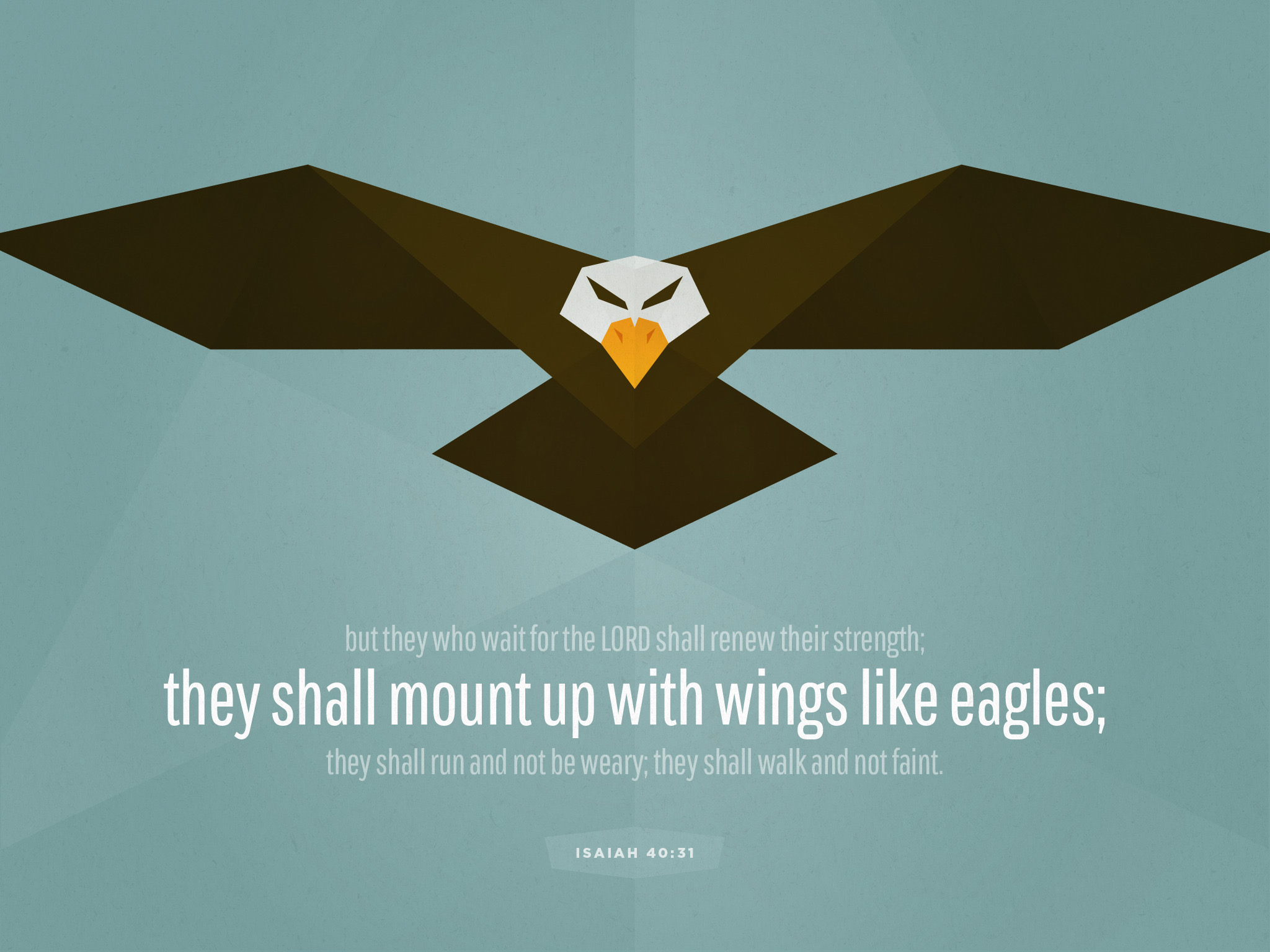
27 Why do you say, O Jacob, and speak, O Israel, “My way is hidden from the Lord, and my right is disregarded by my God”? 28 Have you not known? Have you not heard? The Lord is the everlasting God, the Creator of the ends of the earth. He does not faint or grow weary; his understanding is unsearchable. 29 He gives power to the faint, and to him who has no might he increases strength. 30 Even youths shall faint and be weary, and young men shall fall exhausted; 31 but they who wait for the Lord shall renew their strength; they shall mount up with wings like eagles; they shall run and not be weary; they shall walk and not faint.
Alleluia! Christ is risen! He is risen indeed! Alleluia!
In the name of Jesus. Amen.
One of the greatest spiritual dangers that we all face is that, as we go through difficulties in life, we forget very obvious things – especially the fact that God loves us and is in control of all things. But it’s not as though you’ve actually forgotten it. It’s just that you don’t believe it. You don’t live your life in what you know to be true.
Smack in the middle of this text, God asks a question, and it sounds like He asks it out of frustration. “Why do you say, ‘My way is hidden from the Lord, and my right is disregarded by my God.’?” God doesn’t even wait for an answer. Instead, He addresses His question with a question. “Have you not known? Have you not heard? The Lord is the everlasting God, the Creator of the ends of the earth. He does not faint or grow weary; His understanding is unsearchable.”
Your God doesn’t wear out like you and I do. It’s not as though He needs to go sit in His lazy chair and kick His feet up to take a nap. He never encounters a situation where He isn’t quite sure what to do. We have known and we have heard that God is everlasting, that He is the Creator of the ends of the earth who does not grow faint or weary. We know that God has infinite understanding, that He gives power to the faint and strength to the weak. Our problem is that we don’t live like that is true. We encounter difficulties and live as though God does none of those things.
Dear saints, your God created every single star in the universe. Scientists guess that there are somewhere between 100-400 billion stars in our Milky Way galaxy. They don’t know the exact number, but that’s the estimate. Think about this – even if we took the small end of that estimate – if it only took God one second to name each star, 100 billion seconds is equivalent to 3,171 years, 66 days, 17 hours, and 46 minutes. And that’s just our galaxy.
Scientists estimate that there are between one to two trillion galaxies. Honestly, it wouldn’t surprise me that as we learn how to look farther we found out that the universe is even bigger than that. And it was nothing for God to create all those things. God created all of those things simply by speaking, “Let there be lights in heavens,” (Gen. 1:14) and there they were. Every one of them with a name and carefully placed in its position by your mighty God.
Now, contrast that with how God created you. When God created Adam, He didn’t simply speak. He got down into the mud and dirt and dust. He molded, formed, and shaped you from that dust and breathed into your nostrils the breath of life (Gen. 2:7). He intricately knitted you together in your mother’s womb (Ps. 139:13, 15).
Beyond that, God saved you by taking on your flesh and blood. He entered into His creation and subjected Himself to the weariness and fatigue that you endure (Jn. 4:6). Christ knew suffering and pain (Is. 53:3). Jesus did all of this to step between you and the wrath of God that you and I deserve because of our sin. He came to die and rise again in order to win you as His own.
In other words, God is much more invested in you than all the rest of creation. He’s more interested in what goes on in your life and what happens with you than with all the stars and galaxies that He calls by name. Again, we know this, but by the way we often live, it sure doesn’t look like it. Instead of waiting upon the Lord and soaring like eagles, we flap around like chickens.
I’m no expert on chickens, but the few times I’ve seen them “in flight” it’s pretty unimpressive. When they do get airborne, it’s usually because they’ve jumped as high as they can. They beat their wings – feathers flying all around. And the best they can do is just to fall less quickly. That’s the picture of us when we aren’t waiting upon the Lord. The best we can do in our own strength is fall a bit slower.
Eagles are completely different. This past Tuesday, Sarah and I just got to watch three eagles soaring in the distance. I don’t know what they were looking at, but for, maybe, five minutes they kept circling round and round. They would swoop down periodically, but then they would ascend on the invisible updrafts. The whole time we watched those eagles, none of them flapped their wings even once. They were just lifted by those updrafts. Those huge birds didn’t need to extend any effort to fly.
Dear saints, that is the picture of those who wait upon the Lord. This waiting on the Lord isn’t simply marking off time and watching the minutes and seconds tick by. This waiting is living in a confident expectation of God’s action on our behalf. This waiting is simply resting in God’s mercy which lifts us up to heaven. Romans 4:5 puts it this way, “To the one who does not work but believes in Him who justifies the ungodly, his faith is counted as righteousness.”
I’ll confess my own weakness in this. I’m not good at waiting. I don’t like doing it. I don’t have the patience I should have. Waiting is difficult, and I suspect this is true for all of us. We wrongly live as though everything around us is dependent upon our work, our effort, our wisdom. We think we have to get everything figured out on our own. It’s exhausting. Waiting might feel like we’re descending or, even, free-falling. But this waiting is waiting in faith where we receive from God, and He lifts us up.
I want to change gears for a minute to talk about this upcoming sabbatical. Dear saints, my prayer for this sabbatical is that all of us would come to a better understanding that this is God’s congregation and that He is more interested in His Word being proclaimed here than we are. I’ll confess that I start to slide into the sinful attitude that certain things are dependent on me and what I do. If that were actually the case, you, dear saints, are in deep trouble.
So, during this sabbatical, I’m going to do my best to rest. In 1 Co. 3:5-7, Paul tells the congregation in Corinth that he and other pastors are nothing. He says, “I planted, Apollos watered, but God gave the growth. So neither he who plants nor he who waters is anything, but only God who gives the growth.” This sabbatical will help all of us remember that.
God loves His church. He loves this congregation. He is more ready to give than we are to receive. So, thank you for the gift of this sabbatical so I can stop, wait, and receive from God for an extended time. I trust that God will use this time to renew and refresh me in ways that will benefit me and in ways that will benefit you.
May God remind all of us that when we are weary and exhausted that He is our strength. He is the One who lifts us up by His mercy and grace. His incomparable love carries us along. He protects and keeps us. He grows His church. He forgives our sins. He makes a place for us in eternal life through His inexhaustible love and work for us in Christ Jesus. May we all wait and receive from Him. Amen.
Alleluia! Christ is risen! He is risen indeed! Alleluia!
The peace of God, which surpasses all understanding, will guard your hearts and minds in Christ Jesus. Amen.
41 And when [Jesus] drew near and saw the city, he wept over it, 42 saying, “Would that you, even you, had known on this day the things that make for peace! But now they are hidden from your eyes. 43 For the days will come upon you, when your enemies will set up a barricade around you and surround you and hem you in on every side 44 and tear you down to the ground, you and your children within you. And they will not leave one stone upon another in you, because you did not know the time of your visitation.”
45 And he entered the temple and began to drive out those who sold, 46 saying to them, “It is written, ‘My house shall be a house of prayer,’ but you have made it a den of robbers.”
47 And he was teaching daily in the temple. The chief priests and the scribes and the principal men of the people were seeking to destroy him, 48 but they did not find anything they could do, for all the people were hanging on his words.
In the name of Jesus. Amen.
As the Bible traces through human history, a regular pattern develops. The pattern goes like this: God creates something. Sinful humans defile it. God cleanses it. Then, God refills it. Over and over this happens.
In Genesis 6, we are told that mankind had filled the earth (Gen. 1:28). But because of sin, mankind’s every intention was only evil continually (Gen. 6:5). But Noah found grace in the Lord’s eyes (Gen. 6:8). So, God told Noah that He was about to cleanse the earth with a flood, but Noah, his family, and the animals would be preserved on the ark. After that cleansing, God commanded Noah and his family to, “Be fruitful and multiply and fill the earth” (Gen. 9:1).
Of course, not long after the cleansing of the Flood, people defiled the earth again by not filling it. Instead, they built the tower of Babel (Gen. 11:1-9). And the pattern began again. God came down to cleanse by confusing their languages and dispersing them over the face of all the earth. God then filled the earth with His blessing to Abraham that Abraham’s Offspring would bless all nations (Gen. 15).
Later in Exodus, we see God creating a great number of people to be His own. God delivered them out of slavery in Egypt to be His chosen people and treasured possession (Ex. 19:6). But they repeatedly defiled themselves. They would grumble and complain about their lack of food (Ex. 16) and water (Ex. 17:1-7). They made the golden calf (Ex. 32). Again and again, God would cleanse them by sending punishment. And He would fill them with water and mana.
The whole book of Judges follows this pattern. People would defile themselves and the land with all sorts of sin. God would raise up their enemies and cleanse them through punishment. And God would fill them.
In our Old Testament reading (Jer. 7:1-11), we heard how even as God’s people were in the act of defiling themselves and God’s Temple, God sent Jeremiah to try to cleanse them through his preaching. Jeremiah warned the people about their sins of injustice, oppression, shedding innocent blood, and idolatry. But the people didn’t listen. They kept on defiling themselves, the land God had given them, and even of God’s house. So, God sent the Babylonians to cleanse the land by destroying Jerusalem and the Temple. Later, God allowed them to return, fill the land, and rebuild.
Creating, defiling, cleansing, filling. Over and over this happens. It’s almost like clockwork. But there is a danger with how often this pattern occurs in Scripture. That danger is this: we can too easily become complacent and nonchalant. We might be tempted to be indifferent and unconcerned about our sins and presume that God doesn’t care, “He’ll just cleanse and refill me.” Dear saints, be very careful about that kind of attitude. Don’t do it.
In our Gospel reading here, Jesus draws near to Jerusalem. If you look at the verses just prior to this text, you will see that Jesus is weeping over Jerusalem on Palm Sunday. This is one of only two times that Jesus weeps in the Gospels. The other time happened shortly before this in John 11:35 where Jesus sees the sadness and despair that His friends have over Lazarus’ death. There, of course, Jesus raises Lazarus and defeats death’s grip over His friends. And there is the sense there that Jesus goes to Jerusalem and to the cross to deal the deathblow to death.
But here, Jesus weeps over Jerusalem for an entirely different reason. Listen carefully again to what Jesus says, “Would that you, even you, had known on this day the things that make for peace! But now they are hidden from your eyes.” The only thing that would bring peace to Jerusalem, the only thing that would bring the cleansing they needed, was what Jesus would accomplish that upcoming Friday when He would go to the cross and shed His blood for the forgiveness of all their sin. But that peace was hidden from their eyes. You have to notice that. ‘Hidden’ is in the passive tense. It isn’t as though the people of Jerusalem were refusing to look for the things that made for peace. No, it’s worse than that. The things that make for peace were hidden, and they were hidden by Someone. God Himself had hidden it from their eyes.
This is what the theologians will call God’s ‘alien’ work as opposed to His natural work. Yes, God’s mercies are new every morning (Lam. 3:23). He is merciful and gracious, slow to anger, and abounding in steadfast love and faithfulness (Ex. 34:6). By His very nature, God cleanses. He forgives and restores. He fills with good things (Lk. 1:53). That is who God is by His nature. But God is not mocked. To those who repeatedly and sinfully reject the cleansing He desires to bring, God will eventually hand you over to your sin (Ro. 1:24, 26, 28). Repent.
After weeping over Jerusalem, Jesus enters the Temple to cleanse it. And every day until He was arrested, Jesus filled the Temple with His teaching. Why would He do that? If the things that make for peace were hidden from the eyes of those people, why would Jesus bother to cleanse the Temple and fill it with His teaching? He did it for you. He wants you to hear and believe that He desires to cleanse and fill you. Jesus wants you to know and to have the things that make for peace so that you repent, believe, and have the peace that only He can give.
This pattern of God creating, us defiling, God cleansing and filling has happened again here this morning. Through faith in Christ, God has made you a new creation (2 Cor. 5:17). Though you have sinned against God, He cleansed you through confession and absolution. And He is filling you with His teaching. But He is about to fill you with something even more.
Christ comes to fill you with Himself, with His Body and Blood. He comes to give you what you need to care for the people and places God has given you. Today, if you are hearing this message, the things that make for peace are not hidden from you. So, turn from your sin. Receive God’s forgiveness. Be filled with God’s Word, His mercy, and His grace. Daily hang on Jesus’ words.
In a world that is filled with the defilement of sin, receive God’s cleansing, and be filled with the Holy Spirit. Amen.
The peace of God, which surpasses all understanding, will guard your hearts and minds in Christ Jesus. Amen.
22 Wives, submit to your own husbands, as to the Lord. 23 For the husband is the head of the wife even as Christ is the head of the church, his body, and is himself its Savior. 24 Now as the church submits to Christ, so also wives should submit in everything to their husbands.
25 Husbands, love your wives, as Christ loved the church and gave himself up for her, 26 that he might sanctify her, having cleansed her by the washing of water with the word, 27 so that he might present the church to himself in splendor, without spot or wrinkle or any such thing, that she might be holy and without blemish. 28 In the same way husbands should love their wives as their own bodies. He who loves his wife loves himself. 29 For no one ever hated his own flesh, but nourishes and cherishes it, just as Christ does the church, 30 because we are members of his body. 31 “Therefore a man shall leave his father and mother and hold fast to his wife, and the two shall become one flesh.” 32 This mystery is profound, and I am saying that it refers to Christ and the church. 33 However, let each one of you love his wife as himself, and let the wife see that she respects her husband.
7 [T]hen the Lord God formed the man of dust from the ground and breathed into his nostrils the breath of life, and the man became a living creature. 8 And the Lord God planted a garden in Eden, in the east, and there he put the man whom he had formed. 9 And out of the ground the Lord God made to spring up every tree that is pleasant to the sight and good for food. The tree of life was in the midst of the garden, and the tree of the knowledge of good and evil.
10 A river flowed out of Eden to water the garden, and there it divided and became four rivers. 11 The name of the first is the Pishon. It is the one that flowed around the whole land of Havilah, where there is gold. 12 And the gold of that land is good; bdellium and onyx stone are there. 13 The name of the second river is the Gihon. It is the one that flowed around the whole land of Cush. 14 And the name of the third river is the Tigris, which flows east of Assyria. And the fourth river is the Euphrates.
15 The Lord God took the man and put him in the garden of Eden to work it and keep it. 16 And the Lord God commanded the man, saying, “You may surely eat of every tree of the garden, 17 but of the tree of the knowledge of good and evil you shall not eat, for in the day that you eat of it you shall surely die.”
In the name of Jesus. Amen.
It should come as no surprise, but this text is fundamental and foundational to understanding who we are as God’s creatures. But to really get to the roots of who we are, we first have to understand who God is as our Creator, and this text gives us one piece of that understanding. The other piece came just before our text.
The Bible gives us two very different accounts of creation. In Genesis 1:1-2:3, God creates the sun, moon, stars, land, sky, plants, fish, birds, mankind, and all things by simply speaking. Whatever He commands comes into being. The whole account is filled with the repeated words, “And God said…. And it was so.” Then, God rests. Throughout those six days of creating and the seventh day of rest, He is simply called “God” (Heb.‘Elohim’). In that first account account of creation, we see a God who is transcendent – He is not subject to the limitations we are used to.
But then in our text here, the second account of creation, we see something remarkably different. The difference can be seen just a few verses before our text began in how Moses refers to God. No longer is He simply ‘God’ – He is the Lord God. In Hebrew, it is Yahweh God. In other words, this transcendent, powerful God has a name, and He is close and personal – especially with the head of His creation, Adam.
Yahweh puts His hands into the earth, molds the clay to form the man, and breathes life into Adam’s nostrils (Gen. 2:7). Then that immanent, personal God plants a garden for Adam (Gen. 2:8-9). After our text, Yahweh remains close to Adam by causing him to sleep and performing a surgery on him in order to create the woman. And Yahweh brings the woman to Adam as his suitable helper and joins them together in marriage so they would become one flesh by having children (Mt. 19:6; Mk. 10:9).
From these two accounts of creation, we have an important insight into God. He is mighty, powerful, and uninhibited. But He is also intimately close and involved with mankind.
Finally, after God finishes creation, He rests on the seventh day. Now, God doesn’t rest on the seventh day because He is tired. He created by merely speaking, and God speaks a lot more through the rest of Scripture but doesn’t grow tired or need a nap (Ps. 121:3-4). Instead, those two creation accounts help us understand something about that day of rest. God rests because He has set up all of creation to be His Temple where He will rest in the order and peace that He has established.
When I was younger, I imagined God created everything while He sat far away in heaven, speaking things into existence, but staying aloof somewhere way up there in heaven. But that scenario isn’t compatible with the rest of Scripture.
God’s desire is to dwell with people, the crown of His creation. The final picture Scripture gives of the eternal bliss of believers is God making His dwelling with you (Rev. 21:3). This desire of God to dwell among His creation becomes especially clear after the Fall. When God delivers His people from slavery in Egypt, He instructs them to build the Tabernacle so He can dwell in their midst (Ex. 25:8). In that Tabernacle, and later in the Temple, God says that He will walk among them (Lev. 26:12; 2 Sam. 7:6-7) just as we see He does in Gen. 3:8. To do that, God’s instructions on how to build the Temple in Jerusalem include many of the same materials, like gold and onyx stones, and the same ‘floorplans’ we read about here in the Garden of Eden.[1]
Now, that brings us to the nature of mankind. God puts Adam in the midst of that newly created Temple of Eden and gives Adam two responsibilities. Our translation says that Adam is there “to work it and keep it.” The two Hebrew words there can refer to a lot of activities, but when Scripture uses these two terms together, they most often refer to the duties and responsibilities of the priests in the sanctuary of the Tabernacle and Temple (Num. 3:7-8, 8:26, 18:5-6). In other words, this text is telling us that mankind was created to be the priest and guardian of sacred space. We were not created just to be gardeners.
On top of being priests, God set up mankind to be kings and queens over creation. God said, “Be fruitful and multiply and fill the earth and subdue it, and have dominion over the fish of the sea and over the birds of the heavens and over every living thing that moves on the earth” (Gen. 1:26-28). So, from our very origin, we were created to be priests and the royal rulers over creation with God reigning in our midst.
Of course, sadly, we did not remain in that original state. Adam and his wife failed in their priestly duties. They did not guard the Temple of Eden as they should have. Instead, they let the foul serpent defile it, and they lost their priestly roles. Instead, God sent a cherubim to take over the responsibility of guarding the way to the Tree of Life (Gen. 3:24 [see also Ezk. 28:14-16]). They also gave up their royal status over creation. Instead of having dominion over everything that creeps on the earth, they listened to what should have been under their rule; they listened to the serpent’s lies. By eating the fruit of the Tree of the Knowledge of Good and Evil, they rejected God and His ordering of the world.
But, dear saints, God has provided a way back to the Tree of Life (Rev. 22:2, 14), a way back to being what we were created to be, a way back to our origin. Jesus, the new Adam (1 Cor. 15:21-22, 45, 47), has come and crushed the serpent’s head. By His death and resurrection, Jesus has now redeemed you and made you what you were created to be. Through faith in Christ, you are a chosen race, a royal priesthood, a holy nation, a people for His Own possession (1 Pet. 2:9). This very Jesus dwells among you even now (Mt. 18:20). And, as Christ’s people, you are called to be His priests and kings and queens, guarding the sacred spaces of this congregation and your family.
So repent. Repent of the times you have chosen to neglect and abdicate your position as God’s priests and royalty. Repent of the times you have listened to the serpent’s lies and not expelled him from the good gardens where God has placed you and given you priestly and royal authority. Repent because the only fruit you have gotten from those sins is death (Ro. 6:21).
And know, as our Epistle reading (Ro. 6:19-23) promises, that you have been set free from sin and are now the servants of God who gives you fruit that leads to sanctification and life (Ro. 6:22). And know that Christ has equipped you with everything you need to be His priests and royalty. You have the full armor of God (Eph. 6:10-18) to defend against the attacks of the devil, the world, and your own sinful flesh. And you have God’s promise that He will never leave you or forsake you. In a world that is still soiled and stained with sin, Christ has brought you back into His kingdom, and He will lead you to eternal paradise with Him. Amen.The peace of God, which surpasses all understanding, will guard your hearts and minds in Christ Jesus. Amen.
[1] Gold and onyx (Gen. 2:11-12) are used to decorate the sanctuaries and priestly garments (Ex. 25:7, 11, 17, 31). The Tabernacle/Temple lampstand probably symbolizes the tree of life (Gen. 2:9; Ex. 25:31-35). Even the river flowing from Eden (Gen. 2:10) resembles Ezekiel’s Temple vision (Ezk. 47:1-12).
18 For I consider that the sufferings of this present time are not worth comparing with the glory that is to be revealed to us. 19 For the creation waits with eager longing for the revealing of the sons of God. 20 For the creation was subjected to futility, not willingly, but because of him who subjected it, in hope 21 that the creation itself will be set free from its bondage to corruption and obtain the freedom of the glory of the children of God. 22 For we know that the whole creation has been groaning together in the pains of childbirth until now. 23 And not only the creation, but we ourselves, who have the firstfruits of the Spirit, groan inwardly as we wait eagerly for adoption as sons, the redemption of our bodies.
In the name of Jesus. Amen.
Christian, the Bible never says that you will escape suffering. In fact, Jesus promises that you will suffer. Jesus says that everyone who follows Him will take up a cross (Mt. 16:24). Jesus says that since the world persecuted Him, it will persecute you (Jn. 15:20). Jesus says that in this world you will have tribulation (Jn. 16:33). Jesus even says that the one who kills you will think he is offering service to God (Jn. 16:2).
Christian, you should expect to encounter suffering in this world. 1 Peter 4:12 tells us to not be surprised at the fiery trial when it comes upon you to test you, as though something strange were happening to you. Whether or not we will experience suffering is not the question. Instead, our text here would have us consider how we endure the suffering because our typical response to suffering is not what Scripture would have us do.
Often, your initial response to suffering is to look to the time when your suffering will be over. Your kids keep getting up at night, so you look forward to when they finally stay asleep, and you can rest. Your checking account gets low, so you look to your next payday. You get sick, so you look forward to when you will feel better. Even though all of those things are welcome pauses to your suffering, they are only temporary moments of slight relief. And if that is all you hope for, you are setting your sights way too low. Paul writes in 1 Cor. 15:19, “If in Christ we have hope in this life only, we are of all people most to be pitied.”
Christian, this text is telling you that there is something even better in store for you than the end of your suffering. When you suffer, look past the end of your suffering and raise your eyes to the glory that is to be revealed to you (Rom. 8:18). It is a glory that you have even now, but a glory that you cannot see right now.
Look carefully at v. 19-21 of our text. “The creation waits with eager longing for the revealing of the sons of God. For the creation was subjected to futility, not willingly, but because of Him who subjected it in hope that the creation itself will be set free from its bondage to corruption and obtain the freedom of the glory of the children of God.”
Paul here is inviting us to look at our present suffering from the perspective of the rest of God’s creation, so let’s do that. Jesus helps us get that perspective In Matthew 5:45 where He says that God, “Makes His sun to rise on the evil and the good.” Imagine the suffering that the sun has had to endure since the Fall.
Because of God’s mercy, He has commanded the sun to serve idolators, adulterers, thieves, liars, and murderers. The sun was created to shine on the righteous, but God has commanded it to keep shining on both the evil and the good. God has called the sun to serve all people – including the unrighteous. The sun’s work of shining on the evil is wasted, but the sun does it gladly because it is obeying God’s merciful command. The same could be said about the clouds with their rain, the crops with their fruit, and the water with its nourishment. All creation would much rather only serve only you, Christian. As the sun and the rest of creation serves the evil and the good, the righteous and the unrighteous, it waits with eager longing for you to be revealed as the sons of God (Ro. 8:19).
Catch that. Creation longs for “the revealing” of the sons of God. It will take a “revealing” for creation to recognize you as the sons of God.
Some of you have told me that you don’t recognize how loved and valued you are by God. You don’t see yourselves as God’s children. But listen to what 1 John 3:2 says, “Beloved, we are God’s children now, and what we will be has not yet appeared; but we know that when He appears we shall be like Him, because we shall see Him as He is.”
Here’s the truth. God sees you as His beloved child – holy, blameless, and righteous. Even though you can’t see that, and even though the rest of creation can’t see that, it’s true. But the day will come when you will be revealed as God’s children. All of creation will see it, and you will also see it.
Until then, live like the sun. Shine the light of Christ upon the righteous and the unrighteous as you eagerly wait for the time when you will be revealed before all creation as a beloved, holy, righteous child of God. Sure, you don’t see the glory God has given you yet. That’s fine. That day will come. God has promised. Jesus will return. Your body will be redeemed. You will rise, and all your suffering will fade away.
Dear saints, all suffering in this world is temporary. That doesn’t mean that your suffering doesn’t matter. Suffering can cause deep wounds that leave painful scars. Even though that is very true, the sufferings of this present time are all – every one of them – temporary. In fact, there is only one type of suffering that is nottemporary, and that is the eternal torment of hell. But that is not your destiny, Christian.
Brothers and sisters in Christ, you have God’s promise that the sufferings of this present time are not even worth comparing to the glory that will be revealed to you. And as you eagerly wait for your adoption as sons, as you eagerly await the redemption of your bodies, come to God’s table. Receive Jesus’ resurrected Body and Blood given and shed for the forgiveness of your sins. Be fed with His mercy and grace which strengthens you to serve the rest of creation as you eagerly await His return. Amen.
The peace of God, which surpasses all understanding, will guard your hearts and minds in Christ Jesus. Amen.
Alleluia! Christ is risen! He is risen indeed! Alleluia!
In the name of Jesus. Amen.
As we read through Genesis 1, there was a line that kept repeating. “And there was evening and morning the first day.” “And there was evening and morning the second day.” “And there was evening and morning the third, fourth, fifth, and sixth day.” But then, when we get to the account of the seventh day and expect to hear, “And there was evening and morning the seventh day,” we get nothing but crickets. Moses didn’t write that. But in and through that Holy Spirit inspired silence, there is an indication that the Sabbath day is incomplete. Yes, it was blessed with rest and holiness, but that day was still waiting for its completion and fulfillment.
That fulfillment came today, for us Westerners, or in the Jewish mind yesterday, Holy Saturday. The way days were reckoned in Jesus’ day, the new day began when the first two stars appeared in the sky. That’s why we start celebrating the Resurrection tonight, well before midnight. It’s why we celebrate Christ’s birth on the eve of His birth.
Jesus was crucified on Friday. In our Gospel lesson (Lk. 23:50-24:7), we heard how Joseph of Arimathea asked Pilate for the body of Jesus. Joseph took Jesus down from the cross and wrapped Him in a linen shroud and laid him in a new tomb. But because the Sabbath about to begin, Joseph, Nicodemus (Jn. 19:39), and the women weren’t able to finish the burial of Jesus. The sun was setting, and they didn’t have time to get the job done. The last verse of Luke 23 says, “On the Sabbath they rested according to the commandment.”
So, Joseph rested. The women rested. And, most importantly, Jesus rested, fulfilling the seventh day of creation.
Scripture says that after God finished creating everything on Friday, the sixth day, “God saw everything that He had made, and behold, it was very good” (Gen. 1:31). Then, God rested the following day, the seventh day, and made it holy.
On the Friday we call ‘good,’ the day of the re-creation and redemption of all things, Jesus saw everything He had done – His miracles, His teaching, His faithfulness to God and neighbor, how He perfectly obeyed God, how He had borne our griefs and carried our sorrows, and how He purchased and won us back – and behold, it was very good. That is why He could cry out, “It is finished,” before He breathed His last (Jn. 19:30).
Dear saints, Jesus, your slain Creator and Redeemer, endured the cross and labored in love for your peace and so you could have eternal rest. After completing His work, He entered His Sabbath rest as He lay there in the tomb.
Jesus’ task was done. Your sins were atoned for. He had finished His work that He had done, so He rested from all His work that He had done in creation. And now, Jesus has burst from the tomb, spitting in the face of death. The devil’s head has been crushed. Jesus has rested in the grave, and the Sabbath has been fulfilled so you can also enter into that perfect rest (Heb. 4:10).
And this has eternal significance for you. When you bury your loved ones, and when you yourself are buried, they and you follow Jesus into that rest. This is why Christian burial places are called ‘cemeteries.’ The word ‘cemetery’ comes from a Greek word koimeteria which means ‘sleeping place.’ We bury our brothers and sisters in Christ knowing that God isn’t done with them. We put them where they can rest and await the wake-up call that will be the trumpet blast on the Last Day when Jesus returns to raise them.
Dear saints, Christ has completely stripped death and the grave of its victory and sting (1 Cor. 15:55-56). Jesus lives, and so do you. And you have entered into His rest.
Alleluia! Christ is risen! He is risen indeed! Alleluia!
Amen.
The peace of God, which surpasses all understanding, will guard your hearts and minds in Christ Jesus. Amen.
1 In the beginning, God created the heavens and the earth. 2 The earth was without form and void, and darkness was over the face of the deep. And the Spirit of God was hovering over the face of the waters.
3 And God said, “Let there be light,” and there was light. 4 And God saw that the light was good. And God separated the light from the darkness. 5 God called the light Day, and the darkness he called Night. And there was evening and there was morning, the first day.
6 And God said, “Let there be an expanse in the midst of the waters, and let it separate the waters from the waters.” 7 And God made the expanse and separated the waters that were under the expanse from the waters that were above the expanse. And it was so. 8 And God called the expanse Heaven. And there was evening and there was morning, the second day.
9 And God said, “Let the waters under the heavens be gathered together into one place, and let the dry land appear.” And it was so. 10 God called the dry land Earth, and the waters that were gathered together he called Seas. And God saw that it was good.
11 And God said, “Let the earth sprout vegetation, plants yielding seed, and fruit trees bearing fruit in which is their seed, each according to its kind, on the earth.” And it was so. 12 The earth brought forth vegetation, plants yielding seed according to their own kinds, and trees bearing fruit in which is their seed, each according to its kind. And God saw that it was good. 13 And there was evening and there was morning, the third day.
14 And God said, “Let there be lights in the expanse of the heavens to separate the day from the night. And let them be for signs and for seasons, and for days and years, 15 and let them be lights in the expanse of the heavens to give light upon the earth.” And it was so. 16 And God made the two great lights—the greater light to rule the day and the lesser light to rule the night—and the stars. 17 And God set them in the expanse of the heavens to give light on the earth, 18 to rule over the day and over the night, and to separate the light from the darkness. And God saw that it was good. 19 And there was evening and there was morning, the fourth day.
20 And God said, “Let the waters swarm with swarms of living creatures, and let birds fly above the earth across the expanse of the heavens.” 21 So God created the great sea creatures and every living creature that moves, with which the waters swarm, according to their kinds, and every winged bird according to its kind. And God saw that it was good. 22 And God blessed them, saying, “Be fruitful and multiply and fill the waters in the seas, and let birds multiply on the earth.” 23 And there was evening and there was morning, the fifth day.
24 And God said, “Let the earth bring forth living creatures according to their kinds—livestock and creeping things and beasts of the earth according to their kinds.” And it was so. 25 And God made the beasts of the earth according to their kinds and the livestock according to their kinds, and everything that creeps on the ground according to its kind. And God saw that it was good.
26 Then God said, “Let us make man in our image, after our likeness. And let them have dominion over the fish of the sea and over the birds of the heavens and over the livestock and over all the earth and over every creeping thing that creeps on the earth.”
27 So God created man in his own image, in the image of God he created him; male and female he created them.
28 And God blessed them. And God said to them, “Be fruitful and multiply and fill the earth and subdue it, and have dominion over the fish of the sea and over the birds of the heavens and over every living thing that moves on the earth.” 29 And God said, “Behold, I have given you every plant yielding seed that is on the face of all the earth, and every tree with seed in its fruit. You shall have them for food. 30 And to every beast of the earth and to every bird of the heavens and to everything that creeps on the earth, everything that has the breath of life, I have given every green plant for food.” And it was so. 31 And God saw everything that he had made, and behold, it was very good. And there was evening and there was morning, the sixth day.
1 Thus the heavens and the earth were finished, and all the host of them. 2 And on the seventh day God finished his work that he had done, and he rested on the seventh day from all his work that he had done. 3 So God blessed the seventh day and made it holy, because on it God rested from all his work that he had done in creation.
In the name of Jesus. Amen.
An overture is a medley that opens an opera, suite, or play, and it introduces the different songs you will hear through the whole work. Movies used to do this often. Most of you are probably familiar with The Sound of Music. The movie begins with scenes of the mountains and fields surrounding Salzburg, Austria, and after Julie Andrews frolics through the grass singing “The Hills Are Alive,” the overture begins. The overture continues several more measures of “The Hills Are Alive,” but then transitions into “Do-Re-Mi,” followed by, “A Few of My Favorite Things,” which morphs into “Something Good,” and closes with a brief hint to “Climb Every Mountain.” There aren’t any lyrics in the overture, so you don’t know that part of the song, but you get to hear the melody so it sticks in your mind and you are able to recognize it when the actual song enters the movie. Not every song gets into the overture, but it gives you an idea of the significant events that are coming up in the film.
Well, the text we just heard is the overture of all of Scripture. So much of what the Bible teaches is introduced in these verses, but too often we miss them because we’re so familiar with the account of creation. So, we’re going to do our best to open our ears to hear the themes that are introduced in this text. We will catch some of the melodies presented to us, so that when the rest of Scripture gives us the lyrics, we can recognize the music behind the song. Just so you know, because there is so much packed into these verses, we aren’t going to be able to hit everything. Sorry.
Right off the bat, we are introduced to one of the great, mysterious theological truths of Scripture – we serve a triune God. In Hebrew, the third and fourth words are ‘God’ and ‘created.’ The interesting thing is that the word for ‘God’ is Elohim, which is a plural word, but the verb for ‘created’ is singular. This would sound really weird to a Hebrew-speaker reading it. Imagine if you read, “The painters (pl.) cleans (sg.) their brushes.” It’s a little jarring.
On top of that, in v. 2-3, you are introduced to each of the three Persons of the Trinity (especially if you know the rest of your Bible). You see the Spirit of God hovering over the waters. (The Holy Spirit’s connection to water is a whole theme of Scripture by itself, but we’re not going to dive into that today.) The Holy Spirit is over the water. God the Father speaks. And the Word that is spoken is Jesus who was in the beginning with God through whom all things were made (Jn. 1:3).
We see a return to this theme of the Trinity in v. 26 where God says, “Let us make man in our (pl.) image (sg.) after our (pl.) likeness (sg.).” Then, v. 27 says with poetic beauty, “So God (pl.) created (sg.) man (sg.) in His (sg.) own image, in the image of God (pl.) He created (sg.) him (sg.); male and female He created (sg.) them (pl.).” Just briefly, as a sidenote, part of us being created in the image of God is that we share with God a plurality. Our one God has a plurality of three, one mankind has a plurality of two. This is why I would encourage you to not use someone’s “preferred pronouns” – especially if those pronouns are the plural, they/them. That is a demonic attempt to twist and mangle God’s creation and to make an individual more than he or she actually is. Moving on.
The second part of the overture I’ll point out today is that God is a God of order (1 Cor. 14:33). And we see this in the details of what is created each day. In v. 2, we are told that the earth is without form and void. In days 1-3, God creates defined spaces that give form and order, and in days 4-6, God fills those spaces. You can think of it as God creating a shelf on days 1-3 and God filling those shelves days 4-6. Day one, God creates light and time; then on day four, God fills it with sun, moon, and stars. Day two, God creates the atmosphere and waters; then on day five, God fills those spaces with birds and fish. Day three, God creates land and plants; then on day six, God fills the space with animals and mankind.
This is so beautiful. God doesn’t just build the house of creation. He also fills and decorates it. Because God creates with this order, we can say that wherever and whenever we see disorder, there are evil forces working against God. Satan brought that disordering when he tempted Adam to fall into sin, and we see that continued work of the devil and demons wherever there are attempts to bring anarchy, chaos, and confusion. After the Fall in Gen. 3, the rest of the Bible is about God bringing order back into a sin-sick, chaotic creation.
The third movement of this overture we will highlight is the movement from darkness to light. Verse 2tells us that before God spoke over the formlessness and void, there was darkness over the face of the deep. Before God creates, there is darkness, but then God speaks, “Let there be light,” and there was light. And notice how each of the first six days end with the refrain, “and there was evening and there was morning the ___ day.” So, each day of the creation account begins with darkness and moves toward light.
In our culture today, we mark the beginning of a day at midnight, and this is totally fine. We’re just using the way the Roman empire counted time. The Hebrew culture considers the start of the next day to be right around sunset, which would be about 6 PM because they are closer to the equator than we are. So, they have kept that theme of a day moving from darkness to light. And in the Church, we do this as well. Christmas begins in the “eve.” When it is dark, we celebrate the birth of Christ, and the day moves toward the light.
The interesting thing is that when we get to the seventh day, the pattern “there was evening and morning” that we have heard six times, is broken. There is only mention of the fact that there is a seventh day. So, this entire account moves from chaos and darkness to order and eternal, never-ending light. The book of Revelation shows the conclusion and culmination of this beautiful movement from darkness to light. Rev. 21:23-25 tells us that the eternal city of God will have no sun or moon for the glory of God gives it light and there will be no night there.
Since we’re talking about this seventh day with no darkness, we’ll move to the next beautiful piece of this overture – the eternal day of rest. The seventh day is totally unique in three ways. First, God doesn’t speak a single word on the seventh day. God is silent because the heavens and the earth were finished, completed. God has said all that needed to be said, and His creative Word continues to work to this day as it echoes through His creation. All of creation continues to run and exist because of the Word of God.
The second way the seventh day is unique is that it is blessed. On day five, God blessed the sea creatures and birds to be fruitful and multiply, filling the waters and the air. On day six, God blesses mankind to be fruitful and multiply filling, subduing, and having dominion over the earth. it. (Many people today are calling for population control. They say there are too many people on the planet. Dear saints, this is a demonic thought. God created the world to be filled with people, and He blesses us for the purpose of filling the world.) But then, God finishes creation by blessing a day. It is God’s intention to use the blessed seventh day to bless His people – both physically with rest from work, and spiritually with His holiness being conveyed from God to people.
The third way the seventh day is unique is that it doesn’t have an end in the text. The text makes the seventh day eternal and open. Even though we have fallen into sin, God has given us access to the seventh day of eternal rest until Jesus comes again in glory on the Last Day. Hebrews 3-4 encourages us to listen to God’s Word and enter God’s rest. Hebrews 4:9–10 says, “So then, there remains a Sabbath rest for the people of God, for whoever has entered God’s rest has also rested from his works as God did from His.”
Dear saints, there are so many wonderful themes here in the account of creation, but the one that tops them all is the power of the Word of God. Through His Word, God created all things in six days, and since sin entered the world, God has used His Word to bring the sin-induced chaotic creation back into order and rest. So, God sent His Son, Jesus, the Word made flesh, into the world. Colossians 1:19-20 says, “In [Christ Jesus] all the fullness of God was pleased to dwell, and through Him to reconcile to Himself all things, whether on earth or in heaven, making peace by the blood of His cross.”
The God who says, “Let there be ____,” and that which does not exist obeys, He now says to you, “Your sins are removed from you as far as the east is from the west” (Ps. 103:12), and they are. He says to you, “I am the resurrection and the life. Whoever lives and believes in Me shall never die” (Jn. 11:25-26), and it is true. He says to you, “Come to Me, all you who labor and are heavy laden, and I will rest you” (Mt. 11:28), and you find peace.
Dear saints, this is very good indeed. God has created, redeemed, and sanctified you. Trust in what Christ has done, and you will find your eternal rest with God and will all His saints. Amen.
The peace of God, which surpasses all understanding, will guard your hearts and minds in Christ Jesus. Amen.
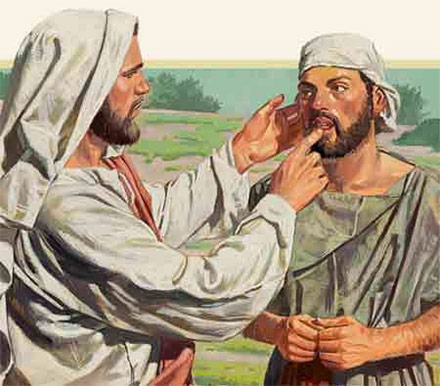
31 Then he returned from the region of Tyre and went through Sidon to the Sea of Galilee, in the region of the Decapolis. 32 And they brought to him a man who was deaf and had a speech impediment, and they begged him to lay his hand on him. 33 And taking him aside from the crowd privately, he put his fingers into his ears, and after spitting touched his tongue. 34 And looking up to heaven, he sighed and said to him, “Ephphatha,” that is, “Be opened.” 35 And his ears were opened, his tongue was released, and he spoke plainly. 36 And Jesus charged them to tell no one. But the more he charged them, the more zealously they proclaimed it. 37 And they were astonished beyond measure, saying, “He has done all things well. He even makes the deaf hear and the mute speak.”
In the name of Jesus. Amen.
When God created Adam from the dust of the ground, God had a purpose behind everything. God created Adam with eyes so Adam could see not just the beauty of creation but also God’s goodness, mercy, and provision. God created Adam’s limbs to work in the garden that God had given to bless and sustain Adam. God gave Adam feet and legs to walk throughout creation and be in awe and wonder at everything God had given. When God created Adam’s mouth, God gave him a tongue and vocal cords that could declare God’s praise (Ps. 51:15) and mercy (Jer. 3:12; Mk. 5:19). Every part of Adam and Eve’s bodies were created to be in harmony with God, with creation, and with each other.
Contrast God’s ordered, creative work with the work of the devil. Unlike God, the devil hates order and cannot create. Satan is completely powerless when it comes to creating anything. So, when the devil saw the order and beauty of God’s creation, the serpent went to work to bring disorder and chaos.
Satan didn’t mind if Adam and Eve had ears that hear; he just wanted to make sure they were deaf to what God really says. So, the devil’s first words recorded in Scripture are, “Did God actually say?” (Gen. 3:1). That old snake went to work at closing the ears of Adam and Eve to God’s voice. And it worked. After they ate from the tree, Adam and Eve heard the sound of God walking in the garden, and they fled from their Creator.
The devil didn’t mind if Adam and Eve had tongues that spoke. He just wanted to make sure those mouths spoke the same lies and bitterness that he has toward God. And it worked. After they ate from the tree, Adam and Eve spoke false words that blamed each other and even God Himself (Gen. 3:11-13) for the sin that they had committed with their own hands and mouths.
And still today, the devil doesn’t care if you have eyes that see. Satan wants to draw your attention to anything that will divert your eyes to God’s mercy and grace because he wants to blind you to God’s goodness. Satan wants to take your eyes off the cross where you see God’s unquestionable mercy toward you and instead focus your eyes on the wickedness, danger, and evil that surrounds you. The devil wants you to see the evil in this world and be filled with fear and worry.
No, the devil can’t create. But he can and does harm, mar, maim, spoil, disfigure, and paralyze. And the devil is effective and efficient at bringing chaos and disorder to our fallen world.
Consider how Satan has distorted your mouth which was created to speak the wonders and mercies of God, but now speaks lies and spreads gossip about your neighbor. Contemplate the ways in which Satan has closed your heart to helping and defending your neighbor who is a fellow son of Adam and daughter of Eve. Reflect on the ways your hands are tightfisted instead of generous. Think about the ways in which the devil has filled your mind with worry and anxiety instead of the peace of God.
Repent. God wants to open your eyes, ears, hands, feet, hearts, minds, and mouth and bring order once again. Consider this deaf man with a speech impediment.
Imagine what this man’s life must have been like. He had lived in a world of silence. He wasn’t able to communicate with others. Imagine his friends and family who have brought him to Jesus. Think of all the times they tried to tell him, “I love you,” but those words fell upon closed, deaf ears. This man’s family has wanted to sing God’s praise with his voice added to their chorus, but his tongue was wrenched and his mouth mute. So, they bring him to Jesus and beg Christ to lay His hand on him, and Jesus acts.
Now, with this healing, please notice first that Christ hears their prayers on behalf of this man whom they love. Dear saints, know that Jesus hears the prayers you pray on behalf of unbelievers who are deaf to God’s Word. Know that without question. But also notice Jesus doesn’t answer their begging and pleas in the way they ask Him to. Jesus doesn’t simply lay His hand upon the deaf man; instead, Jesus does more.
Jesus takes the man away from the crowd. Christ sticks His fingers into those clogged ears, spits, seizes the man’s tongue, and sighs. Actually, the text says that Jesus does more than sigh. Literally, the text says Jesus ‘groans.’ It’s the same word used in Ro. 8:22 where Scripture says that all creation groans as it waits for the revealing of the sons of God. After these things, Jesus speaks one word, “Ephphatha,” which means, “Be opened.”
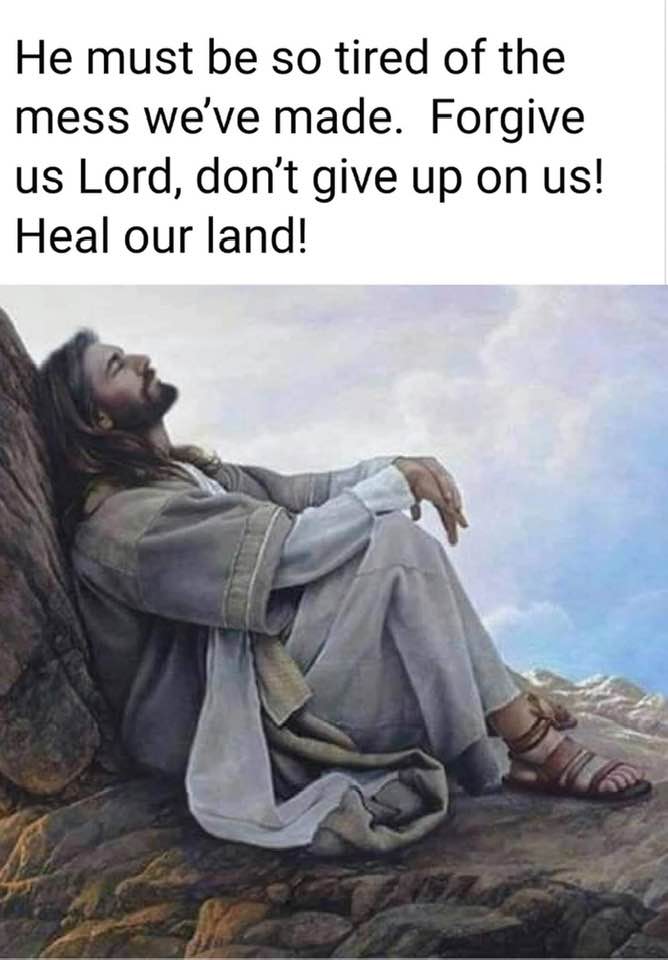
I’ve seen a picture several times this last week floating around social media. It is Jesus leaning against a tree with His eyes closed. Christ looks exhausted. The caption says, “He must be so tired of the mess we’ve made. Forgive us, Lord, don’t give up on us!” On the one hand, I don’t like the picture combined with the caption because it implies that Jesus didn’t know and is surprised by the mess we’ve made. However, there is something very true with that picture of the weary Jesus.
Jesus is wearied by and suffers because of His interaction with us. You see, Jesus sighs before opening this man’s ears and loosening his tongue because it does take effort from our Lord. This healing is work for Him. We tend to think that performing miracles and healings is just what Jesus does. We tend to think that Jesus can do this without any real effort. Part of the reason we think that way is because most of the time, Christ speaks a word and it is done. We think that is simple, easy-peasy.
However, even the miracles where Jesus simply speaks a word, those miracles and healings are still costly work for him. We see that these miracles cost Jesus effort here when He groans. It isn’t cheap or easy for Christ to do these miracles. It costs Jesus. In every miracle, Jesus is making an exchange. He takes upon Himself the deafness, muteness, sickness, paralysis, blindness, and leprosy. He does this because He is the one who bears our griefs and carries our sorrows (Is. 53:4). And this exchange happens with every miracle.
You see, the miracles that Jesus performs – healing the deaf, blind, and lame, cleansing lepers, and providing miraculous wine and bread – are all costly. He doesn’t just send the devil away. Christ Himself suffers Satan’s abuse and attacks. Just think of His temptation in the wilderness. He gets hungry and thirsty. Jesus comes into our broken world, breathes our poisoned air, suffers our backbiting, ingratitude, and greed. He endures and resists the temptations of Satan and the demons. Christ willingly did all of this knowing full well what it will cost Him. Yet, He does it anyway.
Our Lord does this for those He heals, and He does it for you because He has compassion for you. He looks at you the same way He looked at the deaf man and the same way that we look with pity at people who are suffering. Jesus sees us as having weaknesses and disabilities, as needing help. None of this makes Him angry, but it does hurt and move Him. It causes Him to act on our behalf, to intervene, and to send His holy angels.
Christ always has compassion on those who suffer. Yes, we are certainly sinners, but we are also victims. Jesus sighs in sorrow and frustration over our confusion and self-righteousness. He sighs in grief over our sins and self-inflicted pain. He sighs in anger over that which has been done to us by the devil, by our neighbors, and even by our loved ones.
Jesus knows that getting involved with us means that we will hurt Him, that we will complicate matters, that we will betray Him in a thousand ways – but it doesn’t matter. Christ gets involved anyway. He sticks His finger in our ear. He is dirtied by the interaction. He takes our sorrow, our sin, our blame into Himself in order to heal and save us.
As unconventional as the buildup to this miracle is, the man is healed. His ears are opened, and his tongue is loosened. The crowd responds to this miracle that Jesus, “has done all things well.” But, really, they spook too soon because they hadn’t seen nothin’ [sic.] yet. Jesus has more opening to do.
Those same fingers that became full of the deaf man’s ear wax and seized the man’s tongue are the same fingers that would curl around the nails that pinned Him to the cross. The same mouth of Jesus that spits here will cry out for a drink as Jesus became parched on the tree. The same lungs that exhaled here with a groan are the same lungs that would breathe their last as Jesus gave up His spirit.
And Jesus has done all of this so He can do more than open your deaf ears or loosen your muted tongue. He did this to open to you the way that leads to eternal life with God.
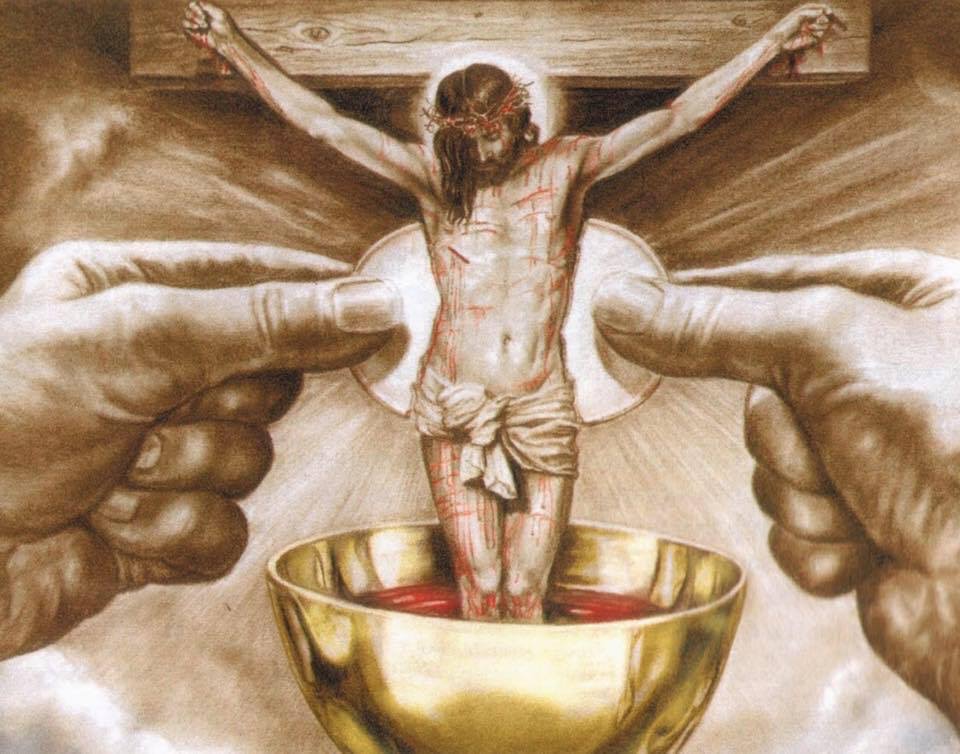
As weird as this miracle is – and it certainly is – Jesus stuck His actual fingers into that man’s ears and mouth. But He comes here now to stick His actual Body and Blood into your mouth. Jesus has been crucified as a ransom for your sins. He has bought you for Himself through His death. And now He is risen and alive for your justification (Ro. 4:25).
Jesus has opened the way to God and invites you now to His table. Jesus comes to you in this holy Supper to remove your doubt that everything He has done is for you. Jesus comes now to drive away all your evil. He comes to you placing His Body into your body. He binds you to Himself. He opens your ears to hear His Word of forgiveness and loosens your tongue so that you can confess Him clearly and be saved.
Oh, Lord Jesus, pull us out of the crowd. Open our ears to hear Your Word and receive Your love. Loosen our tongues to sing Your praise. Jesus, You have done all things well, even loving, forgiving, and saving us. Amen.
The peace of God, which surpasses all understanding, will guard your hearts and minds in Christ Jesus. Amen.
I believe in God the Father Almighty, Maker of heaven and earth.
What does this mean?
I believe that God has created me and all that exists; that He has given and still preserves to me my body and soul, my eyes and ears, and all my members, my reason and all the powers of my soul, together with food and clothing, home and family, and all my property; that He daily provides abundantly for all the needs of my life, protects me from all danger, and guards and keeps me from all evil; and that He does this purely and out of fatherly and divine goodness and mercy, without any merit or worthiness in me; for all of which I am in duty bound to thank, praise, serve, and obey Him. This is most certainly true.
In the name of the Father and of the Son and of the Holy Spirit. Amen.
Tonight, we begin this little adventure of considering the Apostles’ Creed and the God who has created, redeemed, and sanctified us. From the moment I began thinking about this series, I knew that preaching the 1st Article would be the most difficult sermon to write because there are so many possibilities. I thought about preaching against evolution and atheism. Or preaching about the wisdom of God and the wonderful care and detail He used when He situated all the parts of creation for us to live on this little speck of dirt traveling through the universe. I thought about preaching how God our Father and Creator graciously continues to sustain and preserve creation even after the Fall into sin. There were too many possibilities. But my main concern about preaching the 1st Article was to make sure that as we consider the fact that God created us that it also fit with preaching Christ. So tonight, you are going to get a little of all that.
The poisonous theory of evolution that says the entire universe happened by a chance, chaotic explosion, that caused life to accidentally form in a violent world, and that life continues to exist only because of death and survival of the fittest. But the more scientists discover and learn, the more it becomes impossible to believe that we are the product of a series of random events.
We live on a big earth, but when you compare our solar system to the size of the universe, our entire solar system is incredibly small. Yet, our solar system is placed in the perfect spot in the Milky Way Galaxy that protects us from radiation. The number and size of other planets in our solar system protect us from asteroids hurtling through space that would destroy Earth. Our planet is just the right distance from the Sun – move us much closer and everything would be too hot, much further and everything would be too cold. The axis of Earth is tilted just the right number of degrees to regulate heat on the planet. The size of our planet means it has enough gravity to hold on to the gasses of our atmosphere, but it is not so large that we become a gaseous giant like Jupiter. The chemistry of our planet is in perfect balance to sustain life. Our moon is just the right size to regulate tides that sustain life in the oceans. And the magnetic field surrounding us is perfect to shield us from the sun’s radiation. Each of these details show that you believe in an Almighty Creator.
That’s just the big picture, macro stuff. Let’s get tiny and consider the micro stuff. Your body is made up of somewhere around 35 trillion individual cells that serve various functions. If the DNA strands in those cells were laid out end to end, it would travel from here to the sun and back 100 times. From the moment you were conceived, the information in your DNA would fill 600,000 pages with information. And right now, in each of the 35 trillion cells of your body, biological “machines” are copying the volumes of information in your DNA into amino acids which are taken by other machines and folded in specific and precise ways into proteins. (So, don’t let anyone tell you that you are lazy.) But with all those minute details, you believe in an intricate, sophisticated, wise Maker.
Yes, you believe in God Almighty, Maker of heaven and earth. And we could continue to consider all sorts of other facts about the universe and the size of the sun and the necessity of solar flares on the large scale. Or, we could consider the miracle of trillions of bacteria that line your intestines so you can digest the wonderful soup, sandwich, and desserts traveling through your gut right now on the small scale. And that would be time well spent marveling at the wonders of creation. But we would be missing what might be the most important word in the 1st Article – the word ‘Father.’
Every detail – both large and small scale – shows that you have a Creator who cares about everything large and small. Your God is the Father Almighty, Maker of heaven and earth. He cares for you and governs all creation to make sure that you have everything you need for life. Your heavenly Father created and gives you everything. Your body and soul, your eyes and ears, all your members, your reason and senses – everything you have is a good gift from God your Father who daily provides for all the needs of your life. And He promises to continue to provide those things for you without any merit or worthiness in you. So, you don’t have to go running around worrying about what you will eat or drink or wear. God makes the sun to shine on the evil and the good, and He sends rain to the just and the unjust (Mt. 5:45). Everything that God provides for your life in His creation continues to be given as His good gift. The theological shorthand for all these things needed for life in God’s creation is called “1st Article gifts.” So, if you don’t mind, I’ll use that term again in a bit.
Now, the church has been fighting against atheism and the false theory of evolution for so long that we have forgotten to think about two important questions related to the 1st Article: How do we, as God’s creatures, view our neighbor? And what is our relationship and responsibility to creation? The answers to these questions are bound up together.
First of all, everyone you meet is one of God’s creatures intricately created and lovingly preserved by God. Every child from the moment of conception to the oldest person alive is a precious creature of God the Father. Every individual – no matter their skin color, their culture, their political views, or their ability – is valued and prized by the God who created them. So, treat them as such.
Your relationship and responsibility to them is to use all the 1st Article gifts God has given you to love them, to care for them, and to help and assist them. Sometimes, that means changing diapers, feeding, and cleaning up after them. Sometimes, that means holding a door, shoveling a sidewalk, or letting them merge into your lane. Sometimes, that means listening, assuring, encouraging, warning, or protecting them.
So, protect the blessings of creation. Care for this world and protect the blessings God has given both to you and to others. When you look at others, remember that they too are created by God, and He loves them as His creatures.
Rest in the knowledge that God your Father continues to protect you from all danger and guards and keeps you from all evil. He does this because He is your Heavenly Father. He knows what you need. He knows that you need to eat and drink. He knows every last one of your needs, and He will provide every one of these 1st Article gifts because He is your Father.
How can you know this? Because He sent what was most important in Him to provide for your deepest lack.
God the Father Almighty who made you has sent Jesus, His beloved Son, into creation, into this 1stArticle world, to redeem you. And to that redemption, we turn next week. Amen.
The peace of God, which surpasses all understanding, will guard your hearts and minds in Christ Jesus. Amen.
You must be logged in to post a comment.