Comfort to the Heart – Sermon on Isaiah 40:1-8 for the Third Sunday of Advent

Isaiah 40:1-8

In the name of Jesus. Amen.

In your lowest moments – and even before those lowest moments arrive – God is there tenderly speaking, “Comfort, comfort,” to you, His people. He speaks that comfort to remove the burden of the debt of sin, and this changes everything for us sinners.

Just before our text, in Isaiah 39, Hezekiah, the king of Judah, welcomes an envoy of ambassadors from the king of Babylon. That empire was growing in strength and power, and Hezekiah wanted to have Babylon as an ally in case the Assyrian Empire attacked Judah. While those ambassadors were there, Hezekiah does what kings often do. He shows off. He gives the ambassadors a tour of his palace and shows them all of his treasure. He flaunted his silver, gold, and spices. Hezekiah displayed all the weapons of his armory – his entire treasury. He left nothing hidden. Basically, Hezekiah was boasting about himself and the greatness of his kingdom, but he doesn’t boast about his Lord and God who had given it all to him.

After the Babylonian delegation leaves, the prophet Isaiah visits the palace to confront Hezekiah about all this. Isaiah rebukes him for being so foolish and prophesies that the Babylonians will come again in a hundred years to strip the palace and the Temple of everything. All the gold and wealth and treasure and weaponry of Hezekiah’s kingdom – it will all be taken by the Babylonians because Hezekiah’s pride did nothing more than make himself a target by showing off. Isaiah says that Hezekiah’s descendants would pay the price of his foolish actions.

And Hezekiah’s response is, frankly, disgusting. Basically, he says, “Let me get this straight, Isaiah. You’re saying that I get to keep the treasure? Babylon isn’t going to come and ransack and pillage as long as I’m alive?” And Isaiah says, “Yeah, but listen. It’s going to happen to your descendants.” But Hezekiah doesn’t care. Instead, he says, “Cool. Everything will be safe and secure in my days.” That, of course, is the wrong response.

Hezekiah should have fallen to his knees and begged for God to forgive him or, at least, ask that the payment of his foolishness not fall upon his children and grandchildren. Instead, Hezekiah callously says, “This is great. I don’t have to deal with it.”

Just over 100 years later, the price of Hezekiah’s foolishness and pride was paid. Babylon came. They destroyed the Temple. Men, women, and children were slaughtered in the streets. The nation was torn apart. People were ripped from their country, their lands, and their homes. And they were taken into exile in Babylon (2 Kgs. 25:1-212 Ch. 36:17-21Jer. 52:1-30).

Imagine enduring all of that. Imagine being part of that generation who paid the debt of Hezekiah’s pride. They watched as all these things happened, and because they were familiar with the book of Isaiah, they knew that they were paying Hezekiah’s debt because he was totally fine with passing that debt of his sin off to a future generation.

If you were part of that generation who endured that destruction, how would you handle and process that? How could you be anything but bitter and resentful that your forefather had been totally willing to pass the punishment of his sin off to you? How would you cope? Where would you find comfort?

Well, you would find it here in these verses that come immediately after Isaiah recorded Hezekiah’s foolish and callous actions. And dear saints, these verses aren’t only for the people who were carried into exile in Babylon. They are also for you today. Now. “Comfort, comfort My people, says your God. Speak tenderly to Jerusalem.” And that phrase, ‘speak tenderly,’ is a lot stronger in Hebrew. It’s an idiom that is literally translated, “speak to the heart.” God isn’t just speaking cliché platitudes from a far, distant place. No. Your God leans in close to speak comforting words directly into the heart of you, His people.

These words of comfort here in Isaiah 40 are for you because you are God’s people through faith in Christ. And these words cut through the noise and chaos of sin and suffering to touch you where your ache is sharpest and deepest. In the midst of the pain that has come to you because of sin – both your sin and the sins of others – God speaks tenderly, He speaks directly to your heart, “Be comforted. Be comforted. [Your] warfare and hardship is ended; [your] iniquity is pardoned.”

This whole text is beautiful, and dozens sermons could be preached on each line of the text. We could focus on the lines concerning John the Baptizer who would proceed Jesus and make a straight, level highway in the wilderness for the coming of the God who brings this comfort. We could ponder the arrival of God’s glory that will be seen by all flesh for eternity.

Earlier this week, I considered focusing this sermon on the lines about all flesh being like grass. Remember how Adam and Eve – who, after the Fall, became like the grass that withers and fades – they tried to cover themselves with foliage when they heard the sound of God walking in the Garden of Eden (Gen. 3:7-8). But God had come to give them the comfort that He would send the Seed of the woman to crush the serpent’s head (Gen. 3:15). And that Word of promise endures forever. Maybe, I’ll preach that sermon sometime in the future. Anyway, there’s an eternity of sermons that could be preached from these nine verses.

But the thing I want to focus on today is that phrase from the last line of v. 2 about receiving, “from the Lord’s hand double for all [your] sins.” And I want to focus on it because, even though it sounds like Law, it is sweet, sweet Gospel spoken from God’s mouth directly into your heart. But we need to do a little groundwork first.

In Is. 40:2, Isaiah uses two of the three most common Hebrew words for breaking God’s Law – ‘iniquity’ and ‘sin.’ The third word that Isaiah doesn’t use here is ‘transgression.’ And each of these words give a slightly different picture of what sin is.

The Hebrew word that regularly gets translated ‘transgression’ means to cross a boundary. In each Commandment, God sets a line and crossing over that line is a ‘transgression’ or a ‘trespass.’ The Hebrew word that most often gets translated as ‘sin’ means to miss the mark. God has a standard for us, but we keep missing it. Think of an archer who never hits the target, let alone the bullseye. Finally, the Hebrew word that gets translated ‘iniquity’ refers to the guilt and shame caused by sin. Think of the weight and indebtedness you feel when you’ve wronged someone – that’s the iniquity. All three words deal with the same thing (our sin), but each one focuses on a different aspect of that sin.

Well, here God says that your iniquity, that debt and weight of sin, is pardoned and that you have received from His hand double for all your sins. Again, this should be comforting. God isn’t saying that He’s giving you double punishment for your sin. No!

Instead, God has taken that debt of sin. He pays for it. Imagine your sin as a pile debt on your account. Because of Jesus, the billions of debt that you owe because of your sin is all paid off. But God doesn’t stop and just get you to an even balance. In place of that massive debt, God credits your account with the righteous deeds and the perfect obedience of Jesus.

You can imagine a chalkboard where all your sins are written down. Through faith, Jesus comes and wipes every last speck of that chalk and dust off. But He doesn’t stop once your slate is wiped clean. He writes over that chalkboard all of the holy, righteous, and perfect works that He has done (see Mt. 25:31-40).

God knows the full debt of your sin down to the last penny. And when Jesus pours out His forgiveness, mercy, and salvation on you, it is in double measure of your debt.

In Jer. 31:34, God says that He forgives your iniquity and remembers your sin no more. Dear saints, be comforted. God doesn’t remember the kind or type of sins you have committed. He doesn’t remember the specific ways you have transgressed against Him and against your neighbor. The only thing that He remembers about your sin is the amount of debt you owe. And the only reason God remembers that is so He can give you a double portion of His grace and mercy (Jn. 1:16).

That is the comfort He gives to you. That is the comfort He speaks to directly into your heart today and every day. Your Redeemer will continue to speak that comfort to you, and His Word of grace, mercy, and comfort endures forever. Amen.

The peace of God, which surpasses all understanding, will guard your hearts and minds in Christ Jesus (Php. 4:7). Amen.

Scene 2 – Sermon on Matthew 18:21-35 for the Twenty-second Sunday after Trinity

Matthew 18:21-35

21 Then Peter came up and said to him, “Lord, how often will my brother sin against me, and I forgive him? As many as seven times?” 22 Jesus said to him, “I do not say to you seven times, but seventy-seven times.

23 “Therefore the kingdom of heaven may be compared to a king who wished to settle accounts with his servants. 24When he began to settle, one was brought to him who owed him ten thousand talents. 25 And since he could not pay, his master ordered him to be sold, with his wife and children and all that he had, and payment to be made. 26 So the servant fell on his knees, imploring him, ‘Have patience with me, and I will pay you everything.’ 27 And out of pity for him, the master of that servant released him and forgave him the debt. 

28 “But when that same servant went out, he found one of his fellow servants who owed him a hundred denarii, and seizing him, he began to choke him, saying, ‘Pay what you owe.’ 29So his fellow servant fell down and pleaded with him, ‘Have patience with me, and I will pay you.’ 30 He refused and went and put him in prison until he should pay the debt. 31 When his fellow servants saw what had taken place, they were greatly distressed, and they went and reported to their master all that had taken place. 

32 “Then his master summoned him and said to him, ‘You wicked servant! I forgave you all that debt because you pleaded with me. 33 And should not you have had mercy on your fellow servant, as I had mercy on you?’ 34 And in anger his master delivered him to the jailers, until he should pay all his debt. 35 So also my heavenly Father will do to every one of you, if you do not forgive your brother from your heart.”

In the name of Jesus. Amen.

Jesus gives a sober warning at the end of this text. I’m going to reorder and tweak the way Jesus says it to make it crystal clear. Our Lord says, “If you do not forgive your brother from your heart, My heavenly Father will do to you what the king did to that first servant. He will demand you pay your debt and hand you over to the jailers for eternity.” Christian, you are forgiven, so you also must forgive. This is what Jesus is teaching with this parable. The parable has three scenes. And the order in which they happen is what makes Jesus’ point so powerful.

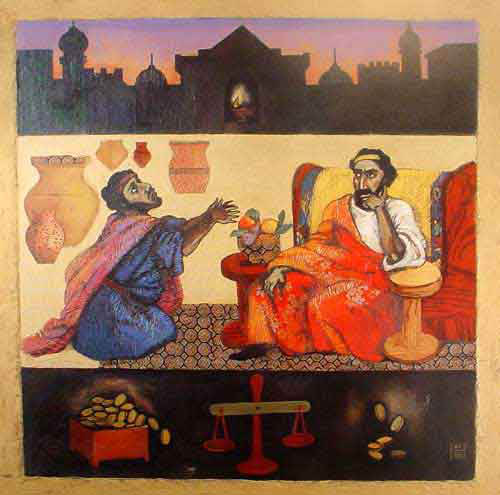
In Scene 1, the first servant (let’s call him ‘Vinnie’). Vinnie is hauled into the palace owing 10,000 talents to the king. Normally, a ‘talent’ is a unit of weight, not currency. Commentators are split on how we should understand what a talent’s value is. Some figure it’s a years’ pay; some say 20 years of wages. Either way, this is an impossible debt for an individual to pay off. After Vinnie’s debt is announced, the king commands that Vinnie, his wife, his children, and everything he has be sold. And Vinnie – notice what he begs for – he says, “Have patience with me, and I’ll pay you everything.” In other words, he asks for time. It’s ridiculous. Time? Time isn’t going to help! So, the king forgives the debt, he releases it. But debts are always paid by someone. They don’t just magically vanish. Here, the king pays. He swallows the debt and releases Vinnie. This is utter, unmerited mercy on the part of the king. End scene one.

The curtain rises and the spotlights illumine Scene 2, and we find Vinnie outside the palace. We’d expect him to be in a fantastic mood – smelling flowers and singing with birds. He’s forgiven and freed. But it sure doesn’t look like it by his actions. Vinnie spots his buddy (let’s call Vinnie’s buddy ‘Chuck’) who owed him 100 denarii, which is 100 days’ wages. That’s not an insignificant amount. But compared to what Vinnie was just forgiven – it’s pittance. Immediately, Vinnie grabs Chuck by the throat, throttles him, and demands, “Pay what you owe me.” And Chuck echoes almost word-for-word what Vinnie said in Scene 1. Chuck asks for time, but Vinnie doesn’t even give Chuck that. He has Chuck thrown into prison. Scene 2 ends with other servants informing the king how Vinnie had acted.

Now, just pause here. It’s intermission in the play of this parable. Let’s say you arrived late to the play and didn’t see Scene 1. All you know about it was that Vinnie is the character who owed 10,000 talents to the king. But you did watch all of Scene 2. What would you suppose happened in Scene 1? You would imagine that the king was still expecting Vinnie to pay the entire debt. The king must be breathing threats down Vinnie’s neck. That’s the only logical explanation. It’s the only way Vinnie’s actions are justified. And they would be just. It’s still futile; Vinnie won’t be able to choke enough throats to get out from under his debt. But at least it would make sense of his actions.

Dear saints, how many people know you are a Christian, but don’t have any idea about what goes on here? I mean, they might have an obscure idea that you’re coming here to meet with God. But they don’t necessarily know what goes on in this sanctuary between you and God while you’re here. So, ponder this: What does your Scene 2 say about the kind of God you have? Do your actions throughout the week accurately reflect on what God does here? Do people have the impression that the God you meet here is loving, kind, merciful, forgiving; or do they think your God is a harsh, cruel, punitive tyrant?

That’s all the time we have. Intermission’s over. The warning bell for Scene 3 just rang. And because we know what happened in the Scenes 1 and 2, we know exactly what’s going to happen in Scene 3. The king treats Vinnie precisely the way he deserves to be treated. Vinnie was given mercy, but he rejected that mercy by his actions. Vinnie demanded justice, so justice is what he gets. The king reinstates Vinnie’s debt, and justly so.

Dear saints, mercy has two sides. The first side of mercy is not getting what you deserve. Vinnie deserved to lose everything. He deserved to be sold with his family and possessions, but the king wanted to be merciful and not give Vinnie what he deserved. The second side of mercy is being given what you do not deserve. Vinnie had his debt forgiven and released by the king. He didn’t deserve it. I mean, Vinnie didn’t even have a grasp on how much debt he owed. Again, he had the delusion that time would help him. But the king doesn’t laugh at his idiotic request. No, the king was willing to release the debt and swallow it himself. Vinnie was given mercy, but he desperately demanded justice.

Here’s the thing: Mercy and justice are something only God can possess simultaneously. Only because of what Jesus has done on the cross can God be merciful and just to forgive and cleanse you from your sin (1 Jn. 1:9). Dear saints, God gives His mercy to you. It’s yours, but it is not something that you can keep for yourself and withhold from others. As soon as you try to hold on to God’s mercy and keep it only for yourself, you lose it. Forgiving others and being a forgiving person is not optional for a Christian. And this is hard.

Forgiving others, releasing someone from the retribution and retaliation that they deserve, is difficult. Some of you have been sinned against in ways that are so painful that I can’t even imagine. So, how do you go about being a person who forgives?

Let me give you two pastoral pieces of advice on how to be better forgivers. First, know that to forgive from the heart is something only a Christian can do, and the only reason a Christian can do it is what has happened in your Scene 1. Because of Christ’s death, God forgives your debt of sin. He separates it from you as far as the east is from the west (Ps. 103:12). The best way to grow as a forgiver is to recognize the massive debt that God has released for you.

Second, know that you aren’t going to forgive as perfectly God does. Pain and distrust will still be there. And forgiving someone does not mean that you have to become best friends. You can, and sometimes you must, forgive and still have boundaries to keep the one who has sinned against you away from you.

Forgiving is hard, but you can choose to forgive. That Holy Spirit-led choice is an act of a reborn disciple of Jesus. The emotions of pain and hurt and anger you have may slowly follow along in agreement. But, you might need to drag your emotions kicking and screaming behind you. Your emotions might take a long time to get on board with the choice to forgive. But one thing I would encourage you to do to help with that process is this: Name the sin.

If you’re angry and frustrated with someone for something, think concretely and specifically how you were sinned against. Figure out what commandment was broken when that person hurt you. We live in a sinful world. It’s naive to think that we are going make it out of here without having someone sin against us. You are going to be hurt in this world, and it will be painful. Your natural reaction to that hurt will be frustration, anger, and resentment. If you have that, name it. Name the sin that has been committed against you because then, it becomes something concrete, something you can identify. And being able to identify it, helps you realize what to do with that sin. It helps you realize that sin has been taken away by the Lamb of God.

You might be justified to want to strangle someone. But remember that God was justified to do that to you, and He didn’t. He didn’t. Instead, your God has released you and your debt for the sake of the complete payment of Jesus for your sin. He’s already done that here for you today in the Absolution, and He’s about to do it again here, at His Table. This is your Scene 1. Let that be reflected out there in your Scene 2. Amen.

The peace of God, which surpasses all understanding, will guard your hearts and minds in Christ Jesus (Php. 4:7). Amen.

Moved Up – Sermon on Luke 14:1-11 for the Seventeenth Sunday after Trinity

Luke 14:1-11

1 One Sabbath, when he went to dine at the house of a ruler of the Pharisees, they were watching him carefully. 2 And behold, there was a man before him who had dropsy. 3 And Jesus responded to the lawyers and Pharisees, saying, “Is it lawful to heal on the Sabbath, or not?” 4 But they remained silent. Then he took him and healed him and sent him away. 5And he said to them, “Which of you, having a son or an ox that has fallen into a well on a Sabbath day, will not immediately pull him out?” 6 And they could not reply to these things. 

7 Now he told a parable to those who were invited, when he noticed how they chose the places of honor, saying to them, 8 “When you are invited by someone to a wedding feast, do not sit down in a place of honor, lest someone more distinguished than you be invited by him, 9 and he who invited you both will come and say to you, ‘Give your place to this person,’ and then you will begin with shame to take the lowest place. 10 But when you are invited, go and sit in the lowest place, so that when your host comes he may say to you, ‘Friend, move up higher.’ Then you will be honored in the presence of all who sit at table with you. 11 For everyone who exalts himself will be humbled, and he who humbles himself will be exalted.”

In the name of Jesus. Amen.

Everyone is religious. Everyone has a belief in what is good and right and true as opposed to what is evil and wrong and false. And in the end, there aren’t hundreds of religions. There are only two. One is true. The other is false. And we can put a title on each of these religions: the true religion of the Gospel of Jesus Christ, and the false religion of the law.

The true religion of the Gospel is faith in our Lord, Jesus Christ, who is the Way, the Truth, and the Life (Jn. 14:6). This true religion believes that God is merciful. It believes that we are made right with Him because of the cross. It believes God is gracious and forgives us despite our sin against His good and holy Law. The false religion of the law wrongly imagines that we have to reconcile ourselves to God by our own works and efforts. Even though the false, pagan religions of Hinduism, Islam, Buddhism, etc. – those all serve false gods instead of the true God. But they all operate in the same manner and under the same premise. And that premise boils down to this: You need to work yourself out of the messes of this world.

In this Gospel reading, it’s that false religion of the law that Jesus is attacking because that is the religion these Pharisees. They have placed the full weight of their trust in the idea that they can make themselves right with God and the world. But their religion is weaker than a house of cards.

Before we continue, one thing needs to be crystal clear. The Pharisee heresy isn’t exclusive to Pharisees. It’s a heresy that’s in all of us. It’s our default operating system because of our sinful nature. Normally, when we think about our sinful nature, we think of it as the part of us that drives and moves us toward sinful actions. And that is true, our sinful nature certainly does that. But it does more than just that. Our sinful nature also invents our own standards, morals, and commandments that are simpler than God’s standard of total, complete perfection.

This is why the Pharisees invented and added all their extra laws to God’s Commands. For example, the Pharisees took the 3rdCommandment, “Remember the Sabbath day to keep it holy,” and because they believed in their false religion of the law, they figured, “Let’s really get after keeping the Sabbath holy to make God happy with us.” So, they added all sorts of extra rules and regulations. They decided you could only walk 2,000 cubits (or about two-thirds of a mile) on the Sabbath because walking further than that would be considered the work of travel. In a futile effort to please God, Pharisees debated if it was ok to walk in the rain on the Sabbath because if you got rain on your clothes and went inside, that could be considered the work of delivering water. I don’t know anyone who drinks water from rain-soaked clothes. I wonder why they didn’t consider walking in rain on the Sabbath the work of doing laundry.

But they would also come up with all sorts of ways to get around their additional Sabbath laws. So, with the 2,000 cubit limitation on walking, they decided that, if you considered the whole town your home, then you could walk as far as you wanted so long as you stayed in town. They decided that if you walked in the rain on the Sabbath, you could just take off your clothes before you entered your house and leave them outside because then you weren’t delivering water. Can you imagine that? “Honey, I’m home.”

Now, we can laugh at how ridiculous this is because – it is. But we do the same sorts of things. Christ is clear that, when we get angry, it is the same as murder (Mt. 5:21-22). But rather than repent of our anger and receive God’s forgiveness, we do all sorts of mental gymnastics to try to justify our breaking of the 5th Command. But the Pharisee inside each of us also does something even worse. When our conscience still bothers us because of our sin, when it isn’t quieted by our mental justification of that sin, we recruit. We recruit and gather others around us. We tell them about whatever it was that made us angry – usually, in a way to make our anger seem right and just. We do that because we want others to confirm and affirm our sin. But it doesn’t matter if you could get the entire world to agree with you. God doesn’t care about the consensus you build, no matter how large it is. If God says it’s sinful, it’s sinful. Period. End of story.

Now, all of that was to build to this point: Dear saints, God’s view of what is right or wrong, what is good or bad, and what is holy or evil – that’s the only opinion that matters. That is what Jesus is getting at in this text – especially with the parable He tells in v. 8-11.

This parable isn’t like any other parable that Jesus tells. In fact, it is so unique that it won’t appear in most lists of Jesus’ parables that you can find. But Luke clearly calls it a parable in v. 7, so a parable it is. I would guess that the confusion about it being a parable stems from the fact that, at face value, it’s an etiquette lesson of how to be a good guest at a wedding feast. Basically, don’t automatically sit yourself in a place of honor because the host might see someone who is more important than you. Then, the host is going to tell you to sit somewhere else and give the more important person the seat of honor. If that happens, you’ll end up sitting somewhere obscure because all the other good seats are taken. Instead, Jesus says to sit in a low, undesirable place so the host can honor you saying, “Hey, friend. You deserve better. I’m going to move you up here.”

Again, this is just good, wise advice. But this advice is also a parable because there is a deeper theological truth here. Discovering that truth hinges on one thing. In this “etiquette parable” whose opinion matters? The host’s. Only the host’s. It doesn’t matter if everyone else at the wedding feast thought you were the most important person there. If the host tells you another guest gets the seat of honor, it’s his feast. So, the other guy gets it.

Here’s the point. Don’t move yourself up. Instead, be moved up by God. In that parable, the host is God Himself. His opinion of you and your honor – that’s the only thing that matters. So, there are times where you have to tell the little Pharisee inside of you to shut up and stop trying to clamor for honor and recognition and accolades. The opinions of others (and even your own opinions), they don’t matter (1 Co. 4:3-5). And Jesus, the Son of God, clearly tells you what He finds honorable and shameful in the last verse of this reading. “Everyone who exalts himself will be humbled, and he who humbles himself will be exalted” (Lk. 14:11).

If you are trying to exalt yourself and be impressive by your self-chosen good works, it isn’t going to go well for you. God is going to come into the banquet hall and say to you, “No. You don’t get to sit here.” And where will that leave you? Ultimately, it’ll leave you outside and in the darkness (Mt. 22:13). Instead, sit in the lowest seat, and don’t worry if others ask, “What are you doing there? Why are you putting up with that lowly, humiliating spot?” Don’t worry about being in positions that others think are shameful. God the Host is going to come Himself and say, “Friend, why are sitting way down here? Move up higher.”

One of the things Jesus is doing with this parable is He’s giving you God’s perspective on your simple, normal, everyday callings and vocations and works. Don’t ever forget that God is the One who has put you in those vocations and given you those works. Even if they don’t look flashy or impressive to the world, they are exactly the places where God has put you and given you holy work to do. If you stop and think about it, what higher seat is there than the seat God gives you?

To understand this better, imagine two people. The first is a devout monk who has abandoned the world to live a life of holiness. He takes a vow to get up every night at 2 AM and pray for three hours. Every night, this monk deprives himself of sleep; goes into a chapel to burn incense; lies face-down on a stone floor; and earnestly prays. The second person is a mom. At 2 AM, she gets woken up by the cries of her newborn because he’s sick with a stuffed, runny nose and has a full, stinky diaper. Exhausted, she stumbles around the room. She gets her hands into the snot and poop. She cleans and comforts and feeds the child. And she spends hours to finally rock him back to sleep.

Both of them are getting up at 2 AM. Both are doing work instead of sleeping. But which one is more holy, exalted, and honorable – the monk who chose to take that vow? Or the mom who received her child from God Himself? Of course it’s the mom.

Think of Paul in today’s Epistle reading (Eph. 4:1-6). In v. 1, he wrote, “I therefore, a prisoner…” I mean how low can you get? Paul is there in prison – rats running across his feet, muck oozing down the walls, mold in the air. And Paul writes, “I a prisoner for the Lord, urge you to walk in a manner worthy of the calling to which you have been called.” Paul recognized that, even in prison, he’s the Lord’s prisoner. It wasn’t Caesar or a king or a governor. God put him there. And if God, his loving heavenly Father, put him there, what better or more honorable place could there be?

Dear saints, the religion of the Gospel is the only thing that moves you up. You don’t need all the Pharisaical nonsense that vainly tries to get God to clap for you and give you accolades. One, it’s not going to work. And two, God has already given you important, holy works to do. Those works are pleasing to Him; those works show your love for Him by showing love for your neighbor. 

So, walk in a manner worthy of the calling to which you have been called. And you’ve been called God’s friend. God’s saints. God’s holy ones. God’s children. The work God gives you is worthy and holy. So, do that work with all your might.

Dear saints, you have the true religion which is faith that God is the One who moves you up. Not yourself. Not ever yourself. You are moved up, exalted, and honored by the holy and righteous God who calls you, “Friend.” And He calls you, “Friend,” solely because of what Christ has done on the cross for you. Amen.

The peace of God, which surpasses all understanding, will guard your hearts and minds in Christ Jesus (Php. 4:7). Amen.
Pause – Sermon on Luke 18:31-43 for Quinquagesima Sunday

Luke 18:31–43

31 And taking the twelve, he said to them, “See, we are going up to Jerusalem, and everything that is written about the Son of Man by the prophets will be accomplished. 32 For he will be delivered over to the Gentiles and will be mocked and shamefully treated and spit upon. 33 And after flogging him, they will kill him, and on the third day he will rise.” 34 But they understood none of these things. This saying was hidden from them, and they did not grasp what was said. 

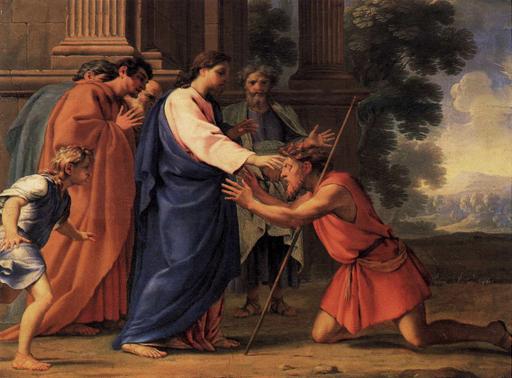
35 As he drew near to Jericho, a blind man was sitting by the roadside begging. 36 And hearing a crowd going by, he inquired what this meant. 37 They told him, “Jesus of Nazareth is passing by.” 38 And he cried out, “Jesus, Son of David, have mercy on me!” 39 And those who were in front rebuked him, telling him to be silent. But he cried out all the more, “Son of David, have mercy on me!” 40 And Jesus stopped and commanded him to be brought to him. And when he came near, he asked him, 41 “What do you want me to do for you?” He said, “Lord, let me recover my sight.” 42 And Jesus said to him, “Recover your sight; your faith has made you well.” 43 And immediately he recovered his sight and followed him, glorifying God. And all the people, when they saw it, gave praise to God.

In the name of Jesus. Amen.

Generally, when we let our imagination go wild, we like to be the heroes. Boys imagine hitting a grand slam in Game 7 bottom of the 9th two outs down by three, or they imagine they are the receiver who dives to catch the hail Mary as time expires to win the Super Bowl. Girls imagine they are Cinderella dancing the night away with Prince Charming, and getting engaged after he returns her glass slipper. Even when it comes to Bible stories, we like to imagine that we are Joshua toppling the walls of Jericho or David slaying Goliath or Elijah defeating the prophets of Baal.

In the two parts of today’s text – the Passion prediction and the healing of the blind man – the only hero is clearly Jesus, and He fully embodies the perfect love that was described in our Epistle reading (1 Co. 13:1-13). This is the third time Jesus explains to the disciples that He is going to Jerusalem to be betrayed, mocked, shamefully treated, spit upon, flogged, crucified, and raised from the dead. But the disciples don’t understand Jesus, the saying is hidden from them, and they could not grasp what Jesus said.

Still, Jesus’ love is on full display. Jesus is patient with and kind toward them. He is not irritated or resentful at their thick skulls. Jesus is going to Jerusalem and will endure all these things because His love does not insist on its own way. Instead, Christ submits to His Father’s will in perfect obedience.

By going to the cross, Jesus will bear all things. All the burdens, all the sins, all the transgressions, all the iniquities, all the wrongdoings, all the evil, all the brokenness of this fallen world – Jesus will bear all of it in His body (1 Pet. 2:24). He does it all for you. Jesus’ journey from His throne in heaven, down into your flesh. His fasting and temptation in the wilderness. His path through the lands of Israel with no place to lay His head (Lk. 9:58). His teaching, healing, casting out demons, forgiving, and restoring. His triumphal entry. His betrayal. His suffering. His death. His burial. His three day rest in the tomb. His resurrection. His ascension. And His continual rule and authority over all things is a journey of love for you.

Jesus’ entire work is directed outward. He didn’t need to do any of that to benefit Himself, and He doesn’t do it for His own, personal gain. He does it because He loves you. And this love of Jesus wasn’t based on your loveliness. It was based on the fact that the God the Father loves you and wanted to rescue you. So, Jesus, God the Son, loved you and did everything necessary to save you.

God hated seeing what sin and death had brought to His creation, so He did something about it by undoing sin and death by the death and resurrection of Jesus. Christ lived the life we were unable to live. He obeyed the whole will and Law of God that we were unable to obey. He took up His cross, endured punishment that you and I deserved, and gave up His dying breath. All of this is done for you.

Jesus does all of this with full knowledge. None of it surprised Him. Christ knew exactly what is going to happen to Him. And still, He goes and does all of this to love you with His perfect, pure love. 

Back in Lk. 9:51, we are told that Jesus had “set His face to go to Jerusalem.” In other words, Jesus is determined to do this loving thing for you. He was focused on redeeming creation, on getting there, and accomplishing it. He goes toward Jerusalem in love.

Day after day, Jesus gets closer to His goal until He arrives in the city of Jericho, which is about fifteen miles from Jerusalem. He’s close – about a day’s journey from the city. But Jesus isn’t in a rush. Sometimes, when you have to do things that you know are going to be unpleasant and painful, you just want to get it over with and put in your rearview mirror. Again, Jesus doesn’t do that. Instead, He paused along His way through Jericho.

Christ hears the blind man’s cry, “Son of David have mercy on me.” Jesus doesn’t say, “I’ve got more important things to do. I’m going to have mercy on you when I get to Jerusalem and go to the cross.” No. Our Lord stops.

The cry for mercy from any corner of His creation gets Jesus’ full attention. He commands that the blind man be brought to Him. Jesus asks him, “What do you want Me to do for you?” “Lord, let me recover my sight.” And in love, Jesus gives the man the mercy he desired. “Recover your sight; your faith has made you well.”

Jesus’ mission to be the Savior of all creation does not stop Him from pausing to give His mercy to the individual He meets along the way. He pauses and heals him.

Dear saints, Lent begins on Wednesday, and Lent is a good time for us to pause and consider all that God has done for us. Today, pause and ponder whom you are most like in this text. Again, we’re not the hero; we’re not Jesus. Instead, sometimes, we’re like the disciples who do not understand or grasp what God is doing for us and saying to us. Sometimes, even though God has plainly and clearly spoken, we are blind and don’t understand what God is doing.

Sometimes, we are broken like the blind man. Even though the blind man could not see with his physical eyes, he understands who Jesus is and what He has come to do. Despite his physical blindness, he has faith that Jesus can and will restore what is broken. So, when Jesus is present, he cries out for mercy. And Jesus gives him the mercy, restoration, and healing that he needed. Maybe, like the blind man, you look foolish to the world how you relentlessly call out to Jesus for His mercy.

Whom are you more like? It probably depends on the day, maybe even the moment.  Whether you don’t have any clue of what God is up to like the disciples or whether all you can do is cry out for mercy, the thing to do is follow Jesus.

Notice that even though the disciples don’t get all the things that God had said through Jesus and through the Scriptures, even though they are blind in their hearts and minds – what do they do? They go with Jesus. They follow Him to Jerusalem and the cross. The blind man, even though he could not see anything until Jesus gave him the sight he desperately wanted, what did he do? He followed too.

Whether you understand what God is up to or not, the conclusion is the same. Follow Jesus. Follow Him to the cross. No matter where you are in your journey through life, no matter how much you understand what God is doing, no matter how much you need from God, no matter how much God has already given you, follow Jesus to the cross.

Stay the course. And as you go with Christ, He will give you ample reasons to glorify God and give Him praise. Amen.

The peace of God, which surpasses all understanding, will guard your hearts and minds in Christ Jesus. Amen.

Pleased – Sermon on Luke 2:1-20 for Christmas Eve 2024

Luke 2:1–20

1 In those days a decree went out from Caesar Augustus that all the world should be registered. 2 This was the first registration when Quirinius was governor of Syria. 3 And all went to be registered, each to his own town. 4 And Joseph also went up from Galilee, from the town of Nazareth, to Judea, to the city of David, which is called Bethlehem, because he was of the house and lineage of David, 5 to be registered with Mary, his betrothed, who was with child. 6 And while they were there, the time came for her to give birth. 7 And she gave birth to her firstborn son and wrapped him in swaddling cloths and laid him in a manger, because there was no place for them in the inn. 

8 And in the same region there were shepherds out in the field, keeping watch over their flock by night. 9 And an angel of the Lord appeared to them, and the glory of the Lord shone around them, and they were filled with great fear. 10 And the angel said to them, “Fear not, for behold, I bring you good news of great joy that will be for all the people. 11 For unto you is born this day in the city of David a Savior, who is Christ the Lord. 12 And this will be a sign for you: you will find a baby wrapped in swaddling cloths and lying in a manger.” 13 And suddenly there was with the angel a multitude of the heavenly host praising God and saying, 

14 “Glory to God in the highest, 
and on earth peace among men, with whom he is pleased!” 

15 When the angels went away from them into heaven, the shepherds said to one another, “Let us go over to Bethlehem and see this thing that has happened, which the Lord has made known to us.” 16 And they went with haste and found Mary and Joseph, and the baby lying in a manger. 17 And when they saw it, they made known the saying that had been told them concerning this child. 18 And all who heard it wondered at what the shepherds told them. 19 But Mary treasured up all these things, pondering them in her heart. 20 And the shepherds returned, glorifying and praising God for all they had heard and seen, as it had been told them.

Grace, mercy, and peace is yours this night from God our Father and from our Lord, Jesus Christ. Amen.

The one thing you should learn from Christmas is that God’s greatest, most earnest desire and purpose is to be with you. That’s the “true meaning of Christmas.” Hollywood will give all sorts of other answers about what the “true meaning of Christmas” is – hope, joy, giving, family togetherness, whatever. To one degree or another, those are only related to God’s desire to be with you. Each of those things is only on the fringe of the purpose of Christmas. The birth of Jesus proves that God doesn’t want to be far away or disconnected from you. He wants to be with you. Each day. Every day. God wants to be with you, as close as possible – even within your own heart (2 Co. 1:22).

I say that because of how Luke records the event. The actual birth of Jesus only takes up a tiny fraction of the reading from Luke 2:1-20. In the first five verses, Luke tells us about the census that Caesar Augustus decreed. All the details in those verses – about Augusts, the fact that it was the first registration while Quirinius was governor in Syria, the fact that Joseph was from Nazareth but had to go to Bethlehem, etc. – all of that seems to be there because Luke wants you to know that what he records has been carefully researched. He’s paid attention to the details. He wants you to know that he got all of this exactly right.

Then, Luke simply records Christ’s birth. It is while Joseph and Mary are in Bethlehem that the time came for her to give birth. She gave birth, wrapped the Infant Jesus in swaddling cloths, and laid Him in the only place available – a manger – because there was no other place for them to be, except in that stable.

It’s remarkable, the way God inspired Luke to write this. The most important thing that has ever happened or will ever happen in all of history – the birth of Jesus – is simply stated. “She gave birth.” That’s it. The thing that gets the most focus, and what we will focus on tonight, is the announcement Jesus’ birth, which starts at v. 8.

Some shepherds are nearby watching over their flocks that night. It was an otherwise normal night for these shepherds. We don’t know how many shepherds there are, but we do know the number of angels that appear to them. At first, it’s one. One angel appears, but that angel isn’t the only thing that appears. The “glory of the Lord” also shines around the shepherds. And because of this, the shepherds are afraid. They are filled with a great (the word in Greek is μέγας), a mega fear. Why?

The source of their fear wasn’t that single angel. No, they are afraid because the glory of the Lord was shining around them. That’s the closest reference to their fear. Why would they be so afraid of God’s glory shining around them? Well, they’re afraid because even though God’s glory is a beautiful and wonderful thing, but it is only wonderful if sin isn’t part of the equation. When there is sin, we can’t stand in God’s presence. In Scripture, sinners are always terrified when they find themselves in God’s presence (Ex. 20:18; Jdg. 13:22; Is. 6:5).

Now, I’ll admit that the text doesn’t mention sin. God didn’t inspire Luke to tell us that the shepherds were filled with mega fear because they remembered that they were sinners. Sure enough. But Luke didn’t need to tell us they were afraid on account of their sin because he records what the angel tells them.

“Fear not, for behold, I bring you good news of great (there’s that word μέγας again). Good news of mega joy that will be for all people. For unto you is born this day in the city of David a Savior, who is Christ the Lord” (Lk. 2:10). 

This angel gives two reasons for the shepherds to not be afraid – the two “for” statements. The first because the angel gives to not be afraid is, “Because I bring you good news of great joy that will be for all people.” The source of this great joy is now (present tense) for these shepherds, but it’s not for the shepherds alone.

The angel makes it clear that this great joy that will be (future tense) for all people. That includes you! The good news was given to those five or ten or however many shepherds then, but the good news of mega joy continues to be given throughout the millennia. What the angel said then still echoes to all mankind, even right now, even as you are hearing it.

The second reason the angel tells them to not be afraid is, “Unto you is born this day a Savior, who is Christ the Lord.” Remember that the shepherds fear because God’s glorious presence makes them keenly aware of their sin, but the angel is quick to announce to them that there is a Savior from sin. So, let’s shorten the entire message from the angel. “Don’t be afraid; you have a Savior. He’s just been born.”

That proclamation is the solution to the shepherds’ fear. For the shepherds, the message was that very night that their Savior is born. For you here tonight, you also have nothing to fear because your Savior was born, about 2,021 years ago.

Every one of you here has a Savior. Maybe, you have believed that as long as you can remember. God be praised! Maybe, you used to believe that, but don’t believe it anymore. Maybe, you’ve never believed it. Your belief or unbelief doesn’t change the fact that your Savior is born, and I’m here tonight to tell you to believe it. Believe it because that’s how it benefits you.

Next, this one angel gives the shepherds a sign as proof that their Savior is born. They’ll find a Baby swaddled up and lying in a manger. And at the end of the text (Lk. 2:16-17), the shepherds find exactly that. There, swaddled up in a feeding trough, was the Savior of the whole world. What the angel announced to those shepherds and what that angel is announcing to you now is true. The sign proves it.

We need to go back, though, to what happens just after the shepherds hear this good news of mega joy. Right after the angel’s announcement, there appears with that one angel a huge army of the heavenly host.

The text doesn’t say that they this angel army came, arranged themselves into a choir, and began to sing. Instead, this army of angels appeared to the shepherds. From this, we are to understand that that massive troop of angels was there in that field the whole time. They just weren’t visible to the shepherds for a period, but now they are. This angelic host was present because they wanted to be there and listen to that one angel announce to the shepherds this good news of mega joy.

Angels aren’t like God. God is everywhere all the time. But angels aren’t; they aren’t omnipresent. But it is true that there are angels all around us even though we can’t see them. The Bible has all sorts of examples of angels being around people, but those people can’t see them (Num. 22:31; 1 Kg. 6:17). The night of Jesus’ birth, that angelic army choir wanted to watch as all humanity receives her King.

That angel army sings, “Glory to God in the highest, and on earth peace among men, with whom He is pleased!”

This song reveals that God is pleased with all mankind. The Greek word there for ‘pleased’ is εὐδοκία. It’s two words combined together. The first part is εὐ, which means ‘good,’ and δοκία, which means ‘thinking.’ In other words, the birth of Jesus proves that God is thinking good toward all humanity – every man, every woman, every boy, every girl. You. Everyone. God is pleased with you, and you can know this because He has sent a Savior to become one of you. That is your peace. Your peace is that you have the goodwill, the good-thinking of God in heaven.

Now, I don’t know all of you here tonight. I don’t know if all of you believe this or not. But I’m here tonight to tell you from God’s Word, from the mouth of God Himself, this message: The eternal, almighty, holy, all-powerful, all-knowing God has come to dwell among you in your flesh and blood to save you from your sin. You can believe it without a doubt.

God thinks good things about you. Even though you have sinned against Him and others whom He loves, God isn’t disappointed with you. God should be. Without a doubt He should be, but He isn’t. He isn’t shaking His head and regretting that He created you. No! He is pleased with you. He loves you. That’s why He comes to save you.

Jesus, God in the flesh, your Savior, has come to you, and that is why the angel choir sings.

Again, each one of you here tonight, if you know anything, know this: God doesn’t want to be far away or disconnected from you. He wants to be with you. Each day. Every day.

Your Savior is born. He is born to shed His blood, to redeem, to ransom, and to rescue you from your sin. God is pleased to save you, to remove your sin and my sin. He has come to remove your guilt and my guilt. That is why and how you can know that God is pleased with you. Amen.

The peace of God, which surpasses all understanding, will guard your hearts and minds in Christ Jesus. Amen.

Help – Sermon on Matthew 9:1-8 for the Nineteenth Sunday after Trinity

Matthew 9:1–8

1 And getting into a boat he crossed over and came to his own city. 2 And behold, some people brought to him a paralytic, lying on a bed. And when Jesus saw their faith, he said to the paralytic, “Take heart, my son; your sins are forgiven.” 3And behold, some of the scribes said to themselves, “This man is blaspheming.” 4 But Jesus, knowing their thoughts, said, “Why do you think evil in your hearts? 5 For which is easier, to say, ‘Your sins are forgiven,’ or to say, ‘Rise and walk’? 6But that you may know that the Son of Man has authority on earth to forgive sins”—he then said to the paralytic—“Rise, pick up your bed and go home.” 7 And he rose and went home. 8 When the crowds saw it, they were afraid, and they glorified God, who had given such authority to men.

In the name of Jesus. Amen.

What do you suppose the friends of this paralyzed man thought when they heard Jesus? They had gone to a lot of trouble to bring him to Jesus. They had heard Jesus was at home (Mt. 9:1; Mk. 2:1), and people from all around knew that the power of God was with Jesus to heal (Lk. 5:17). We can imagine these friends going to the paralyzed man’s house and telling him, “Hey, Charles,” (he probably wasn’t named ‘Charles’ but go with me on this), “Hey Charles, Jesus is in town. We’re going to take you to Him and get you healed.”

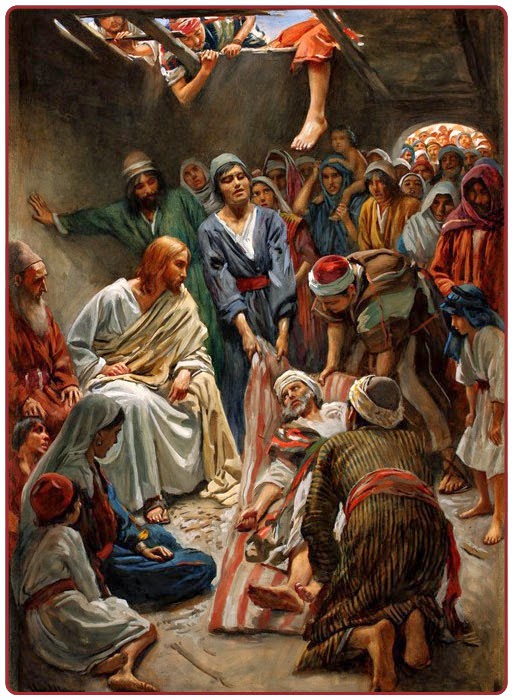
They lift up Charles’ bed and lug him through the city streets. But when they get to where Jesus was, they find that too many people are there, and they can’t even get to the door (Mk. 2:2; Lk. 5:19). So, they take desperate measures. They lug Charles and his bed to the top of the house, tear open the roof, tie ropes on the corners of Charles’ bed, and lower him so he is before Jesus (Mk. 2:4). Charles’ friends are trying to catch their breath, wiping the sweat off of their foreheads, and giving each other tired fist bumps as they surround that gaping hole, thinking, “We did it. Jesus is going to heal our buddy so he can walk.”

But then, down in the house with dust swirling around them, Jesus looks at Charles, and Charles looks up at Jesus. And Jesus says those words, “Take heart, My son; your sins are forgiven.” I imagine those friends were thinking to themselves, “You’ve gotta be kidding me, Jesus. We brought Charles here so You could fix his body!”

We don’t actually know what the paralytics’ friends thought, but we do know what the scribes and Pharisees thought, “Jesus is a blasphemer. Only God can forgive sins” (Mk. 2:7; Lk. 5:21). They grumble. They scoff. They doubt. But Jesus knows their thoughts and hearts, just as He knew the faith and believing hearts of this man’s friends. And because Jesus knows both the faith of these friends and the grumbling of the scribes, we also know that Jesus knew the paralytic’s thoughts.

Maybe, the paralytic was initially excited at the prospect of being healed and using his limbs. But based on Jesus words to him, there is little doubt that Jesus told him exactly what he needed to hear. The first word Jesus says, “Take heart,” is the same command Jesus will give to the disciples when they are out in a huge storm in the middle of the sea. They are being beaten by the waves and wind. Jesus appears, and they think He’s a ghost. But Jesus calms them, “Take heart; it is I. Do not be afraid” (Mt. 14:27).

This paralytic man hears from Jesus the exact words he needed to hear as he was battered by legs that didn’t work and arms that couldn’t move. “Take heart, My son; your sins are forgiven.” As he was lying there before Jesus, maybe he figured Jesus would tell him how awful he had been and that his paralysis was punishment for his sin. But that’s not what Jesus says. Jesus tells him that in the midst of his suffering and horrible situation that he can be of good courage because his sins are forgiven.

Now, of course, Jesus ends up healing the man too. To silence the grumbling scribes and prove that He actually does have the authority to forgive sins, Christ heals the man.

That’s the main teaching of this text. Jesus proves that He has the authority on earth to forgive sins by healing the paralytic. And the crowds respond with fear and glorified God (notice how the text ends) who had given such authority to men. It’s plural. To men. Not just to the man, Jesus. To men.

That was true here, but it is even more evident on the evening of the Resurrection. Then, Jesus tells the disciples, “If you forgive the sins of any, they are forgiven them” (Jn. 20:23). Jesus, the One who has authority to forgive sins, delegates that authority to His Church, to all Christians. Because you have called me to be your pastor, I get to do that each Sunday morning. God uses my voice to proclaim His forgiveness to you. I get to be ‘the Absolution guy.’ It’s pretty cool. And please, don’t think I’m bragging. Believe me, I wouldn’t have the guts to say that if the Bible didn’t teach it. Forgiveness and absolution is the main point of this text.

But today, I want to draw special attention to this guy’s friends and their tenacity to help him by bringing him to Jesus. They know their friend’s need. They know Jesus is where he can get help. So, they do everything in their power to help him by bringing him to Christ.

Dear saints, you do this too. I know you do. But I’d like to point out three specific, concrete ways you do this because these things are easy to overlook. And when we overlook them, it’s easier to neglect doing them. Here are the three ways you help others by bringing them before Jesus, and they are in no particular order.

First, you help people by inviting them to church. Jesus promises to be here as we gather each and every week when He says, “Where two or three are gathered together in My name, there am I among them”(Mt. 18:20). You are eternally helping others when you bring them here, to God’s house and to the gate of heaven (Gen. 28:17) where Jesus meets them with His Word and forgiveness.

Second, you help people by praying for them. When you have an unbelieving family member or coworker who has some need. Help them by praying for them. As you lift others up in prayer, you are bringing them to and laying them before the feet of Christ. Don’t forget that. When someone is suffering, lift them up to Jesus in your prayers. Maybe Jesus won’t answer your prayers in precisely the way you expect. But He knows best how to help.

James 5:13-16 says that your prayers have great power. You don’t even have to tell the person you are praying for them. (Usually, I think letting them know you are praying for them is a good idea. But there might be times [e.g. if they are really deep in unbelief and hatred of God] you don’t. Use your God-given wisdom.) Even if they don’t share their problems with you, pray for them anyway. They might not share their struggles, but they probably tell you the ways they have been blessed. That same section of James 5 says that when someone is cheerful, you can give a prayer of thanks to God for the blessings He has provided.

Third, you help people by forgiving them. The forgiveness you have received from God frees you to forgive others when they sin against you. Christian, your gracious disposition toward them and toward the world is a way that the light of Christ shines through you (Mt. 5:14-16).

All of that brings me to you, Cooper. Cooper, today you are Baptized. Today, your parents have helped you by bringing you to Jesus who also says to you, “Take heart, My son; your sins are forgiven. I have joined you to My death and resurrection (Ro. 6:3-8). I have clothed you in My righteousness (Gal. 3:27), given you the new birth of water and the Holy Spirit (Jn. 3:3, 5) and made you My child.”

Cooper, and all you saints, you are before Jesus right now. He invites you to His Table where He feeds you with His Body and Blood for the forgiveness of all your sins. As you walk out of here today, remember that you have new life in Christ. Use your freshly given strength to help and serve your neighbor. Amen.

The peace of God, which surpasses all understanding, will guard your hearts and minds in Christ Jesus. Amen.

Location – Sermon on Luke 18:9-14 for the Eleventh Sunday after Trinity

Luke 18:9–14

9 He also told this parable to some who trusted in themselves that they were righteous, and treated others with contempt: 10 “Two men went up into the temple to pray, one a Pharisee and the other a tax collector. 11 The Pharisee, standing by himself, prayed thus: ‘God, I thank you that I am not like other men, extortioners, unjust, adulterers, or even like this tax collector. 12 I fast twice a week; I give tithes of all that I get.’ 13 But the tax collector, standing far off, would not even lift up his eyes to heaven, but beat his breast, saying, ‘God, be merciful to me, a sinner!’ 14 I tell you, this man went down to his house justified, rather than the other. For everyone who exalts himself will be humbled, but the one who humbles himself will be exalted.”

In the name of Jesus. Amen.

Most of you are familiar with the phrase, “The three most important factors in real estate are – location, location, location.” A house here in East Grand Forks would probably be triple the cost if you moved it to Los Angeles County. For some reason, want to live there. I’ll gladly take winter.

A similar thing could be said about sin. The three most important factors about sin are – location, location, location. To be clear, I’m not talking about where sin is committed geographically. Speaking a lie to a massive crowd of people is just as damning as lying to yourself in your own mind without ever moving your lips. By referring to sin’s location here, I’m talking about where the sin resides. Sin has a place. Either sin is on you, or sin is on Jesus, the Lamb of God who takes away the sin of the world (Jn. 1:29).

We have this wrong tendency to think of sin as something abstract and floating around somewhere. There is no sin outside of the one who is committing it. Sin starts in the heart. Jesus says, “Out of the heart come evil thoughts, murder, adultery, sexual immorality, theft, false witness, slander” (Mt. 15:19). A sinner isn’t simply a person who commits sins. All people, besides Jesus, commit sin. Being a sinner means to be a person who is outside of God’s fellowship, outside the kingdom of God, someone who belongs with the demons. That is why we need Jesus to be the Savior of sinners. He changes the location of the sin. He removes it from the sinner as far as the east is from the west (Ps. 103:12).

Now, with that in mind, let’s consider the parable, which is about as straightforward as it gets. We’re told that the audience is people who are sinners with sin residing in them but still trusted in themselves and their own righteousness while treating others with contempt. Jesus also gives a clear conclusion to the parable, “Everyone who exalts himself will be humbled, but the one who humbles himself will be exalted.” But to get a fuller sense of what Jesus is teaching here we need to set the picture of what is going on in the parable. The people who originally heard this would have been familiar with what goes on in the Temple, but we probably aren’t.

Two men went up into the Temple, which is God’s house (1 Kgs. 8:13, 27), and they go for a specific purpose – to pray and worship. In English, we typically think of prayer as an individual thing. Sure, we will pray the Lord’s Prayer and say grace before a meal with others. But normally we think of prayer as an individual thing and worship as a corporate, communal thing. But the people in Jesus’ day had one word for both prayer and worship. These two men go to the place of worship at the same time. What kind of service are they attending?

They would have been at the Temple for the atonement offering, which was the only service that took place every day in the Temple, and it occurred twice each day – once at dawn and again at three in the afternoon. The service would begin by the altar for sacrifice. An unblemished lamb was slaughtered, and its blood was sprinkled on the altar following a precise ritual.

This sacrifice was a reminder of how God covered the sin, nakedness, and shame of Adam and his wife by providing garments of animal skins after they fell into sin (Gen. 3:21). It showed that God would accept the death of another in place of the sinner. As the atonement lamb was sacrificed, certain prayers were offered with the sound of silver trumpets and cymbals. The people would sing a Psalm. A priest would go into the Holy Place where he would offer incense, praying that the sacrifice would be pleasing to God. Then, when the priest entered the Holy Place with that incense, the people would offer their private prayers to God.

But the Pharisee’s prayer directly contradicted everything that was happening around him in the Temple. He thanks God that he is acceptable because of who he is and who he is not, what he has not done and what he has done. His prayer in that context would be like coming here on Good Friday and praying, “God, I’m sure glad I’m not like all these sinners around me who need Jesus to die for their sins.” It’s utterly blasphemous.

But the tax collector’s prayer harmonizes with the service in at least two very specific ways. First, when the tax collector prays, “God be merciful to me, a sinner,” he isn’t using the normal word for ‘mercy.’ Many times in the Gospels, we hear people with sickness, disease, or other affliction cry to Jesus, “Have mercy” (Mt. 15:22, 20:31; Lk. 18:38-39). That’s always a good prayer to ask God for blessings you haven’t earned and the relief that you don’t deserve. But the tax collector’s prayer uses a different word. We could translate his prayer as, “God, atone me. God, reconcile me. God, make me what I should be.” That’s the first way his prayer harmonizes with the service. He is praying that the atonement that is taking place there in the Temple and the sacrifice being offered would do what God had promised it would do and remove his sin from him (Lev. 4:35).

Second, his prayer harmonizes with the service because this tax collector recognizes that he is the sinner who needs atonement. He needs to be reconciled. He needs to have his sin, his shame, his guilt removed. Again, that’s precisely what that service was pointing to. That is what the tax collector looked to, and that is why he went down to his house justified.

Now, there is a danger in this parable. We know that the really good, moral Pharisee did not go home justified, but this sinful tax collector did. The danger that can arise for us then is to think that everything about the Pharisee is bad. Be careful with that. It is good and right to not be extortioners, unjust, adulterers. It is good to fast and give tithes. That is all good stuff. There is another side to the coin of the Pharisee’s prayer. We might be tempted to pray, “God, I thank You that I am not like other men, self-righteous, pretentious, holier-than-thou types, or even like this Pharisee. I’ve given You my heart, dedicated my life to You, and made You my Lord.” Do you see what that does? It locates our eyes off of Jesus – the One who atones for our sin (1 Jn. 2:2).

The location of your sin matches where you look. If you look to yourself, your sin is on you. If you look to Christ, your sin is gone, defeated, eternally removed.

Let me close with an analogy: Imagine you had to cross some terrifying span. Far below at the bottom of that span are all the things you fear most – snakes, rats, lava, rough seas, or sharks. You fill in whatever is scariest. But there is a bridge that spans that gap. What would you look to for confidence in crossing that gap? You’d look to the bridge. You’d see if it was well-built, sturdy, and strong. You wouldn’t look inward to see if you have enough confidence in the bridge. And you build confidence in the bridge by looking at the bridge.

So, dear saints, where are you looking? Are you looking toward things you have done – either good works or your own humility? If so, you should have no confidence whatsoever.

Look to Jesus. His sacrifice, His blood, His death, His resurrection is enough. Looking there, you go to your house justified by God’s sure and certain declaration. Amen.

The peace of God, which surpasses all understanding, will guard your hearts and minds in Christ Jesus. Amen.

Learning – Sermon on Luke 6:36-42 for the Fourth Sunday after Trinity

Luke 6:36–42

36 “Be merciful, even as your Father is merciful.

37 “Judge not, and you will not be judged; condemn not, and you will not be condemned; forgive, and you will be forgiven; 38 give, and it will be given to you. Good measure, pressed down, shaken together, running over, will be put into your lap. For with the measure you use it will be measured back to you.”

39 He also told them a parable: “Can a blind man lead a blind man? Will they not both fall into a pit? 40 A disciple is not above his teacher, but everyone when he is fully trained will be like his teacher. 41 Why do you see the speck that is in your brother’s eye, but do not notice the log that is in your own eye? 42 How can you say to your brother, ‘Brother, let me take out the speck that is in your eye,’ when you yourself do not see the log that is in your own eye? You hypocrite, first take the log out of your own eye, and then you will see clearly to take out the speck that is in your brother’s eye.”

In the name of Jesus. Amen.

Certain words and phrases get used so often that we easily forget what they actually mean. In Christian circles, one of those words is ‘disciple.’ What does ‘disciple’ mean? Honestly, it can mean a lot of things. Maybe you hear that word and think of the twelve guys Jesus called to follow Him. That’s good. They were the twelve disciples. It also isn’t wrong to understand ‘disciple’ as an alternate term for ‘Christian.’ Totally legit. There are all sorts of books, podcasts, videos, and ministries today that talk about Christian ‘discipleship’ and they basically use that term to refer to a journey of spiritual growth. Sure, that’s fine too. But what is a disciple?

The Greek word that gets translated as ‘disciple’ simply means ‘one who learns from another,’ so let’s shorten that to this – a disciple is a ‘learner.’ So, when Jesus says in Jn. 8:31, “If you abide in My Word, you are truly My disciples,” He is telling us to keep learning from Him as we read, hear, and confess the Scriptures. When Jesus says in Jn. 13:35, “By this all people will know that you are My disciples, if you have love for one another,” He is saying the world will have evidence that we have learned and are learning from Him by our love for one another (1 Jn. 2:3, 3:23).

Well, today Jesus gives us a hint at how long our training as His disciples and learners will be. He says to us, “A disciple/learner is not above his teacher, but everyone when he is fully trained will be like his teacher”(Lk. 6:40). Your education and learning from Jesus will last until you are like Him. So, don’t worry about throwing a graduation party. God Himself will throw one for you in the Resurrection and the life of the world to come. 

This Gospel reading is from what is called Jesus’ “Sermon on the Plain,” and He teaches some hard and difficult lessons for us learners, disciples, and Christians. These lessons are all intended to make us like Him. “Be merciful even as your Father is merciful. Judge not. Condemn not. And give abundantly.” But before we get into these lessons, I’d like to briefly point out that Jesus has been teaching us those same lessons today through His Word in our liturgy even though you might not realize it.

There’s a great analogy for this in the movie “The Karate Kid,” which is about a high school-aged boy, Daniel, who moved to a new town where he has no friends. He’s an outsider who keeps getting beat up by a bunch bullies. He asks Mr. Miyagi, the handyman for his apartment complex, to teach him karate so he can defend himself. So, Mr. Miyagi tells him to show up early. Daniel arrives, and Miyagi has him wax all of his vintage cars with a certain technique – “Wax on. Wax off. Breathe in through nose, out through mouth. Wax on. Wax off.” Daniel spends the whole day waxing those cars, and Miyagi tells him to come back the next day and has Daniel, “Sand the floor,” with specific motions and breathing. Again, it takes Daniel the whole day to sand the floor. The next day, it was, “Paint the fence.” The fourth day, “Paint the house.” Daniel finishes after sunset and is fed up. He yells that he quits and starts to storm off in anger and frustration because he been worked to the bone but hasn’t learned any karate.

Miyagi calls him back and tells Daniel, “Show me wax on, wax off. Show me sand the floor,” and the other moves. Then Miyagi, without any warning, starts throwing punches at Daniel, and each of those moves are different ways to block the punches. Finally, Miyagi goes berserk throwing all these punches and kicks at Daniel, and he blocks all of them using the moves he instinctively learned doing those tasks. Miyagi stops and bows. Daniel suddenly realizes that he’d been learning karate the whole time he was waxing, sanding, and painting. Our liturgy is doing the same thing Miyagi was doing for Daniel – it teaches us the major lessons we need to train our spiritual instincts as learners and disciples of Jesus.

Today, Jesus teaches us, “Be merciful, even as your Father is merciful. Judge not. Condemn not.” We come here each Sunday and confess our sins then sing, “O God the Father in heaven; O God the Son, Redeemer of the world; O God the Holy Ghost, true Comforter, have mercy upon us.” And then, we hear the absolution. That is training us to be merciful, even as our Father is merciful. It might feel like we’re just mindlessly reciting or singing the same words week after week, but we are learning how God is merciful to us so we can be merciful to others.

Even if we are just going through the motions without much thought or sincerity, God is still teaching us how merciful He is by proclaiming His forgiveness. The liturgy is training us so when people sin against us and hurt us and then offer insincere, half-hearted apologies, we remember how God has forgiven us even when we were insincere and didn’t feel particularly guilty. 

The liturgy trains our spiritual instincts beyond the lessons Jesus teaches in this text. We hear God’s Word and learn to say it back to Him and to the world when we confess our faith using the Creeds. The liturgy teaches us how to pray in good times and in bad times. Our liturgy and hymns teach us who God is and how He is toward us to strengthen our faith toward Him and our love toward one another. When our service closes with the benediction and doxology, we are reminded that we have been in God’s gracious presence, and He dismisses us with His abundant blessings as we go from this place singing His praise.

Yes, of course, there are going to be weeks where we might simply be going through the words and actions of the liturgy. That’s going to happen. But I would strongly encourage you to do your best each week to slow down, pay attention, think about what you are doing, and consider why we are doing what we are doing. God, through His Word in our liturgy, is working on you to prepare you for the spiritual battles you face throughout your life.

I could go on and on about the different things Jesus uses in the liturgy to teach us, but I want to close with one more from today’s text. In this text, Jesus teaches us, “Give abundantly.” We bring our tithes and offerings to God, we put them into the plate, and God showers the gifts of His Word and teaching on us. He gives us His mercy and grace. He gives us a family of brothers and sisters in Christ. He gives us His full attention as we pray and ask for His help and His blessing. God gives and gives and gives so that our lap is overflowing.

Dear saints, you cannot out-give God. Because of what Jesus has done for you, because He has suffered, shed His blood, and died for you, you have received abundant, overflowing, eternal treasures. God has done that for you throughout your entire life. He has done it today. And, if Christ tarries, He will be here to do that again for you next week as well. God’s giving knows no end. Because of God’s mercy freely given to you, you also can be merciful and giving toward others. God even invites you to test Him in this. In Malachi 3:6-12, God says, “Bring in the full tithe and watch what I will do. I will open the windows of heaven for you and pour down for you a blessing until there is no more need.”

Dear saints, you have had a forest of logs removed from your eye by the grace of God given because of Christ. May Christ continually teach us this through His Word, and may we be humble enough to continually learn from Him as we are made to be merciful and giving like He is. Amen.

The peace of God, which surpasses all understanding, will guard your hearts and minds in Christ Jesus. Amen.

A Covering of Love – Sermon on 1 Peter 4:7-11 for the Easter 7/Sunday after the Ascension

1 Peter 4:7–11

7 The end of all things is at hand; therefore be self-controlled and sober-minded for the sake of your prayers. 8 Above all, keep loving one another earnestly, since love covers a multitude of sins. 9 Show hospitality to one another without grumbling. 10 As each has received a gift, use it to serve one another, as good stewards of God’s varied grace: 11 whoever speaks, as one who speaks oracles of God; whoever serves, as one who serves by the strength that God supplies—in order that in everything God may be glorified through Jesus Christ. To him belong glory and dominion forever and ever. Amen.

Alleluia! Christ is risen!
He is risen indeed! Alleluia!

In the name of Jesus. Amen.

When something is coming to an end, there is often a sense of urgency. The last month of my senior year of high school, my class of twelve got together more often than we did the years prior. At Bible camps, kids will goof off at the campfire, but the last night they will share about their life, reflect more on what they have learned, and talk about how they hope to be different and better when they go back to their regular lives. When a family member is in their last days, every moment, every word, every interaction carries more weight to it. As the end draws near, little things become even more insignificant, and the big things become even bigger.

In this epistle reading, Peter says that the end of all things is at hand. Because Jesus has died, risen, and ascended into heaven, His work as the Savior of mankind is complete. Everything necessary for your salvation, redemption, and restoration has been accomplished. Now, your Savior and Brother sits on the throne of all creation. At any moment, Jesus can return and bring an end to all things. All of this is to say that we are living in the end times. Peter said this nearly 2,000 years ago, so it’s at least as true now as it was then. The end, the completion, the finishing of all things is at hand.

And that has a different ring to it than if Peter had written, “The end of all things is coming soon,” doesn’t it? “Soon” presupposes and anticipates a delay – even if it is only a short delay. But Peter doesn’t talk about Christ’s return as coming soon. It is “at hand.” That gives an extra ‘umph’ of urgency and immediacy. But the fact that the end of all things is “at hand” doesn’t excuse us to be worried and get frantic. Peter here doesn’t allow us to be the Christian version of Chicken Little running around and yelling, “The sky is falling; the sky is falling.” Not even close.

Instead, we are called to be self-controlled and sober-minded. In other words, we are to be in control of all our actions. Yes, of course, this refers to not getting drunk with alcohol. It includes that, but Peter means more than that. This call to be self-controlled and sober-minded is an echo of what Jesus says in Mt. 6:25-34, “Do not be anxious,” because when we are anxious, we do all sorts of ridiculous things. There is a myriad of awful, evil, horrible things going on in the world, but Jesus hasn’t given you permission to worry about it or run around all frantic and anxious.

The danger of anxiety and worry is that it would distract us from our prayers. It’s easy to fall into the trap of thinking that our worry will change what is going to happen. But more often worry distracts us from prayers. Take your worries and anxieties and turn them into prayers (1 Pet. 5:7). In a very real sense, worry is just a form spiritual drunkenness. Worry can distort the truth and the reality that Christ is in control of all things. To be self-controlled and sober-minded here is to let the fact that Jesus is ascended to the throne of all creation, that He has promised to hear your prayers, and that He promises to answer those prayers, let those truths keep you calm, clear-headed, and focused. Don’t get drunk with worry and the cares of this world. Be self-controlled and sober-minded because the end of all things is at hand.

Instead of being worried, Peter gives us three instructions of what we are to do as we live in the time of the end. We are to love, show hospitality, and use our God-given gifts. Each of these instructions could be its own sermon. But today, I want to focus on the first one because Peter says it is the most important of the three. He says, “Above all love one another,” and he tells us why we are to love one another, “because love covers a multitude of sins.”

Now, we have to be clear on a couple things here. First, Peter isn’t equating this love that covers a multitude of sins with forgiveness. Yes, forgiveness is a loving thing that releases sins. God’s love for us, which is manifested in Christ’s death, that love has forgiven and removed our sins from us as far as the east is from the west (Ps. 103:12). Other places in Scripture call us to love others by forgiving their sins, but Peter is doing something different here when he talks about covering a multitude of sins. We are to have a love that makes the sins of others invisible. We are to have a love that hides the sins of others.

That brings us to the second thing that needs to be clear. This does not mean that we don’t call sin what it is – sin. Sin is sin is sin. To say anything different is not loving. It isn’t loving to say that it’s ok for someone to be addicted to drugs because that is just the way God made them. That’s not love. Sin needs to be brought to the surface so it can be repented, confessed, and forgiven. So, what does it mean that love covers a multitude of sins?

It means that when others sin against us – especially our brothers and sisters in Christ – we are called to love them in such a way that overlooks, ignores, buries, and covers those sins. Holding grudges just isn’t worth it. The 8th Commandment and its explanation in the Small Catechism is especially helpful here: “Thou shalt not bear false witness against thy neighbor.” What does this mean? “We should fear and love God so that we do not deceitfully lie about, betray, backbite, nor slander our neighbor, but defend him, speak well of him, and put the most charitable construction on all that he does.”

It is extremely easy for us to put the least charitable construction on the actions of people who sin against us. Someone cuts you off in traffic or budges in front of you, and you assume, “That guy is an idiot,” or, “She’s rude and inconsiderate.” But you know what is just as easy? Maybe it’s slightly more difficult because of our pride – it’s just as easy to put the most charitable construction on their actions. “That person just made a mistake. Maybe, they have something going on in their life that I don’t know about.” The danger for us is that when we are always ascribing the worst motives to others, it’s easy to assume and imagine that they do the same to us. That is a dangerous place to be.

Of course, when someone sins against you and you point it out, that person should repent and ask for forgiveness. That’s how things should work. But what happens when you point out someone’s sin and they say, “I didn’t do anything wrong,” and they don’t ask for forgiveness? What do you do then? Is the relationship over? No. It shouldn’t be. That is where this passage comes in. “Love covers a multitude of sins.” And this is what we are to keep doing. Keep loving one another earnestly and fervently because love covers a multitudeof sins.

This covering up of sin through love is a distinct virtue of Christians that does not exist in the world. But the world will notice when you do this, Christian. They will see it and be drawn to it. This kind of love for one another isn’t always going to be pleasant for you. But it will be attractive to those who aren’t Christians. Having this kind of love that covers sin might be the most important evangelistic work that you do. Repeatedly in the book of Acts, this kind of love between Christians is what attracted others to see what was different about believers. So keep loving one another earnestly, since that love covers a multitude of sins.

Now, I know that was a lot of law. I recognize that. I’ll just point out that this text is full of law, so that’s what I have to preach. But I will close with this: your heavenly Father hasn’t only covered your sin and pretended that it isn’t there. No. Because of Jesus, He has removed it, forgiven it, trampled it under His foot, and cast it into the depths of the sea (Mic. 7:19). Because of that – because your sins are gone, taken away, and forgiven – you can more easily cover the sins of others in Christian love. Amen.

Alleluia! Christ is risen!
He is risen indeed! Alleluia!

The peace of God, which surpasses all understanding, will guard your hearts and minds in Christ Jesus. Amen.

Common Union – Sermon for Maundy Thursday

The Scripture readings for tonight’s service are
Exodus 24:3-11; 1 Corinthians 11:23-32; and John 13:1-15, 34-35.

In the name of Jesus. Amen.

On this night, 3,470 years ago, God appointed a feast. God told His people to slaughter a lamb, take its blood, put it on the doorposts of their houses, and live. But the lamb wasn’t only used for its blood. God’s also told them to roast the lamb’s body and eat it. Those Passover lambs doubly provided for God’s people. First, the lambs’ blood marked the doors of God’s people which protected, shielded, and delivered them from the sentence of death. And second, the lambs’ bodies provided the strength and nourishment the people needed for what would happen the next day (Ex. 12:1-14). The morning after that first Passover, God’s people gathered themselves and all that they had and left Egypt to begin their journey to the Promised Land.

On this night, 1,991 years ago, our Lord Jesus celebrated the final Passover feast with His disciples. After that meal was done, Jesus took bread, gave thanks, broke it, and gave it to His disciples saying, “Take, eat; this is My body, which is given for you. This do in remembrance of Me.” Then, He took the cup, blessed it, and gave it to the disciples saying, “Drink of it, all of you; this cup is the new covenant in My blood, which is shed for you for the forgiveness of sins. This do, as often as you drink it, in remembrance of Me.”

By doing this, Jesus put an end to the old covenant that His people had broken and established the New Covenant. In this New Covenant, He forgives your iniquity and remembers your sin no more. And this New Covenant does more than that. Because of this New Covenant, God promises to be your God and make you His people (Jer. 31:31-34; Heb. 8:8-13). Forgiveness and being God’s people. This New Covenant delivers forgiveness through the shedding of Jesus’ blood, but don’t forget that this meal also unites us together as God’s forgiven people.

In 1 Cor. 10:16-17, Scripture says that the Bread and Cup of the Lord’s Supper are, as the ESV translates it, a “participation” in the Body and Blood of Christ. Unfortunately, the way we use “participation” most often these days is simply showing up. In some competitions, simply showing up gets you a participation ribbon. Translating that word as “participation” might give the impression that Jesus does nothing more than show up in the Bread and Cup. I prefer the KJV which uses the word “communion.” The Bread and Cup of the Lord’s Supper is a “communion” in the Body and Blood of Christ. These elements unite us with the Body and Blood of Christ.

Because the Lord’s Supper is, according to Jesus, His true Body and Blood, it first unites us with Him. And second, since this Sacrament unites us with Jesus, it also unites us with one another. It makes us one body (1 Cor. 10:17).

We need this unity, this communion with one another. The first thing that God says about mankind is, “It is not good for the man to be alone” (Gen. 2:18). Man alone is not good. That doesn’t mean that man alone is bad; it’s just not good. To make mankind good, God creates a woman, a companion, a wife, a bride for Adam and this completes him. Then, not only is mankind good like the rest of creation; humanity is elevated above the rest of creation and is very good (Gen. 1:31). We were not created for ourselves to live in isolation. We are created for others.

In the Lord’s Supper, we become a united community, a holy and forgiven people who are bonded together with Jesus and with one another as the body of Christ. And as a body, we love and care for one another because we need each other (1 Cor. 12:12-27).

If one part of your body is hurt, the rest of your body compensates. If you cut one of your fingers, you use your other fingers to do what needs to be done while the injured finger heals. If you break an arm or leg, the other one picks up the slack. When Jesus gives us this new commandment to love one another, He is calling you to do the same thing for the other members, the other parts, of the body of Christ. And the love you have and demonstrate for your brothers and sisters in Christ is evidence to the world that you are truly Jesus’ disciples (Jn. 13:35).

On the same night, 1,991 years ago, when Jesus gave us Holy Communion, He also served His disciples by washing their feet. For several reasons, foot washing isn’t a Sacrament. One of the reasons is that Jesus says that washing was a lesson on how to love one another. He asks if they understand the lesson (Jn. 13:12) and says that what He did was an example of serving others (Jn. 13:14).

By that example, the Creator of all things makes the glory of His love shine by humbly serving His creatures. Jesus is the God of love, and He loves you by giving to you and serving you. This example of foot washing shows that we followers of Jesus are to give and to love and to serve each other as He does. Christ says, “A new commandment I give to you, that you love one another: just as I have loved you, you also are to love one another. By this all people will know that you are my disciples, if you have love for one another” (Jn. 13:34-35).

What does this love look like? Jesus will say a little later, “Greater love has no one than this, that someone lay down his life for his friends” (Jn. 15:13). Laying down your life for someone else can only happen once because you only have one life to lay down. The day may come when you need to lay down your life to save a friend’s life. But until then, lay down your life in the all the other little ways that you can. Lay down your pride and ambition and self-interest and ease and comfort to love and serve your neighbor. Lay down your lives to love and protect those for whom Christ has died because we are a holy communion, God’s blessed, forgiven community.

As you come tonight to receive this Sacrament, this Holy Communion, you receive Christ’s Blood that protects you from death. And you also receive the nourishment and strength that you need to love one another.

So, tonight, come to this altar, this table, at your Savior’s invitation. Come and behold God. Come and eat. Come and drink. Come and be united with Christ and united with one another. Then go. Show the world that you are truly Christ’s disciples by your love for one another as you journey to the Promised Land of His eternal kingdom. Amen.

The peace of God, which surpasses all understanding, will guard your hearts and minds in Christ Jesus. Amen.