Diagnosed – Sermon on Matthew 9:1-8 for the Nineteenth Sunday after Trinity

Matthew 9:1-8

1 And getting into a boat he crossed over and came to his own city. 2 And behold, some people brought to him a paralytic, lying on a bed. And when Jesus saw their faith, he said to the paralytic, “Take heart, my son; your sins are forgiven.” 3 And behold, some of the scribes said to themselves, “This man is blaspheming.” 4But Jesus, knowing their thoughts, said, “Why do you think evil in your hearts? 5 For which is easier, to say, ‘Your sins are forgiven,’ or to say, ‘Rise and walk’? 6 But that you may know that the Son of Man has authority on earth to forgive sins” – he then said to the paralytic – “Rise, pick up your bed and go home.” 7 And he rose and went home. 8 When the crowds saw it, they were afraid, and they glorified God, who had given such authority to men.

In the name of Jesus. Amen.

When you go to the doctor, you have certain expectations of what is going to happen. You know that you will fill out forms and provide information about your health history and habits. You expect to have your weight, heart, lungs, blood pressure, and reflexes checked. Depending on the reason for your visit, you also anticipate other tests – bloodwork or other lab work; an x-ray, ultrasound, or MRI; maybe a stress test or sleep study. Depending on the results of all of that, you expect more tests might get ordered. Only after all those results are studied and considered will the doctor call you in to present a diagnosis and offer a treatment plan.

Well, in our Gospel text today, this paralytic is brought to Jesus, and by all appearances, Jesus skips right over the testing and diagnosis process and goes straight to the treatment saying, “Take heart, My son; your sins are forgiven.”

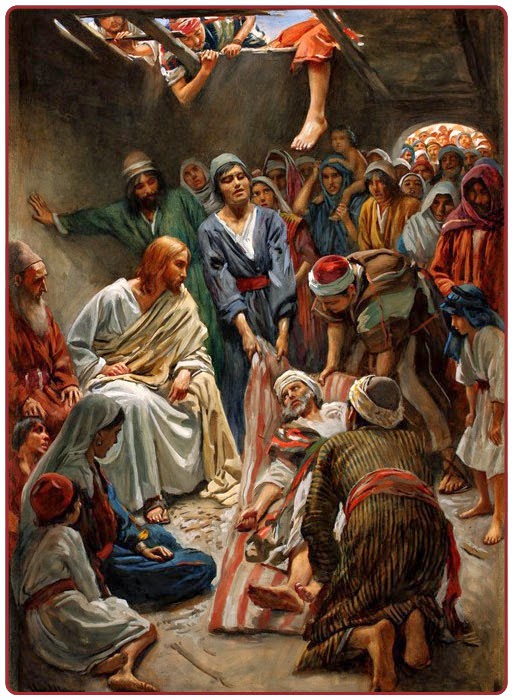
For a moment, use your sanctified imagination to consider this from the perspective of the paralytic’s friends. Matthew has condensed the story in his Gospel. Here in v. 2, he tells us that ‘some people’ brought this paralytic to Jesus. But Mark and Luke give a fuller picture of this event, filling in some of the details (Mk. 2:1-12; Lk. 5:17-26). They let us know that it was four men (Mk. 2:3) who carried this paralytic to Jesus, and they had a difficult time getting their friend there. People from the whole region had heard that Jesus was in town, and so many people had gathered to hear Him preach (Lk. 5:17) that there was no room to even get in the door (Mk. 2:2). So, these four friends lug their paralyzed buddy on top of the house, punch a hole in the roof, and lower him down to get him in front of Jesus (Mk. 2:4).

Now, this is just an aside. As a preacher, I have, what I hope is, a godly and pious curiosity about this. At what point does Jesus stop preaching? Is it when He hears the scuffle of eight feet on the roof above Him? I think that would distract me enough that I’d stop preaching, but, please, don’t test that hypothesis. Is it when the pounding starts or until bits of dirt and debris start falling from the ceiling? Maybe, Jesus preached straight through all of that until the paralytic was being lowered through the new skylight above Him. I guess I’ll just have to go rent the video at heaven’s Blockbuster. Maybe all of heaven’s Blockbusters have closed and everything is available through streaming services. Anyway…

These four friends go through all that work and effort knowing that they would have more work later to fix the hole they made. They had brought their paralyzed friend to Jesus to be healed (Lk. 5:17-18). But, to their perspective, Jesus skips right over the diagnosis and says, “Take heart, My son; your sins are forgiven.”The worst thing is that it looks like the wrong treatment! Imagine you had a friend with a badly sprained ankle, so you bring him to a new doctor in town. The doctor watches your friend limp in, but before your friend even says why he is there, and before asking any questions or doing any tests, the doctor says to your friend, “Here is a prescription for Lipitor for your high cholesterol.” You’d probably report the doctor to have his license revoked. Well, that is essentially what Jesus does.

We might think that the healing of this paralytic is a lesson that the most important thing we need is the forgiveness of sins. Above money, security, food, house, or health we need forgiveness. Once Jesus forgives this paralytic of his sins, he has everything he needs. If the text had stopped there and Jesus hadn’t miraculously given this man the ability to walk, it wouldn’t be too bad. He could have lived the rest of his life paralyzed because he had everything he needed for eternal life. In fact, the physical healing seems to take the back seat in this text. Jesus only heals him after the grumbling of the scribes. You could even conclude that Jesus never intended to heal the guy and only does so as an afterthought.

Now, to be sure, the most important thing that everyone needs is the forgiveness of sins. But if the main thing you take away from this text is that physical healing isn’t important, you’re wrong. This isn’t Jesus’ first miracle. There were many others that He healed before and after this. Just before this, Jesus healed a leper (Mt. 8:1-4), but Jesus didn’t forgive him before He healed him. Right after that, a centurion asks Jesus to heal his paralyzed servant (Mt. 8:5-13), but no absolution. Then, Matthew records that Jesus heals Peter’s mother-in-law who had a fever, Christ heals a whole slew of other people and casts out demons (Mt. 8:14-17), but no mention of Jesus proclaiming forgiveness there either. All over the Gospels, Jesus will heal people, but there is no mention of absolution. In fact, most of the time when Jesus mentions forgiveness and salvation, it’s only after He heals. We don’t take those instances to mean that Jesus cares more about physical healing more than forgiveness.

Now, where am I going with all of this? Jesus is a Pastor – in fact Jesus is the Pastor. The word ‘pastor’ simply means ‘shepherd.’ Jesus is the Good Shepherd (Jn. 10:11), the Good Pastor. Christ knows when His sheep need to be fed by green pastures or led beside still waters, and He knows when His sheep need to have their soul restored with forgiveness and mercy (Ps. 23:1-3). Jesus doesn’t need to run a bunch of diagnostic tests to figure out what His sheep need. He always knows and gives the right treatment, and He always perfectly gives what His sheep need. Jesus, the Good Pastor, so intimately knows you and all your actions, thoughts, and ways that you are always diagnosed and receive the care you need.

The reason Jesus forgives this paralytic before healing his paralysis is that is what the man needed. The man’s friends – maybe even the man himself – figured what he needed most was to be able to use his limbs again. But Jesus, the Good Shepherd and Pastor, knows best. So, Christ forgives the man. “Take heart, My son; your sins are forgiven.” And those words deliver to the paralytic exactly what he needed.

I’m going to change gears here for just a minute. It’s October, and I’m aware that October, among other things, is Pastor Appreciation month. First of all, I want to thank you all for how good you’ve been to me, your pastor, for the past twelve years and ten plus months. I can’t imagine being called by God to shepherd a better flock. Last week, I preached about stewardship and tithing and mentioned how I don’t particularly like to preach about that. Well, preaching about the duties of a pastor is low on my preference list as well. But Scripture teaches about the duties of pastors, so preaching the full council of God requires me to preach about what I’m supposed to do as a pastor. So, here we go.

Every pastor is an under-shepherd of Jesus, the Good Shepherd. And I confess to you that I am a very flawed shepherd. Jesus shepherded this paralytic man exactly as he needed. But I know that there are times where I have not shepherded rightly. I don’t always know what is needed in any given situation.

God has given pastors one tool to use and apply to the flocks entrusted to their care – His Word of Law and Gospel. There have been times where I have given Law when you needed comfort and forgiveness, which results in you being further discouraged and dismayed. And there are times when I gave the Gospel of comfort and forgiveness when the Law should have been proclaimed, and that can lead to a boldness to continue in sin. This is a long way around for me to say, “I’m not as good of a pastor as Jesus is.”

First of all, please forgive me for my shortcomings as your pastor. And second, please pray for me that God would give me the wisdom and words that are needed in each interaction I have as your pastor. But I take great comfort in God’s promise that whenever His Word goes forth it always accomplishes the purpose for which God sends it (Is. 55:10-11). I am also comforted by the fact that God can always shut my mouth if I am doing more harm than good. But again, please pray for me.

I want to close by pointing you back to Jesus, my Boss, and your perfect Shepherd. Notice how Christ is always perfectly in tune with His sheep. Jesus sees the faith of the people who brought the paralytic to Him, so He immediately applies the Gospel of forgiveness. He knows the grumbling of the scribes after He absolves the paralytic and applies the Law to them. And notice how Jesus’ perfect diagnosing and shepherding results in the crowds glorifying God.

Those crowds glorify God because God had given authority to forgive sins to men (Mt. 9:8). That line struck me this week. Notice, it’s plural – to men, not to ‘a man,’ not just to Jesus, but to men. Dear saints, as those who have been redeemed, restored, and forgiven by Jesus’ death and resurrection, Jesus has given you the authority to forgive the sins of others. Jesus says in John 20:23, “If you forgive the sins of any, they are forgiven.”

My fellow Christians, Jesus invites you to join with Him in proclaiming to a broken creation the forgiveness and eternal life He has won by His death and resurrection. May we carry that treatment and soul-saving medicine to a hurting world. Amen.

The peace of God, which surpasses all understanding, will guard your hearts and minds in Christ Jesus. Amen.
God-Shaped Love – Sermon on Luke 10:23-37 for the Thirteenth Sunday after Trinity

Luke 10:23-37

23 Then turning to the disciples he said privately, “Blessed are the eyes that see what you see! 24 For I tell you that many prophets and kings desired to see what you see, and did not see it, and to hear what you hear, and did not hear it.”

25 And behold, a lawyer stood up to put him to the test, saying, “Teacher, what shall I do to inherit eternal life?” 26 He said to him, “What is written in the Law? How do you read it?” 27 And he answered, “You shall love the Lord your God with all your heart and with all your soul and with all your strength and with all your mind, and your neighbor as yourself.” 28 And he said to him, “You have answered correctly; do this, and you will live.”

29 But he, desiring to justify himself, said to Jesus, “And who is my neighbor?” 30 Jesus replied, “A man was going down from Jerusalem to Jericho, and he fell among robbers, who stripped him and beat him and departed, leaving him half dead. 31 Now by chance a priest was going down that road, and when he saw him he passed by on the other side. 32 So likewise a Levite, when he came to the place and saw him, passed by on the other side. 33 But a Samaritan, as he journeyed, came to where he was, and when he saw him, he had compassion. 34 He went to him and bound up his wounds, pouring on oil and wine. Then he set him on his own animal and brought him to an inn and took care of him. 35 And the next day he took out two denarii and gave them to the innkeeper, saying, ‘Take care of him, and whatever more you spend, I will repay you when I come back.’ 36 Which of these three, do you think, proved to be a neighbor to the man who fell among the robbers?” 37 He said, “The one who showed him mercy.” And Jesus said to him, “You go, and do likewise.”

In the name of Jesus. Amen.

Jesus uses the parable of the Good Samaritan to teach the lawyer that he will never be saved by the Law and that he needs a Savior to have compassion on him and give him eternal life. The lawyer is the one who has been robbed, stripped, beaten, and left dead in the ditch. The Law, represented by the priest and Levite, passes by and can not and does not help him. With the parable Jesus is teaching that to be one who inherits eternal life, we must be rescued by an outsider whom we despised (Is. 53:3-4) and who owes us nothing. We sinners need a love and compassion that we could never repay from One who doesn’t even want to be repaid. This is the only way for this lawyer to be saved and the only way for any of us to inherit eternal life.

So, the parable of the Good Samaritan is about Jesus and what He does for sinners. Christ is the Good Samaritan who finds us dead in sin. He has compassion on us, comes to us, binds up our wounds, pours on oil and wine, lays us on His animal to bring us to the inn, and sets us up in an all-expenses paid room. That is the point of the parable. The parable is not telling sinners that they need to do good to everyone. The lawyer already knew that he needed to love everyone (Lk. 10:27). He knew the Law requires that he love God and neighbor perfectly. So, if you ever hear someone preaching or teaching that the purpose of this parable is to tell us to love everyone, know that you are hearing only a half-truth, and, often, half-truths are more dangerous than full lies.

Jesus is not calling us to be the Samaritan in order to be saved. Jesus is the Good Samaritan who saves us. Then, it is true that Jesus calls us to go and do likewise (Lk. 10:37). We are to be like Jesus. Christians are to be little Christs who have compassion on their neighbor because Jesus has had mercy upon us. Because we have been rescued by Christ, we have become inheritors of eternal life and children of God. This means Jesus’ call to, “Go and do likewise,” is an invitation for us to imitate Him because children are like their father.

So now, please know, I’m not going to be preaching on the main point of the parable for a bit here, but I am going to use the parable to show how we Christians, who have been saved and rescued from the ditch, are to love God by loving our neighbor.

Dear saints, we need God to shape our love, and He shapes our love by two things: First, by the Ten Commandments, and second, by our relationship to the neighbor that God puts in our life in at any given moment. Let’s flesh this out with an example:

God has called me here to be your pastor, so I have a love for you, my neighbors and members of my flock, that is shaped by the 3rd Commandment. I am here to faithfully preach and teach God’s Word to you, and you have a love for me, your neighbor, that is shaped by the 3rd Commandment to faithfully hear God’s Word as it is preached and taught. As a parent, I have a different love for my children that is shaped by 4thCommandment, so I buy them socks. Well, how it actually works in our house is I work to earn the funds so my wife can purchase our kids’ socks because she’s a lot better at finding good deals on the socks my kids like. I have no idea which socks they like. Sometimes, my 4th Commandment shaped love is to take those socks from the clothes drier and help my kids fold and organize them in their dresser. So, I have different vocations, different callings, and different kinds of love that are  shaped by the Commandments and my relationship to my neighbor. And these vocations are what any reasonable person would expect. My love as a pastor is to preach and teach the Word of God to His flock, and as a parent, I provide and care for my kids.

Now, stick with me here while I get a little absurd. It would be wrong for me, as your pastor, to come here on a Sunday morning, stand in this pulpit, and say, “No sermon today, but here are some new socks. I’ll come to your house later and help you organize your dresser.” That would be weird, right? At least, I hope you think it would be weird because it is. You still are my neighbor, and I am still commanded to love you as I love myself. But my 4th Commandment love for you is shaped differently than my 4th Commandment love for my own kids. My 4th Commandment love for you is shaped by my relationship to you. So, I am to encourage you to honor, serve, love, obey, and respect your parents and the authorities that God has placed over you. Now, this doesn’t mean that will never buy socks for you. God might change your needs so it would be good and right for me to buy you socks. But, hopefully, God won’t put you in a position like that. But if He does, let me know, and I’d be happy to buy you socks.

So, God shapes your love by the Ten Commandments, and God shapes your love based on the needs of your neighbor whom He places along your path. The English word ‘neighbor’ comes from the old word ‘nigh’ or modernized, ‘near.’ And it’s the same for Greek word used here. A neighbor one who is near to you. So, when God puts someone near to you, that is your neighbor. The priest and Levite in the parable come across the guy in the ditch and they both un-neighbor him by crossing by on the other side of the road. They refuse and reject the neighbor God has put in their life and refuse to care for his needs. They probably thought, “Everybody is my neighbor, so I’m going to go serve them.” That’s sinful. Your neighbor is the person that God puts in your life – whether you like it or not.

In our text the lawyer asks Jesus, “Who is my neighbor?” and Luke tells us that the lawyer was asking this because he desired to justify himself. So, in the context, this was a bad question with wrong motives. But that question, “Who is my neighbor?” is typically a good question for us Christians to ask. It helps us identify our neighbor and see our neighbor’s needs so our love can be shaped by the Commandments. So, think back to the parable. The Samaritan would have passed by many different people on the road that day. He probably even met the Levite and the priest at some point in his journey, but the Samaritan didn’t put them up in an all-inclusive room because their needs didn’t dictate that he needed to.

In the parable, the Samaritan had his plans for the day. He was going somewhere with some purpose, but God put this robbed, stripped, beaten, half dead dude in his path and upended whatever those plans were. And the Samaritan stepped up in compassion and mercy to meet those needs realizing, “This is the guy that God has put in my path, so I am going to help and love him.”

So, please recognize that God shapes your love and gives you callings based on nearness. This is why God calls you to have more love for your family than for friends or for strangers. The closer people are to you, the more responsibility you have to them, the more opportunity you have to do good to them, the more opportunity you have to serve them. But we often turn aside and try to find excuses to not serve the one God has put near us. Instead, we prefer to choose our neighbor. In our technological society, the devil has ample tools to keep us from showing love to the neighbor that God puts in front of us to love and serve.

Dear saints, whomever God puts near you is the one that God has put in your life for you to serve. So, serve the one God has drawn nigh to you. Let God’s Commands and God’s placing of people in your life shape your love. As a spouse, parent, child, boss, employee, teacher, student, or friend, remember that God is the one who has given you those relationships and has brought that person near you. Love that one, and let that love be shaped by the Commandments and your relationship to that neighbor.

And quickly, this is an aside, but it’s something I thought about months ago and marked this text to preach on this: Many of you have experienced the loss of spouses, siblings, parents, and friends recently. When those who are near to you have died, you still have a God-shaped love for them. Even though they have passed from this world, they are still near to you. So, when they die, your God-shaped love takes a different form or shape, and that shape is grief. Jesus Himself wept when His friend, Lazarus, died (Jn. 11:35). Grief is the shape love takes when those God has brought close to you are gone. So, grieve, but grieve as those who have hope in the resurrection (1 Th. 4:13).

Now, all of that was secondary to the parable. I want to close by returning to the main point of the parable. Again, Jesus is the Good Samaritan who proved to be a neighbor to you. And, hopefully, this idea of loving the one who is near to you gives you a deeper understanding and appreciation of Christ’s compassion for you.

Jesus is God. And because He is God, you weren’t His neighbor, but He chose to become your neighbor. The eternal, infinite Son of God took on your flesh in order to be ‘nigh’ to you. Out of pure compassion, He saw you in the ditch, dead in sin (Eph. 2:1). He chose to become your neighbor and raise you from your deadness in sin.

His love for you took the shape of Him going to the cross. He was stripped, beaten, standing under the wrath of God that you deserved because of your sin, and dead. Dead and buried in a grave. Now, He is risen. And because He has done all of that, you are His child. And He will bring you to your inheritance which is eternal life with Him. He has promised. Amen.

The peace of God, which surpasses all understanding, will guard your hearts and minds in Christ Jesus. Amen.

Falling Up – Sermon on Luke 18:9-14 for the Eleventh Sunday after Trinity

Luke 18:9-14

9 [Jesus] also told this parable to some who trusted in themselves that they were righteous, and treated others with contempt: 10 “Two men went up into the temple to pray, one a Pharisee and the other a tax collector. 11 The Pharisee, standing by himself, prayed thus: ‘God, I thank you that I am not like other men, extortioners, unjust, adulterers, or even like this tax collector. 12 I fast twice a week; I give tithes of all that I get.’ 13 But the tax collector, standing far off, would not even lift up his eyes to heaven, but beat his breast, saying, ‘God, be merciful to me, a sinner!’ 14 I tell you, this man went down to his house justified, rather than the other. For everyone who exalts himself will be humbled, but the one who humbles himself will be exalted.”

In the name of Jesus. Amen.

Some portions of Scripture are familiar and important enough that all we need to hear is the book and chapter, and our mind recalls most of the content. For example, when you hear someone mention Psalm 23, you have all the sheep and shepherd imagery that the Psalm contains. Maybe you don’t have Psalm 23 completely memorized, but you know the general content. So, I have a pop quiz for you on this last Sunday of August, what comes to mind when you hear Genesis 3? Typically known as ‘The Fall [into Sin].’

It is somewhat unfortunate. Yes, that is when mankind and all creation became infected with sin. And because of that sin, we are born under God’s judgment and condemnation. So, yes, it is a fall. But when we label it ‘the Fall,’ we can easily forget how we fell. Mankind fell by trying to go up. Now, I’m not going to suggest that we rename that chapter in our minds, but I do want you to recognize the direction of the Fall.

God told Adam and Eve to not eat of the tree, but they decided to do it anyway. The devil asked the woman, “Did God actually say, ‘You shall not eat of any tree in the garden’?” Eve responded mostly correctly by pointing out the big downside of eating, “If we eat from it God says we will die.” (Now, she also adds not touching the tree to God’s prohibition against eating from the tree, but that’s for another time), “God told us to not eat it or we would die.” But Satan poo-poos the downside. “You won’t die; instead, your eyes will be opened, and you will be like God knowing good and evil.” The devil lies saying that the sin will only be beneficial to Adam and Eve.

The text goes on to say that the tree looked good for food, it was a delight to the eyes, and it was desired to make them wise and like God knowing good and evil. They both took and ate. They fell into sin, but they fell by trying to go upward. They rose up in pride. They exalted themselves. Believed in themselves. Trusted in themselves. They desired to rise high, up to godly and divine status. Ever since that moment, everyone who has ever been born has the same desire to exalt themselves.

Now, to the parable. Jesus tells this parable to individuals who continue in that line of thinking, they are falling up. They trusted (lit. they ‘persuaded’ or ‘convinced’ themselves) that they were righteous and treated others with contempt. That is why the two men in the parable are so different.

As the Pharisee prays, he is looking around at the lives of others – extortioners, unjust, adulterers, and tax collectors – and at his own life – his fasting and tithing. Now, all these works are, actually, good things. It is good and right to not be like the sinners that surround you, and it is good and right to do the good works that the Pharisee does. The Pharisee’s problem is not his good works. His problem is that everywhere he looks are places where he won’t find Jesus, the Righteous One, who makes sinners righteous. The Pharisee won’t find Christ by looking at his good life, and he won’t find Jesus by looking at the sins of his neighbor. All he sees is his goodness which leads him to pride. And his pride means that he goes home not justified. The Pharisee fell up. He went to the Temple of God, where God had promised to atone for sins, but the Pharisee receives no atonement.

The tax collector does go home justified. Think of all the things the tax collector could have prayed; he could have prayed, “God help me to be more like this Pharisee. Help me to live better, fast better, pray better, and tithe more.” But he doesn’t. The tax collector goes up to the Temple and sees only two things: the just demands of a holy God and his own sinfulness and depravity. He looks at himself where there is no hope and to God where the only hope lies. He sees the gap and cries out for mercy. Our translation records his prayer as, “God be merciful to me, a sinner!” This translation is weak on two points. First, it is not just ‘a sinner’; he prays, ‘the sinner.’ The only sins he sees are his own. Second, the translation of his prayer, ‘be merciful,’ falls short.

Throughout the Gospels, many people call to Jesus, “Lord, have mercy,” or in Greek, “Kyrie eleison.” They ask Jesus to do exactly what He has come to do, to be their Lord who has mercy. It’s a good prayer. But what the tax collector in this parable prays is something similar but importantly different. The tax collector prays to God (lit.), “Be propitiated to me, the sinner.”

To propitiate means to make an atoning sacrifice. And the tax collector prays that God would be made to be, that God would become the atoning sacrifice for him. In the Greek translation of the Old Testament, this word was also used for the mercy seat on the ark of the covenant. The place where the high priest would sprinkle the blood on the Day of Atonement and where God promised to meet with His people (Ex. 25:22; Lev. 16) was called by the same word. Jesus is that place where God makes the atoning sacrifice. 1 John 2:2 says, “[Jesus] is the propitiation for our sins, and not for ours only but also for the sins of the whole world.” Jesus is your Great High Priest who makes the propitiating sacrifice of Himself. 

Now, our problem is that we flip the parable upside down. We easily swap the Pharisees’ prayer with our own version, “God, I thank You that I am not like other men, self-righteous, pretentious, holier-than-thou types, or even like this Pharisee. I don’t take so much pride in my good works.” But when you do that, you are literally being the Pharisee. Repent.

The Pharisee’s problem was not his fasting or tithing, it isn’t even that he was glad that he wasn’t like the “really bad” sinners. His problem was that he trusted in those things and does not trust that Jesus will forgive him and be the propitiation for his sins. 

In the end, it is the tax collector who leaves the Temple with God having become the propitiation for his sins, so he goes down to his house justified. And that is an important point to keep in mind.

The tax collector goes home declared by God to be holy and just no matter how despicable he was. He goes home a changed man. He now goes down to his house to live out a holy life. God could have forgiven and propitiated him and swept him immediately up into heaven like Jesus did with the thief on the cross. But God doesn’t. And God hasn’t done that for you – not yet anyway. The tax collector goes home justified and that makes a difference for him, his family, his neighbors, and for the entire world. 

By God’s grace freely given through Jesus, the tax collector is exalted; he is lifted up. What Jesus says in Matthew 5 about Christians being the light of the world is fitting here. You aren’t the light of the world because you do all the good works of the Pharisee in this parable. Instead, you are forgiven and justified by Jesus who is the light of the world. That forgiveness and mercy joins you to Jesus who is the light of the world. Through the work of the Holy Spirit, you are given the gift of faith and enlightened. The Holy Spirit then places you on a lampstand so that you, the justified, give light to the whole house (Mt. 5:14-16).

Since the Fall, our thoughts have been upward, but God’s thoughts have been downward.  We sinners keep reaching for the heights, but Jesus has come down into the depths to raise you up and seat you with Him in the heavenly places (Col. 3:1-3).

Dear saints, don’t fall up. Don’t exalt your good works as though you are better than others. And don’t exalt your sinfulness as though you are better than the self-righteous because that isn’t humility either. Both of those are falling up. Instead, be exalted down. The most exalted you can be is to be one of the sinners for whom Jesus has come and given His life as a propitiation, an atoning sacrifice. And, dear saints, Christ has done this, and He has done this for you. Amen.

The peace of God, which surpasses all understanding, will guard your hearts and minds in Christ Jesus. Amen.

The Cure – Sermon on Jeremiah 8:4-12 for the Tenth Sunday after Trinity

Jeremiah 8:4-12

4 “You shall say to them, Thus says the Lord:
When men fall, do they not rise again? 
If one turns away, does he not return? 
5 Why then has this people turned away 
in perpetual backsliding? 
They hold fast to deceit; 
they refuse to return. 
6 I have paid attention and listened, 
but they have not spoken rightly; 
no man relents of his evil, 
saying, ‘What have I done?’ 
Everyone turns to his own course, 
like a horse plunging headlong into battle. 
7 Even the stork in the heavens 
knows her times, 
and the turtledove, swallow, and crane 
keep the time of their coming, 
but my people know not 
the rules of the Lord. 

8 “How can you say, ‘We are wise, 
and the law of the Lord is with us’? 
But behold, the lying pen of the scribes 
has made it into a lie. 
9 The wise men shall be put to shame; 
they shall be dismayed and taken; 
behold, they have rejected the word of the Lord, 
so what wisdom is in them? 
10 Therefore I will give their wives to others 
and their fields to conquerors, 
because from the least to the greatest 
everyone is greedy for unjust gain; 
from prophet to priest, 
everyone deals falsely. 
11 They have healed the wound of my people lightly, 
saying, ‘Peace, peace,’ when there is no peace. 
12 Were they ashamed when they committed abomination? 
No, they were not at all ashamed; 
they did not know how to blush. 
Therefore they shall fall among the fallen; 
when I punish them, they shall be overthrown, 
                                    says the Lord.

In the name of Jesus. Amen.

Imagine that you have been in severe pain for two months, so you finally go to the doctor. The doctor asks some questions, examines you, runs some tests, and orders some imaging. After all that, the doctor comes back and says that your blood tests and x-rays show that you have a bacteria that is slowly eating your bones, and if your condition is left untreated it will liquify every bone in your body within six months. We’ll call this infection I completely made up ‘osteoliquiditis.’

You reply to the doctor, “Osteoliquiditis? That sounds completely made up.” But the doctor shows you all sorts of medical journals and studies, and you learn that osteoliquiditis is, in fact, a well-researched, well-studied condition. Your doctor tells you that you can be treated, but the medication will have the side effect of lowering the levels of dopamine in your body reducing your experience of pleasure. You don’t like the sound of that, so you decide to get a second opinion. The second doctor looks over your chart and says, “Yes, this is a classic case of osteoliquiditis. But don’t listen to your first doctor. That medication should never have been approved. Yes, it kills the bacteria that causes osteoliquiditis, but do you really want to have less pleasure in your life? I don’t recommend any of my osteoliquiditis patients take that medication.” You ask, “Then, how should I treat this?” as you hope and pray this second doctor knows of a treatment that kills the bacteria with little to no side effects.

The doctor hands you a Band-Aid, and says, “Here. Put this on, it’ll help you feel better.” You can’t believe your ears and reply, “A Band-Aid for a bone-liquifying bacterial infection? Is this some magical Band-Aid?” The doctor says, “No, it’s just a regular Band-Aid. It won’t do anything to stop or slow the bacteria. But do you remember how, when you were little, your mom would put a Band-Aid on your shin after you bruised it? That Band-Aid did nothing to heal your shin, but it made you feel better because you knew someone cared. This is the same thing.” And the doctor walks out of the room. 

Now, you are left with a decision. You can go back to your first doctor and get a prescription for the pleasure-reducing medicine, or you can slap that Band-Aid on hoping for the placebo as you live out your last six months while the bacteria slowly liquifies every bone your body. So, what do you do? You open the Band-Aid, slap it on, and go about your life. Thus endeth the analogy.

This text from Jeremiah before us today is utterly depressing and almost exasperating. God Himself is mourning the unrepentance of His people. They keep falling headlong into sin and don’t get back up. They turn away, but never return. God isn’t frustrated because His people take one step forward and two steps back. No, instead, they are perpetually backsliding. They abandoned truth and desperately clung to the lies and deceit that their sin isn’t so bad and their pain and suffering wasn’t being caused by their iniquities. They went after their sins with the speed, strength, and determination of a warhorse. But you can hear God’s frustration when He says that the birds know when to migrate. They don’t need to be told to fly south before winter; they just do. Yet God’s people didn’t know the way home. The animals obey God better than the people God created to rule over nature.

What happened? How did things get so bad that God would be so despondent? Why did God’s people take the Band-Aid instead of running back to God for the treatment? Well, the text tells us exactly why. God’s people did not know the rules (lit. the ‘just decrees’) of the Lord. They claimed to be wise thinking they still had God’s Word, but the religious leaders had twisted the Scriptures into a lie. Because God’s people had rejected God’s Word, there was not even the possibility of them having wisdom. Instead of calling God’s people to turn from their sin, the leaders put a Band-Aid on a terminal disease saying, “Peace, peace,” when there was no peace. As a result, God’s people were not ashamed of their sin and did not even know how to blush.

Dear saints, we are no better. The same sins and abandoning of God’s Word in Jeremiah’s day are rampant today, and we don’t have to go outside these walls to find those sins. If we are honest, if we examine ourselves and our actions, thoughts, words, and deeds, we will find the same. Instead of being convicted of our sins, we justify our actions. Instead of turning from sin, we dive headfirst into more transgression. Instead of blushing, we thrive on the dopamine of our pet iniquities and crave after more. Repent.

Dear saints, there is only one cure for our sin and that is the sacrifice of Jesus on the cross. By His blood shed for you, you are cured of your transgressions. Your iniquity is taken away and your sin is atoned for (Is. 6:7). And by His grace, the false pleasures of sin are shown for what they really are. Your lust, greed, and pride are shown to be empty and shallow compared to the freedom that comes from God’s grace. Your idolatry, adultery, gossip, lies, and covetousness are revealed as the stinking piles of dung that they are.

So, come back. Come back to Jesus, your Great Physician, and get the medicine of immortality. Just as Christ wept over Jerusalem in our Gospel lesson (Lk. 19:41-48), Jesus weeps for your repentance that everything He has done for you would be applied to you. Christ comes and clears out the sinful cravings in your life and turns your body into a temple of the Holy Spirit (1 Cor. 6:19). To you who did not pursue righteousness, God has freely given you the righteousness that comes only by faith (Ro. 9:30) bringing you the eternal cure for all your sin.

Dear Branch, that brings me to you. Branch, today you are Baptized. Today, Jesus has joined you to Himself by placing His name upon you (Mt. 28:19) and clothed you with Himself (Gal. 3:27). Branch, in your Baptism, Jesus joined you to His death so that you have a Jesus-kind of death – in other words, a death that doesn’t last long and ends in resurrection (Ro. 6:3-11). Even though you did not seek the cure for your sin, Jesus has freely gifted all of this to you. As those waters ran down your head God healed, restored, and saved you.

So, Branch, and all of you dear saints, do not think that you can find another righteousness. There is no other cure. When you sin, and sin you will, repent and return. Learn and know and grow in God’s Word. When God’s Word tells you that you have slid back into your old ways of sin and pain, come back to Jesus for the cure. When the Scriptures reveal the evil you have in your heart, ask, “What have I done?” and flee to Christ. When there is pain and chaos all around you because of this fallen and broken world, don’t listen to the voices that say, “Peace, peace,” because Jesus is the only true peace. When you recognize the pain and evil of the abominations of sin surrounding you and within you, blush. But don’t stop there. Return to the Savior whose blood gives you the cure for all the evil, pain, and suffering in this world.

Come back to the brightness and glory of Christ’s eternal medicine and grace. Come now to God’s table of love and mercy where He gives you the cure of His Body and Blood given and shed for the forgiveness of all your sin. Amen.

The peace of God, which surpasses all understanding, will guard your hearts and minds in Christ Jesus. Amen.

Standards – Sermon on Matthew 5:17-26 for the Sixth Sunday after Trinity

Matthew 5:17-26

17 [Jesus says,] “Do not think that I have come to abolish the Law or the Prophets; I have not come to abolish them but to fulfill them. 18 For truly, I say to you, until heaven and earth pass away, not an iota, not a dot, will pass from the Law until all is accomplished. 19 Therefore whoever relaxes one of the least of these commandments and teaches others to do the same will be called least in the kingdom of heaven, but whoever does them and teaches them will be called great in the kingdom of heaven.

20 “For I tell you, unless your righteousness exceeds that of the scribes and Pharisees, you will never enter the kingdom of heaven.

21 “You have heard that it was said to those of old, ‘You shall not murder; and whoever murders will be liable to judgment.’ 22 But I say to you that everyone who is angry with his brother will be liable to judgment; whoever insults his brother will be liable to the council; and whoever says, ‘You fool!’ will be liable to the hell of fire. 23 So if you are offering your gift at the altar and there remember that your brother has something against you, 24 leave your gift there before the altar and go. First be reconciled to your brother, and then come and offer your gift. 25 Come to terms quickly with your accuser while you are going with him to court, lest your accuser hand you over to the judge, and the judge to the guard, and you be put in prison. 26 Truly, I say to you, you will never get out until you have paid the last penny.”

In the name of Jesus. Amen.

I don’t know how well this analogy will work, but I’m going with it. Imagine you are riding a horse up a mountain. Everyone knows the shortest distance between two points is a straight line, but paths up mountains rarely go in a straight line. (I have to say that to you Red River Valley-ers because some of you might not have any idea how to get up a mountain, or even what a mountain is.) This path you are on traverses back and forth, back and forth. The incline of the path is steep, but you’re riding a horse, so that doesn’t bother you too much.

After riding for a while and navigating the switchbacks, you’ve gotten fairly high up the mountain, and you start to get a little nervous because the path is only a little wider than your horse. You took to the left, and you can see hundreds and hundreds of feet below you. If you fell off your horse to the left, you’d fall to your death. But when you look to your right, you see the mountain slope and a fall that way would result in some bumps and bruises, so you decide to lean to the right. This leaning does result in a fall now and then, but you figure the scrapes and bruises are an acceptable alternative compared to certain death. But then you come to one of the switchbacks. Now, when you look to your right, you see a deadly fall, and when you look to your left, you see the slope and a fall of only a few feet. So, you decide to lean a little bit to the left. Your leaning still means falling now and then. More bumps and more bruises. Still much preferrable to falling off a mountain. This keeps happening. Lean right. Switchback. Lean left. Switchback. Right. Left. You’re always trying to avoid the big fall, but the fall keeps changing sides. And those little falls are now leaving you bruised and bloodied.

After hours of riding, leaning, and falling, you’re nearing the top of the mountain, but you aren’t to the summit yet. You’re at the highest ridge, and there’s still a long way to the top. Now, the path is only as wide as the horse. You look to your right, and you see that a fall means death. You look to your left, same thing. Now, you have to stay directly on top of the horse. But you’ve spent hours leaning – right, left, right, left. You’ve also gotten used to falling, and you’re absolutely terrified. 

Today, Jesus is teaching us about God’s Law. (Obvious statement of the day, there.) Whenever we consider the Law of God, we Christians can quickly and easily fall into one of two errors; both are dangerous and harmful. But at times we think falling to one side is going to be less deadly than falling off the other side. But a fall is a fall. Even though those falls don’t necessarily mean death, they still harm us. And the more we fall, the more difficult it is to stay on the horse. In this text, Jesus is teaching us about the Law and our relationship to it in a way that helps us stay on the horse.

When it comes to God’s Law, staying on the horse means that you take it seriously and fear to break God’s Commandments, but it also means that you never, never ever, trust in your Commandment keeping to save you.

As you live the life of faith, there will be times when you will put more trust in your keeping of the Law. You think that by doing righteous things, God is more and more pleased with you. This was the error of the Pharisees and is called ‘legalism.’ Legalism will have varying degrees. Some legalists will figure so long as they do one more good thing than bad thing that God is obligated to save them. Other legalists think that God’s grace saves them, but once they are saved, they have to make sure they live a certain way to stay saved. Legalists take the Law seriously, and figure that not taking the Law seriously is the bigger danger. Legalists would rather fall of the horse on the side of self-justification figuring it is less dangerous. But, again, falling off the horse is always harmful.

At other times in your life of faith, you might think that because Jesus has died for and forgiven you of all your sins that the Law doesn’t apply to you anymore. And because the Law doesn’t apply anymore, you are free to do whatever you want. This error is called ‘antinomianism’ (i.e. no-law-ism). Some antinomians will go so far as to say, “You don’t know what grace is until you have done some really sinful thing and been forgiven.” They will think that the worse past you had before being saved will make you a stronger or more thankful Christian.

Sometimes, antinomians aren’t that extreme. Instead, they will hear passages of Scripture similar to the portion of this Gospel text where Jesus teaches the full meaning of, “Thou shalt not kill,” where He says that anger and name-calling is the same as murder. Antinomians will justify breaking the 5th Commandment about murder saying that their anger toward someone else is justified because, “Look what they did.” Antinomians will justify breaking the 8th Commandment about lying by pointing to the fact that the gossip they spread is true. The Small Catechism rightly teaches that to keep the 8th Commandment, we must defend our neighbor, speak well of our neighbor, and put the most charitable construction on all our neighbor does. Would you want someone sharing an embarrassing truth about you to other people? Do you like it when people assume your motives when you have done something questionable? When you gossip, you either assign false motives to someone else’s actions or you invite the person you are sharing that gossip with to assign false motives to someone else’s actions. In other words, you are being an antinomian thinking that the 8th Commandment doesn’t apply to you. And every one of us does this from time to time with all the Commandments. Repent. 

Both legalism and antinomianism are errors and false doctrine. Both are poison to the soul. It is easy to think that legalism and antinomianism are opposite errors because legalism leads to a strict keeping of the Law and antinomianism leads to ignoring or belittling the Law. But these two errors are not opposites. The two share the same basic problem. Both legalism and antinomianism lower the standard of God’s Law. Legalism lowers the standard by saying that the Law is doable, followable, attainable, and achievable. Antinomianism lowers the standard by saying that the Law doesn’t matter, that the Law doesn’t actually demand what it demands. And, again, we fall into both of these errors. Sometimes, it is in our attitude to the whole Law. Or, we might fall into legalism when it comes to certain Commandments and into antinomianism when it comes to other commandments. But every one of us, at certain times, thinks that falling into one of those errors is preferable to falling into the other error, but that is always a deception. Again, repent.

Dear saints, when it comes to the Law, God doesn’t ever lower the standard. God doesn’t smile and wink at antinomians. God’s grace and mercy does not mean that God doesn’t care about sin. Yes, Jesus welcomed sinners, but not because He overlooked their sin. He welcomed them because He forgave their sin.

And your Pharisaic, legalistic good works and piety don’t impress God. God doesn’t watch your good works and respond. “Great job. I owe you for that.” No, His standards are higher than yours. Your righteousness must, it absolutely must, exceed the best of the best, or you will never enter the kingdom of heaven.

So, where does this righteousness come from? It only comes through Christ. The righteous do not live by the Law; the righteous live by faith (Ro. 1:17). Romans 10:4 says, “Christ is the end of the law for righteousness to everyone who believes.”

Dear saints, stay squarely on the horse. Don’t lean either toward antinomianism or legalism. God does require you to be perfect as He is perfect (Mt. 5:48; Lev. 19:2; 1 Pet. 1:16). And Jesus freely gives you His perfect obedience to every iota and dot of the Law. Christ has filled and fulfilled the Law in your place. His death removes your sin, and His perfection is credited to you through faith. Jesus has attained the righteous, perfect obedience to the Law that God requires, and Jesus freely gives you the righteousness that guarantees your entrance into the kingdom of heaven.

Jesus has come, not to take away the requirements and demands of the Law. He has come to take away the guilt of the Law. On the one hand, don’t imagine you are performing before God to gain His applause, and on the other hand, don’t think God doesn’t care about how you regard His Commands. Instead, God desires to freely give you His gifts of mercy, pardon, grace, and forgiveness which He gives, not through the Law, but through the Gospel.

Dear saints, you are not righteous because you do much. You are righteous when you believe much in Christ. There is a righteousness that exceeds the righteousness of the scribes, Pharisees, and every other moral person you can think of – that is the righteousness given to you by Christ. And, through God-given faith, that righteousness belongs to you. Amen.

The peace of God, which surpasses all understanding, will guard your hearts and minds in Christ Jesus. Amen.

The Umbrella – Sermon on Matthew 4:1-11 for the First Sunday in Lent

Matthew 4:1-11

1 Then Jesus was led up by the Spirit into the wilderness to be tempted by the devil. 2 And after fasting forty days and forty nights, he was hungry. 3 And the tempter came and said to him, “If you are the Son of God, command these stones to become loaves of bread.” 4 But he answered, “It is written,

“‘Man shall not live by bread alone, 
but by every word that comes from the mouth of God.’”

5 Then the devil took him to the holy city and set him on the pinnacle of the temple 6 and said to him, “If you are the Son of God, throw yourself down, for it is written, 

“‘He will command his angels concerning you,’ 

and 

“‘On their hands they will bear you up, 
lest you strike your foot against a stone.’” 

7 Jesus said to him, “Again it is written, ‘You shall not put the Lord your God to the test.’”

8 Again, the devil took him to a very high mountain and showed him all the kingdoms of the world and their glory. 9 And he said to him, “All these I will give you, if you will fall down and worship me.” 10 Then Jesus said to him, “Be gone, Satan! For it is written,

“‘You shall worship the Lord your God 
and him only shall you serve.’”

11 Then the devil left him, and behold, angels came and were ministering to him.

In the name of Jesus. Amen.

Generally, there are two ways to approach preaching a sermon on Jesus’ temptation. The first is to point out the tactics that Jesus used to resist temptation and encourage the hearers to employ those same tactics because we are to fight and resist temptations (Jam. 1:144:7). Those sermons can make you much more prepared than Eve was in our Old Testament lesson (Gen. 3:1-21) when the devil came asking, “Did God really say?” Preaching Jesus’ temptation that way is helpful, beneficial, and Scriptural, and I’ve taken that approach several times in the past. 

That being said, those sermons are mostly oriented toward the Law and have the potential to be dangerous. They can leave you only hearing, “Jesus is your example. Here, use the same strategies and maneuvers that Jesus used. And if you follow this plan when you face temptation, you can resist sin like Jesus.”

But when – not ‘if’ but ‘when’ – you fail and fall into sin, it can be extremely discouraging. If you only hear sermons about how Jesus is your example, it can leave you thinking that the Bible is simply a self-help book. And when your life doesn’t get better, you can start to think that the Bible isn’t really all that helpful. The devil can take sermons like that and place all your sins and failures and in front of you to tempt you into abandoning the Word of God completely. So, I’m not taking that approach today. Maybe I will the next time, but not today.

Today, I’m taking the second common approach of preaching on Jesus’ temptation which is to see that Jesus is resisting temptation for you. He is doing for you what you cannot and could not do. As Christ resists and fights against the devil, He is trusting in God where you have not. And because Jesus has done all of this for you, God credits Jesus’ victory over sin and temptation to your account through faith.

To get a better understanding of this we need to see that these are real temptations for Jesus. Honestly, these temptations don’t sound all that difficult to us. Turning rocks into food, jumping off a building without a bungee cord or parachute, and bowing down at Satan’s feet are not the temptations you and I face. But the reason each of these temptations is difficult for Jesus is that in each of them the devil is tempting Jesus to abandon His mission to be your Savior. To get at this, we’ll need an analogy:

Imagine that the Ten Commandments are a giant umbrella, and God by creating you has put you under that umbrella of His Law. You and I and all humanity live under the Law, and we don’t have a choice of getting out from under it. That is not an option. The Law is always there directing, instructing, and accusing us because we are sinners.

Now, God isn’t under that umbrella of the Law. God is outside and above the Law. Whether you like it or not, God isn’t subject to the Commandments. He can’t be. Consider the 4th Commandment, “Honor thy father and thy mother.” How is God going to keep that Command? He doesn’t have a father or mother or any authorities above Him to honor. Or consider the 7th Commandment, “Thou shalt not steal,” and the 9th and 10thCommandments about coveting. God created all things, so He already owns all things. He can’t steal or covet anything because everything is His already. So, we live under the umbrella of the Law, and God doesn’t.

But when God saw your pitiful condition under the Law and how it always accuses you, He desired to save you, the only way to do that was for Him to come next to you under the umbrella. Jesus came in the flesh to live under the Commandments next to you. This is the picture we are given in Gal. 4:4-5a, “When the fullness of time had come, God sent forth His Son, burn of a woman, born under the Law to redeem [you] who were under the Law.” You see this?

So, when Satan initially comes to tempt Jesus here, he doesn’t tempt our Lord the same way he tempts us. The devil tempts us to break specific commandments – to disrespect those who have authority over us and break the 4th Commandment, to hate and harm our neighbor and break the 5th, to lust and break the 6th, to lie and break the 8th, and so on. But none of the temptations that the devil throws at Jesus here would lead Jesus to break one of the Commandments. Satan is doing something different here.

In each of these temptations, the devil is tempting Jesus to come out from under the umbrella of the Law. Basically, each of these temptations is Satan, that worm, saying to Jesus, “You created the umbrella! You don’t belong under the Commandments. Leave the people under there, they deserve it. They’ve earned all the punishment they get under there.”

Now with that picture in our minds, let’s consider each of the temptations. If you had gone forty days without eating, the devil would tempt you by simply putting some food in front of you. But when the devil tempts Jesus here, he doesn’t put food in front of our Lord; instead, he points to a pile of rocks. That wouldn’t be tempting for you or me, but this temptation is uniquely tailored for Christ. Jesus has the power, ability, and authority to change those stones into bread. He is God after all, so those stones are His creation. If He wanted to turn them into bread, He had every right to do so. But Jesus doesn’t. He responds by quoting Dt. 8:3, “Man shall not live by bread alone, but by every word that comes from the mouth of God.”

What that passage means is that we humans must trust that God will provide our food at the proper time (Ps. 145:15). So, this temptation to turn rocks into bread is the devil saying to Jesus, “You don’t have to wait for God to give You bread. Only the sons of Adam and daughters of Eve have to wait for God to feed them.” And the devil was right. Jesus didn’t have to wait. Because Jesus is God, if He had turned those stones into bread, God would have been providing. But because Jesus is your substitute and has willingly come next to you under the umbrella, He does wait. He waits for His heavenly Father to provide food. He chooses to be patient because you and I have to be patient and wait for food to come from our heavenly Father. So, by resisting this temptation, Jesus stays with you under the umbrella.

In the second temptation, Jesus is taken to the top of the Temple and is told to jump off. This temptation sounds really strange to us because I doubt you have ever been tempted to jump off the roof of the Alerus or the Ralph. How is this tempting? It wouldn’t be for you or me, but it is for Jesus. If Jesus had jumped off the pinnacle of the Temple, which was a very public place, people would see the angels catch Him, and they would know that He was God. Jesus could get all the glory, worship, and praise that is His due as God.

But Jesus’ glory doesn’t mainly come from doing amazing things. His main glory is staying with you under the umbrella and going to the cross to be your Savior. Just before He was arrested, Jesus began His high priestly prayer, “Father, the hour has come; glorify Your Son” (Jn. 17:1). Again, the devil’s temptation here is to get Jesus to come out of the umbrella and get the glory that Jesus rightly deserves. But Jesus won’t do it. He remains with you under the umbrella because it is much more glorious to be the Savior of mankind than to be a miracle-worker.

Finally, in the third temptation, the devil takes Jesus to a high mountain, shows Him all the kingdoms of the world, and says, “I’ll give You all this if You bow down and worship me.” Remember, Jesus had come to win all the kingdoms of the world for Himself. At the very end of the Gospel of Matthew, Jesus says, “All authority in heaven and on earth has been given to Me” (Mt. 28:18). In this temptation, the devil is saying, “I can give You the kingdoms of the world right now.”

But Jesus won’t do it. Again, He stays under the umbrella. Yes, Jesus has come to reclaim the kingdoms of the world, but only after He has redeemed you by shedding His blood and dying and rising again for you.

Dear saints, Jesus has resisted temptation for you. And we know Jesus faced more temptations than these three. When Luke records Jesus’ temptation, he ends it by saying, “The devil departed from Jesus until an opportune time” (Lk. 4:13). Jesus can sympathize with your weakness because He has been tempted in every way that you are but without sin (Heb. 4:15).

One more thing about Christ’s temptation today. Notice, that Jesus was led by the Holy Spirit into the wilderness in order to be tempted by the devil (v. 1). You can take comfort in the fact that the Holy Spirit will never ever lead you into temptation because Scripture promises (Jam. 1:13). But beyond that, you can know that by facing these temptations for you, Jesus is totally and completely determined and committed to be your Savior. He did not and will not ever come out of the umbrella with you. His desire is to give you His mercy. He has brought that mercy, grace, and forgiveness to you who live under the umbrella.

So today, right now, and always You can draw near to His throne of grace with complete confidence. Because at His throne of grace you will always find His mercy and grace to help in every time of need (Heb. 4:16). Amen.

The peace of God, which surpasses all understanding, will guard your hearts and minds in Christ Jesus. Amen.

The Problem – Sermon on Matthew 25:1-13 for the Last Sunday of the Church Year

Matthew 25:1-13

1 “Then the kingdom of heaven will be like ten virgins who took their lamps and went to meet the bridegroom. 2 Five of them were foolish, and five were wise. 3 For when the foolish took their lamps, they took no oil with them, 4 but the wise took flasks of oil with their lamps. 5 As the bridegroom was delayed, they all became drowsy and slept. 6 But at midnight there was a cry, ‘Here is the bridegroom! Come out to meet him.’ 7Then all those virgins rose and trimmed their lamps. 8 And the foolish said to the wise, ‘Give us some of your oil, for our lamps are going out.’ 9 But the wise answered, saying, ‘Since there will not be enough for us and for you, go rather to the dealers and buy for yourselves.’ 10 And while they were going to buy, the bridegroom came, and those who were ready went in with him to the marriage feast, and the door was shut. 11 Afterward the other virgins came also, saying, ‘Lord, lord, open to us.’ 12 But he answered, ‘Truly, I say to you, I do not know you.’ 13 Watch therefore, for you know neither the day nor the hour.”

In the name of Jesus. Amen.

The five foolish virgins had one problem. They were “morons.” That’s literally the word Jesus uses – μωρός. So that’s how I’ll refer to them; if you have a problem with me calling them morons, you can take it up with Jesus. Being morons was their only problem. The fact that they had lamps but no oil is problematic, but their problem is that they are morons. Having an oil lamp but no oil is silly. Wicks without oil can only burn for a few seconds before disappearing in a choking mess of smoke.

We might think that the wise virgins not sharing their oil with the morons is a problem. It doesn’t seem very charitable. Why don’t the wise just offer to let the morons walk in the light of their lamps? Well, we don’t know enough about the customs of Jesus’ day to know why each girl needed to have her own lamp. And who knows? Maybe that arrangement would have been acceptable. But notice what the morons did. When the call rings out, “Here is the bridegroom! Come out to meet him,” they moronically wander away from the banquet hall to try and buy some “midnight oil.” What shop would be open at that hour?

While the morons are gone on their hopeless shopping trip, the bridegroom arrives. The five wise virgins go in to the marriage feast, and the door is shut. When the five morons finally return begging to be allowed in to the feast, they are met with the horrifying reply, “Truly, I say to you, I do not know you.”

Jesus tells this parable as a warning for us to be ready for His return. The moral of the parable is, “Watch therefore, for you know neither the day nor the hour.” Jesus will return to judge the living and the dead. But Jesus didn’t tell us when He would return. So, He commands us to watch and be ready. Wake up from your sleep today. Wake up now. When the feast begins, Jesus wants you there. Have oil. Don’t be left outside.

But now, we have a problem. Jesus doesn’t tell us what the oil is. Is it the Bible, faith, grace, the Holy Spirit, or the Sacraments? Jesus doesn’t say. But the Scriptures would indicate that it can be and is all of those. I’m open to other suggestions that you might have, but my guess is that Jesus doesn’t tell us what the oil is so that we seek after all those things because each of them – Bible, faith, grace, absolution, and the Sacraments – are kingdom of heaven things. And Christ tells us to, “Seek first the kingdom of God and His righteousness” (Mt. 6:33).

That is why you are here today. God has gathered you here around His Word and Sacrament. This is where you need to be and where you belong. In this place, you hear God’s Word, are absolved of your sins, and receive Christ’s risen Body and Blood. In this place, you are supported by your brothers and sisters in Christ, and your presence ministers to them. Here, you unite in prayer making intercessions for yourselves and others, for our nation and this world. This is how faith is given, sustained, and strengthened. The Church is the well-fortified barracks where you are fitted with the whole armor of God (Eph. 6:11). And, here, you help others prepare for the battle.

But you don’t get to stay here. You will return to the battlefield of the world. It is necessary, and it is, in fact, what God has called you to do. You are called by God to go into the world and deal with lazy coworkers and incompetent supervisors and bosses. You will have to endure your children’s temper tantrums, your spouse’s failures and shortcomings, the loneliness of a widowed house, and your relatives’ problems. You will go back to school and classes with boring teachers, pointless homework, and bullies. God calls you to face all of that even while you struggle with your own sins of anger, lust, gossip, and envy.

In each of those places, each of those callings and vocations, the devil has laid all sorts of traps and snares for you; he prowls around like a roaring lion seeking to devour you (1 Pet. 5:8). Satan attacks you in those arenas because everywhere you go, you carry God’s light to a darkened world. Christian, every relationship you have is a holy, divine calling. And because you are God’s child, everything you do has spiritual value. How you handle work, school, chores, laundry, dishes, and whatever else has both temporal and eternal consequences. That is why you come to church and get what is necessary for your salvation. But what happens here must extend to the rest of your week.

Don’t be a moron thinking that a couple hours at church each week (or two to three times each month) is enough to prepare you for what you will face out there. You need more. And parents, listen up. Your children can’t share your oil and can’t walk in the light of your lamp. Each one needs his or her own lit lamp. So, if it hasn’t been your family’s practice in the past, start today. Make the reading of Scripture, prayer, and fellowship around God’s Word together as a family your top priority each day. Fathers, God calls you to take the lead on this. Wives, if he doesn’t do it on his own, pester and nag him until he does.

Family time in the Bible doesn’t need to be complicated or fancy. Start simple. Start with the Gospel of John and read one paragraph each day. After you read, pray for your friends and family. It can be as simple as, “Bless grandma and help Phil. Amen.” Then, pray the Lord’s Prayer. That will take five minutes. You can do that. You have the time to do that. And if you don’t have enough time, rip something out of your schedule. If your job makes it impossible, quit. Find a new one – even if it means a pay cut and you have to buy a smaller, cheaper house. This is eternally serious. Your salvation and the salvation of your children depends on it. If you miss a day, don’t give up. Start again the next. Make it a habit for you and your kids to pray together on the way to school or practice or wherever. All of this will help to begin to make God’s Word part of your regular conversations as you watch and remain ready for His return.

Ok. That was the Law part of the sermon. And, I hope was a bucket of ice water to awaken you from slumber. Now, we need the Gospel. And there is one more problem to address: Now, be honest. Does this parable strike fear into you?

Honestly, if you summarize the parable, it is a story of ten silly girls who fall asleep waiting for a party. Five are able to light a lamp and get to go into the party. Five can’t, so they have to go away. And if your high school experience was like mine, if you aren’t at the party, you just end up at home sulking and feeling a bit lonely and sorry for yourself.

So, when Jesus tells us that the purpose of this parable is to get us to watch for the day of His return, why did He use this analogy of a wedding party and ten silly, sleepy girls? If being ready for His return is so important, why not tell a parable with more urgency and more horrific consequences? Why not a parable of ten fishermen – five who wear life jackets and five morons who don’t and drown when the storm comes and the boat sinks? How about ten soldiers – five who carry their sword at all times and five morons who leave their swords lying around and get slaughtered when the enemy ambushes them?

Well, that is precisely why Jesus’ parable is different. In either of the parables I just suggested, the return of Jesus is depicted as a terrible, tragic event – a storm at sea, or a sudden attack by an enemy army. But in Jesus’ parable, the thing we need to be ready for, well, it’s the greatest day ever – the day of the arrival of Jesus, the Bridegroom and Savior of all mankind. A day of feasting, joy, laughter, and blessedness for those who are ready to enter with Him. It is the very thing we are looking forward to and longing for.

Once we have worked ourselves into a tizzy about the dire urgency of Christ’s return, we need to step back, take a deep breath, and remember: Christ’s return is not something horrific that you need to be scared of. Jesus’ return means that you will be in eternal bliss, happiness, contentment, and joy. There will be no more pain, tears, or sorrow. Christ’s return is something to anticipate – more than a child anticipates the arrival of her favorite aunt and cousins. That excited expectation is what Jesus is highlighting with this parable.

Yes, this parable is a warning. Our lamps can run dry. Faith must be continually fed by God’s Word and the Sacraments. Repent. Believe. Have faith in Christ.

And yes, Jesus teaches that as the end draws near the signs of His return are alarming: wars and rumors of wars, nation rising up against nation, earthquakes, persecution, hatred, false teaching, and love growing cold (Mt. 24:4-12). But, when you see those things, remember what that means for you. Christ says it means your redemption is drawing near (Lk. 21:28). The bridegroom is coming, and you are His bride without spot, wrinkle, or blemish (Eph. 5:27).

Dear saints, this world is ending. Good riddance. You have Christ. Your redemption is secure and your eternity certain. So, look forward to that day. Stay awake. Keep eagerly anticipating and looking for the resurrection of the dead and the life of the world to come. Amen.

The peace of God, which surpasses all understanding, will guard your hearts and minds in Christ Jesus. Amen.

Fear, Love, & Trust – Sermon on Matthew 22:34-46 for the Eighteenth Sunday after Trinity

Matthew 22:34-46

34 But when the Pharisees heard that he had silenced the Sadducees, they gathered together. 35 And one of them, a lawyer, asked him a question to test him. 36 “Teacher, which is the great commandment in the Law?” 37 And he said to him, “You shall love the Lord your God with all your heart and with all your soul and with all your mind. 38 This is the great and first commandment. 39 And a second is like it: You shall love your neighbor as yourself. 40 On these two commandments depend all the Law and the Prophets.”

41 Now while the Pharisees were gathered together, Jesus asked them a question, 42 saying, “What do you think about the Christ? Whose son is he?” They said to him, “The son of David.” 43 He said to them, “How is it then that David, in the Spirit, calls him Lord, saying,

44 “The Lord said to my Lord, 

       ‘Sit at my right hand, 
until I put your enemies under your feet’?

45 “If then David calls him Lord, how is he his son?” 46 And no one was able to answer him a word, nor from that day did anyone dare to ask him any more questions.

In the name of Jesus. Amen.

Well, here they go again. Those tricksy Pharisees. Trying to catch Jesus, trying to get our Lord to say something that would get Him in trouble. Last week, it was at a banquet watching to see what Jesus would do with a sick man (Lk. 14:1-11). This week, it’s with a test question. “Teacher, which is the great commandment in the Law?”

To be honest, there isn’t really anything wrong with the lawyer’s question as it is. (More on that in a bit.) But the motive behind the question was sinful. The Pharisees wanted to catch Jesus pitting one part of God’s Word against another. It’s impossible to know exactly what they had planned to do with Jesus’ response. Maybe, they figured Jesus would say that the 1st Commandment, “Thou shalt have no other gods before Me,” was the greatest. Then, they could falsely accuse Him of teaching that profaning God’s name, dishonoring parents, murder, stealing, or lying wasn’t a big deal. Whatever their plans and thoughts were, they were trying to make Jesus look like a fool with this question about the Law.

They miscalculated. Badly.

They didn’t realize with Whom they were speaking. Jesus is the Author of the Ten Commandments. He carved them into stone tablets and declared them to Moses and all the people of Israel (Jn. 1:18). Trying to trick Jesus with a question about the Ten Commandments is like trying to trick Herman Melville with a question about Moby Dick, Mark Twain with a question about Huck Finn, C.S. Lewis with a question about Aslan, George Lucas with a question about Luke Skywalker, or Dr. Seuss with a question about the Cat in the Hat. (Hopefully, one of those combinations works for you.)

Jesus, the Author of the Law, will not let one part of His perfect will – which is expressed in the Commandments – be pitted against the rest. The Commandments are not in competition with each other. To love God with the whole heart, whole soul, and whole mind is the first and great commandment. And notice how Jesus continues. He says there is another commandment, a second commandment, that is like the first and great commandment. Love your neighbor as yourself.

Now, it is interesting in Mark’s account of this same encounter with the Pharisees Jesus says there’s no other commandment – singular – greater than these – plural (Mk. 8:31). In other words, perfect love of God and perfect love of your neighbor go together. The two are inseparably tied together and are really one commandment. On these hang all the Law and the Prophets. Love for God is demonstrated by love for the neighbor. 1 John 4:20 says, “If anyone says, ‘I love God,’ and hates his brother, he is a liar; for he who does not love his brother whom he has seen cannot love God whom he has not seen.” In other words, when you love your neighbor, you are loving God who has commanded you to love your neighbor.

Some people today will say that since Jesus distills the Commandments down to, “Love God, and love your neighbor,” that we don’t need the Commandments or any other teaching about God’s Law. Basically, they will say, “We just have to love each other.” Be careful with that. The reality is that we need the Commandments, we need the Law, to teach us what love looks like.

If you want to love God, love your neighbor, and here is what that looks like: Loving God is obeying His command to honor your father and mother by serving, obeying, and respecting them. Loving God is obeying His command to not murder your neighbor or cause him any suffering. Loving God is obeying His command to not commit adultery – which means, husbands, live a chaste life for your wife, and wives, live a chaste life for your husband. Love is not stealing, rather helping your neighbor improve and protect his property. Love is not bearing false witness and putting the most charitable construction on all that your neighbor does.

Honestly, it doesn’t matter if you think what you are doing is motivated by love; if your thoughts, words, or actions fall outside of these Commands, it is not love. In fact, we could go a step farther and say that, whenever your actions fall outside of the Ten Commandments, they are selfish and sinful actions motivated by hatred toward both God and neighbor.

Dear saints, all of this is to say, we all have a lot of reasons to repent. We do not fear, love, and trust in God above all things, and we do not love our neighbor as ourselves. We let our fear of things other than God dictate how we act. We let our love of things that are not God distract us from the God who loves us. We let our trust in things other than God draw us away from God. Again, dear saints, repent. The Law always accuses us and shows how we fail in our obligation to love God and neighbor.

Now, I said earlier that there isn’t anything wrong with the lawyer’s question about what is the greatest Command. But that question, by itself is incomplete because the Law leaves us hanging out to dry under God’s wrath and punishment. At best, the Law can only curb and deter people from sin, but that’s as far as it can go. The Law is good because it tells us what we must do, but the Law is limited because it can only reveal what we have failed to do. The Law is never helpful in saving us unless we also know the One who hung upon the cross for all our sins of failing to love God and neighbor.

That is why Jesus asks His question about the Christ. Just like in last week’s Gospel lesson, Jesus turns the tables and asks the Pharisees a question, “The Messiah, whose son is he?” And the Pharisees were right when they answered, “David’s son.” God had promised that a son of David would sit on David’s throne forever (1 Sam. 7). But David also wrote in Psalm 110:1, which is the verse that Jesus quotes, that this Son of David is also David’s Lord. So, Jesus’ question is, “How can the Messiah, David’s son, also be David’s Lord?”because a father would never call his descendent, “Lord.”

Here, Jesus is teaching the Pharisees and you that the Messiah is both God and man. Here’s why that is so important:

Because the Messiah is God, He has kept the Law perfectly. And because He is man, that keeping of the Law is for you. Jesus perfectly loved God and your neighbor in your place. And through faith, that perfect keeping of the Law is credited to you (2 Cor. 5:21).

The easiest example of this is the 4th Commandment. The Law says, “Honor thy father and mother. Love God by loving your parents as yourself.” And you are left saying, “God, I haven’t done that. I need Your help.” If the Jesus had not come to earth as a Man, God would have to say, “Well, I’m God. I don’t have a father or mother, so I can’t help you. You have to do that yourself.” But God did become a Man. Jesus had a mom and a dad. He did love and honor them perfectly. So, He can and does help you by reckoning His obedience and keeping the Commandment to your account. And this applies to each and every one of the Commandments.

Jesus, the eternal, righteous Son of God, became a Man, perfectly loved God and neighbor, died, and rose again. Through this, He has brought the Law to perfection. This might be too simplistic of an explanation, but it might help shape our thinking.

In His answer to the lawyer’s question, Jesus shows us that the Law has a divine aspect and a physical aspect – love God (divine) and love neighbor (physical). God be praised, that He has given you a Savior who is also divine and physical – God and Man. So, now, when you hear the Law and what it requires of you, you realize that you are lost and deserve God’s wrath and judgment in both body and soul. So, you cry out, “God I’m lost. I deserve punishment and death, could You take that punishment and die for me?” And because the Son of God has taken up your flesh, Jesus says, “Sure. I already have.”

Dear saints, Jesus has perfectly loved God and neighbor for you. All of His perfection and righteousness – His perfect fear, love, and trust in God – is given to you through faith. And to strengthen that faith, your Savior is here now to give you His Body and Blood for the forgiveness of all your sins. For that, God be praised. Amen.

The peace of God, which surpasses all understanding, will guard your hearts and minds in Christ Jesus. Amen.

Doxology – Sermon on Ephesians 3:13-21 for the Sixteenth Sunday after Trinity

Ephesians 3:13-21

13 So I ask you not to lose heart over what I am suffering for you, which is your glory. 

14 For this reason I bow my knees before the Father, 15 from whom every family in heaven and on earth is named, 16 that according to the riches of his glory he may grant you to be strengthened with power through his Spirit in your inner being, 17 so that Christ may dwell in your hearts through faith—that you, being rooted and grounded in love, 18 may have strength to comprehend with all the saints what is the breadth and length and height and depth, 19 and to know the love of Christ that surpasses knowledge, that you may be filled with all the fullness of God. 

20 Now to him who is able to do far more abundantly than all that we ask or think, according to the power at work within us, 21 to him be glory in the church and in Christ Jesus throughout all generations, forever and ever. Amen.

In the name of Jesus. Amen.

This text is a prayer that you would be strengthened, rooted, and grounded in faith so that you would know the love of Christ. Whether you know it or not, that is why you are here today. You are here so that you would know the love of Jesus. Now, beware. The prayer in this text is very humbling for us. But if you are willing to be humbled, you will receive a gift greater than you can imagine. So, let’s walk through the text.

In v. 14-15, Paul is basically getting to his knees to pray. Then, in v. 16, the prayer begins. Paul asks that God would strengthen our inner being so we would know the love of Christ that surpasses knowledge. Now, Paul wouldn’t pray that we be strengthened if our inner being were already strong enough to hold on to and grasp Christ’s love. And we can’t make ourselves strong enough by working harder than others or being smarter than others. Of course, it’s good to be smart and work hard, but this text isn’t about that. This strength comes from outside of us.

As we come to v. 17, we need to remember that Paul is writing this text to and praying this prayer for Christians. If you go back to the opening verses of this letter, you see that Paul is writing to the saints who are faithful and have already been blessed in Christ and have been given every spiritual blessing in the heavenly places (Eph. 1:1-3). So, it is good and right to imagine that Paul is praying this for you. But his prayer asks for something you would expect to have already happened. He prays that you, Christian, would be strengthened with power through the Holy Spirit so that Christ would dwell in your hearts through faith. Isn’t that interesting? Doesn’t Christ already dwell in the hearts of Christians? Yes. And don’t you already know this? Yes!

But this prayer shows that even you, God’s people, His saints, you who are chosen by God, you need to be rooted and grounded so that you have strength to comprehend the love of Christ. Let’s consider this idea of being rooted and grounded because it helps us understand why Paul can pray that we would have something we already have and know something we already know.

A lot of our learning moves from one thing to another. In school, you are taught numbers then, when you master that, you move on to addition. When you master addition, you move to subtraction then multiplication then division, etc. Sometimes, we are tempted to think we don’t need to learn something anymore because it’s simplistic. If you showed up for calculus your senior year and the lesson was learning how to count, you’d drop the class! But the Christian life is about learning, and learning again, and again, and again the love of Jesus.

How young were you when you learned the lesson, “Jesus loves me this I know”? Isn’t that teaching for baby Christians? Yes, it is. But Christian, you don’t move beyond those lessons. The teaching of Christ’s love is as elementary as learning that 2 comes after 1, and 3 after 2. But that teaching is also more advanced than differential equations.

Christian, be humbled to learn that simple lesson again. You need to be strengthened to be rooted and grounded in Christ’s love. Rooted and grounded means that you don’t move. You don’t go anywhere. You stay put. You roots go down deeper and deeper where you already are. In other words, there are incredible things to know, but it is the same. Same soil. Same location.

Here’s where those roots dig down – look at v. 18-19. Those roots dig down into the breadth and length and height and depth of the love of Christ that surpasses knowledge. You already know this love, but Paul is praying that you would know more fully the love of Christ.

Now, we know that the place we learn of Christ’s love is always through the Scriptures. But for that message to take deeper root, there needs to be some breaking up of hardened soil. In other words, for your inner being to become stronger, God will come to you through His Word to break you up a bit first. You will hear the Law and learn about your needs, your weaknesses, your limitations, and your sin. And God uses that Law to break you up and expose your failure and sin. Then, the soil is prepared for your roots to go deeper as you hear God say, “You knew before that I loved you, but you didn’t know that I would love you here and in this situation.”

Just briefly consider our Old Testament lesson (1 Kgs. 17:17-24) which is a continuation of the story from last week. The widow of Zarephath learned that God loved her and cared for her during a drought that left her with only enough flour and oil for she and her son to have one more bite before they died. But in the midst of her plight, God loved her and provided so that her little bit of ingredients wouldn’t run out. In today’s text, she learns that God still loved her even when her son died.

Remember what she said. This widow figured that her son’s death was God simply reminding her that she was a sinner (1 Kgs. 17:18). She thinks that God’s love was only enough to provide for her next meal. But God had more blessings and love to pour out on her. Her son was raised. God loved her and did far more abundantly than she could ask or think. God had more love to give that widow even in midst of the death of her son. Her son was raised, and, God be praised, her roots went deeper into the love of God.

Now, that’s her story, how she was broken, strengthened, and more deeply rooted in Christ’s love. I can’t say how this will specifically happen for you. But you will face a time of suffering or weakness. You will encounter something that simply knocks you down so all you can see and feel is how weak and powerless you are. Then, God’s love will come to you in that weakness and place of inability. That love isn’t new, but His love will come into that place, and you will know again and more fully than before the love of Jesus which you already know.

Dear Beau, that brings me to you. Beau, today you are Baptized. Today, God has made you a Christian and saved you (1 Pet. 3:21). God has made you His disciple by placing His name – Father, Son, and Holy Spirit – upon you (Mt. 28:). He has claimed you as His own. God has joined you to the death and resurrection of Christ (Ro. 6:3-10). God has clothed you with Christ (Gal. 3:27). But, Beau, today is just the beginning of God’s love for you in Christ. There’s more. More gifts. More blessings. More love that God will continue to pour out on you. Beau, may God give you the strength to let your roots sink deeper and stronger in the love of Christ as you grow and mature in the faith. May each day of your life be filled with lessons of Christ’s infinite love for you.

And all you saints, may this be the same for you. May God give all of you the strength to sink your roots further and deeper into the knowledge of God’s love so you may know His love which surpasses knowledge. And may you unite your voice with the entire church in a doxology, in praise to God.

Dear saints, your God is able to do far more abundantly than all you ask or think. And His power is at work within you. To Him be glory in the church and in Christ Jesus throughout all generations, forever and ever. Amen.[1]

The peace of God, which surpasses all understanding, will guard your hearts and minds in Christ Jesus. Amen.


[1] Portions of this sermon were adapted from a sermon by Rev. Dr. Jeff Gibbs on this text.

Confidence, Glory, Boldness, & Freedom – Sermon on 2 Corinthians 3:4-18 for the Twelfth Sunday after Trinity

2 Corinthians 3:4-18

4 Such is the confidence that we have through Christ toward God. 5 Not that we are sufficient in ourselves to claim anything as coming from us, but our sufficiency is from God, 6 who has made us sufficient to be ministers of a new covenant, not of the letter but of the Spirit. For the letter kills, but the Spirit gives life. 

7 Now if the ministry of death, carved in letters on stone, came with such glory that the Israelites could not gaze at Moses’ face because of its glory, which was being brought to an end, 8 will not the ministry of the Spirit have even more glory? 9 For if there was glory in the ministry of condemnation, the ministry of righteousness must far exceed it in glory. 10 Indeed, in this case, what once had glory has come to have no glory at all, because of the glory that surpasses it. 11 For if what was being brought to an end came with glory, much more will what is permanent have glory.

12 Since we have such a hope, we are very bold, 13 not like Moses, who would put a veil over his face so that the Israelites might not gaze at the outcome of what was being brought to an end. 14 But their minds were hardened. For to this day, when they read the old covenant, that same veil remains unlifted, because only through Christ is it taken away. 15 Yes, to this day whenever Moses is read a veil lies over their hearts. 16But when one turns to the Lord, the veil is removed. 17 Now the Lord is the Spirit, and where the Spirit of the Lord is, there is freedom. 18 And we all, with unveiled face, beholding the glory of the Lord, are being transformed into the same image from one degree of glory to another. For this comes from the Lord who is the Spirit.

In the name of Jesus. Amen.

This text is all about the two main doctrines (or teachings) of Scripture: the Law and the Gospel. Whenever you read the Scriptures, Law and Gospel is what you should be looking for. Put simply, the Law tells you what you must do or be judged and condemned by God. The Gospel tells you what God has done for you in Christ to forgive you for all your sins against God’s Law. Luther once put it beautifully, “The Law says, ‘Do this,’ and it is never done. [The Gospel] says, ‘Believe this,’ and everything is already done.”

Now, this text doesn’t specifically call these two doctrines ‘Law’ and ‘Gospel.’ No, this text is a lot more colorful using other terms for Law and Gospel to describe what they do and are. So, look through the verses quickly again. In v. 6, Paul calls the Law ‘the letter’ that ‘kills.’ In v. 7, Paul calls the Law ‘the ministry of death, carved in letters on stone.’ In v. 8, the Law is called ‘the ministry of condemnation.’ In v. 14, the Law is called ‘the old covenant.’ All of these terms for the Law give us a picture and understanding of what the Law does to us. In short, the Law is exposes that we are sinners who deserve nothing but death, judgment, and condemnation from God who is our holy and just Creator.

But now, listen to the terms Paul uses to for the Gospel. In v. 6, Paul calls the Gospel ‘the new covenant… of the Spirit who gives life.’ In v. 8, it is called the ‘ministry of the [Holy] Spirit.’ In v. 9, Paul says that the Gospel is ‘the ministry of righteousness.’ So, if you want life, righteousness, and freedom from sin, you don’t look to the Law. You look only to the Gospel.

But the main thing this text is showing us is just how glorious the Gospel is by comparing the glory of the Law with the glory of the Gospel.

With that in mind, let’s consider what happened when God gave the Law on Mt. Sinai (Ex. 20). Back in Exodus 19, we hear how God instructed His people to prepare themselves for the giving of the Ten Commandments. Around three months after the people had left Egypt (v. 1), God had the people consecrate themselves for three days (v. 11). God instructed the people to set up a fence around Mt. Sinai so that no one – neither man nor beast – could touch the mountain (v. 12). The third day came with glory. There was thunder and lightning. A thick cloud descended on Mt. Sinai. There was a loud trumpet blast that caused all the Israelites to tremble (v. 16). God descended on the mountain in fire, and smoke went up like a kiln. The ground was trembling, and the sound of the trumpet kept getting louder and louder (v. 19). Moses went to the top of the mountain, and God spoke all these words:

“I am the Lord your God, who brought you out of the land of Egypt, out of the house of slavery.

“Thou shalt have no other gods before Me….

“Thou shalt not take the Name of the Lord thy God in vain; for the Lord will not hold him guiltless that taketh His Name in vain.

“Remember the Sabbath day, to keep it holy….

“Honor thy father and thy mother, that thy days may be long upon the land which the Lord thy God giveth thee.

“Thou shalt not kill.

“Thou shalt not commit adultery.

“Thou shalt not steal.

“Thou shalt not bear false witness against thy neighbor.

“Thou shalt not covet thy neighbor’s house.

“Thou shalt not covet thy neighbor’s wife, nor his manservant, nor his maidservant, nor his cattle, nor anything that is thy neighbor’s” (Ex. 20:2-17).

In this way, God spoke His perfect will for His people, and the people responded to that glory with fear and terror. They asked that Moses would speak with them instead of God (Ex. 20:18-20Dt. 5:22-33; and 18:15-22). When God gave the Law, His people, who were sinners, were terrified in their conscience. They were confronted with the sins they had committed. And they understood that they were under the curse of death.

When Moses came down with the Ten Commandments written by God’s finger on stone tablets, the people saw that Moses’ face was shining. Exodus 34:29-35 tells us that his face was shining was because he had been talking with God. Whenever Moses would speak with God, he would remove the veil, and after Moses told the people what God had spoken, he would put the veil back over his face again.

So, the Law came with a glory and that glory continued to radiate from Moses’ face, but that Law brought fear and terror. It brought knowledge of God’s wrath. The Law commands and forbids, terrifies and threatens, curses and condemns.

Now, you have called me here, and God has sent me, to be your pastor. Part of that calling is for me to proclaim the Law to you. That means I have to tell you, people whom I love, things that you probably don’t want to hear. I’ve been called here to tell you that the way you handled yourself in that argument with your spouse was wrong. That you are making mistakes raising your children. That skipping church for your kid’s tournament is making an idol out of your kid and making that sport an idol for your kid. God has sent me here to tell you that you are sinfully disrespectful and rude toward your parents. That even though other people laugh, your jokes are inappropriate. That the way you talk about others when they aren’t around is sinful. That you drank too much. That you should have looked away from that show, that movie, that image. That your desires are wrong. And all these sins bring nothing but misery, destruction, and God’s wrath and judgment (Ro. 3:10-18). And I need to hear that as much as you do.

Now, we need to be absolutely clear here. The Law doesn’t condemn and judge us because the Law is bad. No. The Law is good. The Law is the perfect expression of God’s holy will for your life and for my life. The reason the Law brings condemnation and death is your sinful nature – yours and mine. The Law doesn’t causeyour condemnation; instead, it simply reveals it. Yes, the Law came with glory, but it is a glory that consumes and undoes us, like it did to the prophet Isaiah (Is. 6:5).

But there is hope for us sinners because there is something more glorious than the Law. Peter, James, and John saw the glory of the Gospel as it was manifested on the mountain of transfiguration. As those three heard Jesus talk with Moses and Elijah about His exodus the disciples were afraid, but Peter understood and confessed, “Lord, it is good to be here” (Lk. 9:30-33). The Gospel came with glory as Jesus was enthroned upon the cross. The earth trembled as Christ breathed His last and gave up His spirit. The tombs were opened and the dead were restored to life (Mt. 27:50-52). The Gospel came with glory when Christ rose from the grave as the angels proclaimed His victory over death and hell (Mt. 28:1-6). The Gospel came with glory when it spread to all nations on the day of Pentecost. The Holy Spirit was given, and people saw tongues of fire on the disciples and heard the mighty, glorious acts of God – the forgiveness of sins in Jesus’ name, salvation, and eternal life (Act. 2). 

Again, the Law tells you exactly what you must do to have eternal life (Mt. 10:17-1919:16-19), but the Law doesn’t lift a finger to help you do it. That is why, as your pastor, I am here to proclaim the Law and the Gospel. Because while the Law only condemns and accuses, the Gospel runs to you with rescue and help from heaven. The Law leaves you sinking in your sins, but the Gospel takes hold of you and lifts you to firm, solid ground. The Law leaves you naked and cold, but the Gospel clothes you with the glorious robes of Christ.

The Gospel is higher and more glorious than the Law. The Gospel declares that Jesus has finished His work to save you, and His work can’t be undone. He has taken upon Himself all the burden, all the punishment, all the wrath of God that your sins deserve. Yes, you still feel the burden of your sin, but your sin doesn’t belong to you anymore. It belongs to Christ. He is the Lamb of God who takes away the sin of the world (Jn. 1:29) – that includes your sin as well. Now, you belong to Jesus. You are safe in Christ, and you are sufficient as you stand before God. You are not in yourself but in the sufficiency that Christ has won for you. Yes, the Gospel is higher and more glorious than the Law, and we can see that in how each was given.

But what might be the greatest and most glorious distinction between the Law and the Gospel is what Paul says in v. 11 – that the Law passes away while the Gospel remains forever. “For if what was being brought to an end came with glory,” and I can’t for the life of me figure out why our text uses the word ‘was’ there. It is in the present tense. And let me paraphrase v. 11 to make it absolutely clear, “For if [the Law, which] is being brought to an end came with glory, much more will [the Gospel which] is permanent have glory.”

Dear saints, once the Law has done its work to show you what you deserve from God, you can flee from the Law to the light of Jesus who gives you what you do not deserve – mercy, forgiveness, freedom, and eternal life. God gave the Law to chase you to Jesus, who is your refuge and strength. And safe in Christ, the Law cannot touch you. You are free, totally and absolutely free, from the Law’s judgment and condemnation.

Dear saints, because of the Gospel, you are in Christ. You now behold your Savior in His glory with unveiled face. You stand in awe of your God (Is. 29:23). You have freedom. You are being transformed into the image of Christ. Because of Jesus, and Him alone, you can be confident. You share the glory of Christ. Live boldly because of what He has done for you. Live in the freedom you have as a child of God. Amen.

The peace of God, which surpasses all understanding, will guard your hearts and minds in Christ Jesus. Amen.