The Word Among Us – Sermon on John 1:14-18 for Midweek Advent 3

John 1:14-18

In the name of Jesus. Amen.

Moses saw some amazing, glorious things during his lifetime. It began when he was an 80-year-old shepherd for his father-in-law. Moses saw and talked with God at the bush that burned but wasn’t consumed (Ex. 3:1-2). When Moses approached the bush, God told him to remove his sandals because he was standing on holy ground (Ex. 3:5), so Moses hid his face because he was afraid to look at God. Rightly so.

Later, as we heard in tonight’s Old Testament reading (Ex. 33:18-34:8), Moses got a lot bolder than he was back at the burning bush. He asked to see God’s glory. God agreed but with a big caveat. “Ok, Moses, I’ll let you see all My goodness and will proclaim My name, Yahweh, before you. But you cannot see My face, for man shall not see Me and live.” In short, God’s presence is dangerous for fallen mankind. God has to hide His glory from sinners. So, God put Moses in the cleft of a rock and shielded Moses with His hand. And God only removed His hand after He had passed by so Moses could see His back.

There in the cleft of the mountain, God revealed Himself. But even better than that, God proclaimed and defined what His name means, “Yahweh, a God merciful and gracious, slow to anger, and abounding in steadfast love and faithfulness.” Moses was the only human on the mountain when he saw God’s glory (Ex. 34:3) because God had something better in mind for how to reveal Himself to His people.

Shortly after God appeared to Moses, God’s people constructed the Tabernacle. God had told them build the Tabernacle so He could dwell among them (Ex. 29:45-46Lev. 26:11-12). God needed to contain His holiness and glory in a way that His people could approach Him without being destroyed. That is why the Tabernacle was constructed the way it was. For God to dwell among His people, the priesthood, the sacrifices, the blood, the incense, and all sorts of offerings were required.

Even with all the safeguards of the Tabernacle, it was only on one day out of the year, the Day of Atonement, that the high priest, and only the high priest, could enter the Holy of Holies where God dwelled. And even then, the high priest would have to change his clothes fourteen times, wash himself almost 10 times, and offer dozens of sacrifices to safely approach the awesome, holy glory of God. That’s the theology of the Tabernacle. Yes, God wanted to dwell with His people, but they needed protection from His holiness and glory so they wouldn’t be consumed.

But now, here in John 1:14, John says, “the Word became Flesh and dwelt among us.” Now, the Greek word translated ‘dwelt’ is skēnē, which literally means ‘tabernacled.’ “The Word became flesh and tabernacled among us.” Because of this fact, we can truthfully sing, “Veiled in flesh the Godhead see; / Hail th’ incarnate Deity, / Pleased as Man with man to dwell; / Jesus, our Immanuel.” And this is the wonder of all wonders.

The Incarnation, the fact that God became one of us, is how God reveals Himself and His glory to us. Yes, God wraps Himself in flesh, but He wraps Himself in a different way than how you use wrapping paper. When you wrap your gifts, you are trying to keep the gift a secret from the person you are giving it to until he or she opens it. Once they tear the wrapping paper off the gift, the gift isn’t a secret anymore. The Incarnation isn’t like that – it isn’t a secret. Instead, it’s a mystery. And the difference between a secret and a mystery is that a secret is no longer a secret once it is revealed. A mystery is different. A mystery remains a mystery even after it is revealed, and the more you think about a mystery the more mysterious it becomes.

The Eternal Word wraps Himself in flesh so He can tabernacle and dwell with you. In Col. 2:9, Scripture says, “In [Christ] the whole fullness of the Deity dwells bodily.” Jesus does this so you can see and behold His glory, glory as of the only Son from the Father. And this Eternal Word who tabernacles with you is full of grace and truth.

Back in our Old Testament reading, God proclaimed that He is the God who abounds “in steadfast love and faithfulness.” Without getting into too much grammar and vocabulary stuff, that is very phrase – ‘steadfast love and faithfulness’ – that John is picking up when he says that Jesus is “full of grace and truth.” But notice the difference here in Jn. 1. Jesus doesn’t just proclaim that He abounds in grace and truth like He did when Moses was safely nestled in the cleft of the rock. No. Now in Christ, God reveals it.

The Eternal Word humbled and emptied Himself by being born in the likeness of men. God came in human form and became obedient to the point of death, even death on a cross (Php. 2:8). And from the fullness of Christ’s grace and truth, you receive grace on top of grace (Jn. 1:16).

Dear saints, Jesus makes God known. He reveals what God thinks of you. He gives you His grace, and on top of that, He gives you more grace, and more grace, and more grace…

I want to close these Advent services pondering that:

In our normal, human lives, growing up and maturing is a gradual shift from dependence to independence. When you’re born you are totally dependent on others doing things for you – feeding, cleaning, clothing, sheltering, protecting, etc. And as you grow, you become more independent. You don’t need others as much because you can do it yourself.

Spiritual growth is the opposite. Growing and maturing in faith is becoming more and more like a child (Mt. 18:3-4). Being a stronger Christian is learning that you are needy, learning that you need to borrow all that you are and all that you have from Jesus. Dependent upon Him, you receive grace upon grace from His fullness. That is how you mature as a believer. You receive from Him more and more.

That is precisely why the Eternal Word became flesh. He did it so He could dwell with you. So He could live for you. So He could die for you. So He could rise again for you. So He could ascend into heaven and rule over all creation for you. So He could forgive you. So He could give you His mercy. So He can give you grace upon grace. And so you could live and reign forever and ever with Him. Amen.

The peace of God, which surpasses all understanding, will guard your hearts and minds in Christ Jesus (Php. 4:7). Amen.
Moved Up – Sermon on Luke 14:1-11 for the Seventeenth Sunday after Trinity

Luke 14:1-11

1 One Sabbath, when he went to dine at the house of a ruler of the Pharisees, they were watching him carefully. 2 And behold, there was a man before him who had dropsy. 3 And Jesus responded to the lawyers and Pharisees, saying, “Is it lawful to heal on the Sabbath, or not?” 4 But they remained silent. Then he took him and healed him and sent him away. 5And he said to them, “Which of you, having a son or an ox that has fallen into a well on a Sabbath day, will not immediately pull him out?” 6 And they could not reply to these things. 

7 Now he told a parable to those who were invited, when he noticed how they chose the places of honor, saying to them, 8 “When you are invited by someone to a wedding feast, do not sit down in a place of honor, lest someone more distinguished than you be invited by him, 9 and he who invited you both will come and say to you, ‘Give your place to this person,’ and then you will begin with shame to take the lowest place. 10 But when you are invited, go and sit in the lowest place, so that when your host comes he may say to you, ‘Friend, move up higher.’ Then you will be honored in the presence of all who sit at table with you. 11 For everyone who exalts himself will be humbled, and he who humbles himself will be exalted.”

In the name of Jesus. Amen.

Everyone is religious. Everyone has a belief in what is good and right and true as opposed to what is evil and wrong and false. And in the end, there aren’t hundreds of religions. There are only two. One is true. The other is false. And we can put a title on each of these religions: the true religion of the Gospel of Jesus Christ, and the false religion of the law.

The true religion of the Gospel is faith in our Lord, Jesus Christ, who is the Way, the Truth, and the Life (Jn. 14:6). This true religion believes that God is merciful. It believes that we are made right with Him because of the cross. It believes God is gracious and forgives us despite our sin against His good and holy Law. The false religion of the law wrongly imagines that we have to reconcile ourselves to God by our own works and efforts. Even though the false, pagan religions of Hinduism, Islam, Buddhism, etc. – those all serve false gods instead of the true God. But they all operate in the same manner and under the same premise. And that premise boils down to this: You need to work yourself out of the messes of this world.

In this Gospel reading, it’s that false religion of the law that Jesus is attacking because that is the religion these Pharisees. They have placed the full weight of their trust in the idea that they can make themselves right with God and the world. But their religion is weaker than a house of cards.

Before we continue, one thing needs to be crystal clear. The Pharisee heresy isn’t exclusive to Pharisees. It’s a heresy that’s in all of us. It’s our default operating system because of our sinful nature. Normally, when we think about our sinful nature, we think of it as the part of us that drives and moves us toward sinful actions. And that is true, our sinful nature certainly does that. But it does more than just that. Our sinful nature also invents our own standards, morals, and commandments that are simpler than God’s standard of total, complete perfection.

This is why the Pharisees invented and added all their extra laws to God’s Commands. For example, the Pharisees took the 3rdCommandment, “Remember the Sabbath day to keep it holy,” and because they believed in their false religion of the law, they figured, “Let’s really get after keeping the Sabbath holy to make God happy with us.” So, they added all sorts of extra rules and regulations. They decided you could only walk 2,000 cubits (or about two-thirds of a mile) on the Sabbath because walking further than that would be considered the work of travel. In a futile effort to please God, Pharisees debated if it was ok to walk in the rain on the Sabbath because if you got rain on your clothes and went inside, that could be considered the work of delivering water. I don’t know anyone who drinks water from rain-soaked clothes. I wonder why they didn’t consider walking in rain on the Sabbath the work of doing laundry.

But they would also come up with all sorts of ways to get around their additional Sabbath laws. So, with the 2,000 cubit limitation on walking, they decided that, if you considered the whole town your home, then you could walk as far as you wanted so long as you stayed in town. They decided that if you walked in the rain on the Sabbath, you could just take off your clothes before you entered your house and leave them outside because then you weren’t delivering water. Can you imagine that? “Honey, I’m home.”

Now, we can laugh at how ridiculous this is because – it is. But we do the same sorts of things. Christ is clear that, when we get angry, it is the same as murder (Mt. 5:21-22). But rather than repent of our anger and receive God’s forgiveness, we do all sorts of mental gymnastics to try to justify our breaking of the 5th Command. But the Pharisee inside each of us also does something even worse. When our conscience still bothers us because of our sin, when it isn’t quieted by our mental justification of that sin, we recruit. We recruit and gather others around us. We tell them about whatever it was that made us angry – usually, in a way to make our anger seem right and just. We do that because we want others to confirm and affirm our sin. But it doesn’t matter if you could get the entire world to agree with you. God doesn’t care about the consensus you build, no matter how large it is. If God says it’s sinful, it’s sinful. Period. End of story.

Now, all of that was to build to this point: Dear saints, God’s view of what is right or wrong, what is good or bad, and what is holy or evil – that’s the only opinion that matters. That is what Jesus is getting at in this text – especially with the parable He tells in v. 8-11.

This parable isn’t like any other parable that Jesus tells. In fact, it is so unique that it won’t appear in most lists of Jesus’ parables that you can find. But Luke clearly calls it a parable in v. 7, so a parable it is. I would guess that the confusion about it being a parable stems from the fact that, at face value, it’s an etiquette lesson of how to be a good guest at a wedding feast. Basically, don’t automatically sit yourself in a place of honor because the host might see someone who is more important than you. Then, the host is going to tell you to sit somewhere else and give the more important person the seat of honor. If that happens, you’ll end up sitting somewhere obscure because all the other good seats are taken. Instead, Jesus says to sit in a low, undesirable place so the host can honor you saying, “Hey, friend. You deserve better. I’m going to move you up here.”

Again, this is just good, wise advice. But this advice is also a parable because there is a deeper theological truth here. Discovering that truth hinges on one thing. In this “etiquette parable” whose opinion matters? The host’s. Only the host’s. It doesn’t matter if everyone else at the wedding feast thought you were the most important person there. If the host tells you another guest gets the seat of honor, it’s his feast. So, the other guy gets it.

Here’s the point. Don’t move yourself up. Instead, be moved up by God. In that parable, the host is God Himself. His opinion of you and your honor – that’s the only thing that matters. So, there are times where you have to tell the little Pharisee inside of you to shut up and stop trying to clamor for honor and recognition and accolades. The opinions of others (and even your own opinions), they don’t matter (1 Co. 4:3-5). And Jesus, the Son of God, clearly tells you what He finds honorable and shameful in the last verse of this reading. “Everyone who exalts himself will be humbled, and he who humbles himself will be exalted” (Lk. 14:11).

If you are trying to exalt yourself and be impressive by your self-chosen good works, it isn’t going to go well for you. God is going to come into the banquet hall and say to you, “No. You don’t get to sit here.” And where will that leave you? Ultimately, it’ll leave you outside and in the darkness (Mt. 22:13). Instead, sit in the lowest seat, and don’t worry if others ask, “What are you doing there? Why are you putting up with that lowly, humiliating spot?” Don’t worry about being in positions that others think are shameful. God the Host is going to come Himself and say, “Friend, why are sitting way down here? Move up higher.”

One of the things Jesus is doing with this parable is He’s giving you God’s perspective on your simple, normal, everyday callings and vocations and works. Don’t ever forget that God is the One who has put you in those vocations and given you those works. Even if they don’t look flashy or impressive to the world, they are exactly the places where God has put you and given you holy work to do. If you stop and think about it, what higher seat is there than the seat God gives you?

To understand this better, imagine two people. The first is a devout monk who has abandoned the world to live a life of holiness. He takes a vow to get up every night at 2 AM and pray for three hours. Every night, this monk deprives himself of sleep; goes into a chapel to burn incense; lies face-down on a stone floor; and earnestly prays. The second person is a mom. At 2 AM, she gets woken up by the cries of her newborn because he’s sick with a stuffed, runny nose and has a full, stinky diaper. Exhausted, she stumbles around the room. She gets her hands into the snot and poop. She cleans and comforts and feeds the child. And she spends hours to finally rock him back to sleep.

Both of them are getting up at 2 AM. Both are doing work instead of sleeping. But which one is more holy, exalted, and honorable – the monk who chose to take that vow? Or the mom who received her child from God Himself? Of course it’s the mom.

Think of Paul in today’s Epistle reading (Eph. 4:1-6). In v. 1, he wrote, “I therefore, a prisoner…” I mean how low can you get? Paul is there in prison – rats running across his feet, muck oozing down the walls, mold in the air. And Paul writes, “I a prisoner for the Lord, urge you to walk in a manner worthy of the calling to which you have been called.” Paul recognized that, even in prison, he’s the Lord’s prisoner. It wasn’t Caesar or a king or a governor. God put him there. And if God, his loving heavenly Father, put him there, what better or more honorable place could there be?

Dear saints, the religion of the Gospel is the only thing that moves you up. You don’t need all the Pharisaical nonsense that vainly tries to get God to clap for you and give you accolades. One, it’s not going to work. And two, God has already given you important, holy works to do. Those works are pleasing to Him; those works show your love for Him by showing love for your neighbor. 

So, walk in a manner worthy of the calling to which you have been called. And you’ve been called God’s friend. God’s saints. God’s holy ones. God’s children. The work God gives you is worthy and holy. So, do that work with all your might.

Dear saints, you have the true religion which is faith that God is the One who moves you up. Not yourself. Not ever yourself. You are moved up, exalted, and honored by the holy and righteous God who calls you, “Friend.” And He calls you, “Friend,” solely because of what Christ has done on the cross for you. Amen.

The peace of God, which surpasses all understanding, will guard your hearts and minds in Christ Jesus (Php. 4:7). Amen.

Live Man Walking – Sermon on Ephesians 2:1-10 for the Eleventh Sunday after Trinity

Ephesians 2:1-10

1 And you were dead in the trespasses and sins 2 in which you once walked, following the course of this world, following the prince of the power of the air, the spirit that is now at work in the sons of disobedience— 3 among whom we all once lived in the passions of our flesh, carrying out the desires of the body and the mind, and were by nature children of wrath, like the rest of mankind. 4 But God, being rich in mercy, because of the great love with which he loved us, 5 even when we were dead in our trespasses, made us alive together with Christ—by grace you have been saved— 6 and raised us up with him and seated us with him in the heavenly places in Christ Jesus, 7 so that in the coming ages he might show the immeasurable riches of his grace in kindness toward us in Christ Jesus. 8 For by grace you have been saved through faith. And this is not your own doing; it is the gift of God, 9 not a result of works, so that no one may boast. 10 For we are his workmanship, created in Christ Jesus for good works, which God prepared beforehand, that we should walk in them.

In the name of Jesus. Amen.

“Dead man walking!” That phrase originated just over 100 years ago. It was called out when a death-row inmate was being marched through the prison halls to the execution chamber. When that phrase was shouted, the inmate was, obviously, still alive, but he was as good as dead. The inevitable was soon to happen, and judgment would be carried out. Imagine how lonely that soon-to-be-executed inmate would feel hearing that phrase, “Dead man walking.” Yes, he is still breathing, still has a beating heart, still alive, and still a part of humanity. But his demise is mere moments away.

Here, in the first three verses of this text, Paul might as well be calling out, “Dead man walking!” about each of us as he describes our former life in sin. Because of our sin, every one of us was marching to our imminent demise. Hopeless, doomed, and lonely.

God created us in such a way that we are connected to each other. We have all blossomed from the root of Adam. Since the poison of sin ran through his veins, it has spread through the entire plant of humanity. And it isn’t just the fact that you and I inherited Adam’s sin and are charged with a crime that he committed. No. We all willingly march straight forward into the deadness and rebellion against God that we have inherited from Adam.

We do not become sinners by sinning. We sin because we are, by nature, sinful and unclean. We sin against God in our every thought, word, and deed. We were born revolting and fighting against every notion that we should submit ourselves to the will of God, against every idea that we should serve our neighbor. In other words, we fight against what God created us to be. That’s a losing proposition. And yes, our life in sin is that broad road that has been traveled by every member of the human race. But it is still a long, lonely road.

But – that word can be so beautiful – “but God, being rich in mercy, because of the great love with which he loved us, even when we were dead in our trespasses, made us alive” (Eph. 2:4-5). God saw our lonely, helpless, hopeless state, and, in His great love for us, He did something about it. God be praised!

The ESV does a very good job with its translation here through v. 5-6; I just want to highlight it a bit further. Notice all the withs in v. 5-6. God, because of the great love with which He loved you, has made you alive together with Christ, raised you with Christ, and seated you with Christ in the heavenly places. God saw your situation, and He has joined you to and with Jesus. Now, you are alive with, raised with, and seated with your Redeemer and Savior who is the Lord and King of all creation.

Your place in heaven is secure because what is true of Christ is now true of you who have become incorporated into and joined with Him. Dear saints, Jesus became what you are, so that He could make you what He Himself is (St. Irenaeus).

Because of Jesus, no longer are you a lost, lonely “dead man walking.” Now, you are a “live man walking.” All this is yours by God’s grace, through God-given faith. It isn’t because you have made the right sacrifices or have done enough good works. It isn’t because of your efforts, your desiring, your deserving, your trying, or even your deciding. Nope! It isn’t because of your actions or work at all.

It’s only because God has worked faith in you so that you now cry out, “God be merciful to me, the sinner” (Lk. 18:13). Through Jesus, God Himself has made you alive with Christ, raised you with Christ, and seated you with Christ. Normally, when Scripture talks about Christ being seated, it adds that He is seated at God’s right hand. Over and over again, it does this (Ps. 110:1Mt. 26:64Mk. 14:6316:19Act. 7:56Ro. 8:34Eph. 1:20Heb. 1:3).

That’s why, when we confess the creed (either Apostles’ or Nicene), we confess that Jesus is “seated at the right hand of God the Father [Almighty].” But notice here in v. 6 that when Paul announces that you are seated with Christ, he doesn’t add the phrase “at God’s right hand.” That is because God’s right hand isn’t so much a place or location. Instead, it is a position of authority and honor.

Christ has been raised from the dead and has ascended into heaven where He is seated at God’s right hand with all power and authority in heaven and on earth. You are seated with Christ in the heavenly places, and yet you remain here on earth – but still in a position of authority because you are seated with Christ. No, you aren’t all-powerful or everywhere-present like Jesus. But, you do have a share in His authority as you live here on earth. Christian, you have risen with and are seated with Christ not in such a way that you are removed from this world. Instead, you are exalted here – in this world, in this life – with the divine honor of being God’s child.

God intentionally leaves you here to exercise that authority in His creation through your good works. That’s why God has prepared those good works for you to walk in. And – this needs to be abundantly clear – the good works that God has prepared for you to walk in are not some secret thing that God hasn’t revealed to you. You don’t have to go around searching for these good works as though they are hidden. These good works are all around you. And you find them in the people that God puts right, smack dab in front of you.

You have been raised from your deadness in sin to be living men who walk in the love for both God and your neighbor that He created you to have. God has made you His ‘workmanship,’ His work of art, shining His light in a dark, evil, lonely world that is following the prince of the power of the air.

God has made you alive, raised, and seated you with Jesus so that in the coming ages He can show you the immeasurable riches of His grace in kindness toward you in Christ Jesus.

I just have to say here that a text as beautiful and full and rich as this one is barely needs anything added to it. You can just read it over and over and it is enough. But let me preach a little more and change gears here:

The shooting this past Wednesday at Annunciation Catholic School in Minneapolis that left two dead and 18 wounded is a sober reminder to us: this world is very, very evil. The devil, the prince of the power of the air, is constantly at work in the sons of disobedience (Eph. 2:2). Satan along with his demonic forces of evil constantly tempt everyone to live out the passions and desires of our flesh, and it often appears to us as though the devil’s reign of evil has no limits. But God doesn’t and won’t let the devil roam unchecked (Job 1:10122:6Mt. 12:29Col. 2:15).

Even though it seems as though we are entering into a new era of martyrdom in our country and that the persecution of Christianity is increasing and inevitable, God has not given Satan free reign. Jesus is still on the throne and the Head of all things (Eph. 1:22). Jesus is still in control – even in this dark age (Eph. 1:21). Whatever the future holds, God’s grace is, and will remain, constant.

God does not change. He knows what He is doing, and He uses martyrdoms, as painful as they are, for good (Ro. 8:28).

God has delivered those two saints, those two young martyrs, to Himself in mercy, and they are free. God has also made them an example to us that some things are more precious and valuable than living. May God, in His mercy, give us all a measure of their spirit.

We were dead, but now we are alive because of God’s grace given to us by faith. Jesus Himself is our risen and living Savior. Even if we die, we live because Jesus lives, and in Him we live too. Amen.

The peace of God, which surpasses all understanding, will guard your hearts and minds in Christ Jesus (Php. 4:7). Amen.

A Fresh Look – Sermon on Matthew 20:1-16 for Septuagesima Sunday

Matthew 20:1–16

1 “For the kingdom of heaven is like a master of a house who went out early in the morning to hire laborers for his vineyard. 2 After agreeing with the laborers for a denarius a day, he sent them into his vineyard. 3 And going out about the third hour he saw others standing idle in the marketplace, 4 and to them he said, ‘You go into the vineyard too, and whatever is right I will give you.’ 5 So they went. Going out again about the sixth hour and the ninth hour, he did the same. 6 And about the eleventh hour he went out and found others standing. And he said to them, ‘Why do you stand here idle all day?’ 7 They said to him, ‘Because no one has hired us.’ He said to them, ‘You go into the vineyard too.’ 8 And when evening came, the owner of the vineyard said to his foreman, ‘Call the laborers and pay them their wages, beginning with the last, up to the first.’ 9 And when those hired about the eleventh hour came, each of them received a denarius. 10 Now when those hired first came, they thought they would receive more, but each of them also received a denarius. 11 And on receiving it they grumbled at the master of the house, 12 saying, ‘These last worked only one hour, and you have made them equal to us who have borne the burden of the day and the scorching heat.’ 13 But he replied to one of them, ‘Friend, I am doing you no wrong. Did you not agree with me for a denarius? 14 Take what belongs to you and go. I choose to give to this last worker as I give to you. 15 Am I not allowed to do what I choose with what belongs to me? Or do you begrudge my generosity?’ 16 So the last will be first, and the first last.”

In the name of Jesus. Amen.

What is the greatest gift given in this parable?

At first glance, we think that it’s the denarius, that full day’s wage, handed to the workers who showed up last. But that’s the wrong answer. All the workers – those who were hired at the eleventh hour, the ninth hour, the sixth hour, the third hour, and right way at daybreak – they all get the same coin. It looks like the later you come, the greater the gift you receive. We think the only ones who don’t receive a gift are those who worked all day. They simply get what they had agreed to, what they bargained for – an honest day’s wage for an honest day’s work. But the denarius is not the greatest gift in the parable.

The greatest gift is a place in the vineyard. All of these workers – no matter what time of day they were hired – all of them started out in exactly the same place. They were all stuck in the marketplace with no prospects, no future, no income. None of them had anything until the master came to call them into his vineyard.

None of the workers got into the vineyard on their own. All of them knew they needed work to provide for their families. But they had no shot at that until the master called them into his vineyard. Before the master called them, they apparently didn’t even know there was a vineyard or how to get there, otherwise they could have gone to his house, knocked on the door, and asked for work. But that’s not what happens. Instead, the owner comes to them, seeks them, finds them, and promises to give them what they need. It’s the master who brings them all of them in. So, into the vineyard they all go – each at the time of day when the master called – not one moment before, not one moment after.

Back up just a bit and imagine the thought process of the workers hired first. They went to the marketplace because, in that part of the world in Jesus’ day (and still today), people who didn’t have normal, secure, regular jobs, they would gather at a certain spot in the marketplace in hope of being hired. Again, the people who were hired at the beginning of the day had nothing, no money, no job, no prospects. So, as the sun rises and as they march toward the vineyard, they’re excited about the master’s promise of an honest day’s pay for an honest day’s work. That promised denarius motivated them. Throughout the day, all of their work and toil and enduring all the heat and sweat was tolerable because that denarius meant life for each of them and for their families.

The only thing that spoiled it, the only thing made that denarius unappealing, was the fact that others also received the denarius. Seeing others get the same denarius was the only thing that robbed those first workers of their joy in the denarius. To say it bluntly: comparison is the thief or joy.

Imagine a company has two positions open. You apply and are given one of the positions, and you love everything about your new job. You like the environment, your coworkers, and $100,000 per year compensation. But then, you find out that the person hired for the other position – who is doing the same job, working the same hours, and has the same experience as you have – imagine finding out that person makes $101,000. How would that change your perception of your job and salary? If you’re selfish like me, I’m sure your attitude would change. You’d feel cheated. You’d complain. It’d ruin your whole perception of your new job. But here’s the thing: nothing has actually changed. Your paycheck didn’t diminish. The environment around you didn’t get worse. Nothing has been taken from you. You haven’t lost anything. The only thing that has changed is your perception. Someone else has gotten something that you don’t think they deserve. Repent.

Dear saints, God’s grace isn’t only for you. It is certainly given to you, but you aren’t the only one who gets or needs it. Please, please don’t be so foolish as to demand that God give you what you deserve because what you deserve is an eternity in hell. God doesn’t want to give you what you deserve. He wants you to be in His vineyard. And, yes, He has work for you to do there.

Look again at v. 12-15. When the workers hired first grumble about their denarius and all the hard work they did in the scorching heat, the master doesn’t fight or question their claim. He doesn’t diminish the work they have done. Not one bit. The only objection the master against their grumbling is that he’s being completely fair with them. His generosity doesn’t mean they were short-changed. The owner simply says, “If you don’t like my generosity, take what is yours and go. You’re free to leave my vineyard and go back to the marketplace.”

Dear saints, yes, this is a parable about working in God’s kingdom, and I titled this sermon “A Fresh Look” because we all need to be reminded that life in God’s kingdom does require work. God’s call to be a Christian is a call to much work. Jesus says, “If anyone would come after Me, let him deny himself and take up his cross and follow Me” (Mt. 16:24). That calling from your Savior is a call to work. But there is so much joy in your work in God’s kingdom. That’s not to say that all of the work is pleasant and easy.

Dear saints, there are many things in this world that require work, but the work itself is good. There is work, there is labor, there are difficulties involved in all good things. For example, being a parent is work – a lot of work, and even a lot of unpleasant work. Parents have to get up in the middle of the night, change poopy diapers, suck snot out of the noses of the babies. I don’t know anyone who thinks those things are pleasant or anyone who enjoys doing those things. But none of those things mean the baby isn’t a delight or a joy to be around. And there is blessing in doing them. People are happier and more content when they give of themselves and serve others. Yes, the work is its own reward.

Christian, you have been brought into God’s vineyard. A vineyard is a place where there is plenty of work to be done, but the purpose is not to produce grapes. Vineyards exist to produce wine which makes glad the heart of man (Ps. 104:14-15). Life in God’s kingdom is to live where work is done, but that work culminates in joy and feasting. The whole point of your work and labor and toil in God’s kingdom is to join God in producing joy.

Dear saints, you’re going to leave here and head back to your labor, back to your work, back to the heat and sweat and toil of your God-given vocations. But before you do, God invites you to His table to feast. Come and enjoy a foretaste of the feast to come. Come and receive the joy of receiving Christ’s Body and Blood given and shed for you for the forgiveness of all your sin. Come to the feast. Then, go. God still has vineyard work for you to do. Amen.

The peace of God, which surpasses all understanding, will guard your hearts and minds in Christ Jesus. Amen.

The Righteous Live by Faith – Sermon on Habakkuk 2:1-4 for Reformation Sunday

Habakkuk 2:1–4

1 I will take my stand at my watchpost 
and station myself on the tower, 
and look out to see what he will say to me, 
and what I will answer concerning my complaint. 

2 And the Lord answered me: 
“Write the vision; 
make it plain on tablets, 
so he may run who reads it. 
3 For still the vision awaits its appointed time; 
it hastens to the end—it will not lie. 
If it seems slow, wait for it; 
it will surely come; it will not delay. 
4 “Behold, his soul is puffed up; it is not upright within him, 
but the righteous shall live by his faith.

Now & Not Yet – Sermon on 1 John 3:1-3 for the Fourth Sunday of Easter and Confirmation Sunday

1 John 3:1–3

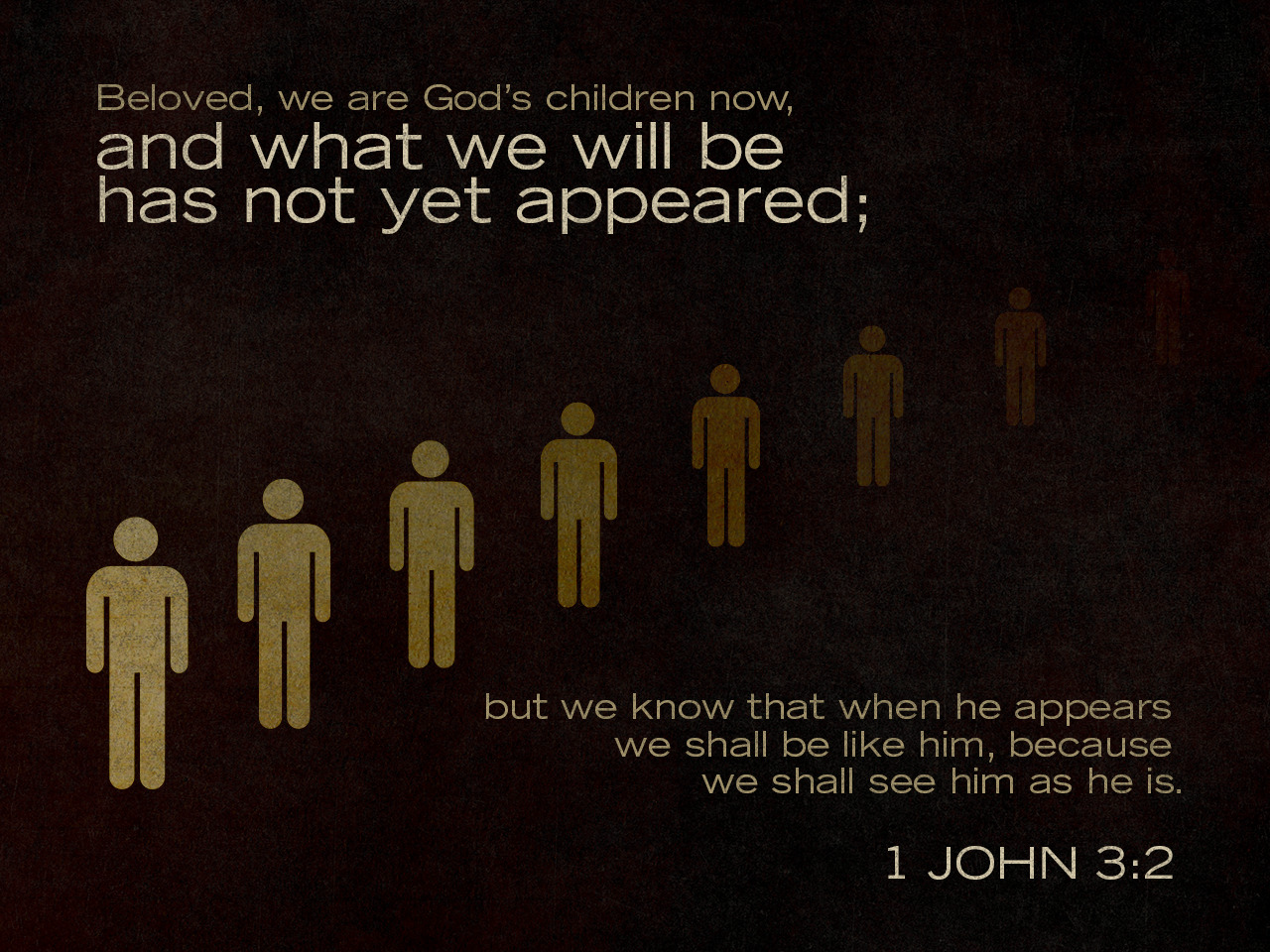
1 See what kind of love the Father has given to us, that we should be called children of God; and so we are. The reason why the world does not know us is that it did not know him. 2 Beloved, we are God’s children now, and what we will be has not yet appeared; but we know that when he appears we shall be like him, because we shall see him as he is. 3 And everyone who thus hopes in him purifies himself as he is pure.

Alleluia! Christ is risen!
He is risen indeed! Alleluia!

In the name of Jesus. Amen.

We live in a noisy world. On any given day, all sorts of things are constantly trying to grab your attention. We get dings and vibrations and taps that let us know who sent a message, what news story is breaking, or who liked that thing you posted. If you have to spend even ten minutes in a waiting room or a restaurant, you’ll find televisions turned to a game or news channel with the constant crawl of information that isn’t important enough, at least at that moment, to be on the main part of the screen. You’re watching the news about what’s going on in the Middle East and get the latest OJ Simpson’s death. Or you’re watching the NBA playoffs and learn about some guy’s hot take on what the Vikings are going to do in the first round of the NFL draft. And on and on it goes.

Now, this isn’t a sermon about how pointless and exhausting this barrage of information is. It’s just an acknowledgement of the conditions in which we live. Our attention is being constantly pulled in a myriad of directions, and all sorts of things shout at you, “Pay attention to me!” Well, this epistle reading (1 Jn. 3:1-3) is calling for your attention. In fact, it’s commanding you to pay attention. So, for the next few minutes, don’t be distracted, don’t be pulled, don’t be thinking about what’s going to happen this afternoon or this week or next summer. Right now, God, through His holy Word, calls you to focus and see. See this.

See the kind of love the Father has given to us. It is the kind of love that calls you, believer, a child of God. It is a love that calls all y’all, Christians, children of God. That is who you are – a child of God. Look around at the believers surrounding you here today, people whom you love and who love you, see that they through faith are also children of God.

See the kind of love that turns sinners and enemies of God into children. See the kind of love that isn’t earned or deserved. See God’s love for you that is demonstrated in that while we were still sinners, Christ died for us (Ro. 5:8). This is the purest kind of love. It’s God’s love that is not based on the lovableness of the individual. It’s a love that is freely given because, in spite of our unloveliness, God determined to seek your highest good and make you His child.

God’s own child, that is what you are, believer. That is what God has called you, and what God says creates reality. Everything in this world – including your own thoughts, opinions, and experiences – will try to convince you otherwise. It will attempt to get you to believe this isn’t true. Don’t listen to any of that. See. Behold. God’s love has made you His child.

Christian, God’s love has given you a new birth. In his Gospel, John says this explicitly. To all who did receive Jesus, those who believe in His name, He gives the right to become children of God (Jn. 1:12), and this right came when you were born again of water and the Spirit (Jn. 3:3, 5-6).

You confirmands, you have this new birth as a child of God. Logan, you received this new birth when you were Baptized on July 3rd, 2011 at Bigwoods Lutheran Church in Bigwoods, MN. Brayden, you were born again as God connected His Word to water on November 16th, 2013 at St. Henry’s in Perham, MN. Maddie, same place, but for you on April 16th, 2011 that was when and where you were born as a child of God. Brady, July 7th, 2013 right there at that font, you became a child of God. And Asher, same font, on November 25th2012, God declared that you are His child. The rest of you here, I’m sorry, but I don’t have your exact information in front of me.

This command to see this kind of love is in the present tense. That means it is a command that you always and continually see this kind of love. That love is to color everything else in your life. Keep holding on to that love because it is the most precious thing you could ever have. That love makes you God’s children now. Right now. What will we children of God be when we grow up? We don’t know, not yet.

John admits that even he doesn’t know exactly what glorious things are in store for us children of God. Think of that. John had seen some glorious things. He saw Jesus’ miracles and transfiguration. John saw the empty tomb. It was so glorious that he kept bragging about the fact that he outran Peter and was the first disciple to see it (Jn. 20:2-5, 8). The evening of Jesus’ resurrection, John had seen Jesus’ resurrected hands, feet, and side (Jn. 20:19-20; Lk. 24:36-43). As best as we can tell, John wrote this epistle after he had seen the vision of recorded in Revelation. That means John had seen Jesus clothed in a robe with a golden sash. He saw Christ’s eyes like a glorious flame of fire. John saw Jesus’ face shining like the sun in full strength (Rev. 1:13-16). And still John says here, “I don’t know what we children of God will grow up to be. I haven’t seen it yet because it hasn’t appeared” (1 Jn. 3:2). “But,” John says, “But we know that when Jesus appears we will be like Him, because we shall see Him as He is.” 

You confirmands and everyone here today, it can be dangerous to look to the past. And it can be troubling to think about the future. If you do look to the past, look at it through the lens of being God’s beloved child. When you consider your present, keep this command and see the constant love God has for you. When you look to the future, have in mind that you, through faith, are a child of God. And keep longing and hoping for that moment when Christ, your Savior, returns knowing that then you will be like Jesus.

That faith, that hope is what makes you pure – pure as Jesus is pure. God wants to orient you to the present reality that you are His child. Because of His love, you have a seat at His table where He gives you His Body to eat and His Blood to drink for the forgiveness of all your sin. You have a seat at His table. Child of God, as you wander through this world, know that you belong among God’s family. Welcome home, children of God. Amen.

Alleluia! Christ is risen!
He is risen indeed! Alleluia!

The peace of God, which surpasses all understanding, will guard your hearts and minds in Christ Jesus. Amen.

Unlocked – Sermon on John 20:19-31 for the Second Sunday of Easter

John 20:19–31

19 On the evening of that day, the first day of the week, the doors being locked where the disciples were for fear of the Jews, Jesus came and stood among them and said to them, “Peace be with you.” 20 When he had said this, he showed them his hands and his side. Then the disciples were glad when they saw the Lord. 21 Jesus said to them again, “Peace be with you. As the Father has sent me, even so I am sending you.” 22 And when he had said this, he breathed on them and said to them, “Receive the Holy Spirit. 23 If you forgive the sins of any, they are forgiven them; if you withhold forgiveness from any, it is withheld.”

24 Now Thomas, one of the twelve, called the Twin, was not with them when Jesus came. 25 So the other disciples told him, “We have seen the Lord.” But he said to them, “Unless I see in his hands the mark of the nails, and place my finger into the mark of the nails, and place my hand into his side, I will never believe.” 

26 Eight days later, his disciples were inside again, and Thomas was with them. Although the doors were locked, Jesus came and stood among them and said, “Peace be with you.” 27 Then he said to Thomas, “Put your finger here, and see my hands; and put out your hand, and place it in my side. Do not disbelieve, but believe.” 28 Thomas answered him, “My Lord and my God!” 29 Jesus said to him, “Have you believed because you have seen me? Blessed are those who have not seen and yet have believed.”

30 Now Jesus did many other signs in the presence of the disciples, which are not written in this book; 31 but these are written so that you may believe that Jesus is the Christ, the Son of God, and that by believing you may have life in his name.

Alleluia! Christ is risen!
He is risen indeed! Alleluia!

In the name of Jesus. Amen.

Normally, I try to have one main theme or point in my sermons. Today, I’m throwing that out the window, and you’re going to get three mini-sermons. Yes, each of them is mini.

Sermon #1 – Jesus unlocks the New Creation. When God the Father created the world, He formed man from the dust of the ground and breathed into his nostrils the breath of life, and man became a living creature (Gen. 2:7). Now in our Gospel text here, the resurrected Son of God stands among His disciples the very evening He rose, and He breathes on them saying, “Receive the Holy Spirit. If you forgive the sins of any, they are forgiven them; if you withhold forgiveness from any it is withheld” (Jn. 20:22-23).

The way the Holy Spirit inspired this to be written, we are supposed to see those two things – Jesus’ breathing on the disciples and also what He says about the Holy Spirit and forgiveness – as one action. In other words, Jesus’ statement is how Jesus breathes on the disciples. With the breathing of those words, Jesus is unlocking the new creation to you, believer. You who are in Christ through faith, you are a new creation; the old has passed away and the new has come (2 Cor. 5:17).

Sermon #2 – Locked doors don’t matter to Jesus. This text drops us into the room with the disciples Easter evening, so 1,991 years and seven days ago. It had been a chaotic day. Angels were appearing and talking to people. The resurrected Jesus has been popping up all over the place. Even with all of that going on throughout the day, the disciples and the women are gathered together in a house with the doors locked because they were afraid.

Luke in his Gospel also tells us about that evening (Lk. 24:36-49), and the way Luke records it, it seems like there is a disagreement between them all. It seems like some of them believe Jesus is raised, but some of them think something else is going on because Luke says that even when they see Jesus they think He is a ghost (Lk. 24:26-27). 

The way John words things here in v. 19, it makes it seem like Jesus invisibly goes through the locked door, but once He’s through He is suddenly visible. But listen to how Luke records it (Lk. 24:36): “As they were talking about these things, Jesus Himself stood among them, and said to them, ‘Peace to you!’” The way that is worded makes it seem like Jesus was right there the whole time, and He suddenly appears – He makes Himself visible – while they are all confused and trying to make sense of everything that had been going on that day.

Then, Jesus asks for some food, and He eats a piece of broiled fish because, of course, ghosts wouldn’t be able to eat food. Then Jesus shows them His hands, feet, and side (just like He does here). The disciples touch Jesus. Not only do they see Him, they also feel Him hug Him. Who knows? Maybe they even gave Him high fives and fist bumps.

Now, here’s the point of mini sermon #2: Just because you can’t see Jesus with your eyes, that does not mean that He isn’t here. Jesus promised, at least a few months before His crucifixion, “Where two or three are gathered in my name, there am I among them” (Mt. 18:20). Dear saints, Jesus is really, truly, actually here with us this morning. If He wanted to, He could appear and ask for something to eat. Anyone carrying a can of sardines? But even better, He is here and will give you His Body to eat and His Blood to drink. Jesus is here. So, believe.

Sermon #3 – Jesus has some unlocking for you to do. When Jesus gives the Holy Spirit, He gives Christians the authority to forgive and to bind sin (Jn. 20:22-23). Remember when the lame man was lowered through the roof to be before Jesus (Mt. 9:1-8; Mk. 2:1-12; Lk. 5:17-26); what did Jesus say to him? “Your sins are forgiven.” The Pharisees grumbled because they rightly said that only God can forgive sins. Then, Jesus proves He is God and has authority to forgive sins by healing the man. Well, the one who has the authority to forgive sins extends that authority to His Church the same day He rose from the dead.

I’ve used this analogy about absolution before, but it’s helpful and worth hearing it again. Imagine you are found guilty of a crime and locked in prison. As you sit in your cell, a judge looks over your case and rules that you are innocent. He sends an order to the guard of your prison to set you free. The guard comes to your cell with the keys, unlocks the door, walks you out of the prison, and releases you back into society. Now who set you free – the judge or the guard? Honestly, the answer is both. The judge uses his authority to free you, and the guard uses his hands and feet to free you. Both things work together – the judge’s authority and the guard’s releasing because of that authority. 

When we gather together as God’s people here in God’s house, it is right for us to confess our sins together. And it is right for the man you have called to be your pastor – which is me – to proclaim God’s absolution and forgiveness for those sins. In the church, the pastors are the guys with the keys (Mt. 16:18-19). And please know that I wouldn’t have the guts to declare that forgiveness if Scripture didn’t clearly say that is what I, as the pastor, am to do. That is why the absolution is “by Christ’s command and authority.”

And this authority isn’t only given to pastors to announce over congregations. Jesus gives all believers this authority. You can announce this forgiveness. If someone comes to you and tells you about their sin and guilt and shame, point them to Jesus. Tell them that Jesus is the Lamb of God who takes away the sins of the world. And tell them, “I forgive you of your sins because of what Jesus has done. And I do that because that’s what Jesus Himself would do.”

Dear saints, Jesus is way better at forgiving than you are at sinning. The absolution is a great gift that Jesus has given to the Church. That is the message Jesus has sent us into the world to announce (Jn. 20:21). That is the peace that Jesus gives when He says, “Peace to you.” It is the peace that declares those sins are gone. As far as the east is from the west, so far has Jesus removed our transgressions from us (Ps. 103:12).

Dear Ava, that brings me to you. Ava, today you are Baptized. Today, Jesus has joined you to Himself by placing His name upon you (Mt. 28:19) and clothed you with Himself (Gal. 3:27). In your Baptism, Jesus joined you to His death so that you have a Jesus-kind of death – in other words, a death that doesn’t last long and ends in resurrection (Ro. 6:3-11). Ava, you have been born of God; stay in the faith which overcomes the world (1 Jn. 5:4).

Our service today opened with 1 Pet. 2:2, “Like newborn infants long for the pure spiritual milk of the Word.” May all of us continually be fed and nourished by that Word that unlocks our sin and opens the way to eternal life. Amen.

Alleluia! Christ is risen!
He is risen indeed! Alleluia!

The peace of God, which surpasses all understanding, will guard your hearts and minds in Christ Jesus. Amen.

Silently Accused – Sermon on Matthew 26:1-27:66 for Palm Sunday

Matthew 26:1-27:66

In the name of Jesus. Amen.

It doesn’t matter how familiar you are with a passage of Scripture, there’s always something more to see, to glean, to meditate on. That’s true for short, familiar passages, but it is certainly true for a long passage like this. While preparing this week, what struck me in a fresh way is what Matthew tells us in Mt. 27:20. The chief priests and elders persuaded the crowd to ask for Barabbas and destroy Jesus.

Of the four Gospels, Matthew is the sharpest on this. They don’t persuade the crowd to just kill, execute, or even crucify Jesus. They want Him destroyed. That’s their desire.

There is utter malice behind this. Jesus looks so weak. He had already been betrayed by Judas. The other eleven disciples fled when He was arrested. Peter denied even knowing Him. Jesus had been mocked, spit upon, beaten, bound, and whipped. And they still call for Jesus to be destroyed. The cruelty of wanting Jesus destroyed is absolutely astounding.

But through all of it, Jesus barely speaks. Jesus talks a lot at the beginning of this reading while He is with the disciples, but once He is arrested, He only speaks three more times before His death here in Matthew’s gospel. All these false accusations are thrown at Him, but He doesn’t respond to any of them. Jesus just stays passive and silent as He is accused. Again, He looks weak.

During His trial before Caiaphas, all sorts of false charges are brought against Jesus, but He simply stands there and receives them. He doesn’t say a word. He only talks when Caiaphas demands, “Tell us if you are the Christ, the Son of God” (Mt. 26:63). But then, Jesus says, “You have said so. But I tell you, from now on you will see the Son of Man seated at the right hand of Power coming on the clouds of heaven.”

It sure doesn’t look like Jesus is seated at the right hand of Power through the rest of His Passion. His silence looks like weakness, but that’s not how we should see it. It is powerful.

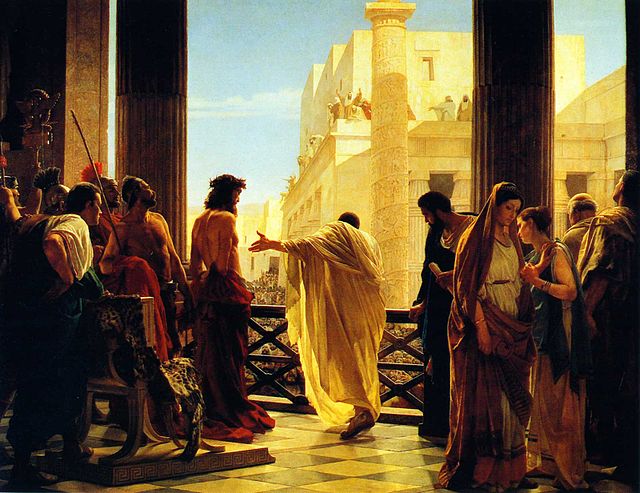
Jesus doesn’t speak again until Pilate asks Him, “Are you the King of the Jews?” There, Jesus says,“You have said so.” But again, as the chief priests and elders accuse Jesus before Pilate, Jesus is silent (Mt. 27:12). Even though Pilate asks Jesus to respond to all these accusations, Jesus still gives no answer, not even to a single charge. In His silence, Jesus looks weak and passive.

All of this reminds me of the scapegoat. Do you remember what God had commanded His people to do on the Day of Atonement (Lev. 16)? Each year, there were two goats. One was sacrificed and the blood of that goat allowed the high priest to enter the Holy of Holies. But the other goat, the scapegoat – it had a different purpose. The high priest laid both of his hands on the head of that goat and confessed all the iniquities, all the transgressions, and all the sins of the people. And God said that what happened there was that the high priest was placing all that sin on the goat’s head (Lev. 16:21).

And what do you suppose that goat did during that? It couldn’t object. The goat didn’t say, “Hey, what do you think you’re doing?” The goat remained passive and silent and simply received it. Once all those sins were placed on that goat’s head, it was led into the wilderness carrying all those sins away from the sinners (Lev. 16:22). The scapegoat and all those sins were destroyed, never to be seen again. Yes, the scapegoat was passive, but by it God powerfully removed those sins.

Pilate hears all these accusations and sees how Jesus is silent. He knows these religious leaders want Jesus destroyed for no good reason, but Pilate has an idea. Pilate has the notorious Barabbas in custody who had committed murder and started a riot and insurrection (Mk. 15:7; Lk. 23:18-19). Pilate puts Barabbas and Jesus forward as his nominees to potentially be released. It seems as though Pilate figured Barabbas was such a rotten individual and danger to society that the crowds would rather have Barabbas crucified for their own safety and protection. But the crowd calls out for Barabbas to be released and for Jesus to be crucified.

And that’s what Jesus wants too. So, Jesus stays silent, passive, and powerful.

It was God’s will that Jesus should be on the cross instead of Barabbas. By taking Barabbas’ place on that cross, Jesus also takes your place under God’s wrath against your sins.

God takes all this evil, malice, and injustice and uses it for your eternal good (Ro. 8:28). Jesus’ Passion isn’t a tragedy. It is God’s victory. In fact, this is the victory. Jesus’ silence in all of this isn’t weakness. It’s God’s power because this is God’s plan playing out. This is how God powerfully removes your sins from you as far as the east is from the west (Ps. 103:12). Jesus is crucified and heaven rejoices to see God’s great, powerful love for His creation. This is how God loves the world. This is how God loves you.

Jesus silently takes all those accusations, He is loaded up with all your sins, and He is led into the wilderness of death as He is crucified and destroyed. But death will no power over Him.

Dear saints, welcome to Holy Week. Easter is coming. Amen.

The peace of God, which surpasses all understanding, will guard your hearts and minds in Christ Jesus. Amen.

The Fight – Sermon on Matthew 4:1-11 for the First Sunday of Lent

Matthew 4:1–11

1 Then Jesus was led up by the Spirit into the wilderness to be tempted by the devil. 2 And after fasting forty days and forty nights, he was hungry. 3 And the tempter came and said to him, “If you are the Son of God, command these stones to become loaves of bread.” 4 But he answered, “It is written,

“‘Man shall not live by bread alone, 
but by every word that comes from the mouth of God.’”

5 Then the devil took him to the holy city and set him on the pinnacle of the temple 6 and said to him, “If you are the Son of God, throw yourself down, for it is written, 

“‘He will command his angels concerning you,’ 

and 

“‘On their hands they will bear you up, 
lest you strike your foot against a stone.’” 

7 Jesus said to him, “Again it is written, ‘You shall not put the Lord your God to the test.’” 8 Again, the devil took him to a very high mountain and showed him all the kingdoms of the world and their glory. 9 And he said to him, “All these I will give you, if you will fall down and worship me.” 10 Then Jesus said to him, “Be gone, Satan! For it is written,

“‘You shall worship the Lord your God 
and him only shall you serve.’”

11 Then the devil left him, and behold, angels came and were ministering to him.

In the name of Jesus. Amen.

Our Old Testament and Gospel readings today both record the devil coming to tempt. The first temptation was in the perfection of Eden and was aimed at Eve and Adam. The second was aimed at Jesus who was alone in the wilderness. In the Garden, Satan succeeded, and in the wilderness, he failed – and failed miserably. Now, in the past, we’ve considered how both of those temptations are similar and follow the pattern that the devil uses with us.

The devil is a one trick pony who tries to get Eve, Adam, Jesus, and you to doubt God’s Word. In the Garden, the devil asks, “Did God really say?” And when he is in the wilderness with Jesus, the devil starts his temptations with, “If you are the Son of God…” Remember, at Jesus’ Baptism, God the Father clearly said, “This is My beloved Son,” so the devil is trying to cast doubt on God’s Word again. He does the same thing In the temptations he throws at you. Now, this is extremely helpful to know and helps us fight against sin. But there is a very important difference between the temptations Satan lobs at Adam, Eve, and Jesus and the temptations he hurls at you. The difference, mainly, lies in the devil’s goal. Think through this for a minute.

In the Garden, the devil only needed to get Adam and Eve to sin once. One sin would rip all of humanity them from perfection and holiness and plunge them into fallenness and corruption. One sin and Satan figured he could stop working and retire to Arizona or Florida. But he was wrong. God completely upended the devil’s plan and promised to send the Seed of the woman to crush Satan’s head (Gen. 3:15). So, with his plans thwarted, the devil had to continue to tempt all people while he waited for that Savior to be born.

When Jesus entered creation, the devil again saw his chance for an early retirement. Here was that long-promised Seed of the woman. If he could just get Christ to commit one sin, then Jesus couldn’t be the Savior of all humanity. So, the devil waited until he thought the moment was ripe. After Jesus had fasted for forty days and nights, the devil came with these three temptations that he aimed at the second Adam (Ro. 5:14; 1 Cor. 15:45).

Do you see the difference? In the Garden with Adam and Eve but especially in the wilderness with Jesus, all it would take is one sin and the devil’s goal would be accomplished. Now, it wasn’t possible for Jesus to sin; He’s God and God cannot sin. But, hypothetically, if Jesus had sinned, there would be no Savior and no reconciliation with God. No mercy. No grace. No forgiveness. But, dear saints, that is not Satan’s goal when he tempts you. The devil’s goal is not to get you to sin once. No, he has to keep coming after you.

Because Jesus did not sin, the devil needs to continually tempt you – day after day, moment after moment. He can’t leave you alone; he has to keep pestering and tempting you. Even though you were born into the sin of your first parents, Jesus has rescued you by His perfect obedience. Now through faith, the devil does not own you; Jesus does. Christ has lived perfectly and has been tempted in every way as you are, but He did it without sin (Heb. 4:15). Jesus kept the Commandments in your place and credits His obedience to you through faith.

The day is coming when the devil will no longer be able to tempt you, but that day is not yet. So, the devil continues to work on you with his temptations, and you have to fight with all the resources God has given to you. Eph. 6:10-18 details the armor that God has provided for you – the belt of truth, the breastplate of righteousness, the shoes of the Gospel of peace, the shield of faith, the helmet of salvation, and the sword of the Spirit which is the Word of God. And remember when you read that passage, you are called to take up that armor and pray. Stand protected and call in the heavenly reinforcements to fight for you. God will send His holy angels to fight back against the devil on your behalf.

This is just an aside, but that is another difference between Jesus’ temptation and yours. Our Lord faced those temptations completely on His own. The angels only came to minister to Him after He resists the temptations and wins. You always have the holy angels assisting you in every moment and temptation. 

Today, you should recognize that the devil is going to be after you constantly to try to get you to fall into temptation and sin to draw you away from Jesus. But even knowing this offers a key strategy to help you in the fight.

Adam and Eve’s fall was instant. But because you are saved and bought by the blood of Jesus, the devil is going to try, little by little, to get you to slowly slip away from the faith. For example, the devil isn’t going to tempt you to blaspheme God; he knows better than that. You aren’t going to just curse God. But the serpent will tempt you to skip church or your family devotions. Satan is going to work, little by little, to harden your conscience toward sin. And this means, dear saints, you need to be actively working to soften your conscience. This is difficult, painful work, but it is work you need to do. Here’s how you go about that.

We’ll use the 5th Commandment as an example. The 5th Commandment, “Thou shalt not kill,” and the Small Catechism’s explanation, “We should fear and love God so that we do our neighbor no bodily harm nor cause him any suffering but help and befriend him in every need.” Now imagine your conscience has a 5thCommandment thermometer. There are degrees by which the 5th Commandment is broken. Genocide would be way up at the boiling point. A little below that would be mass murder, then murder, then hitting and physically harming your neighbor. Way down at the bottom would be anger because when Jesus explains the 5th Commandment, He equates anger with murder (Mt. 5:21-22). But anger doesn’t physically harm others like murdering or even hitting them does. Let me be clear, both are sin; both need repentance and forgiveness because they both break the 5th Commandment.

Now think about where your conscience registers guilt because of your thoughts, words, and deeds somewhere on that 5th Commandment thermometer. Maybe you don’t think twice about being angry in your heart because you figure everyone does it and that guy really was a jerk. But you wouldn’t go grab a baseball bat and hit him. So, the devil isn’t going to tempt you to do that sort of thing. Instead, what the devil is going to do is try to raise the temperature of your conscience just a bit. He’s going to try to get you to break the 5thCommandment with more anger or holding on to that grudge a little harder. Once the temperature of your conscience acclimates to that level of sin, Satan can graduate you to the baseball bat.

What you need to do, dear saints, is stop excusing your anger. Recognize and confess it for the sin that it is. Let go of that anger and continually soften your conscience to the working of the Holy Spirit. Think through all of the Commandments like this. Recognize where your conscience registers sin and take that sin to Jesus. Confess it for the sin that it is and hand it over to the Lamb of God who takes away that sin and nails it to the cross.

And know this. The softer your conscience becomes, the more you will feel your sin. Real sanctification and actually growing in holiness is going to make you feel more and more sinful and cry out like Paul does in Ro. 7:24, “Wretched man that I am! Who will deliver me from this body of death?” The one who will rescue you is your great high priest. He can sympathize with your weakness because He was tempted in every way as you are, yet without sin (Heb. 4:14). He invites you now to come with confidence, right here, to His throne of grace. Here you will find mercy and grace freely given to you in Jesus’ Body and Blood which will continue to strengthen you for the fight against the devil’s temptations. And as you fight, remember that God is faithful and will not let you be tempted beyond what you can bear. He has promised to provide the way of escape (1 Cor. 10:13). Amen.

The peace of God, which surpasses all understanding, will guard your hearts and minds in Christ Jesus. Amen.

Coming to Save – Sermon on Isaiah 35:3-7 for Quinquagesima Sunday

Isaiah 35:3–7

3 Strengthen the weak hands, 
and make firm the feeble knees. 
4 Say to those who have an anxious heart, 
“Be strong; fear not! 
Behold, your God 
will come with vengeance, 
with the recompense of God. 
He will come and save you.” 

5 Then the eyes of the blind shall be opened, 
and the ears of the deaf unstopped; 
6 then shall the lame man leap like a deer,
and the tongue of the mute sing for joy. 
For waters break forth in the wilderness, 
and streams in the desert; 
7 the burning sand shall become a pool, 
and the thirsty ground springs of water; 
in the haunt of jackals, where they lie down, 
the grass shall become reeds and rushes.

In the name of Jesus. Amen.

I promise that we’ll get to this text from Isaiah, but it will be in a roundabout way. When God commanded, “Thou shalt not steal,” He meant it. Stealing is a disruption of God’s creation. When God gives something to someone, that is where He wants it to be. That is why thieves were required to repay the ones they robbed. Throughout the Scriptures, God says that a thief must give back what was stolen, and that repayment comes with interest. If you rob someone of their money or goods but it can be recovered, God says the cost is to pay back double what was stolen (Ex. 22:4, 7). But God set a higher price for other things that were stolen – especially if they could not be recovered. If a thief stole and killed one sheep, he was required to pay back four sheep. For every unrecoverable stolen ox, the repayment was five oxen. And If you stole food, you have to pay that back sevenfold (Pr. 6:31).

The first robbery recorded in the Bible was a theft of food in the Garden of Eden. All of creation belonged to God, and He freely handed it over to the man and woman that He had created in His image. Every plant was nutritious and delicious. And God gave all the plants for food (Gen. 1:29) – except one tree, the Tree of the Knowledge of Good and Evil. That tree, like every other tree, belonged to God. It’s fruit was His, and He said, “You don’t get to eat it.” But that first couple reached out their hands, took God’s fruit, and ate it. They stole food from God.

Now, here’s the problem, how would they repay God sevenfold as the Bible requires? It’s more complex than it might sound. They couldn’t pay with more fruit from that tree. All the fruit that remained on the tree already belonged to God. And to make things worse, they couldn’t put the fruit they had eaten back because it had become part of them. The only way to restore the fruit would be for Adam and Eve to be put back on the tree. But even that repayment was impossible because now they were thieves and sinners. Because it was stolen, that fruit was cursed and infected Adam and Eve with death that was coursing through their veins.

For the seven-fold payment to be made, Adam and all his children, needed a new Adam to offer payment in their place. Jesus entered this world as that new, sinless, and perfect Adam (Ro. 5:14; 1 Cor. 15:45). Only Jesus, perfect God and perfect man, could make repayment for that theft. And that is exactly what He does.

In our Gospel reading (Lk. 18:31-43), we heard how Jesus restored the sight of blind Bartimaeus (Mk. 10:46-52) on the road outside of Jericho. And Jesus did this by taking Bartimaeus’ blindness into Himself (Is. 53:4; Mt. 8:17) while also restoring his sight. That miracle, and all of Jesus’ miracles, show that Christ was removing the venom of sin and death, putting creation back together, and making the payment for that original sin and all subsequent sins. But all of Jesus’ miracles were merely a beginning of the full repayment He was about to make. Bartimaeus’ eyes eventually went blind again when he died. That is why that full, seven-fold repayment for the thievery in Gen. 3 is only made when Jesus is pinned to the cross, sheds His perfect blood, and dies. All of that brings us to this reading from Isaiah.

What is weak is to become strong. What is feeble is to become firm. To you who are anxious and troubled in heart, God says, “Be strong; fear not! Behold, your God will come with vengeance, with the recompense of God.” Normally, when sinners hear about vengeance and recompense, they are afraid and rightly so. But notice what this vengeance and recompense accomplishes – God comes to save you. He pays the debt that you owe. He has avenged your sin upon His only begotten Son. The payment has been made; your sin is atoned for (Is. 6:7).

Throughout Jesus’ ministry, He healed many more blind people besides Bartimaeus. Christ opened the ears of many who were deaf. Our Lord made many lame people walk and loosened all sorts of tongues to sing for joy. Each of those miracles were a display of Jesus’ divine power and authority to fix what sin and death had brought to creation. All of Christ’s miracles showed that He had come to undo the curse of the Fall. And yet, they aren’t the fullness of what Jesus had come to accomplish. They were limited in scope. Here, Isaiah says all the eyes of all the blind shall be opened and all the ears of all the deaf unstopped. 

Jesus didn’t just come to open a few eyes and ears. He came to open all of them. When you read through the Gospels, Jesus is doing these miracles almost constantly. But there is no doubt that there were more blind and deaf in Israel and throughout the world that didn’t get the blessing of Jesus’ miraculous touch. In other words, there is more healing, more restoring, more removal of the curse to be done than Christ accomplished through His miracles.

But now that Christ has died and risen again, now that He is seated on the throne of all creation as the New Adam at the Father’s right hand, the curse of sin and death that hangs over all creation has been paid for. Your God has come and saved. And the day is coming when the eyes of all who are in the category of ‘blind’ will be opened. All the ears of the deaf will be unstopped. All the lame shall leap like a deer. And all the mute will sing for joy because the price has been paid. It has been paid by Jesus for you. Whatever parts of the curse still lay upon you have all been taken by Jesus. Christ has redeemed you by becoming a curse for you (Gal. 3:13).

As we move into Lent this year, we are going to consider what the suffering of Christ has accomplished. Out of God’s great love for you, Christ endured all the wrath, judgment, and death you deserved because of your sins. In Christ, God came to save you. Every illness, every malady, every pain, every sorrow you experience had a price, and that price was the precious death of God’s beloved Son.

And as we go on this Lenten journey, we do it remembering the destination – eternal life with God. Take a Bible and open to the end of Isaiah 35. Just after our text, Isaiah speaks of a highway. Listen to how Isaiah describes it. Isaiah 35:8-10, “And a highway shall be there, and it shall be called the Way of Holiness; the unclean shall not pass over it. It shall belong to those who walk on the way; even if they are fools, they shall not go astray. No lion shall be there, nor shall any ravenous beast come up on it; they shall not be found there, but the redeemed shall walk there.” Pause there for a minute.

All of that is to say that God has come to save you, and He has placed you on this highway. When you pass through areas of this highway that are dreadful, don’t worry because Jesus is with you. When you pass through areas of this highway that are delightful, remember, it is only the highway. The highway has its own joys and foretastes of what is to come, but the destination lies ahead. And what is that destination?

Back to Isaiah 35:10, “And the ransomed of the Lord shall return and come to Zion with singing; everlasting joy shall be upon their heads; they shall obtain gladness and joy, and sorrow and sighing shall flee away.” In other words, the point of the highway is the destination. The Resurrection, the new creation, the life of the world to come – that is your destination, believer. Don’t forget that.

Your God has come and saved you. Your journey is secure on God’s highway. How unspeakably great will it be when we arrive at our ultimate destination? Amen.

The peace of God, which surpasses all understanding, will guard your hearts and minds in Christ Jesus. Amen.