Isaiah 40:1-8
1 Comfort, comfort my people, says your God.
2 Speak tenderly to Jerusalem,
and cry to her
that her warfare is ended,
that her iniquity is pardoned,
that she has received from the Lord’s hand
double for all her sins.
3 A voice cries:
“In the wilderness prepare the way of the Lord;
make straight in the desert a highway for our God.
4 Every valley shall be lifted up,
and every mountain and hill be made low;
the uneven ground shall become level,
and the rough places a plain.
5 And the glory of the Lord shall be revealed,
and all flesh shall see it together,
for the mouth of the Lord has spoken.”
6 A voice says, “Cry!”
And I said, “What shall I cry?”
All flesh is grass,
and all its beauty is like the flower of the field.
7 The grass withers, the flower fades
when the breath of the Lord blows on it;
surely the people are grass.
8 The grass withers, the flower fades,
but the word of our God will stand forever.
In the name of Jesus. Amen.
I titled this sermon “Comfort Doubled,” but it maybe should have been “Infinite Comfort” because the whole text is dripping with comfort. Dear saints, whenever God comes, He comes to comfort you. Listen to what He says in v. 1 again, “Comfort, comfort my people, says your God.” These words are akin to what Jesus, who came not to call the righteous but sinners (Mt. 9:13), says in Mt. 11:28, “Come to Me, all who labor and heavy laden, and I will give you rest.” To any and all who are troubled, afflicted, and uncomfortable, God says, “Here is a double dose – two shots of comfort.”
Who gets this comfort? God’s people – whenever they are troubled. That means you. You are those for whom Christ was born. You are those whom God has claimed as His Own. You are the people for whom Christ has died. God says so Himself. He is the One who calls you, “My people,” and He is not ashamed to call Himself, “Your God.” If you play the first verse of this text backwards, God says to you, “I am your God. You are My people. And I give to you comfort on top of comfort.”
The context in which these verses were originally written helps us see just how comforting these words from God are. God has Isaiah tell Jerusalem that her warfare is ended, but when Isaiah writes these words Jerusalem isn’t even at war. Eventually, Babylon will come and besiege Jerusalem, and God’s people will be taken into exile. But even before any of that has happened, God comforts His people with the promise that her warfare will end.
Dear saints, God’s anger is but for a moment, and His favor is for a lifetime. Weeping may tarry for the night, but joy comes with the morning (Ps. 30:5). And before the suffering begins God preaches comfort to His people.
This is in line with God’s character, and we see this repeatedly in Scripture. Isaiah experienced this when God called Him to be a prophet. Isaiah saw God’s holiness and was terrified because he recognized his sinful lips. But God sent the seraph with a flaming coal to take away Isaiah’s guilt and atone for his sin (Is. 6:1-7).
Remember how the shepherds saw the glory of God (Is. 40:5) and were terrified? But the angel assured and calmed them saying that God’s appearance in the birth of Jesus was “good news of great joy that would be for all people” (Lk. 2:10).
And even think to our Gospel lesson. John the Baptizer was sitting in a dank, dark prison cell, likely knowing that he would soon be executed. In that dark moment, John sent some of his disciples to confirm that Jesus was indeed the coming Messiah. And Jesus sends them back to John with those beautiful words of reassurance, “The blind receive their sight and the lame walk, lepers are cleansed and the deaf hear, and the dead are raised up, and the poor have good news preached to them. And blessed is the one who is not offended by me” (Mt. 11:4-6). All of these are fulfillments of what the coming Messiah would do (Is. 29:18; 35:5-6). John’s disciples return to John to reassure him with Jesus’ words. And after John’s disciples leave, Jesus goes on to talk to the crowd about John, and I think there is comfort for you in how Jesus speaks of John.
Think of this. After John’s disciples leave, Jesus affirms the fact that John was the prophet who was going to prepare the way of the Messiah. And Christ confirms to this large crowd that there is no one born of women who is greater than John the Baptizer. Now, here’s why you should find this comforting:
When you are in the lowest moments in life, when you have doubts and grow weak, you would be pleasantly surprised to know who was defending you even though you might not know it. While John sits alone in prison, Jesus is in front of that large crowd gushing John’s praise. Remember that. Remember that especially when you get down on yourself for your shortcomings. Know that God doesn’t think of you in low terms even though you might. You are God’s beloved child. And do not forget what Jesus says, “Whoever acknowledges me before men, I will acknowledge before My Father and before the angels” (Mt. 10:32; Lk. 12:8). Dear saints be comforted. In any and every time of suffering, God brings His comforting words to you.
Ok. Back to our text from Isaiah. That final line of v. 2 may still make you scratch your head a little bit. This talk of receiving “from the Lord’s hand double for all her sins.” What is that all about?
Be careful with what you do with that verse in your mind. Unfortunately, we are often tempted to add a word to that sentence. We read it and add, “she has received double punishment for her sins.”
Why do we do that? Well, we all know what Scripture says, “The wages of sin is death” (Ro. 6:23). So, it is natural to think of punishment whenever we think of receiving something for our sins. But that can’t be what God means when He says His people have received double for all her sins. You wouldn’t speak tenderly and tell someone, “Your warfare is ended. Your iniquity is pardoned. And it’s ok. I’ve punished you twice for your sins.” That doesn’t fit the context.
Again, what is God giving here? Comfort. A reminder of punishment isn’t comforting. God has given double comfort. Christ came giving double for your sins. First, He took them away which brings comfort, and second, He gave you His righteousness which brings even more comfort.
You see, God doesn’t want you to receive any of His wrath or judgment. He doesn’t want you to pay for any of your sin.
Be comforted. Christ has come. Jesus has ended your warfare and pardoned you. You receive double from God for all your sins because your sin is already punished – not on you but on Christ. And in return, you are given Jesus’ righteousness, holiness, innocence, and good works.
This is how God’s accounting works; here is how God manages the debt of your sin. Jesus doesn’t just simply get you out of debt; He gives you an increase. In other words, imagine you stole $1,000 worth of stuff from God. Instead of simply forgiving the debt and calling it even, God gives you $1,000 more (Pr. David Petersen). That is how your God is for you.
Here is your hope, Christian. You have God’s comfort in all things.
There is nothing sure or lasting or certain in this world. Not the trees, not the mountains, not the grass or the flowers. Only this: the Word of your God stands forever. You can be sure of that. And by that Word you are forgiven, you are justified, you are sanctified, you are glorified, you are comforted, all in Jesus, and all for Jesus‘ sake.
Heaven is on your side. Your warfare is ended. Your iniquity pardoned. And no one, not even God Himself, will charge you for your sins because His Word of comfort stands forever.
You heard it at the beginning of our service, but it bears repeating. “Rejoice in the Lord always; again, I will say, rejoice” (Php. 4:4). Rejoice, rejoice, Emmanuel, God with you, shall come to you. Amen.
The peace of God, which surpasses all understanding, will guard your hearts and minds in Christ Jesus. Amen.
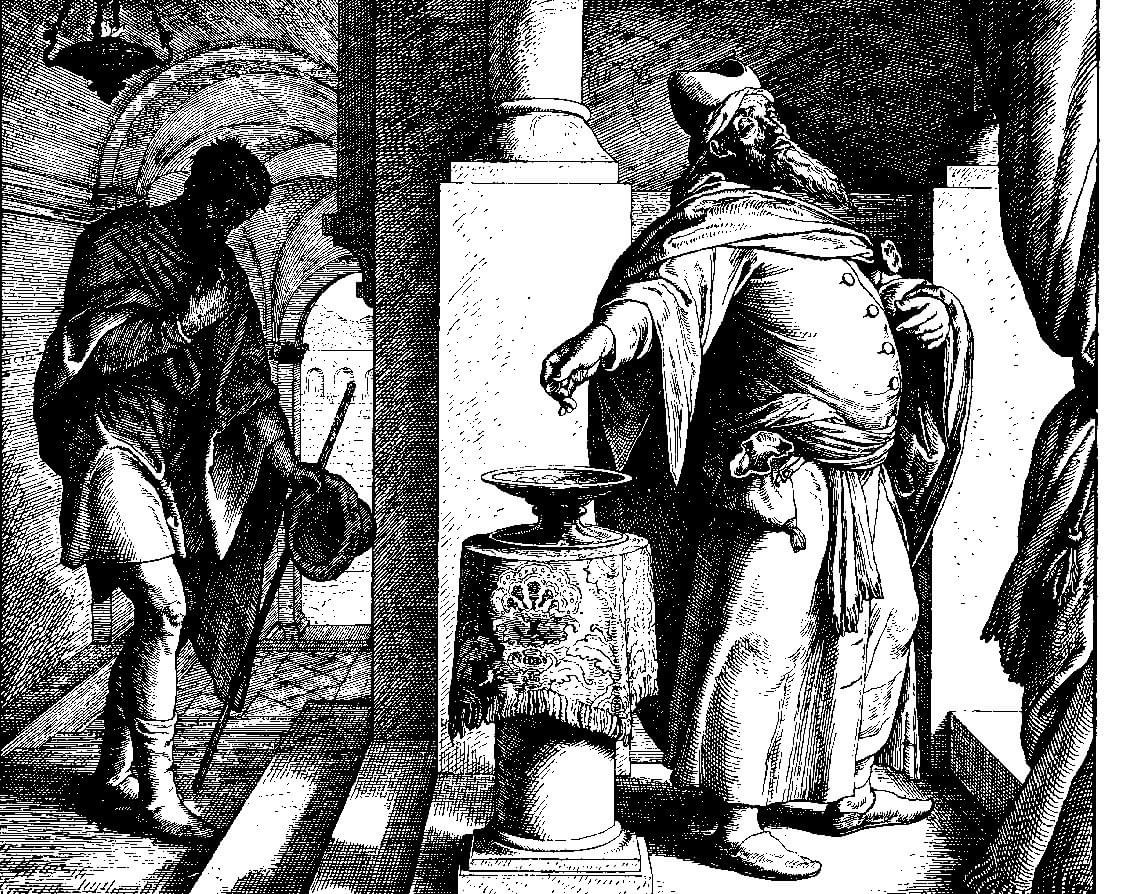 10 “Two men went up into the temple to pray, one a Pharisee and the other a tax collector. 11 The Pharisee, standing by himself, prayed thus: ‘God, I thank you that I am not like other men, extortioners, unjust, adulterers, or even like this tax collector. 12 I fast twice a week; I give tithes of all that I get.’ 13 But the tax collector, standing far off, would not even lift up his eyes to heaven, but beat his breast, saying, ‘God, be merciful to me, a sinner!’ 14 I tell you, this man went down to his house justified, rather than the other. For everyone who exalts himself will be humbled, but the one who humbles himself will be exalted.”
 The tax collector’s eyes of prayer are much different. He doesn’t look to heaven, and he doesn’t look at the sinners around him. He stands far off from the others, likely with his face to the floor, tears flowing down his cheeks, and beating his chest. He looks two places – at himself where there is no hope and to God where the only hope lies.
 When in the hour of deepest need
 The master had every right to reinstate the debts, but he doesn’t want his reputation of being merciful to be tainted. The master would rather eat the loss than have his mercy put into doubt. So, the merciful master praises and commends the dishonest manager for his shrewdness.
 When Jonah preached to the sinners of Nineveh in our Old Testament lesson (Jon. 3:1-10), they repented from their evil, violent ways. And for them, it was as crazy an idea as closing their eyes to enable invisibility mode. The king says in his proclamation, “Who knows? God may turn aside from His fierce anger, so that we may not perish.” In other words, “Let’s try repenting. It might work.” Dear saints, we do not have to wonder how God will respond to humble, contrite sinners. Our Epistle Lesson (1 Jn. 1:5-10) says, “If we confess our sins, God is faithful and just to forgive our sins and to cleanse us from all unrighteousness.”
 35 As he drew near to Jericho, a blind man was sitting by the roadside begging. 36 And hearing a crowd going by, he inquired what this meant. 37 They told him, “Jesus of Nazareth is passing by.” 38 And he cried out, “Jesus, Son of David, have mercy on me!” 39 And those who were in front rebuked him, telling him to be silent. But he cried out all the more, “Son of David, have mercy on me!” 40 And Jesus stopped and commanded him to be brought to him. And when he came near, he asked him, 41 “What do you want me to do for you?” He said, “Lord, let me recover my sight.” 42 And Jesus said to him, “Recover your sight; your faith has made you well.” 43 And immediately he recovered his sight and followed him, glorifying God. And all the people, when they saw it, gave praise to God.
 Joshua lead God’s people marching around those thick, fortified walls for six days, and on the seventh day, the people shouted and “the walls came a-tumbilin’ down.” Afterward, they burned the fallen rubble and reduced the city to ashes.
 On the cross, Jesus did everything for your salvation. On the cross, Jesus won the victory over sin, death, and the devil. But God delivers what Jesus did on the cross to you here and now. God delivers the mercy, grace, life, and salvation of Jesus through the preaching of His Word (Ro. 10:17), through your Baptism (Ro. 6:3-11), and through the Lord’s Supper (Lk. 22:14-20). God brings His holy deliverance to you through all those things, and as you receive those gifts of God through faith, you are saved.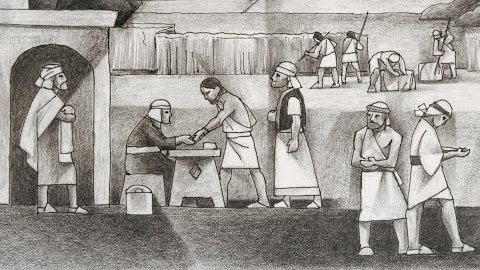
 Dear saints, welcome to the kingdom of heaven. In the kingdom of heaven, you are never rewarded based on your works or efforts because, if you received what you deserved, you would be sent straight to hell. In the kingdom of heaven, there are no formulas or set, hourly wages. You are given to based solely on the merits of Christ’s work for you. He is the only one who can say that He bore the burden of the day and the scorching heat. His atonement, His mercy, His grace is what you get, nothing less. Because of God’s unmerited, unearned, undeserved, unconditional love freely given to you for the sake of Christ, you are an heir of the kingdom of heaven. God be praised!
 Each of them was called, and each of them was called at the precise time the owner called them. He went and retrieved them.
 God had a reason for bringing you in when He did. Trust His timing. He brought you into His vineyard exactly when He wanted you.
 And it isn’t just their work. Your work, done as a Christian, is holy work. Fathers and mothers, the work you do day in and day out will reap results in the lives in your children, grandchildren, and great-great-great-great grandchildren if Christ tarries. But it will also reap results in the lives of others whom you will never meet because you have shined the light of Christ to those you have met, and they will shine that light elsewhere. You Sunday school teachers, you who are praying for and encouraging our youth, you trustees who are caring for our facility, and everyone who is here encouraging another person is offering holy work that will be used by God until Christ returns. Everyone has a story of being impacted by someone else long after that person has entered into glory. So, take heart, and keep working. The labor that God has called you to is fruitful, holy work. It is holy work that God will multiply and expand. For that, God be praised. Amen.
 “You brood of vipers! Who warned you to flee from the wrath to come? Bear fruit in keeping with repentance.” The text doesn’t explicitly say it, but it appears as though John refused to baptize at least some of the Pharisees and Sadducees. But why? Why do they get a tongue-lashing and no baptism?
 Now we come to our text. John is baptizing all these people. A thief comes confessing his stealing, an adulterer confesses his adultery, a liar confesses her sin, and John absolves and baptizes them. But then to the front of the line comes Jesus, and John knows Him (Lk. 1:39-45). They’re related to each other. John knows what the angel Gabriel told Mary, that this Jesus would be Son of the Most High, that He would reign over the house of God, and that His kingdom would have no end (Lk. 1:26-38). John knows the angel Gabriel told Joseph that Jesus would be the One to save His people from their sins (Mt. 1:18-25). John knows that Jesus is the sinless God in the flesh. And here He is coming to be baptized unto repentance for the forgiveness of sins? This shouldn’t be!
 But also, the same thing that happens to Jesus in his Baptism happens to you in yours. In your Baptism, you are given the gift of the Holy Spirit and are made God’s beloved child. In your Baptism, God intimately joins you to Jesus, and to His death and resurrection (Ro. 6:3-6).
 In your Baptism, God has given you the new birth of water and the Spirit (Jn. 3:5). In your Baptism, God has promised to wash away your sins (Act. 2:38-39), save you (1 Pet. 3:21), make you His child (Mt. 3:17), connect you to Jesus’ death and resurrection (Ro. 6:3-6), clothe you with Christ (Gal. 3:27), and fill you with the Holy Spirit (Tit. 3:5). So now, whenever wash your hands or take a shower, you can remember that God Himself has washed you clean and made you holy and sacred. Whenever you take a drink, you can remember that, in your Baptism, Jesus has given you to drink of the living water that wells up to eternal life (Jn. 4:10, 14).
 Pastorsamwise
You must be logged in to post a comment.