Matthew 20:1-16
1 “For the kingdom of heaven is like a master of a house who went out early in the morning to hire laborers for his vineyard. 2 After agreeing with the laborers for a denarius a day, he sent them into his vineyard. 3 And going out about the third hour he saw others standing idle in the marketplace, 4 and to them he said, ‘You go into the vineyard too, and whatever is right I will give you.’ 5 So they went. Going out again about the sixth hour and the ninth hour, he did the same. 6 And about the eleventh hour he went out and found others standing. And he said to them, ‘Why do you stand here idle all day?’ 7 They said to him, ‘Because no one has hired us.’ He said to them, ‘You go into the vineyard too.’ 8 And when evening came, the owner of the vineyard said to his foreman, ‘Call the laborers and pay them their wages, beginning with the last, up to the first.’ 9 And when those hired about the eleventh hour came, each of them received a denarius. 10 Now when those hired first came, they thought they would receive more, but each of them also received a denarius. 11And on receiving it they grumbled at the master of the house, 12 saying, ‘These last worked only one hour, and you have made them equal to us who have borne the burden of the day and the scorching heat.’ 13 But he replied to one of them, ‘Friend, I am doing you no wrong. Did you not agree with me for a denarius? 14 Take what belongs to you and go. I choose to give to this last worker as I give to you. 15 Am I not allowed to do what I choose with what belongs to me? Or do you begrudge my generosity?’ 16 So the last will be first, and the first last.”
In the name of Jesus. Amen.
To get at the main point of this parable, I’m going to borrow an analogy. Imagine two waitresses working at a small cafe by themselves. Suddenly, a man brings in eighty of his family members to celebrate an occasion, and those two waitresses have to serve this massive, unexpected crowd. One of the waitresses works hard the whole time. She does her best to get all the drinks and orders. She puts in the effort to make sure all the plates are served to the correct spots. She attempts to keep the glasses full of refills. She promptly comes to wipe up a spill. And even though she is flustered, she does all of this with a friendly smile on her face.
The other waitress is angry about the whole ordeal. She’s mad that such a large party didn’t call ahead to let them know they were coming so the restaurant could be properly staffed. She grumbles when extra napkins are requested. She intentionally lets some of the food sit for several minutes after it was prepared so that it isn’t hot when it is delivered to the table. And she interacts with the party as little as possible and pretends not to hear certain requests. This second waitress actually made the evening more difficult for the first, so difficult, in fact, that it would have been easier for the first waitress to do the whole thing herself.
When the party is ready to leave, the man who brought everyone in walks up to both waitresses and hands each of them a handsome 30% tip. Which of the two is going to complain? Right. The first. She would have preferred for the man to give her a 15 or even 10% tip so long as the second waitress got stiffed. She would rather get less if it meant that all her effort was recognized and appreciated.
 Dear saints, welcome to the kingdom of heaven. In the kingdom of heaven, you are never rewarded based on your works or efforts because, if you received what you deserved, you would be sent straight to hell. In the kingdom of heaven, there are no formulas or set, hourly wages. You are given to based solely on the merits of Christ’s work for you. He is the only one who can say that He bore the burden of the day and the scorching heat. His atonement, His mercy, His grace is what you get, nothing less. Because of God’s unmerited, unearned, undeserved, unconditional love freely given to you for the sake of Christ, you are an heir of the kingdom of heaven. God be praised!
That’s the main point of the parable. The sermon could end here, but it won’t. There are other points in the parable. Yes, they are minor points, but I have four that I know will be helpful and comforting to you today. So, I’d like to draw them out a little bit. And these points all come from a small phrase in the parable from v. 6that never jumped out at me before. Notice in that verse that when the master goes out at the eleventh hour, just before the sun begins to set and working day is ending, the master finds more people standing there in the marketplace waiting to be hired and asks them, “Why do you stand here idle all day?” Did you catch it?
“All day.” It means the guys hired at the very end of the day had been there all along. I can’t tell you how many times I’ve studied, taught, and preached on this parable, but I kept missing that phrase. I had figured these guys were lazy. I thought maybe they slept in, maybe they were trying to avoid working during the hot part of the day. But that’s not the case! They were there early in the morning, at dawn, when the master first went out to hire workers. And they were there at the third and the sixth and the ninth hour when he came. Most people would have given up and gone home around the sixth hour (which is noon). But no. When the master asks why they have been standing there idle all day, they say, “Because no one has hired us.”
Here’s the first point we can draw from that: no one who got paid their denarius at the end of the day decided on their own to go work for the master. Every one of them was called and sent only by the initiative of the vineyard owner. No one volunteered themselves for labor when he came, and no one went to knock at his door to ask, “Would you hire me to work in your vineyard?” Nope.  Each of them was called, and each of them was called at the precise time the owner called them. He went and retrieved them.
So, if you are a worker in the Lord’s vineyard, if you have been called into the service of the kingdom of heaven, i.e. if you are a Christian, you were called by God. Period. He came. He gave you work to do. You didn’t seek to work for Him. God called you into His service when it pleased Him. Some, God brings in early and has them work the whole day, but for some reason – a reason known only to God – He brings others in a later, at the third, sixth, ninth, and eleventh hour. If it had pleased the master to hire all of them at dawn, he could have.
Which brings us to second point. if you think that you are one of the early hires, if you have been a Christian your whole life and faithfully carried out your vocations, if you have been tempted at times to grumble for all your hard work or tempted to pat yourself on the back for what you have accomplished, be careful. Remember that it was not you who offered up yourself to work. You were called by the grace of God. “By grace you have been saved through faith. And this is not your own doing; it is the gift of God, not a result of works, so that no one may boast. You are his workmanship, created in Christ Jesus for good works, which God prepared beforehand, that you should walk in them” (Eph. 2:8-10).
Know this. God is pleased with your work. He designed all those works for you, and He laid them all out before you to serve those who needed God’s work offered through your hands. You will be rewarded, and you will be rewarded far better than you deserve.
The third point: Maybe you think that you are one of those who were called to work late. Maybe you are saddened by how much time you wasted pursuing a life of pleasure for yourself. If you think, “How much more good could have I done if I hadn’t been so foolish? If I had been studying Scripture earlier, I could have been of better service.” Dear saint, don’t get discouraged.  God had a reason for bringing you in when He did. Trust His timing. He brought you into His vineyard exactly when He wanted you.
The fourth point is also along those lines, and I know it will be comforting to many of you, so listen up! If you have been praying for someone who is not in God’s vineyard, or if you have been aching for someone who was once in the vineyard but left – maybe it is a friend or relative. If it seems like your prayers and efforts have been wasted, take courage. Don’t stop praying for them. Yes, God calls some early, but some aren’t called into the vineyard until later. Some are called so late that they only arrive in time to get paid which means they do no more than receive their gracious reward. Be comforted. God has His own timing. Keep praying.
One more thing. I know the most common way the different hours that the workers get hired is understood to be a time in each individual’s life. When it is interpreted this way, the workers hired first represent people who have been Christians their entire lives. They were given faith in baptism and continued in that faith until they died. Those who were hired at the third, sixth, and ninth hour are commonly viewed as those who came to faith later in life – as youth, adults, and seniors. And those hired at the eleventh hour are the deathbed converts. That seems to be a legitimate way to understand that detail of the parable, in fact, that is how this sermon has interpreted that detail up to now.
However, remember this parable is about the kingdom of heaven. 1 John 2:18, written almost two-thousand years ago, says that it is the last hour. In the book of Revelation, we get repeated pictures of the saints who have died and entered into glory, and they are still working by praying for us (Rev. 6:9-11). Also, consider Hebrews 11 that uses the faith and deeds of the Old Testament saints to encourage us. Then, Hebrews 12[:1-2] gives us a picture of the great cloud of saints surrounding us and cheering us on to keep walking in faith. And Revelation 14:13 says that those who die in Christ are blessed because they now rest from their labors, but – and this is the point – their deeds follow them.
Considering all of that, none of us can claim to be those who worked through the heat of the day. Rejoice that God is merciful and has and will continue to give to you far better than you deserve. But also, be encouraged because this means that your labor in Christ is never wasted and is valuable work that lives on after you are gone. Think of the labor done by the authors of Scripture – Moses, David, Isaiah, Matthew, John, and Paul– their labor continues to reap results for the kingdom of God today.
 And it isn’t just their work. Your work, done as a Christian, is holy work. Fathers and mothers, the work you do day in and day out will reap results in the lives in your children, grandchildren, and great-great-great-great grandchildren if Christ tarries. But it will also reap results in the lives of others whom you will never meet because you have shined the light of Christ to those you have met, and they will shine that light elsewhere. You Sunday school teachers, you who are praying for and encouraging our youth, you trustees who are caring for our facility, and everyone who is here encouraging another person is offering holy work that will be used by God until Christ returns. Everyone has a story of being impacted by someone else long after that person has entered into glory. So, take heart, and keep working. The labor that God has called you to is fruitful, holy work. It is holy work that God will multiply and expand. For that, God be praised. Amen.
The peace of God, which surpasses all understanding, will guard your hearts and minds in Christ Jesus. Amen.
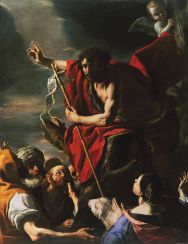 “You brood of vipers! Who warned you to flee from the wrath to come? Bear fruit in keeping with repentance.” The text doesn’t explicitly say it, but it appears as though John refused to baptize at least some of the Pharisees and Sadducees. But why? Why do they get a tongue-lashing and no baptism?
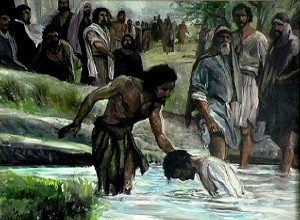 Now we come to our text. John is baptizing all these people. A thief comes confessing his stealing, an adulterer confesses his adultery, a liar confesses her sin, and John absolves and baptizes them. But then to the front of the line comes Jesus, and John knows Him (Lk. 1:39-45). They’re related to each other. John knows what the angel Gabriel told Mary, that this Jesus would be Son of the Most High, that He would reign over the house of God, and that His kingdom would have no end (Lk. 1:26-38). John knows the angel Gabriel told Joseph that Jesus would be the One to save His people from their sins (Mt. 1:18-25). John knows that Jesus is the sinless God in the flesh. And here He is coming to be baptized unto repentance for the forgiveness of sins? This shouldn’t be!
 But also, the same thing that happens to Jesus in his Baptism happens to you in yours. In your Baptism, you are given the gift of the Holy Spirit and are made God’s beloved child. In your Baptism, God intimately joins you to Jesus, and to His death and resurrection (Ro. 6:3-6).
 In your Baptism, God has given you the new birth of water and the Spirit (Jn. 3:5). In your Baptism, God has promised to wash away your sins (Act. 2:38-39), save you (1 Pet. 3:21), make you His child (Mt. 3:17), connect you to Jesus’ death and resurrection (Ro. 6:3-6), clothe you with Christ (Gal. 3:27), and fill you with the Holy Spirit (Tit. 3:5). So now, whenever wash your hands or take a shower, you can remember that God Himself has washed you clean and made you holy and sacred. Whenever you take a drink, you can remember that, in your Baptism, Jesus has given you to drink of the living water that wells up to eternal life (Jn. 4:10, 14).
 First, love is a beautiful summary of the Law, but that one word, love, does not replace the Law. Many people will say that since we have these two great commandments to love God and love our neighbor that we don’t need the rest of the Law. But that is false. Just because you think you are motivated by love does not mean that you are doing the right thing. We are so fallen that sometimes we try to pit love against the Commandments. Love is never an excuse to sin or an excuse to overlook sin. Instead, the Commandments define the shape of love, which is the second point about the Law.
 But, Christian, you know the answer. In fact, you have been taught this and have believed it for so long that you hardly think about it too much. But it is the most amazing thing. Jesus is man, born of His mother. And Jesus is God, begotten of His Father before all worlds. Jesus is man so that He can die, and He is God so that His death can be an atoning sacrifice for our sins.
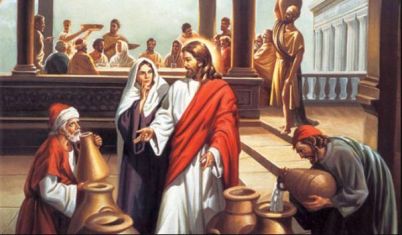 6 Now there were six stone water jars there for the Jewish rites of purification, each holding twenty or thirty gallons. 7 Jesus said to the servants, “Fill the jars with water.”And they filled them up to the brim. 8 And he said to them, “Now draw some out and take it to the master of the feast.”So they took it. 9 When the master of the feast tasted the water now become wine, and did not know where it came from (though the servants who had drawn the water knew), the master of the feast called the bridegroom 10 and said to him, “Everyone serves the good wine first, and when people have become drunk, then the poor wine. But you have kept the good wine until now.” 11 This, the first of his signs, Jesus did at Cana in Galilee, and manifested his glory. And his disciples believed in him.
 Jesus tells the servants to fill the jars with water, and they fill them up to the brim. And, at Jesus’ command, they take some of it to the master of the feast. The master tastes it, and it isn’t water anymore. It is wine. The master didn’t know. The guests didn’t know. Only Jesus, Mary, the servants, and the disciples know that this had been water miraculously turned into wine.
 But, dear saint, that is precisely the point. God is willing to give His gifts and mercy anyway. This isn’t a license to go on and sin because God will forgive you anyway. In fact, you are to abhor what is evil and hold to fast to what is good. Love one another. Outdo one another in showing honor (Ro. 12:9-11). And do all of that as you remember that God gives better than you deserve or appreciate.
 This miracle, on the other hand, is odd. It’s dirty. Maybe, you even find it disgusting. Jesus takes a deaf man who has a speech impediment off to the side. He sticks His fingers into wax-filled ears. God in the flesh spits (apparently, Jesus wasn’t taught how to give a proper wet-Willy). Christ literally seizes, not just ‘touches,’ the man’s tongue. And then, Jesus looks up to heaven. Sighs. And says, “Ephphatha,” which means,“Be opened.”
 Jesus had come to be the Lamb of God who takes away the sin of the world, not to be the audiologist who takes away the deafness of the world. Jesus had come to give eternal life through His death and resurrection, not to give a voice to the voiceless.
 Yes, Jesus sighs and acts. He gets involved with us even though it hurts Him. He cannot help Himself. In His love and mercy, He gets bound up in the mess we make and that others have made for us. He gets entangled in our sin. In fact, He becomes sin so that we might become the righteousness of God (2 Cor. 5:21).
 In the name of the Father and of the Son and of the Holy Spirit. Amen.
 The point of this parable at the twenty-eight-year-old’s funeral was that this famous rabbi had done enough good works to go to heaven early. In other words, be good, do good, and get rewarded. Santa Claus anyone?
 And, with the Gospel, there is no room for despair. God’s love has been poured out for you to save you. In Christ, God has won your salvation on the cross. On the cross, Jesus bore the heat of the day, the heat of God’s wrath. And you, believer, get His wages.

You must be logged in to post a comment.