Limping – Sermon on Genesis 32:22-32 for the Second Sunday of Lent

Genesis 32:22–32

22 The same night he arose and took his two wives, his two female servants, and his eleven children, and crossed the ford of the Jabbok. 23 He took them and sent them across the stream, and everything else that he had. 24 And Jacob was left alone. And a man wrestled with him until the breaking of the day. 25 When the man saw that he did not prevail against Jacob, he touched his hip socket, and Jacob’s hip was put out of joint as he wrestled with him. 26 Then he said, “Let me go, for the day has broken.” But Jacob said, “I will not let you go unless you bless me.” 27 And he said to him, “What is your name?” And he said, “Jacob.” 28 Then he said, “Your name shall no longer be called Jacob, but Israel, for you have striven with God and with men, and have prevailed.” 29 Then Jacob asked him, “Please tell me your name.” But he said, “Why is it that you ask my name?” And there he blessed him. 30 So Jacob called the name of the place Peniel, saying, “For I have seen God face to face, and yet my life has been delivered.” 31 The sun rose upon him as he passed Penuel, limping because of his hip. 32 Therefore to this day the people of Israel do not eat the sinew of the thigh that is on the hip socket, because he touched the socket of Jacob’s hip on the sinew of the thigh.

In the name of Jesus. Amen.

Everyone faces difficulties, but what do you do when something difficult stares you in the face? It probably depends on the situation. You might try to find another, easier alternative. You might try to get others to help and assist you. You might try to avoid that difficult thing altogether. A lot of times, the most difficult tasks come with the highest reward, so if you always try to avoid difficulties, you are also going to miss out on some of the greatest joys.

On the 4th of July in 2015, we were on a family trip in Colorado. We wanted to find a nice mountain hike that all of could enjoy. Our kids were 2, 4, 6, and 8 at the time. A quick search yielded a recommendation of the Hanging Lake trail. The review had some pictures that were breathtaking. It said the hike would only took an hour and claimed it was great for families. The person who wrote that review must be the 17th generation of sherpas who lead expeditions up Mt. Everest because I’ve since learned that that trail climbs 1,000 ft. (basically, 90-100 flights of stairs) over 1.2 miles. The thing that kept us going was hearing people hiking back down encouraging us, “Keep going. You’ve got a way to go still, but it’s totally worth it.” They were right. I can show you pictures after the service, but it’s one of the most stunning places I’ve seen on God’s green earth. Difficult? Absolutely. Worth all the pain and struggle? Also, yes.

God had given a promise to Abraham that the Savior first mentioned in the Garden of Eden (Gen. 3:15) would be one of his descents (Gen. 22:17). Jacob here was the third in that line. And Jacob faced difficulties his entire life, and, yes, many of those were self-inflicted. 

Jacob’s difficulties started in his mother’s womb as he wrestled with his twin brother, Esau before they were even born (Gen. 25:19-26). When they were older, Jacob took advantage of Esau’s hunger and purchased Esau’s birthright for a cup of stew (Gen. 25:29-34). Later, Jacob deceived their father, Isaac, into passing the blessing that was first given to Abraham on to him even though he was younger than Esau (Gen. 27:1-40). Because of that deception, Esau planned to kill Jacob, who had to flee (Gen. 27:41-45).

During his exile, Jacob ends up working for a guy named Laban, and his wages for seven years of work would be marrying Laban’s daughter, Rachel. But Laban tricked Jacob and gave him his daughter Leah instead of Rachel. Still, Jacob agreed to work another seven years to marry Rachel (Gen. 29:15-20). Despite all of the deception of his father-in-law, Jacob continued to work for Laban and was paid with certain portions of Laban’s flocks. But that was difficult too. Jacob had to plot against Laban throughout his employment (Gen. 30:25-43).

Finally, God told Jacob to move away from Laban and return to his origins (Gen. 31:3). But as he’s returning home, Jacob hears that Esau is marching toward him with 400 men, which was the standard size of an army in that day (Gen. 32:6). So, what does Jacob do? He prays, and I’ll summarize his prayer (Gen. 32:9-12), “Ok, God. You told me to go back home and promised to do good to me. I’m really thankful about that, but now Esau is coming, and I’m afraid that he’ll kill me. But You’ve promised to be with me. So, what’s going on?” But God doesn’t answer.

So, Jacob does what he’s always done when he is in a difficult situation. He takes matters into his own hands and starts plotting and scheming. He sends a massive, expensive gift from his flocks to Esau (Gen. 32:13-15). That’s his “plan A.” But Jacob isn’t done plotting. He also divides his family into two camps figuring, if Esau attacks one camp, the other one will be able to escape (Gen. 32:7-8). That’s Jacob’s “plan B.” Jacob also sends those two camps ahead of him across a stream while he stays behind on the other side. It almost seems like that’s his “plan C” thinking that if Esau wipes out his family at least he’ll escape so God can keep His promise. Like his grandfather Abraham did before him with Hagar and Ishmael, Jacob decides he needs to matters into his own hands so God can keep His promises.

God did have a plan to get Jacob out of this difficult situation, but God isn’t going to give Jacob a large army. It won’t be because of Jacob’s gift to Esau, or letting half of Jacob’s family escape, and God doesn’t deliver Jacob from this difficulty by anything Jacob does on his own.

Instead, God comes down. God comes down to wrestle with Jacob who, at this point, is 96 years old. Sure, Jacob lived to be 147 (see Gen. 47:28), but wrestling with anyone for an entire night, and having your hip thrown out of joint is going to take a toll on a person. So when you consider the whole context here, it seems as though God has two intentions with this wrestling. On the one hand, is seems like God is letting Jacob take out all his frustration on God Himself in a physical way. On the other hand, it seems like this wrestling is intended to make Jacob look weak. Keeping Jacob up all night isn’t enough, so God wrestles with him. And even that isn’t enough, so God also touches and dislocates Jacob’s hip socket.

The next day, when Jacob limps toward Esau, he looks so weak and pathetic that Esau runs to Jacob, and the two brothers embrace and weep together (Ex. 33:1-4).

All of this is further proof of what God says in 2 Cor. 12:9-10, “My grace is sufficient for you, for my power is made perfect in weakness.” This wrestling match left its toll on Jacob. For the rest of his life, Jacob was limping, and that limping served as a constant reminder that he had held on to God and refused to let God go until God blessed him. Every step of the rest of Jacob’s life, served as a reminder of that night when Jacob grappled with God and was blessed through it – even though that blessing came through the difficulty of limping the rest of his life.

Dear saints, I have two things for you to remember from this account. First, when you look at your life and all of God’s promises to you, remember first that you don’t need to give yourself over to bitterness or political machines or other contrived solutions to fight the difficulty and evil you face. Don’t think that God can only bring about His promises if you get your hands dirty with anger, hostility, and bitterness. God keeps His promises and is always faithful.

Second, remember that God knows what you need better than you or I do. And what you need may be a difficulty. Dear saints, whatever difficulty you have – if it’s pain or trauma or a disease that the doctors cannot treat or heal – yes, this is definitely a difficult, horrible thing that you have to face. But it is not a reason to despair and stop trusting God. Instead, it’s is a call for you to hope. In the brokenness of your flesh, remember Jesus who was broken Himself in order to crush the head of the serpent. And the day is coming when you and all who believe in Christ will be raised to a new life with no more suffering, pain, anguish, or difficulty.

Again, God’s power is made perfect in weakness. There’s no greater proof of that than in what Jesus has done for you by taking on your flesh; being beaten, mocked, whipped, and crucified; and by dying the death you and I deserve. So, in our limping, we do not lose heart, as 2 Cor. 4:16-18 says, “Though our outer self is wasting away, our inner self is being renewed day by day. For this light momentary affliction is preparing for us an eternal weight of glory beyond all comparison, as we look to not to the things that are seen but to the things unseen. For the things that are seen are transient, but the things that are unseen are eternal.” 

Dear saints, when you face difficult things and are struggling to even limp along, lean on God. Trust His promises. Jesus is there with you in your limping. Amen.

The peace of God, which surpasses all understanding, will guard your hearts and minds in Christ Jesus. Amen.

Ingredients of Great Faith – Sermon on Matthew 15:21-28 for the Second Sunday of Lent

Matthew 15:21–28

21 And Jesus went away from there and withdrew to the district of Tyre and Sidon. 22 And behold, a Canaanite woman from that region came out and was crying, “Have mercy on me, O Lord, Son of David; my daughter is severely oppressed by a demon.” 23 But he did not answer her a word. And his disciples came and begged him, saying, “Send her away, for she is crying out after us.” 24 He answered, “I was sent only to the lost sheep of the house of Israel.” 25 But she came and knelt before him, saying, “Lord, help me.” 26 And he answered, “It is not right to take the children’s bread and throw it to the dogs.” 27 She said, “Yes, Lord, yet even the dogs eat the crumbs that fall from their masters’ table.” 28 Then Jesus answered her, “O woman, great is your faith! Be it done for you as you desire.” And her daughter was healed instantly.

In the name of Jesus. Amen.

I want to start with an analogy that gets regularly used. Imagine two men who want to cross a frozen river with thick ice. One man doesn’t hesitate at all because he believes the ice is strong and stable. So, he gets in his ¾ ton pickup truck and drives straight across no sweat. The other man is terrified and trembling because he doesn’t trust the ice. He lays out as flat as possible to distribute his weight and crawls on his belly inch by inch and makes it to the other side. Both men had faith. The guy in the truck had a strong faith, and the guy wriggling on his belly had a weak faith. Was their success in crossing based on their faith? No. Obviously, one had an easier time than the other but they both succeeded in the goal of crossing.

Now imagine those same two men needing to cross the frozen river, but the ice is less than an inch thick. Again, the first man doesn’t hesitate at all because he believes the ice is fine, but he and his pickup plunge into the frigid river and are swept away. The other man is crawling because he’s worried about the thickness of the ice. But it doesn’t matter how careful he is. That thin ice cracks, and he’s swept away too. Now again, was their failure in crossing based on their faith? No. It was based on the thickness of the ice.

Here’s the point: Faith has an object; faith is in something. You can have a lot of faith, but if that faith is in the wrong thing it doesn’t matter how strong that faith is because the thing you believe isn’t right. The opposite is true too. You can have a tiny, little, weak faith in the right thing and that’s what matters because that thing can support that faith even though it’s weak.

For a long time now, you’ll hear people talk about being a “believer.” Ok, but a believer in what? That term is fine. The Bible uses it, but it needs more context. What is it that you believe? A newer term that seems to be gaining popularity is “a person of faith.” That one drives me nuts – as though faith is the thing that matters. Everyone has faith in something. A “person of faith” has faith in what? Honestly, an atheist is a person of faith. They are. An atheist believes that everything that exists came from nothing or believes that matter is eternal. An atheist believes, contrary to every observable fact, that the order and beauty we see in creation happened by mere chance. An atheist believes he knows enough to conclude that there is no designer or creator. Now that takes a lot of faith, but that faith is based on complete foolishness.

Christian, you can define your faith. The Creeds are excellent summaries of what you believe. The strength of your faith or the amount of your faith doesn’t matter as much because what you believe is solid, right, and true. The stronger your faith is, the better your life will be. Think back to the analogy of the two guys crossing the river: They both get across. The guy who has great faith gets across quickly and easily, but the guy who crawls still gets across.

We do want to grow in and strengthen our faith. Sometimes people will think that when Jesus calls us to have the faith of a child (Mk. 10:14-15) that He’s saying that a weak faith is fine. A child’s faith is not weak. Think about it. An infant can’t do anything on her own. But that infant has faith that simply crying will get her parents to spring into action to fix her problem – her hunger, need for a nap, or messy diaper. Infants actually have a strong faith that trusts the adults will take care of whatever needs that infant has.

Ok. All of that brings us to the text about the Canaanite woman. She is one of only two people in the Gospels who has a faith that gets praised by Jesus, “O woman, great is your faith!” (the other is in Mt. 8:10; Lk. 7:9). So, it’s good for us to consider what is it about this woman’s faith that makes it great enough that Jesus would praise it. Well, let’s consider the text.

The first ingredient of great faith is that it trusts that Jesus is the Savior of all mankind. This woman is an outsider – a Canaanite. She was part of the people that should have been eliminated because of their demonic worship. Psalm 106 talks about the failure of the Israelites to drive out the Canaanites and how that failure led to tolerating the pagan religious practices of the Canaanites. Because of that failure, the people were sacrificing their sons and daughters to the demons (Ps. 106:34-39).

It is no stretch to assume the reason this woman’s daughter was so severely possessed by a demon was because of her own actions and due to her pagan worship. If I’m wrong about that, I’ll apologize to this woman in heaven because we’ll meet her there. Now, despite all of that, this woman trusts that Jesus is herSavior and can help her and her daughter. So, she goes to Him and prays, which leads us to the second ingredient.

The second ingredient of great faith is that it is bold and persistent in prayer. This woman is unflinching. I know that it’s hard to hear how our Lord treats this woman. She cries out, and He ignores her. Jesus dismisses her and acts as though He doesn’t have anything for her. And, finally, Christ insults her by calling her a dog.

By the way, don’t let the way Jesus acts toward her make you think that Jesus is a misogynist or is racist. Look at the end of the account. Because He praises her faith, we know what He thought of all those prayers that came before. He loves this woman and her daughter. But in the middle of it the woman doesn’t know what Jesus thinks of her or her prayer. And despite the way she is treated, she keeps praying. She doesn’t let up. She keeps asking for relief and trusts that Jesus will deal with her according to His grace and mercy.

How many times have you prayed about something and it seems as though God is ignoring you or the situation gets even worse? That is not the time to stop praying. Great faith stays bold and steadfast even when it appears that God doesn’t care. Know that He does care and loves you.

The third and final ingredient of great faith is that it recognizes that God’s crumbs are more than enough. Now, getting rid of that demon was huge for the woman. It’s something she can’t do on her own. But her faith has such a high opinion of Jesus and His power that she recognizes that it’s no big deal for Him to conqueror that demon and expel it from her daughter. This woman recognizes that it is just a crumb for Jesus to completely defeat this demon who has crushed her soul, who has plunged her entire world into chaos and grief and suffering, and who has brought her all this pain and torment. It’s just a crumb. It’s no big deal for Jesus.

Dear saints, it’s nothing for Jesus to take away all your sins. He’s already done all the heavy lifting. So, it’s a simple task for Him now to forgive you, bless you, and grant you eternal life. He gives you better than crumbs. He gives you Himself to cure your soul and bring you unto eternal life with Him. Amen.

The peace of God, which surpasses all understanding, will guard your hearts and minds in Christ Jesus. Amen.

When Crumbs Become a Feast – Sermon on Matthew 15:21-28 for the Second Sunday of Lent

Matthew 15:21–28

21 And Jesus went away from there and withdrew to the district of Tyre and Sidon. 22 And behold, a Canaanite woman from that region came out and was crying, “Have mercy on me, O Lord, Son of David; my daughter is severely oppressed by a demon.” 23 But he did not answer her a word. And his disciples came and begged him, saying, “Send her away, for she is crying out after us.” 24 He answered, “I was sent only to the lost sheep of the house of Israel.” 25 But she came and knelt before him, saying, “Lord, help me.” 26 And he answered, “It is not right to take the children’s bread and throw it to the dogs.” 27 She said, “Yes, Lord, yet even the dogs eat the crumbs that fall from their masters’ table.” 28 Then Jesus answered her, “O woman, great is your faith! Be it done for you as you desire.” And her daughter was healed instantly.

In the name of Jesus. Amen.

Whenever you are reading Scripture, look for the surprises. To see the surprises in this particular text, we first have to recognize some things that are not surprising. This Canaanite mother cries out to Jesus because her daughter is severely oppressed by a demon. As harsh as this sounds, it is no surprise at all that her daughter is suffering at the hands of demons.

Jesus is in the district of Tyre and Sidon, and that region was the center of Baal worship. Baal worship, among other horrible things, included child sacrifice. Obviously, this Canaanite woman hadn’t killed her daughter as a sacrifice to Baal. But in that pagan culture, it was common to engage in occult practices and make deals with demons in order to make your fields more fruitful, to get revenge on someone, to make a person fall in love with you, and all sorts of other things. While we don’t know exactly what caused the girl to be demonized, both this woman’s background and what she says suggest that she does know, and it is very possible that it was because of something she had done. If she and her daughter were innocent regarding this demonic possession, the woman would be crying out for justice, but that isn’t what she cries out for. She cries out to Jesus for mercy. She sees her daughter’s suffering and feels guilt.

Let’s bring this to us today. Dear saints, be aware. Demons have not gone away. If you ignore their existence, it is to your own peril. Demons are real, and they are active. Even if you don’t read horoscopes, call psychic hotlines, use healing crystals or ouija boards – and don’t do those things, they are demonic and evil – but even if you don’t do those things, that doesn’t mean you aren’t opening up yourself to demons. Pornography can be a portal for demons. Getting drunk, giving in to your anger, or being lazy also opens you up to their influence (Col. 3:5-8; 2 Thess. 3:6, 11). In fact, all pet sins dabble in the demonic. We want to imagine that our sins are no big deal or excusable. They aren’t. Sin hurts both the sinner and the sinner’s immediate family. Repent. Know that Christ has defeated the demons and protects you from them. But engaging in pet sins is like dangling your bleeding foot in shark-infested waters. Don’t invite the demons into your life by continuing in those sins.

Now, that brings us to the first surprise in the text which comes in the woman’s initial prayer. She addresses Jesus as the Son of David, and that is a loaded term – especially from her. She’s a foreigner. King David never ruled over her people or her homeland. And yet there are all sorts of promises that a descendent of David would sit on the throne forever and save even the inhabitants of the pagan nations (Is. 11:10-16). And this woman believes Jesus is the Son of David who can help her and her daughter. Jesus is her last hope.

And that brings us to the second surprise. Jesus doesn’t answer her a word. Jesus is usually so quick to have mercy when called upon, but not here. More on that surprise in a minute.

First, we have to consider the disciples’ reaction to her. They pray and ask Jesus to send her away. Unfortunately, this isn’t surprising. It’s disappointing, callous, and sinful, but not surprising. They were tired of hearing her shrieking for mercy. They probably speculated that she is suffering because of her own wickedness. Their attitude and thinking toward her seems to be along the lines of, “Well of course your daughter has a demon. You’ve brought this on yourself. Jesus, if You’re not going to help her, at least tell her to take a hike.” But even though this speculation was probably correct, the disciples failed to have compassion.

Dear saints, too often we are like the disciples. We fail to have compassion on those who are suffering around us. When people are groaning under their suffering, that isn’t the time to be like Job’s ‘friend’ Zophar and say, “You’re getting what you deserve. In fact, your sins deserve even worse punishment” (see Job 11:6). Now, we cannot excuse sin or say that sin doesn’t really matter. Downplaying sin is also unmerciful. Don’t do that! There are times where we have to correct and rebuke, but when someone is crying out for mercy, rebuke is not appropriate. Point the suffering to Jesus, the Source of mercy. Comfort them with God’s promises of forgiveness and mercy in the midst their suffering. And pray that God will give you wisdom to know when to comfort and when to rebuke and correct (Jam. 1:5).

Back to Jesus’ surprisingly slow response in giving this woman mercy. First, Jesus ignores her. Then, Jesus says that He came only for the lost sheep of Israel. And finally, He calls her a dog. Yes, it’s surprising, but it shouldn’t be too surprising. Because He is God, Jesus knows this woman; He knows her daughter; He knows the struggles she and her daughter have had with this demon; and, most importantly, Jesus knows this woman’s great faith. There is no question that Jesus is putting her through the ringer, but what He is doing here is strengthening and purifying her faith.

Even though Jesus ignores her, dismisses her, and calls her a dog, she continues to dig her roots of faith deeper and deeper. You heard in our Epistle text (Ro. 5:1-5) that we can rejoice in our suffering because suffering produces endurance which produces character which produces hope. Jesus is using this woman’s suffering to strengthen her faith. Christ knows how much suffering this woman can take, and through that suffering her faith grows, matures, and gets stronger. Jesus uses her suffering for her good. That doesn’t mean that the suffering is good, but Jesus uses it to bring about good.

That leads us to the next surprise. The demon who is causing the suffering wants to destroy this woman and her daughter, but the demon utterly fails because he ends up driving her to Jesus. And Christ draws this woman in even closer to Himself.

Dear saints, when – not if but when – you suffer, flee to Christ. When you are suffering because of your sinful actions, because of the sin of others, or because God doesn’t immediately deliver you, dig your heels into God’s promises. In your prayers, remind God of what He has promised to do and hold Him to those promises. That is faith. Faith is trusting that what God has promised He will do, despite your experience.

That brings us to the final surprise. The woman says that she will be content with crumbs from Jesus table. Even though Jesus calls this woman a dog, she says, “Ok, Jesus. I’ll be a dog so long as I’m Your dog. It isn’t right for You to give me Your children’s bread. I don’t need bread. Crumbs from Your hand are all I need.” She’s content with crumbs, but here’s the surprise – she gets more than crumbs. She gets a full feast.

Jesus says, “O woman, great is your faith! Be it done for you as you desire.” This woman is one of only two people whose faith is praised by Jesus (Mt. 8:10). Jesus is the Bread of Life (Jn. 6:35). Even the crumbs that fall from Jesus’ table deliver mercy, life, and salvation. This woman gets the very thing she desired and more. Her daughter is delivered, and she receives everything Jesus came to give to sinners.

God’s mercy is of such a nature that it never falls in crumbs. God’s mercy is directly and precisely delivered to give exactly what is needed in every situation.

Right now, your Lord invites you to His table. Not to sit under it like a dog waiting for some crumbs to fall from a careless child. No, you are Jesus’ guest of honor. What you receive might look like crumbs to those who do not know what is being given. But through faith, you know that Jesus gives you a full feast of forgiveness, life, and salvation as He gives you His Body and Blood for the forgiveness of all your sins. Welcome to the feast. Amen.

The peace of God, which surpasses all understanding, will guard your hearts and minds in Christ Jesus. Amen.

When Prayer Gets Violent – Sermon on Matthew 15:21-28 for the Second Sunday in Lent

Matthew 15:21-28

21 And Jesus went away from there and withdrew to the district of Tyre and Sidon. 22 And behold, a Canaanite woman from that region came out and was crying, “Have mercy on me, O Lord, Son of David; my daughter is severely oppressed by a demon.” 23 But he did not answer her a word. And his disciples came and begged him, saying, “Send her away, for she is crying out after us.” 24 He answered, “I was sent only to the lost sheep of the house of Israel.” 25 But she came and knelt before him, saying, “Lord, help me.” 26 And he answered, “It is not right to take the children’s bread and throw it to the dogs.” 27 She said, “Yes, Lord, yet even the dogs eat the crumbs that fall from their masters’ table.” 28 Then Jesus answered her, “O woman, great is your faith! Be it done for you as you desire.” And her daughter was healed instantly.

In the name of Jesus. Amen.

In our Old Testament lesson today (Gen. 32:22-32), you heard how Jacob wrestled with God. Jacob was already tired and under a lot of stress. He was returning home after living with and working for his father-in-law for a couple decades, and he was approaching his brother Esau who had sworn to kill Jacob for taking his birthright and blessing (Gen. 27:41-42). The night before Jacob and Esau met, God came down to Jacob, and they wrestled mano a mano. Once the dust from their scuffle settled, God blessed Jacob and gave him a new name. Now, Jacob is known as ‘Israel’ which means ‘God strives.’

That text is a fantastic set-up for this Gospel lesson. Here, God has again descended, and Jesus wrestles with one of His creatures who, like Jacob, is already tired and afraid. This time, God’s opponent is a woman; she is a foreigner; and she is a pagan. Three strikes, so she should be out. But she approaches Jesus in great need. She comes boldly, and her prayer is violent. It doesn’t sound so violent in our translation. We heard that she is ‘crying out,’ but the Greek word there conveys the shrieking of a raven. We heard that she ‘knelt’ before Jesus, but the Greek word there is more along the lines of flung – she flung herself at Jesus feet.

Notice how she addresses Jesus with two titles: ‘Lord’ and ‘Son of David.’ In the Gospel of Matthew, only disciples address Jesus as ‘Lord.’ And she refers to Jesus as only an Israelite would with the kingly title, ‘Son of David.’ And her request isn’t for herself. Her little daughter is severely oppressed by a demon. So, her prayer checks all the right boxes. Jesus is the Lord and King. And He has come to destroy the works of the devil (1 Jn. 3:8). But Jesus acts in a way that can make us Christians feel a bit awkward.

Christ first ignores her. The disciples start praying against her and beg Jesus to send her away. Then, Jesus says, “I was sent only to the lost sheep of the house of Israel.” And when she flings herself into the dust before Jesus’ feet with a last gasp prayer, “Lord, help me,” Jesus calls her a dog. This isn’t the Jesus we are used to hearing about in the Gospels, the one who welcomes the lowly and despised, the one who heals, the one who casts out all sorts of demons.

But even though Jesus has her in a submission hold (figuratively speaking), this woman has one last punch to throw at Jesus to win this fight, and it’s a haymaker. Yes, Jesus has called her a dog, but she takes the insult. She says, in effect, “Yes Lord, I am a dog. I don’t belong or have any right to sit at Your table. I don’t deserve the bread that You feed to Your children. But if You call me a dog, I’ll be your dog. And I’ll be content with nothing more than what the dogs get. The crumbs from Your table are enough for me.”

After that statement, Jesus taps out, “O woman, great is your faith!” This is one of two times in the Gospels that Jesus praises someone’s faith (Mt. 8:5-13 is the other). “Be it done for you as you desire.” And her daughter was healed instantly.

This wrestling match between Jesus and the Canaanite woman reminds me of the parable of the unrighteous judge that Jesus tells in Lk. 18:1-6. In that parable, a woman repeatedly asks an unjust judge for justice. The judge just ignores her, but the woman keeps crying out for justice. Finally, the judge gives her what she wants because, according to the judge, the woman is beating him down with her continual requests. Luke tells us that Jesus told that parable to encourage His disciples to be persistent in their prayers because God is just and will not delay in answering.

There is no question, Jesus heard every one of this Canaanite woman’s prayers. Christ loved this woman and her daughter and had come to set them free from the oppression of demons. So, why did it take so long for Jesus to give her what she wanted, and why did He treat her like this? I think the only safe answer to those questions is, “I don’t know.” God’s ways are not our ways (Is. 55:8-9). But we can say this because Scripture clearly teaches it:

By delaying His answer to her prayer, Jesus purifies this woman’s faith. James 1:2-3 says, “Count it all joy, my brothers, when you meet trials of various kinds, for you know that the testing of your faith produces steadfastness.” And our Epistle Lesson today (Ro. 5:1-5) says that we can rejoice in our suffering because suffering produces endurance, and endurance produces character, and character produces hope. Jesus knows how much heat this woman can take, and she comes out the other side with a stronger faith than what she had before this violent wrestling match of prayer.

There is no question that Jesus sent trial after trial to this woman. But that is what makes her faith so beautiful. Rather than turning her back on Jesus for being a jerk, her roots sink in deeper. She knows there is no other help for her and her daughter. So, here is the real question. Can you trust God when, to all appearances, He ignores you? Can you trust God when the wicked prosper, when the world is falling apart, and when your loved ones die too early? Will you trust Him when He doesn’t do what you ask? Faith trusts in God even when it is contrary to experience and our fallen reason.

The greatness of the woman’s faith wasn’t in her confidence or certainty. Its greatness was in its weakness. Her faith was great not when she was crying, “Son of David have mercy on me,” but it was great when she says, “Yes, Lord. I am Your dog.” It was great then because it only wanted what He gave.

In your walk of faith, remember that God doesn’t keep every promise you can imagine. But He has, does, and will keep every promise He has made. When it appears – and please note, I said, appears – that God isn’t listening to your prayers and seems to be sending you away, have the ingenuity of this woman. When God tells you, “You are lost,” you can take God at His Word and cry to Him, “Yes, God. I’m lost; find me.” When God says, “You’re a sinner,” say, “Yes, God. I’m a sinner; save me.” When God says, “You’re dead,” cry to Him “Yes, raise me.”

Finally, don’t give up on your prayers. Keep wrestling in them. You can’t hurt God by getting too violent with your prayer. Jesus wants you, like this woman did, to continue bringing your requests to Him. Jesus says, “Ask, and it will be given to you; seek, and you will find; knock, and it will be opened to you” (Mt. 7:7). So, keep asking; keep seeking; keep knocking. God will answer in the best way and at the exact right time.

Dear saints, you can be bold in your prayers because Christ has come and restored peace between you and God; you now stand in God’s grace (Ro. 5:2). He will remember His mercy and steadfast love, and He will redeem you out of all your troubles (Ps. 25:6, 22). Amen.

The peace of God, which surpasses all understanding, will guard your hearts and minds in Christ Jesus. Amen.

The Canaanite School of Beggary – Sermon on Matthew 15:21-28 for the Second Sunday in Lent

Listen here.

Matthew 15:21-28

21 And Jesus went away from there and withdrew to the district of Tyre and Sidon. 22 And behold, a Canaanite woman from that region came out and was crying, “Have mercy on me, O Lord, Son of David; my daughter is severely oppressed by a demon.” 23 But he did not answer her a word. And his disciples came and begged him, saying, “Send her away, for she is crying out after us.” 24 He answered, “I was sent only to the lost sheep of the house of Israel.” 25 But she came and knelt before him, saying, “Lord, help me.” 26 And he answered, “It is not right to take the children’s bread and throw it to the dogs.” 27 She said, “Yes, Lord, yet even the dogs eat the crumbs that fall from their masters’ table.” 28 Then Jesus answered her, “O woman, great is your faith! Be it done for you as you desire.” And her daughter was healed instantly.

In the name of Jesus. Amen.

No one likes being insulted. I remember playing kickball in 7th grade and kicking a home run. One of the 8th grade girls on the other team complained to her teammates about not getting me out. I can still hear her saying, “Come on guys, we can’t even get string bean out!” It hurt, but, in her defense, calling me ‘string bean’ was probably accurate. I think I had just reached 6’ 2”, probably weighed all of 120 lbs. when soaking wet, and was as coordinated as a linguini noodle. And if I remember right, it wasn’t a home run because it was some high, majestic kick that cleared a fence. The ball probably made it to the outfield and they tried to throw it at me a couple times, but I was too skinny of a target. Back then, I was basically two dimensional.

Insulting words can hurt from certain people’s lips, but there are times words can feel insulting and we should not be offended because those words are simply true. A prime example of this is when God Himself doles out insults in Scripture. Jesus said that He came to call not the righteous, but sinners (Mt. 9:13). Yes, Jesus came for everyone, so Jesus is calling all of us ‘sinners.’ Jesus says that He came to seek and save the lost (Lk. 19:10), that means you and I are the ‘lost.’ When you read Ro. 3[:10b-18] there is a whole series of insults for all people. Here’s a few for you: no one understands, no one seeks for God, together they have become worthless, no one does good, their throat is an open grave, the venom of asps is under their lips, their mouth is full of curses and bitterness, their feet are swift to shed blood, in their paths are ruin and misery, the way of peace they have not known, there is no fear of God before their eyes.

In our text today, we have this Canaanite woman whose daughter is severely oppressed by a demon; she gets ignored, rejected, and even insulted by Jesus. But then Christ holds her up before us as an example of great faith because she continues to beg and pray to Jesus – the only One who can help her. In fact, she is only one of two people in all the Gospels whose faith is praised by Jesus. The other person whose faith is praised by Jesus is the Gentile centurion who had a sick servant (Mt. 8:5-13). Not even the disciples, who were personally called by Jesus, get praised for their faith. Because she has great faith, she has something to teach us. As Christians and disciples of Jesus, we should always learn from Christ, and here today, Jesus tells us to be learners and disciples of this Canaanite woman.

So, settle down class. Let’s all learn from our guest lecturer visiting us from the Canaanite School of Beggary.

This Canaanite woman comes to Jesus asking for mercy because, again, her daughter was severely oppressed by a demon. She is going to the right place – to Jesus – and asking Him to do exactly what He came to do. 1 John 3:8 says, “The reason the Son of God appeared was to destroy the works of the devil.” But what does Jesus do? “He did not answer her a word.”

According to this woman’s experience Jesus is completely ignoring her. But rather than letting her experience discourage her so that she goes away, she keeps crying out. She cries out so much that the disciples become embarrassed and tell Jesus to send her away. Not only is her experience with Jesus harsh, but this foreign Rabbi’s disciples are actually praying against her. And notice that still Jesus doesn’t address her. He answers the disciples. “I was sent only to the lost sheep of Israel.”

So now, this woman is not only fighting against her experience, she is also fighting against the disciples’ prayers and Jesus’ own words. When Jesus says that He’s only sent for Israel, it is reasonable to think that Jesus is saying that He was not sent for her. But she fights against what reason would say and stubbornly clings to her hope in Jesus. She kneels before Jesus and gives Him a command, “Lord, help me.” Finally, Jesus gives her some attention, but it’s devastating. He replies, “It is not right to take the children’s bread and throw it to the dogs.” And that is as insulting as it sounds.

I think it’s safe to say that if most people heard Jesus say this to them, they’d be looking for another god. But this woman knows there is no other help for her, so look what she does. She takes the insult, holds on to it for dear life and says, “Yes, Lord.” Then our translation, the ESV, does something weird here (so do all English translations); they translate the next word as ‘yet.’ Some other translations will use the word ‘but.’ (I think I understand why all the English translations use ‘yet’ or ‘but’ as their translation.) But the word there means ‘for.’ It’s one of the most common words in the New Testament, and of the 1,009 times it’s used in the New Testament this is the only place the ESV translates it as ‘yet.’ The problem with using ‘yet’ or ‘but’ is that it sounds like she is disagreeing with Jesus. She isn’t disagreeing with Jesus. Instead, she agrees with him. She confesses that she is a dog. “Yes, Lord, for even the dogs eat the crumbs that fall from their masters’ table.”

Basically, she is saying, “Ok, Jesus. You call me a dog? Then a dog is what I am. I don’t need the bread You give to Your children. You’re correct. It isn’t right to give Your children’s bread to a dog like me. Treat me like a dog and I’ll be more than content to get the crumbs that dogs get. The crumbs that the children drop without realizing it are enough for me.”

I think the first lesson we learn in the Canaanite School of Beggars is that we can be bold in our prayers. 

I love what Luther says when he preached on this text. (I included this quote in your bulletin insert.) “When we feel in our conscience that God reproaches us as sinners and judges us unworthy of the kingdom of heaven, then we experience hell and think that we are eternally lost. Whoever has this woman’s ingenuity should catch God in His own judgment and say, ‘Yes. Lord, it is true. I am a sinner and unworthy of Your grace. Nevertheless, You have promised forgiveness to sinners.’”

Dear saints, have the ingenuity of this woman. When God’s Law comes to you and says, “You are lost,” we take God at His Word and cry to Him. “Yes, God. I’m lost. Find me.” When God’s Law says, “You’re a sinner,” we say, “Yes, God. I’m a sinner. Save me” (Mt. 9:13). When God says, “You’re dead,” we cry to Him “Raise me.” And we can be bold when we pray these things. God has promised to do these things for the lost, the sinner, and the dead in sin. So we can take those promises, hold them in front of God’s face, and demand that He be true to His Word.

We actually had a little debate about this in our family this past week. I ran through this idea during our Bible time, and my family had a consensus that we should add a ‘please’ to these prayers. I’m glad my family has manners, but there might be times when we get frustrated with God because He appears to be continually denying our prayers for things He has promised to give us. In this text, it appears that Jesus isn’t going to answer this woman’s prayer.

Now, this whole event with might have lasted an hour or it might have been as short as fifteen minutes. But there is no denying that Jesus puts this woman through the ringer. In our lives, there may be times where it might seem that God is denying our prayers for days or weeks or years. Don’t stop praying. Grab God’s promises and hold them in front of His face like this Canaanite woman did. That’s faith, and Jesus praises that faith.

When the disciples ask Jesus to teach them how to pray, Jesus gives them the Lord’s Prayer. There isn’t one, “Please,” in that prayer. All the petitions of the Lord’s Prayer are imperatives – they’re commands. “Make Your name holy. Bring Your kingdom. Do Your will. Give us our daily bread.” Even the petition, “Forgive us our trespasses,” is a command. “Don’t lead us into temptation. Deliver us from evil.” Every last one of them is a command addressed to your Heavenly Father. Dear saints, be bold when you pray. Hold God to His promises. Like Jacob in our Old Testament lesson (Gen. 32:22-32), don’t let God go until He blesses you. According to Jesus, that is great faith.

Also, you can be consistent and constant in your prayers. After being bold in our prayers, I think that’s the other important lesson we should learn from the Canaanite School of Beggary. God wants you to annoy Him with your prayers. In fact, Jesus teaches two parables to this effect. The first one is in Luke 11[:5-8]. The parable is about a guy who knocks at his neighbor’s door at midnight asking for some bread to give to a guest who has just showed up. And because the guy keeps knocking the neighbor will get out of his bed, get dressed, and find some bread to give to him.

The other parable is Lk. 18[:1-7] where a widow keeps going to a judge to ask for justice. And the judge gets so tired of her asking, he finally gives her what she wants so she doesn’t beat him down with her continual requests.

This text is those two parables played out in real life. She keeps going to Jesus until He gives her what she needs.

Dear saints, like this Canaanite woman, you can take God’s insults because we are all beggars before God. And even when God seems indifferent, when He seems distant, and even when He insults you, you can keep asking boldly. You can do all this because God has sent His Son Jesus to die and rise again for you.

Because Jesus has done this, He has taken us beggars and made us His children. God is your Father, and He won’t let His reputation as your Father be tarnished. He will answer your prayers. It is His good pleasure to give you the kingdom (Lk. 12:32). He will remember His mercy and steadfast love for you. Amen.

The peace of God, which surpasses all understanding, will guard your hearts and minds in Christ Jesus. Amen.

Yes, Lord – Sermon on Matthew 15:21-28 for the Second Sunday in Lent

Listen here.

Matthew 15:21-28

21 And Jesus went away from there and withdrew to the district of Tyre and Sidon. 22 And behold, a Canaanite woman from that region came out and was crying, “Have mercy on me, O Lord, Son of David; my daughter is severely oppressed by a demon.” 23 But he did not answer her a word. And his disciples came and begged him, saying, “Send her away, for she is crying out after us.” 24 He answered, “I was sent only to the lost sheep of the house of Israel.” 25 But she came and knelt before him, saying, “Lord, help me.” 26 And he answered, “It is not right to take the children’s bread and throw it to the dogs.” 27 She said, “Yes, Lord, yet even the dogs eat the crumbs that fall from their masters’ table. 28 Then Jesus answered her, “O woman, great is your faith! Be it done for you as you desire.” And her daughter was healed instantly.

In the name of the Father and of the Son and of the Holy Spirit. Amen.

I told you at the beginning of the service, but do you remember what this Sunday is called? Yes, Remember Sunday (in Latin it is called ‘Reminiscere’). In the Call to Worship (Introit) we asked God to remember His mercy and His steadfast love (Ps. 25:6), and we asked God to not remember our past sins (Ps. 25:7). This is the form and shape of prayer. We ask God to remember His good and gracious promises to us, and we ask God to not remember our sins so that He will not be angry with us and reject our prayers. As an example of prayer, we have before us this Canaanite woman.

The woman is not part of the people of God. She was a Canaanite, a pagan who was involved in occult worship, and this is likely why her daughter was severely demonized. James 4[:7], says, “Resist the devil and he will flee from you.” It isn’t stretching the text at all to connect this woman’s Canaanite identity to her daughter’s terrible, horrific situation. Canaanites weren’t resisting the devil; they were dabbling in demonic stuff.

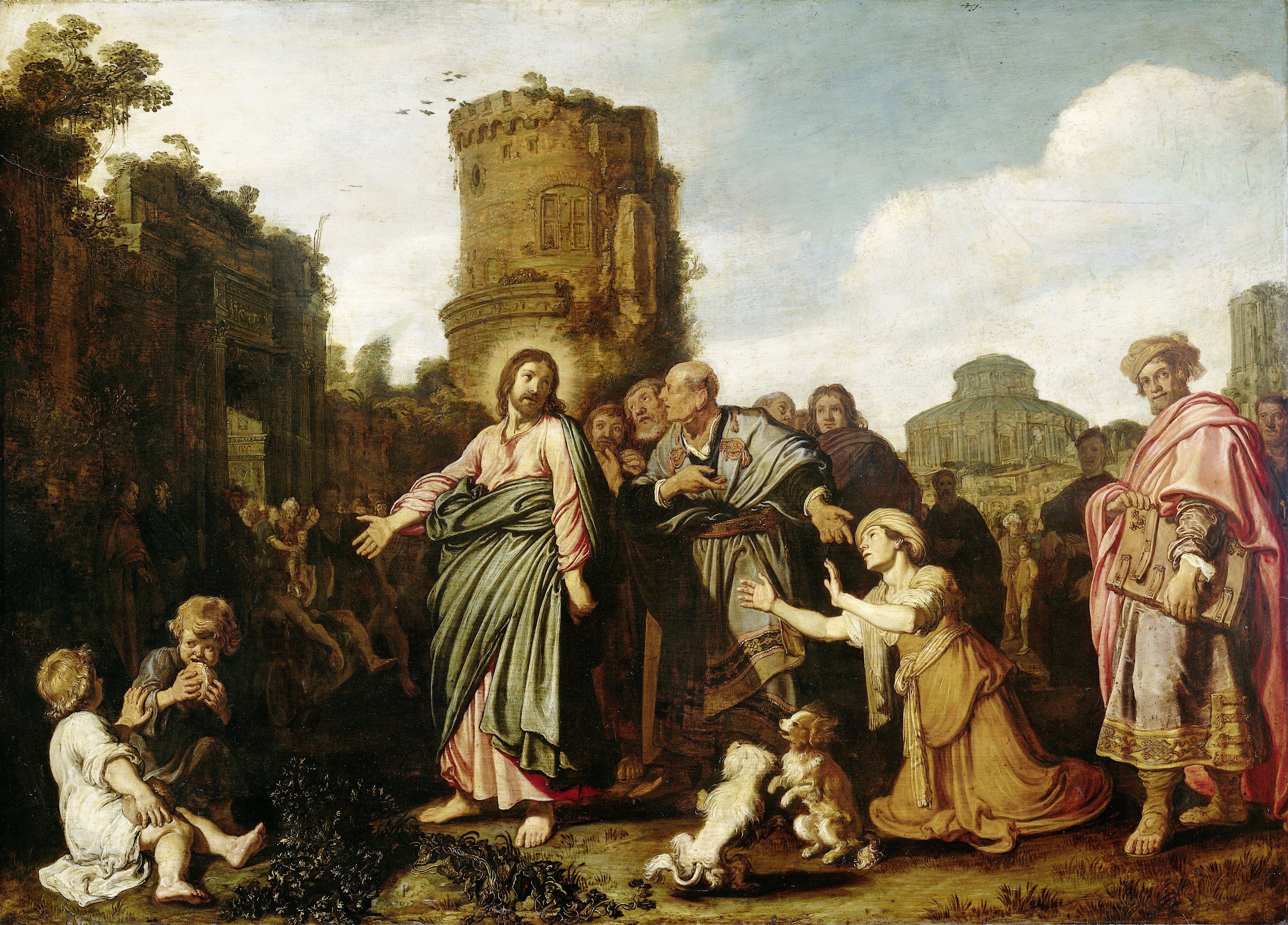
This woman knows that the demon oppressing her daughter is evil and that Jesus can help her. So, she prays. Jesus and the Syrophoenician WomanShe prays because she remembers that the God of Israel promised to deliver His people from the devil, which is why she addresses Jesus as the Son of David – to remind Him of His promises. And she remembers that she doesn’t deserve Jesus’ help because of her sins, so her prayer is, “Have mercy on me.”

She comes to Jesus in prayer, and what does your Savior do? He ignores her. He doesn’t answer her a word. But does she go away? Does she stop praying? No! She persists because she knows her trouble. She walks by faith and not by sight. She keeps praying because she knows that Jesus is the one who answers prayer. She prays so fervently that the disciples pray against her, “Send her away.”

So, Jesus answers the disciples, not this woman, “I was sent only to the lost sheep of Israel.” Now, at least this woman knows two things: First, she knows that Jesus has heard her prayer. And second, she knows that Jesus knows who she is – a Canaanite and not an Israelite, not part of God’s people. She continues to persist in prayer. She kneels down before Jesus and says, “Lord, help me.” And finally, she gets her own word from Jesus, “It isn’t right to take the children’s bread and throw it to the dogs.”Yes, Jesus called her a dog.

This looks to us like a terrible insult. It looks horrible, racist, and sexist. If you did this today, it would go ‘viral,’ and your reputation would likely be ruined. But in faith, this woman takes the insult. She says, “Yes, Lord.” In other words, “If You, Jesus, Son of David and Messiah, if You call me a dog, I’ll take it. I’ll be a dog. Go ahead and treat me like a dog. Just give me what the dogs get. I’m a dog, but dogs get crumbs. And a crumb is enough. Yes, Lord.”

Now, Jesus praises her faith. “O woman, great is your faith! Be it done for you as you desire.” And her daughter was healed instantly.

Here’s the thing. God insults you as well. The Bible calls you worse than a dog. God in His Word calls you a sinner. He says that you deserve His wrath and anger. God says that you don’t deserve anything good from Him because you have rebelled against Him and hate Him. But here is what faith does. Faith believes that word from God. Faith clings to God’s declaration that says you are a sinner.

Faith says, “Yes. Yes, Lord. I am a sinner.” But faith doesn’t stop there either. Faith says, “Yes, Lord. I am a sinner. But, Jesus, You have said, ‘I came not to call the righteous, but sinners’” (Mt. 9:13). Faith says, “Lord, treat me like you treat sinners.” In other words, “Remember Your mercy and steadfast love. Don’t remember my sin.”

Boone, today you are Baptized. Boone, though you were a sinner, Christ has died for you and risen for you. Today in your Baptism, Jesus has clothed you with Himself (Gal. 3:27). Christ connected His Word to water and washed you clean making you His child and heir (Gal. 3:7, 9). So, Boone, Jesus has given you a word to remember, a word to cling to. Always cling to that Word. Remember His love and mercy for you. When you sin, have the boldness to ask Jesus to be what He says He is, the Savior of sinners.

The Table of GodBoone, and all of you, be bold in your prayers. Even when it seems that God is distant and ignoring you, He hears you. He loves you. Jesus has died and risen for you and is even now interceding for you before His Father in heaven (1 Jn. 2:1).
Know also that Jesus doesn’t only let you have the crumbs that fall from His table. He has given you a seat at His table. He invites you now to come to His table to receive the Bread of Life from heaven – His very Body. Come and receive His Blood given and shed for you for the forgiveness of all your sins. Amen.

The peace of God, which surpasses all understanding, will guard your hearts and minds in Christ Jesus. Amen.

Wrestle – Sermon for the Second Sunday in Lent on Genesis 32:22-32

Listen here.

Genesis 32:22–32

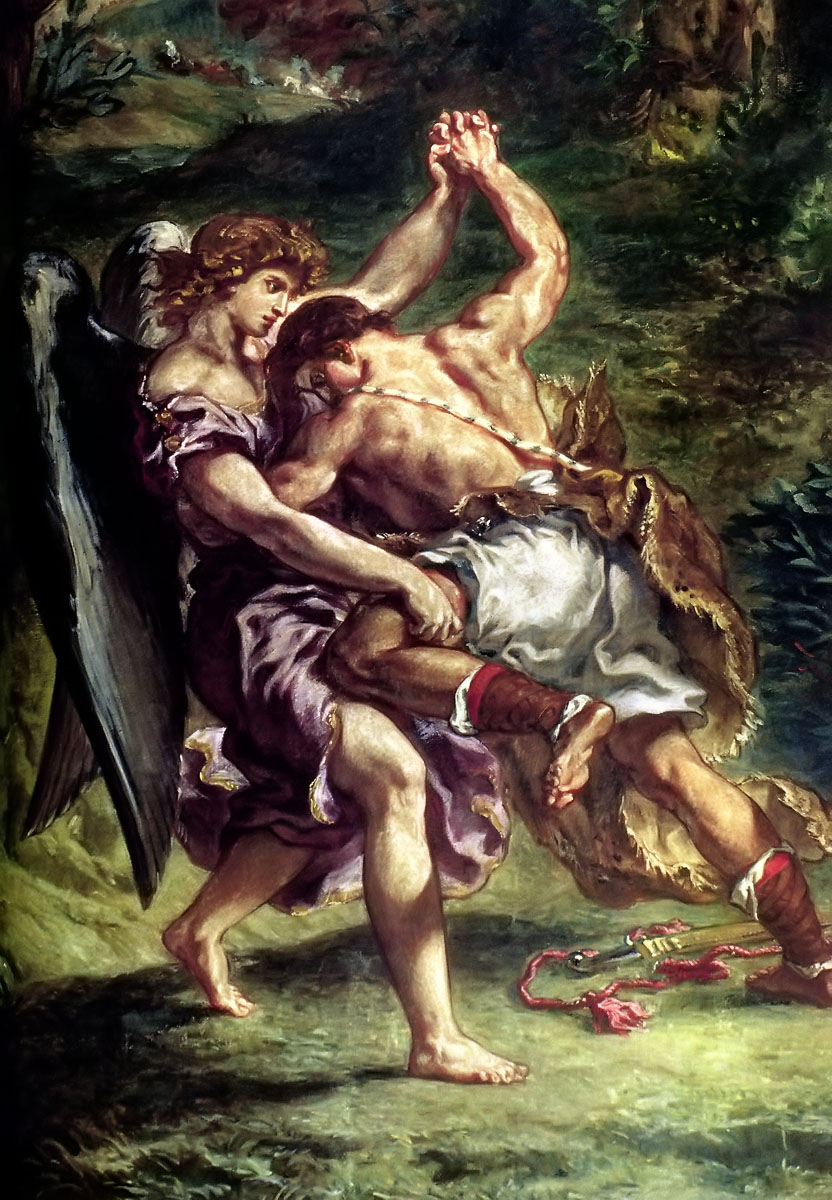
Jacob Wrestling with the Angel, Eugene Delacroix c. 186122 The same night [Jacob] arose and took his two wives, his two female servants, and his eleven children, and crossed the ford of the Jabbok. 23 He took them and sent them across the stream, and everything else that he had. 24 And Jacob was left alone. And a man wrestled with him until the breaking of the day. 25 When [he] saw that he did not prevail against [him], he touched his hip socket, and Jacob’s hip was put out of joint as he wrestled with him. 26 Then he said, “Let me go, for the day has broken.” But [he] said, “I will not let you go unless you bless me.” 27 And he said to him, “What is your name?” And he said, “Jacob.” 28 Then he said, “Your name shall no longer be called Jacob, but Israel, for you have striven with God and with men, and have prevailed.” 29 Then Jacob asked him, “Please tell me your name.” But he said, “Why is it that you ask my name?” And there he blessed him. 30 So Jacob called the name of the place Peniel, saying, “For I have seen God face to face, and yet my life has been delivered.” 31 The sun rose upon him as he passed Penuel, limping because of his hip. 32 Therefore to this day the people of Israel do not eat the sinew of the thigh that is on the hip socket, because he touched the socket of Jacob’s hip on the sinew of the thigh.

In the name of the Father and of the Son and of the Holy Spirit. Amen.

Ladies and gentlemen, welcome to the main event.

In this corner, we have a husband of two and father of eleven sons. But don’t let the fact that he is a family man fool you. He’s been a fighter all his life. Even in his mother’s womb, he was scrapping with his twin brother. He fights dirty and knows how to prey on weakness. He’s so ruthless that when that same brother was famished, he used food to steal a birthright. When his father was nearly blind, he covered himself with animal skins to steal a blessing. The meaning of his name says it all; I give you Jacob, the Deciever, son of Isaac.

And in this corner, we have a stranger. But don’t let his anonymity fool you either. He’s more powerful than any other being in all creation. When He looks defeated, watch out. He has finishing moves that will cripple you for the rest of your life. Before Abraham was, He is. The Alpha. The Omega. The Beginning and the End. I give you, the pre-incarnate Messiah – Jesus.

We are given front-row seats to this bout. Jacob has divided his family and sent them across the river. He is alone for the night to think about what will happen the next day when he will meet Esau, his brother. The last time Jacob saw any of his immediate family, his mother warned him that Esau was comforting himself with the thought of killing him (Gen. 27:42).

Suddenly, a man springs out of the bushes. And Jacob finds himself wrestling all night. Now, the Scripture doesn’t give us a very good play-by-play of the fight – at least not for the radio. V. 25 is full of ‘he’s’ and ‘him’s.’ But, the text makes it clear. Jacob prevails over Jesus (see also Hosea 12:3-4). But then, suddenly, the Man touches Jacob’s side. BAM! And Jacob’s hip is dislocated.

And the ‘he’s’ and ‘him’s’ continue in v. 26. He said, “Let me go, for the day has broken.” Who said that? Could be Jesus, but it could be Jacob. “I will not let you go unless you bless me.” Who said that? Could be Jacob, but it could be Jesus. And if it is Jesus, and I just want you to consider the possibility, Jesus is saying, “I will not let you go until you trust and believe in Me.”

Jesus asks Jacob for his name. And Jacob gives it to him, “My name is Deciever.” And Jesus says, “Your name will no longer be Deciever, but Israel,” which means ‘God fights.’

Jacob asks for the Man’s name, but he doesn’t get it. It seems as though that Jacob is still trying to be tricksy. The common thought back then was that if you knew the name of a god, you could control him. But Jacob doesn’t get the name. He doesn’t get to control Jesus.

So, what does this have to do with you? Should you be like Jacob and wrestle with God in prayer? Should you never give up until you make God answer all your prayers and bless you?

No. No, you are not stronger than God. Even though Jacob prevailed over Jesus in this wrestling match, it is clear who was in charge. At any point, Jesus could have ended the match by blasting Jacob into orbit.

For his whole life, Jacob had been relying on his own cunning and deceit. He had relied on his manipulation of others and his dirty tactics to make sure he always ended up on top. But in this wrestling match, God wanted Jacob to see that even when Jacob won, it was because of what God was doing by fighting for him. And by changing Jacob’s name to Israel, God cements that fact into Jacob’s very identity.

God fights, and He fights for you. It was God who promised our first parents that He would fight for them by sending the Seed who would crush the serpent’s head. It was God who fought against Pharaoh and delivered Israel out of bondage and slavery in Egypt. It was God who fought with the pagan nations who inhabited the Promised Land.

And it was God who took on the greatest fight of all, but in the strangest way imaginable. A Baby came to earth in a manger. That Child grew up and fought with the devil as he threw all his best moves tempting Jesus to fall into sin. Jesus beat Satan up there, but His final victory came when Jesus went to the mat of the cross facing your greatest foes.

Passion of Christ on the CrossLoaded with your sin and the sin of the whole world, He fights to the very end, to the last breath. And the fight looked lost. Jesus looked like a loser – dead, lifeless, buried. But, even in that apparent defeat, He rose victorious.

And Jesus keeps fighting. He fights for you. Jesus fights your enemies: sickness, sorrow, sin, and Satan. You may think that you face your enemies alone because God has abandoned you. He has not. You may feel like you are helpless, friendless, defenseless. You are not. You might even be tempted to believe that your worst enemy is God Himself. You would be wrong.

God is your wrestler. He is the one who fights for you. He will never leave you or forsake you. Jesus says that you are His. He has given you eternal life, and no one will snatch you from His victorious, nail-pierced hand (Jn. 10:28). Amen.

The peace of God, which surpasses all understanding, will guard your hearts and minds in Christ Jesus. Amen.