What Is the Sacrament of the Altar? – Sermon for Midweek Lent 1

The Scripture readings for tonight’s service are Psalm 23; 1 Corinthians 10:1-22; and Matthew 26:26-29.

I. What Is the Sacrament of the Altar?
It is the true Body and Blood of our Lord Jesus Christ,
under the bread and wine, given unto us Christians to eat and to drink,
as it was instituted by Christ Himself.

Luther’s Small Catechism

In the name of Jesus. Amen.

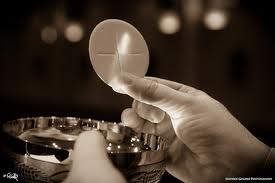
When Jesus instituted the Lord’s Supper, He gave the disciples bread which He said is His Body, and He gave the disciples the cup which He said is His Blood (Mt. 26:26-29). Next week, we will take more time to consider those words of institution. For tonight, we see that in the Lord’s Supper Jesus gives us His Body and Blood to eat and to drink. A couple of years ago when we considered Baptism during our Lenten services, we saw how Baptism is two elements put together: God’s Word and water. In the Lord’s Supper, there are three elements, factors, or ingredients: God’s Word, the elements of bread and wine, and Jesus’ Body and Blood. Those three things make up the Sacrament.

A helpful way for us to see what the Lord’s Supper is is to consider the different names we have for it: Lord’s Supper, Holy Communion, the Sacrament of the Altar, and the Eucharist.

First, we call it ‘the Lord’s Supper’ because that is what Paul calls it in 1 Cor. 11:20. It is the Lord’s Supper because it was instituted by our Lord Jesus Himself. Jesus instituted it, so He defines what it is. Jesus says it is the new covenant in His Blood which isn’t a little meal to fill bellies; instead, it delivers the gifts of His Body and Blood for the forgiveness of sins (Jer. 31:33-34).

Second, we call it ‘Holy Communion.’ Holy Communion is holy because Jesus, the holy One, gave it to us. It is holy because it delivers Jesus’ holy Body and Blood to us which then makes us holy as we receive it in faith. It is ‘Communion’ because of what you heard in our Epistle text (1 Cor. 10:1-22), “The cup of blessing that we bless, is it not a participation in the blood of Christ? The bread that we break, is it not a participation in the body of Christ?” (1 Cor. 10:16). The Greek word there for ‘participation’ is κοινωνία which means ‘fellowship’ or ‘common unity.’ Holy Communion unites us to Jesus, and when Christians are united to Jesus, they are also united to one another.

The third common term comes from the Small Catechism where Luther calls it ‘the Sacrament of the Altar.’ Even though this isn’t a term that Scripture uses, it is helpful because it highlights the fact that Jesus’ sacrificial death on the altar of the cross is given to us from the altars of His churches. What Christ accomplished on the cross, He delivers to you in the Sacrament of the Altar.

Finally, the church has also used the term ‘Eucharist’ after the Greek word for ‘thanksgiving’ which is εὐχαριστέω. Calling it ‘Eucharist’ reminds us how Jesus blessed the bread and wine by giving thanks before giving them to His disciples. It is also a reminder of our response to receiving it. We give thanks to God for giving us the gift of Jesus’ Body and Blood.

Again, because Jesus says it is His Body and Blood, the Lord’s Supper is not just a little snack we have at church before we head out the door. No, the Lord’s Supper is a heavenly meal.

In our Epistle text tonight (1 Cor. 10:1-22), we heard that after God’s people left Egypt, they all “ate the same spiritual food” (1 Cor. 11:3). For forty years, God fed His people with manna that appeared on the ground six days every week as God’s people wandered in the wilderness. Sunday through Thursday, they were to gather up enough to eat for that day. But on Friday, the sixth day, they were to gather enough for that day andfor Saturday, the Sabbath day, so they could rest on the Sabbath (Ex. 16:4-31).

The manna was the actual food that God provided to them to keep their bodies going. But the manna was providing more than just the calories they needed to live physically. The manna was also spiritual food that fed their faith by teaching them to daily trust in God’s provision and mercy. Psalm 78 remembers how God provided for His people during the exodus saying, “[God] commanded the skies above and opened the doors of heaven, and He rained down on them manna to eat and gave them the grain of heaven. Man ate of the bread of the angels; He sent them food in abundance” (Ps. 78:23-25).

The nutritional value of the Lord’s Supper wouldn’t keep our bodies going for very long because there isn’t much there, but that isn’t why Jesus gives it to us. Christ says that He gives us this heavenly meal for the forgiveness of our sins. He gives us food that feeds our souls and our faith by giving us a taste of heaven. As we receive Jesus’ Body and Blood in our mouth, we also receive the forgiveness of our sins in our heart by faith.

Now, there are some who say that simply taking Christ at His word about His Body and Blood being given in Communion is cannibalistic. They will say that when Jesus said ‘is’ what He really meant was this ‘represents’ or ‘symbolizes’ His Body and Blood. I’m not going to address that tonight, but I will in a few weeks. But I do want to say that Jesus giving His Blood to drink is pretty radical.

Right after the flood, God told Noah and his family that consuming blood was strictly forbidden because according to God, the life of the creature was in the blood (Gen. 9:4). Throughout Leviticus, God continued to forbid the consuming blood (Lev. 7:25-27; 17:10-12) saying, “The life of every creature is its blood: its blood is its life” (Lev. 17:14). There were and still are pagan cultures that dabble in demonic practices (1 Cor. 10:19-22) by drinking the blood of animals to get the power and ability of those animals. So, in the old covenant, God set apart the blood of each sacrifice to be used for atonement. By offering the lifeblood of those animals, God was showing His people that He accepted the death of another in place of the sinner.

This was pointing to Jesus. Now, Christ has come and fulfilled the old covenant and established the new covenant in His blood (Heb. 9:11-14, 10:11-14, 19-22). God accepts Jesus’ death and the shedding of His blood in place of the sinner. All the Old Testament sacrifices pointed forward to Jesus shedding His Blood and offering it to God as the one-time sacrifice for all sin. And in Holy Communion, the forbidding of consuming blood stops. Jesus gives you His blood to drink. Remember that God says, “the life is in the blood.” That means in the Lord’s Supper Jesus, the Son of God, gives you His Blood, God’s Blood, and God’s life – a life that that has conquered death and is eternal.

Dear saints, when you come to the Lord’s Supper, God prepares a table before you in the presence of your enemies (Ps. 23:5) and fills you who hunger and thirst for righteousness (Mt. 5:6) with the good things of His Body and Blood (Lk. 1:53) for the forgiveness of your sins and everlasting life. And for all of that, we give thanks. Amen.

The peace of God, which surpasses all understanding, will guard your hearts and minds in Christ Jesus. Amen.

The King in the Wicked City – Sermon on Luke 18:31-43 for Quinauagesima Sunday

Luke 18:31–43

31 And taking the twelve, he said to them, “See, we are going up to Jerusalem, and everything that is written about the Son of Man by the prophets will be accomplished. 32 For he will be delivered over to the Gentiles and will be mocked and shamefully treated and spit upon. 33 And after flogging him, they will kill him, and on the third day he will rise.” 34 But they understood none of these things. This saying was hidden from them, and they did not grasp what was said. 

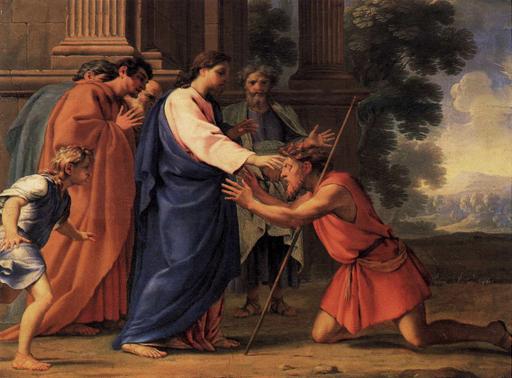
35 As he drew near to Jericho, a blind man was sitting by the roadside begging. 36 And hearing a crowd going by, he inquired what this meant. 37 They told him, “Jesus of Nazareth is passing by.” 38 And he cried out, “Jesus, Son of David, have mercy on me!” 39 And those who were in front rebuked him, telling him to be silent. But he cried out all the more, “Son of David, have mercy on me!” 40 And Jesus stopped and commanded him to be brought to him. And when he came near, he asked him, 41 “What do you want me to do for you?” He said, “Lord, let me recover my sight.” 42 And Jesus said to him, “Recover your sight; your faith has made you well.” 43 And immediately he recovered his sight and followed him, glorifying God. And all the people, when they saw it, gave praise to God.

In the name of Jesus. Amen.

Today, our text has us focus on two cities – Jerusalem and Jericho. Jerusalem was the city chosen by God to be the place where He would dwell with His people (1 Kgs. 8:10-11, 27-30). If anyone sinned; if God’s people were defeated in battle; if there was drought, famine, pestilence, or plague; they would pray toward God’s house in Jerusalem. God would hear their prayer and forgive (1 Kgs. 8:31-53; 9:3-5). According to Scripture, Jerusalem was a city firmly built together, and God’s people would go there to give thanks to God for all the blessings He had given them (Ps. 122:3-4). It was the city of King David, and God had promised that David’s line would never lack a man to sit on the throne as long as David’s sons walked in God’s ways (1 Kgs. 2:4).

Then, there is Jericho. God commanded His people, “Destroy Jericho. Never rebuild it. If anyone tries to rebuild it, I will consider that to be open idolatry and rebellion against Me. In fact, if someone tries to rebuild Jericho, laying the foundation will come at the cost of his firstborn, and setting up the gates will cost his youngest son,” (Jos. 6:2, 26). What happened? God led His people in battle against Jericho and its walls came tumblin’ down. But about 500 years later, Ahab was king of Israel and led God’s people into idolatry, and during Ahab’s reign, a guy named Hiel rebuilt Jericho. The foundation was laid, and his firstborn died. But Hiel kept going and set up Jericho’s gates at the cost of his youngest son (1 Kgs. 16:34). Whenever you read your Bible and come across Jericho after Joshua 6, think of it as ‘sin city’ because it is a city founded on idolatry and rebellion against God, and its very existence is wicked.

The cities of Jerusalem and Jericho could not be more different. But now, look at our text again. Jesus reminds His disciples, “Hey, we’re going up to Jerusalem. There, I’m going to be delivered to the Gentiles to be mocked, shamefully treated, spit upon, flogged, and killed just as the Scriptures said.” In other words, Jerusalem has joined with Jericho and is in open rebellion against God. But Jesus is purposefully going to Jerusalem to bear the curse of our sin (Gal. 3:3).

And to get to Jerusalem, Jesus must first pass through the wicked, cursed city of Jericho. When God gave Joshua the battle plans on how to defeat Jericho, God instructed that His people were to march around the city in silence once each day for six days then seven times on the seventh day. Then, after circling the city seven times, they shouted, and the walls of Jericho fell down flat (Jos. 6:20). Only then did they enter the city and destroyed everyone in it except Rahab and her household.

Here in Luke, it is almost as if Jesus is doing a similar thing. He is passing by (Lk. 18:36), but there is this blind man crying out, “Jesus, Son of David, have mercy on me!” Instead of quietly marching around Jericho, Jesus stops. It’s like Christ can’t help Himself. Even in the cursed city, Jesus doesn’t ignore cries for mercy because He is mercy embodied. He stops, stands still, and asks for the blind man to be brought to Him. There, in the wicked city, King Jesus, the Son of David, makes a kingly offer, “What do you want me to do for you?” Think of all the times throughout the Scriptures, a king will be pleased with someone and make an offer, “Ask me for anything, up to half my kingdom, and I will give it to you.” Here Jesus doesn’t put any limit on the request, “What do you want me to do for you?” The blind man answers, “Lord, let me recover my sight.” And Jesus says to him, “Recover your sight; your faith has made you well (lit. ‘saved you’).” Not only does the man get the sight he asks for, he gets more. Christ gives this resident of wicked Jericho life and salvation.

Dear saints, this same scene played out today just as it does every Sunday you gather here. Jesus comes into the midst of our wickedness. We beggars find ourselves in the presence of Jesus. We cry to Him for His kingly mercy, and Jesus doesn’t simply march around us and pass through. No. He hears your plea. He stops and stands still, and Christ the King answers your plea by absolving and saving you.

Jesus did that then, and He does that now because of what He is about to do in Jerusalem. Jesus could have, and maybe should have, marched around Jerusalem to destroy it with all their wicked plans for Him. But He doesn’t. Instead, He hangs still as He sheds His blood and pours out His mercy for you upon the cross.

Finally, notice the man’s response after his sight is restored. He can go wherever he wants with his new sight and salvation, but with every option open to him, he follows Jesus. The formerly blind man leaves his home in the wicked city of Jericho and follows Jesus to Jerusalem.

As we begin Lent this Wednesday, let us do the same as we follow Jesus as well. Let us abandon our wickedness and follow King Jesus to Jerusalem this Lent. He leads, and we follow with grateful hearts to Jerusalem, to the cross, and to the empty tomb on Easter.

This same King Jesus invites you now to your seat at His table, where He pours His love and mercy into you by giving you His Body and Blood given and shed for the forgiveness of all your sins. Dear saints, your faith in the crucified and risen Jesus has saved you. Amen.

The peace of God, which surpasses all understanding, will guard your hearts and minds in Christ Jesus. Amen.

Sackcloth & Ashes to Robes of Righteousness – Sermon on Joel 2:12-19 & Revelation 7:9-14 for Ash Wednesday

Joel 2:12-19; Revelation 7:9-14; Matthew 6:1-6, 16-21

In the name of Jesus. Amen.

Humanity’s first experiment with clothes didn’t work very well. You remember that God had created Adam and Eve without sin, and they were both naked and unashamed (Gen. 2:25). But after they sinned, Adam and Eve became aware of their nakedness. They saw their shame, and because of their disobedience, they now knew what evil was and were ashamed of what God had created to be good. So, they tried to cover their nakedness and shame with fig leaves (Gen. 3:7). Those fig leaves were Adam and Eve’s feeble attempt to cover their sin. It didn’t work.

When God came to the Garden, He was seeking them out asking, “Where are you?” (Gen. 3:9). Of course, God knew where they were, but He was giving Adam and Eve opportunity to repent. Adam knew his half-stitched leaf sewing wasn’t enough to cover his guilt. Adam replied, “I heard the sound of You in the garden, and I was afraid, because I was naked, and I hid myself” (Gen. 3:10). Fig leaves and hiding weren’t enough. Adam and Eve stood before a holy God utterly and totally incapable of covering their sin and shame.

Now, God had told Adam that the day he ate from the Tree of the Knowledge of Good and Evil that Adam would surely die (Gen. 2:17). And those fig leaves were no escape from the death sentence that Adam had earned by his disobedience. The problem of Adam and Eve’s sin and shame doesn’t get fixed until toward the end of Gen. 3 when God makes garments of skins and clothes them (Gen. 3:21). You’ve heard me say this before, but it needs regular repeating. When God makes cloths of skins for Adam and Eve, blood is shed. You can’t get skins from an animal without spilling blood. So, when God clothes Adam and Eve, He is teaching them that He will accept the death of another to cover their sin and guilt.

After clothing Adam and Eve, God did one more gracious thing – He expelled them from the Garden of Eden. We typically think of this exile from Eden and banishment from the Tree of Life as a further penalty (Gen. 3:22). But not so fast. This exile from the Garden wasn’t a punishment. Think about it for a minute. Adam and Eve were now sinners. If they ate from the Tree of Life as sinners, they would live forever in their sin. Dear saints, that is the definition of hell. Their expulsion from the Garden and inability to access the Tree of Life was God acting in grace and mercy. Clothed in those animal skins, Adam and Eve are sent out of the Garden and into exile, but their garments served as a constant reminder of God’s promise to crush the serpent’s head (Gen. 3:15).

Now, we’re going to change gears here, but stick with me. Tonight, we heard in our Old Testament lesson (Joel 2:12-19) God calling to humanity again. But this time, God isn’t calling us to come out of a hiding place in Eden. Instead, He is calling to us who are in the exile of sin. And in this invitation, God brings up the topic of clothing again.

God invites us to return to Him with fasting, weeping, and mourning. He says to rend and rip our hearts and not our garments. Rending and ripping clothes was a way to express and reveal deep sorrow. After all of Job’s possessions and children were destroyed, Job tore his clothes in mourning (Job 1:20). David tore his clothes when King Saul and his dear friend Jonathan were killed in battle (2 Sam. 1:11). The interesting thing about that verse from Joel about rending hearts and not clothes is what comes after. Notice in Joel 2:13 what comes immediately after the call to rend your heart: “Return to the Lord your God, for He is gracious and merciful, slow to anger, and abounding in steadfast love.” Even with your clothes rent and your nakedness uncovered, God invites you to leave your exile in sin, shame, and nakedness to return to Him to receive His grace and mercy.

Instead of simply an outward sign of ripping and rending clothes, God calls us to rend our hearts. God is calling for true repentance – not merely an external show of repentance. When a person rends their garments, it only reveals the nakedness and shame underneath. But after the problem is revealed, God calls us to a step further. Underneath our ripped cloths, lies a broken spirit and heart. And Ps. 51:17 tells us, “The sacrifices of God are a broken spirit; a broken and contrite heart, O God You will not despise.”

Tonight, our corrupt, sinful hearts are laid bare before God. Because of our sin we are under the same curse as Adam, “Remember you are dust, and to dust you shall return” (Gen. 3:19). The wages of our sin is death (Ro. 6:23), but God in His abundant mercy still seeks us out. He desires to save us and bring us out of our exile. And God has fulfilled His promise to cover our sin and shame. God has accepted the death of Another in our place. Jesus has taken your place. He went to the cross and hung there naked, and not just physically. He bore your all your sins in His body on the tree and by His wounds you have been healed (1 Pet. 2:24).

Our Epistle lesson (Rev. 7:9-14) shows what is in store for us. God has permanently covered us in Christ. Because of what Christ has done, we can sing with Isaiah, “I will greatly rejoice in the Lord; my soul shall exult in my God, for He has clothed me with the garments of salvation; He has covered me with the robe of righteousness” (Is. 61:10). You who are baptized into Christ have put on Christ (Gal. 3:27). Even now, you have a white robe that is washed perfectly clean in the blood of the Lamb.

Dear saints, because of what Christ has done, your sackcloth and your dusty ashes have been exchanged for the robe of righteousness. Your exile in sin and shame is ended because Jesus has won the victory over sin and death. By His resurrection, He has turned your mourning into dancing and loosed your sackcloth and clothed you with gladness (Ps. 30:11). By God’s action of seeking you out, you have returned to His presence, and now He welcomes you as His beloved bride (Is. 54:5). Your time in exile is over. You have returned to God. And there is treasure in heaven laid up for you. A treasure that lies hidden with Christ where moth and rust do not destroy and where thieves do not break in and steal (Mt. 6:19-21).

Dear saints, come. Come clothed in Jesus’ righteousness. Come to God’s table and receive Christ’s body and blood for the forgiveness of all your sins. He welcomes you home. In Jesus’ name. Amen.

The peace of God, which surpasses all understanding, will guard your hearts and minds in Christ Jesus. Amen.

The Devil’s Lie – Sermon for the Fifth Sunday in Lent on John 8:42-59

Listen here.

John 8:42–59

42 Jesus said to them, “If God were your Father, you would love me, for I came from God and I am here. I came not of my own accord, but he sent me. 43 Why do you not understand what I say? It is because you cannot bear to hear my word. 44 You are of your father the devil, and your will is to do your father’s desires. He was a murderer from the beginning, and does not stand in the truth, because there is no truth in him. When he lies, he speaks out of his own character, for he is a liar and the father of lies. 45 But because I tell the truth, you do not believe me. 46 Which one of you convicts me of sin? If I tell the truth, why do you not believe me? 47 Whoever is of God hears the words of God. The reason why you do not hear them is that you are not of God.”

48 The Jews answered him, “Are we not right in saying that you are a Samaritan and have a demon?” 49 Jesus answered, “I do not have a demon, but I honor my Father, and you dishonor me. 50 Yet I do not seek my own glory; there is One who seeks it, and he is the judge. 51 Truly, truly, I say to you, if anyone keeps my word, he will never see death.” 52 The Jews said to him, “Now we know that you have a demon! Abraham died, as did the prophets, yet you say, ‘If anyone keeps my word, he will never taste death.’ 53 Are you greater than our father Abraham, who died? And the prophets died! Who do you make yourself out to be?” 54 Jesus answered, “If I glorify myself, my glory is nothing. It is my Father who glorifies me, of whom you say, ‘He is our God.’ 55 But you have not known him. I know him. If I were to say that I do not know him, I would be a liar like you, but I do know him and I keep his word. 56 Your father Abraham rejoiced that he would see my day. He saw it and was glad.” 57 So the Jews said to him, “You are not yet fifty years old, and have you seen Abraham?” 58 Jesus said to them, “Truly, truly, I say to you, before Abraham was, I am.” 59 So they picked up stones to throw at him, but Jesus hid himself and went out of the temple.

In the name of Jesus. Amen.

So, you wake up this morning. Shower (hopefully). Get dressed. Drive yourself over to church. Grab a cup of coffee. Catch up on how others’ week went and talk about the weather. Grab your bulletin. Sit down in your pew. Speak some Scripture. Sing some songs. Confess your faith. Pass the offering plate. And this is the Jesus you hear?

Combative Jesus. Intolerant Jesus. Name-calling Jesus. Rude Jesus.

Jesus is fed up because these people, like you, have believed the devil’s lie rather than the truth of God’s Word. So, Jesus doesn’t beat around the bush. The people arguing with Him are Satan’s spawn, children of the murdering devil.

Jesus says something extremely important here. Look at the last sentence of v. 44. Our translation reads, “When he (that is, the devil) lies, he speaks out of his own character.” What Jesus actually says is, “When [the devil] speaks the lie, he speaks out of his own character…” Now, it’s not that we have a bad translation, but that little nuance gets to the core of what the devil is constantly doing to you. He tells you his one lie.

The one lie that is under all of the devil’s work is simply this: God is not good and does not love you – which is the boldest, basest lie there is. But the devil doesn’t just come out and say that. Instead, the devil disguises that lie. Little by little, Satan is always pointing you away from Jesus crucified for the complete, total forgiveness of all your sins.

You don’t get that promotion, raise, or contract. The devil comes along and says, “You must have made God mad. Until you get yourself in order, God isn’t going to bless you or help you.”

Then, rather than fixing your eyes Christ crucified for you, you put every aspect of your life under a microscope. You examine your motivations and try to make them purer. But then when blessings do come your way, you pat yourself on the back and, like little Jack Horner, say, “What a good boy am I.” And the devil has you right where he wants you.

Or you keep falling into the same sin. No matter how hard you try, you can’t keep yourself from doing that one thing. So, the devil comes along and whispers his lie into your ear. “Sure, God said that He forgives sin. But You can’t expect Him to forgive it all the time. Maybe you haven’t repented enough. Sure, you believe in Jesus, but you must have not fully yielded to Him.”

And you fall for the devil’s bait. Your eyes are diverted just a little from Jesus. You go off and try this program to keep you from falling into sin. Or you go and try to make up for your sin by doing some good work. And you trust in your self-improvement rather than in Christ’s sacrifice.

Repent. Knock it off. Stop believing the devil’s lie. All your works, all your efforts, all your striving does is take the crucified Jesus, the only Jesus, out of the equation. It puts you in the driver’s seat of your salvation. And when your salvation, or even the maintenance and preservation of your salvation, rests on you, you are going to fall big time. And every time you fail, the devil’s lie is easier to believe.

That is why Jesus is so combative and abrasive in this text. Jesus in this passage shows us what God meant what He said that He is a jealous God (Ex. 20:5). God wants you for Himself. That is why Jesus came and gave Himself for you. He wants you to trust in Him for your salvation and for everything else.

Jesus, by His cross and death, has secured for you an eternal redemption and given you an eternal inheritance. His blood poured out for you on Calvary will absolutely purify your conscience (Heb. 9:11-15).

Jesus doesn’t give you credit or leave part of the job in your hands. He works repentance in you. He puts His Word of forgiveness in your ear. He turns your heart of stone into a heart of flesh. He raises you from death. He pays your debt in full by His precious blood.

That is Jesus’ word, that is His promise, to you. Keep that word. Trust that promise, and Jesus says, “You will never see death,” because Jesus will pull you through death to eternal life with Him. Amen.

The peace of God, which surpasses all understanding, will guard your hearts and minds in Christ Jesus. Amen.

It’s Not Enough – Sermon for the Fourth Sunday in Lent on John 6:1-15

Listen here.

John 6:1-15

1 After this Jesus went away to the other side of the Sea of Galilee, which is the Sea of Tiberias. 2 And a large crowd was following him, because they saw the signs that he was doing on the sick. 3 Jesus went up on the mountain, and there he sat down with his disciples. 4 Now the Passover, the feast of the Jews, was at hand.

5 Lifting up his eyes, then, and seeing that a large crowd was coming toward him, Jesus said to Philip, “Where are we to buy bread, so that these people may eat?” 6 He said this to test him, for he himself knew what he would do. 7 Philip answered him, “Two hundred denarii worth of bread would not be enough for each of them to get a little.” 8 One of his disciples, Andrew, Simon Peter’s brother, said to him, 9 “There is a boy here who has five barley loaves and two fish, but what are they for so many?” 10 Jesus said, “Have the people sit down.” Now there was much grass in the place. So the men sat down, about five thousand in number. 11 Jesus then took the loaves, and when he had given thanks, he distributed them to those who were seated. So also the fish, as much as they wanted. Jesus feeds the 5000 112 And when they had eaten their fill, he told his disciples, “Gather up the leftover fragments, that nothing may be lost.” 13 So they gathered them up and filled twelve baskets with fragments from the five barley loaves left by those who had eaten. 14 When the people saw the sign that he had done, they said, “This is indeed the Prophet who is to come into the world!”

15 Perceiving then that they were about to come and take him by force to make him king, Jesus withdrew again to the mountain by himself.

In the name of Jesus. Amen.

Armies can’t feed a crowd this size without preparing in advance. But Jesus knew all along what He was going to do. He knew that this boy would be there with his little snack of five loaves and two fish, and what Jesus does is absolutely remarkable. This miracle shows that Jesus doesn’t need soil and seed and rain and time and combines and grain elevators and flour mills and bakers and grocers to feed people bread. It shows that Jesus doesn’t need fishing boats and bait and nets and processing plants or even water to feed people fish.

But if we come away from this text seeing only Jesus’ power, we miss the point. Now, don’t get me wrong. This miracle certainly shows His power, that He is God in the flesh. But there is much more than simply that. This text shows us who we are as sinners and how generous God is. That is why the text tells us that Jesus set this whole situation up as a test (v. 6). Because we are sinners, we always think that what God provides isn’t enough. The disciples show how we aren’t content when God gives little, and the crowd shows how we aren’t content when God gives an abundance.

Phillip is the first to say there isn’t enough. Jesus asks, “Hey, Phillip. Know any good bakeries around here where we can buy bread for all these people?” Without even checking his pockets or asking the other disciples how much they have in their wallets, Phillip answers, “Whoa there Jesus. We don’t have enough. Two hundred day’s wages wouldn’t scratch the surface.”

Andrew chimes in as well. “This kid has five loaves and two fish. But it’s not enough. It’s just his afternoon snack.” The disciples see their lack and fall into despair.

You and I do the same. We never think we have enough. We sinfully think that we need more income to pay the bills, more time to get things done, more resources at our disposal. Like the disciples, we worry when there is a lack. We forget that we have a God who has promised to be our Father and give all that we need for this body and life. Jesus has promised, “Seek first the kingdom of God and His righteousness and all these things will be added to you” (Mt. 6:33).

So, the disciples see their lack and say, “It’s not enough.” But Jesus proves the disciples to be wrong.

Christ extravagantly feeds the whole crowd. Jesus has them lie down. Our translation says ‘sit down,’ but Jesus has them lie down like lords, kings, and emperors at a feast so they can be served. When their ancestors were fed with mana in the wilderness, they had to go out each morning and gather it up themselves (Ex. 16:2-21). But Jesus makes sure they are waited upon.

Each and every last one of them gets to stuff their face with as much food as they like. No one is told, “Look fatty, slow down. You’ve had enough.” There is always more – even for the gluttons.

But even in the midst of this abundance, the crowds say, “It’s not enough; we need more.” They see this sign and want to make Jesus their bread king. They figure that if Jesus can provide food for them to eat like royalty, they can make Him their king and they won’t ever need to worry about food or clothes or homes or anything ever again. Just put Jesus on a throne in Jerusalem and they can live the rest of their lives on easy street.

But Jesus didn’t come to be their bread king. Jesus Himself says, “It’s not enough. I will not be your bread king. I will not be your king apart from the cross.”

Jesus came to give them more than bread and fish. He desired to give them more than food, clothing, homes, shelter and protection. Jesus had come to give them, and you, Himself.

Cross and CommunionJesus came to have His back torn by a whip and His forehead sliced open by the crown of thorns. Jesus came to have His body broken. Jesus came to have His hands and feet nailed to the cross, His side run through with a spear. Jesus came to give you every last drop of His forgiving blood. Jesus came to give you eternal mercy, forgiveness, and life.

So, don’t be like the disciples who see their lack and day, “It’s not enough.” Jesus wants you to believe when you have nothing because He will certainly provide.

And don’t be like the crowds who see the abundance and say, “It’s not enough; we want more.” Jesus wants you to receive what He gives. Don’t let it spoil. Use it knowing that He will always provide more than you will ever need.

Also, don’t forget about the boy. He is the picture of faith in contrast to both the disciples and the crowds. This boy generously gives everything he has. He doesn’t know what Jesus will do with it. He doesn’t give because there is a promise that he will be blessed or rewarded. The boy simply believes that what he gives to Jesus will be used for good. And it is. Jesus multiplies what the boy gives – multiplies it and satisfies the hunger of others.

The same is true when you give, no matter how much or how little. God can and will multiply it because God knows how to multiply the gifts that you bring and satisfy the needs of others. Amen.

The peace of God, which surpasses all understanding, will guard your hearts and minds in Christ Jesus. Amen.