The Word & Children of God – Sermon on John 1:6-13 for Midweek Advent 2

John 1:6-13

In the name of Jesus. Amen.

These verses make the Advent and Christmas seasons feel like the coming of Spring. And I know we just had our first major snowstorm. We’re currently in meteorological Winter, but astronomical Winter is still eleven days away. Daylight keeps getting shorter. I get it. But even though the coldest days of winter are, probably, still ahead of us, this text fills our sanctuary with a hint of Spring. Can you smell it?

Jesus, the Eternal Word, was there at the beginning of creation with God and as God. All things were created through Christ. In Jesus was Life, and the Life was the Light of men. That Light shines in the darkness, and the darkness has not overcome it. Jesus, the true Light has arrived, not as a conqueror from a far, distant country, but to rescue you from the darkness of death. The winter of sin is passing. Jesus, the Word made flesh, has come. And the Life that Christ brings is budding all around you even now. Dear saints, because Jesus has come, you now live in the never-ending Spring of the new creation (2 Co. 5:7).

John the Baptizer came as a herald to point to Christ, the Light. John was there calling everyone into Jesus’ Light. But then, when the Light burst through the darkness to shine on everyone, many sank further into the shadows (Jn. 1:10-11). And sadly, this is still too often the case. The Light can be rejected. In Jn. 3:19-20, we learn why it is rejected, “Light has come into the world, and people loved the darkness rather than the Light because their works were evil. For everyone who does wicked things hates the Light and does not come to the Light, lest his works should be exposed.”

Light reveals the things hidden in darkness. That’s why, when Jesus came as Light, it seemed to many as though judgment had come. But Jesus was not sent into the world to judge the world. No. He came in order that the world would be saved through Him (Jn. 3:17). Jesus came to give Light to the world, to take away sin, and to give eternal life. But His coming felt like judgment because His presence exposes the darkness and filthiness of sinners. In the Light of Christ, there is no hiding. So, the Light is a threat to the will and the way of every sinner. That’s why sinners hate and reject the Light. Even though the darkness cannot overcome the Light (Jn. 1:5), people can love and choose the darkness instead of receiving the Light (Jn. 1:11).

But to all who did receive the Light, to all who believed in His Name, He gave the right and the authority to become children of God (Jn. 1:12). That’s you, dear saints. You, believer. You are rightfully children of God through faith in Christ. And this idea of being God’s child here in Jn. 1 is so rich and unique. But first, we need to recognize what that phrase ‘children of God’ doesn’t mean – at least not in these verses.

The Bible does talk about all humanity being children of God by virtue of our creation. Because Adam was created in God’s image (Gen. 1:27), he is called the son of God – lowercase ‘s’ (Lk. 3:38). Since your first ancestor is God’s son, you also are a child of God. Malachi 2:10 says that since God created us, He is everyone’s Father. In Act. 17:28-29, Paul says that all people are God’s offspring. So, yes, we are God’s children by virtue of creation. The Bible does teach that. But we have a severe problem if that’s the only kind of childhood we have because our sin has totally and completely alienated us from God. It isn’t a stretch to say that we divorced ourselves from Him by our sin. So, being God’s child by virtue of creation is not the childhood John has in mind here.

Better than the childhood that comes by virtue of your creation is the fact that the eternal Son of God took on flesh and became one of you. So, Moses in our Old Testament reading (Dt. 18:15-19) could rightly prophesy that God would raise up a prophet like him “from among you, from your brothers.” By virtue of Jesus’ incarnation, He has become your Brother. Since Jesus is your brother, you share a Father with Him, which means that you are a child of God. And this is amazing news that we will be pondering for all eternity. But even as wonderful as that is, it still isn’t the kind of childhood that John talks about here.

Dear saints, here John says that you are a child of God by virtue of a birth. None of us here can say that we chose to be born. You didn’t cause your birth or make it happen. In the same way, it isn’t your will, or the will of any other human, that causes you to be born of God. James 1:18 says this plainly, “Of [God’s] own will He brought us forth by the Word of Truth, that we should be a kind of firstfruits of His creatures” (also 1 Pet. 1:23).

So, John is not talking here about a physical birth. It wasn’t anything that nature can accomplish. It’s a miraculous birth that God Himself brings about by the means that He has established. And Jesus teaches about this birth in Jn. 3 when He sheds His Light as He talks with Nicodemus at night. It is a birth that comes from above (Jn. 3:3). It is a birth of water and the Spirit (Jn. 3:5). It is your birth that God has given you through your Baptism. That kind of birth from and of God is solid and sure. God Himself caused it. It’s His action, His working, His doing (Jn. 15:1619) that has made you His child.

The Light, which gives light to everyone was coming into the world, and because of what Jesus has done by His death and resurrection, you are born as God’s own child.

Dear saints, again, can you smell it? The winter of sin and death is passing away. The never-ending Spring of the new creation has dawned in Christ. As His Light shines on you now, receive it again. Let it expose and scatter the shadows in and around you. Always cling to the sonship that you have been given. You are God’s child. And in the Spring of Light that He has brought, you will bloom forever in His unending grace and mercy. Amen.

The peace of God, which surpasses all understanding, will guard your hearts and minds in Christ Jesus (Php. 4:7). Amen.

The Word, the Light, & the Darkness – Sermon on John 1:1-5 for Midweek Advent 1

John 1:1-5

1 In the beginning was the Word, and the Word was with God, and the Word was God. 2 He was in the beginning with God. 3 All things were made through him, and without him was not any thing made that was made. 4 In him was life, and the life was the light of men. 5 The light shines in the darkness, and the darkness has not overcome it.

In the name of Jesus. Amen.

Texts like this are one of many reasons why I’ll never attempt to create a chronological Bible reading plan. I’m familiar with several of those plans, but none of the ones I’ve seen have these verses from the opening of John’s Gospel anywhere near Genesis 1. And they should be. Parts of these verses are chronologically before the beginning. But I don’t know how exactly how a person could decide where to put them. You have Gen. 1:1, “In the beginning, God created the heavens and the earth,” and Jn. 1:1-2, “In the beginning was the Word, and the Word was with God, and the Word was God. He was in the beginning with God.” Which of those should come first? How do you order those? Would you put them parallel to each other? I don’t know. There are valid arguments to go either way.

Then, what do you do with v. 3-5? I suppose you could put v. 3-4 after the, “and there was evening and there was morning, the sixth day” (Gen. 1:31). But then, what do you do with v. 5, “The light shines in the darkness”? You might consider putting that back on the first day of creation when God creates light and separates light from dark. But ‘the Light’ there doesn’t refer to light as we know it. There, ‘Light’ refers to Jesus Himself, and He existed even before God said, “Let there be light” (Gen. 1:3). On top of that, “The light shines in the darkness,” is present tense and is always true. Jesus constantly, continually, always shines into and pierces the darkness, and He will never be overcome. So, maybe you’d need to put v. 5 running down the margin of every single page from Genesis to Revelation.

John 1:5 is so comforting. It’s a verse that I would recommend that you tuck in your back pocket so you can contemplate and meditate on it whenever you get the sense that the darkness of this world is gaining the upper hand. It isn’t. Not now. Not ever. The darkness will never win. It can’t. Use Jn. 1:5 to constantly remind yourself, “Jesus is my Life and Light. No darkness will ever overcome Him, so no darkness will overcome me. The darkness simply isn’t strong enough.” Isn’t that a wonderful, comforting thought?

The reason no darkness can overcome Jesus is that He is eternal. There was never a time when He was not. In fact, time itself exists through and because of Him. He created time and everything else that has been made. Scripture clearly teaches that Jesus’ birth in Bethlehem was not His beginning. He always is. Notice it’s not, “He always was” but is (Jn. 8:58Ex. 3:14).

Look again at our Old Testament reading (Pr. 8:22-31). Jesus, the Word and Wisdom God, is there before the beginning of the earth (Pr. 8:22-23). He was there before the depths were carved. He was there before the mountains were stretched into the sky. He was there before the stars were placed into their orbits and before the foundations of the earth were laid (Pr. 8:24-29). Jesus was right there beside God the Father like a master craftsman (Pr. 8:30). Jesus Himself was the Word that God that the Father spoke and which gave shape and order and beauty to all of creation. And notice the joyful exchange between God the Father and God the Son at the end of that text. God the Son says, “I was daily [the Father’s] delight,” and, “[I was] always rejoicing before [the Father]” (Pr. 8:30).

Jesus delighted in all of God’s creation. But He especially found delight in the crown of God’s creation – the children of man (Pr. 8:31). Just stop and think of that. Do you ever think of yourself as Jesus’ delight and source of joy? You should! Imagine Jesus watching over God the Father’s shoulder as Adam is being formed from the dust of the ground. He stares in amazed joy as God shapes him and uses Adam’s rib to make Eve. And even now, Jesus delights as God knits together every subsequent human who has ever been born – including you (Ps. 139:13-15).

Jesus, the eternal Son of God and God’s life-giving Word, delights in you to the extent that He can’t stand the thought of you being severed from Him. Whenever we sin, we start walking away from God’s Light and into darkness. That is why the Word became flesh and dwelt among us (Jn. 1:14). (We’ll cover that verse in a couple weeks. And I hope I’m not preaching myself into a corner here.) God became flesh for you.

Jesus’ delight in you is so great that even though He was God, He became one of you. He took on your flesh. Now, because of the incarnation, part of God’s nature is that He has a human body. Even though Jesus is true God, He doesn’t refuse to endure the same things that you experience as a human. Jesus got hungry and thirsty. He became tired and weary. Jesus prayed to His Father when He was in danger. 

As God, Jesus is always feeding everyone everywhere in the world. But as a human Infant, Jesus nursed from Mary’s breast and was fed from Joseph’s hand. As God, Jesus never needs to sleep. But as a Man, He sleeps on a pillow in the stern of a boat during a storm (Mk. 4:38). As God, Jesus is the commanding General of all the angel armies. But as a Man, Jesus was strengthened by an angel (Lk. 22:43-44). As God, Jesus put into place the entire starry height of planets, stars, and galaxies. But as a Man, Jesus’ Body is nailed to a block of wood in the shape of a cross. As God, Jesus gives life to all. But as a Man, Jesus’ side was pierced by a spear. Jesus is the One who raises the dead, but He was laid in a tomb for you.

Dear saints, the eternal Word of God – begotten of the Father before all worlds, God of God, Light of Light, very God of very God – came down from heaven and was made Man. He did all of this for you. He did this to give you Life and Light. He did this because you are His delight. He will not let the darkness overcome you. And He will bring you to Himself in His eternal city where there will be no more night or darkness. He is and will always be your Light, and through faith you will reign with Him forever and ever (Rev. 21:22-22:5). Amen.

The peace of God, which surpasses all understanding, will guard your hearts and minds in Christ Jesus (Php. 4:7). Amen.

Children of Light – Sermon on Ephesians 5:1-9 for the Third Sunday of Lent

Ephesians 5:1-9

1 Therefore be imitators of God, as beloved children. 2 And walk in love, as Christ loved us and gave himself up for us, a fragrant offering and sacrifice to God. 

3 But sexual immorality and all impurity or covetousness must not even be named among you, as is proper among saints. 4 Let there be no filthiness nor foolish talk nor crude joking, which are out of place, but instead let there be thanksgiving. 5 For you may be sure of this, that everyone who is sexually immoral or impure, or who is covetous (that is, an idolater), has no inheritance in the kingdom of Christ and God. 6 Let no one deceive you with empty words, for because of these things the wrath of God comes upon the sons of disobedience. 7 Therefore do not become partners with them; 8 for at one time you were darkness, but now you are light in the Lord. Walk as children of light 9 (for the fruit of light is found in all that is good and right and true),

In the name of Jesus. Amen.

You’ve probably all heard the phrase, “Nothing good happens after ___ o’clock.” If a news anchor said it, the time might have been midnight or 2 AM. If it was one of your parents, it was probably 10:00. Kids, if you ever hear that phrase from your parents or grandparents, they know what they’re talking about. When darkness falls, it is a lot more likely that evil things are going to happen.

Darkness is the favorite blanket of evil, and we know this instinctively. It’s why kids go into their parents’ room in the middle of the night and cry about monsters under the bed or whatever other impossible things kids imagine. Everyone has a keen sense of vulnerability in the dark. Even adults often have their bleakest thoughts when the world is dark. The thoughts that wake me up at 3 AM are never the best, brightest, or most hopeful ones.

In a wonderful way, Scripture repeatedly gives a picture of the Savior as the bright Morning Star (Is. 60:1-3; Mal. 4:2; 2 Pet. 1:19; Rev. 2:28, 22:16). Or, in a similar vein, Scripture says that, when Jesus comes, a new day dawns (Ps. 84:11; Ro. 13:12). In the first chapter of Luke’s Gospel, the coming of Jesus is described as the “sunrise from on high” that “give[s] light to those who sit in darkness and in the shadow of death,” and His coming, “guide[s] our feet into the way of peace” (Lk. 1:78-79).

Dear saints, the picture Scripture gives us is that all of creation has changed because Christ has come. The darkness has been dispelled, put to flight, and broken up. Jesus hints at this in our Gospel reading (Lk. 11:14-28). Christ says that He casts out demons by the finger of God, and His power to do that is proof that the kingdom of God has come upon us (Lk. 11:20).

Because of Jesus’ resurrection, there is a new day – the day that the Lord has made. Because He has made it, we rejoice and are glad in it (Ps. 118:24). And this new day will never end. Believer, this changes you, and it changes how you think about the world. The fact that today and every other day of your life is the day that the Lord has made, the things in front of you that are ominous, scary, and threatening are all less intimidating. Yes, they are still threats, but you know that they are all defeated threats.

All three of our readings today are about spiritual warfare, about the battle between the kingdom of darkness and Christ’s kingdom of light. It’s obvious in both the Old Testament (Ex. 8:16-24) and Gospel (Lk. 11:14-28). In our Gospel reading, Jesus tells us know how the kingdom of Satan operates, and our Lord comforts us because He tells us how He, our Savior and Champion, has defeated sin, death, and the devil.

And in the Old Testament reading, we heard how Pharaoh’s magicians recognized that the finger of God was at work when they couldn’t replicate the gnats that swarmed throughout Egypt (Ex. 8:18-19). Those evil, demonic sorcerers were able to duplicate the sign God did through Moses of turning his staff into a serpent (Ex. 7:11-12), but they failed to do the smaller thing of reproducing gnats.

The last time these texts came up, I had fully intended to preach about the folly of the kingdom of darkness because that folly is on full display through Pharaoh and his magicians. Their whole country is completely overrun with gnats, but they still try to duplicate the sign done through Moses. That text shows how self-destructive the kingdom of Satan is. “Our whole nation is filled with these gnats.” “I know what we should do; let’s try to make more of them.”

But today, rather than seeing how the kingdom of darkness works or how self-destructive it is, I decided to preach on this Epistle reading because it gives us the strategy of how to fight back against the forces of darkness. Throughout Scripture you are given several ways to fight evil, but this text gives you one simple weapon – thankfulness and thanksgiving.

Notice that v. 3 gives us a list of things we are to not only avoid we aren’t even to name them. That list is sexual immorality, impurity, and covetousness. Then in v. 5, that list is repeated when we’re told that the sexually immoral, the impure, and those who are covetous have no inheritance in the kingdom of Christ and God.

To contrast that twice-repeated list, Paul mentions only one thing here – thanksgiving. The beloved children of God who walk in love as children of light have thanksgiving on their lips, not filthiness or foolish talk or crude joking.

Thanksgiving is one of the fruits of the Spirit (Gal. 5:22-23). And thanksgiving is one of your best weapons against the darkness from which you have been rescued. When thanksgiving is on your lips, the temptations and sins you face are much easier to fight because those things become revolting.

Think back to the Garden of Eden and how the devil tempted our first parents to fall into sin. “Can’t you eat from any tree? If you eat from this one that God told you not to eat from, you will be like God. Don’t you want to be like Him?” (Gen. 3:1, 5). Instead of being thankful that God had given all the other trees for food, instead of being thankful that God had already made created them in His image (Gen. 1:27), Adam and Eve coveted (Gen. 3:6). The fruit of the forbidden tree looked good, and it was desirable. Because of that coveting, because of that wrong desire to be more than God had already made them to be, they took of the fruit and ate and plunged all of creation into the darkness of sin and death.

Coveting is a sin, but it is a sin that rarely registers in our conscience. We pass off coveting as nothing because we think it doesn’t hurt anyone else. That is so wrong. Here coveting is equated with idolatry (Eph. 5:5). Coveting is the first step into sin. To put it another way, every time you sin, you first covet and idolize yourself. Coveting is basically saying, “God, you got it wrong. You messed up. That thing over there,” whatever it is, “should be here. It should be mine.”

Whenever you sin, you break at least three commandments. Every time you sin, you first covet which is nothing less than idolizing yourself. Then you commit adultery, steal, lie, take the Lord’s name in vain, etc. The way to fight against this is to give thanks instead of coveting and having those false desires.

Imagine for just a minute if thankfulness had replaced Adam and Eve’s coveting. They would have realized, “We aren’t hungry; the entire world is our pantry! Thank you, God. We are already created in God’s image and are exactly what God wants us to be. Thank you, God, that we are created in Your image and that you have declared that we are ‘very good’” (Gen. 1:31).

Dear saints, Scripture gives you several ways to fight against the devil and the darkness. But today, you children of light, this text gives you one simple, specific weapon to fight back against the forces of evil, and that is thanksgiving.

You husbands, the next time you are tempted with lust, pause. Take a moment to give thanks to God for your wife. Thank God for uniting the two of you in the bond of holy marriage (Mt. 19:6). You wives, the next time you are tempted to complain to someone about your husband, take a moment to give thanks to God for him and all the ways he cares for you and your family. Children, the next time you are tempted to disobey your parents, take a moment to give thanks to God for all that your parents provide to you and how they protect you.

Dear saints, the light of Christ has shined upon you, and because of that you are now children of the light. You used to be darkness, and notice the way Eph. 5:8 says that. It isn’t just that you were in darkness. No. You were darkness itself. But now that you are God’s children, you are light in the Lord, so now you walk as children of the light. And as children of the light, you produce the fruit of light which is found in all that is good and right and true.

You give thanks to God for all the good He has given you. You give thanks to God, and it is right to do so because He has truly blessed you because He has given Himself up for you as a fragrant offering and sacrifice.

God has forgiven you (Eph 4:32). He has made this new day of light and has shined His light into you. So, rejoice, be glad in this day, and give thanks. And as you give thanks, the darkness flees. Amen.

The peace of God, which surpasses all understanding, will guard your hearts and minds in Christ Jesus. Amen.

Successful Steward – Sermon on 1 Corinthians 4:1-5 for the Third Sunday of Advent

1 Corinthians 4:1–5

1 This is how one should regard us, as servants of Christ and stewards of the mysteries of God. 2 Moreover, it is required of stewards that they be found faithful. 3 But with me it is a very small thing that I should be judged by you or by any human court. In fact, I do not even judge myself. 4 For I am not aware of anything against myself, but I am not thereby acquitted. It is the Lord who judges me. 5 Therefore do not pronounce judgment before the time, before the Lord comes, who will bring to light the things now hidden in darkness and will disclose the purposes of the heart. Then each one will receive his commendation from God.

In the name of Jesus. Amen.

In these days leading up to Christmas, gifts are probably taking a lot of your time, energy, and mental space. Maybe, you’re still looking for that perfect present that evens out the number of gifts and the amount you’ve spent on each individual. You might be struggling to find a spot to hide everything until you can get it all wrapped, or you’re closely following the tracking information so you can intercept the packages before they are discovered on your front step.

In this season of giving gifts, it’s good to remember that everything you have is a gift. Just two verses after this reading (1 Cor. 4:7), Paul rhetorically asks, “What do you have that you did not receive?” Everything we possess has been graciously given to us by our God and Father (Jn. 3:27). Our houses and vehicles, our food and clothing, our families and jobs are all good gifts freely given by the hand of God. He has given you your time, your talents, your body, your energy, and strength. Don’t fool yourself into thinking that you have earned anything you have. God has given it. The epistle of James says, “Every good and every perfect gift is from above coming down from the Father of lights” (Jam. 1:17).

Because everything you have is a gift, that means you are a steward or manager of those gifts. It all belongs to God, and God wants and expects you to use everything He has given you to love Him by loving your neighbor (Mk. 12:28-31). Stewards know that what they have will all eventually be returned to their Owner, and on the Last Day, you will give an account to God for how you have used those gifts (Heb. 4:13). The issue that Paul is dealing with here is about being a successful steward.

Here, Paul is specifically talking about his stewardship of his office, his vocation, of being an apostle. God made Paul a steward of the mysteries of God. That means that Paul is to preach God’s Word and write the sacred, Holy Spirit-inspired Scriptures. He recognizes that he needs to be faithful in that. But this text extends far beyond just Paul.

All stewards are required to be faithful with what they are given. Paul writes, “It is required of stewards that they be found faithful” (1 Cor. 4:2). In other words, faithfulness is the one standard by which stewards are judged. And there is great comfort in this. Stewards aren’t judged by numbers or growth or success or fame. Faithfulness is the one, and only, standard by which a stewards’ success will be determined. And the only One who can and does judge by that standard is God, the Giver of the good gifts that we have.

As Paul writes about himself here, he says, “with me it is a very small thing that I should be judged by you or by any human court” (v. 3a). It doesn’t matter how they judge him. And it doesn’t matter what anyone else thinks. In fact, Paul says that it doesn’t even matter what his own estimation is; he says, “I do not even judge myself” (v. 3b). The only thing that matters is what the Lord God judges (v. 4). In God’s timing, He will bring to light the things that are now hidden in darkness and disclose the purposes and intentions of the heart. Then, and only then, will each one receive his commendation and praise from God (v. 5).

Dear saints, there is such freedom for you here. It can be incredibly easy to get discouraged in life. We make our plans, and they don’t pan out. We struggle through our tasks at work and don’t seem to make any progress. We do our best to teach our kids and train them how they should act, but they keep disobeying. We try to provide financially for ourselves and our families, but we always seem to be behind. In all those moments, we start judging ourselves and our work by metrics that – honestly, in the end – don’t really matter.

Now, that does not mean that we shouldn’t use those metrics to improve and do better as stewards. I’m not saying that. We should always strive to be better stewards of what God has given us.

What I am saying, though, is this: At the end of the day, at the completion of a task, when we consider how well we’ve done at anything, the question we should ask is, “Have I been faithful?” In other words, “Did I do what God has given me to do? Did I use the resources and means that God provided in the best way I could?” If the answer to that is, “Yes,” then that is enough. But remember that your estimation doesn’t matter. Only God’s does.

This standard of success for stewards applies to all areas of your life. It applies to your schooling, your marriage, your career, your time, talents, and treasures because, again, all of it is a gift from God. Some of you think far worse of yourself than you really are. And, yes, some of you think far better of yourself than you actually are. The day will come when God will reveal all sorts of hidden obstacles and struggles – as well as blessings and gifts – that we didn’t have any idea were there. And then, He will be the Judge who commends or condemns. So, don’t you go jump the gun. Don’t bother with rating or grading yourself. God will take care of it when He comes.

Another pastor put it well when he said that this text gives us a “blessed uncertainty” as it concerns our success, our failure, our progress, or our lack of progress. And there are at least two reasons God wants you to have this uncertainty.

First, God wants you to be uncertain about your success because if you were confident in either direction – either how well or how poorly you had done – that becomes a distraction to you remaining faithful. If you’re always looking around to see how well or how poorly you’re doing, you’re probably not paying enough attention to what you are actually doing. God wants you to be focused on the thing He has given you to do. All you have to do is to be faithful.

Second, and more importantly, God wants you to be uncertain about your success because He wants you to be certain of only one thing – just one thing. And that is the certainty of your position in Christ alone. God wants you to be certain that you are justified because Christ Jesus has died for you. Through faith in Him, your sins are not and will not be counted against you. You have a future and a hope in Christ that is immovable. Keep your focus and attention on that because, again, that is certain.

Dear saints, the Lord, and the Lord Jesus Christ alone, judges you. And, through faith, you already know what that judgment is. You heard it in the Absolution. Jesus Himself says, “I entirely forgive you all of your sins because I have died for them.” Rejoice in that, my fellow stewards of God’s gifts. Amen.

The peace of God, which surpasses all understanding, will guard your hearts and minds in Christ Jesus. Amen.

Redeeming the Time – Sermon on Ephesians 5:15-21 for the Twentieth Sunday after Trinity

Ephesians 5:15–21

15 Look carefully then how you walk, not as unwise but as wise, 16 making the best use of the time, because the days are evil. 17 Therefore do not be foolish, but understand what the will of the Lord is. 18 And do not get drunk with wine, for that is debauchery, but be filled with the Spirit, 19 addressing one another in psalms and hymns and spiritual songs, singing and making melody to the Lord with your heart, 20 giving thanks always and for everything to God the Father in the name of our Lord Jesus Christ, 21 submitting to one another out of reverence for Christ.

Roadblock – Sermon on Proverbs 4:10-23 for the Fourteenth Sunday after Trinity

Proverbs 4:10–23

10 Hear, my son, and accept my words, 
that the years of your life may be many. 
11 I have taught you the way of wisdom; 
I have led you in the paths of uprightness. 
12 When you walk, your step will not be hampered,
and if you run, you will not stumble. 
13 Keep hold of instruction; do not let go; 
guard her, for she is your life. 
14 Do not enter the path of the wicked, 
and do not walk in the way of the evil. 
15 Avoid it; do not go on it; 
turn away from it and pass on. 
16 For they cannot sleep unless they have done wrong; 
they are robbed of sleep unless they have made someone stumble. 
17 For they eat the bread of wickedness 
and drink the wine of violence. 
18 But the path of the righteous is like the light of dawn, 
which shines brighter and brighter until full day. 
19 The way of the wicked is like deep darkness; 
they do not know over what they stumble. 

20 My son, be attentive to my words; 
incline your ear to my sayings. 
21 Let them not escape from your sight; 
keep them within your heart. 
22 For they are life to those who find them, 
and healing to all their flesh. 
23 Keep your heart with all vigilance, 
for from it flow the springs of life.

In the name of Jesus. Amen.

In 2019, the AFLC’s Annual Conference was held near Scranton, PA. To save our congregations a bit of money, four other pastors and I decided to travel together. We rented a vehicle in Minneapolis which ended up being a brand new, black GMC Yukon with tinted windows and all the bells and whistles. Our first day of travel together was from Minneapolis to a hotel in Toledo, OH which is just under 700 miles and would take about 10 hours. We had Google Maps plot our course to avoid toll roads, made our way through Wisconsin, and started to enter the Chicago metro. As we got deeper into Chicago, Google kindly told us that our current course had congested traffic and that there was an alternate route which would save us 45 minutes. That’s what you call a no brainer. Reroute.

We got off the freeway and quickly found ourselves driving through the neighborhoods of Chicago. Sure, there were stoplights and stop signs, but we kept moving. Now, one of the other pastors had grown up near Chicago, but he had been asleep in the third-row seat when we decided to reroute. I’m not exactly sure what woke him up, but he looked out the window and asked, “Where are we?” We told him that we were still in Chicago and that we had left the freeway to avoid traffic. He looked at a couple of street signs and said in the most serious voice I had ever heard him use. “We need to get out of here. Now!”

We had been redirected to the south side of Chicago, not only that, but a neighborhood notorious for stray bullets and carjackings. Apparently, Google Maps can help you avoid tolls and traffic jams, but it isn’t able to assist five, slightly overweight, mostly Scandinavian pastors avoid being robbed at gunpoint. We did make it out safely with the rented Yukon.

The point is this: it is easy to quickly and unintentionally end up on the wrong path. For us five pastors, the address of our destination didn’t even change, but we were deeply down the wrong path.

Now, there is a temptation for us to hear about the two paths described in these verses and lull ourselves into a false sense of security. We can wrongly think, “I’ve been taught the Bible which is the Word of Life. I’m not overly influenced by all that bad stuff ‘out there.’ I’ll just set the cruise control on my mostly moral life, make sure the lane departure warning system is enabled so I keep being virtuous, and everything will be just fine and dandy.”

Dear saints, beware of that attitude sneaking up on you because when it does, you are already several steps down the dark path of wickedness. The fork in the road between the path of life and the path of the wicked isn’t just ‘out there’ and clearly marked with signs. No. The exit down road of evil is always in the heart of each of us sinners and you can start down it without realizing that your destination has changed. Repent.

Go back for just a minute to that picture of the wicked being unable to rest or sleep unless they have done wrong or made someone stumble. If it weren’t so haunting, it would almost be comical. Imagine the wicked getting ready for bed. They put on their pajamas, brush their teeth, go to the bathroom, fluff their pillow, snuggle up under the covers, but toss and turn because they realize they haven’t gotten someone else to sin. It sounds so ridiculous, but, if you’re honest, you’ve probably experienced that restlessness and sleeplessness when you realize you haven’t caused someone else to stumble.

Stick with me on this. The most natural reaction we sinners have to our sin is, sadly, not to repent, not to get off the dark, evil path of the wicked. Instead, our natural reaction is to recruit other sinners by trying one of two things:

First, we try to recruit other sinners when we play the comparison game. We compare our sin to the sin of others. We search high and low for people who have fallen into sin and think that God will look more kindly on us because there are others who fell harder or further than we did. In our opinion – which, frankly, doesn’t matter – our sin isn’t as grievous as those other people’s. That comparing our sin to the sin of others brings us to a place where we celebrate the sin and downfall of others. We hope to find others stumbling.

But the second way we recruit others to sin is more dangerous and, I think, more common. We recruit other sinners when we try to defend ourselves and make excuses for our sin. When we make excuses for our sin, we are foolishly trying to rig a jury that has no jurisdiction over our case. We figure if we can get enough people to understand why we did that sinful thing, whatever it was, then they will be ‘on our side.’ We lose sleep thinking of ways to convince others that our sin was justified. We want them to make us comfortable with our unrepented sin.

Adam tried to pull this asinine trick when he ate the forbidden fruit. He tried to excuse his sin by convincing God that the reason he ate the fruit was the fault of God Himself. Adam basically says, “Listen God, the only reason I ate the fruit was that this woman, whom You gave to be with me, gave me that fruit. You’re responsible and culpable for my sin” (Gen. 3:12).

When we make excuses for our sin, what we are actually doing is we are trying to get others to fall into their own sin. We want them to lie by calling the evil, sinful thing we did ‘good’ or ‘ok’ or, at least, ‘neutral.’ But Isaiah 5:20 says, “Woe,” in other words, ‘damned,’ “are those who call evil good and good evil.” When we try to excuse our sin before others, we are trying to get them to call something evil we have done ‘good.’ Again, repent.

Dear saints, constantly be on the alert for the path of the wicked knowing that you are always inclined to reroute yourself to it. See the roadblock that this passage puts in front of that wicked path. “Do not enter the path of the wicked, and do not walk in the way of the evil. Avoid it; do not go on it; turn away from it and pass on” (v. 14-15). Don’t be like a foolish child and blow through that roadblock.

Dear saints, stay on the righteous path. Hold fast to the Words of Scripture. Notice how the opening verses also call this righteous path the way of wisdom. This wise, righteous path is clear of obstacles. When you walk on this path, you will not be hampered, and if you run (I’m so glad that the text leaves that as optional by saying, ‘if’) if you run on this path, you will not stumble. This path is life – it is full of life, and it grants life.

To follow this path means that when Scripture points out your sin, be wise. Confess that sin. Receive God’s mercy and forgiveness freely given to you because it has been bought and paid for by Jesus’ holy and precious blood. Confess that sin and be filled with Christ’s righteousness.

And know that this path is like the light of dawn. You who are righteous through faith in Christ, you don’t walk in the light of the full day – not yet. But you do walk in the light of the dawn which is always growing brighter and brighter so you see the righteous way more clearly as the day of your Savior’s return draws ever nearer. Amen.

The peace of God, which surpasses all understanding, will guard your hearts and minds in Christ Jesus. Amen.

Unveiled – Sermon on Exodus 34:29-35; Matthew 17:1-9; and 2 Peter 1:16-21 for the Transfiguration of Our Lord

Exodus 34:29-35; Matthew 17:1-9; & 2 Peter 1:16-21

In the name of Jesus. Amen.

This is a glorious text, but even more glorious is that the beloved Son of God would give His life for you on the cross. Because Jesus has died for you, you, dear saints, will also shine like the sun (Mt. 13:43). To make that point, we’re going to consider all three of our Scripture readings and two other passages, 2 Cor. 3:4-18 and Mt. 13:43. A figure skater or a competitive diver will do a routine with a high degree of difficulty to get a higher score. Hopefully, my execution of the sermon will be good enough that the payoff will be worth it in the end.

A person’s face can tell you a lot. Just to be clear, I’m not talking about the mouth part of a person’s face – of course, the mouth can tell you a lot too. I’m talking about a person’s facial demeanor. Someone could be talking to you in a normal tone, but if you watch their face, you can tell if they are sad or happy, discouraged or excited, heartbroken or twitterpated. Sometimes you just enter a room, and a family member will ask, “What’s wrong?” or, “Why are you so happy?” Your word hole doesn’t have to be operating for your face to say a lot.

Between our Old Testament and Gospel readings today (Ex. 34:29-35 & Mt. 17:1-9), we heard about two different shining faces – Moses’ and Jesus’. And those two shining faces produced two very different responses.

Right before our OT text, Scripture says that Moses had been on Mt. Sinai for forty days and forty nights, and during that time he neither ate bread nor drank water (Ex. 34:28). How Moses survived that, I don’t know. Somehow, God miraculously kept Moses going. After being on a mountain for forty days and nights with nothing to eat or drink, you would expect Moses’ face to be weathered, worn, and weary. But when he arrives back in the camp, Moses’ face was shining because he had been talking with God. This made the people so afraid that they wouldn’t even approach Moses. Now, Moses admits here (because he wrote Exodus) that he had no idea that his face was shining. And this gives us a glimpse into what Moses must have seen and heard during those forty days and nights. Being in God’s presence and talking directly to God was so grand and glorious that the glory Moses saw continued to radiate from his face. And Moses was so used to being in that glory that he didn’t realize his face was shining.

In 2 Cor. 3:4-18, Paul contemplates on this. I would encourage you to read that passage later today, and you might want to turn there because we’re going to come back to it. In 2 Cor. 3:4-18, Paul says that the Law came with such splendor and glory that people were afraid to come near because of Moses’ shining face. Paul goes on to say how much more glorious is the ministry of the Gospel, and we see that glory on the Mount of Transfiguration.

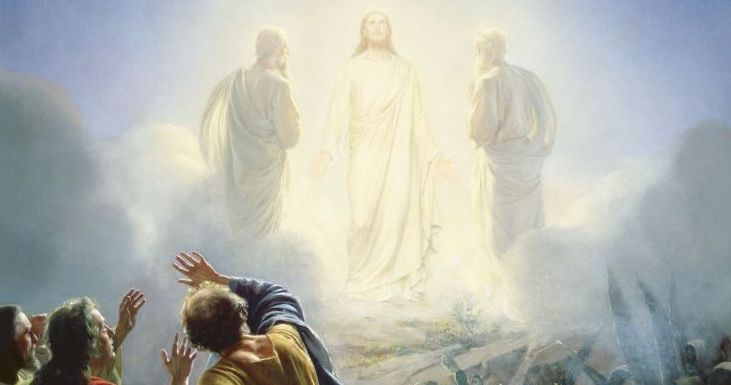
Jesus goes up a high mountain with Peter, James, and John and is transfigured. His clothes become white as light. Moses and Elijah appear and are talking with Jesus. And Jesus’ face shone like the sun. Now, Scripture doesn’t give us the total lumens of Moses’ face compared to Jesus’ face. It is interesting to note that the Greek translation of our Old Testament text uses a word that means ‘glow’ to refer Moses’ face while Matthew here uses the word λάμπω (lampō) which means ‘shine’ to refer to Jesus’ face. So, Moses’ face glowed with a radiant, reflected glory, but Jesus’ face shines like the sun with its own glory.

We do know that Moses’ face was bright enough that people could see it and were afraid, but a thin veil was enough to calm their fears. But here Jesus’ face shines like the sun, and I’m pretty sure a little veil wasn’t going to do much to dim that shining. Despite the brightness and glory, notice that Peter, James, and John don’t ask Jesus to veil His face. Instead, the reaction is completely different. Peter says, “Lord, it is good that we are here. In fact, let’s stay here. I’ll make three tents – one for You, one for Moses, and one for Elijah.” But while Peter is still speaking, the bright cloud of God’s glory overshadowed them, and God the Father said, “This is My beloved Son, with whom I am well pleased; listen to Him.” This terrifies the three disciples, but Jesus came and touched them saying, “Rise, and have no fear.”

In our Epistle text (2 Pet. 1:16-21), Peter reflects on the Transfiguration about thirty years later. There, Peter says that the Transfiguration does show Jesus’ glory, but even more so, it unveils the glory of the Bible. Peter says that it is better for you to have the Scriptures than for you to have witnessed the Transfiguration because every verse of the Scriptures unveils God’s great love for you. The shining face of Jesus points us to the bright lamp of the Scriptures that shines in a dark place. But what is this dark place?

Your initial thought is probably that the lamp of the Scriptures shines in the darkness of this world. The Bible certainly does talk about the world being full of darkness and sin. Psalm 119:105 says, “Your Word is a lamp to my feet and a light to my path.” God’s Word does enlighten this dark world so that we don’t stumble or go the wrong way. But here Peter is talking about a different dark place. He says to pay careful attention to the Scriptures as “a lamp shining in a dark place until the day dawns and the morning star rises” – and catch this – “the morning star rises in your hearts.”

You see, it’s not just the world and things outside of you that are a dark place. Your heart also has a darkness that needs the light of God’s Word. Peter doesn’t use the normal word for ‘dark’ here. The word Peter uses means, “foul and repulsive from a lack of care; neglected and filthy.” Here is the picture: Our sinful hearts are a filthy, murky, dark place. And we do well to pay attention to the Word of God shining in the dirty, neglected, dark place of our heart. When we pay attention to them, the lamp of the Scriptures shines in the darkness of our heart and pierces through the filth inside us. And the Gospel also changes us.

Even though you weren’t a witness to Jesus’ Transfiguration (lit. His ‘metamorphosis’), you have something better. Back to 2 Cor. 3:18, “And we all, with unveiled face, beholding the glory of the Lord, are being transfigured (same word used for Jesus’ transfiguration though the ESV translates it as ‘transformed’) we are being transfigured into the same image from one degree of glory to another.” Even now, already in this life, Christian, you are being transfigured into the same glory that Jesus had on the mountain. God brings about that transfiguration through His Word. By God’s gracious working through His Word, you are slowly being transfigured and metamorphosized into Jesus’ glory.

God has promised that you are being transfigured. And the picture of Jesus on the mountain today is what you are heading toward by the grace of God. In Mt. 13:43, Jesus says that you who are righteous through faith in Him will shine like the sun, just like Jesus did.

So that you could shine like the sun and be like Him, Jesus went down from the mount of Transfiguration. He descended from that glorious peak, so He could ascend another mountain, Mt. Calvary, where He laid down His life for Peter, for Moses and Elijah, and for you. He did this because He loves you and wants you to be transfigured and share in His unveiled glory. Lord Jesus, come soon and bring us to that glory. Amen.

The peace of God, which surpasses all understanding, will guard your hearts and minds in Christ Jesus. Amen.

Living in Holy Light & Being Holy Light – Sermon for Midweek Advent 3 2019

Listen here. (The first 30 seconds of tonight’s sermon were not recorded. The missed portion was simply a summary of the previous weeks’ messages.)

The texts for tonight’s service were Isaiah 60:1-5; 2 Corinthians 4:6-12; and John 1:1-14.

In the name of Jesus. Amen.

Tonight, we are continuing the theme from 1 Timothy 4:4-5, “Everything is made holy by the Word of God and prayer.” In the first of these Advent sermons, we considered how God, the Holy One, makes us holy through His Word which cleanses and sanctifies us (Jn. 15:1-5; 17:17). Last week, we saw how God initially created all things good, but nothing created was holy by itself – nothing is inherently or intrinsically holy. So, God places His holy name upon us in our Baptism which makes us holy so we can be in His presence. This not only gives us access to God’s presence, it actually makes us a temple of the Holy Spirit who dwells in us (1 Cor. 6:19). This means, Christian, that you are no longer common. Now, you are sacred.

Tonight’s sermon will give us the picture of what our sacred life looks like according to Scripture especially from the Epistle lesson (2 Cor. 4:6-12). Paul is using imagery that was very common in his day, lamps. In the verses leading up to that text, he says that the Gospel – the good news that our sins are forgiven because of Jesus’ birth, life, death, and resurrection – is a light (2 Cor. 4:1-5). Then our text picks up that image. Look at those verses while I read and comment on them:

The God who said, ‘Let light shine out of darkness,’ has shone (Where?) in our hearts. (Why?) To give the light of the knowledge of the glory of God. We have this treasure – the treasure of God’s glory – in jars of clay.

These jars of clay are the lamps people used in New Testament times. Back then, houses were lit up, not by flipping on a switch but by little clay lamps filled with olive oil. Those clay lamps (or jars) had a small hole for a wick that floated in the oil and fed the flame.

So, God’s holy presence is in us. We have the treasure of His glory and power, but that holiness, that sacredness, that power, and that glory is hidden. You can’t see it just like you couldn’t see the oil inside of that clay lamp. But you know that oil is there as long as the wick continues to burn. If you lit a wick that didn’t have any fuel feeding it, that wick would burn up quickly. But when that wick has fuel, it will burn for hours and hours. Imagine that you didn’t know about the oil in the lamp, you would be surprised at how long the wick can burn.

Back to v. 7, we have this treasure hidden in jars of clay (Why?) to show that the surpassing power belongs to God and not to us. To close out this picture, Paul says that the life we have in Christ is reveled and shown in our suffering. Listen to v. 8-9, “We are afflicted but not crushed. Perplexed, but not driven to despair. Persecuted, but not forsaken. Struck down, but not destroyed.” When we endure suffering, others are able to see this surpassing power of God because of how it is manifested.

Afflictions do not crush us. Instead, they cause us to run to God (Ps. 129:2). Things that are perplexing and confusing do not cause us to despair (Ps. 37:32-33). When we have trials, we don’t need to wonder if God loves us – He does! When we are persecuted, we can know that we are suffering the very same things that Christ did. Jesus said, “If they persecuted Me, they will persecute you” (Jn. 15:20). When we are struck down, we turn the other cheek (Mt. 5:39) because we know that our enemies cannot destroy us – Christ has promised (Mt. 10:28). We have died and our life is hidden with Christ in God (Col. 3:1-4).

You see, dear saints who have been made sacred, God’s glory and power given to you is manifested to this world in your weakness for when you are weak, then you are made strong by God’s power (2 Cor. 12:9-10). Our problem is that this is the opposite of what we normally think. In every other aspect of our lives, growing up means that we move from depending on others to becoming independent. When a child can feed herself, walk, is potty trained, able to dress herself, tie her shoes, etc., we see that she is growing up into an independent woman.

The exact opposite is true of spiritual growth. Growing up spiritually means that we become more dependent upon Christ for everything in every situation. As we mature in faith, we learn to borrow all that we need from Christ which means that we grow in holiness.

As God shines the light of the Gospel into you, that light shines out of you so that you are a light to others. Jesus puts it this way Mt. 5:14–16, “You are the light of the world. A city set on a hill cannot be hidden. Nor do people light a lamp and put it under a basket, but on a stand, and it gives light to all in the house. In the same way, let your light shine before others, so that they may see your good works and give glory to your Father who is in heaven.”

God put the light of His Gospel into you so that you would give light to the dark house of this world. Jesus commands that light within you to shine. English cannot do justice to what the Greek does there. Jesus commands the light He has placed within you to shine so that the people of this world would see your good works and give glory to your heavenly Father.

I want to conclude tonight with one more image of what living in this light looks like by considering. Proverbs 3:5-6 (and I’m going to use a translation that might be different from what you are used to[1]), “Trust in the Lord with all your heart, and do not lean on your own understanding. In all your ways know Him, so that He will straighten your paths.”

These verses picture traveling, but it isn’t the normal traveling from one place to another. It is traveling through life. Throughout your life, you travel on many different roads and paths that seem to have little or nothing to do with each other and it can feel like you aren’t getting anywhere. You go from one thing to another, but it feels like you have no destination.

But these verses invite to you to know the Lord in all your ways. What does that mean? It means that He is present with you in everything. Wherever you go, He is there with you. He is your invisible partner and companion. When you woke up this morning, He was there. When you traveled to work or school, as you ate lunch, while you drove here, He didn’t abandon you. He was right there beside you. You have had lots of little journeys today, and the Lord was with you the whole time.

All the paths of today and yesterday and six months ago, and all the paths of tomorrow and every day of your future are all one journey because God is with you every step of the way. In all your ways, know Him, see Him, expect Him. He is there walking with you leading you along the way. You don’t have to map out your own journey, you can simply trust Him because He is there making your path straight.

The biggest problem you have and that I have is that we think we are traveling by ourselves. We don’t even bother to look for Him because we don’t expect Him to be there. But there He is giving us His light, leading us, guiding us, directing us along our paths. This means that all our paths are sacred because of God’s presence.

All the little paths and bits and tasks of your life are not the story of your journey but the story of Jesus’ journey with you. Live your life in His holy light as you radiate that holy light. Amen.

The peace of God, which surpasses all understanding, will guard your hearts and minds in Christ Jesus. Amen.

[1] Translation from Rev. Dr. John Klienig.