Coming to Save – Sermon on Isaiah 35:3-7 for Quinquagesima Sunday

Isaiah 35:3–7

3 Strengthen the weak hands, 
and make firm the feeble knees. 
4 Say to those who have an anxious heart, 
“Be strong; fear not! 
Behold, your God 
will come with vengeance, 
with the recompense of God. 
He will come and save you.” 

5 Then the eyes of the blind shall be opened, 
and the ears of the deaf unstopped; 
6 then shall the lame man leap like a deer,
and the tongue of the mute sing for joy. 
For waters break forth in the wilderness, 
and streams in the desert; 
7 the burning sand shall become a pool, 
and the thirsty ground springs of water; 
in the haunt of jackals, where they lie down, 
the grass shall become reeds and rushes.

In the name of Jesus. Amen.

I promise that we’ll get to this text from Isaiah, but it will be in a roundabout way. When God commanded, “Thou shalt not steal,” He meant it. Stealing is a disruption of God’s creation. When God gives something to someone, that is where He wants it to be. That is why thieves were required to repay the ones they robbed. Throughout the Scriptures, God says that a thief must give back what was stolen, and that repayment comes with interest. If you rob someone of their money or goods but it can be recovered, God says the cost is to pay back double what was stolen (Ex. 22:4, 7). But God set a higher price for other things that were stolen – especially if they could not be recovered. If a thief stole and killed one sheep, he was required to pay back four sheep. For every unrecoverable stolen ox, the repayment was five oxen. And If you stole food, you have to pay that back sevenfold (Pr. 6:31).

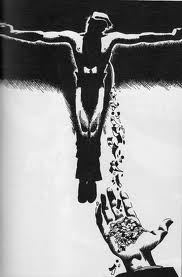
The first robbery recorded in the Bible was a theft of food in the Garden of Eden. All of creation belonged to God, and He freely handed it over to the man and woman that He had created in His image. Every plant was nutritious and delicious. And God gave all the plants for food (Gen. 1:29) – except one tree, the Tree of the Knowledge of Good and Evil. That tree, like every other tree, belonged to God. It’s fruit was His, and He said, “You don’t get to eat it.” But that first couple reached out their hands, took God’s fruit, and ate it. They stole food from God.

Now, here’s the problem, how would they repay God sevenfold as the Bible requires? It’s more complex than it might sound. They couldn’t pay with more fruit from that tree. All the fruit that remained on the tree already belonged to God. And to make things worse, they couldn’t put the fruit they had eaten back because it had become part of them. The only way to restore the fruit would be for Adam and Eve to be put back on the tree. But even that repayment was impossible because now they were thieves and sinners. Because it was stolen, that fruit was cursed and infected Adam and Eve with death that was coursing through their veins.

For the seven-fold payment to be made, Adam and all his children, needed a new Adam to offer payment in their place. Jesus entered this world as that new, sinless, and perfect Adam (Ro. 5:14; 1 Cor. 15:45). Only Jesus, perfect God and perfect man, could make repayment for that theft. And that is exactly what He does.

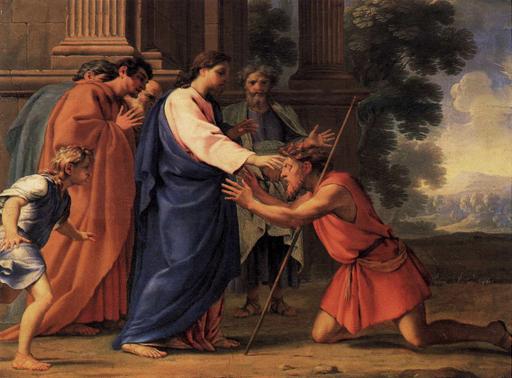
In our Gospel reading (Lk. 18:31-43), we heard how Jesus restored the sight of blind Bartimaeus (Mk. 10:46-52) on the road outside of Jericho. And Jesus did this by taking Bartimaeus’ blindness into Himself (Is. 53:4; Mt. 8:17) while also restoring his sight. That miracle, and all of Jesus’ miracles, show that Christ was removing the venom of sin and death, putting creation back together, and making the payment for that original sin and all subsequent sins. But all of Jesus’ miracles were merely a beginning of the full repayment He was about to make. Bartimaeus’ eyes eventually went blind again when he died. That is why that full, seven-fold repayment for the thievery in Gen. 3 is only made when Jesus is pinned to the cross, sheds His perfect blood, and dies. All of that brings us to this reading from Isaiah.

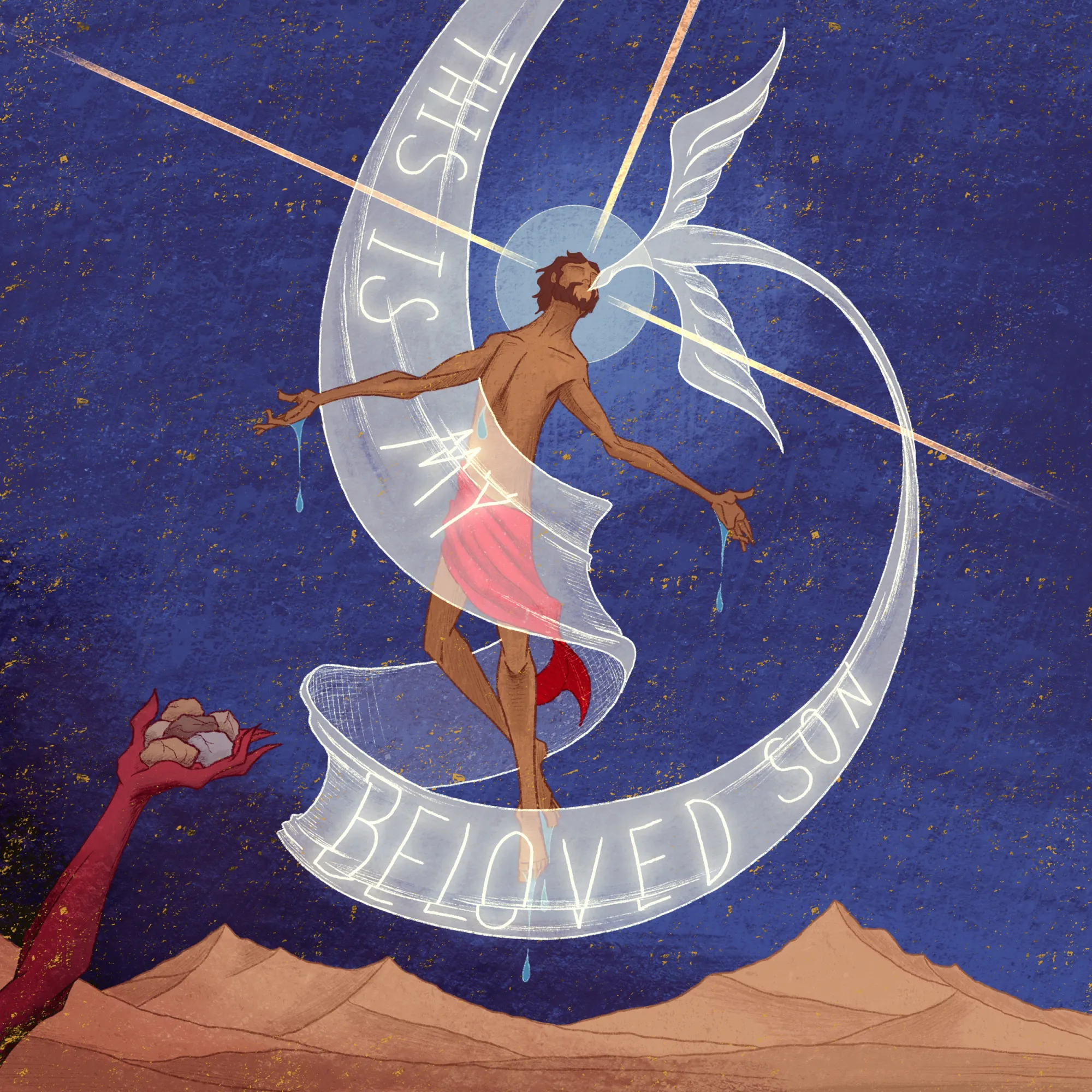
What is weak is to become strong. What is feeble is to become firm. To you who are anxious and troubled in heart, God says, “Be strong; fear not! Behold, your God will come with vengeance, with the recompense of God.” Normally, when sinners hear about vengeance and recompense, they are afraid and rightly so. But notice what this vengeance and recompense accomplishes – God comes to save you. He pays the debt that you owe. He has avenged your sin upon His only begotten Son. The payment has been made; your sin is atoned for (Is. 6:7).

Throughout Jesus’ ministry, He healed many more blind people besides Bartimaeus. Christ opened the ears of many who were deaf. Our Lord made many lame people walk and loosened all sorts of tongues to sing for joy. Each of those miracles were a display of Jesus’ divine power and authority to fix what sin and death had brought to creation. All of Christ’s miracles showed that He had come to undo the curse of the Fall. And yet, they aren’t the fullness of what Jesus had come to accomplish. They were limited in scope. Here, Isaiah says all the eyes of all the blind shall be opened and all the ears of all the deaf unstopped. 

Jesus didn’t just come to open a few eyes and ears. He came to open all of them. When you read through the Gospels, Jesus is doing these miracles almost constantly. But there is no doubt that there were more blind and deaf in Israel and throughout the world that didn’t get the blessing of Jesus’ miraculous touch. In other words, there is more healing, more restoring, more removal of the curse to be done than Christ accomplished through His miracles.

But now that Christ has died and risen again, now that He is seated on the throne of all creation as the New Adam at the Father’s right hand, the curse of sin and death that hangs over all creation has been paid for. Your God has come and saved. And the day is coming when the eyes of all who are in the category of ‘blind’ will be opened. All the ears of the deaf will be unstopped. All the lame shall leap like a deer. And all the mute will sing for joy because the price has been paid. It has been paid by Jesus for you. Whatever parts of the curse still lay upon you have all been taken by Jesus. Christ has redeemed you by becoming a curse for you (Gal. 3:13).

As we move into Lent this year, we are going to consider what the suffering of Christ has accomplished. Out of God’s great love for you, Christ endured all the wrath, judgment, and death you deserved because of your sins. In Christ, God came to save you. Every illness, every malady, every pain, every sorrow you experience had a price, and that price was the precious death of God’s beloved Son.

And as we go on this Lenten journey, we do it remembering the destination – eternal life with God. Take a Bible and open to the end of Isaiah 35. Just after our text, Isaiah speaks of a highway. Listen to how Isaiah describes it. Isaiah 35:8-10, “And a highway shall be there, and it shall be called the Way of Holiness; the unclean shall not pass over it. It shall belong to those who walk on the way; even if they are fools, they shall not go astray. No lion shall be there, nor shall any ravenous beast come up on it; they shall not be found there, but the redeemed shall walk there.” Pause there for a minute.

All of that is to say that God has come to save you, and He has placed you on this highway. When you pass through areas of this highway that are dreadful, don’t worry because Jesus is with you. When you pass through areas of this highway that are delightful, remember, it is only the highway. The highway has its own joys and foretastes of what is to come, but the destination lies ahead. And what is that destination?

Back to Isaiah 35:10, “And the ransomed of the Lord shall return and come to Zion with singing; everlasting joy shall be upon their heads; they shall obtain gladness and joy, and sorrow and sighing shall flee away.” In other words, the point of the highway is the destination. The Resurrection, the new creation, the life of the world to come – that is your destination, believer. Don’t forget that.

Your God has come and saved you. Your journey is secure on God’s highway. How unspeakably great will it be when we arrive at our ultimate destination? Amen.

The peace of God, which surpasses all understanding, will guard your hearts and minds in Christ Jesus. Amen.

Fleshly Thorns – Sermon on 2 Corinthians 11:19-12:9 for Sexagesima Sunday

2 Corinthians 11:19–12:9

19 You gladly put up with fools since you are so wise! 20 In fact, you even put up with anyone who enslaves you or exploits you or takes advantage of you or pushes himself forward or slaps you in the face. 21 To my shame I admit that we were too weak for that! 

What anyone else dares to boast about—I am speaking as a fool—I also dare to boast about. 22 Are they Hebrews? So am I. Are they Israelites? So am I. Are they Abraham’s descendants? So am I. 23 Are they servants of Christ? (I am out of my mind to talk like this.) I am more. I have worked much harder, been in prison more frequently, been flogged more severely, and been exposed to death again and again. 24 Five times I received from the Jews the forty lashes minus one. 25Three times I was beaten with rods, once I was stoned, three times I was shipwrecked, I spent a night and a day in the open sea, 26 I have been constantly on the move. I have been in danger from rivers, in danger from bandits, in danger from my own countrymen, in danger from Gentiles; in danger in the city, in danger in the country, in danger at sea; and in danger from false brothers. 27 I have labored and toiled and have often gone without sleep; I have known hunger and thirst and have often gone without food; I have been cold and naked. 28 Besides everything else, I face daily the pressure of my concern for all the churches. 29 Who is weak, and I do not feel weak? Who is led into sin, and I do not inwardly burn? 

30 If I must boast, I will boast of the things that show my weakness. 31 The God and Father of the Lord Jesus, who is to be praised forever, knows that I am not lying. 32 In Damascus the governor under King Aretas had the city of the Damascenes guarded in order to arrest me. 33 But I was lowered in a basket from a window in the wall and slipped through his hands. 

1 I must go on boasting. Although there is nothing to be gained, I will go on to visions and revelations from the Lord. 2 I know a man in Christ who fourteen years ago was caught up to the third heaven. Whether it was in the body or out of the body I do not know—God knows. 3 And I know that this man—whether in the body or apart from the body I do not know, but God knows— 4 was caught up to paradise. He heard inexpressible things, things that man is not permitted to tell. 5 I will boast about a man like that, but I will not boast about myself, except about my weaknesses. 6 Even if I should choose to boast, I would not be a fool, because I would be speaking the truth. But I refrain, so no one will think more of me than is warranted by what I do or say. 

7 To keep me from becoming conceited because of these surpassingly great revelations, there was given me a thorn in my flesh, a messenger of Satan, to torment me. 8 Three times I pleaded with the Lord to take it away from me. 9 But he said to me, “My grace is sufficient for you, for my power is made perfect in weakness.” Therefore I will boast all the more gladly about my weaknesses, so that Christ’s power may rest on me.

In the name of Jesus. Amen.

This is a fairly long text, and Paul boasts about himself quite a bit here, but please notice he acknowledges that. He even calls himself a fool and madman (2 Cor. 11:21, 23) for talking like this. But still, to our northern Minnesota, Midwestern ears, a lot of this text can be a bit off-putting. Paul would probably be more ‘at home’ in a place like New York or New Jersey. But basically, all that bragging is Paul defending status as an apostle. That long list of things he endured – the beatings, lashings, shipwrecks, and dangers – all of that is Paul saying that he learned what Jesus meant when He said, “If anyone would come after Me, let him deny himself and take up his cross and follow Me” (Mt. 16:24).

Then, Paul mentions this vision that he had fourteen years before he wrote this letter, but he does it in a roundabout way. He talks about a man who was caught up into the third heaven. We don’t know what this ‘third heaven’ is other than the fact that Paul calls it ‘paradise.’ While he was there, he heard things that he isn’t allowed to speak about; in other words, the vision was just for him. That isn’t unique. In the book of Revelation, John has a similar experience; he hears the voice of seven thunders, but he isn’t allowed to write what those thunders said (Rev. 10:1-4). Now, it’s clear that the man who had the vision is Paul himself. Notice how in 2 Cor. 12:7, Paul says that he was given a thorn in the flesh to keep him from becoming conceited because of the surpassing greatness of that vision. God knew Paul’s weakness of being prideful, so to limit that pride, God gives Paul this thorn in the flesh to keep him humble.

We don’t know exactly what this thorn is. We can speculate, but we can’t say for sure. The possibility that I gravitate toward is that this thorn in Paul’s flesh was poor vision (see Act. 9:18; Gal. 6:11). But I also will admit that I lean toward that understanding because I can identify with it. I also think Paul is intentional about not saying exactly what this thorn is so that you can take his conclusion about the thorn and apply it to yourself in whatever afflictions and suffering you face. Whatever this thorn in the flesh is, it wasn’t a minor thing for Paul. He pleads and begs with Jesus three times to have it removed. This thorn, Paul’s pleading, Jesus’ response to that pleading, and Paul’s conclusion have a lot to teach us about suffering as a Christian.

The first thing to notice is that this thorn was given to Paul. So, who gave it? Well, we have some clues. That thorn is a messenger (lit. an ἄγγελος) of Satan to harass him. In other words, it is one of the devil’s demons who afflicts and torments Paul with the thorn. The devil’s intention is always to push us toward more pride and greater sin. You especially see it when the devil tempts Adam and Eve by saying, “you’ll be like God,” in the Garden of Eden (Gen. 3:5). Because of this, we might conclude it was the devil who gave this thorn, but hold on just a second. Also notice that this thorn was given in order to limit Paul’s pride and conceit. The devil wouldn’t want to do that. So, who gave Paul this thorn? We’d have to conclude God did, but God does it through the devil.

So, here’s the lesson for us: Both the thorn and the demon are evil – utterly and completely evil – but God takes those evil things and uses them for good. When Ro. 8:28 says that God works all things together for good for those who love him, it is true. Even the work and attacks of the devil can be tools in God’s hand to bring about good. We see a similar thing happen with Job. God allows the devil to afflict Job by destroying all Job’s possessions and even Job’s health (Job. 1:9-12, 2:4-6). There, the devil admits that he can’t touch anything connected with Job unless God permits it. The devil’s intention in tormenting Job with all that suffering is to get Job to curse God. But when you get to the end of the book of Job, you see that Job remains blameless and upright. God uses that affliction of the devil to increase Job’s faith, and on top of that, Job’s three “friends” get brought closer to God as well.

The devil’s intention with both Job’s suffering and Paul’s thorn in the flesh is to destroy faith and increase sin, but God uses the devil’s work to accomplish His purposes. This happens all the time, but the clearest place we see this is in the crucifixion of Jesus. The devil’s fingerprints are all over it! Judas’ betrayal, the crowds who get stirred up by the priests and elders to release the murderer Barabbas instead of Jesus (Mt. 27:20), and the high priest Caiaphas who says that Jesus should die instead of the whole nation perishing (Jn. 11:49-50), there’s no question that all of that was Satan’s work in order to kill Jesus on the cross.

But what actually happened on the cross? Did the devil win by getting Jesus pinned there? Nope! It is on the cross that Jesus crushes that worm’s head. On the cross, Jesus took the record of debt that stood against us and nailed it to the cross which completely disarmed the devil and demons and put them to open shame (Col. 2:14-15). In the crucifixion, Satan thought he was beating God, but God was using the devil’s own strategy and plan to utterly defeat Satan, to deliver you, and to win you back for Himself. God be praised!

Now, let’s draw some practical application from all of this because there are all sorts of lessons to take away from this text (more than I’m going to cover here).

First, God can and does use suffering for your benefit. You don’t have to like suffering; in fact, we long for our suffering to be over. But you can know that God is working in and through your suffering – whatever it is. Scripture doesn’t call you to rejoice because of your suffering, but it does call you to rejoice even in the midst of your suffering (Ro. 5:3-5).

Second, if you are suffering in any way, if you have some thorn, that does not mean that God is angry with you or pitted against you. Remember, Job’s suffering began because God bragged about Job to the devil (Job 1:8, 2:4). And God wasn’t angry with Paul either. It was God’s love for Paul that permitted that fleshly thorn that Paul dealt with for so long.

Third, if you are afflicted by demons, that doesn’t mean you are a bad Christian. Paul had one for fourteen years while he was proclaiming the Gospel, starting new churches, and furthering the kingdom of God. And Jesus tells Paul, “My grace is sufficient for you. I’m going to let that demon do his thing while I give you My grace. This will show My strength is working through you.”

Fourth, unanswered prayers and denied petitions do not mean that God is unhappy with you. Paul begged and pleaded three times, and Jesus said, “No.” Yes, sometimes, Jesus will release you from the things that cause you suffering, but even when He says, “No,” it is for your benefit.

Finally, look at Paul’s reaction to all of this. He doesn’t say, “I asked for this thorn to be removed, but Jesus said, ‘No,’ so I’m going to complain.” No! He says, “Therefore I will boast all the more gladly of my weaknesses, so that the power of Christ may rest upon me. I’ll be content with weaknesses, insults, hardships, persecutions, and calamities. For when I am weak, then I am strong.”

Dear saints, you are right to lament and long for your suffering to come to an end. Jesus came to rescue you from all suffering. But in your suffering, know that God is at work, and you don’t know what kind of fruit God will bring about through that suffering. Christ is right there beside you in every affliction and weakness you have. He is there present with His strength. And He comes now to strengthen you with His all-powerful Body and Blood, given and shed for you for the forgiveness of all your sins. To Him be all the glory, honor, praise, and thanks now and forever. Amen.

The peace of God, which surpasses all understanding, will guard your hearts and minds in Christ Jesus. Amen.

Coming – Sermon on Matthew 21:1-9 for the First Sunday of Advent

Matthew 21:1–9

1 Now when they drew near to Jerusalem and came to Bethphage, to the Mount of Olives, then Jesus sent two disciples, 2saying to them, “Go into the village in front of you, and immediately you will find a donkey tied, and a colt with her. Untie them and bring them to me. 3 If anyone says anything to you, you shall say, ‘The Lord needs them,’ and he will send them at once.” 4 This took place to fulfill what was spoken by the prophet, saying, 

5 “Say to the daughter of Zion, 
‘Behold, your king is coming to you, 
humble, and mounted on a donkey, 
on a colt, the foal of a beast of burden.’” 

6 The disciples went and did as Jesus had directed them. 7 They brought the donkey and the colt and put on them their cloaks, and he sat on them. 8 Most of the crowd spread their cloaks on the road, and others cut branches from the trees and spread them on the road. 9 And the crowds that went before him and that followed him were shouting, “Hosanna to the Son of David! Blessed is he who comes in the name of the Lord! Hosanna in the highest!”

In the name of Jesus. Amen.

Dear saints, welcome to Advent. ‘Advent’ means ‘coming.’ One of my goals with this sermon and the rest of the sermons leading up to our Christmas Eve service is to deepen your appreciation for the season of Advent and cultivate the attitude Advent gives us. And I want to be clear: I’m not going to chide you if you put up your Christmas tree and decorations immediately after putting the Thanksgiving leftovers in your fridge, and I’m not going to call you to repent if you started watching Hallmark Christmas movies or listening to Christmas music weeks ago. Don’t worry about that.

So, about Advent. Yes, Advent precedes Christmas, but Advent isn’t “pre-Christmas.” The season of Advent isn’t meant to only prepare us to celebrate that Jesus was born. The dominant idea of Advent is the thought of our Lord’s coming in three ways. First, God has come in the flesh of Jesus. Second, God will come again; Jesus will return in His body to judge the living and the dead. And third – and maybe most importantly – God continually comes to us now in grace in His Body and Blood given in Holy Communion, in the preaching and hearing of His Word, and in the fellowship of the Church which is His body (Col. 1:24).

Dear saints, God came, God is coming, and God comes. And this is exceptionally Good News because, as Psalm 16:11 says, “In Your presence there is fullness of joy.” God’s coming brings joy. But too often, we prefer to substitute the joy of God’s presence with other things.

In his book Mere Christianity, C.S. Lewis wrote, “[H]uman history… [is] the long terrible story of man trying to find something other than God which will make him happy” (p. 49). We see this playing out at the beginning of human history. I know you know all of this, but it’s good to hear it again. The devil enticed Adam and the woman to take what God had forbidden. Rather than trusting God’s promise that gaining the knowledge of good and evil would turn out badly, the couple took the fruit and ate. They got the knowledge of evil, but it didn’t make them happy.

Instead, they realized their nakedness and shame, so they tried to cover themselves with fig leaves. Their own attempt at finding an answer to their sin and guilt apart from God providing a solution didn’t make them happy either. But something made the first couple even more unhappy. They heard God coming into the Garden. The all-powerful Creator of the universe was coming, and they thought He was coming for their destruction. Rather than running toward God, they ran away from Him. God was coming with power, but He was coming in mercy and grace to give them chance after chance to repent. This is why we need Advent; it helps us see that God’s coming is Good News because He comes to restore sinners unto Himself.

God asks, “Where are you?” (Gen. 3:9). God knew where they were, but God was coming in peace and love, begging them to confess and be forgiven. But Adam responded that he was afraid because he was naked. So, God asks, “Who told you were naked? Have you eaten the forbidden fruit?” (Gen. 3:11). In other words, “Adam, repent.” But Adam starts pointing his finger, “The woman, whom You gave to be with me, she gave me the fruit, and I ate” (Gen. 3:12). Basically, Adam is saying, “God, it’s all Your fault.” So, God turns to the bone of Adam’s bones and the flesh of Adam’s flesh, and asks her, “What did you do?” which is yet another call for repentance. But the woman also passes the buck, “The serpent deceived me, and I ate” (Gen. 3:13). All of this running from God, passing the blame for our own sin, and blaming God is, sadly, how we sinners naturally react to God’s coming.

In a real sense, the rest of Genesis 3 along with the rest of the Bible is God promising to restore the fullness of joy in His presence (Ps. 16:11). Yet still, we fallen sinners seek happiness apart from God and His coming because we wrongly think that God’s coming means our judgment and condemnation. Now, yes, on the Last Day when Jesus returns that will be true for unbelievers who keep seeking a false, temporary happiness apart from God’s gracious presence. But for you, while you still breathe, God comes in grace and mercy. That is why we read this Gospel text today to open the season of Advent. It occurred on Palm Sunday just days before Jesus’ crucifixion. Look how God comes:

King Jesus comes to His royal city, and there is power in His coming. The cattle on a thousand hills are His (Ps. 50:10), so is the donkey and its colt. If He needs them, they are His to use. This crowd of people welcomes Him as the King without anyone telling them what to do. Yes, His coming is an unstoppable force. But, unlike other kings, He comes humbly. He didn’t ride into the city as a regal conqueror on an impressive war horse. He came riding on a colt. He didn’t come with legions of armies. He came with crowds of lowly, common people crying out, “Hosanna,” which means, “Save us.” He didn’t enter a lavish palace with a high and lofty throne. His battered, beaten, bloodied body hiked up a hill carrying His own cross to the place where He gave His life for sinners. Even when Jesus came as King, He came to give His life for sinners to bring them back into the joy of His presence (Ps. 16:11).

And this kind of humble coming marked His entire life. During His ministry, Jesus dined and associated with tax collectors and sinners (Lk. 15:1-2, 7:39). He surrounded Himself with an entourage of fishermen. And, of course, His arrival in the flesh was also meek, lowly, and gracious. Conceived by a young fiancée of a carpenter from Nazareth, born in a barn, and laid in a feeding trough, God came in the flesh of a swaddled infant.

Until He comes again in glory, God comes to forgive, redeem, and purchase you from all your sins and trespasses against Him. God comes to you to restore you back into a right relationship with Himself.

Believer, in a sense, you have always been living in Advent. Until Jesus returns, you are always looking, waiting, and watching for His coming even as He comes to You now in His Word and Sacrament. Yes, He always comes in power, but He humbly uses His power to forgive, redeem, restore, and save you.

Christ came, He is coming, and Christ comes now inviting you to His table where He will show you His steadfast love and grant you His salvation (Ps. 85:7). Dear saints, Christ doesn’t to judge you. He comes to bring you forgiveness, life, salvation, and the joy of His presence. Amen.

The peace of God, which surpasses all understanding, will guard your hearts and minds in Christ Jesus. Amen.

The Garment-Giving King – Sermon on Matthew 22:1-14 for the Twentieth Sunday after Trinity

Matthew 22:1–14

1 And again Jesus spoke to them in parables, saying, 2 “The kingdom of heaven may be compared to a king who gave a wedding feast for his son, 3 and sent his servants to call those who were invited to the wedding feast, but they would not come. 4 Again he sent other servants, saying, ‘Tell those who are invited, “See, I have prepared my dinner, my oxen and my fat calves have been slaughtered, and everything is ready. Come to the wedding feast.” ’ 5 But they paid no attention and went off, one to his farm, another to his business, 6 while the rest seized his servants, treated them shamefully, and killed them. 7 The king was angry, and he sent his troops and destroyed those murderers and burned their city. 8 Then he said to his servants, ‘The wedding feast is ready, but those invited were not worthy. 9 Go therefore to the main roads and invite to the wedding feast as many as you find.’ 10 And those servants went out into the roads and gathered all whom they found, both bad and good. So the wedding hall was filled with guests.

11 “But when the king came in to look at the guests, he saw there a man who had no wedding garment. 12 And he said to him, ‘Friend, how did you get in here without a wedding garment?’ And he was speechless. 13 Then the king said to the attendants, ‘Bind him hand and foot and cast him into the outer darkness. In that place there will be weeping and gnashing of teeth.’ 14 For many are called, but few are chosen.”

In the name of Jesus. Amen.

What kind of king is this? Throughout most of this parable, he doesn’t look or act like a normal king.

His royal highness is throwing a wedding feast for his son and has already sent out invitations to his subjects. But when he sends his servants to call the guests, they don’t come. The king sends out a second batch of servants with a third invitation, “The feast is ready, the best food – the oxen and fattened calves – have been slaughtered and prepared. Come to the wedding feast.”

Here the king just looks desperate. He doesn’t look like a dignified, royal ruler. He looks more like the smelly, dorky kid in school who wants his classmates to come to his party. And that is how his subjects treat him. They don’t pay any attention to the invitation. They don’t care about his party. They have better things to do. Some go off to work in the dirt, others simply go about business as normal, but some get violent. They seize the servants, commit all kinds of atrocities against them, and even kill them.

What kind of king is this? He seems desperate, needy, whiny, and almost pathetic. That’s what his subjects seem to think of him. They have no interest in him. They don’t care about him, his son, the wedding, or the banquet. How is the king going to react? Well, he’s still the king. Even though he appears weak, he still has his army. After his three invitations have been despised and dismissed as an inconvenience, the king is done with these ungrateful, unworthy subjects. No more servants. Now, it’s time for the troops, the horses, chariots, battering rams, swords, and torches. Vengeance against these unworthy subjects is what is called for and is doled out. The ungrateful invitees are destroyed, and their city is burned to the ground.

But what happens next? Standing on the walls of his castle and overlooking the smoldering ruins that surround him, we would expect that the king would give up on this party and just have a small ceremony for his son. But still the king hasn’t given up. He sends out more servants to the highways and byways. “Bring in anyone you can find. I don’t care who they are. I don’t care if they are good or bad. Just bring as many as you can find into the palace. Fill the banquet hall. It’s time to feast.” All this king wants to do is celebrate the marriage of his son. And he wants people around him to enjoy what he provides.

So, the servants go out and find people. It doesn’t matter if they are noble or common peasants. It doesn’t matter if they are rich or beggars. If the servants can find them, they bring them in. This is a royal wedding and a “black tie” event, but none of these guests needed to rush home and find their best attire. No need to rent a tuxedo or evening gown. The king had them covered, literally. Upon their arrival, the king provided each one of these unprepared, unwashed guests with a wedding garment. He would clothe them from his own royal wardrobe. This king spares no expense when it comes to throwing this feast.

So, the hall is filled with guests. The food is served. The drinks are poured. The music starts. The dancing begins. And the king enters the banquet hall to finally enjoy his party. But what does he see? Another holdout, another person who despises him and his provisions. There in the corner is a man without a wedding garment, a man who decided his own stinky, smelly, unwashed clothes were just fine. He figured he didn’t need the king’s gift, so he refused it. But he miscalculated. Badly.

The king addresses this man, “Friend,” and this isn’t the normal word for ‘friend,’ so we could almost translate it, “Buster, how did you get in here without a wedding garment?” This king had provided everything that was needed. Everything was free. And the man has no excuse because there is none. So, the king has the man bound and tossed out – not just out of the party – out into the darkness where there is weeping and gnashing of teeth.

The parable ends there, but based on what the king has done so far in the story, what do you suppose he does after this rascal is thrown out? I would imagine he simply goes back to the wedding feast, back to the party, the food, the drink, the dancing, and the merry making. The king wanted his feast, so why wouldn’t he let the feast go on?

Seriously, what kind of king is this? Remember, according to Jesus, this is a parable about the kingdom of heaven. The King is God Himself. And this parable mirrors what you see and experience.

In this world, almost everywhere you look, people despise God, the true King. And it isn’t just His invitation they despise. People despise everything God has said. There is little or no respect for God or the authorities He has established – parents, police, leaders, etc. And the people in those positions of authority, who have been placed there by God (Ro. 13:1), don’t seem to deserve authority. You turn on the news, and you see killing, looting, riots, and stealing. Nations are at war. Terrorists are mercilessly attacking women and children. In our estimation, it looks like God doesn’t seem to care about the sin and wickedness that runs rampant throughout the kingdom of His creation. But our understanding of the situation is not correct.

In our Old Testament reading (Is. 55:1-9), we heard what God desires, “Come, everyone who thirsts, come to the waters; and he who has no money, come, buy and eat! Come, buy wine and milk without money and without price. Why do you spend your money for that which is not bread, and your labor for that which does not satisfy? Listen diligently to me, and eat what is good, and delight yourselves in rich food.” God desires that everyone would be His guest at His table; He desires that all would be saved and at His banquet (1 Tim. 2:4).

When we look at the state of this world, we are tempted to think that God doesn’t care, or that He can’t or won’t do anything about it. We are wrong. Whenever God delays judgment on the wicked, any time we imagine that He is overlooking sin, it is a display of His mercy and grace. God delays His judgment because He wants His banquet filled. God wants to clothe all sinners in the robe of Christ’s righteousness won on the cross. You don’t know better than God. Your ways are not better than His ways. Your thoughts are not higher than His thoughts (Is. 55:8-9).

God is King. He rules and reigns over all things. He isn’t ignoring the sin and wickedness in this world. No. God’s being patient. He wants as many as possible at His feast; He wants His banquet to be filled. To us, His promises seem to be slow, and even forgotten. But they aren’t. He wishes all to reach repentance and faith (2 Pet. 3:9). He is merciful and gracious, slow to anger and abounding in steadfast love and faithfulness (Ex. 34:6).

Dear saints, the banquet is prepared. The King has invited you and clothed you in Christ’s righteousness. The garment-giving King has given you a seat at His feast. His patience in judgment is for your good and for the good of others. In His timing, everything that is wrong will be put to right. Stand in the garment of righteousness that you have been given, and be patient. The feast will begin soon. Amen.

The peace of God, which surpasses all understanding, will guard your hearts and minds in Christ Jesus. Amen.

Your Good Things – Sermon on Luke 16:19-31 for the First Sunday after Trinity

Luke 16:19–31

19 “There was a rich man who was clothed in purple and fine linen and who feasted sumptuously every day. 20 And at his gate was laid a poor man named Lazarus, covered with sores, 21 who desired to be fed with what fell from the rich man’s table. Moreover, even the dogs came and licked his sores. 22 The poor man died and was carried by the angels to Abraham’s side. The rich man also died and was buried, 23 and in Hades, being in torment, he lifted up his eyes and saw Abraham far off and Lazarus at his side. 24 And he called out, ‘Father Abraham, have mercy on me, and send Lazarus to dip the end of his finger in water and cool my tongue, for I am in anguish in this flame.’ 25 But Abraham said, ‘Child, remember that you in your lifetime received your good things, and Lazarus in like manner bad things; but now he is comforted here, and you are in anguish. 26 And besides all this, between us and you a great chasm has been fixed, in order that those who would pass from here to you may not be able, and none may cross from there to us.’ 27 And he said, ‘Then I beg you, father, to send him to my father’s house— 28 for I have five brothers—so that he may warn them, lest they also come into this place of torment.’ 29 But Abraham said, ‘They have Moses and the Prophets; let them hear them.’ 30 And he said, ‘No, father Abraham, but if someone goes to them from the dead, they will repent.’ 31 He said to him, ‘If they do not hear Moses and the Prophets, neither will they be convinced if someone should rise from the dead.’ ”

In the name of Jesus. Amen.

If you had to choose, which character in this parable would you rather be? The rich man is clothed like royalty and has daily feasts. Sounds like a pretty good life. Lazarus has nothing. He apparently can’t walk; he has to be laid at the rich man’s gate. He’s poor and diseased. He’s so hungry he wants to the garbage that falls from the rich man’s table. And he can’t even fend off the dogs who come and lick his sores. But then, both of them die, and everything changes. Lazarus is escorted by the holy angels to paradise and bliss. The rich man dies, is buried, and goes to hell and eternal torment. So, which character would you rather be?

Most of you are probably thinking Lazarus. No one would choose to be the rich man. But a few of you smarties out there would say, “I’ll be Abraham. He was rich during his earthly life, and he went to heaven.” Very clever of you.

Today, we are going to focus on v. 25 of the parable where Abraham says to the rich man, “Child, remember that you in your lifetime received your good things, and Lazarus in like manner bad things, but now he is comforted here, and you are in anguish.”

That response is a little surprising to the eternal torment of the rich man. We expect that Abraham would tell the rich man, “You didn’t believe in Jesus,” or, “You didn’t love the Bible,” or even, “You received good things.” But Abraham doesn’t say any of that; instead, he says, “You received your good things.” It’s almost a little sarcastic as though Abraham is saying that the rich man received things that he thought were good – the clothes, the feasts, the expensive house, etc. All of those are good things and are gifts from God’s hand, but those aren’t God’s best things.

The rich man didn’t receive God’s steadfast love and salvation (Ps. 13:5-6); he didn’t receive God’s mercy and forgiveness. The rich man didn’t care about those things during his life, and he didn’t even care about them while suffering in hell. In hell, the rich man only desired relief from his suffering, and, when he couldn’t get that, he wanted his brothers to avoid the suffering. The rich man’s problem is that during his life and even in hell he rejected the means to avoid that suffering which is God’s mercy, steadfast love, and salvation which is delivered through the Bible – through the word of Moses, the prophets, and the apostles.

The devil wants to twist this parable so we think that we have to choose between two different existences. On the one hand, we could love God and go to heaven, or, on the other hand, we could love money and stuff and go to hell. So, we suppose, “I guess I’ll pick God” and go grumbling through this life. But the idea that you can only have either riches and hell or poverty and heaven is a false dichotomy.

God is the One who gave you the desire for nice things. The Scriptures even teach that God promises to fulfill the longings you have. Psalm 37:4 says, “Delight yourself in the Lord, and He will give you the desires of your heart.”

So, Christian, do you care about living in a fancy house? Yes, you do. Don’t lie. Remember Jesus promised, “In My Father’s house are many mansions, and I’m going to prepare a place for you” (Jn. 14:2). When you go to heaven and Jesus shows you the mansion He prepared for you, are you going to tell Him, “Meh. I don’t really care about that”? No!

Christian, do you care about good food and feasting? Yes, you do. How many times does the Bible talk about eternal life as a lavish feast (Is. 25:6; Mt. 22:1-10; Rev. 19:9)? God promises that feast because He knows that it is appealing to you. It’s something you want from His hand.

Christian, do you care about nice clothes? Yes, you do. The Bible promises that you will have extravagant, dazzling robes that are washed white in the blood of the lamb (Eph. 5:26-27; Rev. 7:13-14).

Christian, do you care about living a pain-free life? If you don’t now, just wait a few years and you will. You care about a life without pain, and God has promised that one day your body will be raised incorruptible, glorified, imperishable (1 Cor. 15:42-44) and you will have no more pain (Rev. 21:4).

Being a Christian doesn’t mean you have to give up your desire for nice things. You don’t have to have some Buddhist or monastic attitude toward the blessings that God gives you. Instead, you can and should give thanks and praise to God who gives every blessing. The Bible talks about the mansions, feasting, spectacular clothing, and escape from pain and suffering because God knows that it is a draw for you – it’s something you desire. You long for those things, and that isn’t a problem – not by itself anyway.

What is a problem is trying to get those things apart from God’s giving of those things. When you’re narrowly focused on living a comfortable earthly life, it becomes easy to forget about eternity. When you are focused on temporal mercies, you quickly forget about eternal mercies. Do you want your enjoyment of all those nice things now for the fleeting moments of this life? Or would you rather have them just a little bit later and retain them forever?

I know this sounds like some of the prosperity preaching you might hear on TV. To be clear, the health and wealth preachers are heretics, and I’m not becoming one of them. Those preachers are wrong – not because they promise health and wealth – but because of when they promise it. They promise it now when God makes no such promise in the Scriptures, but God does promise you will have it for eternity. 

The point of the parable is that the rich man loved those blessings more than he loved God and His Word. The rich man found his joy in the God’s gifts more than in the God who gives those gifts. The parable wants us to consider this question: What are my good things? Are your good things the temporal, fleeting pleasures of this life? Or are your good things the steadfast love, mercy, and salvation of God?

No one here is as destitute as Lazarus, and no one here is as wealthy as the rich man. You are all somewhere in between. The point of the parable is not for you to make yourself poor like Lazarus was, and the point is certainly not to make yourself like the rich man. The point of the parable is to get you to take your eyes off of the earthly things you either have or don’t have and focus on the eternal things that God gives you in His mercy which cannot be taken away. Remember, where your treasure is, there your heart will be also (Mt. 6:21).

Our call to worship helps us have the right focus. Psalm 13:5-6 says, “I have trusted in Your steadfast love; my heart shall rejoice in Your salvation. I will sing to the Lord, because He has dealt bountifully with me.” Christian, you have God’s steadfast love; you have His salvation. God be praised! That is more than enough. God has dealt bountifully with you because of what Jesus has done. Through Christ’s death and resurrection, you have an eternal inheritance that surpasses anything that the richest person could even dream of having.

Recognizing that you have the riches of Christ’s death and resurrection is the main point of the parable. And the parable has something to say about the riches you have in this life.

All of us are richer than we know. Even the poorest in our country would be the envy of most kings throughout history. Again, you aren’t the wealthy like the rich man, but you aren’t destitute like Lazarus. You’re somewhere between.

Don’t think to yourself, “If I were a little wealthier and closer to the rich man, I would be more generous with my things.” Don’t let the perfect be the enemy of the good. Jesus praised the two small copper coins that the widow gave, and not the fat checks of the rest (Lk. 21:1-4). Even though that widow’s gift was nothing in earthly comparison to the large sums put in by others, it was much more in Jesus’ eyes than all the other offerings combined. And remember, Lazarus didn’t want the rich man’s house, fancy clothes, or lavish feast. Lazarus only wanted what fell from the rich man’s table.

So, no; you probably can’t set up a trust fund that would cover the annual expenses of our congregation. Fine. But you can give your tithe. You probably can’t give a donation to pay for a new addition of a fellowship hall. Fine. But you can come and vacuum the sanctuary and scrub the toilets.

Dear saints, share your crumbs. They are more valuable than you know, and God will bless you as you give them away.

Hebrews 10:34 says, “You [Christians] joyfully accepted the plundering of your property, since you knew that you yourselves had a better possession and an abiding one.” In other words, whatever blessings you might lose in this life, they pale in comparison to the eternal blessings and treasures God has in store for you. So, if you lose something here, don’t worry about it. Your eternal inheritance cannot be taken from you.

Dear saints, seek first the kingdom of God and His righteousness – which God freely gives through His Word – and every other blessing will be added unto you (Mt. 6:33). Amen.

The peace of God, which surpasses all understanding, will guard your hearts and minds in Christ Jesus. Amen.

Innocent Blood – Sermon on Matthew 26:1-27:66 for Palm Sunday

Matthew 26:1-27:66

In the name of Jesus. Amen.

Matthew is the only one of the four Gospels that tells us what happened to Judas after Jesus was arrested and condemned (Mt. 27:3-10). Judas was overcome with regret and guilt because he knew that God had cursed anyone for taking a bribe to shed innocent blood (Dt. 27:25). Our translation says that Judas “changed his mind” (Mt. 27:3). In Greek, it’s one word (μεταμέλομαι) that is similar to the word for repentance (μετανοέω), but the change of mind Judas had was only one-sided. And here’s what the text conveys: Judas was very sorry. He wished that what he had done could be undone. He regretted his betrayal, but Judas did not repent the way Christians repent. Christian repentance has two parts. It includes the regret and change of mind Judas had. But saving repentance goes one step further. Christian repentance also trusts and believes in God’s grace and mercy given on account of Jesus’ death and resurrection (Mk. 1:15). Judas was lacking that faith and trust.

That lack of faith in God’s mercy is why Judas goes to the chief priests and elders. He doesn’t know where else to turn even though he had been taught better. Sadly, Judas brings his confession to the wrong place. Judas went to the Temple which had been the place of forgiveness (1 Kgs. 8:30), but the night before, Jesus had clearly told Judas and the rest of the disciples that He was instituting the New Covenant (Jer. 31:33-34) in His Blood for the forgiveness of sin (Mt. 26:26-29). The result was that Judas went to the very ones who had been seeking Jesus’ death (Mt. 26:14-15). Judas knew where he needed to go for forgiveness – he had been told just a few hours earlier. But instead of going to Jesus, he sought forgiveness where it could not be found.

Judas’ confession of sin and his action of returning the thirty pieces of silver were both right. He had betrayed innocent blood and returning the payment he received for his sin was what he should do. But his sorrow and penance could not undo what he had done; it could not remove the guilt of his sin. The chief priests and elders were supposed to be forgivers, absolvers, and ministers of atonement. Yet, after hearing Judas’ confession, they refuse to lift the burden of guilt from him. Instead, they bind Judas’ sin and betrayal on his head. “What is that to us? See to it yourself” (Mt. 27:4). What a chilling, horrific thing to say to someone who is crushed with guilt.

Throughout the Gospels, those religious leaders had tried to convict Jesus of sin. They would accuse Jesus and the disciples of eating with defiled hands (Mt. 15:1-20) and of eating and associating with tax collectors and sinners (Lk. 15:1-2). They were always trying to trap Jesus (Mt. 22:15-40). You would think that they would at least tell Judas something like, “Don’t worry, Jesus isn’t innocent. He’s a sinner. He’s dangerous. He’ll bring trouble to all of us with his teaching.” But they don’t. They don’t try to convince Judas that Jesus was guilty. They don’t even offer that little shred of comfort to Judas. It appears as though they also know that Jesus was innocent. Back in Mt. 23:2-4, Jesus rightly said of them, “They tie up heavy burdens, hard to bear, and lay them on people’s shoulders, but they themselves are not willing to move them with their finger.”

If the chief priests and elders had offered Judas forgiveness, it would have required them to admit their own guilt. Again, they were the ones who conspired with Judas to shed Jesus’ innocent blood. But instead of repenting, they insisted they were doing the right thing in condemning Jesus. So, they become absurdly hypocritical.

After Judas throws the pieces of silver in the Temple, they quickly work to get that money out of the Temple because it is blood money. They recognize they cannot put the bounty they had placed on Jesus’ head back in the holy treasury because it is unclean money (Dt. 23:18). But (here’s the hypocrisy) they were the ones who defiled that holy money. They were the ones who took it from the treasury. They were the ones who turned that silver into blood money using it to pay Judas for his betrayal (Mt. 26:15).

While it is tempting to despise the chief priests and Judas, in Christian humility we need to recognize that we do just as they did. Too often, we are filled with sinful desires and passions and make any excuse to attempt to justify them. Too often, we will do all sorts of horrific things and try to hide them under the guise of holiness while we ignore the carnage it wreaks on others. Too often, we are like Judas and don’t realize how destructive our behavior is until it’s too late. When we do, finally, realize the great harm we have done, it can lead us to despair. And despair is a dangerous place to walk. Judas despairs of all hope and kills himself. Judas is condemned, not because he kills himself, and not even because he betrayed Jesus. Jesus’ death covered even Judas’ sins of suicide and betrayal. Judas is condemned because he died outside of faith in Jesus’ grace and mercy. Jesus calls Judas the “son of destruction” (Jn. 17:12) and says that it would have been better for Judas if he had never been born (Mt. 26:24). Jesus never says anything like that about His sheep.

Please allow me a brief aside here: Suicide, self-murder, is not the unforgivable sin. Can people commit suicide and still be a Christian? Yes. To those of you who have lost someone to suicide, you can have comfort in the promises of Scripture. Christ Himself is the man of sorrows, acquainted with grief (Is. 53:3). When someone is walking in grief, depression, and even in the valley of the shadow of death, Jesus is with them (Ps. 23:4) and desires to save them (1 Tim. 2:4). In that deathly vale, Jesus calls to them, “Come to Me, all who labor and are heavy laden, and I will give you rest” (Mt. 11:28). All that being said, suicide is an evil death and is never the answer to despair.

The answer to all sin and despair is in the innocent Blood of Jesus which has been shed for you. His innocent Blood was shed to cleanse you of your guilty blood. Whenever you recognize your guilt and sin against God, bring those sins to Christ. Let Him deal with them because He has dealt with them in His death and resurrection. He is the Lamb of God who takes away the sin of the world (Jn. 1:29). 

The answer to sin is the innocent Blood of Jesus that He freely gives to you in Holy Communion. And now, Jesus invites you to His table to receive that Blood which He will put in your mouth. Here, Jesus’ innocent Blood becomes your blood. Dear saints, come, take, eat, and drink the perfect, innocent Blood of your Savior which He has shed for the forgiveness of all your sins. Amen.

The peace of God, which surpasses all understanding, will guard your hearts and minds in Christ Jesus. Amen.

The King in the Wicked City – Sermon on Luke 18:31-43 for Quinauagesima Sunday

Luke 18:31–43

31 And taking the twelve, he said to them, “See, we are going up to Jerusalem, and everything that is written about the Son of Man by the prophets will be accomplished. 32 For he will be delivered over to the Gentiles and will be mocked and shamefully treated and spit upon. 33 And after flogging him, they will kill him, and on the third day he will rise.” 34 But they understood none of these things. This saying was hidden from them, and they did not grasp what was said. 

35 As he drew near to Jericho, a blind man was sitting by the roadside begging. 36 And hearing a crowd going by, he inquired what this meant. 37 They told him, “Jesus of Nazareth is passing by.” 38 And he cried out, “Jesus, Son of David, have mercy on me!” 39 And those who were in front rebuked him, telling him to be silent. But he cried out all the more, “Son of David, have mercy on me!” 40 And Jesus stopped and commanded him to be brought to him. And when he came near, he asked him, 41 “What do you want me to do for you?” He said, “Lord, let me recover my sight.” 42 And Jesus said to him, “Recover your sight; your faith has made you well.” 43 And immediately he recovered his sight and followed him, glorifying God. And all the people, when they saw it, gave praise to God.

In the name of Jesus. Amen.

Today, our text has us focus on two cities – Jerusalem and Jericho. Jerusalem was the city chosen by God to be the place where He would dwell with His people (1 Kgs. 8:10-11, 27-30). If anyone sinned; if God’s people were defeated in battle; if there was drought, famine, pestilence, or plague; they would pray toward God’s house in Jerusalem. God would hear their prayer and forgive (1 Kgs. 8:31-53; 9:3-5). According to Scripture, Jerusalem was a city firmly built together, and God’s people would go there to give thanks to God for all the blessings He had given them (Ps. 122:3-4). It was the city of King David, and God had promised that David’s line would never lack a man to sit on the throne as long as David’s sons walked in God’s ways (1 Kgs. 2:4).

Then, there is Jericho. God commanded His people, “Destroy Jericho. Never rebuild it. If anyone tries to rebuild it, I will consider that to be open idolatry and rebellion against Me. In fact, if someone tries to rebuild Jericho, laying the foundation will come at the cost of his firstborn, and setting up the gates will cost his youngest son,” (Jos. 6:2, 26). What happened? God led His people in battle against Jericho and its walls came tumblin’ down. But about 500 years later, Ahab was king of Israel and led God’s people into idolatry, and during Ahab’s reign, a guy named Hiel rebuilt Jericho. The foundation was laid, and his firstborn died. But Hiel kept going and set up Jericho’s gates at the cost of his youngest son (1 Kgs. 16:34). Whenever you read your Bible and come across Jericho after Joshua 6, think of it as ‘sin city’ because it is a city founded on idolatry and rebellion against God, and its very existence is wicked.

The cities of Jerusalem and Jericho could not be more different. But now, look at our text again. Jesus reminds His disciples, “Hey, we’re going up to Jerusalem. There, I’m going to be delivered to the Gentiles to be mocked, shamefully treated, spit upon, flogged, and killed just as the Scriptures said.” In other words, Jerusalem has joined with Jericho and is in open rebellion against God. But Jesus is purposefully going to Jerusalem to bear the curse of our sin (Gal. 3:3).

And to get to Jerusalem, Jesus must first pass through the wicked, cursed city of Jericho. When God gave Joshua the battle plans on how to defeat Jericho, God instructed that His people were to march around the city in silence once each day for six days then seven times on the seventh day. Then, after circling the city seven times, they shouted, and the walls of Jericho fell down flat (Jos. 6:20). Only then did they enter the city and destroyed everyone in it except Rahab and her household.

Here in Luke, it is almost as if Jesus is doing a similar thing. He is passing by (Lk. 18:36), but there is this blind man crying out, “Jesus, Son of David, have mercy on me!” Instead of quietly marching around Jericho, Jesus stops. It’s like Christ can’t help Himself. Even in the cursed city, Jesus doesn’t ignore cries for mercy because He is mercy embodied. He stops, stands still, and asks for the blind man to be brought to Him. There, in the wicked city, King Jesus, the Son of David, makes a kingly offer, “What do you want me to do for you?” Think of all the times throughout the Scriptures, a king will be pleased with someone and make an offer, “Ask me for anything, up to half my kingdom, and I will give it to you.” Here Jesus doesn’t put any limit on the request, “What do you want me to do for you?” The blind man answers, “Lord, let me recover my sight.” And Jesus says to him, “Recover your sight; your faith has made you well (lit. ‘saved you’).” Not only does the man get the sight he asks for, he gets more. Christ gives this resident of wicked Jericho life and salvation.

Dear saints, this same scene played out today just as it does every Sunday you gather here. Jesus comes into the midst of our wickedness. We beggars find ourselves in the presence of Jesus. We cry to Him for His kingly mercy, and Jesus doesn’t simply march around us and pass through. No. He hears your plea. He stops and stands still, and Christ the King answers your plea by absolving and saving you.

Jesus did that then, and He does that now because of what He is about to do in Jerusalem. Jesus could have, and maybe should have, marched around Jerusalem to destroy it with all their wicked plans for Him. But He doesn’t. Instead, He hangs still as He sheds His blood and pours out His mercy for you upon the cross.

Finally, notice the man’s response after his sight is restored. He can go wherever he wants with his new sight and salvation, but with every option open to him, he follows Jesus. The formerly blind man leaves his home in the wicked city of Jericho and follows Jesus to Jerusalem.

As we begin Lent this Wednesday, let us do the same as we follow Jesus as well. Let us abandon our wickedness and follow King Jesus to Jerusalem this Lent. He leads, and we follow with grateful hearts to Jerusalem, to the cross, and to the empty tomb on Easter.

This same King Jesus invites you now to your seat at His table, where He pours His love and mercy into you by giving you His Body and Blood given and shed for the forgiveness of all your sins. Dear saints, your faith in the crucified and risen Jesus has saved you. Amen.

The peace of God, which surpasses all understanding, will guard your hearts and minds in Christ Jesus. Amen.

Out of the Marketplace & into the Vineyard – Sermon on Matthew 20:1-16 for Septuagesima Sunday

Matthew 20:1–16

1 “For the kingdom of heaven is like a master of a house who went out early in the morning to hire laborers for his vineyard. 2 After agreeing with the laborers for a denarius a day, he sent them into his vineyard. 3 And going out about the third hour he saw others standing idle in the marketplace, 4 and to them he said, ‘You go into the vineyard too, and whatever is right I will give you.’ 5 So they went. Going out again about the sixth hour and the ninth hour, he did the same. 6 And about the eleventh hour he went out and found others standing. And he said to them, ‘Why do you stand here idle all day?’ 7 They said to him, ‘Because no one has hired us.’ He said to them, ‘You go into the vineyard too.’ 8 And when evening came, the owner of the vineyard said to his foreman, ‘Call the laborers and pay them their wages, beginning with the last, up to the first.’ 9 And when those hired about the eleventh hour came, each of them received a denarius. 10 Now when those hired first came, they thought they would receive more, but each of them also received a denarius. 11 And on receiving it they grumbled at the master of the house, 12 saying, ‘These last worked only one hour, and you have made them equal to us who have borne the burden of the day and the scorching heat.’ 13 But he replied to one of them, ‘Friend, I am doing you no wrong. Did you not agree with me for a denarius? 14 Take what belongs to you and go. I choose to give to this last worker as I give to you. 15 Am I not allowed to do what I choose with what belongs to me? Or do you begrudge my generosity?’ 16 So the last will be first, and the first last.”

In the name of Jesus. Amen.

Was this vineyard owner being fair, or was he being merciful? Was he being just, or was he being gracious? As I was preparing for the sermon this week, I came across several sermons that summarized the parable as a dichotomy: “Not fair, but merciful,” or, “Not just, but gracious.” If you think fairness and mercy or justice and grace do not exist together, you are wrong. Just plain wrong.

We must get one thing straight. With this parable, Jesus isn’t giving advice on how to run a business. An economic system where everyone is paid equal wages without considering how much experience they have, the skills required for the position, or the number of hours a person works has been tried. Even when whole governments try to force this type of arrangement in the country, it fails. It fails miserably, and that failure is always accompanied by a lot of suffering and death. But even in a small business, it doesn’t work. There are tons of examples of this, but I was reading about one particular company near London that tried to do this,[1]and the experiment lasted only a year before they had to abandon it and adopt a normal pay scale.

The reason this doesn’t work is companies do not have unlimited, infinite resources. Sure, they might have massive profits and huge budgets, but that doesn’t mean a business can afford to pay everyone equally. Companies always need to be taking in more money than they are spending and paying. If a company doesn’t balance its finances, it won’t be in business for long. A business should pay its employees a fair day’s wage for a fair day’s work. The economy of the marketplace needs to operate on a fair and just scale because it is always dealing in the realm of supply and demand, and supply is always limited.

Now, all of that is just basic economics. But I am not an economist, I don’t play one on TV, and didn’t I stay at a Holiday Inn last night. And this is not an economics lecture; this is a sermon. I only say all of that to set the stage so you can see that the vineyard owner is fair and just as well as merciful and gracious. Through the whole parable, this vineyard owner follows every standard of just of economics.

In Jesus’ day, you didn’t have a 9-5 job; instead, you worked while it was light until it got dark. Because Israel is geographically close to the equator, the workday throughout the year is basically consistent, 6 AM to 6 PM. We don’t have that luxury here in the bitter north. Our shortest day has about 8.5 hours of daylight, and our longest day just over 16 hours. So, this vineyard owner goes to the marketplace to hire workers just before sunrise. In Jesus’ day (and still today), people who didn’t have regular jobs would gather in a certain spot in the marketplace hoping to be hired – even if it was just for a day. The vineyard owner selects some workers and offers them the standard wage for a regular workday – one denarius. Because the arrangement is acceptable to the workers he selects, off to the vineyard they go. They have the confidence and security that they will be able to provide for their family for the day.

About the third hour of the workday, think 9 AM or during the morning coffee break, the owner goes back to the marketplace, and notice how different v. 1 and v. 3 are. In v. 1, he goes to the market to hire workers. But in v. 3, there is no mention of the owner wanting to hire more workers. He simply goes to the marketplace and sees people who are still there hoping to get a job. The owner gives them two things: an invitation and a promise. Listen carefully to what he says, “You go into the vineyard too, and whatever is right I will give you.” This group sees it as a job offer, and since they trust the owner to be a fair and just guy, they go and work in the vineyard.

The owner goes out two more times – the 6th hour (lunchtime), and the 9th hour (afternoon break) – and does the exact same thing. “You go into the vineyard too, and whatever is right I will give you.” And the owner isn’t done visiting the marketplace. He goes again at the 11th hour, right as all the other businesses are getting ready to close up. He finds even more people standing around because no one hired them. Now, the owner simply invites them, “You go into the vineyard too.” They don’t get a promise of getting what is right, fair, or just. They are simply invited to leave the marketplace and go into the vineyard.

Now, the surprises start coming in the parable. Suddenly, there’s a new character, a foreman. Think of him as the manager of the vineyard. Now, why wasn’t this manager going out to hire workers? But we don’t even have time to ponder the question because the next two surprises come so quickly. The owner tells the manager lit., “Call the workers and pay them the wage.” (Our translation makes it sound like the wages are still a secret, but the Greek is clear.) No matter when they arrived in the vineyard, they all are to receive the wageof a full day’s pay. The final surprise comes with the order in which the wage is paid out. The owner decides that the order will be the last get their denarius first and the first will get their denarius last.

Why not do it the other way? Those who agreed for a denarius could get exactly what they bargained for, and every subsequent group would get a surprise that would bring more delight because they worked fewer hours. Everyone would be happy, and it would avoid the trouble of the argument which comes at the end of the parable. We could also ask, when the owner went to the marketplace at the eleventh hour, why didn’t he just toss a denarius to those who were still there? Why go through the trouble of bringing them to the vineyard? The answer to both questions is that the owner wants his grace and mercy to be seen and witnessed by everyone in his vineyard. This vineyard is the place to be. The owner doesn’t want them to have to go back to the marketplace.

Well, the grumbling comes, “These last worked only one hour, and you have made them equal to us who have borne the burden of the day and the scorching heat.” If those grumblers had thought two seconds about what they were saying, they would have realized their complaint roughly means, “This isn’t right, fair, or just. Why are you being gracious and merciful to them? They haven’t deserved it!”

Let me paraphrase the owner’s response, “Um, excuse me? I’ve been completely fair and just with you. Remember our contract this morning? You agreed on a denarius. You have it. It’s yours. You are free to do whatever you want with what is yours. Don’t I have the freedom to do what I want with what is mine? Why does the grace I give to others irritate you? You don’t have any less because I give more to others. I understand that you want to be richer at the end of the day. That’s fine. You are. I have chosen to be poorer at the end of the day. If you don’t like that, you can take what is yours, get out of my vineyard, and go back to the marketplace.”

The parable ends there, and we are left hanging. How did the full-day workers respond? Did they leave the vineyard where the owner runs things with both justice and mercy? We don’t know.

What would you do? Or, more accurately, what are you doing?

Again, this parable is not about companies and businesses who have limited assets. This parable is about the kingdom of your God who has unlimited resources, and the vastness of His resources is only outmatched by His incalculable mercy. There is only one vineyard and one master who is fair and just as well as being merciful and gracious like this. You can certainly return to the marketplace if you want, but there you will only find justice and no mercy.

Dear saints, in the end, there is only One who has worked a full day’s shift – Jesus. Christ has borne the burden and heat of the day. He has come and did the work you could never do. He has fully kept God’s Law and was perfectly obedient to God’s Commands. You get His wages, and this is Jesus’ delight. Christ willingly went to the cross got the wrath and punishment of sin that you deserve. For the joy that was set before Him, He endured the cross for you (Heb. 12:2). Jesus wants to bring you out of the marketplace and into the vineyard. There is no better place to be, but if you don’t like the vineyard, you are free to go.

Christ Jesus invites you to remain in His vineyard and never go back to the marketplace that is empty of mercy and grace. Because of the mercy and grace of God, you are no longer workers being overpaid. You are a member of the kingdom, a child of God, and a brother or sister of Christ. You remain with Him. Not only do you get paid generously; you also have a permanent place and remain in the vineyard.

And secure in His vineyard, Jesus invites you now to a feast at His table where He will give you what is right and just as well as what is merciful and gracious. So, come. Dear saints, when you confess your sins, He is faithful and just to mercifully and graciously forgive you and cleanse you from all unrighteousness (1 Jn. 1:9). Amen.

The peace of God, which surpasses all understanding, will guard your hearts and minds in Christ Jesus. Amen.


Information on the company in London that wasn’t used:

The company started out small, just five people. The owner realized everyone was basically contributing the same, so he talked to his employees, and they all agreed to be paid the same. From the owner himself down to the office assistant, they all received the same amount which is what they all agreed was a ‘decent living wage’ for London. For a while it worked just fine, but as the company grew, this wage model caused all sorts of problems. The company needed to hire more staff because of a higher demand for their services. When they advertised a position for a software developer, they didn’t get applicants because that skill is in high demand and was typically compensated higher than the living wage the company had set. And when they advertised for more another office assistant, they were inundated with applications because the salary was much higher than other companies were offering for the same type of work. In short, the experiment lasted only one year before the company started basing their salaries on experience and expertise.


[1] “CEO Secrets: ‘We tried paying everyone the same salary. It failed.’” https://www.bbc.com/news/business-55800730

The Non-Avengers – Sermon on Romans 12:16-21 for the Third Sunday after Epiphany

Romans 12:16-21

16 Live in harmony with one another. Do not be haughty, but associate with the lowly. Never be wise in your own sight. 17 Repay no one evil for evil, but give thought to do what is honorable in the sight of all. 18 If possible, so far as it depends on you, live peaceably with all. 19 Beloved, never avenge yourselves, but leave it to the wrath of God, for it is written, “Vengeance is mine, I will repay, says the Lord.” 20 To the contrary, “if your enemy is hungry, feed him; if he is thirsty, give him something to drink; for by so doing you will heap burning coals on his head.” 21 Do not be overcome by evil, but overcome evil with good.

In the name of Jesus. Amen.

We’re going to be spending a lot of time in this sermon thinking about vengeance, but to do that we have to establish something very basic first. Sin is bad, and the affects of sin are bad. I don’t think anyone here would disagree with that. Sin is awful, and the results of sin can be hideous. When you sin against others and know the hurt and pain you have caused, you feel terrible, and you should repent and reconcile with the person you have sinned against. And when someone sins against you, you know the injustice and pain that accompanies that too. Of course, depending on the nature and circumstances surrounding sins committed against you, that injustice will bring various levels of anger and pain that you have in response to that sin.

For example, imagine you are in the grocery store and have a shopping cart full of items and a pile of coupons. You are just a few steps away from the checkout line when someone who has an item or two quickly darts in line in front of you. That person has sinned against you. But you are only slightly perturbed and can let something like that roll off your back. You console yourself thinking how you were going to offer to let them go first anyway. Sure, you’re annoyed, but you can let it go fairly easily.

Ok now, flip the script. You are the one with only a couple items and the person who barges in front of you has the full cart and a ream of coupons. Now, you are going to be angry. And if you’ve already had a bad day and your patience has been spread very thin, you might be really angry. Maybe you will make loud sighs when their coupon doesn’t ring up the way they think it should or even say something rude to them. You might let that moment stew in your mind for the rest of the evening and next day, thinking of all sorts of ways you could have responded that would have made them feel bad.

Those responses to sin – whether you are only slightly annoyed or are angry and stewing – those responses reveal something about the nature of sin. Sin ruins things. It throws things off in the world makes the entire universe off-kilter. This is clear because it only took the one sin in the Garden to bring pain, strife, and death to all creation. Now, we’ve only known what it is to live in a world that is filled with the chaos of sin. But it is important for us to remember that when we sin and when we are sinned against, it is an injustice that brings further chaos and disorder to creation. Someone cutting in line in front of you might only affect your small corner of creation, but when you sin in response to your sphere of creation being thrown off, those effects continue to spread.

One more piece in all of this: When we see sin, injustice, and the hurt that accompanies all of that, we want to fix it. Since we are made in the image of God, we are like God and want to restore the order and justice which has been disturbed because of sin. That is what vengeance is. Vengeance isn’t necessarily a bad thing. We’ve gotten so used to the word ‘vengeance’ being used in a negative way that we think vengeance is always evil. Yes, vengeance can be evil, but look, God Himself here says, “Vengeance is Mine, I will repay.” Paul there is quoting Dt. 32:35. The same verse gets quoted again in Heb. 10:30. Throughout the Scriptures, both in the Old and New Testament, we hear that God will execute vengeance on the wicked and restore justice. In Ps. 94 and many other places in the Bible, this idea is repeated. God is just and will punish sin and make creation right again.

With all of that in our minds now, we can consider this text. Here in v. 19, Paul says, “Beloved, never avenge yourselves, but leave it to the wrath of God.” Christian, that is what you are to do. When you are wronged and sinned against, it might seem like everything in creation is against you – depending on the nature, gravity, and seriousness of the sin. But you are instructed here to not avenge yourself because executing vengeance is, typically, not your job. Instead, you are commanded to leave it to the wrath of God. “Beloved, never avenge yourselves, but leave it to the wrath of God,” and then Paul uses a very important word – ‘for.’ In other words, here is why you are not to avenge yourself, “for it is written, ‘Vengeance is Mine, I will repay, says the Lord.’” Bringing order and justice back to a broken creation is not your responsibility. Vengeance belongs to God.

You already know this, but I’ll give you an example. Since, I had you imagining yourself in a grocery store earlier, let’s stick with that setting. When you are in the store and a mom is there with her little boy who is whining, kicking, and screaming because she said, “No,” to the treat he wanted, you aren’t going to go over to that boy and punish him. It isn’t your job. You can’t go over to that boy and tell him, “Because you are acting like this, you don’t get desert tonight and will be going to bed early.” You can’t enforce that punishment. And you will be arrested if you spank the boy – as you should be. It isn’t your office to bring vengeance, justice, and punishment in that situation.

Now, of course, if it is your boy doing the exact same thing, you can and should punish him. God has placed you in a position of authority over your children to train, guide, and direct their behavior and character. Exactly how you do that is up to you since you are placed in that authority by God. An important thing here is that right after our text comes Ro. 13, and I would highly encourage you to read this text along with Ro. 13 together. In Ro. 13, Paul will say that every authority that exists is placed in that position by God, and God puts people in positions of authority to bear God’s sword of vengeance – i.e. to be the hand of God that punishes people who sin and do wrong.

Now, this is a brief but important aside: There are times when the authorities that God has put in positions to punish sin do not use that authority as they should. Sometimes, they let the guilty off with minimal or no punishment, and other times they overstep their bounds and punish the innocent. That happens. But navigating those situations falls outside the scope of this sermon. I will say that is an important thing to think through. Just know that the authorities God puts in place are responsible to God for how they use that authority, and God will judge His servants and hold them accountable for any misuse of that authority (Ro. 13:4a; Mt. 24:45-51). 

One more brief thing on this before we all get hammered by the Law: Depending on the nature of the sin against you, you can and should take legal action against others. But have your day in court. You can even ask that the court throw the book at them and punish them to the fullest extent of the law. If they do, God is working through them to execute His vengeance. Just remember that it is not for you to execute vengeance. You, Christian, are to forgive in your heart. And, yes, you can forgive and ask that the authorities punish the wrong done to you (Ro. 13:3-4).

Christian, you are not to avenge yourself. Avenging ends up being idolatry of yourself. You put yourself in the place of God and try to usurp Christ from His throne. Yes, you have enemies who sin against you, but you are not to repay their evil with your own evil. By returning evil for evil, you become as evil as the person who sinned against you. Repent.

Instead, as far as it depends on you, live peaceably with everyone. If you really want to hurt the person who hurt you, love and care for them. “If your enemy is hungry, feed him; if he is thirsty, give him something to drink,” doing that will be like heaping burning coals on his head (Ro. 12:20). Do not be overcome by evil, but overcome evil with good. In other words, Christian, be the non-avengers and leave room for God’s vengeance.

We often think that the reason we should be merciful and forgiving because God is merciful and forgiving. Scripture does teach that (e.g. Mt. 5:43-48), but not here. Here, Scripture gives a different motive for being merciful and kind to our enemies. The motivation is that God Himself will repay, and God’s punishment will far exceed any retribution and vengeance that you could ever dole out. Jesus described that punishment in our Gospel lesson (Mt. 8:1-13). Those who have done evil will be thrown into the outer darkness where there will be weeping and gnashing of teeth (Mt. 8:12).

I know this is a difficult passage and teaching. It isn’t comfortable. I know that because it convicts me of my idolatry and desire to execute vengeance, and I hope and pray it convicts you as well. Texts like this make us squirm because of the pain we feel when someone sins against us. We want to hold grudges and be the avengers. And when Scripture forbids that, we recognize that we have sinned against our enemies by not being kind to them and that means we have sinned against God.

Well, take that sin of yours. Take that guilt of carrying out your vengeance and bring it to the cross. Because on the cross, God poured out His justice upon all sin – not upon you, but upon Jesus, your Savior. There on the cross, Christ drank the cup of God’s wrath against you. Every ounce of God’s righteous anger against you was placed upon Jesus so you can receive His mercy. Know that when you confess your sins God mercifully forgives you because of what Christ has done. God’s mercy does not negate or cancel His justice. When you confess your sins, God is faithful, and God is just to forgive your sins and cleanse you from all your unrighteousness (1 Jn. 1:9). For that, God be praised. Amen.

The peace of God, which surpasses all understanding, will guard your hearts and minds in Christ Jesus. Amen.

Stepping In – Sermon on John 2:1-11 for the Second Sunday after Epiphany

John 2:1-11

1 On the third day there was a wedding at Cana in Galilee, and the mother of Jesus was there. 2 Jesus also was invited to the wedding with his disciples. 3 When the wine ran out, the mother of Jesus said to him, “They have no wine.” 4 And Jesus said to her, “Woman, what does this have to do with me? My hour has not yet come.” 5 His mother said to the servants, “Do whatever he tells you.” 6 Now there were six stone water jars there for the Jewish rites of purification, each holding twenty or thirty gallons. 7 Jesus said to the servants, “Fill the jars with water.” And they filled them up to the brim. 8 And he said to them, “Now draw some out and take it to the master of the feast.” So they took it. 9 When the master of the feast tasted the water now become wine, and did not know where it came from (though the servants who had drawn the water knew), the master of the feast called the bridegroom 10 and said to him, “Everyone serves the good wine first, and when people have become drunk, then the poor wine. But you have kept the good wine until now.” 11 This, the first of his signs, Jesus did at Cana in Galilee, and manifested his glory. And his disciples believed in him.

In the name of Jesus. Amen.

This text is so rich; it’s a pile of treasure for preachers. This whole week, I felt like Scrooge McDuck taking a daily swim in all the wealth.

The main point of the text is that Jesus supplies more mercifully and abundantly than we can ask or imagine (Eph. 3:20). Christ manifests His glory by turning 120-180 gallons of water into wine for a bunch of people who are drunk. Most English translations have the master of the feast say in v. 10, “Everyone serves the good wine first, and when people have drunk freely, then the poor wine.” Every other place that word gets used in the New Testament (Lk. 12:45; Eph. 5:18; 1 Th. 5:7; and Rev. 17:2), it is a reference to drinking too much alcohol and is condemned. Do not – I repeat, DO NOT – take this text to mean that Jesus is ok with getting drunk. Instead, see that in turning water into wine, Jesus is giving sinful people good things they do not deserve and cannot fully appreciate. That is the definition and nature of mercy, and God’s glory is to give mercy (Jn. 1:14).

My fellow failures, Jesus gives you the full forgiveness of your sins even though He knows that you will turn around and fall into the same sin tomorrow. And when you fall into the same sin over and over, repent, and confess again. Jesus will answer with His mercy again. That is the main point of this text.

But there are many other gems here. We could consider how Jesus removes all human efforts to purify ourselves. He makes the stone jars that are there for man-made purification rites hold wine instead of water. Or, we could spend a lot of time talking about how much God loves marriage and weddings. Jesus makes sure that the celebration of the union of man and woman as husband and wife keeps going by providing for the feast. God created marriage, He blesses marriage, and He sustains joy in marriage.

Again, this text is a treasure-trove for preachers. But today, we are going to consider what this text has to preach to us about prayer. Yes, Jesus turning water into wine has a lot to teach us about prayer, so let’s get to that.

In Jesus’ day, wedding feasts would last several days, typically a whole week. At some point during this feast, [1] the wine runs out. The custom in Jesus’ day was for the groom and his family to pay for the wedding and the feast that followed. But here, Mary steps in, “They have no wine.” The wine wasn’t Mary’s responsibility. It isn’t one of her kids getting married; if it were, she would have told Jesus, “We have no wine.” But she says, “They have no wine.”

Having no wine is a fairly trivial thing and something we probably wouldn’t think Jesus would get involved in. It isn’t like someone is demon possessed, leprous, blind, lame, or dead. Those are typically the times Jesus steps in for a miracle. Even in the feeding of the five and four thousand, Jesus is concerned that the people won’t make it home because they will faint on the way. No one is in physical or spiritual danger at this feast because they ran out of wine. 

Now that being said, running out of wine at a wedding feast in that culture would mean public humiliation and disgrace. It’s impossible to make a direct equivalent between the customs of Jesus’ day and ours, but here’s my best shot. Imagine you get invited to a wedding. You love the couple and excited for their marriage, and you RSVP indicating that you would like the bone-in tomahawk ribeye (rare, of course) and chicken cordon bleu for the reception. (And yes, that would be a really fancy wedding reception.) But after the wedding, you go to where the reception is supposed to be only to find out the party has been cancelled because the couple didn’t pay the caterer and venue, so the doors are locked. For the rest of your life, you would remember that the wedding gift you bought for the couple was way too expensive. (In saying that, I’m assuming the custom is to buy a gift that is similar to the amount spent on the reception.)

Again, Mary has or nothing to do with this quandary of the wine running out. But here, she presents this problem to Jesus as though she is responsible for keeping the feast kept going. And Jesus initially responds, “What is that to you and to Me. My hour has not yet come.” In the Gospel of John, Jesus’ hour is His Passion and cross (see Jn. 12:23, 27; 17:1). In other words, according to Jesus, fixing this problem will cost Jesus His life – eventually. (There is a whole sermon there too.)

Even though His response sounds rude, Mary trusts that Jesus will do what is right and good. So, she steps in a little further telling the servants, “Do whatever He tells you.” Jesus directs the servants to fill the six jars full of water, and He miraculously turns them into wine. This would be equivalent to between 750 and 900 bottles of wine. Jesus steps in because Mary had stepped in seeking Jesus’ help in a problem that is fairly minor and more of a luxury than a need, and Jesus responds with abundance. And this is where the text has something to say about prayer – or, even more importantly, the grace and mercy of our God who answers prayer.

Only a few people know where the wine came from. The servants, the disciples, and Mary knew, but no one else at the feast did. The master of the feast, the guests, and the groom didn’t know the Source of the wine. For the most part, the miracle is done in secret. As best as we can tell, the groom has no clue about the embarrassment and shame he was spared because Mary stepped in by her prayer, and Jesus stepped in to answer her petition. So, here are the two things this text teaches us about prayer. 

First, we benefit from the prayers of others when they step in and intercede for us. Dear saints, we are like the groom in this account. The way John records this miracle, the groom is a necessary character, but he’s almost invisible. The groom doesn’t say or do anything except listen to the master of the feast call him an idiot for serving the good wine to guests who can’t appreciate it. The groom goes stumbling through the wedding feast unaware of what is happening behind the scenes and completely dependent on the prayers of others who interceded for him. He simply benefits from Jesus’ miraculous provision because Mary stepped in and prayed.

Now, I don’t think you and I can even begin to imagine how many millions of people have stepped in and prayed for us, maybe not by name, but with a general prayer that God has answered in a way that blesses you. If we could see how God answers those prayers through governing all of creation; by commanding His angel armies to protect and defend us; and by using His infinite power, wisdom, and might to cause all things to work together for our good (Ro. 8:28), if we could see all of that, we would fall on our faces in humility and praise.

And the second thought on prayer from this text is that we should pray for others because Jesus steps in by answering our prayers with His grace, mercy, and abundant provision. Each week in our corporate prayer we pray for all sorts of people we will never meet. We pray that they would hear God’s Word taught and preached; that God would protect families, husbands, wives, children, widows, and orphans; that God would provide our nation with good leaders, good economic conditions, and good laws; that God would heal those who are sick; etc. I don’t know what your thought is about that prayer, but I would encourage you to imagine it as all of us going into battle together. As we pray corporately, we aren’t individual soldiers fighting on our own. We are a while squad or battalion fighting a spiritual battle together as one. So, each week, listen to that prayer, and as it concludes with, “Lord, in Your mercy…” you pray with me, “hear our prayer.”

And as you go through your week, be a soldier fighting the spiritual battles around you through prayer. When you hear of someone in need, pray for them. It can be as simple as, “Lord, have mercy.” When you hear that something good has happened, pray, “God be praised.” 

Don’t be concerned with how trivial or silly your prayer might sound to God. In Romans 8:26, Paul says that none of us, and he includes himself in this, none of us know how to pray as we should, but the Holy Spirit intercedes for us with groanings too deep for words. God loves to hear your prayers, the Holy Spirit loves to interpret those prayers, and the almighty God of armies will always answer those prayers in the way He knows is best.

Dear saints, God gives better than we deserve and better than we can even appreciate. And He invites you now to come to this altar where He will do another miracle by giving you His very Body and Blood for the forgiveness of your sin. Here, Christ gives better than you deserve and more than you can appreciate. Come to His table and receive a foretaste of the great wedding feast to come. Amen.

The peace of God, which surpasses all understanding, will guard your hearts and minds in Christ Jesus. Amen.


[1] We don’t know how many days had elapsed during this wedding feast before the wine ran out. When John talks about “the third day” in v. 1, he’s making a connection to the sixth day of creation when God created mankind and instituted marriage. If you go back to John 1, you see John start to number days. Day 1 – Jn. 1:19-28. Day 2 – Jn. 2:29-34. Day 3 – Jn. 1:35-42. Day 4 – Jn. 1:43-51. Day 6 begins in our text with the phrase “on the third day” (i.e. ‘after, but including, day four’).