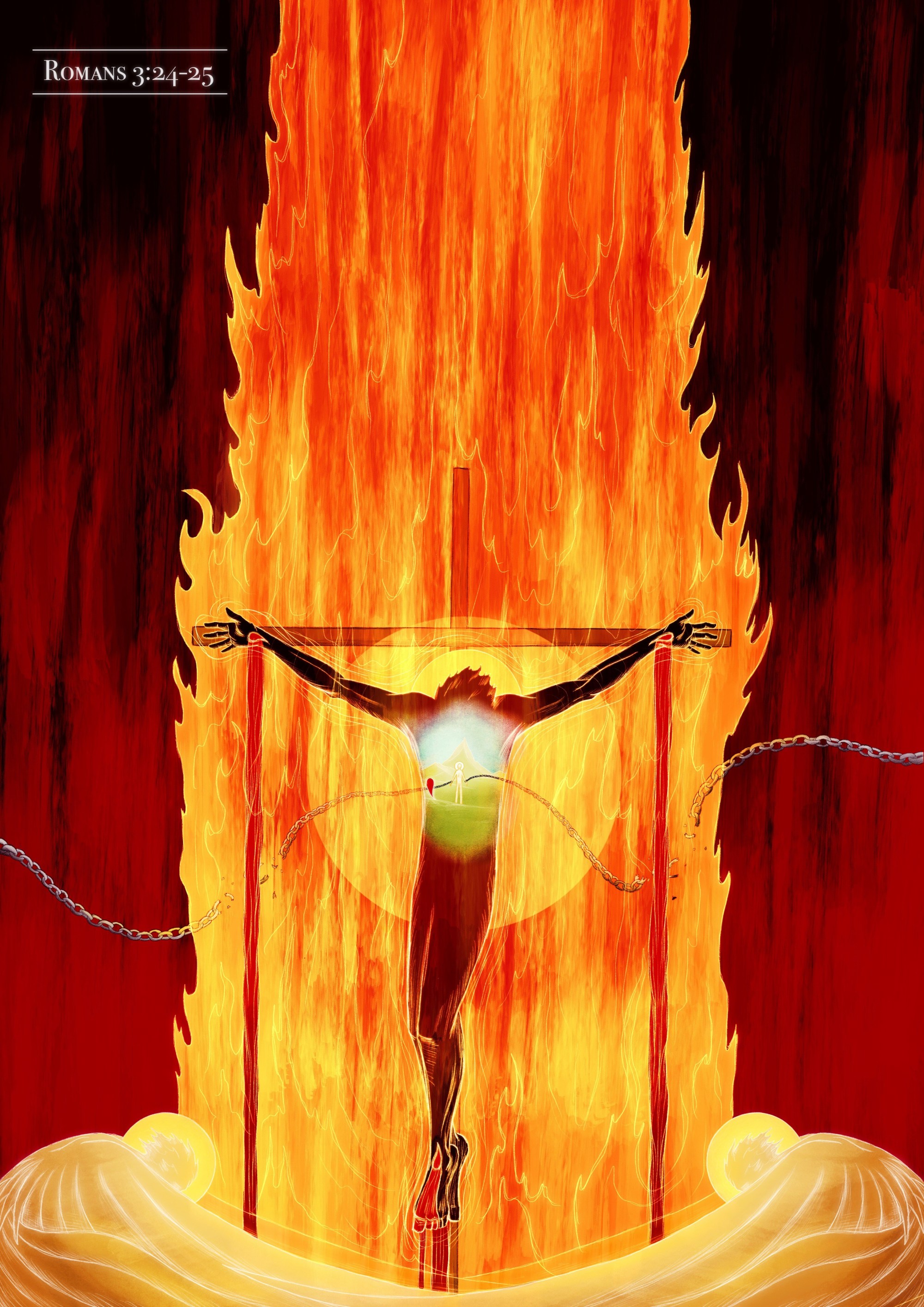
The Righteous Live by Faith – Sermon on Habakkuk 2:1-4 for Reformation Sunday

Habakkuk 2:1–4

1 I will take my stand at my watchpost 
and station myself on the tower, 
and look out to see what he will say to me, 
and what I will answer concerning my complaint. 

2 And the Lord answered me: 
“Write the vision; 
make it plain on tablets, 
so he may run who reads it. 
3 For still the vision awaits its appointed time; 
it hastens to the end—it will not lie. 
If it seems slow, wait for it; 
it will surely come; it will not delay. 
4 “Behold, his soul is puffed up; it is not upright within him, 
but the righteous shall live by his faith.

Slaves & Sons – Sermon on John 8:31-36 for Reformation Sunday

John 8:31–36

31 So Jesus said to the Jews who had believed him, “If you abide in my word, you are truly my disciples, 32 and you will know the truth, and the truth will set you free.” 33 They answered him, “We are offspring of Abraham and have never been enslaved to anyone. How is it that you say, ‘You will become free’?” 

34 Jesus answered them, “Truly, truly, I say to you, everyone who practices sin is a slave to sin. 35 The slave does not remain in the house forever; the son remains forever. 36 So if the Son sets you free, you will be free indeed.

In the name of Jesus. Amen.

Jesus says, “If you abide in My Word, you are truly My disciples, and you will know the truth, and the truth will set you free.” Those words of our Lord have been rolling around in my mind this past month. What Jesus says there has a lot of implications both for individuals and, by extension, for congregations. To be a disciple of Jesus – in other words to be a Christian – means abiding, remaining, and staying in Jesus’ Word. Those who are saved love to hear their Savior’s words. And that does not only refer to the red-letter words in our Bibles. It’s the whole thing. From the words, “In the beginning,” in Gen. 1:1 through the final, “Amen,” of Rev. 22:21 are all Jesus’ Words.

And notice to whom Jesus says this – this is so important. Jesus is speaking to “the Jews who had believed in Him.” In other words, Christ is speaking to Christians (Ro. 10:17) – people who believe His words. So, what Jesus is calling them to do is to continue abiding and remaining in His Words because if they do notremain in Jesus’ Words, they will not be His disciples, they will not know the truth, and they will not be free. Dear saints, your life as a Christian is to continue to learn and grow in your knowledge and understanding of the Bible. To be a Christian is to be a student of the Scriptures.

Now, all of that is important to ponder and consider, but there is something even more profound here that I want us to consider today. Again, as Jesus speaks to people who believe in Him, He calls them to abide in His Word so that they will (future tense) be set free. In other words, those who believe in Jesus are waiting for a freedom that is still to come. That freedom is promised, and that freedom is the hope of every Christian, but it is still in the future.

Today, as Jesus’ disciples, let’s abide in these words of Jesus here for a moment because many other passages in Scripture say that we are free when we believe. Romans 6:22 says that you, believer, have been set free from sin. A little later in Romans 8:2, Scripture says that the Spirit of Life has set you free in Christ Jesus. Galatians 5:1 says that it is for freedom that Christ has set us free.

Just like the people in this reading did, we might want to ask Jesus, “How is it that You say, ‘You will become free’? Aren’t we free already?” Well, Jesus is clear. “Truly, truly. Amen, amen, I say to you everyone who practices,” probably a better way to translate this would be ‘does,’ “everyone who does sin is a slave to sin.” To do sin is to be a slave to sin.

So, dear saints, consider this: Are you a Christian? Do you believe in Jesus? Do you believe His Word? Yes. Then Scripture is clear, you are free – right now.

But also consider this: Are you perfect? Do you do things that God forbids? Do you not do things that God demands? In other words, do you sin? Yes. Then, your Lord is also clear – you are a slave to sin. And you can’t wiggle out of this. It isn’t just that you make mistakes or that you are programmed to do things that aren’t quite right. No. All of us deliberately sin. We sin on purpose, with full knowledge, and repeatedly. And by sinning, we place ourselves under slavery to sin and put our faith in danger. Repent.

Jesus knows when He says that those who do sin are slaves to sin is a devastating judgment. That’s why He continues speaking and offers us hope saying that even though, “the slave does not remain in the house forever; the son does remain forever. So if the Son sets you free, you will be free indeed.”

Jesus doesn’t just leave you in slavery to sin. He is the Son who sets you free – both now and in the future. Romans 6 says that you have been joined to Jesus’ death and resurrection in your Baptism, and it goes on to say, “our old self was crucified with Him in order that the body of sin may be brought to nothing, so that,” and listen carefully here, “so that we would no longer be enslaved to sin. For one who has died has been set free from sin” (Ro. 6:6-7). 

Jesus tells us the truth. The one who does sin is a slave to sin, and He sets us free from the evil master of sin. These two clear truths from Scripture have to be one of the most difficult tensions in all the world. You are, for a time, both slaves (because you sin) and sons (because you believe and are redeemed). You are free, and at the same time you are a slave to sin. You aren’t one or the other or bounce back and forth. At the same time, you are sons of God and still slaves to sin. The last half of Romans 7 talks about this tension (Ro. 7:14-25).

You are simultaneously saint and sinner, or, as Jesus puts it here, simultaneously slaves and sons. The tension between those two teachings isn’t understandable or comprehensible. But that’s ok. The Bible teaches all sorts of things that are beyond our understanding like the Trinity; the two natures of Jesus, that He is both God and man; etc. We don’t hesitate to believe those things because Scripture clearly teaches them. Well, Scripture also teaches that you are a slave to sin and a redeemed son of God. 

This tension is what keeps you running back to Jesus. It isn’t your obedience or your consistency or the fact that you feel bad about being a sinner that sets you free. Yes, you should feel bad about being a sinner, but that isn’t what sets you free from your slavery to sin. It’s Jesus, the Son, and Him alone who sets you free now and will make you free forever.

Dear saints, when – not ‘if’ but ‘when’ – when you feel the weight of your slavery, when the shackles of your iniquities rub your wrists and ankles raw, when the whip of your transgressions has shredded your back, remember Jesus came for you. He came – not for the righteous because there aren’t any righteous – He came to call you, sinner, to repentance and faith (Mt. 9:13; Mk. 2:17; Lk. 5:32). Jesus sets you free, and if He sets you free, then you are free indeed.

Child of God, abide in Jesus’ Word, and you will remain in the house forever. Amen.

The peace of God, which surpasses all understanding, will guard your hearts and minds in Christ Jesus. Amen.

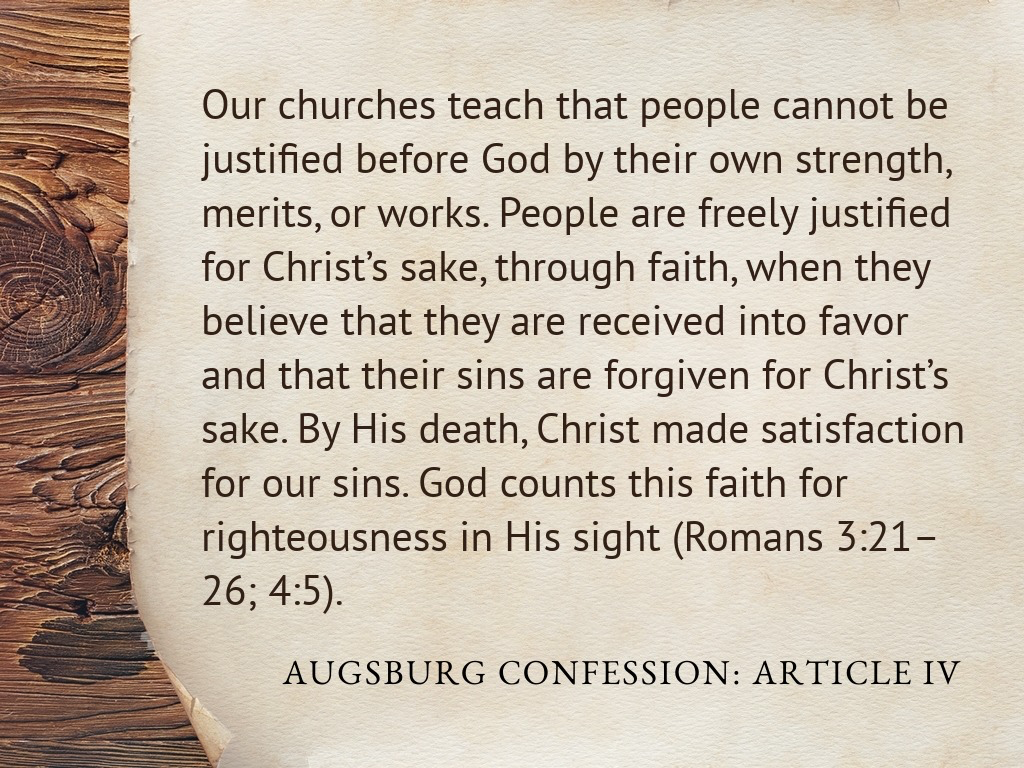
Salvation unto Us Has Come – Sermon for Reformation Sunday (Observed) 2022

The Scripture readings for our service today were Revelation 14:6-7; Romans 3:19-28; and John 8:31-36.

A sheet with Scripture verses that were used to compose the hymn “Salvation unto Us Has Come” can be found here.

In the name of Jesus. Amen.

We are all slaves – every one of us. Romans 3:23 says, “all have sinned and fallen short of the glory of God.” And here in v. 34, Jesus says, “Everyone who practices sin is a slave to sin.” And don’t misunderstand the word ‘practice’ there. It is a fine translation, but we might get the wrong idea if we think the word ‘practice’ means someone who does something over and over to get better at it. I don’t think anyone here is actively trying to get better at lying, stealing, cheating, etc. The word Jesus uses here that gets translated as ‘practice’ is simply the word ‘do’ or ‘does.’ We will say that a doctor ‘practices’ medicine because medicine is simply what the doctor does. Literally, Jesus’ statement here could read, “All who do sin are slaves to sin.” And because “all have sinned,” (Ro. 3:23), we all are slaves to sin.

Slaves do not remain in the house. Only sons do. That is why you need Jesus – the eternal Son of God – to set you free. Christ sets you free through His Word because His Word delivers to you everything that He has done and accomplished on the cross. Through Jesus’ death and resurrection, you are delivered from your slavery, you are freed, you become God’s child, and, as God’s children, you remain in the house forever with Jesus.

Now, that’s a full sermon right there, but we’ve still got some time. So, I want to bring in a guest preacher to teach us the same thing. The name of the preacher is Pastor Paul Speratus. Pastor Speratus wrote the hymn that you have in your Scripture insert. This hymn, “Salvation unto Us Has Come,” ends up being a complete summary of the theology of the Reformation, and since today is Reformation Sunday, we’re going to sing it and let it preach to us. I know some of you will find this boring, but please give me just a minute to set the stage for how this hymn came to be written.

Speratus was a Catholic priest in Salzburg, Austria. You probably know Salzburg because of the movie The Sound of Music. Well, Speratus had read Luther’s writings that came after the 95 Thesis, and Speratus recognized how far the church had wandered from the teaching of the Scriptures. So, Speratus starts preaching Law and Gospel in Salzburg. Luther got condemned for his writings in 1521, but Luther was protected from that sentence of death – basically, by being kidnapped and hidden in a castle where he spends 300 days translating the Bible into German. Well, Speratus also ends up being sentenced to death for heresy in 1523 and was sentenced to be burned at the stake. Like Luther, Speratus gets rescued from execution. But during his time in prison, Speratus writes this hymn.

You might think that sitting in prison and waiting for execution, Speratus would write a hymn about God’s protection and provision. But no. Speratus writes a hymn about the theology of salvation. Speratus wrote this hymn because Luther had just started conducting services in German and called on German-speakers to write hymns that taught the truths of Scripture in the German language so the people would have good songs to use in worship. This hymn is one of those. Apparently, when Luther first heard it, he offered the singer all the money he had in his pocket for the lyrics. And the hymn ended up being included in the first German hymnal which only had eight songs in it. The history lesson on the hymn is now over.

Personally, I love how clearly this hymn teaches what the Bible teaches, and according to Scripture, that is what Christian songs should do (Col. 3:16). The nice thing about this hymn is that Speratus included the Scripture passages he had in mind when he wrote the hymn. Those passages are included on the insert in your bulletin. This hymn would be a good addition to your devotional time. If you don’t have a regular devotional, my suggestion would be to read the passages for the first verse then sing it. The next day sing the first verse, then read the passages for the second verse and sing it. The third day, sing the first two verses, then read the Scriptures for the third and sing it. Do that for ten days adding a new verse each day.

By the time you finish, you will be a great theologian because this hymn so clearly teaches Law, Gospel, and holy living. It clearly teaches how our good works don’t help or save us, which is what the church of Rome was falsely teaching. Instead, faith produces the fruit of good works which are good because they serve our neighbor.

So, we’re going to let the hymn preach to us. Because it’s a long hymn, we won’t sing all ten verses at once. I’ll give your voices a break and make brief comments here and there. Feel free to sing it from the insert, but if you would like to have the music, it is #410 in your hymnal. Let’s start with the first verse.

1. Salvation unto us has come
by God’s free grace and favor;
Good works cannot avert our doom,
they help and save us never.
Faith looks to Jesus Christ alone,
Who did for all the world atone;
He is our one Redeemer.

This verse summarizes everything that will come after it. God, by His free grace and favor given through Jesus, has set you free. Through faith in Jesus, you are a child of God. The last two lines of that verse tell us what Jesus has done. He made the payment for you. He is the one and only Redeemer.

Now, because the hymn was written in German then translated into English, some of the wording is slightly changed from the original to make the poetry work in English. But those last two lines in German say that Jesus, “has done enough for us all. He has become our Mediator.” Jesus has done everything you needed to be saved, and now He sits at God’s right hand interceding for you and governing all things for your good.

Now, the hymn goes on to elaborate what Jesus needed to do. Let’s sing verses 2-3.

2. What God did in His Law demand
and none to Him could render
Caused wrath and woe on ev’ry hand
for man, the vile offender,
Our flesh has not those pure desires
The spirit of the Law requires,
and lost is our condition.

3. It was a false, misleading dream
that God His Law had given
That sinners could themselves redeem
and by their works gain heaven.
The Law is but a mirror bright
To bring the inbred sin to light
that lurks within our nature.

Because of our sinful nature, we don’t even begin to do what God requires of us through the Law. And even though we falsely think that we’re better than others, the Law is a bright mirror that shows our desperately lost and sinful condition. Let’s sing verse 4.

4. From sin our flesh could not abstain,
sin held its sway unceasing;
The task was useless and in vain,
our guilt was e’er increasing.
None can remove sin’s poisoned dart
Or purify our guileful heart—
so deep is our corruption.

Apart from Jesus, we have no hope of salvation. The poison of sin continues to slowly kill and destroy us. The Law leaves us dead in sin. But that does not mean that we are without hope. We’ll sing verse 5.

5. Yet as the Law must be fulfilled
or we must die despairing,
Christ came and hath God’s anger stilled,
our human nature sharing.
He hath for us the Law obeyed
And thus, the Father’s vengeance stayed
which over us impended.

Jesus has fulfilled the Law for you. He is your substitute. The eternal Son of God took on your flesh to do all this for you. He perfectly obeyed the Law for you. He suffered the punishment your sins deserved. And because of that, God sees Jesus’ perfection when He looks at you, believer. God has no anger left for your sins because Jesus has taken it all. Verse 6.

6. Since Christ hath full atonement made
and brought to us salvation,
Each Christian therefore may be glad
and build on this foundation.
Thy grace alone, dear Lord, I plead,
Thy death is now my life indeed,
for Thou hast paid my ransom.

There is nothing left for you to do to be saved. Everything is done; it is finished (Jn. 19:30). The hymn takes a turn in that verse and addresses God directly. We ask God to apply everything Jesus has done to us. His death is your life. He has fully paid the ransom for your soul. Verses 7-8.

7. Let me not doubt, but trust in Thee,
Thy Word cannot be broken;
Thy call rings out, “Come unto Me!”
no falsehood hast Thou spoken.
Baptized into Thy precious name,
My faith cannot be put to shame,
and I shall never perish.

8. The Law reveals the guilt of sin
and makes men conscience-stricken;
The Gospel then doth enter in
the sinful soul to quicken.
Come to the cross, trust Christ, and live;
The Law no peace can ever give,
no comfort and no blessing.

Jesus calls to you, “Come to Me, all who labor and are heavy laden, and I will give you rest.” Trusting in that call, you will never ever be put to shame. Jesus has come so that you have eternal, abundant life. Verse 9.

9. Faith clings to Jesus’ cross alone
and rests in Him unceasing;
And by its fruits true faith is known.
with love and hope increasing.
Yet faith alone doth justify,
Works serve thy neighbor and supply
the proof that faith is living.

Faith in Jesus is the only thing that saves you, but faith is never alone. Christian, you do good works, but those works never save you. Those works are simply the fruit of the Spirit that serves your neighbor and shows that your faith is alive and well.

Now, the hymn closes with a doxology. We get swept up into the liturgy of heaven and join all the saints who have gone before us by praising God for what He has done for us in Christ. Let’s sing the final verse.

10. All blessing, honor, thanks, and praise
to Father, Son, and Spirit,
The God that saved us by His grace—
all glory to His merit!
O Triune God in heaven above,
Who hast revealed Thy saving love,
Thy blessed name be hallowed.

Amen.The peace of God, which surpasses all understanding, will guard your hearts and minds in Christ Jesus. Amen.

Unmoved – Sermon on Psalm 46 for Reformation Sunday

Listen here.

Psalm 46

In the name of Jesus. Amen.

Winston Churchill is often cited as the one who coined the phrase, “Those who fail to learn from history are condemned to repeat it.” In a tasty bit of irony, the quote wasn’t original to Churchill. He was slightly altering a quote from a Spanish-born, American-raised, man named George Santayana, and the original statement was, “Those who cannot remember the past are condemned to repeat it.”

Since today is the last Sunday in October, we remember with gratitude how God used Martin Luther to preserve His Church and the preaching of the Gospel for the world. So, today’s sermon is going to be slightly different than most sermons you will hear me preach. First, we are going to consider a little bit of Reformation history especially surrounding the writing of the hymn we just sang “A Mighty Fortress.” Then, we are going to consider the lyrics of the hymn by looking at the Biblical text the hymn is based on, Psalm 46. So first, the history.

As popular as “A Mighty Fortress” is, we actually know very little about it. The earliest hymnal that contains it is from 1533. Historians mostly agree that Luther wrote the hymn sometime during the years of 1527-1528, about a decade after he posted the 95 Thesis on the door of the castle church in Wittenberg.

Now during the first eight years after Luther posted the 95 Theses, Luther was fighting mainly against abuses in the Roman church. It is important to note that Luther wanted to reform the church and not break away from it. However, as Luther repeatedly tried to get the leaders in the Roman Church to return to the pure teaching of the Gospel, they decided to throw him out by excommunicating him. In April 1521, Luther refused to recant of his writings at the Diet of Worms where he famously stated, “Here I stand. I can do no other. God help me.” Luther was supposed to be executed for his teaching, but a nobleman hid Luther in Wartburg Castle for ten months.

When Luther finally returned to Wittenberg in 1522, he found that some radical reformers were taking his teachings too far. Some were destroying statues and art in churches. Some were teaching that the Lord’s Supper was only symbolic. Some claimed to be directly inspired by the Holy Spirit and that they had the ability to reveal God’s will apart from Scripture. So, Luther found himself fighting against these abuses as well.

Beyond that, Luther got very sick around this time. There were national threats as the Muslims were warring their way toward Germany. Catholic armies were threatening Lutheran areas. In August of 1527, a man who followed Luther’s teaching was martyred. That same Fall, a plague broke out in Wittenberg. During that plague, Luther’s wife, Katie, got sick and was quarantined twice. Just a few months later in December, Luther’s daughter, Elizabeth, was born and was always very sick. Things were so bad for Luther that he wrote to a colleague, “[I am] physically well, but outwardly the whole world and inwardly the devil and all his angels are making [me] suffer.” Luther spent the next six months praying that God would save little Elizabeth, but in May of 1528, she died.

Somewhere in the midst of all this, Luther wrote “A Mighty Fortress” based on Psalm 46. He wrote this hymn for himself, his family, and his church. A lot of times, this hymn is called ‘the battle hymn of the Reformation,’ but in one of his publications, Luther called it, ‘a hymn of comfort.’

So, today may we find comfort in the truths of Psalm 46 as they are expressed in “A Mighty Fortress” because we, like Luther then, face pandemic, upheaval, sorrow, uncertainty, and tumult. Follow along with me as we walk through this Psalm.

Psalm 46

1 God is our refuge and strength, 

a very present help in trouble.

2 Therefore we will not fear though the earth gives way, 

though the mountains be moved into the heart of the sea, 

3 though its waters roar and foam, 

though the mountains tremble at its swelling. 

First, notice that this Psalm is mainly written in the plural. God is ‘our’ refuge,’ ‘we will not fear,’ etc. This will be very important when we get to v. 10. Also, did you catch the confidence we have? Because God is our refuge, because God is our strength, because God is a very present help in trouble – we will not fear. “We will not fear though the earth gives way, though the mountains be moved into the heart of the sea.” 

The devil loves to cause us to fear. Satan loves to whisper into our ears that we should be afraid of all sorts of things. Satan says, “Cases of COVID are rising. You should be afraid.” “The economy isn’t doing well, and your retirement account is shrinking. You should be afraid.” “Trump might get re-elected; Biden might win. You should be afraid.” “There is a lot of violence going on around the country. You should be afraid.” “We found an abnormal growth in your scans and need to do more testing. You should be afraid.” “God hates sinners and judges the unjust. You should be afraid.” 

This is all the preaching of the devil. But God puts in our hearts and on our lips these verses. “God is our refuge and strength, a very present help in trouble” – any trouble. Even in the flood of the troubles of this life, even in the face of our ancient foe, the devil, who seeks to work us woe, God remains our mighty fortress who never fails us.

Why can we have this confidence and fearlessness? Pick up again at v. 4.

4 There is a river whose streams make glad the city of God, 

the holy habitation of the Most High.  

V. 4 tells us about a river whose streams make glad the city of God. Now, the earthly city of God is, of course, Jerusalem. But that is not and cannot be the city that this Psalm is speaking about because there is no river in Jerusalem. So, the Psalm has to be pointing us to something else. In fact, the Psalm is pointing us to what Jesus says in John 7. In John 7, Jesus is in Jerusalem for the Feast of Tabernacles, and while He is there, He speaks about a river. Jesus says, “If anyone thirsts, let him come to Me and drink. Whoever believes in Me, as the Scripture has said, ‘Out of his heart will flow rivers of living water’” (Jn. 7:37-38).

Jesus is the fount, fountain, and the source of this river, and those who have faith in Him have rivers of living water flowing from their hearts.

It is never our strength or good works that provide the rivers of water that we need. It only comes from Jesus. If we confided and trusted in our own strength, no amount of our striving would do us any god. But Jesus, the Man of God’s choosing is on our side. In fact, He has set up His habitation (lit. His ‘tabernalce’) in our hearts (1 Cor. 6:19). He is the never-changing Lord of hosts. He will always win the battle.

We’ll pick up the pace now as we move on to v. 5.

5 God is in the midst of her; she shall not be moved; 

God will help her when morning dawns. 

God is in the midst of His people as a very present help which means that His people are unmoved. Think about that. God’s church, His kingdom, His people are unmoved while everything we see and know is wavering, tottering, and melting. V. 6:

6 The nations rage, the kingdoms totter; 
he utters his voice, the earth melts.

While nations rage and kingdoms totter, while the world is filled with devils threatens to undo us, God will triumph. The prince of darkness and all his forces and all his minions will be felled by one little word.

I’ve always wondered what that one little word was that Luther had in mind. What is the one little word that will fell the devil? There is no verse in Scripture that says what word destroys the devil. Certainly, Jesus is the Word of God in the flesh who defeats every craft and assault of the devil. I think in the context of the hymn combined with v. 6 here, any word from God will do. Everything God says exposes the devil’s lies and shows his emptiness. 

On to v. 7.

7 The Lord of hosts is with us; 

the God of Jacob is our fortress.

This verse will be repeated again in v. 11, and it is an echo of v. 1. The God who is our refuge and strength, a present help in every trouble is the Lord of hosts is with us as our fortress. Whatever threat faces us, we are eternally safe in the kingdom of God. 

On to v. 8-9.

8 Come, behold the works of the Lord, 
how he has brought desolations on the earth. 

9 He makes wars cease to the end of the earth; 

he breaks the bow and shatters the spear; 

he burns the chariots with fire. 

God has repeatedly shown that He can and will deliver His people from the mightiest kingdoms, powers, and forces on earth – from Egypt, Midian, Philistia, Assyria, Babylon, Rome, and on and on we could go. Every threat in this world is nothing for you, Christian, because of God’s might. 

Now, we need to slow down again as we get to v. 10.

10 “Be still, and know that I am God. 

I will be exalted among the nations, 

I will be exalted in the earth!” 

I mentioned as we began to consider the Psalm that it is written in first person plural. The Psalm is rightly said and prayed by any of God’s people. But v. 10 stands out like a sore thumb because here God steps in and speaks. And what does He say when we are surrounded by threats? “Be still.”

Most art that I’ve seen that includes this verse is a relaxing, beautiful, calm, tranquil, idyllic scene. A quiet forest, a pristine beach, a beautiful plain, or a majestic mountain. None of those scenes are anywhere to be found in this Psalm.

Instead, this is what God speaks to us when chaos and evil, when destruction and death surrounds us. And what is it that He speaks to us as we watch everything falling around us, as we see the cosmos melting? What does God speak to us as He fights for us, as He wins every battle, as He defeats all our enemies, as He we find our refuge in Him? God says, “Be still. Cease.”

The only other time God says this is when He speaks to Moses at the Red Sea while God’s people are pinned between Pharaoh’s army and the sea. God says, “Fear not, stand firm. I will fight for you, you have only to be silent” (Ex. 14:13-14).

When everything surrounding you says that you should be afraid, God days, “Stay still. I’ve got everything under control. I will fight for you.” And again, the repeated refrain of v. 11 closes out the Psalm.

11 The Lord of hosts is with us; 

the God of Jacob is our fortress.

Dear saints, because Christ has died and risen again for you, God is on your side. Everything in this life can be taken from you by the devil and his minions, but the truth of God’s Word remains. Because Jesus is on the throne, you dwell in a kingdom that will last forever and ever. Stand strong. Take refuge in Christ. Be still in the midst of all the troubles of this world. You are safe and secure in His eternal kingdom. He will sustain you unmoved. Amen.

The peace of God, which surpasses all understanding, will guard your hearts and minds in Christ Jesus. Amen.
God’s Righteousness – Sermon on Romans 3:19-28 for Reformation Sunday

Listen here.

Note:
The last Sunday in October is the day when most Lutheran churches (and other churches for that matter) will remember the Reformation. This coming Thursday, October 31st will mark the anniversary of five-hundred-two years ago when Martin Luther posted his 95 Theses on the door of the Castle Church in Wittenberg Germany. This event was just the beginning of what would take place over the next few decades which is the rediscovery of the Gospel that God saves us by grace alone, through faith alone, on account of Christ alone.
This isn’t a day when we thank and praise Luther. No. Instead, we thank and praise God for using sinful people who are faithful to the Scriptures to call us back to the eternal truths of God’s Word so that we repent of our sins and believe the Gospel. May we, as God’s people, be faithful to the life-giving Word of God.

Romans 3:19-28

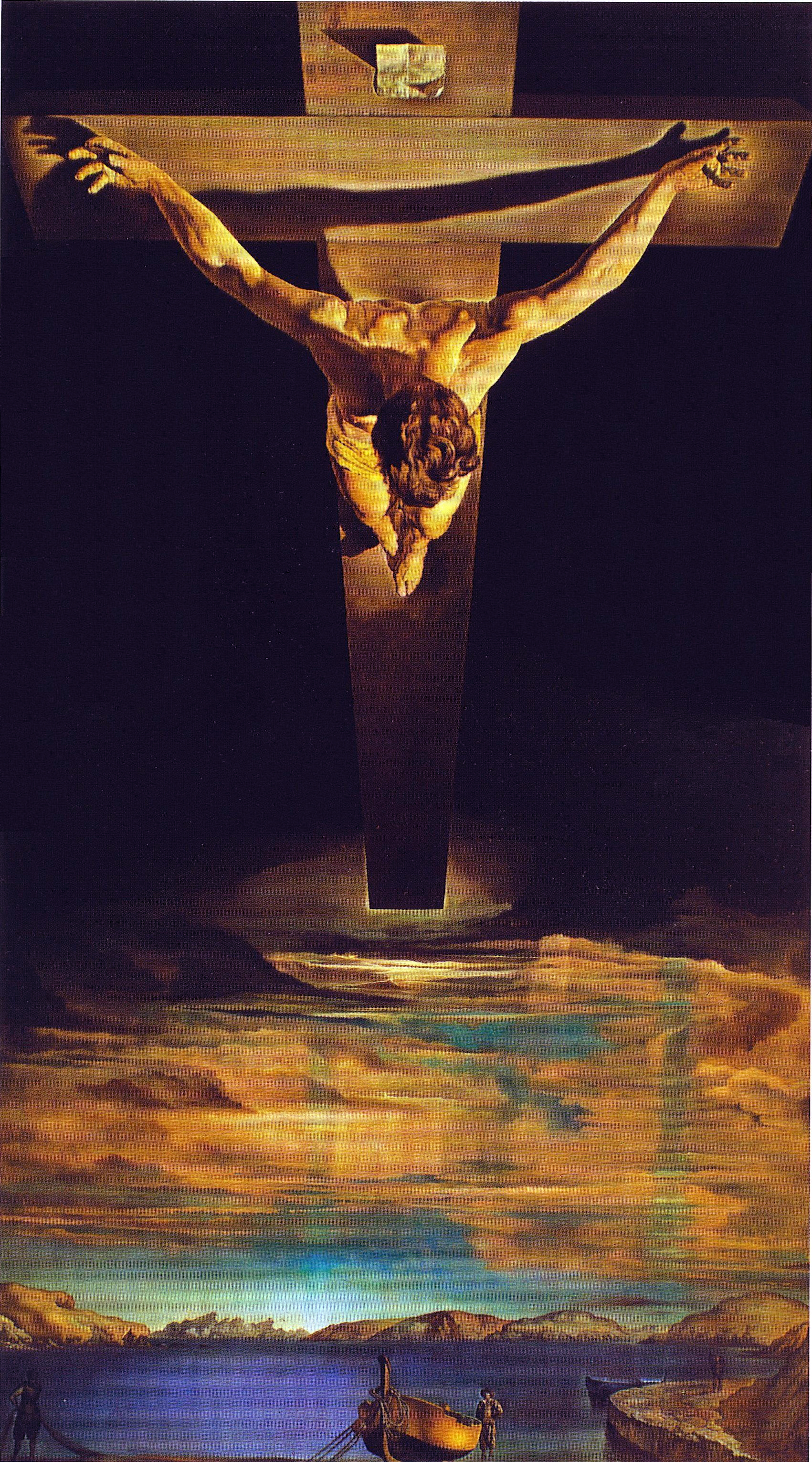
19 Now we know that whatever the law says it speaks to those who are under the law, so that every mouth may be stopped, and the whole world may be held accountable to God. 20 For by works of the law no human being will be justified in his sight, since through the law comes knowledge of sin.Christ of St John on the Cross Salvador Dali

21 But now the righteousness of God has been manifested apart from the law, although the Law and the Prophets bear witness to it— 22 the righteousness of God through faith in Jesus Christ for all who believe. For there is no distinction: 23 for all have sinned and fall short of the glory of God, 24 and are justified by his grace as a gift, through the redemption that is in Christ Jesus, 25 whom God put forward as a propitiation by his blood, to be received by faith. This was to show God’s righteousness, because in his divine forbearance he had passed over former sins. 26 It was to show his righteousness at the present time, so that he might be just and the justifier of the one who has faith in Jesus.

27 Then what becomes of our boasting? It is excluded. By what kind of law? By a law of works? No, but by the law of faith. 28 For we hold that one is justified by faith apart from works of the law.

In the name of the Father and of the Son and of the Holy Spirit. Amen.

This text is centered around righteousness and justification. There is one Greek root in this text that is used ten times in this text and gets translated as righteous, righteousness, just, justified, and justifier. When you look at the text in the Greek, that root word is constantly popping up. It’s harder to see in English because of the various ways it gets translated (which overall, I think are good and helpful; it just is a little more hidden in English). Anyway, the sermon is going to be centered around the second sentence of v. 25, “This was to show God’s righteousness, because in His divine forbearance He had passed over former sins.”

So, to begin: Imagine that you have been caught after robbing a bank and are in a courtroom being tried for robbery, shooting a security guard, and fleeing police. The prosecution has presented a monumental case against you. They presented security footage from inside the bank with a clear picture of your face. Witnesses who were there all pointed to you as the one who demanded the money and fired at the security guard. The attorney produced the gun you used which was registered to you and had your fingerprints all over it. The police identified that it was your car that fled the scene. Bank records show that you deposited the exact amount of cash that was stolen into your own account, and the serial numbers of the bills match the numbers taken from the bank. They even produced text messages of you bragging to your friend about how you took the money and escaped. Every bit of evidence points to your guilt.


Now, you stand before a judge who is about to announce the verdict. Nothing you could say will change the facts. You did it, and nothing can excuse what you have done. It doesn’t matter that the reason you stole the money is that you lost your job and needed to feed your family.

Judge banging gavel on bench in courtroom. CU, slow motion.

You have taken what was not yours. You harmed and endangered others in the process. But you stand before the judge and say, “I am sorry, and I need forgiveness.”

Imagine that the judge, after considering all the evidence says, “I find the defendant not guilty.” He pounds his gavel, your handcuffs are removed, and you are free to go.

The whole courtroom would erupt. The prosecutors would shake their heads. The witnesses, the security guard’s family, and police would be enraged. The judge would probably soon be facing impeachment. That verdict of innocence would be seen as a travesty of justice because that is precisely what it is.

The fact is that this scenario had played out countless times through history – or at least scenarios very much like it. Moses murdered an Egyptian and fled his punishment; yet, God used him to lead Israel out of slavery in Egypt. Samson was a womanizing braggart, but God used Samson to deliver His people from their enemies, the Philistines. And think of David. David used the power and influence God had given him as king to commit adultery, steal another man’s wife, and, in an act of total cowardice, to murder that man by the hands of another. But, when David is confronted by his many and great sins and confesses them, the prophet Nathen simply forgives him and says, “The Lord has put away your sin” (2 Sam. 12:13).

Imagine being Uriah’s father. Your son is dead; his wife was violated and stolen. And the man who did it is simply forgiven? It is egregious, scandalous, shocking, and abhorrent.

I’m going to change gears, so please stay with me. One of the most common criticisms of Christians and Christianity today is people who say that God’s wrath against sin is unjust. Unbelievers will say things like, “How can you believe in a god who destroys all but eight people in a flood, rains down fire and sulphur on Sodom and Gomorrah, and condemns all humanity for eating a piece of fruit?” Unbelievers typically think that the wrath of God is unrighteous and unjust. But it isn’t just unbelievers who think this way.

In fact, God’s kindness and mercy is so prominent in the Scriptures that, when we see God being nice and patient, we start to think that is how He should act. Then, when God is angry, wrathful, and demands death as a punishment for sin, well, we get uncomfortable with that. God's Wrath against SinI have to confess, as I was doing my devotions this week, even when I had this sermon running through my mind, I got uncomfortable with some of the punishments God commanded for certain sins. But God does not owe us an explanation for His anger and wrath.

The reason God doesn’t owe us an explanation for His anger and wrath is given in this text. It is probably one of the verses you know by heart Ro. 3:23, “for all have sinned and fall short of the glory of God.” We all believe that, but it doesn’t have the bite that it should. We have a tendency to turn the phrase, “all have sinned,” into a trite and simple, “Nobody’s perfect.” And the phrase, “fall short of the glory of God,” what does that mean? It doesn’t sound so bad. Maybe, if we have fallen short, maybe we got kinda close.

Well, first of all “have fallen short” is a slightly weak translation; the word there means ‘lack.’ We lack the glory of God. But still, what’s the big deal? Are we supposed to have an equal amount of God’s glory? Did Adam and Eve match God’s glory before they fell into sin? Well, God did create us in His image, but even still we are the creature and do not and could match or equal the glory of our Creator.

To lack the glory of God means something different. And we can be thankful that Romans tells us what this means back in Ro. 1:23. There, Paul describes our fall into wickedness and sin, and he makes this statement we, “exchanged the glory of the immortal God for images.” We lack the glory of God because we knew about God’s glory – it had been given to us in nature and creation, it had been given to us in our conscience before we fell into sin – and though we knew it, we traded it away for idols. Our sin is that we would rather find our contentment and joy and fulfillment in the things God has given us than in God Himself. We took what should be our greatest joy and happiness and exchanged it for trinkets and crumbs.

This is a silly analogy, but… Imagine you gave your grown child a new house, a fancy car, and got him an easy, secure, high-paying job in a stable company. But imagine that your child went and traded every last bit of it away for one of those packets of salt that you can get at Culver’s so he could sprinkle it over his scrambled eggs. As egregious and wasteful as that would be, it still pales in comparison to us exchanging the glory of the immortal God for our sinful desires.

God’s wrath and anger against sin are assumed in the Scripture. And God doesn’t need to explain His punishment of our deep and damnable sins. But this text does say that God did need to explain something else. God did find it necessary to show, explain, and manifest His righteousness, but not because of His anger against or His punishment of our sin. Instead, God needed to manifest and show His righteousness because of His mercy.

Romans 3_24-25Remember, I told you that this sermon was going to be an explanation of that sentence in v. 25, “This was to show God’s righteousness, because in His divine forbearance He had passed over former sins.” What is it that showed God’s righteousness in giving us mercy? Nothing but Jesus Christ. Nothing but Jesus shedding His blood and dying on the cross. Nothing but Jesus being our propitiation – the atoning sacrifice, the mercy seat, the place where God forgives us and meets with us sinners.

Jesus’ death in our place, His suffering for our sins, shows God’s righteousness and proves that God is just when He justifies us and declares us innocent through faith in Jesus.

Think back to that analogy of the judge declaring you innocent of robbing the bank. Imagine that, as the judge was being questioned to be impeached, he said, “Yes, all the evidence pointed to guilt. But trust me, I’m going to make it all right. I’m going to repay everyone who lost money in the robbery. I’m going to completely heal and restore the security guard who was shot. I’m going to take away all the fatigue of the police who chased him. I’m going to remove every last fear of all the people who were put in danger. Everything will be put back to right.”

Christian, Jesus has removed your sin and has put everything back in its proper place. C. S. Lewis expresses this in a beautiful analogy in The Lion, the Witch, and the Wardrobe with the character that represents Jesus, Aslan the lion. “Wrong will be right, when Aslan comes in sight. At the sound of his roar, sorrows will be no more. When he bares his teeth, winter meets its death. And when he shakes his mane, we shall have spring again.” Jesus has done all of this and more on the cross, and it will again be manifested when He returns in glory.

Dear saints, God has justly proclaimed and declared that you are righteous and just in His court because of Christ. Because of what Jesus has done, you are justified. This means you are exactly what you ought to be in God’s sight by His verdict of innocence. You are holy, perfect, and just through God-given faith in Christ. When He looks at you, God does not find the tiniest speck of sin in you. He sees you and treats you as completely and wholly worthy. He does this not because you are sinless or without guilt. No, He does this because of the perfect completeness of Christ’s finished work on the cross.

This is all of God’s just mercy. It leaves no room for us to boast. For this, may God alone be praised, now and forever. Amen.

The peace of God, which surpasses all understanding, will guard your hearts and minds in Christ Jesus. Amen.

Liberated – Sermon on John 8:31-36 Remembering the Reformation

Listen here.

John 8:31-36

31 So Jesus said to the Jews who had believed him, “If you abide in my word, you are truly my disciples, 32 and you will know the truth, and the truth will set you free.” 33 They answered him, “We are offspring of Abraham and have never been enslaved to anyone. How is it that you say, ‘You will become free’?” 34 Jesus answered them, “Truly, truly, I say to you, everyone who practices sin is a slave to sin. 35 The slave does not remain in the house forever; the son remains forever. 36 So if the Son sets you free, you will be free indeed.”

In the name of the Father and of the Son and of the Holy Spirit. Amen.

The parable of the prodigal son was just that – a parable. It was a story Jesus told to teach the people that He had come to save, restore, and free sinners from their slavery to sin, death, and the devil. It was a parable. But that parable tells a story about two – not just one, but two – who are lost. The younger one was obviously lost. But the older brother had wandered farther away from his father even though he never left home.

Remember the older brother in the parable of the prodigal son (Lk. 15:11-32)? He didn’t do all the wrong things his younger brother did.He didn’t tell his father to drop dead. He didn’t demand his inheritance be given to him so he could move away and blow it all. He didn’t end up in the pig-pen. He didn’t have to come crawling home begging for daddy to make him a servant. No, the older brother hadn’t done anything wrong.

Instead, that older brother insists that he did all the right things. He was dutifully working in his father’s field when his despicable brother returned. And when his father came outside to compel him to come in to the party celebrating his brother’s restoration, he answered his father, “I’ve served,” notice that, “I’ve servedyou my whole life. I’ve never disobeyed your command. I’ve never wasted your money. But when this son of yours comes home, you go and kill the fattened calf for him.”

And the parable ends with the father pleading for his older son to come inside the house and join his party.

Now, bring this picture of the older brother stubbornly standing outside the party with his father pleading him to come in. Bring that picture to the text before us now. Jesus says, “The slave does not remain in the house forever; the son remains forever.”

Jesus is speaking to people who believed in Him. Please note that, these people believed in Him. But when Jesus tells them that the truth will set them free, they aren’t interested in the freedom that Jesus offers because they figured they haven’t ever been slaves to anyone (which is ironic because they are basically slaves to Rome and Caesar). But they honestly thought they were already free.

Their belief in their freedom was a lie. And they had a more demanding master than Caesar. They were enslaved to their sin. They figured they had done all the right things, and they denied ever doing anything wrong.

So, when Jesus tells them, “The truth will set you free,”they balk at the idea. They honestly don’t think they needed the freedom that Jesus offers.

As the Gospel of John will continue to play out, the people following Jesus will dwindle. In just a handful of chapters, Jesus’ followers will be few enough that they will fit around a table in the upper room. And the people Jesus is speaking to here in our text, again people who had believed in Him, will be found crying, “Crucify Him.”

Jesus says, “If you abide in My word, you are truly My disciples, and you will know the truth, and the truth will set you free.”

Freedom, liberation comes from the truth. The truth must be learned. You must be discipled. And the only place that learning, that discipling, happens is in the Word. And not just any ‘word,’ but the Word of Jesus. If you want to be free, if you want to be liberated, you must learn the truth of Jesus’ Word.

Listen to what the Scriptures teach. Listen to what Jesus teaches in His Word. Jesus teaches in His Word that you cannot set yourself free from sin. Sin is stronger than you are. You cannot simply choose the good and avoid the evil. You do not have free will. It sounds nice, but it’s not true. Your flesh is totally and completely corrupted by sin.

How do you know this? Because that’s what God’s Word teaches, and God cannot lie. We heard in our epistle lesson (Ro. 3:19-28) that God’s Law finds all of us guilty so that every mouth is stopped, and we are all held accountable to God.

You are a sinner. “All have sinned and fallen short of the glory of God.” ‘All’ means ‘all.’ ‘All’ includes you. You have sinned. You have fallen short of the glory of God. You practice sin. You are a slave.

Learn this. God demands that you obey His commands. But you demand your own way. God says, “Do this,” and you don’t. God says, “Don’t do that,” and there you are doing what was forbidden.

But here also is the truth of God’s Word. Here is the truth that sets you free, sinner.

God has sent His Son, Jesus. Jesus has redeemed you. His obedience, His righteousness, His perfection, His life, His shed blood, His death, His resurrection was and is all for you. Romans 8:1 says, “There is therefore now no condemnation for those who are in Christ Jesus.”

Yes, “all have sinned.” But for you who abide by faith in Christ Jesus, “there is no condemnation.” None. Zip. Zero. Zilch. Nada. Nothin’. No condemnation.

It doesn’t matter what the world thinks. It doesn’t matter what other people think. It doesn’t even matter what you think. There is no condemnation for you who are in Christ Jesus.

Christian, you don’t ever get beyond this truth of God’s Word in this life. Learn it. Abide in it. Because in it is freedom. In the truth of Jesus’ Word that you are a sinner liberated by Jesus, there is freedom. In that truth, Jesus sets you free, and you are free indeed.

We celebrate it as a congregation today, but Wednesday will mark the 501stAnniversary of Martin Luther walking from his dwelling to the Castle Church door in Wittenberg Germany to nail his 95 Theses. The events that followed changed history.

But we would be wrong to look only at Luther as the one who caused the things that followed. Luther even said so. He described himself as a rotting bag of flesh who did nothing but preach and teach the Word of God. The Word of God did everything.

May we cling faithfully to that Word of God, and may it change us from slaves and captives to sin to liberated sons and daughters of our heavenly Father so that we may dwell with Jesus in God’s house forever. Amen.

The peace of God, which surpasses all understanding, will guard your hearts and minds in Christ Jesus. Amen.