
Luke 5:1-11
1 On one occasion, while the crowd was pressing in on him to hear the word of God, he was standing by the lake of Gennesaret, 2 and he saw two boats by the lake, but the fishermen had gone out of them and were washing their nets. 3 Getting into one of the boats, which was Simon’s, he asked him to put out a little from the land. And he sat down and taught the people from the boat.
4 And when he had finished speaking, he said to Simon, “Put out into the deep and let down your nets for a catch.” 5 And Simon answered, “Master, we toiled all night and took nothing! But at your word I will let down the nets.” 6 And when they had done this, they enclosed a large number of fish, and their nets were breaking. 7 They signaled to their partners in the other boat to come and help them. And they came and filled both the boats, so that they began to sink. 8 But when Simon Peter saw it, he fell down at Jesus’ knees, saying, “Depart from me, for I am a sinful man, O Lord.” 9 For he and all who were with him were astonished at the catch of fish that they had taken, 10 and so also were James and John, sons of Zebedee, who were partners with Simon. And Jesus said to Simon, “Do not be afraid; from now on you will be catching men.” 11And when they had brought their boats to land, they left everything and followed him.
In the name of Jesus. Amen.
If I am ever asked to preach at a seminary graduation, an ordination, or installation of a pastor, this is the text I will use. This miracle is uniquely fashioned for preachers.
Most of Jesus’ miracles fall into one of two categories when it comes to the reason Jesus does the miracle. Probably, the most common reason for Jesus’ miracles is to bring relief when there is a great need – casting out a demon, calming a storm, healing the sick, feeding the crowds, and raising the dead. The other common reason behind Jesus’ miracles is to authenticate or initiate His teaching. Sometimes, Jesus would do a miracle in response to the grumbling of the scribes and Pharisees (Mt. 9:2-8), or He would agitate them by healing on the Sabbath.
This miraculous catch of fish doesn’t really fit into either of those categories. Jesus doesn’t do this miracle to validate or initiate His teaching. Sure, the text starts by telling us that Jesus was teaching the Word of God to a crowd so large that Jesus has to preach from Peter’s boat a little off from shore. But the way Luke records this, the miracle happens well after Jesus’ sermon was finished. Jesus had finished preaching, and it would take Peter a while to row out into the deep parts of the Sea of Galilee like Jesus tells him to. The crowds wouldn’t just stand around and watch this whole thing take place. I looked at a depth chart for Gennesaret, and they probably wouldn’t have been able to see the miracle. The crowds would have gone home, so the massive catch of fish doesn’t fit this miracle into the category of meeting a need. This haul of fish isn’t Jesus’ way of feeding that congregation.
This miracle is directed at and tailor-made for Peter (and we could probably also throw in the other disciples). After this miracle, these fishermen, who were already disciples of Jesus (see Jn. 1:35-42 and Mk. 1:16-20 which both appear to be separate calls of the disciples), leave everything behind to follow Jesus and learn to become fishers of men.
That’s why this miracle fits so well for preachers. Peter was a successful fisherman, but his knowledge, wisdom, and expertise had its limits – even when it came to fishing. After wasting a whole night where he and his partners caught nothing despite using every trick they knew, Peter listens to fishing tips from this carpenter from Nazareth and has a catch of fish that was more than Peter and his partners could handle. That catch came in an unlikely place, out in the deep, and at an unlikely time, probably late afternoon or early evening when you aren’t likely to catch many fish.
All of this points to the fact that this miracle is teaching Peter that he is going to have to learn to simply trust Jesus’ word, especially when he enters the new vocation of preaching. In other words, this catch is a preview of what is going to happen when Peter preaches the Gospel, and that is exactly what we see. On Pentecost, Peter preaches a sermon that, honestly, isn’t that impressive or insightful, but God uses that sermon to bring a massive catch of souls into the Church. The Gospel net is cast at a place and time that is unlikely to have success. Peter is preaching only fifty days after these same people called for Jesus to be crucified. But the net of the Gospel brings in 3,000 souls into the boat of the holy Christian Church.
This is why this text would be so good to preach to seminarians, pastors, and preachers. In this text, Jesus is showing preachers that their success won’t be based on their rhetoric or skill or cunning or persuasiveness or methodology. The success of the Gospel comes by simply being faithful to Jesus’ Word and throwing out the nets. The Holy Spirit does the work. The only thing a pastor needs to do in order to be a faithful shepherd of God’s flock, and the only thing a congregation needs to do to be a faithful body of Christ, is to simply teach God’s Word, stand firm on what it says, and God will use that Word to do things beyond our imagination or comprehension.
But, my dear congregation, you aren’t seminarians or pastors. So, I won’t preach that sermon to you. Wink, wink. Nod, nod. I guess I need to come up with a different sermon, and this text does have something very important to teach you, but it isn’t, maybe, what you would expect.
If you look at this text in your Bible, you will probably see a heading over these verses in bold letters that says something like, “Jesus Calls the First Disciples.” Well, that heading is a bit misleading because, when we look at the other Gospels, we learn that this is the third time Jesus’ disciples follow after Him. Actually, John 1 is where we see Jesus first calling these disciples. There, Andrew, who is Peter’s brother, is a disciple of John the Baptizer. Andrew hears John call Jesus the Lamb of God. Andrew goes and finds Peter and they begin to follow Jesus and see Him do miracles (see Jn. 2 and Lk. 4) Later, Jesus sees Andrew and Peter and James and John fishing and calls them to follow Him, and they do (Mk. 1:16-20). So, by the time we get to this text in Luke 5, Peter, Andrew, James, and John are already disciples who follow Jesus. But notice, they are still providing for their families through their fishing business.
They are making sure their company will have a future by taking care of their nets. Even though those nets went empty that night, they still needed tending and cleaning to be ready for the next excursion. Tired after a completely unproductive night of fishing but still needing to finish his work, Peter would have had every excuse to ignore Jesus and let Him do His preaching thing over there on the shore for the crowds. Peter had other work to do, and it was good, God-given work to make a living and provide for His family.
But Peter also recognized that he needed to give his attention to the Word of God, which he did. Notice Peter leaves his nets twice in this passage. Yes, he leaves his net to follow after Jesus at the end of the text, but don’t miss the first time Peter leaves his net. The first time, he leaves his work of cleaning them to bring Jesus out a little way into the sea so Christ can continue preaching to both the crowds and Peter.
Peter doesn’t let his career be an idol. He recognizes his work of cleaning the nets can wait. In that moment, Peter was called to something more important than plucking seaweed out of a net. He was called to listen to Jesus’ preaching. And Peter is called by Jesus to let his boat be used for that same preaching. Peter uses the gifts God had given him serve Jesus and those crowds who also needed to hear the Word of God.
Dear saints, it is good to see your job and your paycheck the same way. God has given you work and money to provide you and those in your care with food and clothing, house and home. But God has also given you work and a paycheck so you can set aside time to find rest – not just for a weekend away from your desk, your boss, your coworkers, or your employees – but to find rest from the toil and sin of this fallen world. And God wants you to share those gifts with others so they can also hear God’s Word and find rest in His mercy and grace. Putting your tithe in the offering plate is the same as letting Jesus use your boat to preach. That is also why, even though there are many charities and organizations to give to – and you should give to them – don’t let that come at the expense of giving to the preaching of God’s Word. Your tithe to these plates comes first. Other charitable giving should come second. You need the preaching and so do your brothers and sisters in Christ.
Jesus’ teaching did its work in Peter. When Jesus tells Peter to put out into the deep for a catch – which, again, is the wrong place and wrong time – Peter listened to Jesus and trusted Him, admittedly begrudgingly. Peter puts out the nets, and there are too many fish. The nets threaten to break. The boats threaten to sink. Peter sees all of this and is filled with fear. He isn’t afraid of the nets breaking or the boats sinking. Instead, the sinner is afraid of the wrath of God. Peter is afraid because he recognizes that he, a sinner, is standing in the presence of the holy, almighty God in the flesh. “Depart from me, for I am a sinful man, O Lord.”
But the nets don’t break, the boats don’t sink, and the sinner doesn’t get the wrath and punishment he deserves. “Do not be afraid;” Jesus says, “from now on you will be catching men.” Jesus’ words there are an absolution. Jesus casts Peter’s sins into the depths of the sea where the fish and boats should have ended up. But Jesus doesn’t stop with saving Peter. He has more saving to do. That’s why Peter and the apostles are given the task of preaching. Jesus desires that His work would spread to all.
A lot of sermons on this text will end by challenging you to be like Peter and leave everything to follow Jesus. Dear saints, God in His infinite wisdom hasn’t given you that calling, and that is totally fine. Maybe God will call you into the office of ministry one day. But for now, God has called you into the vocations He has put before you. Right now, you are called by God to listen to His Word being preached to you. And this week, God will put other tasks in front of you. Do them, and do them faithfully. Col. 3:23-24 says, “Whatever you do, work heartily, as for the Lord and not for men, knowing that from the Lord you will receive the inheritance as your reward. You are serving the Lord Christ.” Your work, your calling, your vocations are never wasted, never in vain (1 Cor. 15:58). Everything you have and everything you do is made sacred by the Word of God and prayer (1 Tim. 4:4-5).
So, hear God’s Word. Be forgiven of all your sins. Then, go and do your work. Fulfill the callings God has given to you because your work isn’t done for your paycheck or your boss. The work and calling God gives you has goodness because God uses that work to help and serve your neighbor.
Dear saints, God needs you in the stations and vocations where He has placed you. Jesus knows how He can best use you in the kingdom of God. Jesus knew what He was doing when He placed you into your family, into this congregation, in your job, in your neighborhood. He has placed you there to be a faithful husband, wife, child, employer, worker, friend, and neighbor. You don’t need to leave that in order to serve God more faithfully. God has placed you there to serve Him by serving those neighbors He has given you. Even if you think Jesus made a mistake by putting you there, just trust that Jesus knows what He is doing and that He will use you in the way that He sees fit.
All your earthly work and calling has something of eternity in it because it is done in service to God. And God will use that work to bring about His purposes. To Him alone be the glory, now and forever. Amen.
The peace of God, which surpasses all understanding, will guard your hearts and minds in Christ Jesus. Amen.


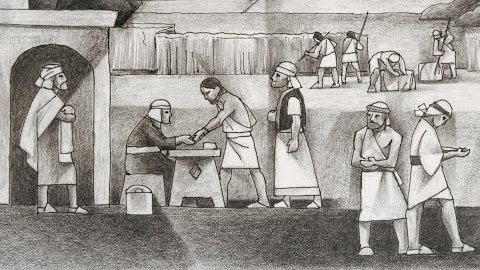
 Dear saints, welcome to the kingdom of heaven. In the kingdom of heaven, you are never rewarded based on your works or efforts because, if you received what you deserved, you would be sent straight to hell. In the kingdom of heaven, there are no formulas or set, hourly wages. You are given to based solely on the merits of Christ’s work for you. He is the only one who can say that He bore the burden of the day and the scorching heat. His atonement, His mercy, His grace is what you get, nothing less. Because of God’s unmerited, unearned, undeserved, unconditional love freely given to you for the sake of Christ, you are an heir of the kingdom of heaven. God be praised!
 Each of them was called, and each of them was called at the precise time the owner called them. He went and retrieved them.
 God had a reason for bringing you in when He did. Trust His timing. He brought you into His vineyard exactly when He wanted you.
 And it isn’t just their work. Your work, done as a Christian, is holy work. Fathers and mothers, the work you do day in and day out will reap results in the lives in your children, grandchildren, and great-great-great-great grandchildren if Christ tarries. But it will also reap results in the lives of others whom you will never meet because you have shined the light of Christ to those you have met, and they will shine that light elsewhere. You Sunday school teachers, you who are praying for and encouraging our youth, you trustees who are caring for our facility, and everyone who is here encouraging another person is offering holy work that will be used by God until Christ returns. Everyone has a story of being impacted by someone else long after that person has entered into glory. So, take heart, and keep working. The labor that God has called you to is fruitful, holy work. It is holy work that God will multiply and expand. For that, God be praised. Amen.
 5 When he had entered Capernaum, a centurion came forward to him, appealing to him, 6 “Lord, my servant is lying paralyzed at home, suffering terribly.” 7 And he said to him, “I will come and heal him.” 8 But the centurion replied, “Lord, I am not worthy to have you come under my roof, but only say the word, and my servant will be healed. 9 For I too am a man under authority, with soldiers under me. And I say to one, ‘Go,’ and he goes, and to another, ‘Come,’ and he comes, and to my servant, ‘Do this,’ and he does it.” 10 When Jesus heard this, he marveled and said to those who followed him, “Truly, I tell you, with no one in Israel have I found such faith. 11 I tell you, many will come from east and west and recline at table with Abraham, Isaac, and Jacob in the kingdom of heaven, 12 while the sons of the kingdom will be thrown into the outer darkness. In that place there will be weeping and gnashing of teeth.” 13 And to the centurion Jesus said, “Go; let it be done for you as you have believed.” And the servant was healed at that very moment.
 “Centurion” was his title and meant he was a commander over one-hundred soldiers. Centurions wore impressive armor including a helmet with all the feathers sticking out of the top, a shiny breastplate, a metal skirt, and a huge shield. Like a leper, a centurion’s command was also obeyed, but not to avoid becoming one of them. A centurion could say, “Go,” and the soldier would go. “Destroy,” and they would destroy. “Kill,” and they would kill.
 Repent, but do not despair. Jesus, God in the flesh, comes down from the mountain in order to save us. He is a God of mercy and grace. He comes to make the unworthy worthy and the unholy sacred. Jesus willingly approaches the untouchable leper to touch and heal. And Christ has compassion upon a centurion who appeared to have everything, but in reality, had nothing.

You must be logged in to post a comment.