Dirty Work – Sermon on Ezekiel 34:11-16 for the Third Sunday of Easter

Ezekiel 34:11-16

11 “For thus says the Lord God: Behold, I, I myself will search for my sheep and will seek them out. 12 As a shepherd seeks out his flock when he is among his sheep that have been scattered, so will I seek out my sheep, and I will rescue them from all places where they have been scattered on a day of clouds and thick darkness. 13 And I will bring them out from the peoples and gather them from the countries, and will bring them into their own land. And I will feed them on the mountains of Israel, by the ravines, and in all the inhabited places of the country. 14 I will feed them with good pasture, and on the mountain heights of Israel shall be their grazing land. There they shall lie down in good grazing land, and on rich pasture they shall feed on the mountains of Israel. 15 I myself will be the shepherd of my sheep, and I myself will make them lie down, declares the Lord God. 16 I will seek the lost, and I will bring back the strayed, and I will bind up the injured, and I will strengthen the weak, and the fat and the strong I will destroy. I will feed them in justice.

Alleluia! Christ is risen! 
He is risen indeed! Alleluia!

In the name of Jesus. Amen.

One of the most common metaphors that the Bible uses for how we relate to God is the relationship between a shepherd and his sheep. It’s not the most common image, but it’s toward the top. It’s probably merciful that God didn’t make it the most common one because it isn’t overly complimentary. Sheep aren’t strong or fast or smart or impressive animals. Sheep are needy and, honestly, stupid. They get themselves into all kinds of dirty, sticky messes. The imagery isn’t meant to be flattering, but we don’t need to be flattered. God be praised that He doesn’t expect us to be anything more than His sheep.

When you’re the sheep, the image is very comforting. That’s why Psalm 23 is so popular. When you’re the Shepherd, it’s a lot of work – in fact a lot of dirty work. That’s why this text from Ezekiel 34 isn’t as well-known as Psalm 23. The context of this passage is that God is speaking against the shepherds (i.e. the rulers and religious leaders) whom He had called to shepherd His people. He is speaking against them because they hadn’t been faithful (Ezk. 34:1-10).

These shepherds failed to do what God called them to do. They had been feeding themselves instead of the sheep. They had fattened themselves by devouring the sheep. They had not strengthened the weak; they had not healed the sick; they had not bound up the injured, brought back the strayed, or sought the lost. Because of these failures, God’s sheep had been scattered over the face of the earth. God’s sheep had become food for the wild beasts, wandered all over the mountains, and were scattered with no one to search or seek them.

So right before our text starts, God says to those shepherds, “I am against you and will require My sheep from your hand.” God says that He’s going to put a stop to their neglect and lack of care for the sheep. He Himself will rescue them.

One of the classic children’s stories that I enjoy is “The Little Red Hen.” You remember how it goes. The little red hen finds some wheat seed and asks her friends, the dog, the cat, the duck, and the pig a series of questions. “Who will help me plant the seed, water the seed, harvest the wheat, grind the grain, bake the bread?” To each question, there’s the rhythmic reply, “’Not I,’ said the dog, ’Not I,’ said the cat, ’Not I,’ said the duck, ’Not I,’ said the pig.” So, the determined hen says, “Then I will do it myself.” Then, when the bread is finally out of the oven, the little red hen asks, “Who’s going to help me eat the bread?” And of course, the dog, the cat, the duck, and the pig are all eager and ready to eat, but she says, “No, you didn’t help me plant, water, harvest, grind, or bake. I will eat it myself.” And she did.

This passage has a similar tone to it. The shepherds had not done their job, and so God says, “Ok. I will do it Myself.” And He does. He did exactly what we needed as His sheep.

God says that He, Himself, seeks us, rescues us from all the places we’ve been scattered on a day of clouds and thick darkness. He brings us out from the peoples, gathers us from the countries, brings us into our own land, and feeds us with good pasture. He makes us lie down, seeks us when we’re lost, brings us back when we’re strayed, binds us up when we are injured, strengthens us when we are weak. He does all the dirty work that sheep need from their shepherd. God’s frustration here is not directed at the sheep – it’s directed to the shepherds. God willingly does all of these things out of His love, care, and compassion for you, His sheep.

When Jesus calls Himself the Good Shepherd in our Gospel reading today (Jn. 10:11-16), He says that He is that Shepherd. His work of seeking us lost ones, bringing back us strayed ones, binding up our injuries, and strengthening our weaknesses – all of this happens as He lays down His life for us. That is how He is your Good Shepherd.

You are His sheep. He cares for you and does all the dirty work of being your Good Shepherd. Christ does all of this dirty work for the joy set before Him (Heb. 12:2) of having you as His sheep. Your Good Shepherd fully knows that you need to be fed, found, brought back, bound up, and strengthened. In other words, He knows you are His sheep who need His care.

But don’t miss the fact that, as your Good Shepherd, He knows what tasks and responsibilities you can handle. So, He calls you to be His under-shepherds. Just because you are an under-shepherd doesn’t mean you are no longer His sheep. You are always a sheep. But He, as the Good Shepherd, entrusts the care of His sheep to you. Can you imagine a parent saying about their kid, “That’s God’s child, not mine”? Of course not! A parent recognizes, “That’s my child that God has given and entrusted to me.”

Dear saints, every relationship you have is a calling from God to care for His beloved sheep. Be faithful in those callings whether you are a parent, a worker, a student, a friend, a sibling, whatever. You are an under-shepherd.

In our Gospel reading, Jesus calls us hired hands (Jn. 10:12-13). Jesus doesn’t say that all the hired hands are cowards who run away at the sight of the wolf simply because they are hired hands. He says that the ones who flee do so because they don’t care about the sheep. Christ has given you callings and wants you to have the same care for His sheep that He has entrusted to you. Again, the context of this passage from Ezekiel is clear that God intends that His under-shepherds be faithful in doing the dirty work of caring for His sheep. So, be a good under-shepherd.

Dear saints, you have been called to follow Christ’s example (1 Pet. 2:21). Imitate and follow Him. Your Good Shepherd has joined you to His cause of bringing back the strayed to the Shepherd and Overseer of souls (1 Pet. 2:25). Jesus is the Shepherd who clears the path before you, His sheep. Christ is also the janitor who cleans up after you when you fail as His under-shepherd.

Dear saints, you are called to do the dirty work of being shepherds, caring for God’s flock, and ministering to all the different needs of God’s sheep. You are to bind up the injured, bring back the strayed, and strengthen the weak.

I want to close with these verses from 1 Pet. 5:2-4 where the Holy Spirit says to all of us, “Shepherd the flock of God that is among you, exercising oversight, not under compulsion, but willingly, as God would have you; not for shameful gain, but eagerly; not domineering over those in your charge, but being examples to the flock.” And listen to the conclusion, “And when the chief Shepherd appears, you will receive the unfading crown of glory.” 

God be praised that Christ Himself is our Good Shepherd who both leads us and follows after us as He cares for all His sheep. Amen.

Alleluia! Christ is risen! 
He is risen indeed! Alleluia!

The peace of God, which surpasses all understanding, will guard your hearts and minds in Christ Jesus. Amen.

Life’s Sacred Rhythm – Sermon on Ecclesiastes 2:18-26 for Midweek Lent 2

The Scripture readings for tonight’s service are Psalm 127:1-2, 104:24-25, 29-30; Ecclesiastes 2:18-26; 1 Thessalonians 4:9-12; and Matthew 11:25-30.

In the name of Jesus. Amen.

How you talk matters. The words you use shape how you and others think. You can call a house “small” or “cozy. Someone who has lived several more decades than you might be “over the hill” or have “a lot of life experience.”

Think about the words you use for eating. You eat many different things of many different qualities for many different reasons, and the language you use reflects that. You might “have a snack” of carrots and hummus. You might “treat yourself” to a candy bar or a bowl of ice cream. You might “pig out” and eat an entire bag of chips. All of that language refers to eating. But the purpose or result of eating is always the same. Eating gives your body calories and fuel to function.

At Thanksgiving, Christmas, or when grandma makes her pot roast for your extended family, it’s “a feast.” Everything tastes wonderful, there’s more than enough for everyone, and it is great to be at a table with people you love. Now, is the food you eat at that feast going to give your body the energy and fuel that it needs to function? Yes, of course. Again that’s the purpose of eating. But when you thank grandma for all of her work preparing that meal, are you going to use words and phrases only reflect that? “Grandmother, you have given my body the calories I need to live”? Of course not! You’ll say, “Grandma, what a tremendous, tasty feast!”

Tonight’s verses from Ecclesiastes focus on our work. How we talk about work matters. You might talk about your “job” or your “work.” Both of those terms can be fairly neutral. But you might also use the word “job’ in a negative sense. “This is my job, but I don’t want it to be my career” because that shows a lot more commitment. You might refer to your work as “the daily grind” or “my 9-5.” Those types of phrases make your work sound like toil.

One of the Hebrew words for ‘work’ (there are several of them) comes up ten times in the text. And, to it’s credit, our translation is quite consistent in how that word is translated – 9 of the 10 times that word occurs, it’s translated as ‘toil’ and one time (in v. 20) it translates it as ‘labor.’ But do the words ‘toil’ and ‘labor’ have a good or a bad connotation in your mind? Probably bad. The word ‘toil’ probably puts an image of a witch stirring pot of glowing green stuff over a fire, “Double, double, toil and trouble.” And ‘labor’ might make you think about being sentenced to decades of difficult life in Siberia. But the Hebrew word simply refers to putting effort into something. Exerting effort isn’t a bad thing. All sorts of things we enjoy require effort.

Maybe some of you went outside close to 2:00 AM this past Friday to see the ‘blood moon’ eclipse. That required effort, both to get out of bed at that time (or to stay up that late) and then to push through the next day. Baking, gardening, knitting, reading a good book, playing an instrument, camping, jogging, cheering your favorite sports team – all of those things require degrees of effort. Everything you do requires effort – even sleep.

With that simpler meaning of the word that gets translated as ‘toil,’ I want you to follow along as I slightly rephrase v. 21, “Sometimes, a person puts in effort that requires wisdom and knowledge and skill, [but] must leave everything to be enjoyed by someone who did not put in any effort for it. This is breath [vanity] and a great evil.”

Sticking with food analogies: imagine that you’ve spent hours of effort making a brisket, prime rib, or turkey. It’s cooked and is just resting on the kitchen counter before you serve it so you don’t lose all the juices. But you leave the kitchen for a minute only to come back and find that Fido has devoured the whole thing. This is, indeed, a great evil. All your effort and toil has become like a breath that’s instantly vanished.

Are there times when your work and effort is wasted and done in vain? Sure, of course. But that isn’t always the case. It doesn’t mean that all your work and all your effort is vain, meaningless, and evil toil. Not at all! Look again at v. 24-25. These are the verses we’ll focus on for the rest of the sermon because, in them, Solomon gives us one of the ingredients for a life that is filled with God-given joy. “There is nothing better for a person than that he should eat and drink and find enjoyment in all the effort he expends. I saw that this [joy] is from the hand of God, for apart from God, who can eat or who can have enjoyment?”

This is so beautiful and comforting. Under inspiration of the Holy Spirit, Solomon wisely tells us how to find joy in life. Joy comes from eating and drinking and finding enjoyment in your effort. This is God’s design. It is the holy, sacred rhythm of your life. God gives you moments when you need to work, sweat, and strive with all your strength. Then, God gives moments when you live quietly. The point Solomon is making here is there is joy in both (1 Thes. 4:11). 

Notice especially that Solomon says that joy comes in your effort. This is so simple, but it’s the opposite of how we often think. We think that we work and work and work to get a paycheck. Then, we take that paycheck and use it to buy things that we think we will enjoy. In that perspective, we enjoy the things that come from the work we did, but not the work itself. What that does is it makes our work a sort of punishment, a penance or purgatory, that we have to endure to eventually, maybe, get enjoyment. Our typical mindset that we work to get something from our work that we hope will bring us happiness. But it doesn’t bring happiness.

Through all of ch. 2 prior to this text, Solomon talked about all the wealth and stuff he accumulated in an attempt to find joy. He had more than we can even imagine, but Solomon says that those things didn’t bring him joy or satisfaction. Solomon even tried saving for the future, but it didn’t bring joy because you can’t enjoy the future. The future isn’t here. You can only enjoy today, this present moment.

Solomon’s correction for us, and the wisdom he gives us is that we are not to work so we can get joy from our effort; instead, find enjoyment in our effort. That’s a big difference. God gives us work to do, and He wants us to find enjoyment in the work – not from it, but in it. A more literal translation from the Hebrew of v. 24 goes like this, “eat and drink and see in your soul the good in your effort.” In other words, open your eyes and see the good in all the things where you spend your effort and work because that work is given to you by God’s own hand.

I remember being in school and thinking about all sorts of subjects, “What’s the point of all this? When will I ever use this information?” Do you see how that orients things? It assumes there can only be a benefit in the future, which, again, isn’t ours to control.

Christian, is it true that God is in control and directs all things? Yes, “in Him we live and move and have our being” (Act. 17:28). And is God good? Yes. So, if God has put you in a classroom where the teacher wants you to be able to locate Djibouti on a map, calculate the volume of a sphere, diagram a sentence, or identify the parts of a flower – your loving, heavenly Father has given you that task from His good hand. The effort you spend on that task is good. Your opinion of the importance of any task is irrelevant. God is the One who put that task in front of you. And because He is good, that task and the effort you spend on it is good. This is true for all your efforts. It includes your job, the ways you serve your parents and family, the ways you volunteer, your prayers, etc. Seeing your tasks, whatever they are, is a gift from God’s hand, and recognizing that will give you joy.

And God doesn’t only give you work and tasks. He also blesses you with the leisure of eating and drinking. This is how God has ordered and established the rhythm of creation. The God-given rhythm of your life is work and eat and drink, you can think of this as having time to enjoy the gifts God gives you. Have a little leisure and enjoy God’s gifts. Get a bit of sleep. And wake up again and go, enjoy your work. Again, this might sound simple or even naive, but this is what the Bible gives us to find joy in. This is all a gift of God.

Finally, dear saints, notice who receives this wisdom and knowledge and joy. Your told who in v. 26. This joy is given to the one who pleases God.

And you are pleasing to God because Christ has removed all of your guilt. In Jesus, God absolves your sins by His death and resurrection. Jesus is your Savior so you can have joy in your work and in your leisure. This is the kind of rest Jesus talked about in our Gospel reading. Christ places His easy yoke and light burden upon you. In Him, and in Him alone, you find rest and joy for your soul (Mt. 11:28-30). Amen.

The peace of God, which surpasses all understanding, will guard your hearts and minds in Christ Jesus. Amen.

A Fresh Look – Sermon on Matthew 20:1-16 for Septuagesima Sunday

Matthew 20:1–16

1 “For the kingdom of heaven is like a master of a house who went out early in the morning to hire laborers for his vineyard. 2 After agreeing with the laborers for a denarius a day, he sent them into his vineyard. 3 And going out about the third hour he saw others standing idle in the marketplace, 4 and to them he said, ‘You go into the vineyard too, and whatever is right I will give you.’ 5 So they went. Going out again about the sixth hour and the ninth hour, he did the same. 6 And about the eleventh hour he went out and found others standing. And he said to them, ‘Why do you stand here idle all day?’ 7 They said to him, ‘Because no one has hired us.’ He said to them, ‘You go into the vineyard too.’ 8 And when evening came, the owner of the vineyard said to his foreman, ‘Call the laborers and pay them their wages, beginning with the last, up to the first.’ 9 And when those hired about the eleventh hour came, each of them received a denarius. 10 Now when those hired first came, they thought they would receive more, but each of them also received a denarius. 11 And on receiving it they grumbled at the master of the house, 12 saying, ‘These last worked only one hour, and you have made them equal to us who have borne the burden of the day and the scorching heat.’ 13 But he replied to one of them, ‘Friend, I am doing you no wrong. Did you not agree with me for a denarius? 14 Take what belongs to you and go. I choose to give to this last worker as I give to you. 15 Am I not allowed to do what I choose with what belongs to me? Or do you begrudge my generosity?’ 16 So the last will be first, and the first last.”

In the name of Jesus. Amen.

What is the greatest gift given in this parable?

At first glance, we think that it’s the denarius, that full day’s wage, handed to the workers who showed up last. But that’s the wrong answer. All the workers – those who were hired at the eleventh hour, the ninth hour, the sixth hour, the third hour, and right way at daybreak – they all get the same coin. It looks like the later you come, the greater the gift you receive. We think the only ones who don’t receive a gift are those who worked all day. They simply get what they had agreed to, what they bargained for – an honest day’s wage for an honest day’s work. But the denarius is not the greatest gift in the parable.

The greatest gift is a place in the vineyard. All of these workers – no matter what time of day they were hired – all of them started out in exactly the same place. They were all stuck in the marketplace with no prospects, no future, no income. None of them had anything until the master came to call them into his vineyard.

None of the workers got into the vineyard on their own. All of them knew they needed work to provide for their families. But they had no shot at that until the master called them into his vineyard. Before the master called them, they apparently didn’t even know there was a vineyard or how to get there, otherwise they could have gone to his house, knocked on the door, and asked for work. But that’s not what happens. Instead, the owner comes to them, seeks them, finds them, and promises to give them what they need. It’s the master who brings them all of them in. So, into the vineyard they all go – each at the time of day when the master called – not one moment before, not one moment after.

Back up just a bit and imagine the thought process of the workers hired first. They went to the marketplace because, in that part of the world in Jesus’ day (and still today), people who didn’t have normal, secure, regular jobs, they would gather at a certain spot in the marketplace in hope of being hired. Again, the people who were hired at the beginning of the day had nothing, no money, no job, no prospects. So, as the sun rises and as they march toward the vineyard, they’re excited about the master’s promise of an honest day’s pay for an honest day’s work. That promised denarius motivated them. Throughout the day, all of their work and toil and enduring all the heat and sweat was tolerable because that denarius meant life for each of them and for their families.

The only thing that spoiled it, the only thing made that denarius unappealing, was the fact that others also received the denarius. Seeing others get the same denarius was the only thing that robbed those first workers of their joy in the denarius. To say it bluntly: comparison is the thief or joy.

Imagine a company has two positions open. You apply and are given one of the positions, and you love everything about your new job. You like the environment, your coworkers, and $100,000 per year compensation. But then, you find out that the person hired for the other position – who is doing the same job, working the same hours, and has the same experience as you have – imagine finding out that person makes $101,000. How would that change your perception of your job and salary? If you’re selfish like me, I’m sure your attitude would change. You’d feel cheated. You’d complain. It’d ruin your whole perception of your new job. But here’s the thing: nothing has actually changed. Your paycheck didn’t diminish. The environment around you didn’t get worse. Nothing has been taken from you. You haven’t lost anything. The only thing that has changed is your perception. Someone else has gotten something that you don’t think they deserve. Repent.

Dear saints, God’s grace isn’t only for you. It is certainly given to you, but you aren’t the only one who gets or needs it. Please, please don’t be so foolish as to demand that God give you what you deserve because what you deserve is an eternity in hell. God doesn’t want to give you what you deserve. He wants you to be in His vineyard. And, yes, He has work for you to do there.

Look again at v. 12-15. When the workers hired first grumble about their denarius and all the hard work they did in the scorching heat, the master doesn’t fight or question their claim. He doesn’t diminish the work they have done. Not one bit. The only objection the master against their grumbling is that he’s being completely fair with them. His generosity doesn’t mean they were short-changed. The owner simply says, “If you don’t like my generosity, take what is yours and go. You’re free to leave my vineyard and go back to the marketplace.”

Dear saints, yes, this is a parable about working in God’s kingdom, and I titled this sermon “A Fresh Look” because we all need to be reminded that life in God’s kingdom does require work. God’s call to be a Christian is a call to much work. Jesus says, “If anyone would come after Me, let him deny himself and take up his cross and follow Me” (Mt. 16:24). That calling from your Savior is a call to work. But there is so much joy in your work in God’s kingdom. That’s not to say that all of the work is pleasant and easy.

Dear saints, there are many things in this world that require work, but the work itself is good. There is work, there is labor, there are difficulties involved in all good things. For example, being a parent is work – a lot of work, and even a lot of unpleasant work. Parents have to get up in the middle of the night, change poopy diapers, suck snot out of the noses of the babies. I don’t know anyone who thinks those things are pleasant or anyone who enjoys doing those things. But none of those things mean the baby isn’t a delight or a joy to be around. And there is blessing in doing them. People are happier and more content when they give of themselves and serve others. Yes, the work is its own reward.

Christian, you have been brought into God’s vineyard. A vineyard is a place where there is plenty of work to be done, but the purpose is not to produce grapes. Vineyards exist to produce wine which makes glad the heart of man (Ps. 104:14-15). Life in God’s kingdom is to live where work is done, but that work culminates in joy and feasting. The whole point of your work and labor and toil in God’s kingdom is to join God in producing joy.

Dear saints, you’re going to leave here and head back to your labor, back to your work, back to the heat and sweat and toil of your God-given vocations. But before you do, God invites you to His table to feast. Come and enjoy a foretaste of the feast to come. Come and receive the joy of receiving Christ’s Body and Blood given and shed for you for the forgiveness of all your sin. Come to the feast. Then, go. God still has vineyard work for you to do. Amen.

The peace of God, which surpasses all understanding, will guard your hearts and minds in Christ Jesus. Amen.

Keep Asking – Sermon on John 16:23-33 for the Sixth Sunday of Easter

John 16:23–33

23 In that day you will ask nothing of me. Truly, truly, I say to you, whatever you ask of the Father in my name, he will give it to you. 24 Until now you have asked nothing in my name. Ask, and you will receive, that your joy may be full.

25 “I have said these things to you in figures of speech. The hour is coming when I will no longer speak to you in figures of speech but will tell you plainly about the Father. 26 In that day you will ask in my name, and I do not say to you that I will ask the Father on your behalf; 27 for the Father himself loves you, because you have loved me and have believed that I came from God. 28 I came from the Father and have come into the world, and now I am leaving the world and going to the Father.”

29 His disciples said, “Ah, now you are speaking plainly and not using figurative speech! 30 Now we know that you know all things and do not need anyone to question you; this is why we believe that you came from God.” 31 Jesus answered them, “Do you now believe? 32 Behold, the hour is coming, indeed it has come, when you will be scattered, each to his own home, and will leave me alone. Yet I am not alone, for the Father is with me. 33 I have said these things to you, that in me you may have peace. In the world you will have tribulation. But take heart; I have overcome the world.”

Alleluia! Christ is risen!
He is risen indeed! Alleluia!

In the name of Jesus. Amen.

In this Gospel reading, Jesus gives us a command to pray. On the night He was betrayed, Christ said to the disciples, “Until now you have asked nothing in My name. Ask, and you will receive, that your joy may be full” (Jn. 16:24). So, according to Jesus if you want full joy, ask. That’s the command. ‘Ask’ in other words, pray. And the grammar there has a durative aspect to it. It is what you are to continually do. “Keep asking.” That has a different nuance to it than the way the ESV translates it here with just the word ‘ask.’

I don’t particularly like running. I know some of you here do, God bless your soul. I don’t, but when I was in junior high and high school, I ran cross country to help get me in shape for swimming season. At meets, people would stand along the course and cheer us runners on, and it would have been very frustrating if they said, “Run.” That’s what I was already doing. Instead, they would cheer, “Keep running.” Here, Jesus is doing something similar. He’s cheering you on by commanding you to keep asking and keep praying. And we need this encouragement because prayer is work.

Lately, the devil has doubled his efforts to discourage the work of prayer. That attack of Satan comes in many ways, but I’ve noticed it most often after someone commits an evil, heinous crime, politicians and pagans will say, “Prayers aren’t enough. We need to actually do something.” And we Christians, myself included, hear that and start to get at least a little shy about what prayer does. I know I’ve been guilty at times of saying things like, “Well, all we can do is pray.” God, forgive me.

Your prayers work. They work powerfully. They are not a waste of time. In Col. 4:2, 5, Scripture says, “Continue steadfastly in prayer,” and that call comes in the middle of several instructions which Paul says are, “making the best use of the time.” Christians are to use their time wisely and prayer is a good and wise use of your time because prayer does stuff. When you are praying, you aren’t wasting time. Praying isn’t setting aside important things to take a break. Prayer is the important thing. Christian, prayer is the most powerful, impactful thing you can do. A few verses later (Col. 4:12), Paul talks about a man named Epaphras who is “always struggling on your behalf in his prayers.” Does that sound like he’s taking some time off and relaxing? Nope! He’s doing something mighty and powerful by praying.

James 5:16 says, “The prayer of a righteous person,” and, yes, that is you, Christian, “The prayer of a righteous person has great power as it is working.” Prayer accomplishes things because of the power of the One to Whom you are praying. C.S. Lewis might be the most brilliant Christian thinker of the last hundred years, but he gets something wrong about prayer. He said, “[Prayer] doesn’t change God. It changes me.” Sure, yes, prayer changes us, but prayer changes God as well. Scripture teaches that God changes course because of prayer. He does something different than what He was going to do.

James 5:17-18 says that Elijah prayed fervently that it would not rain, and for three and a half years there was no rain. Then, he prayed that it would rain, and it did (1 Kgs. 17:1; 18:42-45). God told King Hezekiah to get ready to die. But he prayed, and God added fifteen years to his life (Is. 38:1-6; 2 Kgs. 20:1-6). Through the prophet Jonah, God told the people of Nineveh that they were going to be destroyed in forty days. But they prayed, and God changed His mind and did not do it (Jon. 3). In our Old Testament reading (Num. 21:4-9), God’s people were complaining about the bread that God was literally raining down from heaven for them to eat, so He sent fiery serpents to kill them. They prayed, and God delivered them because of their prayer. I could go on, but those are all crystal-clear examples of prayer changing what God was doing.

Picture God up in heaven. He is sturdy, calm, cool, collected. He’s got all His plans laid out of how He’s going to conduct the affairs of the world for the benefit of His people. When He Baptized you and made you His child (1 Jn. 3:1-3), He invited you into His “situation room.” There He is looking over His plans, and He asks you, “What do you think we should do here? How should this be handled?” You’d respond, “Um, well, I don’t know. You’re God. Shouldn’t You have this all under control and know how to run everything?” But God says, “Come on, now. I want to know what you think. What do you suggest?” So, you say, “Well, maybe You could move that thing over there. Send someone to preach Your Word over here. Heal this person. Bless that one.” And God says, “Ok. I like it. That’s the plan.”

Now, this doesn’t limit God in any way. The effectiveness of your prayers and the foreknowledge of God is a mystery that we cannot comprehend – similar to the doctrine of the Trinity and the two natures of Christ. How can there be one God yet three Persons? How can Jesus be 100% God and 100% man? We can’t understand or comprehend those things. But Scripture teaches them, so we believe them. The same thing is true about your prayer. Well, Scripture teaches that God is sovereign; He knows what will happen and isn’t your slave. And Scripture also teaches that your prayer changes what God will do. Just because you can’t fit those two things together logically, don’t throw one of them out to make it make sense to your logic.

Instead, see these two seemingly incompatible teachings of Scripture – God’s sovereignty and the power of prayer – see them as a further proof of God’s great love for you. The reason you ask and God responds is His love for you. Back to our Gospel reading, Jesus says in v. 26-27 (I’ll paraphrase a little bit), “Ask in My name. I don’t need to ask the Father for you because the Father Himself loves you.”

This is why God wants you to pray and brings you into His situation room. When you love someone, you permit them to affect and influence your actions, decisions, and directions. Think of a father who comes home from a rough day at work where everything went wrong. He’s frustrated and discouraged. He gets home and just wants to sit in his chair and watch the game. But he gets home, and his son asks, “Daddy, can you read this book to me?” That might not fit in with the father’s plans, but he loves his son and gladly sits on his bed and reads to him. And they spend time laughing and joking together.

When you love someone, you permit and even prefer to let them change what you want to do. Instead, you do what they want. And in that sacrifice, you and the person you love find joy.

Well, God is your perfect, loving Father, and He never tires of your asking. He loves you. He knows your sin and failures. Yet, the Father loves you because you love Jesus and have been forgiven much (Lk. 7:47). So, keep praying. Keep asking. Amen.

Alleluia! Christ is risen!
He is risen indeed! Alleluia!

The peace of God, which surpasses all understanding, will guard your hearts and minds in Christ Jesus. Amen.

Life in the Vineyard – Sermon on Matthew 20:1-16 for Septuagesima Sunday

Matthew 20:1–16

1 “For the kingdom of heaven is like a master of a house who went out early in the morning to hire laborers for his vineyard. 2 After agreeing with the laborers for a denarius a day, he sent them into his vineyard. 3 And going out about the third hour he saw others standing idle in the marketplace, 4 and to them he said, ‘You go into the vineyard too, and whatever is right I will give you.’ 5 So they went. Going out again about the sixth hour and the ninth hour, he did the same. 6 And about the eleventh hour he went out and found others standing. And he said to them, ‘Why do you stand here idle all day?’ 7 They said to him, ‘Because no one has hired us.’ He said to them, ‘You go into the vineyard too.’ 8 And when evening came, the owner of the vineyard said to his foreman, ‘Call the laborers and pay them their wages, beginning with the last, up to the first.’ 9 And when those hired about the eleventh hour came, each of them received a denarius. 10 Now when those hired first came, they thought they would receive more, but each of them also received a denarius. 11 And on receiving it they grumbled at the master of the house, 12 saying, ‘These last worked only one hour, and you have made them equal to us who have borne the burden of the day and the scorching heat.’ 13 But he replied to one of them, ‘Friend, I am doing you no wrong. Did you not agree with me for a denarius? 14 Take what belongs to you and go. I choose to give to this last worker as I give to you. 15 Am I not allowed to do what I choose with what belongs to me? Or do you begrudge my generosity?’ 16 So the last will be first, and the first last.”

In the name of Jesus. Amen.

The Bible refers to Christians as many things. Christians are God’s sons (Ro. 8:14; Gal. 3:26), daughters (2 Cor. 6:18), children (Mt. 6:9; Ro. 8:16; 1 Jn. 3:1), and heirs (Ro. 8:17; Gal. 4:7). All Christians are called the bride of Christ (Eph 5:25-27) and the body of Christ (Ro. 12:4-5; 1 Cor. 12:27). The Bible will refer to you Christians as sheep with Jesus as your Shepherd (Jn. 10:1ff). There are all sorts of other things I could mention, but in this parable, Jesus calls you workers or laborers in God’s vineyard, and that is what we are going to focus on.

In the parable, the vineyard is the kingdom of God or the Church, the master is Jesus, and, Christian, you are in this parable as a worker who was brought into the vineyard by Jesus. Some of you were brought in early and some later, but you were all brought in by the invitation of Christ. You were brought in to the kingdom of God for a purpose.

Christ has called you into His kingdom not just to lounge around and dangle your toes in the pool while you get a tan. No, He has work for you to do. Husbands and fathers; wives and mothers; children; students; employees with a boss or business owners with staff; citizens of cities, states, and countries – all of these are tasks put in front of you as you work for God in His kingdom. There are times when the work Jesus puts in front of you is hard, difficult, and requires more strength than you can muster on your own. There are times when that work is easier. But it doesn’t matter how challenging or easy the work is, it is work in God’s kingdom.

And this parable harkens back to our origins, back to what God created us to be. Remember how it was at the beginning of creation and before the Fall? God creates everything, plants a garden, and puts Adam and Eve there so they could work it and keep it (Gen. 2:15). Those of you who have been attending our adult class Sunday mornings will, hopefully, remember this. Those two responsibilities – to work and to keep the Garden of Eden – are the same duties that God gives to the priests who served in the Tabernacle and Temple (Num. 3:7-8, 8:26, 18:5-6); the Hebrew words are the same. God didn’t just create Adam and Eve to be gardeners, they were guardians of sacred space. So, this parable refers to how God calls you to be guardians of the sacred space of His kingdom.

This vineyard, the kingdom of God, is a blessed place. Yes, there’s work to do. You have tasks and responsibilities to faithfully carry out, and at times you will struggle and even fail in those responsibilities as laborers in the vineyard. But remember, Scripture doesn’t only call you a laborer; again, you are also a child of God. As a laborer in God’s vineyard and as a child of God, you are part of the family business. Now, please know that I’m going to push past the boundaries of the parable a bit here (i.e. this goes a bit past the scope of the parable), but it is still in line with what the Scriptures teach.

In a family business, the children get all sorts of perks, freedom, and leeway that regular employees, who aren’t part of the family, don’t get. Now, I don’t know enough about vineyards to know if they regularly use tractors, but sick with me on this for a minute. Imagine a normal vineyard with a worker who crashes the tractor because he’s being careless or reckless. That guy is probably going to get fired. But if one of the vineyard owner’s own children makes the same mistake, sure he might get a lecture or not be allowed to drive the new tractor that replaces the one he broke, but he’s still going to be in the business because he’s family.

Now, what might that look like for you as a laborer in God’s vineyard? Again, as a Christian, you are working in God’s vineyard no matter what you are doing. You adults – in your job, whatever it is; in your home with your spouse and children; or in your town, state, and country – every responsibility is vineyard work that God gives you to do. You kids – at home, you empty the dishwasher, make your bed, brush your teeth; in your school, whatever subject you are studying or even being a friend to others at recess – all of that is vineyard work.

There are times you are going to mess up in that vineyard work. You’re going to burn the supper. You’re going to bomb the spelling, math, or science test. But you’re family, so there is forgiveness and mercy extended. You’re still going to be in the vineyard. Sure, you’ll have lessons to learn (and, sometimes, those lessons won’t be pleasant). You might be relegated to different tasks that better fit your abilities (see 1 Cor. 12:21-26). But you’re still in the vineyard because you’re family. Ultimately, the only failure is not learning from your mistakes and doing better the next time.

According to the parable, the thing that gets you thrown out of the vineyard is being angry with the master because of his generosity and goodness toward others (Mt. 20:13-15). But now, I have to add this just briefly: None of that is an excuse to be lazy or reckless with your labor in the vineyard. Remember, the better you work in the vineyard, the more you will benefit. So, take your work in the vineyard of God’s kingdom seriously, but also know that your place in the vineyard is safe and secure.

Ok, back inside the boundaries of the parable and to the elephant in the room – the wages. 

In the parable, the only place outside of the vineyard is the marketplace. Markets are where goods and money are exchanged. This thing costs so much, and if you don’t have enough, tough cookies. The marketplace operates only in justice. Now don’t get me wrong, justice is a good thing. We need justice, but because we are sinners, justice is a terrifying thing. God be praised that we have a God who is merciful andjust (Ro. 3:26; 1 Jn. 1:9). The marketplace is where the master of the vineyard finds his laborers and calls them out of it. Notice how the master says to the eleventh-hour workers, “Why do you stand here idle all day?” They don’t respond, “Well, we like it here.” No. The marketplace is a terrible place to be as it is presented in this parable. When the master says, “You go into the vineyard too,” they don’t respond, “Aw man, now we have to work.” They willingly and joyfully go into the vineyard.

Again, notice how the judgment in this parable is being tossed out of the vineyard because the grumblers didn’t like the master’s pay scale based on mercy and generosity. Dear saints, we want to remain in the vineyard where we are benefactors of Jesus’ death and resurrection. Because of what Jesus has done, we are in the vineyard where we get better than our sins deserve.

The parable is not just a description of the last day and final judgment. The parable is also about the life of faith. Some of you have said something like this to me, “Pastor, I don’t really like this parable. I’ve been a Christian my whole life and worked in God’s kingdom. And Jesus is saying that all I’ve done as a worker in His kingdom doesn’t really matter because anyone who converts on their deathbed or in a foxhole gets treated the same way I will. I know this is a wrong attitude, but I still don’t like what the parable teaches.” 

I’ve done my best to address that in the past, but after studying this week, I’ve got an answer that is better than what I remember sharing in the past. If you look back to the end of Mt. 19, the context of when Jesus tells this parable is also recorded in Lk. 18:18-30. Luke doesn’t record this parable, but Jesus tells this parable in the context of Peter’s little brag and question, “Jesus, we disciples have left our homes and everything and followed you. What are we going to get?” (see Mt. 19:27 & Lk. 18:28). And in Lk. 18:29-30, Jesus promises, “Truly, I say to you, there is no one who has left house or wife or brothers or parents or children, for the sake of the kingdom of God, who will not receive many times more in this time, and in the age to come eternal life.”

Did you catch that? Jesus promises eternal blessings and rewards to you in the life to come, but you also get blessings and rewards in this life for your labor in His kingdom. That’s what Jesus says. And He wouldn’t say it if it weren’t meant to be enticing to you to do the work that He has for you in His kingdom. Plus, consider this: you know what those eleventh-hour workers, who got paid the same denarius as those who worked the whole day, you know they did the next day? They got up and worked a full day in the vineyard. They got more strength, more endurance, more experience, and did what they could for the benefit of the vineyard.

Finally, and I’ll leave you with this: Remember your Christian life is work and labor in the vineyard. Jesus doesn’t tell the parable about the owner of a factory that produces sweatpants or sneakers or frozen French fries. No. It’s about a vineyard. Vineyards exist to produce wine which God gives to make glad the heart of man (Ps. 104:15). The work you do in Christ’s kingdom brings joy, rest, and feasting to you and to those around you. May we all be diligent and faithful and joyful as we live out our faith in the life of the vineyard. Amen.

The peace of God, which surpasses all understanding, will guard your hearts and minds in Christ Jesus. Amen.

Kingdom Work – Sermon on Matthew 20:1-16 for Septuagesima Sunday

Matthew 20:1-16

1 [Jesus says,] “For the kingdom of heaven is like a master of a house who went out early in the morning to hire laborers for his vineyard. 2 After agreeing with the laborers for a denarius a day, he sent them into his vineyard. 3 And going out about the third hour he saw others standing idle in the marketplace, 4 and to them he said, ‘You go into the vineyard too, and whatever is right I will give you.’ 5 So they went. Going out again about the sixth hour and the ninth hour, he did the same. 6 And about the eleventh hour he went out and found others standing. And he said to them, ‘Why do you stand here idle all day?’ 7 They said to him, ‘Because no one has hired us.’ He said to them, ‘You go into the vineyard too.’ 8 And when evening came, the owner of the vineyard said to his foreman, ‘Call the laborers and pay them their wages, beginning with the last, up to the first.’ 9 And when those hired about the eleventh hour came, each of them received a denarius. 10 Now when those hired first came, they thought they would receive more, but each of them also received a denarius. 11And on receiving it they grumbled at the master of the house, 12 saying, ‘These last worked only one hour, and you have made them equal to us who have borne the burden of the day and the scorching heat.’ 13 But he replied to one of them, ‘Friend, I am doing you no wrong. Did you not agree with me for a denarius? 14 Take what belongs to you and go. I choose to give to this last worker as I give to you. 15 Am I not allowed to do what I choose with what belongs to me? Or do you begrudge my generosity?’ 16 So the last will be first, and the first last.”

In the name of Jesus. Amen.

This parable is about the kingdom of heaven and not about the kingdom of this world. An economy where workers are given equal wages without considering how much they have contributed does not work a world filled with sinners. If any CEO operated a company this way, they would have a lot of employees but no workers, and that business would go under in short order because the funds would be gone in to time. Anyone who suggests that the Scriptures are in favor of a Marxist, Socialist economy has proven that he doesn’t know the Bible very well. Several places in Proverbs say that the sluggard will not eat. And just so you know that isn’t ‘just an Old Testament thing,’ Paul says in 2 Thess. 3:10–12, “If anyone is not willing to work, let him not eat. For we hear that some among you walk in idleness, not busy at work, but busybodies. Now such persons we command and encourage in the Lord Jesus Christ to do their work quietly and to earn their own living.”

With that in mind, we can turn to the parable.

This parable is about the kingdom of heaven which works the opposite of the kingdoms of men. In the kingdom of heaven, you don’t earn a wage, and you don’t pay for goods or services. Instead, everything in the kingdom of heaven is given away for free because Christ has done all the work and paid for it all by His death and resurrection. God can do this because He isn’t out to make a living by running a profitable business. Instead, God is only interested in giving you His kingdom for free. That’s the main point of the parable, and Jesus stresses that point with two important details.

First, notice when the vineyard owner goes out early in the morning, he bargains with the full-day workers. They agree to work for the day, and in exchange, they will receive a denarius (which, just to be clear, was the normal wage for a day’s work). That was the settled agreement. None of the other workers got a contract like that. They only get a promise. The vineyard owner promises those who were hired at the third hour, “Whatever is right I will give you” (v. 4). And the word there that gets translated ‘right’ is the Greek word for ‘just’ and ‘justice.’

At the sixth and ninth hour, the vineyard owner said the same thing to the workers. But then, notice how the schlubs who are standing idly in the marketplace at the eleventh hour (which would be about 5:00 PM our time and one hour before payday), they don’t even get a promise. The vineyard owner simply tells them, “You go into the vineyard too.” When the wages are given out, everyone gets the same – one denarius. It didn’t matter if the workers had bargained for the denarius or if they simply trusted the promise of the vineyard owner to give what was right and just or if they just went into the vineyard because the owner told them to. Everyone gets the same – one denarius.

And it is good to recognize that the denarius was a gift no matter how long each person worked. None of the workers, not a single one, took the initiative to go and work in the vineyard. No one went knocking at the owner’s door to ask for a job, and none of them volunteered to work for him when he came into the marketplace. Each of them was called at the precise time the owner called them. He went and retrieved them to come into his vineyard. 

This is God’s economy in the kingdom of heaven. And this is the way it must be if it is by grace. Nothing is earned; nothing deserved. That’s the first detail to notice. The denarius was a gift from the hand of the vineyard owner for everyone – those who worked twelve hours, who worked nine hours, or six, or three, or one.

The second detail that shows that God’s intention is to give away the kingdom for free cones at the end. Notice that those who were upset with everyone getting a denarius are sent away from the vineyard which implies that those who were grateful for what they received get to stay.

If you don’t like the fact that in the kingdom of heaven everyone gets the same, then these harsh words of judgment are for you, “Take what belongs to you and go.” In other words, you are free to leave God’s vineyard with your wages and nothing more. Just remember what your wages are. Ro. 6:23 says, “The wages of sin is death.”  If you want to, you can look at your denarius and complain to God that others, who you think haven’t worked as hard as you, have gotten the same as you. But you do so at your own peril and will be sent away from the vineyard.

The most beautiful thing in the parable is not the fact that some get overpaid, and the owner pretends like they worked the whole day and asks them to come back to the next morning. Instead, they have a new home with the gracious vineyard owner. Grace is a one-way street. Everything you have is a gift from God which has been paid for by the blood of Christ. Eternal life is given solely because of what Christ has done by dying and rising again for you. Those who don’t like it and are angry with the vineyard owner are sent away. In this way, the first become the last. 

But there is one more thing about the parable that I want to highlight. It is a minor but important point. Jesus depicts the kingdom of God as working in His vineyard. Dear saints, God has kingdom work for you to do; you are a laborer in His vineyard. I know a lot of devout Christians who are constantly trying to figure out, “What is God’s will for my life?” They have a good heart and want to serve God in meaningful ways. This is a good thing, but you don’t have to agonize yourself trying to discern what God wants you to be doing in His kingdom because Jesus has already told you where He wants you working in His vineyard.

Jesus says that the second great command is, “Love your neighbor as yourself” (Mt. 22:39). So, if you want to figure out how to serve God in any given moment, all you have to do is ask yourself, “Who is my neighbor, and what do I owe that neighbor?” If you find yourself at your job, the kingdom work that God has given you to do is to be a good employee, coworker, and provider for your household. When you are out running errands, be a good driver, help the short person reach the item on the top shelf (or, if you’re short, help me reach the stuff on the bottom shelf). Be kind and polite to the people around you. Plow your neighbor’s sidewalk or driveway. Be a good parent. Feed your kids, help them with their homework, and teach them about life. If you’re retired, spend more time praying and interceding for the needs of others. All of this is fruitful kingdom work.

Kids, do what your parents ask you to do at home. When you’re at school, be a good student and classmate and recognize that you are preparing yourself to become a productive member of society. Parents, instill that fact into your children. When they complain about their homework (the multiplication tables, the sentence diagraming, and memorizing facts about ancient Egypt or photosynthesis) when they complain that it is pointless and boring, remind them that they are doing that work not just for their teacher or for a grade, they are doing it for God. Col. 3:23 says, “Whatever you do, work heartily, as for the Lord and not for men.”

In all of those situations, you aren’t just serving your neighbor, you are serving God and doing kingdom work. It doesn’t matter how small or seemingly insignificant the task is, it is the vocation that God has called you to do.

Here’s the thing: God certainly doesn’t need you to work in His kingdom. He could do it all better Himself. He has the power, strength, and ability to do it all without you. But He has called you into His vineyard and join Him in all of these things.

I’d like to close with an illustration. Imagine a dad tells his young son, “Let’s go chop some wood.” The boy jumps at the invitation because he doesn’t even see it as work. He wants to be like his dad. He wants to be strong, swing that axe, and be productive. He would rather do that than anything else. So, the boy goes out and, of course, he stinks at it. The dad is doing all the real work. At some point, the boy gets tired, bored, discouraged, or distracted. But the dad calls the boy back to the task at hand, “No, we’re chopping wood here.” At the end of it all, the dad has produced a giant pile of wood, and the boy has only chopped a handful of little logs. The dad could have probably produced a way more logs by himself than the two of them did together because the dad had to teach his son how to swing the axe and keep calling his son back to work. But here’s the thing: the wood that the boy has chopped is used. It contributes to the needs of the family. And as long as that pile of wood that the dad and boy produced lasts, the dad is going to brag to his family and guests, “Isn’t that fire nice? Timmy helped me chop that wood. Thanks for all your work, Timmy.”

Dear saints, your Heavenly Father has called you to work with Him doing kingdom work. Going back to Col. 3:23-34, “Whatever you do, work heartily, as for the Lord and not for men,” and listen carefully now, “knowing that from the Lord you will receive the inheritance as your reward. You are serving the Lord Christ.”

The day is coming, and it is coming soon, when Jesus will return. And on that day, He will give you faithful Christians the inheritance of the vineyard. In the meantime, God will use every last bit of what you do to expand and grow His kingdom because everything you do and say is made holy and sanctified by what Christ has done for you (Ps. 18:32). Amen.

The peace of God, which surpasses all understanding, will guard your hearts and minds in Christ Jesus. Amen.

What Are You Doing Here? – Sermon on 1 Kings 19:11-21 for the Fifth Sunday after Trinity

Listen here.

1 Kings 19:11-21

11 And [the Lord] said, “Go out and stand on the mount before the Lord.” And behold, the Lordpassed by, and a great and strong wind tore the mountains and broke in pieces the rocks before the Lord, but the Lordwas not in the wind. And after the wind an earthquake, but the Lordwas not in the earthquake. 12 And after the earthquake a fire, but the Lordwas not in the fire. And after the fire the sound of a low whisper. 13 And when Elijah heard it, he wrapped his face in his cloak and went out and stood at the entrance of the cave. What are you doing here ElijahAnd behold, there came a voice to him and said, “What are you doing here, Elijah?” 14 He said, “I have been very jealous for the Lord, the God of hosts. For the people of Israel have forsaken your covenant, thrown down your altars, and killed your prophets with the sword, and I, even I only, am left, and they seek my life, to take it away.” 15 And the Lord said to him, “Go, return on your way to the wilderness of Damascus. And when you arrive, you shall anoint Hazael to be king over Syria. 16 And Jehu the son of Nimshi you shall anoint to be king over Israel, and Elisha the son of Shaphat of Abel-meholah you shall anoint to be prophet in your place. 17 And the one who escapes from the sword of Hazael shall Jehu put to death, and the one who escapes from the sword of Jehu shall Elisha put to death. 18 Yet I will leave seven thousand in Israel, all the knees that have not bowed to Baal, and every mouth that has not kissed him.”

19 So he departed from there and found Elisha the son of Shaphat, who was plowing with twelve yoke of oxen in front of him, and he was with the twelfth. Elijah passed by him and cast his cloak upon him. 20 And he left the oxen and ran after Elijah and said, “Let me kiss my father and my mother, and then I will follow you.” And he said to him, “Go back again, for what have I done to you?” 21 And he returned from following him and took the yoke of oxen and sacrificed them and boiled their flesh with the yokes of the oxen and gave it to the people, and they ate. Then he arose and went after Elijah and assisted him.

In the name of Jesus. Amen.

When was the last time you felt like a total failure? You labored and worked and toiled and strived to complete that one monumental task. All your effort comes to an end, and the task is finished. But before you can pat yourself on the back, you look around and there is still so much to do. More to accomplish. More things that need your attention. And all you want to do is crawl into a cave and give up.

That’s where we find Elijah this morning. Fleeing, alone, scared, and hiding in a cave at Mt. Horeb (which is the same as Mt. Sinai) God asks in a low whisper, “What are you doing here, Elijah?”

Elijah had had a busy month. But even before we consider what had just happened, we have to go back even further.

Elijah first came on the scene while Ahab was king in Israel. Ahab’s wife, Queen Jezebel, had introduced worship of Baal to God’s people. They were sacrificing their own children to Baal and praising themselves for it. The people were tearing down the true God’s altars and replacing them with temple prostitutes, and they would worship their false god by fornicating with them. All the while Jezebel was ruthlessly persecuting Yahweh’s faithful prophets by murdering them.

So, God sends the prophet Elijah to King Ahab to tell him that there would be neither dew nor rain (1 Kgs. 17:1). And for three and a half years (Jam. 5:17-18), Israel had no precipitation. Finally, God sent Elijah back to Ahab and the people of Israel saying, “How long will you go limping between two different opinions? If Yahweh is God, follow Him; but if Baal is god, follow him.”

After this, Elijah challenges Baal’s prophets to a duel – mano-e-450-manos. The 450 prophets of Baal would sacrifice a bull, lay it on an altar, and call down fire from heaven, and Elijah would do the same. The prophets of Baal call out all morning to their pagan god while Elijah taunts them because there was, of course, no answer (1 Kgs. 18:27-29). Elijah prepares his bull, places it on the altar, and Yahweh, the true God, answers by completely consuming the sacrifice. Afterward, the people of Israel confess, “Yahweh is God.” Elijah took the 450 pagan prophets and slaughters them, and God, sent rain once again.

However, Queen Jezebel wasn’t pleased. She sends a messenger to Elijah swearing by her defeated, pagan gods that she will kill Elijah by the same time tomorrow (1 Kgs. 19:2). That is why Elijah is on the run here in our text. God sends an angel to give Elijah food and water. That meal provided Elijah with the strength to travel forty days to Horeb (1 Kgs. 19:3-8) where he crawls into a cave.

So, after this great victory over the pagan prophets, after God’s provision of rain, after God’s provision of food, there is Elijah standing in a cave feeling very alone and very abandoned. God rightly asks, “What are you doing here, Elijah?”

Elijah in the cave What are you doing hereListen again to Elijah’s response, “Listen God, I’ve been very jealous for You. I’ve done what You have commanded. But Your people have forsaken Your covenant. They have thrown down Your altars. And they have killed Your prophets with the sword. I’m the only faithful one left, and they are out to kill me as well.” Elijah’s response makes it sound like God had lost and that Baal had won. His answer makes it seem like no rain had fallen, and as though God had failed.

God won’t have it. Yahweh patiently but sternly whispers in Elijah’s ear, “What are you doing here, Elijah?” He sends Elijah back with work to do. “Go anoint two kings and your successor as prophet.” And God promises that He will keep and preserve not just Elijah but another seven thousand faithful people for God who have neither bowed down nor kissed Baal. And Elijah goes.

Our society isn’t so different than Israel was in the days of Elijah. We live in a society that sacrifices our children on the altars of convenience and choice. Instead of cult prostitutes, we have every deviant sexual practice imaginable being tolerated and even promoted in our schools. Jezebel isn’t threatening our lives, but we have political leaders who might as well be Jezebel. They say that if we speak out against any of the prevailing sins in our culture, we are backwards and old-fashioned Bible thumpers. They threaten that our morals and the Scripture that teaches them will be forgotten and thrown in the corner of history to gather dust.

With all those voices against us, we might be tempted to be like Elijah and flee to our cave. But what is happening in our nation now is nothing new. We are saddened that the world is driving us to the cave, but, by our silence and fear of speaking out against sin, we have voluntarily walked halfway there in the first place.

Dear Christians, repent. We cannot retreat. We cannot have the defeatist attitude that Elijah had. God still has work for us to do. God has called you to be His salt and light in this world. He desires that you be His faithful witnesses proclaiming that Christ Jesus is the Savior of the world. The world does genuinely want to destroy us, but never forget that God is faithful.

Even if it looks like the Jezebels of our day have won, they haven’t. God defeats Jezebel both physically and spiritually. God told Elijah to anoint Jehu to be king of Israel in place of Ahab and his sons. A little while later Jehu overthrows Ahab’s son who was king. Then, Jehu marches into the city and has Jezebel thrown out of a window where the dogs tear her apart and eat her flesh (2 Kgs. 9:30-37). In her life Jezebel loses in spectacular fashion physically. But even more importantly, Jezebel loses spiritually.

Jezebel had a daughter named Athaliah who married Jehoram, king of Judah. Athaliah and her husband had a son, who had a son, who had a son, and so on and so forth, who eventually a boy named Jesus was born in Bethlehem. Despite Jezebel’s hatred and animosity of Yahweh, God made her the many times over great-grandmother of Christ Jesus, the Savior of the world.

Jezebel tried to defeat God by hating Him. But God defeated Jezebel by loving her. With Jezebel’s blood coursing through His veins, Christ shed His holy and precious blood to forgive even the sins of Jezebel. On the cross, Jesus’ foot, which was formed from Jezebel’s genetic material, crushed the head of the devil and of Baal.

So, stop worrying about how things are going in this world. God is able, and has already, defeated your enemies because they are also His enemies.

“What are you doing here, Elijah?” With words that are stern yet compassionate, God calls Elijah out of his cave and gives him work to do for the kingdom of God. And today, God calls you out of your cave because He has work for you to do as well.

God hasn’t called you to go anoint kings and prophets. But He has called you to raise up your children in the faith. God has called you to proclaim and confess that He has called you out of the darkness of your caves and into His marvelous light.

And when you do crawl into your cave, God calls you through His Word, “What are you doing here?” Jesus Coming out of the TombGod will continue to defeat His enemies by raising up faithful believers from the offspring of His enemies. Scripture doesn’t promise that the Jezebels of our day will fall before our eyes. In fact, it is very likely that the voices of Jezebel will continue to grow stronger in our culture and society.

But Scripture does promise that Baal is dead and Christ is living. Jezebel has lost, and you have already won. And, you, Christian, are called to remain faithful.

“What are you doing here?” Come out of your cave, and do the work that God has called you to do. Amen.

The peace of God, which surpasses all understanding, will guard your hearts and minds inChrist Jesus. Amen.

Love Bears All Things – Sermon on 1 Corinthians 13:1-13 for Quinquagesima.

Listen here.

1 Corinthians 13:1-13

If I speak in the tongues of men and of angels, but have not love, I am a noisy gong or a clanging cymbal. And if I have prophetic powers, and understand all mysteries and all knowledge, and if I have all faith, so as to remove mountains, but have not love, I am nothing. If I give away all I have, and if I deliver up my body to be burned, but have not love, I gain nothing.

Love is patient and kind; love does not envy or boast; it is not arrogant or rude. It does not insist on its own way; it is not irritable or resentful; it does not rejoice at wrongdoing, but rejoices with the truth. Love bears all things, believes all things, hopes all things, endures all things.

Love never ends. As for prophecies, they will pass away; as for tongues, they will cease; as for knowledge, it will pass away. For we know in part and we prophesy in part, 10 but when the perfect comes, the partial will pass away. 11 When I was a child, I spoke like a child, I thought like a child, I reasoned like a child. When I became a man, I gave up childish ways. 12 For now we see in a mirror dimly, but then face to face. Now I know in part; then I shall know fully, even as I have been fully known. 13 So now faith, hope, and love abide, these three; but the greatest of these is love.

In the name of the Father and of the Son and of the Holy Spirit. Amen.

If you’re like me, you’re looking for ways to do things more efficiently and make life easier. You’re searching for ways to lessen your burdens. A better system for your workflow. A quicker route from here to there. Ways to make dinner faster. Every mom I know is ready to get out from the burden of folding laundry. Well, a machine called the FoldiMate is for you; it doesn’t come out until late this year, and it’ll cost you about $1,000. We’re always looking for ways to make life easier, be more productive, and most of all to lessen our burdens. While a lot of good has come from technology and machines and processes that lessen our burdens, there are some things that we just have to deal with because some burdens cannot be lessened.

This chapter of Scripture tells us about one area of our lives that will always be hard – loving others. Love isn’t easy. Love is, in fact, work. Love is patient. Love is kind. Love does not envy or boast. Love is not arrogant or rude. Love does not insist on its own way. Love is not irritable or resentful. Love does not rejoice at wrongdoing but rejoices with the truth. Love never ends. These clear words of Scripture obliterate much of what our society calls ‘love’ today.

1 Corinthians 13 7 - Love Bears All ThingsBut today, I want to focus on one phrase from this text about love; it is the first phrase from v. 7, “Love bears all things.” Remember, that the second great commandment is to “love your neighbor as yourself” (Mt. 22:39). Paul writes in Gal. 6:2, “Bear one another’s burdens, and so fulfill the law of Christ.” One aspect of love is to bear another’s burdens. And there is no way to make bearing others’ burdens less burdensome.

I remember when I was in seminary things were pretty hectic during my second year. I had four hours of class every morning, and to keep our finances in order, I worked each afternoon. Sarah and I had been married for about a year and a half, so I was still adjusting to being a husband who wanted to provide for his wife (even though she was the main bread-winner). I would come home tired, have dinner, study my Greek and Hebrew, and write papers. Sarah was pregnant with Elijah, and I knew that, after he was born, I would have to cut back on my hours at work in order to take care of him and keep up with my studies. But I didn’t know how we would make everything work. The stress of it all was weighing down on me. So, one day, I went to one of my professors and I spent the better part of an hour unloading all my worries on him. And do you know what he did? He listened.

He didn’t say much. When he did speak, it was to let me know that he was hearing what I said as I continued to spew about my situation. When I was done, he didn’t give me extra time to turn in homework for his classes. He didn’t tell me about how he went through a similar time in his life. And he didn’t give me advice about how to manage my time better. He didn’t really do anything but hear me out.

So, when I left his office, nothing had changed. In fact, things should have probably been worse because I had taken a precious hour that I could have used for studying. But I left his office feeling better. You know why? Because, in a real sense, he was now carrying some of my burden. He loved me and allowed me to transfer my stress to him.

Maybe, you have had a similar experience – either unloading your own or listening to someone else’s burdens. Maybe you have come away from a conversation with someone who is facing all sorts of difficulties in their life, you come away from that conversation and you feel tired – not physically, but emotionally or spiritually. You feel tired because you are sharing that person’s burdens. This is an act of love that has cost you something, but it has truly helped the other person.

Stress.jpgWhich brings me back to where we started about looking for ways to make life easier. Too often, we try to make our own lives easier by avoiding the Scriptural command to bear one another’s burdens. But this is unloving, and it is, in fact, sinful. I can think of three tricks we commonly use to avoid bearing the burdens of others, but I am sure there are more (if you know more, let me know after the service).
The first trick is to simply avoid being around people. We don’t let people have access to us. And I’m not only talking about avoiding certain people who seem to always be unloading on us. We often go farther and avoid meaningful interactions with others as much as possible. We have schedules that are so full that we are running from one thing to the next. Even though you may be around people every waking moment, there is not really time or occasion for others to have a real conversation with you. So, the first trick is avoidance.

The second trick is, when other people start to tell us their troubles, we may listen for a bit, but then we start telling them our troubles. We interrupt and tell them how bad things are for us. It can almost become a contest about who has the most stress. And this trick is simply building a wall between us and their problems. I’ll talk about myself and my problems so I don’t have to deal with you and your problems. So, the second trick is putting a barrier between us and others’ burdens.

The third trick is the most dangerous because we think it is pious or virtuous. We give advice. We listen for a bit, and then we say, “Have you considered doing this?” Or even worse, we tell them what to think. “You should look at this as an opportunity for God to teach you something.” That may be right and correct and our advice might be really good – which is why we think it is so pious. But don’t miss the point, it deflects their burden from us back on to them. It can leave the person more deflated and more burdened, and we leave the conversation thinking we’ve done something good and loving. But we aren’t bearing their burden. And remember, if they wanted your advice… they would’ve asked for it.

Avoidance, barriers, and advice – all tricks we use to avoid bearing another’s burdens.

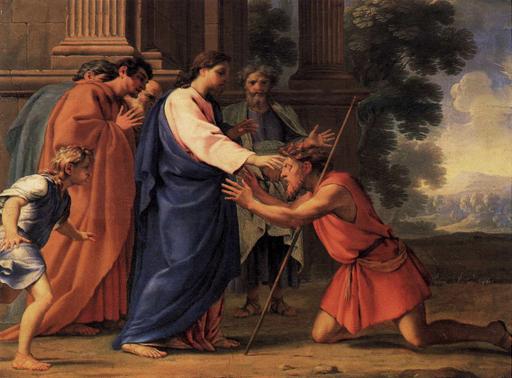
Jesus Heals BartimeausWe heard about love in action in our Gospel lesson (Lk. 18:31-43). Jesus encountered blind Bartimeaus (Mk. 10:46). Bartimaeus cries out to Jesus, “Have mercy on me!” Jesus pauses on His important trek up to Jerusalem, where He is going to save the whole world. He stops to listen to Bartimeaus asking him, “What do you want me to do for you?”Bartimeaus says that he wants to receive his sight. And Jesus doesn’t start talking about Himself and the problems He is about to face even though Jesus’ burden is going to be much more than blindness. And Jesus doesn’t give advice – and if anyone is in a position to give advice it’s Jesus. Jesus simply says, “Receive your sight, your faith has made you well.”By doing this, please note, Jesus recognizes that Bartimaeus’ blindness is bad.

Now, at this point, insert whatever problem you have, or the problems of people who are unloading their burdens on you – high blood pressure, diabetes, cancer, fatigue, depression, being bullied – these things are not natural and are a product of the devil. Unlike Jesus, we can’t simply say the word and make things better. But we can, like Jesus recognize and acknowledge the brokenness in people’s lives and say, “I’m sorry. I’m sorry you’re going through this.” Another way to show love to those who share their burdens with us is to simply listen. Listen, and ask, “How can I pray for you?” Then, pray for them then and there. Pray for them and say, “May Jesus bless you.”

hebrews-12_1-2.jpg
Jesus not only healed Bartimaeus’ blindness, Jesus bears his burden completely. Jesus was on His way to Jerusalem where He would bear all mankind’s burdens, all your sins and iniquities. He would suffer all the consequences of sin in this world as He hung in darkness on the cross. And He carried all those burdens, every last one, to the grave. But He wouldn’t stay there. Because of that, because we await the Resurrection, we know that whatever we suffer in this world is temporary. So whatever burdens you bear – whether they are yours or others’ – they will disappear when our Lord returns.

You see, the love of Jesus has already and continues to bear all things – all your sins, all your iniquities, all your transgressions, all your griefs, all your cares, all your sorrows. And this becomes our focus for the next six weeks. Amen.

The peace of God, which surpasses all understanding, will guard your hearts and minds in Christ Jesus. Amen.