Matthew 8:1-13
1 When [Jesus] came down from the mountain, great crowds followed him. 2 And behold, a leper came to him and knelt before him, saying, “Lord, if you will, you can make me clean.” 3 And Jesus stretched out his hand and touched him, saying, “I will; be clean.” And immediately his leprosy was cleansed. 4 And Jesus said to him, “See that you say nothing to anyone, but go, show yourself to the priest and offer the gift that Moses commanded, for a proof to them.”
 5 When he had entered Capernaum, a centurion came forward to him, appealing to him, 6 “Lord, my servant is lying paralyzed at home, suffering terribly.” 7 And he said to him, “I will come and heal him.” 8 But the centurion replied, “Lord, I am not worthy to have you come under my roof, but only say the word, and my servant will be healed. 9 For I too am a man under authority, with soldiers under me. And I say to one, ‘Go,’ and he goes, and to another, ‘Come,’ and he comes, and to my servant, ‘Do this,’ and he does it.” 10 When Jesus heard this, he marveled and said to those who followed him, “Truly, I tell you, with no one in Israel have I found such faith. 11 I tell you, many will come from east and west and recline at table with Abraham, Isaac, and Jacob in the kingdom of heaven, 12 while the sons of the kingdom will be thrown into the outer darkness. In that place there will be weeping and gnashing of teeth.” 13 And to the centurion Jesus said, “Go; let it be done for you as you have believed.” And the servant was healed at that very moment.
In the name of Jesus. Amen.
Today we have two very different people approaching Jesus. The first is a leper (people with leprosy are called ‘lepers’ not ‘leopards’ as some seem to think – kids and adults alike). This leper has absolutely nothing. Leprosy was a terrible skin infection that would eat away at a person’s flesh and destroy the nerves. One of the worst things about leprosy was that you could cut or burn or injure yourself and not even know it.
Leprosy did damage to a person’s body, but even worse, it damaged society. Lepers would live separately from everyone else to avoid infecting others. Even while leprosy ate away at a person’s flesh, it also ripped apart relationships – husbands and wives, parents and children. And if a leper did encounter someone who was uninfected, they would have to cry out, “Unclean! Unclean!” to avoid spreading the disease. If you heard a leper warning you of his presence, you would get out of the way to avoid becoming leprous yourself.
Contrast all of that with the second person who approaches Jesus, the centurion. 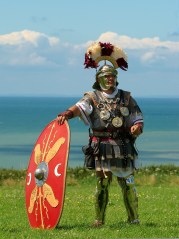 “Centurion” was his title and meant he was a commander over one-hundred soldiers. Centurions wore impressive armor including a helmet with all the feathers sticking out of the top, a shiny breastplate, a metal skirt, and a huge shield. Like a leper, a centurion’s command was also obeyed, but not to avoid becoming one of them. A centurion could say, “Go,” and the soldier would go. “Destroy,” and they would destroy. “Kill,” and they would kill.
Roman centurions were also very religious. The Romans believed in many pagan gods, but their chief god was Jupiter, the god of the sky. They believed that Jupiter threw lightning bolts when he was angry. Romans, like many other pagan religions, believed that if you wanted something from your god, you had to offer a gift or bribe to get that god on your side like Naaman did with his silver, gold, and cloths in our Old Testament text (2 Kgs. 5:1-15). But here in this text, the centurion approaches Jesus in Capernaum with completely empty hands. His beloved servant is paralyzed and dying at home, and he can’t do anything about it. He recognizes that he has no strength, no authority, no power over the condition of his servant.
Don’t miss the significance of this. A man with his power, influence, and strength could easily replace a measly servant. All he had to do was say the word, and the soldiers under his command would find another person with better skills or more strength to be his slave. For this centurion to go to Jesus would have been a despicable display of weakness not only in the eyes of his peers but also for the soldiers under his command. More on this later. And now he approaches Jesus with no gifts, no bribes, no promises. This centurion comes with nothing but a plea, “My servant is lying at home and dying. Don’t come to my house because I am not worthy to have You under my roof. Just say the word, and he will be healed.”
Jesus marvels. And if Jesus marveled at this man’s faith, so should we. Here is “a man of strength coming in weakness, a man of wealth coming in poverty, a Gentile coming in faith” (Rev. David Petersen). With no attempt to bribe, he simply trusts in the mercy of Jesus, God in the flesh, the One with real authority and power, full of mercy and compassion.
It is no marvel that Jesus found no such faith in Israel. But instead of casting stones at them, we should ask ourselves: would Jesus find such faith among us? How often are our prayers attached to promises of living a better life, being more obedient or more faithful? How often do we try to bargain with God in order to gain His favor? Repent.
Even if from this moment on, you promised to be perfectly obedient (which is impossible), without God’s mercy you and I are still unworthy for the Lord to come under our roof. The only thing we are worthy of is to be cast into the outer darkness of hell for all eternity.
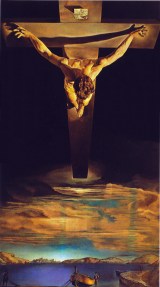 Repent, but do not despair. Jesus, God in the flesh, comes down from the mountain in order to save us. He is a God of mercy and grace. He comes to make the unworthy worthy and the unholy sacred. Jesus willingly approaches the untouchable leper to touch and heal. And Christ has compassion upon a centurion who appeared to have everything, but in reality, had nothing.
May we also have such faith as we approach our compassionate God who willingly and marvelously went to the cross to bear our sins. Christ was cast out of society with nothing but a cross and a crown of thorns. Though Jesus is the Lord of hosts, He did not call the angels to deliver Him as He was pinned to the cross. Instead, in love He shed His holy and precious blood to heal our souls. He bears all our sin in His body on the cross and proves that He is stronger than the devil. He shuts Satan’s mouth and triumphs over sin, death, and hell by His resurrection. He says, “Go,” to your sins and they go. He says, “Come to Me, all who labor and are heavy laden,” and you come and find rest for your soul (Mt. 11:28).
Remember, for this centurion to come to Jesus was an act of humility. He could have simply found another servant, but the centurion humbles himself to seek Jesus’ help because of his love for his servant. The centurion becomes a picture of what it means to be a Christian. His faith in Christ is manifested in love for his neighbor in a marvelous way.
The centurion is a Christ figure for his servant. Though he had power and authority, the centurion humbles himself to serve his servant. And, Christian, so do we. Through faith, we have everything since we are children of the Most High God. Yet, through love, we use our access to God in order to serve our neighbor by interceding on their behalf. Through faith, we receive treasures from above, from God. Through love we release those treasures below to our neighbors (Luther).
May our faith in Christ manifest itself in love for our neighbor so that the earth may know the mercies of our Lord and Savior, Jesus Christ. Amen.
The peace of God, which surpasses all understanding, will guard your hearts and minds in Christ Jesus. Amen.

 I just have to run faster than you.” Well, guess what. When the bear of God’s Law is finished eating the guy who is slower to obey than you, it picks up your scent and resumes its pursuit of you because its appetite is never satisfied by eating up sinners.
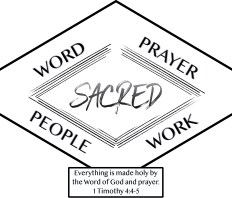 There’s a better way to understand these verses, and to get at that understanding, I’m going to connect this text to our theme for the year – “Sacred.” In Lev. 19:2, God speaks to His people, Israel, and says, “You shall be holy, for I the Lord your God am holy.” And Peter repeats those words for us Christians in 1 Pet. 1:16. In English, this sounds like a command because of the word ‘shall.’ But in both Hebrew and Greek it isn’t a command/imperative. A better translation for both is, “You will be holy.”
 likeness of sinful flesh and for sin, he condemned sin in the flesh, in order that the righteous requirement of the law might be fulfilled in us, who walk not according to the flesh but according to the Spirit.”
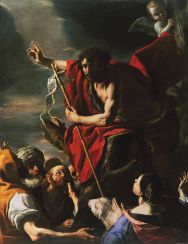 “You brood of vipers! Who warned you to flee from the wrath to come? Bear fruit in keeping with repentance.” The text doesn’t explicitly say it, but it appears as though John refused to baptize at least some of the Pharisees and Sadducees. But why? Why do they get a tongue-lashing and no baptism?
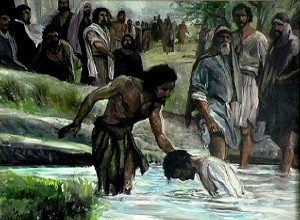 Now we come to our text. John is baptizing all these people. A thief comes confessing his stealing, an adulterer confesses his adultery, a liar confesses her sin, and John absolves and baptizes them. But then to the front of the line comes Jesus, and John knows Him (Lk. 1:39-45). They’re related to each other. John knows what the angel Gabriel told Mary, that this Jesus would be Son of the Most High, that He would reign over the house of God, and that His kingdom would have no end (Lk. 1:26-38). John knows the angel Gabriel told Joseph that Jesus would be the One to save His people from their sins (Mt. 1:18-25). John knows that Jesus is the sinless God in the flesh. And here He is coming to be baptized unto repentance for the forgiveness of sins? This shouldn’t be!
 But also, the same thing that happens to Jesus in his Baptism happens to you in yours. In your Baptism, you are given the gift of the Holy Spirit and are made God’s beloved child. In your Baptism, God intimately joins you to Jesus, and to His death and resurrection (Ro. 6:3-6).
 In your Baptism, God has given you the new birth of water and the Spirit (Jn. 3:5). In your Baptism, God has promised to wash away your sins (Act. 2:38-39), save you (1 Pet. 3:21), make you His child (Mt. 3:17), connect you to Jesus’ death and resurrection (Ro. 6:3-6), clothe you with Christ (Gal. 3:27), and fill you with the Holy Spirit (Tit. 3:5). So now, whenever wash your hands or take a shower, you can remember that God Himself has washed you clean and made you holy and sacred. Whenever you take a drink, you can remember that, in your Baptism, Jesus has given you to drink of the living water that wells up to eternal life (Jn. 4:10, 14).
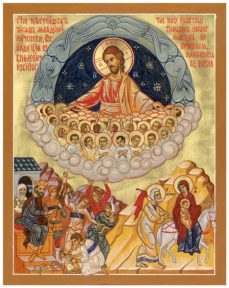 16 Then Herod, when he saw that he had been tricked by the wise men, became furious, and he sent and killed all the male children in Bethlehem and in all that region who were two years old or under, according to the time that he had ascertained from the wise men. 17 Then was fulfilled what was spoken by the prophet Jeremiah:
 The guy who didn’t even want his own children to be king after him hears that someone else has been born to be King of the Jews. Well, Herod isn’t going to let that stand. And when Herod is troubled about this, the rest of Jerusalem is also quaking as they wonder what will happen next.
 In the incarnation, the eternal Son of God shares in the life of every man, woman, and child – born and unborn. We human beings are all taken out of the flesh of Adam which means that we are all part of one another. But even more importantly, by His conception, the eternal Son of God has permeated all of humanity. This is why the devil loves abortion. Satan loves abortion because every unborn child reminds him of the fact that the Son of God came in the flesh, took up residence in His mother’s womb, and defeated him. The fact that your Savior was once a pre-born child is primary the reason Christians oppose abortion.
 Tonight, and all the days of your life, you can celebrate the fact that Jesus is born. God has taken on your flesh to save you. He has come in your likeness, born of a woman, in order to deliver you from your sin.
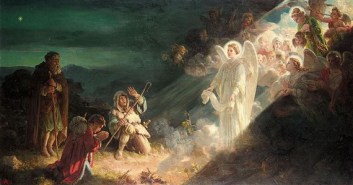 Luke tells us that those shepherds, who were minding their own business, suddenly found themselves surrounded by the shining, dazzling glory of the Lord. The surprising, unexpected thing is not the existence of God’s glory. God’s glory shining is something that happens throughout the Scriptures.
 This went on for centuries until the King Solomon finished construction of the Temple. When the Ark of the Covenant was brought into the Temple, the cloud descended into the most Holy Place, and the priests had to leave because God’s glory filled the Temple (1 Kgs. 8:10-11; 2 Chron. 5:13-14). God no longer dwelt in the tent of the Tabernacle; now, He dwelled in the house of the Temple which was where heaven and earth intersected. And still, year after year, the high priest would enter the most holy place be the representative of the people and meet with God behind the smoke made by the incense and the cloud that subdued God’s glory (Ex. 25:21-22).
 He is there so He can grow up and walk among us in the towns and streets of Galilee, Judea, and Jerusalem. He is there so He can be betrayed, arrested, beaten, tried, crucified, loaded up with your sin, die, and rise again.
 29 The next day he saw Jesus coming toward him, and said, “Behold, the Lamb of God, who takes away the sin of the world!”
 God sends the angel of death to go through the land of Egypt. But God’s people were to take a lamb. They were to slaughter that lamb and smear some of the lamb’s blood on the door of their house and eat the rest of the lamb roasted that night. And when the angel would see the blood on the door, he would pass by.
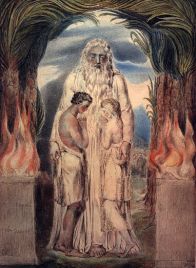 God hung that animal up and stripped the skin from its lifeless body as blood stained the ground. And God wraps that skin around the shameful, sinful bodies of Adam and Eve.
 Dear Lincoln, today you are Baptized. Today, God has given you the new birth of water and the Spirit (Jn. 3:5). Today in your Baptism, you have been joined to Jesus’ death and resurrection (Ro. 6:3-5) and have been clothed with Christ (Gal. 3:27). And Lincoln, Derek, Brittney, and all you saints, that means that today is a day to rejoice. Even as we see the grass wither, the flower fade, and creation crumble, we know that the Word of our God will stand forever. God continues to shower His blessings upon us through that Word. And His Word to us today, and every day of our Christian walk, is the Word of the Gospel which causes us to rejoice.
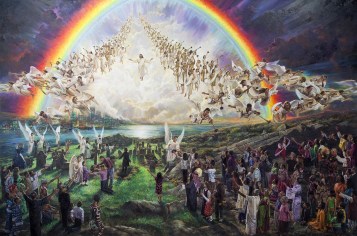 In Advent we are watching and waiting for the coming of our Savior and the end of our exile in this fallen, sinful world. Advent is the Christian life in a nutshell. We watch and we wait for the coming of our Lord. And as we wait, we are reminded that, whatever may happen to us in this veil of tears, the end is a joyful day for you whose citizenship is in heaven. As we wait, we remember that all the cares and sorrows of this world are temporary.
 God’s holiness creates three interlocking spheres which I’ve tried to show with this figure.
 offered himself without blemish to God, purify our conscience from dead works to serve the living God.”
 In Jesus, God has come into this common world and brought His holiness to you. Because of what Christ has done, God has claimed you as His own so that you can live with Him in His kingdom and serve Him in everlasting righteousness. He placed His holy name upon you when you were Baptized. In your Baptism, you were marked with the name of the Father, Son, and Holy Spirit (Mt. 28:18-20). That holiness, given to you in your Baptism, is now continually delivered to you when you hear and believe God’s holy Word. As you hear the word of truth, the gospel of your salvation, you are sealed with the promised Holy Spirit (Eph. 1:13). God continues to place His name on you as He blesses you, keeps you, makes His face shine upon you, and be gracious to you (Num. 6:22-27). Bearing His holy name, you are brought into His holy presence, and radiate His holiness to those around you.
 Our texts today seem to have conflicting messages. This text from Romans 15 has a lot to say about endurance, encouragement, hope, harmony, joy, and peace. It’s nice. But in our Gospel lesson, when Jesus talks about the day of His return, He speaks of signs in the sun and moon and stars. He mentions the distress of nations in perplexity, the roaring of the sea and waves, and people fainting with fear and foreboding because of what is coming on the world. Our Lord declares that the powers of the heavens will be shaken.
 The castle doors and the walls are shaking. Boulders are hurled against the fortress. Windows are shattering and dust is falling from the ceiling. The floor you are standing on is rocked by the sounds of battle all around you.
 What was defiled was made holy. What was dead was raised. Where there were sinners, Christ brought forgiveness. And all of that was just the beginning. All of this was written to give us encouragement to endure in the hope that the healing Christ brought to the broken of this world would be ushered into the entire creation – into the new creation.
 Pastorsamwise
You must be logged in to post a comment.