Luke 14:15-23
15When one of those who reclined at table with him heard these things, he said to him, “Blessed is everyone who will eat bread in the kingdom of God!”
16But he said to him, “A man once gave a great banquet and invited many. 17And at the time for the banquet he sent his servant to say to those who had been invited, ‘Come, for everything is now ready.’ 18But they all alike began to make excuses. The first said to him, ‘I have bought a field, and I must go out and see it. Please have me excused.’ 19And another said, ‘I have bought five yoke of oxen, and I go to examine them. Please have me excused.’ 20And another said, ‘I have married a wife, and therefore I cannot come.’ 21So the servant came and reported these things to his master. Then the master of the house became angry and said to his servant, ‘Go out quickly to the streets and lanes of the city, and bring in the poor and crippled and blind and lame.’ 22And the servant said, ‘Sir, what you commanded has been done, and still there is room.’ 23And the master said to the servant, ‘Go out to the highways and hedges and compel people to come in, that my house may be filled. 24For I tell you, none of those men who were invited shall taste my banquet.’”
In the name of the Father and of the Son and of the Holy Spirit. Amen.
Once, there was a young child whose parents loved him very much. They taught him the Scriptures, and the child was gradually learning to repeat the passages his parents read to him. The child grew, and it was time to train him to use the toilet. His parents would sit him on the potty chair and give him privacy to do his business. This child, schooled in the Scriptures, had a signal to his parents when he needed help cleaning himself after going number 2. He would recite from our text, “Come, for everything is now ready.” Thankfully, his parents were not like those who offered excuses in the parable. They were loving and went and cared for his needs.
The men who make excuses to escape going to the king’s banquet are treating the invitation like it is a call to help wipe a toddler’s derriere. They simply aren’t interested in going to the banquet because they thought they had something better to do, and they don’t care about the repercussions if they are absent. They are comfortable insulting the king, his invitation, and his feast because they have treasures on earth. They don’t realize that, unlike the feast, the invitation is not eternal.
The point of the parable is easy to see. Not everyone goes to heaven. Those who do not think they need God’s grace will find that, outside of His grace, there is only eternal loneliness and torment. As our hymn just said:
But they who have … resisted His grace
And on their own virtue depended,
Shall then be condemned and cast out from His face,
Eternally lost and unfriended.
Have mercy upon us, O Jesus![1]
At the time of death or when Jesus returns, the invitation is withdrawn. Those who reject the invitation will get what they want. They won’t have to offer any more excuses to the king and his messengers. Those who continually reject God’s invitation will one day be free of God, but they will be eternal prisoners of themselves.
 So, this parable should give us an urgency. There is still room for more at the feast. We should be those who go out and call more of the poor, crippled, blind, and lame. We should go out to the highways and hedges and compel more to come in. And we wouldn’t even have to go far from this very place. How many Muslim refugees do we have living less than one block away? They play in our yard and use our trees for shade. Jesus wants them to come to His feast as much as He wants you.
But this parable should hit each and every one of us harder because of the context. And when this parable hits us harder, we will become more eager to extend the invitation of Christ the King.
Here is why this parable should crush us – it isn’t just that it exposes our sinful hesitation to share the Gospel with others. Jesus tells this parable in response to a statement, “Blessed is everyone who will eat bread in the kingdom of God.” In its context, that is a heretical benediction.
Now, don’t get me wrong. At face value, it is true. Everyone who eats bread in the kingdom of God is blessed. But the person who says this is, at that very moment, eating with Jesus. In that context, this statement would be like a newlywed husband getting to the hotel on his wedding night and saying to his bride, “Today was nice, but I’m really looking forward to my retirement party.” The man who says, “Blessed is everyone who will eat bread in the kingdom of God,” doesn’t realize that he is, in truth, living in that present blessing. The blessed existence he that would come sometime in the future was going on right around him.
Wherever Jesus is, there is the kingdom of God. Jesus came preaching that the kingdom of God was at hand (Mk. 1:14-15). And just a couple of chapters earlier in Luke’s Gospel, Jesus said that because He was casting out demons by the finger of God that God’s kingdom had come (Lk. 11:20).
You see, the person sitting there with Jesus at the table was sitting with the present King and eating with God incarnate. So, this parable speaks to us today about being at church. When God’s people gather together to hear God’s Word and receive His gifts, there is the kingdom of God. So, if you are looking forward to going to heaven and being with Jesus, you should also look forward to coming to church because it is a foretaste of eternity with Jesus.
Each of the men who offer excuses in the parable aren’t saying that they never want to go to the party; they just want to go when it is more convenient for them. And their excuses show that they view the things of the world as more important than eternal things.
The pleasures and cares of this world are dangerous to faith when we appreciate and love them more than the blessing of gathering with our Lord and Savior and brothers and sisters in Christ here every Sunday morning.
 Weekends at the lake, sport tournaments, and even time with family are all blessings from God. But when those things keep us from gathering around God’s Word in the place where God says He meets with us, they are deadly. They are idols. When you are not in church for whatever reason on any given Sunday, you are missing the blessing of being and feasting with God.
The king is angry with those who offer excuses. And notice – this is the most amazing thing that is hard to wrap our minds around – the king is angry because all he wants is for them to be there with him. The king is angry because he wants these people to have the good and joyous things he has for them. God is much more desirous of giving to and helping us than we are of receiving or asking for those things (Luther).
Repent. Repent of your excuses. Jesus has died and shed His blood so that the sinful excuses you would offer are washed away. They are removed as far from you as the east is from the west. And know that God’s invitation stands. “Come. Come to my feast. Come and receive what you could never earn or deserve. Come, you who are worthy. Come, you who are unworthy. Come, for all the blessings of heaven are here for you for free. Come, for everything is now ready.”Amen.
The peace of God, which surpasses all understanding, will guard your hearts and minds inChrist Jesus. Amen.
[1]“There Many Shall Come” Ambassador Hymnal #627. Magnus Brostrup Landstad.
 2Above him stood the seraphim. Each had six wings: with two he covered his face, and with two he covered his feet, and with two he flew. 3And one called to another and said:
 Hebrews 12[:22–23]tells us that there are many more here today than our eyes can see, “But you have come to Mount Zion and to the city of the living God, the heavenly Jerusalem, and to innumerable angels in festal gathering,and to the assembly of the firstborn who are enrolled in heaven, and to God, the judge of all, and to the spirits of the righteous made perfect.”
 12 “I still have many things to say to you, but you cannot bear them now. 13 When the Spirit of truth comes, he will guide you into all the truth, for he will not speak on his own authority, but whatever he hears he will speak, and he will declare to you the things that are to come. 14 He will glorify me, for he will take what is mine and declare it to you. 15 All that the Father has is mine; therefore I said that he will take what is mine and declare it to you.”
 We think that the opposite of sin is good works. So, we wrongly think our sin is something we can manage on our own. We imagine we can hide our stains by being kind to those around us. We think we can distract God from our lust, anger, pride, and selfishness with a few good works.
 This is the Holy Spirit’s work. The Holy Spirit convicts you of sin, righteousness and judgment. The Holy Spirit takes all the work of Jesus and declares it to you. He is your Helper, Comforter, Advocate. Through Spirit’s working, He opens the Scriptures creating, sustaining, and strengthening faith and guiding you into all the truth.
 You are God’s children. “See what sort of love the Father has given to us, that we should be called children of God.”
 So, Blair: Today, God has Baptized you. Today, God has connected His Word to water and joined you to Christ’s death and resurrection (Ro. 6:3-11). God has clothed you with Christ (Gal. 3:27). God has given you the washing of regeneration and renewal of the Holy Spirit and saved you (Tit. 3:5-7). Today, you are born again, and God has made you His beloved child.
 When Christ appears, you will be like Him because you will see Him as He is.
 And now, you have angel’s work to do. Go. Tell others. Tell them that because Jesus is their brother, they are God’s children. Tell them they are forgiven because of Jesus. Tell them they are made holy because of Jesus. Tell them because everything is finished just as He told you.
 The first words of Scripture you heard in today’s service told how Jesus rode into Jerusalem. Matthew tells us that it happened this way to fulfill what was spoken by the prophet, “Behold, your king is coming to you, humble, and mounted on a donkey” (Zech. 9:9 quoted in Mt. 21:5). That word that gets translated as ‘humble’ means ‘of no importance.’
 King Jesus didn’t come to sit as judge. Instead, He came to be judged. He didn’t have subjects who shout, “Long live the king!” Instead, they holler, “Crucify Him!” He didn’t come to command armies. Instead, He came to be beaten by soldiers. He didn’t come to be clothed in the finest garments and crowned with gold and jewels. Instead, He came to have a robe ripped from Him and be thorns pressed into His head. He didn’t come to drink fine wine from a golden chalice. Instead, He came to be offered wine mixed with gall. He didn’t come to sit in a fine hall with nobles surrounding Him. Instead, He came to hang on a splintered cross between two thieves. He didn’t come to execute justice. Instead, He came to die an unjust death.
 But Christian, by God’s grace, you know better. You know that those are the very things that God has given and uses to complete the good work of faith that He began in you.
 12 And when they had eaten their fill, he told his disciples, “Gather up the leftover fragments, that nothing may be lost.” 13 So they gathered them up and filled twelve baskets with fragments from the five barley loaves left by those who had eaten. 14 When the people saw the sign that he had done, they said, “This is indeed the Prophet who is to come into the world!”
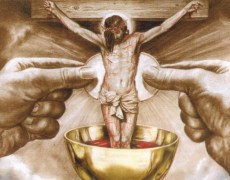 Jesus came to have His back torn by a whip and His forehead sliced open by the crown of thorns. Jesus came to have His body broken. Jesus came to have His hands and feet nailed to the cross, His side run through with a spear. Jesus came to give you every last drop of His forgiving blood. Jesus came to give you eternal mercy, forgiveness, and life.

You must be logged in to post a comment.