Luke 11:14-28
14 Now he was casting out a demon that was mute. When the demon had gone out, the mute man spoke, and the people marveled. 15 But some of them said, “He casts out demons by Beelzebul, the prince of demons,” 16 while others, to test him, kept seeking from him a sign from heaven. 17 But he, knowing their thoughts, said to them, “Every kingdom divided against itself is laid waste, and a divided household falls. 18And if Satan also is divided against himself, how will his kingdom stand? For you say that I cast out demons by Beelzebul. 19 And if I cast out demons by Beelzebul, by whom do your sons cast them out? Therefore they will be your judges. 20 But if it is by the finger of God that I cast out demons, then the kingdom of God has come upon you. 21 When a strong man, fully armed, guards his own palace, his goods are safe; 22 but when one stronger than he attacks him and overcomes him, he takes away his armor in which he trusted and divides his spoil. 23 Whoever is not with me is against me, and whoever does not gather with me scatters.
24 “When the unclean spirit has gone out of a person, it passes through waterless places seeking rest, and finding none it says, ‘I will return to my house from which I came.’ 25 And when it comes, it finds the house swept and put in order. 26 Then it goes and brings seven other spirits more evil than itself, and they enter and dwell there. And the last state of that person is worse than the first.”
27 As he said these things, a woman in the crowd raised her voice and said to him, “Blessed is the womb that bore you, and the breasts at which you nursed!” 28 But he said, “Blessed rather are those who hear the word of God and keep it!”
In the name of Jesus. Amen.
In 2014, it had been about two years of me waking up feeling more tired than when I had gone to bed. At my loving wife’s urging, I went to the doctor to request a referral for a sleep study. I remember the doctor saying, “Well, you’re not old, and you’re not overweight. I don’t think you have apnea, but I’ll refer you for the sleep study.” A couple weeks later, I went down to Altru Specialty Center to spend the night. When I checked in, the nurse who would be monitoring me met me and said, “You’re not old, and you’re not overweight. I doubt you have apnea.” But she dutifully brought me to a room and proceeded to put all the little sensors on my body, head, and beard. A couple hours later, I went to sleep. Less than an hour after that, she woke me up and said, “Put this on.” It was a cushion that covered my nose and blasted air into my nostrils. I hated it. It took me about an hour to figure out how to breathe with it and another hour to fall asleep once again. I only slept for four more hours, but it was the best sleep I had had in years.
The next morning, she unhooked the wires from my head and body. The nurse said I could expect to hear from the doctor in a few days. When I went to that appointment, this new doctor said to me, “Well, you’re not old and you’re not overweight, but you definitely have sleep apnea. We will write things up and get everything to your insurance so you can have a CPAP machine.”
Finally, two weeks after that appointment, I was told I could go to Yorhom and get the machine. The technician who instructed me on its usage said, “You’re not old and you’re not overweight, but this should help you feel better.”
 The CPAP means that a hose dictates how I can move when I turn at night. It means that, when I lie on my side, I have to adjust how the mask fits on my face and doesn’t get moved off my nose by my pillow. It means that I can’t fall asleep having a conversation with my wife. There are mornings that I wake up and have to unwrap the hose from around my neck. But in the six years since I started using that machine, there have only been just over a handful of nights that I have slept without that mask blasting air into my nostrils. I still don’t always like to use it. I wish there were some sort of medicine or a shot I could take, but such a thing doesn’t exist. Sometimes, I wish I could use the machine one night a month or one night a week and be fine, but it doesn’t work that way. I know that if I don’t use that mask and machine each night, I won’t rest or be able to function like I should.
Sorry for the long story, but there is a point and it is connected to the text. Here’s how:
Imagine how frustrated Jesus gets with us when we think that we can simply get a dose of His grace and mercy and then move on with our lives until we recognize or feel the need to take another dose. Imagine how frustrated Jesus gets with us when we think all we need is an occasional shot of the Holy Spirit when He desires that we have the daily and eternal presence of the Holy Spirit in our heart.
You see, your problem is not that you sin every now and then. Your problem is that the devil has essentially taken up residence in your heart. That’s what Jesus means when He says, “When an unclean spirit has gone out of a person, it seeks but finds no rest it says, ‘I will return to my house from which I came.’” The devil has led you into sin and possesses you. That problem can, obviously, be solved. Jesus, the one who is stronger than the strong man devil, expels Satan. And Jesus doesn’t leave you simply as an empty vessel because the house of your heart won’t stay empty. Instead, the Holy Spirit comes and resides within you, and this means that you need to continually receive the Holy Spirit because He can be pushed out. You can neglect God’s good gifts, and the Holy Spirit can be resisted so that He leaves.
 When this happens, your last state is worse than your first because as Jesus says, the demons come, it finds the house (you) swept and put in order. Then that evil spirit brings seven other spirits more evil than itself.
Throughout your lives, you find yourself in the position of thinking that it would be enough if God would just drive out the devil. And praise God that He does. However, that isn’t the end of the matter. Don’t forget that your house won’t stay empty. If you turn away from the Word that fills you with the Holy Spirit, the devil is going to come back worse then he was before. Don’t think that because you believe today that you will tomorrow.
Read. Study. Meditate on the Scriptures. Make the Bible more important to you today than it was yesterday. Don’t think that you can bring your kids to Sunday School and Confirmation and think they’ll be ok. Don’t be lulled into thinking that is enough Jesus for them.
The greatest threat to you and your children isn’t from terrorism, war, or a virus. The thousands of kids who grow up thinking that they were raised to be Christian because they were taken to church a few times a year. Those same people then go and read five out-of-context verses from some atheist blog thinking they know everything about what Christians believe. They are the very ones who are going to be the most likely to draw your children away from the faith.
But also be comforted because that is much less likely to happen if you train your children now to be in the Scriptures. To be in the very place that the Holy Spirit continues to work in their hearts and lives. That very Word of God is where God fills the house of your heart and theirs with the Holy Spirit and with treasures that cannot be spoiled.
You need to hear this today. There is a lot of uncertainty in our world and country right now. And while there are no plans to stop holding regular services here, it is possible that option might be taken from us. The devil is working very hard to bring enough uncertainty and fear to our society – and to Christians especially – that they would be tempted to think being at church and within the fellowship of the Body of Christ is not essential.
 Right now, we Christians need one another. Those who do not have faith in Christ need us as well. They need us to comfort them with the very same that we have in Christ. They need to know there is something more than this life. They need to know that Christ is coming back. They need to know that the One who is returning is the very one who shed His holy and precious blood for them. That very blood of Christ is the medicine they need to be freed from the devil’s tyranny over the house of their heart. They need to know that Jesus is the Lamb of God who takes away their sin.
Dear saints, today know that the house of your heart won’t stay empty. Know that the stronger man is on your side. And know that He desires all to be saved, and this may be the time He uses to call them to repentance and faith. Amen.
The peace of God, which surpasses all understanding, will guard your hearts and minds in Christ Jesus. Amen.
 A lord is not simply someone who has the final say or ultimate authority over a situation. A lord is anyone who exercises power over someone at any time. For example, you are a lord when you get into your car and drive 32 mph instead of the posted 30 mph because your time is more important than the safety of others. By the way, you are also a lord when you slow down to 27 mph in a 30 mph in order to teach a lesson to that guy driving 40 mph behind you. You are a lord when you sit down after a long day and your spouse or kids ask you for something, but you don’t feel like giving them the time or attention they desire. You are a lord when you go to the store or click your mouse to spend your money on yourself or family while ignoring the hungry and needy. Kids, you are a lord when you decide that your sibling has done something you don’t like, so you turn around and do something to them that they don’t like. Yes, there are too many lords today.
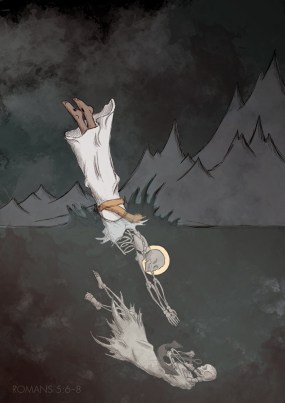 Jesus, the Son of God, emptied Himself by taking the form of a servant. He was formed and woven together in His mother’s womb, just like you were. Jesus was born just as you were born, but in a stable. The shepherds and wise men saw Him as an infant. As a helpless infant, Jesus entrusted Himself to the care of His parents who had to flee the violent, wicked hands of Herod, the lord of Jesus’ land. Jesus learned to walk, talk, and eat in Egypt. He was even potty trained there. He learned His letters and how to read after His parents moved Him to their hometown of Nazareth. Jesus grew up learning carpentry, the trade of His (earthly) father, Joseph. Lord Jesus made friends with the neighborhood kids, and He had siblings who didn’t always treat Him with kindness (Mk. 3:31-32, Jn. 7:1-5).
 survival of the fittest. But the more scientists discover and learn, the more it becomes impossible to believe that we are the product of a series of random events.
 From the moment you were conceived, the information in your DNA would fill 600,000 pages with information. And right now, in each of the 35 trillion cells of your body, biological “machines” are copying the volumes of information in your DNA into amino acids which are taken by other machines and folded in specific and precise ways into proteins. (So, don’t let anyone tell you that you are lazy.) But with all those minute details, you believe in an intricate, sophisticated, wise Maker.
 Your heavenly Father created and gives you everything. Your body and soul, your eyes and ears, all your members, your reason and senses – everything you have is a good gift from God your Father who daily provides for all the needs of your life. And He promises to continue to provide those things for you without any merit or worthiness in you. So, you don’t have to go running around worrying about what you will eat or drink or wear. God makes the sun to shine on the evil and the good, and He sends rain to the just and the unjust (Mt. 5:45). Everything that God provides for your life in His creation continues to be given as His good gift. The theological shorthand for all these things needed for life in God’s creation is called “1st Article gifts.” So, if you don’t mind, I’ll use that term again in a bit.
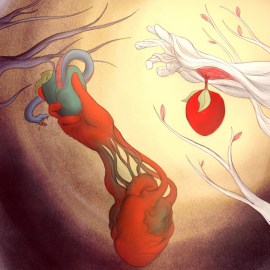 Your heart has a wrong desire, and that false desire is conceived and eventually gives birth to sin. Then, when sin grows up, it brings forth death. Knowing this, we know Satan’s game plan. But it is helpful for us to see how the devil’s game plan plays out in real time, and we saw it in our Old Testament text (Gen. 3:1-21).
 When Eve looked at that fruit, she should have recognized, “That fruit is death.” Instead, she wrongly sees that it is to be desired to make one wise. This is the danger for us. There are things that are put in front of us and God says, “That’s bad, and it leads to death.” But instead of regarding those things according to God’s Word, we regard them according to how we see and think. We put ourselves over and above God and judge Him to be wrong. The devil entices us to think that God is the bad guy who is holding out on us, keeping us from having our heart’s desires. Then, we think we know better than God, and we fall for the temptation and into sin.
 Jesus has been fasting forty days and nights. I remember as a kid being hungry forty minutes after dinner. Jesus is famished. He is weakened by this fast. So, this temptation to turn stones into bread is a real temptation. The tempter again tries to exploit the gap between Jesus’ desires and what God has given. Jesus wanted food. Because He is man just like you and me, His stomach and His brain would have been screaming at Him, “Feed us!” But God has not yet given Jesus food. So Satan tries to get Jesus to take for Himself what God has not given.
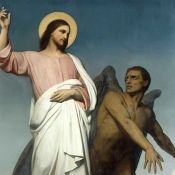 “to guard you in all your ways.” God the Father will protect Jesus in all His ways. But God didn’t send Jesus to earth to be some X-Games-temple-pinnacle jumper.
 So, dear saints, be wise. Know the devil’s attacks and tactics. The devil is going to use those tactics against you, but God has given you weapons against the devil, your flesh, and the world (1 Jn. 2:15-16). When the devil comes to tempt you, take up the weapon of prayer. Pray God’s Word and watch the devils flee. When your flesh tempts you, take up the weapon of fasting. If you are tempted to certain desires of your flesh, fast from those things. Tell your body, “Body, you aren’t in control.” And when the world tempts you with its vain riches, give. Be generous to the point that it makes you unable to afford falling into the temptations of this world.
 When Jonah preached to the sinners of Nineveh in our Old Testament lesson (Jon. 3:1-10), they repented from their evil, violent ways. And for them, it was as crazy an idea as closing their eyes to enable invisibility mode. The king says in his proclamation, “Who knows? God may turn aside from His fierce anger, so that we may not perish.” In other words, “Let’s try repenting. It might work.” Dear saints, we do not have to wonder how God will respond to humble, contrite sinners. Our Epistle Lesson (1 Jn. 1:5-10) says, “If we confess our sins, God is faithful and just to forgive our sins and to cleanse us from all unrighteousness.”
 35 As he drew near to Jericho, a blind man was sitting by the roadside begging. 36 And hearing a crowd going by, he inquired what this meant. 37 They told him, “Jesus of Nazareth is passing by.” 38 And he cried out, “Jesus, Son of David, have mercy on me!” 39 And those who were in front rebuked him, telling him to be silent. But he cried out all the more, “Son of David, have mercy on me!” 40 And Jesus stopped and commanded him to be brought to him. And when he came near, he asked him, 41 “What do you want me to do for you?” He said, “Lord, let me recover my sight.” 42 And Jesus said to him, “Recover your sight; your faith has made you well.” 43 And immediately he recovered his sight and followed him, glorifying God. And all the people, when they saw it, gave praise to God.
 Joshua lead God’s people marching around those thick, fortified walls for six days, and on the seventh day, the people shouted and “the walls came a-tumbilin’ down.” Afterward, they burned the fallen rubble and reduced the city to ashes.
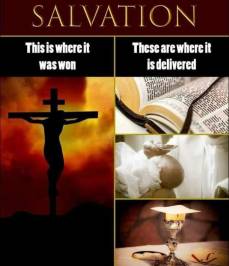 On the cross, Jesus did everything for your salvation. On the cross, Jesus won the victory over sin, death, and the devil. But God delivers what Jesus did on the cross to you here and now. God delivers the mercy, grace, life, and salvation of Jesus through the preaching of His Word (Ro. 10:17), through your Baptism (Ro. 6:3-11), and through the Lord’s Supper (Lk. 22:14-20). God brings His holy deliverance to you through all those things, and as you receive those gifts of God through faith, you are saved.
 Striving means that you work hard because you aren’t sure if you are going to make it. That’s why you strive. And rest? Well, rest is rest. It’s the opposite of striving. Typically, striving and rest only go together when the later follows the former. People strive so they can go home and rest for the evening or the weekend, or they work for decades so that eventually they can retire and rest. But that is only how things are in this fallen world.
 Christian, you have entered into the rest of God. You find your rest as you simply allow God’s Word to do its work in your heart as it pierces to the division of soul and spirit and discerns the thoughts and intentions of your heart. That Word of God convicts you of your sin revealing that your thoughts, words, and deeds are sinful in God’s sight. And that same Word invites you to faith in Christ who says, “Come to Me, all who labor and are heavy laden, and I will give you rest,” or better translated, “I will rest you” Mt. 11:28).
 And on a Friday, the sixth day from the cross, Jesus cried out as He died, “It is finished” (Jn. 19:30). His striving for your salvation was done. Jesus was laid to rest in a tomb on the Sabbath, the seventh day because all His work to redeem you was complete. And Christ rises on the first day of the week, the first day of the new creation.
 Bella, and all you saints, because you and I are always tempted to think there is something left for us to do to be saved, God desires that you continue to be pointed to the holy, eternal rest that Christ has given you. Here, assembled in God’s presence with your brothers and sisters in Christ, God reminds you of the holy rest you have now. There is nothing left for you to do. Every time you come here, you receive that rest by listening to God’s life-giving Word and letting that Word do God’s work in you.
 Dear saints, welcome to the kingdom of heaven. In the kingdom of heaven, you are never rewarded based on your works or efforts because, if you received what you deserved, you would be sent straight to hell. In the kingdom of heaven, there are no formulas or set, hourly wages. You are given to based solely on the merits of Christ’s work for you. He is the only one who can say that He bore the burden of the day and the scorching heat. His atonement, His mercy, His grace is what you get, nothing less. Because of God’s unmerited, unearned, undeserved, unconditional love freely given to you for the sake of Christ, you are an heir of the kingdom of heaven. God be praised!
 Each of them was called, and each of them was called at the precise time the owner called them. He went and retrieved them.
 God had a reason for bringing you in when He did. Trust His timing. He brought you into His vineyard exactly when He wanted you.
 And it isn’t just their work. Your work, done as a Christian, is holy work. Fathers and mothers, the work you do day in and day out will reap results in the lives in your children, grandchildren, and great-great-great-great grandchildren if Christ tarries. But it will also reap results in the lives of others whom you will never meet because you have shined the light of Christ to those you have met, and they will shine that light elsewhere. You Sunday school teachers, you who are praying for and encouraging our youth, you trustees who are caring for our facility, and everyone who is here encouraging another person is offering holy work that will be used by God until Christ returns. Everyone has a story of being impacted by someone else long after that person has entered into glory. So, take heart, and keep working. The labor that God has called you to is fruitful, holy work. It is holy work that God will multiply and expand. For that, God be praised. Amen.
 And from this point, things get a little crazy and awkward. It is almost as though Peter didn’t hear Jesus say that He would rise from the dead because Peter rebukes Jesus – the very one he just confessed is the Son of the living God. Peter says, “Far be it from You, Lord! This shall never happen to You.” It would be easy to sling mud at Peter here for telling God that what He says is going to happen won’t ever happen. But you do it all the time – more on that in a bit.
 But here is where all of this is leading: Jesus comes to Peter, James, and John cowering in their sins and touches them. And notice what He says. He doesn’t continue to rebuke Peter. Jesus doesn’t say, “See I told you so.” Instead, Jesus says, “Rise,” the same word Jesus used when He spoke about His resurrection.“Rise, and have no fear.” Of all the things our Lord could have said, He says, “Rise, and have no fear.” Jesus is resurrecting Peter from his sin.
 5 When he had entered Capernaum, a centurion came forward to him, appealing to him, 6 “Lord, my servant is lying paralyzed at home, suffering terribly.” 7 And he said to him, “I will come and heal him.” 8 But the centurion replied, “Lord, I am not worthy to have you come under my roof, but only say the word, and my servant will be healed. 9 For I too am a man under authority, with soldiers under me. And I say to one, ‘Go,’ and he goes, and to another, ‘Come,’ and he comes, and to my servant, ‘Do this,’ and he does it.” 10 When Jesus heard this, he marveled and said to those who followed him, “Truly, I tell you, with no one in Israel have I found such faith. 11 I tell you, many will come from east and west and recline at table with Abraham, Isaac, and Jacob in the kingdom of heaven, 12 while the sons of the kingdom will be thrown into the outer darkness. In that place there will be weeping and gnashing of teeth.” 13 And to the centurion Jesus said, “Go; let it be done for you as you have believed.” And the servant was healed at that very moment.
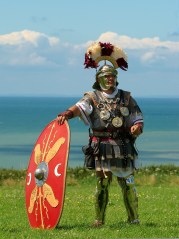 “Centurion” was his title and meant he was a commander over one-hundred soldiers. Centurions wore impressive armor including a helmet with all the feathers sticking out of the top, a shiny breastplate, a metal skirt, and a huge shield. Like a leper, a centurion’s command was also obeyed, but not to avoid becoming one of them. A centurion could say, “Go,” and the soldier would go. “Destroy,” and they would destroy. “Kill,” and they would kill.
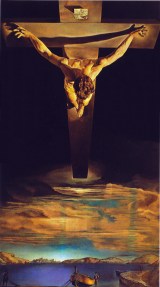 Repent, but do not despair. Jesus, God in the flesh, comes down from the mountain in order to save us. He is a God of mercy and grace. He comes to make the unworthy worthy and the unholy sacred. Jesus willingly approaches the untouchable leper to touch and heal. And Christ has compassion upon a centurion who appeared to have everything, but in reality, had nothing.
 Pastorsamwise
You must be logged in to post a comment.