Matthew 17:1-9
1 And after six days Jesus took with him Peter and James, and John his brother, and led them up a high mountain by themselves. 2 And he was transfigured before them, and his face shone like the sun, and his clothes became white as light. 3 And behold, there appeared to them Moses and Elijah, talking with him. 4 And Peter said to Jesus, “Lord, it is good that we are here. If you wish, I will make three tents here, one for you and one for Moses and one for Elijah.” 5 He was still speaking when, behold, a bright cloud overshadowed them, and a voice from the cloud said, “This is my beloved Son, with whom I am well pleased; listen to him.”
6 When the disciples heard this, they fell on their faces and were terrified. 7 But Jesus came and touched them, saying, “Rise, and have no fear.” 8 And when they lifted up their eyes, they saw no one but Jesus only. 9 And as they were coming down the mountain, Jesus commanded them, “Tell no one the vision, until the Son of Man is raised from the dead.”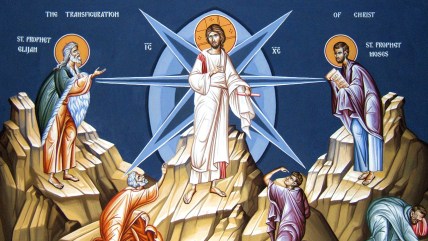
In the name of Jesus. Amen.
Chapter and verse breaks are helpful for us to find the same passage of Scripture, but they can also get in the way of important context. Our text, which begins a new chapter of Matthew, starts with the phrase “And after six days….” So, before we get to the Transfiguration, we need to see what was happening that week prior to Jesus getting shiny up on the mountain.
Matthew’ context for the Transfiguration starts back in Matthew 16[:13ff]. Jesus asks the disciples, “Who do people say that the Son of Man is?” The disciples report that some say that the Son of Man is John the Baptist, Elijah, Jeremiah, or one of the prophets. But then Jesus turns the question to them, “But who do you say that I am?” and Peter has his great confession, “You are the Christ, the Son of the living God.” Jesus had been proving that all along with His miracles and teaching. So, Jesus praises and blesses Peter even while He states that Peter didn’t come up with this confession on his own. Instead, God the Father had revealed this to Peter.
Then, Matthew tells us from that time Jesus began to show His disciples that He must go to Jerusalem and suffer many things, be killed, and on the third day be raised (Mt. 16:21). 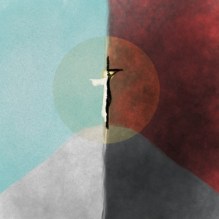 And from this point, things get a little crazy and awkward. It is almost as though Peter didn’t hear Jesus say that He would rise from the dead because Peter rebukes Jesus – the very one he just confessed is the Son of the living God. Peter says, “Far be it from You, Lord! This shall never happen to You.” It would be easy to sling mud at Peter here for telling God that what He says is going to happen won’t ever happen. But you do it all the time – more on that in a bit.
Now, when Peter confessed that Jesus is the Messiah, it meant something for him. What exactly Peter had in mind that Jesus would do as the Messiah is a bit hard to pin down. But basically, Peter figured that Jesus, the Messiah, had come to fix problems. Exactly what those problems were we can’t say with certainty. But whatever Peter had in mind, one thing is sure, it would be difficult for Jesus the Messiah and Great Problem Solver to fix those problems if He was dead.
So, Peter rebukes Jesus, and Jesus rebukes Peter. “Get behind Me, Satan! You are a hindrance to Me. For you are not setting your mind on the things of God, but on the things of man” (Mt. 16:23). And this is the sharpest rebuke Jesus ever gave an individual.
You know how it can be after you have an argument with someone. You try to avoid the other person for fear that a fight will break out at any moment. When you have to talk with them, you feel uncomfortable during every conversation. You carefully word everything in order to avoid the issue flaring up again. Imagine how Peter must have felt during those six days between this rebuke and the Transfiguration.
Now, let’s ascend the mountain. Jesus invites Peter, James, and John to come up the mountain with Him. Maybe this summons made Peter figure the whole issue was over and done with. Anyway, while they are there, Jesus is transfigured. Christ’s face shines like the sun. His clothes become white as light. Moses and Elijah appear and talk with Jesus. Luke tells us that conversation centered around Jesus’ exodus (usually translated as “departure” but the word is ἔξοδος) which Jesus was about to accomplish at Jerusalem (Lk. 9:30). In other words, they were discussing the very thing that Peter said should never happen just a week ago.
To summarize: Six days prior, Jesus told the disciples about His suffering, death, and resurrection. And Peter didn’t like it then, and Peter doesn’t like it now even in the presence of shiny Jesus. Instead, Peter likes being there on the mountain basking in Jesus’ unveiled glory. But even more than that, Peter doesn’t want Jesus to walk down that mountain, down to Jerusalem, down to be arrested, down to be tried, down to suffer, and down to die on a cross – which would appear to be a complete waste. So, Peter pips up and says, “Lord, it is good that we are here.” And the word that receives the most emphasis in Peter’s statement is ‘here.’ It is nice to be there on the mountain away from where Jesus says He will die, so Peter says, “Let’s stay here. I can build some tents so we can stay here!”
In a few weeks, we are going to hear the account of Jesus’ temptation. After Jesus resists the devil’s temptations in the wilderness, Luke tells us that the devil left Jesus to tempt Him at a more opportune time (Lk. 4:13). This, right here, is a more opportune time. In other words, this statement by Peter is a real temptation for Jesus to stay there with Peter, James, John, Moses, and Elijah on that mountain of glory.
But while Peter was still speaking, a bright cloud overshadowed them, and God the Father speaks the same words He spoke over Jesus at His Baptism, “This is my beloved Son, with whom I am well pleased.” But then the Father has one more thing to say – a command to give – “Listen to Him.” That’s not just friendly advice. The previous week, Peter had been rebuked by Jesus Himself for saying that Jesus shouldn’t die, “Get behind me Satan.” Now, Peter is rebuked again by God the Father for telling Jesus to stay away from Jerusalem and death. God says, “Listen to Him!” And the disciples hear this and are terrified.
Now, which of us does not have the same kind of weakness that Peter had? How often do you think you know better than God? You sin, but instead of confessing it for the rebellion that it is, you try to self-justify your actions. You judge God for being hard-nosed because of the things He has declared are evil. You think you know better than God how to raise your children, run your bank account, drive your car, and what to look at on the internet. Every time you complain, covet, and get angry, you are bucking God’s commands and setting yourself above God. It’s all idolatry, and we are all guilty. Stay in your lane. You don’t know better than God. You don’t get to tell God how things should be. Stay in your lane, and repent.
The voice of the Father from heaven says, “Listen to Him,” and crushes Peter’s conscience along with yours and mine.
 But here is where all of this is leading: Jesus comes to Peter, James, and John cowering in their sins and touches them. And notice what He says. He doesn’t continue to rebuke Peter. Jesus doesn’t say, “See I told you so.” Instead, Jesus says, “Rise,” the same word Jesus used when He spoke about His resurrection.“Rise, and have no fear.” Of all the things our Lord could have said, He says, “Rise, and have no fear.” Jesus is resurrecting Peter from his sin.
And Jesus stays in resurrection mode. As they are coming down the mountain, Jesus says, “Don’t tell anyone about what you saw until I rise from the dead.” There, Jesus speaks about His death. But it almost seems as though this is the first time the disciples realize Jesus says that as the Messiah that He will die and rise again. Christ will rise again.
Despite your objections; despite your idolatrous thinking that you know better than God; despite your continual, obstinate, insubordination against God; Jesus knows what you need. You need His suffering, the shedding of His blood, His death, and His resurrection. You need exactly what Jesus is here to provide for you right now. Here is His body, given for you. Here is His blood, shed for the forgiveness of all your sins. Here, Jesus gives you Himself to be your Savior. Amen.
The peace of God, which surpasses all understanding, will guard your hearts and minds in Christ Jesus. Amen.


You must be logged in to post a comment.