Holy Peace Dwelling with Us – Sermon on Luke 2:1-20 for Christmas Eve 2019

Listen here.

Grace, mercy, and peace be to you from God our Father and from our Lord and Savior, Jesus Christ. Amen.

Dear saints, merry Christmas!Incarnation Icon Tonight, and all the days of your life, you can celebrate the fact that Jesus is born. God has taken on your flesh to save you. He has come in your likeness, born of a woman, in order to deliver you from your sin.

This Gospel text is one of the most familiar passages for Christians. As it was read, you could probably finish most of the phrases from memory, and that is good. But that familiarity can bring with it a loss of the wonder, awe, peace, power, and glory that this text has for us.

Whenever we read the Scriptures, we should be looking for the unexpected. But our familiarity with the text means that almost nothing is unexpected, at least not anymore. We’re so familiar with it that we aren’t surprised even though there are surprises at every turn. It’s surprising that God uses something as normal as a census and taxes to bring Joseph and Mary to Bethlehem to fulfill His promise that the Messiah would be born in the city of David (Mic. 5:2). It is surprising, and saddening, that none of Joseph’s relatives had a place for him and his laboring wife to stay which meant they ended up delivering their Son in a barn. Though those things are familiar to us, they are still shocking, unexpected, and are worthy to have us to pause and consider them more closely. However, tonight we are going to focus on what happens outside of Bethlehem in the fields so that we get a fuller picture of what happened in Bethlehem.
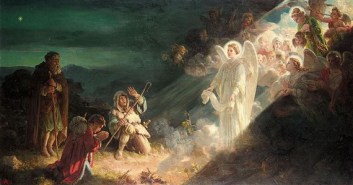
Glory appears to the ShepherdsLuke tells us that those shepherds, who were minding their own business, suddenly found themselves surrounded by the shining, dazzling glory of the Lord. The surprising, unexpected thing is not the existence of God’s glory. God’s glory shining is something that happens throughout the Scriptures.

The glory of God led Israel out of Egypt, but God’s glory was veiled and hidden in a pillar of cloud by day and a pillar of fire by night (Ex. 13:21-22). That same glory, veiled in a cloud, descended on Mt. Sinai when God spoke to the people to give them the Ten Commandments (Ex. 19:9, 16-17). Even though God’s glory was hidden behind the cloud, the people were so afraid of God’s glory that they asked Moses to tell God to not speak directly to them anymore (Dt. 18:15-19). God’s voice along with His glory, even when it was concealed by the cloud, was too much for them to behold.

But God’s glory continued to be with His people. When they built the Tabernacle, that same cloud entered the Tabernacle. And it was this glory of God that led the people through the wilderness during the Exodus. Whenever the cloud would stop, the people would set up their camp and stay there until the cloud was taken up and led them further (Num. 9:17-22).

Every time the people set up their camp, the cloud would enter into the most holy place in the Tabernacle. And God gave strict instructions to Aaron, the high priest, that he wasn’t to enter the holy of holies any time he wanted or else he would die (Lev. 16:2). And even when Aaron, and the high priests after him, were allowed to enter the holy of holies on the Day of Atonement, those high priests were told to burn incense and make a cloud of smoke to serve as an additional barrier between them and the holy presence of God (Lev. 16:12-13).

Glory in Solomon's TempleThis went on for centuries until the King Solomon finished construction of the Temple. When the Ark of the Covenant was brought into the Temple, the cloud descended into the most Holy Place, and the priests had to leave because God’s glory filled the Temple (1 Kgs. 8:10-11; 2 Chron. 5:13-14). God no longer dwelt in the tent of the Tabernacle; now, He dwelled in the house of the Temple which was where heaven and earth intersected. And still, year after year, the high priest would enter the most holy place be the representative of the people and meet with God behind the smoke made by the incense and the cloud that subdued God’s glory (Ex. 25:21-22).

But year after year, God’s people kept serving other pagan gods which defiled them and God’s Temple. And though God repeatedly warned them about their sin, they refused to trust in God alone. So, God sent His people into exile in Babylon. And it was in Babylon that Ezekiel had a vision of the Temple. In that vision, Ezekiel saw the glory of God in that cloud leave the Temple (Ezek. 10:1-19). And shortly after this, Jerusalem was destroyed along with the Temple.

God did bring His people back to their land. They rebuilt Jerusalem and the Temple, but when the second Temple was completed, God’s people had a problem. The cloud of God’s glory didn’t return to dwell there (Ezra 3:10-15; 6:16-18). God did not enter that second, rebuilt Temple. For several hundred years, it went on like this. God’s people had the Temple, but God’s glory wasn’t seen. So, the people didn’t know if God was there for them as He had been with them in the past. Because God’s glory had not entered the Temple, there was confusion and doubt. The people wondered, “Has God forsaken us forever?” And this was a legitimate question.

But now here in Luke 2, outside of the Temple, away from Jerusalem, out in a field, the glory of the Lord reappears. But notice, there is no cloud to veil God’s glory. Why was there no cloud? Well, the cloud was no longer necessary.

The cloud had been there to hide the full glory of God so the people wouldn’t be destroyed by God’s holy presence. Now in the birth of Jesus, the full glory of God is still hidden, but not in a cloud. Now, the glory of God is hidden in the infant Jesus lying in a manger.

Dear saints, tonight we celebrate the fact that God has hidden Himself in your flesh. This is the miracle of Christmas. God hides Himself in your humanity so that He can be with you, dwell with you, and reveal Himself to you. God veils His glory in the body of Jesus so that He can appear as your Savior. God hides Himself so that He can reveal Himself as your Redeemer.

We are sinners. To be found by God in His glory and majesty would be our eternal destruction. But there in Bethlehem is God wrapped in swaddling clothes. Empty Manger With Cross ShadowHe is there so He can grow up and walk among us in the towns and streets of Galilee, Judea, and Jerusalem. He is there so He can be betrayed, arrested, beaten, tried, crucified, loaded up with your sin, die, and rise again.

This is how your God is for you. God does not approach you with His consuming holiness. He hides His holy glory, and He comes in peace so that He can clothe you in His holiness. And clothed in that holiness, you are now the temple of the Holy Spirit who dwells within you (1 Cor. 6:19). God continues to reveal His glory to all creation through you, Christian (Ro. 8:21). Because of what Christ has done for you by making you holy, heaven and earth continue to overlap as God’s glory shines through you (Mt. 5:14-16).

So tonight, we join our voices with the heavenly choir. “Glory to God in the highest, and on earth peace to you.” Behold Christ’s glory which is full of grace and truth. From this Jesus, you receive grace upon grace. For your God is pleased to well with you now and forever. Amen.

The peace of God, which surpasses all understanding, will guard your hearts and minds in Christ Jesus. Amen.

The Shortest, Most Beautiful Sermon – Sermon on John 1:19-29 for the Fourth Sunday of Advent

Listen here.

John 1:19-29

19 And this is the testimony of John, when the Jews sent priests and Levites from Jerusalem to ask him, “Who are you?” 20 He confessed, and did not deny, but confessed, “I am not the Christ.” 21 And they asked him, “What then? Are you Elijah?” He said, “I am not.” “Are you the Prophet?” And he answered, “No.” 22 So they said to him, “Who are you? We need to give an answer to those who sent us. What do you say about yourself?” 23 He said,

“I am the voice of one crying out in the wilderness,
‘Make straight the way of the Lord,’
as the prophet Isaiah said.”

24 (Now they had been sent from the Pharisees.) 25 They asked him, “Then why are you baptizing, if you are neither the Christ, nor Elijah, nor the Prophet?” 26 John answered them, “I baptize with water, but among you stands one you do not know, 27 even he who comes after me, the strap of whose sandal I am not worthy to untie.” 28 These things took place in Bethany across the Jordan, where John was baptizing.

Lamb of God who takes away the sins of the wolrd29 The next day he saw Jesus coming toward him, and said, “Behold, the Lamb of God, who takes away the sin of the world!”

In the name of Jesus. Amen.

A more beautiful sermon has never been preached than John’s short, little sermon there: “Behold, the Lamb of God, who takes away the sin of the world!” In this Gospel text, John does exactly what he was sent by God to do. He points everyone who was there listening to him and the rest of humanity, including us, to Jesus. In that thirteen-word, one sentence sermon, John takes all the theology of the Old Testament and all of the religious practices and ceremonies and worship God had given to His people and piles it all on Jesus. Christ fulfills it all (Jn. 5:39; Lk. 24:27; Ro. 15:8; 2 Cor. 1:20).

Consider the Day of Atonement. That day was the only day that someone could enter the most holy place in the Temple. Only the high priest could enter on that one day. On that day, the people took two rams and flipped a coin to determine which one would be sacrificed and which one would be the scapegoat.

The high priest would take the scapegoat and bring it into the midst of the people, place his hands on the head of the goat, and confess all the sins of all the people over the previous year (Lev. 16:21). All their idolatry, blaspheming, and Sabbath-breaking. All their rebelliousness. All their murderous and adulterous ways. All their theft, lying, and discontentment. All those sins would be placed on the head of the goat which would then be led into the wilderness and away from the people.

Hebrews 10(:3) says, “It impossible for the blood of bulls and goats to take away sins,” but those goats could and did preach about the One who would come and take away the sins of the people. Those goats pointed the people to the Messiah who would bear the sin of the world in His body (1 Pet. 2:24). That was the point of all the sacrifices in the Old Testament – to preach about Jesus who would remove sin. When you saw any of the sacrifices – a bull or sheep or ram or pigeon burning there on the altar – you knew that animal didn’t do anything, it hadn’t committed those sins. But it pleased God to take the sins of the people and have them relocated to that animal. And as you saw that animal being killed and burned, you realize, “That should be me, but God accepts the death of another, He accepts a substitute, for my sin.”

That is what John is doing when he points to Jesus and preaches, “Behold, the lamb of God, who takes away the sin of the world.” John is saying, “Here is the One who dies in your place. Here is Jesus, the One who has all of your sin upon Himself.”

John wasn’t just preaching about the fulfillment of the Day of Atonement and the sacrifices. He was also preaching about the fulfillment of the Passover (Ex. 12). Remember, the people were slaves in Egypt, and God sends plague after plague to get Pharaoh to let His people go, but Pharaoh refuses. So, in the final plague, Exodus 12_46 - Passover Blood marking the doorpostsGod sends the angel of death to go through the land of Egypt. But God’s people were to take a lamb. They were to slaughter that lamb and smear some of the lamb’s blood on the door of their house and eat the rest of the lamb roasted that night. And when the angel would see the blood on the door, he would pass by.
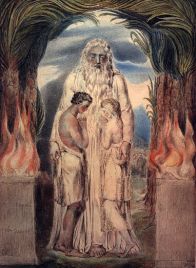
Again, when John points at Jesus, he is preaching, “Here is the one whose blood marks your door and guards you from the wrath of God.”

John is preaching about the fulfillment of Abraham’s sacrifice of Isaac. For years, God had promised Abraham that He would give Abraham a child in his old age and through that child God would bless all the nations of the world. Finally, Isaac was born, but God told Abraham to offer Isaac as a burnt offering (Gen. 22). God wasn’t testing Abraham’s obedience with this crazy command; He was testing Abraham’s faith. God had promised that through Isaac, He would raise up the Messiah. And Abraham believed God’s promise that he would have great-great-great-grandchildren through Isaac even if he sacrificed Isaac on top of the mountain. Hebrews 11(:17-20) says that Abraham figured that God would raise Isaac from the dead because God had to keep His promise. Abraham believed that Isaac, the child of promise, wouldn’t stay dead. Abraham believed that God would be faithful. But God provided another way of keeping the promise. The angel stopped Abraham’s hand from sacrificing Isaac. And there in the thorns was a ram caught by its horns, and it was sacrificed in Isaac’s place. After this, Abraham named that place “God provides” because God provided Himself as the sacrifice (Gen. 22:8).

And on that very mountain, the Temple would be built. On that mountain and in that Temple, God would continually accept the death of another in place of the children of promise. And now, John says, “Here is Jesus, the Lamb of God, the one who trades places with you, sinner.”

One more. Let’s go all the way back to the Garden of Eden (Gen. 3). Adam and Eve ate the forbidden fruit. They believed the devil’s lie instead of God’s Word. Their eyes are opened, and they realized they were naked. To try and cover their shame, they sewed fig leaves together. Those leafy clothes are like every other human religion; they don’t work. They don’t cover their sin and shame – especially when God shows up. Then, when God comes into the Garden, Adam and Eve try to hide from God. God gives them all sorts of chances to repent, but their sin has made them so afraid of punishment that they continually try to hide behind the leaves of their excuses. God warns them about the curses that have come because of their sin, but He also promises that He will send the Seed of the woman who will crush the serpent’s head.

God had said that on the day Adam and Eve ate that fruit they would surly die (Gen. 2:17), but they didn’t die that day. Instead, Adam and Eve watch God take an animal, who hadn’t done anything wrong, and kill it. This was the first time in all of creation that something died. Genesis 3-21 - God made clothes from skins.jpgGod hung that animal up and stripped the skin from its lifeless body as blood stained the ground. And God wraps that skin around the shameful, sinful bodies of Adam and Eve.

Scripture doesn’t record this, but it invites us to imagine Adam and Eve watching God do all of this. And you can imagine them in their shock and horror asking God, “Is this what it takes to cover our sin and shame?” And imagine God responding, “No. This is only preaching. There is a sacrifice to come.”

That sacrifice is Jesus, God’s own Son. Prior to Jesus, all of the Scriptures tell the story of Jesus coming to be that Lamb who takes away the sin of the world. And all of the Scriptures would have you believe that God lays on Jesus the sin and iniquity of you and me and of the whole world (Is. 53:6).

This short, beautiful sermon of John takes all of these pictures and points you to Jesus as the fulfillment – not the picture. He is the One who actually bears your sin in His body. This Jesus, who knew no sin, became your sin, so that in Jesus you might become the righteousness of God (2 Cor. 5:21).

Jesus is the Lamb of God who takes away the sin of the world. Did you catch that? The sin of the world. That means this Jesus takes away your sin. God’s anger falls on Jesus, not on you. When you see Jesus on the cross, you say, “That should be me. But Jesus, my Savior, has willingly taken my place under God’s wrath so that I can take my place with Him in eternal life.”

Dear saints, this Christmas remember that Jesus is born to be your Substitute and your Savior. He, and He alone, takes away your sin now and forever. Amen.[1]

The peace of God, which surpasses all understanding, will guard your hearts and minds in Christ Jesus. Amen.

[1] I am thankful for a sermon from Pr. Bryan Wolfmueller for much of the content of this sermon.

Living in Holy Light & Being Holy Light – Sermon for Midweek Advent 3 2019

Listen here. (The first 30 seconds of tonight’s sermon were not recorded. The missed portion was simply a summary of the previous weeks’ messages.)

The texts for tonight’s service were Isaiah 60:1-5; 2 Corinthians 4:6-12; and John 1:1-14.

In the name of Jesus. Amen.

Tonight, we are continuing the theme from 1 Timothy 4:4-5, “Everything is made holy by the Word of God and prayer.” In the first of these Advent sermons, we considered how God, the Holy One, makes us holy through His Word which cleanses and sanctifies us (Jn. 15:1-5; 17:17). Last week, we saw how God initially created all things good, but nothing created was holy by itself – nothing is inherently or intrinsically holy. So, God places His holy name upon us in our Baptism which makes us holy so we can be in His presence. This not only gives us access to God’s presence, it actually makes us a temple of the Holy Spirit who dwells in us (1 Cor. 6:19). This means, Christian, that you are no longer common. Now, you are sacred.

Tonight’s sermon will give us the picture of what our sacred life looks like according to Scripture especially from the Epistle lesson (2 Cor. 4:6-12). Paul is using imagery that was very common in his day, lamps. In the verses leading up to that text, he says that the Gospel – the good news that our sins are forgiven because of Jesus’ birth, life, death, and resurrection – is a light (2 Cor. 4:1-5). Then our text picks up that image. Look at those verses while I read and comment on them:

The God who said, ‘Let light shine out of darkness,’ has shone (Where?) in our hearts. (Why?) To give the light of the knowledge of the glory of God. We have this treasure – the treasure of God’s glory – in jars of clay.

These jars of clay are the lamps people used in New Testament times. Back then, houses were lit up, not by flipping on a switch but by little clay lamps filled with olive oil. Those clay lamps (or jars) had a small hole for a wick that floated in the oil and fed the flame.

So, God’s holy presence is in us. We have the treasure of His glory and power, but that holiness, that sacredness, that power, and that glory is hidden. You can’t see it just like you couldn’t see the oil inside of that clay lamp. But you know that oil is there as long as the wick continues to burn. If you lit a wick that didn’t have any fuel feeding it, that wick would burn up quickly. But when that wick has fuel, it will burn for hours and hours. Imagine that you didn’t know about the oil in the lamp, you would be surprised at how long the wick can burn.

Back to v. 7, we have this treasure hidden in jars of clay (Why?) to show that the surpassing power belongs to God and not to us. To close out this picture, Paul says that the life we have in Christ is reveled and shown in our suffering. Listen to v. 8-9, “We are afflicted but not crushed. Perplexed, but not driven to despair. Persecuted, but not forsaken. Struck down, but not destroyed.” When we endure suffering, others are able to see this surpassing power of God because of how it is manifested.

Afflictions do not crush us. Instead, they cause us to run to God (Ps. 129:2). Things that are perplexing and confusing do not cause us to despair (Ps. 37:32-33). When we have trials, we don’t need to wonder if God loves us – He does! When we are persecuted, we can know that we are suffering the very same things that Christ did. Jesus said, “If they persecuted Me, they will persecute you” (Jn. 15:20). When we are struck down, we turn the other cheek (Mt. 5:39) because we know that our enemies cannot destroy us – Christ has promised (Mt. 10:28). We have died and our life is hidden with Christ in God (Col. 3:1-4).

You see, dear saints who have been made sacred, God’s glory and power given to you is manifested to this world in your weakness for when you are weak, then you are made strong by God’s power (2 Cor. 12:9-10). Our problem is that this is the opposite of what we normally think. In every other aspect of our lives, growing up means that we move from depending on others to becoming independent. When a child can feed herself, walk, is potty trained, able to dress herself, tie her shoes, etc., we see that she is growing up into an independent woman.

The exact opposite is true of spiritual growth. Growing up spiritually means that we become more dependent upon Christ for everything in every situation. As we mature in faith, we learn to borrow all that we need from Christ which means that we grow in holiness.

As God shines the light of the Gospel into you, that light shines out of you so that you are a light to others. Jesus puts it this way Mt. 5:14–16, “You are the light of the world. A city set on a hill cannot be hidden. Nor do people light a lamp and put it under a basket, but on a stand, and it gives light to all in the house. In the same way, let your light shine before others, so that they may see your good works and give glory to your Father who is in heaven.”

God put the light of His Gospel into you so that you would give light to the dark house of this world. Jesus commands that light within you to shine. English cannot do justice to what the Greek does there. Jesus commands the light He has placed within you to shine so that the people of this world would see your good works and give glory to your heavenly Father.

I want to conclude tonight with one more image of what living in this light looks like by considering. Proverbs 3:5-6 (and I’m going to use a translation that might be different from what you are used to[1]), “Trust in the Lord with all your heart, and do not lean on your own understanding. In all your ways know Him, so that He will straighten your paths.”

These verses picture traveling, but it isn’t the normal traveling from one place to another. It is traveling through life. Throughout your life, you travel on many different roads and paths that seem to have little or nothing to do with each other and it can feel like you aren’t getting anywhere. You go from one thing to another, but it feels like you have no destination.

But these verses invite to you to know the Lord in all your ways. What does that mean? It means that He is present with you in everything. Wherever you go, He is there with you. He is your invisible partner and companion. When you woke up this morning, He was there. When you traveled to work or school, as you ate lunch, while you drove here, He didn’t abandon you. He was right there beside you. You have had lots of little journeys today, and the Lord was with you the whole time.

All the paths of today and yesterday and six months ago, and all the paths of tomorrow and every day of your future are all one journey because God is with you every step of the way. In all your ways, know Him, see Him, expect Him. He is there walking with you leading you along the way. You don’t have to map out your own journey, you can simply trust Him because He is there making your path straight.

The biggest problem you have and that I have is that we think we are traveling by ourselves. We don’t even bother to look for Him because we don’t expect Him to be there. But there He is giving us His light, leading us, guiding us, directing us along our paths. This means that all our paths are sacred because of God’s presence.

All the little paths and bits and tasks of your life are not the story of your journey but the story of Jesus’ journey with you. Live your life in His holy light as you radiate that holy light. Amen.

The peace of God, which surpasses all understanding, will guard your hearts and minds in Christ Jesus. Amen.

[1] Translation from Rev. Dr. John Klienig.

Rejoice! – Sermon on Matthew 11:2-11 for the Third Sunday of Advent

Listen here.

The Scripture lessons for today’s service were Isaiah 40:1-8; 1 Corinthians 4:1-5; and Matthew 11:2-11.

Matthew 11:2-11

2 Now when John heard in prison about the deeds of the Christ, he sent word by his disciples 3 and said to him, “Are you the one who is to come, or shall we look for another?” 4 And Jesus answered them, “Go and tell John what you hear and see: 5 the blind receive their sight and the lame walk, lepers are cleansed and the deaf hear, and the dead are raised up, and the poor have good news preached to them. 6 And blessed is the one who is not offended by me.”

7 As they went away, Jesus began to speak to the crowds concerning John: “What did you go out into the wilderness to see? A reed shaken by the wind? 8 What then did you go out to see? A man dressed in soft clothing? Behold, those who wear soft clothing are in kings’ houses. 9 What then did you go out to see? A prophet? Yes, I tell you, and more than a prophet. 10 This is he of whom it is written,

“‘Behold, I send my messenger before your face,
who will prepare your way before you.’

11 Truly, I say to you, among those born of women there has arisen no one greater than John the Baptist. Yet the one who is least in the kingdom of heaven is greater than he.”

In the name of Jesus. Amen.

Baptism 2Dear Lincoln, today you are Baptized. Today, God has given you the new birth of water and the Spirit (Jn. 3:5). Today in your Baptism, you have been joined to Jesus’ death and resurrection (Ro. 6:3-5) and have been clothed with Christ (Gal. 3:27). And Lincoln, Derek, Brittney, and all you saints, that means that today is a day to rejoice. Even as we see the grass wither, the flower fade, and creation crumble, we know that the Word of our God will stand forever. God continues to shower His blessings upon us through that Word. And His Word to us today, and every day of our Christian walk, is the Word of the Gospel which causes us to rejoice.
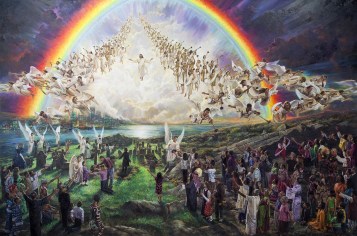
But we just heard of John being in prison. In that dungeon, John isn’t wearing soft clothing. He is cold. He is hungry. He is lonely. And he is waiting to be executed. He doesn’t know when Herod is going to kill him, but he knows it is coming. In that dark night of his soul, John the Baptizer, greatest among those born of women, has doubts. It isn’t as though he doesn’t believe in Jesus anymore, but he has is struggling with doubt. John had preached about the one who would set the captives free (Ps. 102:20; Is. 58:6), yet he sits in chains and behind bars. So, John sends his disciples to Jesus with a question, “Are you the one who is to come, or shall we look for another?”

So much for rejoicing. And I’m sorry to be a downer here, but this is the reality of all Christians. For all believers, faith and doubt coexist on this side of glory.

We live in a fallen and broken world. We suffer the effects of our sin. We work, we fight, we toil, and we struggle against our sin only to fall into it again and again. We imprison ourselves in the guilt and shame of our iniquities. Family and friends fail us. Health deteriorates. We bury those we love. And in the midst of all this, we wonder if God is truly our Father. If He still cares for us. And if He still loves us. We doubt and ask, “Are You really my Savior, or should I look for another?”

Lincoln, you will have days when you find yourself in these times of doubt. You too will struggle in your faith. But, again, on this side of glory faith and doubt coexist in the Christian.

And it is in those moments of doubt, Lincoln and all of you here, that you need to go back to inquire of your Savior like John did here. You need to hear from Jesus again and again and again. Joy isn’t the absence of pain, sorrow, and doubt. Joy is given to us through the peace that only Jesus can deliver in the midst of those things. Here is the reason we can have joy: listen to what Christ says, “The blind receive their sight and the lame walk, lepers are cleansed and the deaf hear, and the dead are raised up, and the poor have good news preached to them.”

Christ had not abandoned John as he sat in prison. And Jesus does not abandon you in your doubt either. He continues to bring His healing, resurrection, and Gospel to those who struggle balancing their faith and doubt today. Faith always asks for Christ to reveal Himself in mercy and lift us out of those doubts. Faith askes for Christ to forgive, strengthen, and encourage. And Jesus never fails to do those things because His steadfast love never ceases, and His mercies never come to an end (Lam. 3:22).

Christ Returns in Power and GloryIn Advent we are watching and waiting for the coming of our Savior and the end of our exile in this fallen, sinful world. Advent is the Christian life in a nutshell. We watch and we wait for the coming of our Lord. And as we wait, we are reminded that, whatever may happen to us in this veil of tears, the end is a joyful day for you whose citizenship is in heaven. As we wait, we remember that all the cares and sorrows of this world are temporary.

Lincoln and all you saints. Jesus comes to you today in the midst of your guilt, sorrow, and doubt to bring you His Gospel. He is your Savior, your Redeemer, your Friend, your Resurrection, and your Life.

This is why you hope and rejoice. Christ has died, He has risen, and He will come again. May God grant that this light would shine into our own hearts, deliver us from our doubts, and rescue us in our trials until the day we see Him face to face. Amen.

The peace of God, which surpasses all understanding, will guard your hearts and minds in Christ Jesus. Amen.

The Name That Makes Us Holy – Sermon for Midweek Advent 2 2019

Listen here.

The texts for tonight’s service were Numbers 6:22-27; Ephesians 1:3-14; and Matthew 28:16-20.

In the name of Jesus. Amen.

Last week, we considered how God, the Holy One, makes us holy through His Holy Word which cleanses and sanctifies us (Jn. 15:1-5; Jn. 17:17). Tonight, we are going to look at Scripture and see what this notion of holiness is all about. So, in order to try get an idea what is holy, we are going to look at Leviticus 10:10 to see how God views everything when it comes to holiness.

But before we can do that, we have to remember that when God finished creation, He stepped back and declared everything to be “very good” (Gen. 1:31). Everything created by God is, by God’s declaration, good as the theme verses (1 Tim. 4:4-5) for these services say. Notice that Scripture doesn’t say that God created things and called them ‘holy.’ Nothing created is inherently or intrinsically holy or unclean; instead created things were all created ‘good.’ However, now that we have brought sin into the world, there are various degrees of holiness and impurity. So, Aaron, the high priest and all the priests after him (Ezek. 44:23), were called by God to make distinctions. Look at Lev. 10:10, “You are to distinguish between the holy and the common, and between the unclean and the clean.”

Holiness SpheresGod’s holiness creates three interlocking spheres which I’ve tried to show with this figure.[1] Because God’s holy presence dwelled in the Tabernacle and later in the Temple, those places became the place where the holy God dwelt with fallen mankind (2 Chron. 6:14-21). They served as a bridge between heaven and earth, and specifically the Holy of Holies was where heaven and earth overlapped. So, in this figure, on the one hand, you have God’s holy presence and on the opposite side, there is the state of impurity which is utterly incompatible with holiness. What is unclean and defiled has been corrupted by sin and the devil. But you will notice there is all sorts of space between God’s holy presence on the one side and Satan and the demons on the other side. That is where we dwell.

Here’s the picture: What is holy is clean, but it is possible for something to be clean yet not holy which means it normal or common, which most things are. And something can be common but also unclean or abnormal.

In this ordering, things that are common must be cleansed of impurity before they can come into contact with God and share in His holiness or else, they are destroyed and consumed by God’s holiness. Last week we briefly considered Isaiah’s call (Is. 6:1-7). That event is helpful in understanding this concept.

When Isaiah was in God’s holy presence, he recognized his uncleanness. Isaiah’s lips were death-dealing, disordering, cursing, and made things around him sick. But the angel came with that coal from the altar (Is. 6:6) – which is an important fact because God had said that anything that touches the altar becomes holy (Ex. 29:37). With that holy coal, the angel touched Isaiah’s lips to purify him from his sins. Made holy by God’s declaration, that coal was life-giving, ordering, blessing, and healing so that Isaiah was made clean. After this encounter with God, Isaiah continued to receive God’s holiness as He received God’s Word, and Isaiah even emanated and transferred God’s holiness to others when He preached God’s Word. Even still today you receive God’s holiness that He dispersed through Isaiah as you hear God’s Word when you read the book of Isaiah. Get the picture?

Let’s fill this out a little more. The closer something comes to God, the holier it becomes. Think of it this way: The high priest was more holy than a normal Israelite, even though God had declared His people to be holy and sanctified them (Lev. 19:2; 21:8), because only the high priest could go into the Holy of Holies while the Israelite could only enter as far as the outer part of the Temple. The same thing was true for different sacrifices. Certain sacrifices and offerings, like peace offerings, were holy, but they were less holy than other sacrifices because they were offered outside of the Temple and didn’t ever come into the Temple.

The opposite is true for things or people that were unclean. Some things were desecrated and defiled – like a person who was a medium (Lev. 20:27) or someone who sacrificed a child to Molech (Lev. 20:2). These were so defiled and unclean that God required the death sentence. But other people who were defiled – like someone who touched a corpse (Lev. 11:31-32) or who had a skin disease (see Lev. 14) – were easily fixed and made clean. That person could be purified of the uncleanness and sanctified.

Now, I can hear some of you saying, “Sure, pastor. But that is all Old Testament stuff. Jesus did away with that kind of thinking.” To which I say, “Not so fast!”

In Mark 7[:1-23] Jesus, our great High Priest, continued to teach about what makes a person clean or defiled.[2] It is true that the incarnation of Jesus meant that the location of God’s holiness moved from the Temple building to Jesus’ body (Jn. 2:21-22). And now, Jesus’ death has ripped open the curtain that guarded the Holy of Holies (Lk. 25:45-46), so the focus of defilement is no longer the physical body, but the human heart.

And Hebrews (9:13-14) addresses this as well: “For if the blood of goats and bulls, and the sprinkling of defiled persons with the ashes of a heifer, sanctify for the purification of the flesh, how much more will the blood of Christ, who through the eternal Spirit Hebrews 9_14 - Christ offered Himself without blemish to Godoffered himself without blemish to God, purify our conscience from dead works to serve the living God.”

In Jesus, God’s holiness entered our common realm so that He could cleanse unclean sinners and expel the demons that brought defilement. And the demons recognized Jesus as the holy one of God who had come into the flesh to undo and cast out the uncleanness they brought with them (Mk. 1:21-27). All of this means that God’s holiness isn’t limited to the Temple building anymore.

Jesus’ incarnation, death, resurrection, and ascension has brought about such a cleansing that now you, believer, are the temple of the Holy Spirit who abides in you (1 Cor. 6:19). So, continue to receive God’s holiness.

One more analogy to help get this across: Today was a bright, sunshiny day. There were no clouds on the sky and the sun’s light wasn’t blocked; it came clearly through the sky and bounced off the snow making everything outside bright. If you braved the cold and went outside you were receiving amazing amounts of light from the sun. It isn’t possible to capture that light – bottle it up or something – and have it to use it later in these short, dark days. To keep receiving the sun’s light, you have to be where the sun is. The same is true with God’s holiness. You have to be where God has promised to deliver His holiness to continue in it.

Hebrews 10_19-23 Jesus our High PriestIn Jesus, God has come into this common world and brought His holiness to you. Because of what Christ has done, God has claimed you as His own so that you can live with Him in His kingdom and serve Him in everlasting righteousness. He placed His holy name upon you when you were Baptized. In your Baptism, you were marked with the name of the Father, Son, and Holy Spirit (Mt. 28:18-20). That holiness, given to you in your Baptism, is now continually delivered to you when you hear and believe God’s holy Word. As you hear the word of truth, the gospel of your salvation, you are sealed with the promised Holy Spirit (Eph. 1:13). God continues to place His name on you as He blesses you, keeps you, makes His face shine upon you, and be gracious to you (Num. 6:22-27). Bearing His holy name, you are brought into His holy presence, and radiate His holiness to those around you.

Christian, you are no longer common. Now, you are sacred. You bear the holy name of God throughout creation as you go about your common life in the midst of common people. Made holy by that name, you bring God’s sacred space to those who need purification and sanctification through Jesus’ blood. Rejoice and proclaim that name so that God’s sacred space continues to spread. Amen.

The peace of God, which surpasses all understanding, will guard your hearts and minds in Christ Jesus. Amen.

[1] The idea for this figure came from this paper by Rev. Dr. John Kleinig.

[2] See also what Jesus says when He washes His disciples’ feet in John 13:8-11. And when Jesus, our High Priest, came to wash His disciples’ feet, Peter objected. Jesus responded, “If I do not wash you, you have no share with me.” So, Peter went all in, “Lord, not my feet only but also my hands and my head!” And Jesus responded, “The one who has bathed does not need to wash, except for his feet, but is completely clean.” (See also Jn. 15:3, 17:17-19.)

Filled with Joy & Peace – Sermon on Romans 15:4-13 for the Second Sunday of Advent

Listen here.

Romans 15:4-13

4 For whatever was written in former days was written for our instruction, that through endurance and through the encouragement of the Scriptures we might have hope. 5 May the God of endurance and encouragement grant you to live in such harmony with one another, in accord with Christ Jesus, 6 that together you may with one voice glorify the God and Father of our Lord Jesus Christ. 7 Therefore welcome one another as Christ has welcomed you, for the glory of God.

8 For I tell you that Christ became a servant to the circumcised to show God’s truthfulness, in order to confirm the promises given to the patriarchs, 9 and in order that the Gentiles might glorify God for his mercy. As it is written,

“Therefore I will praise you among the Gentiles,
and sing to your name.”

10 And again it is said,

“Rejoice, O Gentiles, with his people.”

11 And again,

“Praise the Lord, all you Gentiles,
and let all the peoples extol him.”

12 And again Isaiah says,

“The root of Jesse will come,
even he who arises to rule the Gentiles;
in him will the Gentiles hope.”

13 May the God of hope fill you with all joy and peace in believing, so that by the power of the Holy Spirit you may abound in hope.

In the name of Jesus. Amen.

Romans 15_13 - Joy Peace and HopeOur texts today seem to have conflicting messages. This text from Romans 15 has a lot to say about endurance, encouragement, hope, harmony, joy, and peace. It’s nice. But in our Gospel lesson, when Jesus talks about the day of His return, He speaks of signs in the sun and moon and stars. He mentions the distress of nations in perplexity, the roaring of the sea and waves, and people fainting with fear and foreboding because of what is coming on the world. Our Lord declares that the powers of the heavens will be shaken.

Come on, Jesus. We don’t like that imagery, and it doesn’t fill us with joy or peace or hope. We don’t like to hear about the world coming apart at the seams. But then, we turn on the news or scroll through our social media accounts and see evidence of creation collapsing and society crumbling, and we get anxious. Our fear of the end of the world probably lies in the fact that this world is all we have experienced and known. Repent and remember this world is not all there is.

Jesus tells us about all these distressing things so that when they happen, we can be filled with all joy and peace so that we abound in hope in the midst of it all. Similar to when a patient has been physically suffering for months while the doctors only scratch their heads, once the doctors can give a diagnosis there is a sense of relief even if it is a devastating diagnosis. Jesus, the God of hope, has diagnosed the situation and tells us exactly what is going on.

Jesus told us that it would happen so when we see it we wouldn’t be afraid. Dear saints, we don’t need to be worried when we see the world collapsing. It’s like Jesus is saying, “When it looks like everything is falling apart, when all creation seems to be disintegrating, it is. It is, but don’t worry about it because nothing bad is going to happen to you. Instead, be glad because all of it means that your redemption is drawing near.”

Christ warns us so we can straighten up, raise our heads, and stand before Him when He returns. These words of Christ are exactly what we need to endure and be encouraged so that we have hope and strive to live in harmony with one another.

I’ve used this picture before, but I think it is so helpful. Imagine you are in a castle at night, and suddenly all the guards and soldiers start running to their battle stations because an army is marching to attack the fortress. The boots of that attacking force stop tramping, and you hear the shouts of commanders telling the troops to load the catapults and start banging the gates with the battering ram.Castle Besieged The castle doors and the walls are shaking. Boulders are hurled against the fortress. Windows are shattering and dust is falling from the ceiling. The floor you are standing on is rocked by the sounds of battle all around you.

Normally, you would be terrified in that situation. But not now. Not now because you are a captive in the prison of that castle. And the commander leading the invading army is Jesus coming to rescue you and all your prison mates, all your brothers and sisters in Christ. Knowing that, every crash, every clang, every shout of battle, and every wall that crumbles around you means that your release is that much closer. And as the morning sunlight peeks through the cracks of the walls, you and your fellow prisoners all know that a new day is dawning, and it is the day of your deliverance.

This world is often a beautiful place full of the good gifts of God. But remember that this world is broken and incomplete. This world is fallen and there is so much wrong with where we are. And much of what is broken, incomplete, fallen, and wrong is your own doing and my own doing. And all of this has been going on so long that you get used to it. You and I get used to sin, and we start to think that it is normal. Like a pig farmer who doesn’t notice the stink of the barn, the stench of our sin starts to not bother us anymore. Repent, but don’t despair.

The Jesus who will come again in glory has come already to bring the beginning of hope. His words and works and deeds were written for our instruction. In the Scriptures we learn that when Jesus ministered in this fallen world what was broken was made whole. What was sick was cured. Romans 15_4 What was written peace joy hope.jpgWhat was defiled was made holy. What was dead was raised. Where there were sinners, Christ brought forgiveness. And all of that was just the beginning. All of this was written to give us encouragement to endure in the hope that the healing Christ brought to the broken of this world would be ushered into the entire creation – into the new creation.

The God of hope encourages you. He wants you to endure. And He wants you to have hope. May the God of endurance and encouragement grant you that hope because it is certain and true. The sun of righteousness will rise with healing in its wings (Mal. 4:2). Straighten up. Raise your heads because your redemption draws near. May that same God, Jesus, the God of hope, fill you with all joy and peace in believing so that you abound in hope. Amen.

The peace of God, which surpasses all understanding, will guard your hearts and minds in Christ Jesus. Amen.

The Holy One Makes Us Holy – Sermon for Midweek Advent 1 2019

Listen here.

The texts for tonight’s service were Exodus 3:1-5; 1 Timothy 4:1-10; and John 15:1-5.

In the name of Jesus. Amen.

For a little over two years, I have been mulling over those words we heard from 1 Timothy 4[:4-5], “Everything created by God is good, and nothing is to be rejected if it is received with thanksgiving, for it is made holy by the Word of God and prayer.” These words have a profound impact on how we, as God’s holy people, go about our daily lives and interact with the world.

Every home, every marriage, every relationship, every gift, every possession, every day, every night, all our work, all our sleep, all our joys, and all our sorrows: everything is made holy and sacred by God’s Word.

Tonight, we are going to begin a year-long journey considering God’s holiness: how that holiness comes to us, and the implications of what it means to live as God’s sacred people. Now, I know that a year sounds like a long time. It probably is. But when I was at a conference in the beginning of October, one of the pastors who was presenting mentioned that people have to hear something eight times before they begin to latch on to it. (For me, it is probably more like sixteen times.)

So, these mid-week Advent services will serve as an introduction to that theme: Sacred. And through this Church year I will repeatedly draw on this idea. Hopefully, by the end of it all, I will have touched on this theme often enough that we will have a better understanding of how God’s holiness is given to us in our Baptism, maintained by His Word, sustained in us through ongoing faith, and changes the way we interact with everyone and everything around us.

Now, it’s tempting for me to throw everything at you all at once, but I’m going to try to resist that temptation and remind myself that I have a whole year. So, tonight, we will begin by briefly considering how our holy God makes us holy.

God alone is holy, and, apart from Him, nothing is ever holy. We fallen, sinful humans can only be holy if we receive God’s holiness. Just as a flashlight has no energy to shine unless it has batteries, our holiness is completely dependent to being connected with the holiness of God. Our holiness is never our achievement; it is always a gift from God. And, yes, God wants to give us this holiness.

Exodus 3_14 - Burning BushIn our Old Testament lesson tonight (Ex. 3:1-5), Moses found himself standing on holy ground when God appeared in a bush. That bush was burning because of God’s holy presence, and Moses’ curiosity was piqued when he noticed that though the bush was aflame it was not consumed; it didn’t burn up. In the same way, when God’s holiness comes to us, it burns but God does not want us to be consumed by the fire of His holiness. Instead, He wants us to be changed by it.

Consider when Isaiah found himself in God’s presence (Is. 6:1-7). Isaiah saw the Lord high and lifted up, seated on the throne, the train of His robe filled the Temple, and the seraphim called out, “Holy, holy, holy is the Lord of hosts.” Isaiah knew this put him in a bad place. He cried out, “Woe is me! For I am undone; for I am a man of unclean lips, and I dwell in the midst of a people of unclean lips; for my eyes have seen the King, the Lord of hosts.” God’s holiness does two things to Isaiah.

First, God’s holiness revealed and unmasked Isaiah’s sin, and it wasn’t only Isaiah’s defilement that troubled him. Isaiah knew that because he lived among other sinners, their sinfulness and defilement had rubbed off on him making him more unclean and unholy. And God’s holiness was a fire that would reduce Isaiah to ashes. But God would not have it be this way.

Isaiah 6 - Holy Holy Holy Lips CoalSo, the second thing God’s holiness does to Isaiah is rub off on him. God sent one of the seraphs to fetch a burning coal, take it to Isaiah, and touch his lips with it and give a word of promise, “Behold, this has touched your lips; your guilt is taken away, and your sin atoned for.”

God didn’t appear in His holiness to undo Isaiah and destroy him. Instead, God brings Isaiah into fellowship with Him as He forgave and reconciled Isaiah to Himself making Isaiah holy and sacred to go and proclaim God’s Word.

Like Isaiah, we do not ever possess God’s holiness as our own. It isn’t something we can bottle up and store for later. We continually receive and borrow holiness from God, and God isn’t stingy in sharing His holiness with us. He happily and readily gives us His holiness through His Word making us sacred.

We heard this in the Gospel lesson (Jn. 15:1-5) where Jesus tells us that He is the Vine and we are the branches. There, Jesus gives us a beautiful picture of the holy lives we lead. As we abide in Him, who is the Vine, we bear sacred fruit. And God the Father prunes us so what we may bear more of that fruit. But Jesus doesn’t stop there. He tells us that already we are clean (it’s the same word Jesus used which was translated ‘pruned’). And what is the instrument that prunes us and makes us clean? It is His Word.

This means that Jesus doesn’t make us holy and then leave us to continue being holy on our own. Instead, He meets us where we are, calls us through His Word, and by that Word He joins us to Himself. As we abide in Jesus’ Word, He does everything for us and gives everything to us. Jesus invites us to safely approach our holy heavenly Father in faith with Him. Apart from Him, we cannot accomplish anything spiritually. But with Jesus, we stand on holy ground before God the Father in the heavenly sanctuary. Jesus brings heaven to earth for us so that we can live heavenly lives with Him here on earth.

God’s will for us as His children is to be holy as He Himself is holy (1 Pet. 1:14-16). The good news is that God doesn’t expect us to generate our own holiness. Jesus continually doles out His holiness upon us through His Word which makes us and all we do sacred.

More on that in the weeks to come. Amen.

The peace of God, which surpasses all understanding, will guard your hearts and minds in Christ Jesus. Amen.

The Humble King – Sermon on Matthew 21:1-9 for the First Sunday of Advent

Due to a winter storm, our service was cancelled 12/1. This recording includes an abbreviated service for use in lieu of gathering together.

Listen here.

Matthew 21:1-9

1 Now when they drew near to Jerusalem and came to Bethphage, to the Mount of Olives, then Jesus sent two disciples, 2 saying to them, “Go into the village in front of you, and immediately you will find a donkey tied, and a colt with her. Untie them and bring them to me. 3 If anyone says anything to you, you shall say, ‘The Lord needs them,’ and he will send them at once.” 4 This took place to fulfill what was spoken by the prophet, saying,

5 “Say to the daughter of Zion,

‘Behold, your king is coming to you,
humble, and mounted on a donkey,
on a colt, the foal of a beast of burden.’”

6 The disciples went and did as Jesus had directed them. 7 They brought the donkey and the colt and put on them their cloaks, and he sat on them. 8 Most of the crowd spread their cloaks on the road, and others cut branches from the trees and spread them on the road. 9 And the crowds that went before him and that followed him were shouting,

“Hosanna to the Son of David!
Blessed is he who comes in the name of the Lord!

Hosanna in the highest!”

In the name Jesus. Amen.

Happy New Year! Today is the beginning of Advent and the dawning of a new year in the Church. If you’ve been listening today, you can hear Christmas steadily approaching. And even though this Gospel lesson sounds like we are getting ready for Easter, since these events occurred on Palm Sunday, this Gospel lesson is intended to prepare us for Jesus’ coming. That’s what Advent means, by the way, “coming.”

The Church has always centered its life around Jesus – so much so that Christians have a unique way of telling time that is different from the rest of the world. The Church year is designed to retell the entire life of Jesus, but we don’t begin at Christmas – at His birth. Instead, we begin with Advent – four weeks of patiently waiting for and anticipating what happened in Bethlehem nearly two-thousand years ago.

Ever since the Fall into sin (Gen. 3), believers were expecting God to come and rescue us from sin. Adam, Eve, Abel, Noah, Abraham, Isaac, Jacob, Moses, Joshua, Samuel, David, Elijah, Isaiah, Jeremiah, Ezekiel, Daniel, and all believers in the Old Testament were waiting for the deliverance that Jesus brought when He was born, died, and rose again. Just like them we are waiting but with a difference. Since Jesus’ resurrection and ascension, Christians like Matthew, Mark, Luke, John, Peter, Paul, Augustine, Luther, and us have been waiting for Christ to come back as He promised (Act. 1:6-11).

Advent isn’t a time for us to prepare for Christ’s birth. He’s already been born; we know the story. It isn’t as though we don’t pretend that He wasn’t born so that we are surprised when we come to church on Christmas Eve and hear the passage from Luke 2 about His birth. Instead, we are patiently preparing our hearts to celebrate His birth while we also anticipate His future return in glory. Advent is also a time to rejoice in His coming repeatedly to us as we gather together and receive the Lord’s Supper where He comes to us here and now.

Since Advent is about how Jesus came to us in His birth, how He comes now in these last days, and how He will come again on the Last Day, we want to consider why He comes. What is He coming to do?

If we take a step back and think about it, the coming of God into our midst is not necessarily good news. If you were a pagan Greek and heard that Zeus is coming, it isn’t good news. Or of you are a Muslim and heard that Allah was coming, it wouldn’t be comforting. Instead, it would be frightful. Even the prophets in the Old Testament, when they would preach about God’s coming, it would often be a warning (Jer. 7:8-15).

Listen to these words from Amos 7:18-20 talking about God’s coming, “Woe to you who desire the day of the Lord! Why would you have the day of the Lord? It is darkness, and not light, as if a man fled from a lion, and a bear met him, or went into the house and leaned his hand against the wall, and a serpent bit him. Is not the day of the Lord darkness, and not light, and gloom with no brightness in it?” Or think of Isaiah’s response when he found himself in God’s presence in the Temple (Is. 6:1-5), “Woe is me! For I am undone; for I am a man of unclean lips and I dwell in the midst of a people of unclean lips.” When you consider God’s holiness and purity, God showing up is bad news for all of us who are unholy, unclean, defiled, and sinful. God’s holiness and our unholiness cannot exist together.

Think about the last time you had to fix something that had been turned into a complete mess by someone else. Think about the time your brother or sister messed up your room. Or the time your kid, who really should know better, made the kitchen or bathroom explode in a flour-ery or fingernail-polishy mess. Or your co-worker undid days of your work on that task and messed up the whole project. You see that disaster, and you know that you are the one who has to clean it up, straighten it out, and restore everything to its proper place.

You’re upset. You’re angry. You’re mumbling or thinking like a sailor because now you have to spend hours of effort fixing that catastrophe when your time could have been better used elsewhere. Too often, we think God is the same. Because our reaction is to be angry and upset, we believe God’s only reaction is to be angry and upset. Well, He is. We provoke His anger because of our sin. Our sins have broken His creation and create havoc and chaos. Our iniquities harm our neighbor and others. Our transgressions break our fellowship with Him. All of this means that the coming of God into our midst should be terrifying for us.

This is why we need the Scriptures. When Jesus rides into Jerusalem the first day of Holy Week, He is coming to fix the mess we have made of this world by our sin. But He doesn’t come riding a war horse and leading an army. He doesn’t come to annihilate everyone. He comes on a rescue mission. He comes to save and deliver you from sin, death, and the devil. To show that this is why He comes, He comes as the humble king in meekness. “Behold your King is coming to you, humble, and mounted on a donkey” (Zech. 9:9). He comes to be rejected. He comes to take your sin. He comes to be spit upon, beaten, mocked, and scorned. He comes to be led outside Jerusalem. He comes to be crucified. He comes to suffer the wrath of God against your sin.

Dear saints, the Gospel is not the news that God is here. The Gospel is that God is here to save, and He is here to save you. In fact, that is what Jesus’ name means, “Yahweh saves.”

Here comes Jesus, right now, into our midst. He’s not riding on a donkey but on bread and wine to come and bless us. He comes to meet us with His salvation, mercy, and forgiveness. Amen.

The peace of God, which surpasses all understanding, will guard your hearts and minds in Christ Jesus. Amen.

Thankful & Waiting – Sermon on Matthew 25:1-13 for the Last Sunday of the Church Year

Listen here.

Matthew 25:1-13

1 “Then the kingdom of heaven will be like ten virgins who took their lamps and went to meet the bridegroom. 2 Five of them were foolish, and five were wise. 3 For when the foolish took their lamps, they took no oil with them, 4 but the wise took flasks of oil with their lamps. 5 As the bridegroom was delayed, they all became drowsy and slept. The Ten Virgins Riojas6 But at midnight there was a cry, ‘Here is the bridegroom! Come out to meet him.’ 7Then all those virgins rose and trimmed their lamps. 8 And the foolish said to the wise, ‘Give us some of your oil, for our lamps are going out.’ 9 But the wise answered, saying, ‘Since there will not be enough for us and for you, go rather to the dealers and buy for yourselves.’ 10 And while they were going to buy, the bridegroom came, and those who were ready went in with him to the marriage feast, and the door was shut. 11 Afterward the other virgins came also, saying, ‘Lord, lord, open to us.’ 12 But he answered, ‘Truly, I say to you, I do not know you.’ 13 Watch therefore, for you know neither the day nor the hour.”

In the name of Jesus. Amen.

I promise we’ll get to the parable; it’ll be in a roundabout way. But first…

Four days from now, our nation will pause and dedicate a day to giving thanks. Friends and families will gather. Tables will be set. Turkeys will be cooked. (By the way, if you’re in charge of the turkey, make sure you brine it first – use kosher salt, 24 hours. Talk to me after the service.) Potatoes will be mashed. Stuffing will be fluffed. Pies will be baked. Cream will be whipped. Football will be watched. And couches and recliners will be tested for structural integrity.

Having a day for Thanksgiving is good, right, and important – probably more important than we could ever realize. Even though it is in the name – “Thanksgiving” – most people probably miss the whole meaning of the day. Thanksgiving is a day to give thanks, and that means there must be a recipient of our thanks – someone to whom we give thanks. And, dear Christian, I hope Thanksgiving Day is different for you than it is for many in our country because you know to Whom you give thanks. Let me parse that out.

Many people today will talk about gratitude. Some people finish each day by crawling into bed and thinking of five things for which they can be grateful. That is a good exercise, but it only goes so far. While there are similarities between the two, gratitude is not always the same as thanksgiving.

Let me try this on you, and you can tell me what you think. Gratitude tends to look at the goodness of the thing received. 1 Thessalonians 5 18But thanksgiving, yes it recognizes the goodness of the thing, but it looks past that and sees the goodness of the giver of the thing. This is why Christians can give thanks in all circumstances (1 Th. 5:18). Even in the tough stuff, even in difficult times, in sorrow, and in afflictions that come to us in this broken world, you can know that everything comes to you from the very same hands that were nailed to the cross for you.

Christians give thanks. Scripture even goes so far as to say that not giving thanks is one of the marks of the unbeliever. Romans 1:21-23 says of idolators, “Although they knew God, they did not honor Him as God or give thanks to Him, but they became futile in their thinking and their foolish hearts were darkened. Claiming to be wise, they became fools,” (see there a connection to the parable), “and exchanged the glory of the immortal God for images resembling mortal man and birds and creeping things.” In other words, people fall into idolatry because they foolishly do not give thanks to God.

Think back to Eden and the Fall when sin was being born: Eve rightly told the serpent that they could eat of any tree in the garden except the Tree of the Knowledge of Good and Evil. Nothing was forbidden to Adam and Eve except learning what evil is. But the devil awakened the desire to become more. Remember, the devil lied, “You will not surely die. God knows when you eat of it your eyes will be opened, and you will be like God, knowing good and evil.”

Instead of being content and thankful for everything God had given, the desire for something more was awakened. Then, those fateful words, “When the woman saw that the tree was good for food, and that it was a delight to the eyes, and that the tree was to be desired to make one wise, she took of its fruit and ate, and she gave some to her husband who was with her, and he ate” (Gen. 3:6).

In the account of the Fall, we can see how thanklessness is the root of every sin. When we aren’t giving thanks, we are lured and enticed by misguided and false desires. The Epistle of James warns us about this (1:14-15), “Each person is tempted when he is lured and enticed by his own desire. Then desire when it has conceived gives birth to sin, and sin when it is fully grown brings forth death.”

All of this is to say that one of the most important things for us to do to fight against sin is to give thanks. When we are giving thanks, we are looking at the goodness of our God and fighting against the false desires that lead to sin which grows and matures into death. So, again, as Scripture says, “Give thanks in all circumstances” (1 Th. 5:18). For many in our community – you farmers especially – this is important. Many of you have to leave your crops in the ground, and not only that you have to pay to do so. Lord, have mercy. It is awful and horrible.

Yet, in the midst of this suffering, God is giving you a chance to grow in your faith. Remember when Job had his oxen, donkeys, sheep, camels, children, and his health taken away? His wife tells him to curse God and die. But Job responds, “You speak as one of the foolish women. Shall we receive good from God, and shall we not receive evil?” (Job 2:9-10).

You farmers who are suffering now, everyone else who is suffering in other ways, and those of you who will suffer in the future, remember that God is your Heavenly Father. He will never withhold anything good from you. Psalm 84:11, “The Lord bestows favor and honor. No good thing does he withhold from those who walk uprightly.” Psalm 34:9–10, “Oh, fear the Lord, you his saints, for those who fear him have no lack! Those who seek the Lord lack no good thing.” Any suffering you experience is an opportunity for your faith in God’s goodness to grow and mature (1 Pet. 1:7, 4:12-16). He will not fail you.

Parable of the Ten VirginsNow, to the parable. Honestly, it is very difficult, and the difficulty mainly lies in the fact that we don’t know enough about Jewish wedding customs in Jesus’ day to know why it was so important that these virgins have lit lamps when the groom arrived.

I would love to be able to tell you exactly what the oil represents, but Jesus doesn’t tell us. Is it the fear of the Lord which is the beginning of wisdom (Ps. 111:10; Prov. 1:7)? Since the fear of the Lord is the beginning of wisdom do we need to also add God’s Word, faith, grace, the Holy Spirit, the Sacraments, or thanksgiving? The safest answer is that it is probably all of them, because they are all tied together to make a sinner ready for the Day of the Lord. There are two things we can say for sure – the first is about the oil and the second about the lamps.

First, the oil is not something that can be shared. When the foolish ask the wise to share their oil, they say, “No,” because, even though the groom is around the corner, they will not have enough for both themselves and the foolish. The second thing we can say is about the lamps that no one can walk by the light of another’s lamp, each must have their own.

Also, we know for sure that all of these girls are failures. They all sleep. They all need to be awakened. They all need to quickly trim their lamps to be ready to meet the groom, but not all are able. Five are wise and get into the feast. And five are foolish and are left outside like strangers. We also know the purpose of the parable. Jesus wants us to be wise as we watch for His return. We need to have faith that God’s promises are sure and certain. He will return. He will come back. And He wants you at the feast.

Dear saints, the One who was born for you; the One who lived a life of perfect obedience for you; the One who suffered, bled, and died for you is the same One who is coming for you. Jesus will return and take you to be with Himself.

So, be wise. Continue even now to be where your Lord has promised to be. Be in His Word. Be here where He gives you His mercy and grace in the Supper. Be in the fellowship of your fellow believers. Be fed by His promises because those promises will never fail you. And be fighting against the foolishness of sin. Your Lord and Savior is coming. Amen.

The peace of God, which surpasses all understanding, will guard your hearts and minds in Christ Jesus. Amen.

Attentive Ears – Sermon on Matthew 18:21-35 for the Twenty-Second Sunday after Trinity

Listen here.

Matthew 18:21-35

21 Then Peter came up and said to him, “Lord, how often will my brother sin against me, and I forgive him? As many as seven times?” 22 Jesus said to him, “I do not say to you seven times, but seventy-seven times.

23 “Therefore the kingdom of heaven may be compared to a king who wished to settle accounts with his servants. 24 When he began to settle, one was brought to him who owed him ten thousand talents. 25 And since he could not pay, his master ordered him to be sold, with his wife and children and all that he had, and payment to be made. 26 So the servant fell on his knees, imploring him, ‘Have patience with me, and I will pay you everything.’ 27 And out of pity for him, the master of that servant released him and forgave him the debt. H-76 Trinity 22 (Mt 18.21-35)28 But when that same servant went out, he found one of his fellow servants who owed him a hundred denarii, and seizing him, he began to choke him, saying, ‘Pay what you owe.’ 29 So his fellow servant fell down and pleaded with him, ‘Have patience with me, and I will pay you.’ 30 He refused and went and put him in prison until he should pay the debt. 31 When his fellow servants saw what had taken place, they were greatly distressed, and they went and reported to their master all that had taken place. 32 Then his master summoned him and said to him, ‘You wicked servant! I forgave you all that debt because you pleaded with me. 33 And should not you have had mercy on your fellow servant, as I had mercy on you?’ 34 And in anger his master delivered him to the jailers, until he should pay all his debt. 35 So also my heavenly Father will do to every one of you, if you do not forgive your brother from your heart.”

In the name of Jesus. Amen.

Today, our Lord Jesus wants us to consider forgiveness – both the forgiveness we receive and the forgiveness we extend. Slow down and consider the first four verses of the parable (v. 23-26).

A king wishes to settle accounts with his servants. In other words, the king wants his books to be clean, so all the servants who owe him money are brought in. Picture them standing in a line to appear before the king one-by-one. In this line is a particular servant. Let’s give him a name, shall we? We’ll call him Owen (pun intended). Owen knows why he is there. He patiently awaits his turn and slowly moves forward as the other servants have their audience with the king. Finally, it’s Owen’s turn. The bookkeeper asks for his name, turns a few pages, and announces, “Your highness, this is Owen who owes you ten thousand talents.”

Now this is an absurd amount of debt. One talent is equivalent to twenty-years’ pay. Owen owes two-hundred-thousand years’ wages. “Your highness, this is Owen who owes you ten thousand talents.” All eyes turn to him, but Owen doesn’t fall to his knees to beg or plead yet. The picture Jesus gives in the parable is that Owen simply says, “Yeah, I don’t have it.” The parable simply states, “he could not pay.” No kidding! He couldn’t pay? Of course he couldn’t pay!

So, the king orders that Owen be sold. He will no longer be the king’s problem. Sell off Owen, his wife, his children, and everything that Owen has will belong to the king. Then, and only then, does Owen fall to his knees and beg.

Why wasn’t Owen begging from the moment he was brought into the room? Did he think that the king didn’t mind about all that debt? Was Owen unaware of how much he owed the king? If this parable were about money, there is no question that Owen would have at least had an idea about the enormity of his debt. But remember, dear saints, this parable is about forgiveness. In the end, this debt of Owen isn’t about money; it is about sin.

Stop and consider this. When we remember the fact that the debt in this parable is sin, we can see how this kind of debt is possible, and we start to get a bit of a handle on our own sinful condition and indebtedness before God. So, buckle up and consider this for a moment:

Children are a gift from God, but we daily take them for granted, ignore them, and snap at them out of irritation. God does not want it to be that way.

Ponder how you spend your time at work. When you aren’t concentrated on your tasks, you aren’t just robbing your boss or the company. Your coworkers know that you are a Christian, and they see how you dishonor God’s name by loafing.

Think about the number of times you have come into this sanctuary and dropped a $20 bill into the offering plate.  God knows your income. He knows your priorities and how you have spent what He has given you on vehicles, clothes, cell phones, and travel to kids’ sporting tournaments.

Kids, listen up. Think about how you act at school. Do you give your best effort on your assignments? Do you say hurtful things to your classmates? Do you not help and befriend the kids who are being bullied? Do you try to get attention by using language or jokes that you wouldn’t dare use in front of your parents? Think about how rudely and disrespectfully you talk to your parents or your attitude toward them when they ask you to do something. Think about how you don’t recognize or acknowledge how much they have done and sacrificed for you.

Everyone, think about the times you have told your friends about the mistakes of others. Or, maybe you have been hurt by someone, and you think it will make you feel better to tell other people about it. You see something on Facebook or Twitter, and your response there will do nothing more than stir up strife. But you do it anyway.

Remember the times you were on vacation and you thought it wouldn’t hurt to skip church that Sunday morning. It did hurt. It hurt God. He wanted you to hear again how He loves you and sent Jesus to pay the price for your soul. When you aren’t in church, you lose something, your children lose something, and God loses something.

Jesus takes and becomes sinThink about the other night. You were watching that show. Men, that woman wasn’t your wife; she was sitting next to you. But God knew your lusts. Women, that handsome, considerate, compassionate character wasn’t your husband. You know what? That’s lust too.

Or think about the time you had sex outside of marriage. Nothing came of it – no pregnancy, no infections or diseases – you weren’t “caught.” But you did get caught. God knew about it. And it hurt the other person.

Think about all the times God has given you a golden opportunity to invite someone to church and receive the forgiveness of sins in the Absolution and Lord’s Supper. They are hurting and lonely because of their sins, and we have the fellowship and community here to heal them. But you were too embarrassed to bring them with you.

Think about that little comment that embarrassed your spouse or your friend. Or think about that time you got something new for your house, but you didn’t thank God for it. Think of how you lost your temper watching the game or the news. Your kids saw that, but even if they didn’t, God did.

Think too, about how each of these sins harms your neighbor. Your neighbor, hurt by that sin, goes and harms someone else. While you aren’t directly responsible for their actions, you end up being an accomplice to their sin.

We could go on and on all day like this. And, maybe, you think this is all nit-picking. The point of all this is to recognize that it isn’t just those particular sins that bother your conscience that rack up a debt of sin. All these little things count toward your debt. It all accumulates. Your sin grows and multiplies and expands. Yet, we go on day after day blissfully unaware of the debt we have racked up.

Remember David? After his sin with Bathsheba – Uriah is dead, his child doesn’t survive, his kingdom is torn to pieces, and there is all sorts of carnage left in the wake of that sin – David rightly confesses to God in Ps. 51:4, “Against You, You only, have I sinned, and done what is evil in Your sight.” Repent. Repent, and see the mercy of God.

Back to the parable. Maybe Owen was so casual about his audit because he figured the king didn’t mind the debt. Or that there aren’t jailors or punishment or a day of reckoning or that his family isn’t harmed by his debt. He only begs after the sentence is read. Owen’s debt has cost him and those closest to him. Only when he sees that does Owen plead with the king.

But, to see the greatness of God’s mercy, notice what Owen begs for. He doesn’t beg for mercy. He begs for time. “Have patience with me, and I will pay you everything.” But the king, God, out of pity doesn’t give Owen what he asks for. No, the king is more merciful than that. He releases Owen and forgives him the debt.

The first verses of Scripture in our service today from Ps. 130[:3-4, 1-2, 7-8] are so beautiful. Hear them again, “If you, O Lord, should mark iniquities, O Lord, who could stand? But with you there is forgiveness, that you may be feared. O Lord, hear my voice! Isaiah 53_6 - Sin BearerLet your ears be attentive to the voice of my pleas for mercy! [W]ith the Lord there is steadfast love, and with him is plentiful redemption. And he will redeem Israel from all his iniquities.”

Dear saints, God’s ears are more attentive in mercy to forgive your sins than your tongue is willing to confess. Because of Christ and what He has done for you on the cross, God erases your entire debt, completely and absolutely. Today, come to this altar and receive Christ’s forgiveness in this Sacrament. Then, go from here as God’s children ready to forgive the inexcusable in others because He has forgiven the inexcusable in you. Amen.

The peace of God, which surpasses all understanding, will guard your hearts and minds in Christ Jesus. Amen.