John 4:46-54
46 So he came again to Cana in Galilee, where he had made the water wine. And at Capernaum there was an official whose son was ill. 47 When this man heard that Jesus had come from Judea to Galilee, he went to him and asked him to come down and heal his son, for he was at the point of death. 48 So Jesus said to him, “Unless you see signs and wonders you will not believe.” 49 The official said to him, “Sir, come down before my child dies.” 50 Jesus said to him, “Go; your son lives.” The man believed the word that Jesus spoke to him and went on his way. 51 As he was going down, his servants met him and told him that his son was recovering. 52 So he asked them the hour when he began to get better, and they said to him, “Yesterday at the seventh hour the fever left him.” 53 The father knew that was the hour when Jesus had said to him, “Your son lives.” And he himself believed, and all his household. 54 This was now the second sign that Jesus did when he had come from Judea to Galilee.
In the name of Jesus. Amen.
God loves to give us gifts. He has given us life. He has given us our families, our homes, our jobs, our cars, our money, our talents, everything. God graciously and happily gives us these things because He loves us and wants us to have good things.
 However, because we are sinful and corrupt to our core, we have a tendency to turn God’s good gifts into idols. This happens all over in the Scriptures. God has given beautiful trees and precious metals and stones, but people would take those things and make images out of them into false gods and bow down and worship them. In Isaiah 44[:9-20], God mocks the people for the foolishness of idols. God says, “You foolish people will cut down a tree and take some of the wood and make a bonfire to warm yourself and bake bread. Then, you take other parts of that same tree and carve it into an idol, bow down to it, and worship it saying, ‘Deliver me, for you are my god!’” What folly to say to a hunk of wood, “You are my god.”
Well, we fallen, sinful humans do this with more than just wood and gold and jewels. We do this with our careers, our homes, our bank accounts. And – I’m going to step on some toes here – we can even do this with our family and children. That is what seems to be going on in this text before us today.
To set this all up, I need to give a summary of what has been going on from John 2 up to our text, so please stay with me (I promise it’ll be quick). This text ends with John telling us that this is the second sign recorded for us in his Gospel. The first sign was Jesus turning water into wine. After that miracle, Jesus went to Jerusalem for the Passover, and while He was there, Jesus did other signs. But John doesn’t tell us what those miracles were. John simply says that many people believed in Jesus’ name when they saw those signs (Jn. 2:23). While He is in Jerusalem, Jesus talks with Nicodemus (Jn. 3:1-21). Then, He goes out to where John had been baptizing (Jn. 3:22-36). Jesus travels into Samaria where He talks with the woman at the well, and she believes in Him because of what He says to her (Jn. 4:26, 29). And, even though Jesus doesn’t do any miracles there, the Samaritans also believe in Jesus because they heard His teaching and believed that He is the Savior of the world (Jn. 4:42). They heard Jesus teach and believed in Him as the Messiah without seeing any miracles.
Finally, in the three verses leading up to our text, John tells us that Jesus returns to Galilee, and the people welcome Him because they had seen the signs that He had done in Jerusalem. Through all of this, John is setting up two different responses to the miracles Jesus is doing. On the one hand, you have people who see the signs and recognize that those miracles of Jesus point to the fact that He is the Savior of the world. And, on the other hand, you have people who see the signs but just want the miracle worker to do something for them. For this second group, Jesus is nothing more than a good luck charm. That context is the only way Jesus’ response to this official makes sense. Now, to our text.
Jesus returns to Cana in Galilee and an official, a nobleman – he is likely some higher-up bureaucrat in Herod’s court – he comes to Jesus because his son is desperately sick and at the point of death. The official asks Jesus to come and heal his son. But, again, John’s Gospel has set us up to see that this official is part of that second group. The official sees Jesus only as a means to an end – a way to save his son from death. This official has taken God’s good gift of a child and turned that gift into an idol. The official doesn’t care one lick about Jesus except that Christ might be able to heal his son. Once Jesus heals his son, sure he might be thankful, but that’s all. His son is everything and Jesus is nothing more than a magic pill to preserve his son’s life.
Again, I think that’s the only way Jesus’ response there in v. 48 makes any sense. Our Lord says, “Unless you people,” the pronoun there is plural. It’s directed to this nobleman, but also to the other people there who want a miracle worker instead of a Savior from their sins. Jesus says, “Unless you people see signs and wonders you will not believe.”
The conversation gets more heated and confrontational from there. The official isn’t happy with what Jesus said. He commands Jesus, “Sir, come down before my child dies.” His words don’t appear to be begging and pleading; instead, they are firm and demanding. Stop and ponder that for a minute. This official was used to giving orders and having people obey. And here he has the audacity, pride, and hubris to give Jesus, God in the flesh, a command.
I’m embarrassed to admit it, but I’ve done this too. Most of you, maybe all of you, know that I was born blind in my left eye. Two years ago, I needed cataract surgery for my right eye which meant the only vision I had left was in jeopardy. When I was praying for a successful cataract surgery, my prayers were just as demanding as this official’s request. They were basically, “God, You’ve taken half my sight, and I still trust You. Now, I’m having this procedure done, and You’d better guide the surgeon so I can watch my children grow up because if I lose my sight completely…” And I’d guess you have made similar demands of God as well. Repent.
Jesus doesn’t bow to our idols and demands. If He did, it would do nothing more than reinforce our false faith in those idols. Our heart would keep going after something that can’t save us and is, in fact, harming us. God wants us to have good things, but when His gifts become idols, God has no other course of action than to bash those idols into dust to turn us back to Him.  There is a quote from C. S. Lewis in your Scripture insert from his book The Problem of Pain, which I’d encourage you to read. Here’s the quote, “God whispers to us in our pleasures, speaks in our conscience, but shouts in our pain; [pain] is His megaphone to rouse a deaf world.” In other words, in His mercy, God gets our attention by allowing pain to bring us back to Him for mercy and grace.
And that is precisely what Jesus does here. He doesn’t obey or meet the official’s demands. Instead, Jesus commands him, “Go.” It’s not quite so harsh as though Jesus is saying, “Get outa here,” but Jesus makes it clear that He isn’t going to be ordered around by this man. Jesus is saying, “Listen, I’m not going to bow to your commands. You, go. Your son lives,” present tense, and it is intentionally ambiguous. Jesus says, “Your son is living; he is alive right now.” The official could interpret this as though Jesus is saying, “Go home and spend the final hours of your son’s life with him.” But John tells us that the official interprets this in a different way. He sees this as a promise. He believed the word that Jesus spoke to him and went on his way (Jn. 4:50).
Here’s the point: the official initially had his son, his own flesh and blood, as an idol. And Jesus won’t and can’t condone that official’s worship of his son. But Jesus deeply loves both the official and his son. Christ will be crucified and shed His blood for the official and that boy. So, Jesus doesn’t endorse the idolatry that the official has for his son, but neither does Jesus take away the good gift of his son. Instead, Jesus restores all things.
He heals the official’s son without bowing to the official’s demands to protect his idol. Christ removes the idol, gives a promise for faith to the official. This promise even gives the official’s entire family faith that Jesus is the Messiah. In other words, Jesus removes the idol even as He restores His gift of the son. The official has his family in a new and better way than the he had ever had before. Jesus gives the official his son as a good gift and as a brother in faith.
So, what does this mean for you? Well, a few things to take note of today:
First, always remember that Jesus can help from a distance. Yes, Christ has ascended into heaven and sits at God’s right hand with all authority in heaven and on earth given to Him. And Scripture promises that all things work together for good for those who love Him (Ro. 8:28). Christ knows your troubles and trials, and He sends His love, mercy, and forgiveness. He still saves you, forgives you, and gives you His mercy. And on the last day, He will give you everlasting life.
 Second, God will not leave you alone with your idols. Know that, even when you make an idol of God’s good gifts, God wants you to have what He has given you in a way that is better than you deserve or know. Even in those moments when your pain is acute and severe, God is good and is working all things together for good for those who love and trust Him. So, trust Him because He is completely worthy of your trust.
Finally, the son lives. This official’s son lives today, because his Savior, Jesus, the Son of God, lives. Dear saints, Jesus, the Son, lives, and because He lives, you do to – now and forever. Amen.
The peace of God, which surpasses all understanding, will guard your hearts and minds in Christ Jesus. Amen.
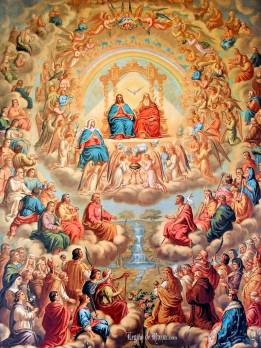 9 After this I looked, and behold, a great multitude that no one could number, from every nation, from all tribes and peoples and languages, standing before the throne and before the Lamb, clothed in white robes, with palm branches in their hands, 10 and crying out with a loud voice,
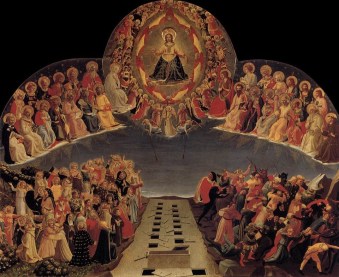 While death may come suddenly and abruptly here, those who die in the faith are not surprise arrivals in heaven. The company in heaven is not startled or shocked by those who show up at the doors of glory. The gates are open, and the believers who arrive there have been anticipated and are welcomed into the great multitude to be with the Lamb who shepherds them. Their arrival into glory is no shock to the residents of heaven. It is perfectly ordinary and on time.
 Because of this, we can have joy in the midst of sorrow. Here and now, as we are gathered together in God’s house and are invited to God’s table, we come to what is described in Hebrews 12(:22-24). This very morning in a small church on the north end of East Grand Forks, MN, we have come, “to Mount Zion and to the city of the living God, the heavenly Jerusalem, and to innumerable angels in festal gathering, and to the assembly of the firstborn who are enrolled in heaven, and to God, the judge of all, and to the spirits of the righteous made perfect, and to Jesus, the mediator of a new covenant.”

 I have to confess, as I was doing my devotions this week, even when I had this sermon running through my mind, I got uncomfortable with some of the punishments God commanded for certain sins. But God does not owe us an explanation for His anger and wrath.
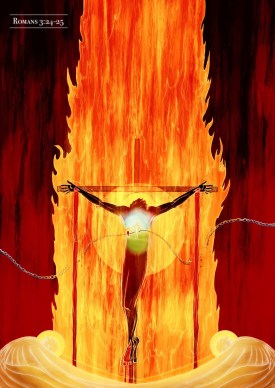 Remember, I told you that this sermon was going to be an explanation of that sentence in v. 25, “This was to show God’s righteousness, because in His divine forbearance He had passed over former sins.” What is it that showed God’s righteousness in giving us mercy? Nothing but Jesus Christ. Nothing but Jesus shedding His blood and dying on the cross. Nothing but Jesus being our propitiation – the atoning sacrifice, the mercy seat, the place where God forgives us and meets with us sinners.
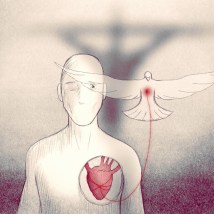 First, love is a beautiful summary of the Law, but that one word, love, does not replace the Law. Many people will say that since we have these two great commandments to love God and love our neighbor that we don’t need the rest of the Law. But that is false. Just because you think you are motivated by love does not mean that you are doing the right thing. We are so fallen that sometimes we try to pit love against the Commandments. Love is never an excuse to sin or an excuse to overlook sin. Instead, the Commandments define the shape of love, which is the second point about the Law.
 But, Christian, you know the answer. In fact, you have been taught this and have believed it for so long that you hardly think about it too much. But it is the most amazing thing. Jesus is man, born of His mother. And Jesus is God, begotten of His Father before all worlds. Jesus is man so that He can die, and He is God so that His death can be an atoning sacrifice for our sins.
 If Menards can have Christmas decorations out already and if the Hallmark Channel can do nonstop Christmas movies in July, then the Church can certainly have Easter in October. In fact, we have to celebrate Easter because this text screams Easter – loud and clear. But always before Easter, there is Good Friday. Before resurrection, there must be death. Good Friday sadness is a prerequisite to Easter joy. We have to see that first.
 Then, Jesus walks past the pallbearers, straight up to the bier, touches it, and says, “Young man, I say to you, arise,” as though He was waking up a sleepy teenager late on a Saturday morning. The boy gets up and begins to speak. I wonder what he said.
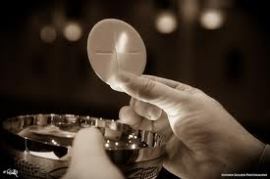 Jesus marches toward your funeral procession, and He does not stop or yield. Jesus does not give way or defer to death. Instead, Jesus defeats death with His death and resurrection, each and every time He meets it. Jesus meets you here today as you plod along in your personal funeral procession and gives you life. Jesus meets you at this altar to give you His living Body and His life-giving Blood.
 17 The seventy-two returned with joy, saying, “Lord, even the demons are subject to us in your name!” 18 And he said to them, “I saw Satan fall like lightning from heaven. 19 Behold, I have given you authority to tread on serpents and scorpions, and over all the power of the enemy, and nothing shall hurt you. 20 Nevertheless, do not rejoice in this, that the spirits are subject to you, but rejoice that your names are written in heaven.”
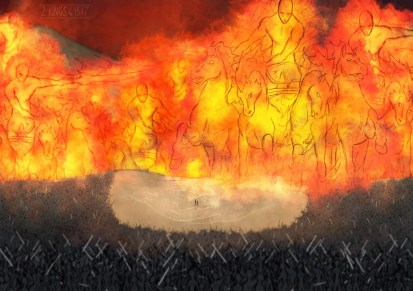 And the young servant sees a huge host of angels with horses and chariots of fire all around Elisha. The Syrian army rushes in toward them. Elisha simply prays that the entire army would be struck with blindness, and they are. Then Elisha leads this blinded army straight into the capitol of Israel where they are all captured. In this account, we see the unfolding of what is said in Ps. 34:7, “The angel of the Lord encamps around those who fear him, and delivers them.”
 Hebrews 12:22-24 says that in church we have “come to Mount Zion and to the city of the living God, the heavenly Jerusalem, and to innumerable angels in festal gathering…” Jesus says that the angels in heaven are joyful over one sinner who repents (Lk. 15:7, 10). As we confessed our sins earlier, a whole host of angels whom we cannot see or hear rejoiced as they heard Christ absolve and free us from our sins. In fact, Heb. 1:14 calls angles ‘liturgizing’ spirits (the ESV translates λειτουργικός as ‘ministering’). Using the liturgy is a way that we connect our worship with the worship of the angels in heaven, which is why we draw the words and order of our liturgy from the words of Scripture.
 down and out of heaven. How was Satan cast down? The text is clear. Satan was cast out by the blood of the Lamb.
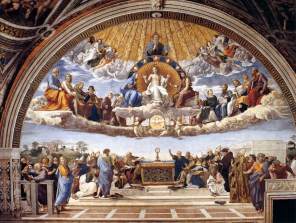 So today, dear saints, come to Jesus’ table and receive His body given for you. Receive His blood which was shed for you for the forgiveness of your sins knowing that neither death nor life, nor angels nor rulers, nor things present nor things to come, nor anything else in all creation, will be able to separate you from the love of God in Christ Jesus your Lord (Ro. 8:38-39).
 them, “Go and show yourselves to the priests.”And as they went they were cleansed. 15 Then one of them, when he saw that he was healed, turned back, praising God with a loud voice; 16 and he fell on his face at Jesus’ feet, giving him thanks. Now he was a Samaritan. 17 Then Jesus answered, “Were not ten cleansed? Where are the nine? 18 Was no one found to return and give praise to God except this foreigner?” 19 And he said to him, “Rise and go your way; your faith has made you well.”
 This Samaritan who returns to the true Temple and true High Priest. He returns to Jesus to give thanks. Did you catch what Jesus said there, “Was no one found to return and give praise to God except this foreigner?” In other words, the nine went onto the Temple and God’s house, but God wasn’t there. He was walking in the flesh between Samaria and Galilee where the Samaritan falls at His human feet giving Him thanks. Some people will read the Gospels and say that Jesus never claimed to be God. Well, sorry, they are wrong. He does right here.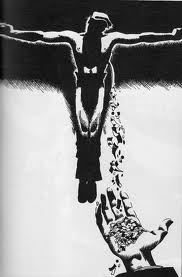

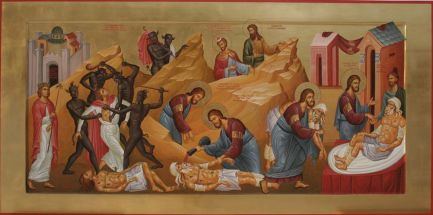 Because, first and foremost, the parable of the Good Samaritan is a picture of what Jesus has done for you. Jesus, and Jesus alone, is the Good Samaritan who has compassion. He left His throne in the glory of heaven to become your neighbor. He risks His own safety while scoundrels and robbers are roaming about. He stops to give you aid. He pours on you oil and wine. He gives up His own comfort and convenience to bring you to the inn of the holy Christian Church. And Jesus sets up an all-expenses-paid stay there promising to return. Jesus is the one who has and continues to show you mercy. Amen.
 32 And they brought to him a man who was deaf and had a speech impediment, and they begged him to lay his hand on him. 33 And taking him aside from the crowd privately, he put his fingers into his ears, and after spitting touched his tongue. 34 And looking up to heaven, he sighed and said to him, “Ephphatha,”that is, “Be opened.” 35 And his ears were opened, his tongue was released, and he spoke plainly. 36 And Jesus charged them to tell no one. But the more he charged them, the more zealously they proclaimed it. 37 And they were astonished beyond measure, saying, “He has done all things well. He even makes the deaf hear and the mute speak.”
 Groaning, however, is an involuntary response to being hurt or wounded. Every time the New Testament uses this word ‘groan’ it is from sorrow or suffering because of sin. And, in the New Testament, only four things groan – creation groans, believers groan, the Holy Spirit groans, and Jesus groans twice.
 And He no longer groans in pain when He does it. The price has been paid. Your forgiveness has been purchased and won on the cross.
 10 “Two men went up into the temple to pray, one a Pharisee and the other a tax collector. 11 The Pharisee, standing by himself, prayed thus: ‘God, I thank you that I am not like other men, extortioners, unjust, adulterers, or even like this tax collector. 12 I fast twice a week; I give tithes of all that I get.’ 13 But the tax collector, standing far off, would not even lift up his eyes to heaven, but beat his breast, saying, ‘God, be merciful to me, a sinner!’ 14 I tell you, this man went down to his house justified, rather than the other. For everyone who exalts himself will be humbled, but the one who humbles himself will be exalted.”
 The parable does teach that the worst of sinners can go to heaven. We know this, but unfortunately, we can grow a little numb to this. But the main reason Jesus tells this parable is to destroy any self-righteousness and contempt we would have against other sinners.
 Dear saint, you look there too. Look to the cross. Look to the blood of Jesus shed for you on Calvary. Look to His death. Look to His resurrection. Look to His ascension. And know that Jesus promises that all of that is for you.
 Pastorsamwise
You must be logged in to post a comment.