Acts 2:1-21
 1 When the day of Pentecost arrived, they were all together in one place. 2 And suddenly there came from heaven a sound like a mighty rushing wind, and it filled the entire house where they were sitting. 3 And divided tongues as of fire appeared to them and rested on each one of them. 4 And they were all filled with the Holy Spirit and began to speak in other tongues as the Spirit gave them utterance.
5 Now there were dwelling in Jerusalem Jews, devout men from every nation under heaven. 6 And at this sound the multitude came together, and they were bewildered, because each one was hearing them speak in his own language. 7 And they were amazed and astonished, saying, “Are not all these who are speaking Galileans? 8 And how is it that we hear, each of us in his own native language? 9 Parthians and Medes and Elamites and residents of Mesopotamia, Judea and Cappadocia, Pontus and Asia, 10 Phrygia and Pamphylia, Egypt and the parts of Libya belonging to Cyrene, and visitors from Rome, 11 both Jews and proselytes, Cretans and Arabians—we hear them telling in our own tongues the mighty works of God.” 12 And all were amazed and perplexed, saying to one another, “What does this mean?” 13 But others mocking said, “They are filled with new wine.”
14 But Peter, standing with the eleven, lifted up his voice and addressed them: “Men of Judea and all who dwell in Jerusalem, let this be known to you, and give ear to my words. 15 For these people are not drunk, as you suppose, since it is only the third hour of the day. 16 But this is what was uttered through the prophet Joel:
17 “‘And in the last days it shall be, God declares,
that I will pour out my Spirit on all flesh,
and your sons and your daughters shall prophesy,
and your young men shall see visions,
and your old men shall dream dreams;
18 even on my male servants and female servants
in those days I will pour out my Spirit, and they shall prophesy.
19 And I will show wonders in the heavens above
and signs on the earth below,
blood, and fire, and vapor of smoke;
20 the sun shall be turned to darkness
and the moon to blood,
before the day of the Lord comes, the great and magnificent day.
21 And it shall come to pass that everyone who calls upon
the name of the Lord shall be saved.’”
In the name of the Father and of the Son and of the Holy Spirit. Amen.
The crowd in Jerusalem on the day of Pentecost was there because it was Pentecost – a harvest festival. We have gotten so accustomed to connecting the celebration of Pentecost with the sending of the Holy Spirit that we forget that Pentecost was one of the three major festivals of the Jews. All the way back in Leviticus 23[:15-21], God had commanded that this feast be kept; though, in the Old Testament, it is normally called the “Feast of Weeks.” Pentecost was celebrated fifty days after the Passover, which was why it became known as ‘Pentecost.’ Pentecost was one of three festivals that required a pilgrimage to Jerusalem.
One of the other festivals that required a pilgrimage to Jerusalem was, of course, Passover. I mention Passover because most of the people in the crowd we just heard about there in Acts 2 would have been in Jerusalem fifty days earlier to celebrate the Passover when Jesus was tried, convicted, and crucified. They would have been the very crowds that cried out, “Crucify Him,” when Pilate asked what he should do with Jesus.
So, people from all over the world are in Jerusalem again. But this time, they are hearing in their own, native languages about the mighty works of God. They were amazed. Amazed at the sound of the mighty rushing wind and amazed at the mighty works of God being told in their own language, their own tongue. This is the amazed crowd to whom Peter preaches.
 We didn’t hear Peter’s whole sermon. It goes on for another fifteen verses, but I want you to hear the highlights of the whole thing. In the part of Peter’s sermon that we did hear, Peter tells the people that, if they had read their Bible, wouldn’t have been surprised at what they are hearing because it had been foretold in the prophet Joel. Then, Peter goes on to proclaim Jesus to the people.
Peter reminds the people how they had, with their own eyes, seen Jesus heal the sick, give sight to the blind, and do all sorts of miracles. But even though they had seen all of this, they delivered Jesus into the hands of lawless men in order to be crucified. But Peter adds that Jesus was crucified according to the definite plan and foreknowledge of God.
The sermon goes on to tell how though Jesus was crucified, He rose from the dead and is forever seated at God’s right hand. And Peter makes it clear that Jesus was and forever is the Lord and Christ whom they had crucified (Act. 2:36).
Upon hearing this, the people in the crowd are, according to Scripture, “cut to the heart” (Act. 2:37). But before I go to describe what happened that day, I want to make a quick mention of another time when a similar sermon was preached. A few years after our reading in Acts 2 today, Stephen preaches a very similar sermon to a similar crowd (Act. 7). But when Stephen’s sermon ends, the crowd is enraged. They grind their teeth, put their hands over their ears, rush Stephen out of the city, and throw rocks at him until he dies.
I mention that to highlight the greatest miracle on the day of Pentecost. The greatest miracle of Pentecost is what happens when Peter concludes his sermon by saying, “[K]now for certain that God has made him both Lord and Christ, this Jesus whom you crucified,” and the people do not kill Peter or run to their safe spaces. Instead, the Holy Spirit works on them. They are, again, “cut to the heart.” They are devastated and full of regret. In other words, they lament and despair because of their sin. They go from amazement to fear.
But in their fear because of their sin, they offer no excuses. They point no fingers. Their mouths are silent before the Law with the exception that they fearfully ask, “What shall we do?” (Act. 2:37). Of course, they know that there is nothing they can do. They can’t go back. They can’t make up for it. They can’t pay Jesus off. No excuses will help them. They know they can’t remove their guilt, but Peter points them to Jesus who can.
Peter says, “Repent and be baptized every one of you in the name of Jesus Christ for the forgiveness of your sins, and you will receive the gift of the Holy Spirit. For the promise is for you and for your children and for all who are far off, everyone whom the Lord our God calls to himself” (Act. 2:38).
That day, God added 3,000 souls to the Holy Christian Church. Their fear is swallowed up in faith. Faith in the Jesus whom Peter preached. Faith in the name of Jesus given to them in their Baptism. Faith in the Jesus who died for them, rose for them, and washed them.
And it is that promise of Scripture that I want you to consider today. Sometimes, we get too caught up in the amazement of the coming of the Holy Spirit. But the most amazing thing that happens when the Holy Spirit arrives is how people are moved by the Holy Spirit working through the Word of God to repentance and faith.
 So you, when the Law comes and points its finger at you and declares you to be a sinner, don’t make excuses. Don’t try to turn the accusations away. Don’t try to put your own spin on it and say that at least you aren’t as bad as so-and-so. Instead, repent. Repent because the Holy Spirit wants you to know that Jesus came to save you who are lost in sin. That means that Jesus has come to save you and me.
Secondly, know that this salvation isn’t only for you. It is for your children. The promises of Baptism are for the cute little sinners who are born into your family. Jesus calls them to Himself as well.
Finally, know also that this promise is for everyone you meet. Your family, your co-workers, your acquaintances, the people you pass by on the street – Jesus died for them as well. And your Savior desires that they hear the promises of life, mercy, forgiveness, and salvation as well. So, fill your speech with those promises.
One study showed that 86% of people who attend church regularly attend because someone invited them. That’s amazing. So, as your pastor, I ask you: When was the last time you invited someone to join you here at church? I am willing to bet that you would be fearful if I were to have everyone stand and say when the last time was.
Brothers and sisters, our world is dark, and people are hurting. Let us, all of us, be people of faith in our Lord while we invite others to the faith as well. Amen.
The peace of God, which surpasses all understanding, will guard your hearts and minds in Christ Jesus. Amen.
 God given you a new heart and a new spirit. God has put His Holy Spirit within you, and He has caused you to walk in His statutes and rules. Again, God promised to do this for the sake of His name, His reputation, and your benefit because you are His.
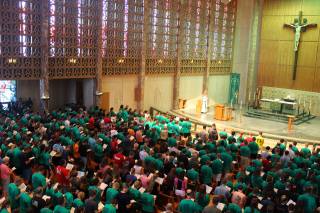 So, “Sing praises to the Lord, for He has done gloriously. Shout, and sing for joy, O inhabitant of Zion, for great in your midst is the Holy One of Israel.” The Scripture readings today have called you – in fact, they have commanded you – to sing to God five times (Ps. 98:1, 4, Is. 12:5, 6).
 Now, why does God command us to sing; isn’t speaking good enough? Apparently, no. There is a great passage in everyone’s favorite Old Testament book, Zephaniah 3:17. Listen to this, “The Lordyour God is in your midst, a mighty one who will save; he will rejoice over you with gladness; he will quiet you by his love; he will exult over you with loud singing.” It is an absolutely beautiful picture. But the reason I bring this up is that this is the one place in all the Scriptures where God sings, and the reason He sings is His joy over you.
 And Jehoshaphat appoints the front line to be – guess who – the Kohathites and the Korahites, the choir. The Lordwould fight for them, so why not have the singers be the first into battle? The army marches out behind the choir and listen to this, it’s from 2 Chron. 20:22, “And when they began to sing and praise, the Lordset an ambush against the men of Ammon [and] Moab… who had come against Judah, so that they were routed.” Through their singing, God defeated the enemies of His people.
 This ‘little while’ has lasted nearly two thousand years and counting. Yet, two thousand years is nothing when you compare it to everything that lies ahead for you in eternity. And it is even more miniscule when you realize that it will only be a few short years before you meet Jesus face-to-face – even if you live to be one-hundred-twenty. But we still have a problem. During our pain and anguish, our difficulties and seasons of tribulation, time seems to stand still while we suffer. But we can take heart and be encouraged. Jesus says it will only be ‘a little while.’
 Now, there is no denying that your suffering is real. Some of you are currently enduring that suffering in severe ways right now. We pray that your relief will be soon and swift. But know this: God is working through those sorrows. He is using your trials to keep you close to Himself, to work virtue in you, to teach you to trust in Him. This does not mean that you should rejoice because of trials and tribulations. Instead, it is a reminder that you can rejoice in spite of and in the midst of that suffering. Like buds on a tree indicate that full blossom is coming, those troubles, trials, sorrows, and crosses are harbingers of the joy that is to come.
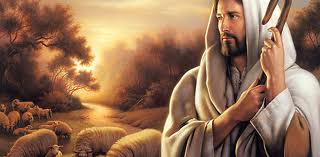 For our great comfort, Scripture gives many images of God shepherding His people. Psalm 23, of course, comes to mind. We have a picture in the entry of our church of Jesus walking through green pastures and still waters leading a flock of good-looking sheep. Jesus tells the parable of the shepherd who goes out seeking his one lost sheep, hefts it on his shoulders, and brings it home. All of that imagery is Scriptural and comforting and good.
 Yes, it does mean ‘good’ but not in a subjective sense, not in a way that is open to anyone’s interpretation. Jesus is uniquely qualified to be the Shepherd of sinful sheep. Christ is the ‘good for you’ Shepherd. Kalos also means ‘right, fitting, true, beautiful, and competent.’ And Jesus Himself defines exactly what makes Him the kalos Shepherd. His the kalos Shepherd because of the fact that He lays down His life for the sheep.
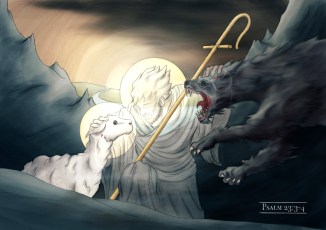 My dear fellow sheep: Jesus is the kalos Shepherd; you are the sheep. You are not called to stand toe-to-toe with the devil. Satan, sin, and death are the wolves, and you are the sheep. Hide behind Jesus. Christ, your kalos Shepherd, places Himself in danger to rescue you from every threat. But even as you hide behind your kalos Shepherd, you do not cower in fear. Hide behind Jesus confidently knowing that He has overcome the wolf, won the victory, and His victory is your victory because you are His.
 he showed them his hands and his side. Then the disciples were glad when they saw the Lord. 21 Jesus said to them again, “Peace be with you. As the Father has sent me, even so I am sending you.” 22 And when he had said this, he breathed on them and said to them, “Receive the Holy Spirit. 23 If you forgive the sins of any, they are forgiven them; if you withhold forgiveness from any, it is withheld.”
 Listen carefully: You don’t outgrow your need for the Gospel. Ever. There are many things that Scripture teaches that are important about how to live and function in this world, and all of us need to heed that instruction from the Word. But you don’t graduate from the pure spiritual milk of the Gospel. You never mature past the point of needing to hear about the peace that Jesus has won for you on the cross and which He preaches to His disciples in this text.
 Jesus is speaking about you. Christian, Jesus had you in mind when He spoke those words. You have not seen Your resurrected Savior in the flesh. You don’t see the marks in Jesus’ hands and side. Instead, you see crosses that remind you of the death that Christ died for you. You see the font where Jesus delivers to you His mercy and forgiveness and washes away your sins. You see an altar on which nothing has ever been sacrificed but which Jesus uses as His table to feed you His risen Body and Blood.
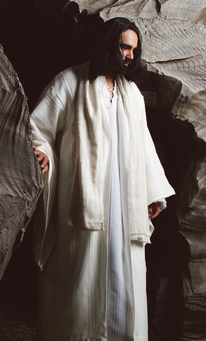 And you can smile in his face, “Yes, death, you used your sting, didn’t you? You should have used your sting on me. The sting would have stuck on me. But you didn’t. Instead, death, you used your sting on my Savior, my God, and my Lord. You used your sting on Jesus, didn’t you? You had Jesus pinned tightly on the cross, and you stuck Him with your stinger and buried it into Him. Death, you were a fool that day. You stung God Himself. You stung Jesus who is the Resurrection and the Life (Jn. 11:25). But when you went to the tomb to find your stinger and get it back, Jesus wasn’t there. And guess what, death, Christ has taken my sin as He hung on the cross. And, death, you will not ever get your sting back. Never. That empty tomb means that your sting is lost forever. Death, I don’t fear you any longer.”
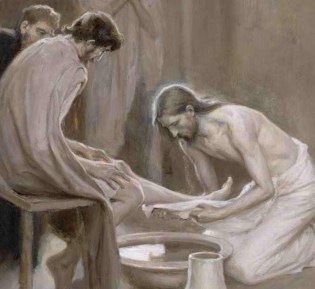 The Man whom Peter had confessed to be the Son of the living God (Mt. 16:16), the Man who had healed the sick, fed the masses, and raised the dead, the Head of all creation (Col. 1:15) kneels to wash Peter’s dirty, smelly feet.
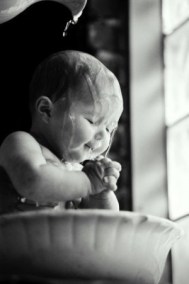 In your Baptism, Jesus has sprinkled clean water on you thus cleansing you from all your uncleannesses (Ezk. 36:25). In your Baptism, God has given you the new birth (Jn. 3:5), He has connected you to Jesus’ death and resurrection (Ro. 6:3-5), He has given you the washing of regeneration and the renewal of the Holy Spirit (Tit. 3:5).
 Pastorsamwise
You must be logged in to post a comment.