1 Corinthians 12:1-11
1 Now concerning spiritual gifts, brothers, I do not want you to be uninformed. 2 You know that when you were pagans you were led astray to mute idols, however you were led. 3 Therefore I want you to understand that no one speaking in the Spirit of God ever says “Jesus is accursed!” and no one can say “Jesus is Lord” except in the Holy Spirit.
4 Now there are varieties of gifts, but the same Spirit; 5 and there are varieties of service, but the same Lord; 6 and there are varieties of activities, but it is the same God who empowers them all in everyone. 7 To each is given the manifestation of the Spirit for the common good. 8 For to one is given through the Spirit the utterance of wisdom, and to another the utterance of knowledge according to the same Spirit, 9 to another faith by the same Spirit, to another gifts of healing by the one Spirit, 10 to another the working of miracles, to another prophecy, to another the ability to distinguish between spirits, to another various kinds of tongues, to another the interpretation of tongues. 11 All these are empowered by one and the same Spirit, who apportions to each one individually as he wills.
In the name of the Father and of the Son and of the Holy Spirit. Amen.
How many of you would say that we are a “charismatic” church? Some of you might be thinking, “No! And thank goodness. I don’t want to part of a church where people are rolling around on the floor and babbling in tongues.” But some of you might be thinking, “We should shake things up! We could use more manifestations of the Spirit in this stuffy place.” Maybe, some of you are somewhere in the middle. Well, wherever you fall in the charismatic opinion spectrum, this sermon is for you. Technically, of course, all the sermons I preach are for you which is why they are preached from this pulpit. (That isn’t a throw-away line. Remember that for later in the sermon).
 Three times the English word ‘gifts’ came up in this text, but in Greek, Paul uses two different words that get translated as ‘gifts.’ Twice the Greek word is χάρισμα (which is singular and the plural is χαρίσματα – I’m going to try to be grammatically correct through the sermon). Χάρισμα is where we get our word ‘charismatic.’ Inv. 4, “there are varieties of gifts/χαρίσματα,” and in v. 9, he mentions the “gifts/χαρίσματα of healing…” But in v. 1, Paul uses a different word that gets translated as ‘spiritual gifts’ or ‘spiritual things.’
The New Testament uses six different words or phrases to talk bout spiritual gifts. For the sake of time, I’m not going to give you all six, but χάρισμα is the most common and means ‘gift of grace.’ And if you look through all the texts about gifts, you see that the Holy Spirit doesn’t make Christians clones of each other but there is an enormous variety of ways the Holy Spirit’s work is manifested in people.
Now, Scripture has two different lists of the gifts/χαρίσματα (1 Cor. 12:7-11, 27-30 and Ro. 12:6-8). The two lists aren’t the same, but they include: prophets and prophecy; service (διακονία where we get our word ‘deacon’); teaching; encouragement; generous giving; leadership (yes, that’s a gift of the Holy Spirit); the gift of being merciful; a word of wisdom/guidance; a word of knowledge; faith, not what we would call ‘saving faith’ but an abundant trust and confidence in God’s provision; gifts of healing – which would include physical, mental, spiritual, and psychological healing; mighty works (probably referring to exorcisms); discernment of spirits; the gift of tongues and interpretation of tongues; being an apostle is a χαρίσμα; so are helpful acts; even chastity (within marriage and outside of marriage) is a χαρίσμα. All these are the gifts/χαρίσματα that Scripture talks about. Notice that most of these aren’t the wowie-zowie things that you think about as being charismatic gifts, but this is the list that Scripture gives.
For a long time in our country, Christians have been talking about spiritual gifts. You can take inventories to try to discover what your spiritual gift is so that you use it in service to the Lord. Some people get all tied up in knots trying to figure out what their gift is so they can figure out where they should be and what they should be doing to serve the Lord. But Scripture actually teaches that wherever you are as a Christian, you are serving God. Instead of seeking to try to find out what our spiritual gift is, we should be asking ourselves, “Where has God put me?” and, “Who is the neighbor that God has given me to serve?” Or to combine the two and make it a shorter question, “What is my vocation?”
I know I’ve used the term ‘vocation’ quite a bit in the past, but it is good to be clear. When we talk about ‘vocation’ in the Scriptural sense, it means your office or your relationship to the person or people God has placed in your life at any given moment. Every moment of every day God puts you into a relationship with another person where you have different responsibilities. That is your vocation.
As a silly example, if you are in a moving car, you have one of two possible vocations. Either your vocation is to be a driver and your responsibilities are to drive safely, follow the traffic laws, don’t cause danger to others, and get to your destination safely. Or, if you aren’t the driver, your vocation is to be a passenger and your responsibilities are to not put your hands over the driver’s eyes or make the driver’s vocation more difficult than it needs to be.
Here is the good news, God gives you gifts to fulfill your vocation in every moment of every day. So, rather than filling out inventories and reading books to try to discover your spiritual gift, or your χάρισμα, simply ask yourself, “What is my vocation?” and Scripture promises that everything will fall into place.
Thinking back on that list of χαρίσματα, Scripture teaches that there is a great diversity of gifts that are given by the Holy Spirit. The Holy Spirit gives these gifts equally, but, again, He doesn’t clone people. Instead, He individualizes believers and brings out their distinctive character. Each believer represents and reflects a different aspect of the image of God which is why there is a diversity of gifts.
 According to our text (v. 4-7), these various gifts are given through the Holy Spirit, but the Holy Spirit doesn’t ever work alone; instead, the entire Trinity is involved. These various gifts are given by the Spirit; the varieties of service are given by the same Lord, Jesus Christ, the Son; and the varieties of activities are empowered by the same God (think Father) who empowers them all in everyone. We don’t determine what gift we receive, it’s up to our Triune God. And God will provide whatever we need to fulfill our Christian duty to our neighbor.
Paul will go on after our text to say that each member of the entire church and each congregation is part of the body of Christ. And each member is dependent upon the other members. Eyes need ears and toes and noses and hearts and livers and bladders. No part of the body can say that they don’t need the other parts. All the parts work together to do one common thing, and the most important thing is that the forgiveness of sins through Jesus’ death and resurrection, the Gospel, is proclaimed.
Back to that line that wasn’t a “throw away”: I have been called by God to be your pastor and to preach this sermon today. And God has called you here today to hear this sermon, use your Holy Spirit-given gift to listen because Jesus says, “Blessed are those who hear the Word of God and keep it” (Lk. 11:28, Rev. 1:3).
So, you might be wondering, “What are my gifts? What are my χαρίσματα?” Well, rather than focusing on what gifts we have, we should be focusing on the people that God has placed in our lives to serve. Doing this helps to shape our prayers so that we ask God for the gifts we need in any particular moment. It also helps to protect us from getting puffed up and arrogant so that we decrease and Christ increases (Jn. 3:30). First, get your priorities right.  Do you believe in Christ’s death and resurrection for the forgiveness of your sins? Do you trust that His blood has covered all your iniquities and transgressions? If so, praise God! Then ask, “What is my vocation/station in life? What am I called to do right now?” “What do I need now as a mother?” “What do I need now as a husband?” “As a child?” “A student?” “A customer?” “A citizen?” God has called you to those vocations and He won’t leave you in a lurch. He will give you the gifts you need. In every moment of every day, you have a particular relationship to someone else, so you are called to be God’s representative in that moment. So, ask God to give you what you need to fulfill that vocation.
God doesn’t equip us with gifts/χαρίσματα in advance, but He gives us what we need when we need it to minister to others as we serve in our vocations.
When you need to do something, you can confidently expect to receive exactly what you need to serve in the way that God has called you. Wherever God calls you He will give you whatever you need to minister to that person in that situation (Mt. 10:19-20).
Now, there is a lot here, and I need to wrap things up. So, two concluding thoughts. You, Christian, have been given unique gifts by the Holy Spirit to serve those whom God has put in your life through your various vocations. The Holy Spirit has uniquely equipped you to serve in every vocation where He has placed you. So, what are you waiting for? Don’t wait to figure out how God has gifted you because He has already called and equipped you to serve your neighbor in your vocation. Which brings me to the second conclusion.
In the opening verse of our text, Paul says that he does not want us to be ignorant about spiritual gifts. Our translation says ‘uninformed’ but the word there isn’t about a lack of information rather a lack of knowledge, so ‘ignorant’ is probably better. So, understand this, and don’t be ignorant. Paul speaks about many different gifts/χαρίσματα in our text. But Paul will go on to boil everything down to the three greatest gifts by the end of ch. 13 – faith, hope, and love. These three gifts are the most important χαρίσματα given by the Holy Spirit. The Holy Spirit has given you faith. No one can say, “Jesus is Lord,” except by the Holy Spirit. And because of that God-given faith, you have the gift/χάρισμα of hope.
Dear saints, the Holy Spirit has called you by the Gospel, enlightened you with His gifts, and will continue sanctify and preserve you in the true faith. But also remember that the greatest χάρισμα that you are given is love. Any use of your gifts without the gift, without the χάρισμα, of love is detrimental to the body of Christ. So, may you be faithful, may you be hopeful, and may you be loving as you use the other gifts He gives you as well.In Jesus’ name. Amen.[1]
The peace of God, which surpasses all understanding, will guard your hearts and minds in Christ Jesus. Amen.
[1]I am thankful for a lecture by Rev. Dr. John Kleinig titled “Heavenly Power for Earthly Service” for much of the information in this sermon.
 This reduction was, of course, not legally binding. The rich man could have simply said, “Hang on everyone. I fired that guy before he lowered your debt. You still owe the original amount.” But that isn’t the character of the rich man. Instead, the whole town is singing the praises of the rich man because he is so generous. And the rich man isn’t willing to harm his reputation as a merciful guy. So, what does the rich man do in the parable? He tells the fired, scoundrel of a manager, “Dude, you’re shrewd. You knew I’d rather be known as a merciful person rather than hold on to my wealth. And by your shrewdness, you’ve helped yourself.”
 Now, Jesus is absolutely clear, “You cannot serve God and money.”It can’t be done. If you trust in money, you do not trust God. So, repent of your love of money.
 The only thing that matters for your salvation is what Christ has done and completed for you upon the cross. Even when you are stingy and fail to be generous with what God has given to you, God was not. He gave what was most valuable to Him for your salvation. God, in His mercy, gave Jesus to die upon the cross for you. Don’t trust in your stewardship of what God has given you. Instead, trust in Christ’s giving of Himself completely for you and for others. Amen.
 Out of that conversation came creation, and most importantly, out of that conversation came the creation of humanity. We get to hear that conversation in Gen. 1:26 where the Triune God says, “Let Us make man in Our image, after Our likeness.” It was so, and it was good – very good.
 One of the most amazing things is that God even gives His prophets a seat and a voice in this council. You remember when God was going to destroy Sodom and Gomorrah, and Abraham speaks up and gets God to agree to not destroy the cities if ten righteous people are found there (Gen. 18:22-33). Or, when God is going to destroy the Israelites for making the golden calf, Moses speaks up in the council and says, “God, if You go down and destroy them, the Egyptians will say that You only brought them out of slavery to destroy them.” And God relents of the disaster He had said He would bring on the people (Gen. 32:1-14).
 Now, Jesus has ascended to the right hand of the Father. Today, your Savior is talking with the Father, your Creator, and with the Holy Spirit, your Sanctifier. And do you know what they are talking about? They are talking about you and the cross. They are talking about how Jesus won your salvation there. How His blood shed there made a place in heaven for you forever. And the Holy Spirit is there, translating your prayers and interceding for you with groanings too deep for words (Ro. 8:26). The Holy Spirit whispers into your ear that you are an adopted child of God and heir with Christ. And you respond by crying, “Abba, Father” (Ro. 8:12-17).
 Our English word ‘desolation’ contains the word ‘solo,’ and that gives a sense of what ‘desolation’ means. Adam and Eve went solo. Rather than trusting God, they went solo and trusted the devil’s lie bringing sin, death, condemnation, and desolation into the world.
 Look at what Jesus, God in the flesh does – notice the verbs. He calls the disciples. Jesus directs the crowd to sit down. He takes the bread. Christ gives thanks for the bread. He breaks the bread. He gives the bread to the disciples to set before the people. Jesus blesses the fish. He gives the fish to the disciples to set before the people. And Jesus watches them all eat until every last one of them is satisfied. Jesus continues to do this for us today.
 19 Therefore whoever relaxes one of the least of these commandments and teaches others to do the same will be called least in the kingdom of heaven, but whoever does them and teaches them will be called great in the kingdom of heaven. 20 For I tell you, unless your righteousness exceeds that of the scribes and Pharisees, you will never enter the kingdom of heaven.
 Sure, you aren’t Lady Macbeth yelling at the blood of Duncan to wash off your hands, but you are guilty of murder before God. You have been angry with others. You have called others, “Fool.” You have held grudges. You have refused to ask your neighbor for forgiveness. And Jesus goes on to the other Commandments as well – lust is adultery and fornication, gossip is perjury, etc.
 The Law should never be allowed to access into your ‘How do I stand before God?’ room, your ‘Am I good enough to go to heaven?’ room, your ‘Does God love me?’ room, your ‘Does God think I am a good person?’ room, or your ‘assurance of salvation’ room. The Law should never be allowed to enter those rooms because Jesus has made you as good and as righteous and as perfect as He is.
 And behold, there came a voice to him and said, “What are you doing here, Elijah?” 14 He said, “I have been very jealous for the Lord, the God of hosts. For the people of Israel have forsaken your covenant, thrown down your altars, and killed your prophets with the sword, and I, even I only, am left, and they seek my life, to take it away.” 15 And the Lord said to him, “Go, return on your way to the wilderness of Damascus. And when you arrive, you shall anoint Hazael to be king over Syria. 16 And Jehu the son of Nimshi you shall anoint to be king over Israel, and Elisha the son of Shaphat of Abel-meholah you shall anoint to be prophet in your place. 17 And the one who escapes from the sword of Hazael shall Jehu put to death, and the one who escapes from the sword of Jehu shall Elisha put to death. 18 Yet I will leave seven thousand in Israel, all the knees that have not bowed to Baal, and every mouth that has not kissed him.”
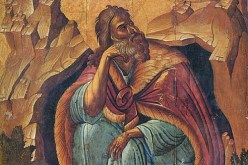 Listen again to Elijah’s response, “Listen God, I’ve been very jealous for You. I’ve done what You have commanded. But Your people have forsaken Your covenant. They have thrown down Your altars. And they have killed Your prophets with the sword. I’m the only faithful one left, and they are out to kill me as well.” Elijah’s response makes it sound like God had lost and that Baal had won. His answer makes it seem like no rain had fallen, and as though God had failed.
 God will continue to defeat His enemies by raising up faithful believers from the offspring of His enemies. Scripture doesn’t promise that the Jezebels of our day will fall before our eyes. In fact, it is very likely that the voices of Jezebel will continue to grow stronger in our culture and society.
 To get an understanding of this, we are going to start by considering what happened in our Old Testament text (Gen 50:15-21) where we heard about what happened between Joseph and his brothers after their father has died. Joseph’s brothers were afraid that Joseph would punish them because of all the wrong things they had done.
 But, Christian, this passage of Scripture is telling you that there is something even better in store for you than the end of your suffering – whatever has caused it. Paul writes in 1 Cor. 15:19, “If in Christ we have hope in this life only, we are of all people most to be pitied.” Dear saint, when you suffer, you do not simply look to the end of your pain. Instead, you are to look to the glory that is to be revealed to you. And, in fact, all of creation is groaning for this as well.
 Dear saints, the same is true of you. In Christ, God has done all the work required to give you your glory. And the day is coming when you will hear your heavenly Father’s voice, praising you for the work He has done in you (Mt. 25:21).
 In each of these parables, what is lost – the sheep, the coin, and even the son – is not valuable. That is the point of the parables. This is most apparent in the parable of the lost coin. The party the woman throws costs more than the coin that she recovered. That one sheep was worth less than the cost of the party that the shepherd threw. Even that one son was not worth the cost of the party. And don’t pish-posh that statement.
 Because of our sin, we are broken. No one wants to admit it, but we are happy when our neighbor suffers and we are sad when he rejoices. The Germans created a word for this by combining their words for ‘harm’ and ‘joy’ into one word, Schadenfreude. The worst part is we justify our Schadenfreude. We enjoy others’ pain because we figure they deserved it. We want others to get what we think is justice. But this is the opposite of compassion and is from the devil.
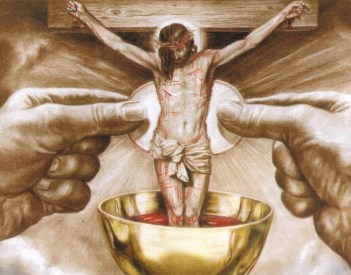 he restored and received his son back into the family. Sinner, your heavenly Father has fattened up Jesus, His faithful Son, to serve as food for you who are unworthy.
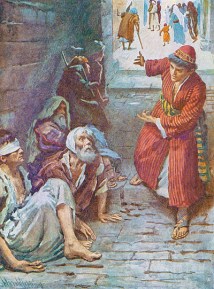 Then the master of the house became angry and said to his servant, ‘Go out quickly to the streets and lanes of the city, and bring in the poor and crippled and blind and lame.’ 22 And the servant said, ‘Sir, what you commanded has been done, and still there is room.’ 23 And the master said to the servant, ‘Go out to the highways and hedges and compel people to come in, that my house may be filled. 24 For I tell you, none of those men who were invited shall taste my banquet.’”
 So, the man has sent out this invitation without saying exactly when the banquet would begin. Then in v. 17, the preparations are finished – the food is cooked, the table is set, the decorations are hung, the wine is poured, everything is ready. The man sends his servant to tell all those who were invited, “Come, for everything is now ready.” But they all make excuses, and their excuses are lame and stupid.
 22 The poor man died and was carried by the angels to Abraham’s side. The rich man also died and was buried, 23 and in Hades, being in torment, he lifted up his eyes and saw Abraham far off and Lazarus at his side. 24 And he called out, ‘Father Abraham, have mercy on me, and send Lazarus to dip the end of his finger in water and cool my tongue, for I am in anguish in this flame.’ 25 But Abraham said, ‘Child, remember that you in your lifetime received your good things, and Lazarus in like manner bad things; but now he is comforted here, and you are in anguish. 26 And besides all this, between us and you a great chasm has been fixed, in order that those who would pass from here to you may not be able, and none may cross from there to us.’ 27 And he said, ‘Then I beg you, father, to send him to my father’s house— 28 for I have five brothers—so that he may warn them, lest they also come into this place of torment.’ 29 But Abraham said, ‘They have Moses and the Prophets; let them hear them.’ 30 And he said, ‘No, father Abraham, but if someone goes to them from the dead, they will repent.’ 31 He said to him, ‘If they do not hear Moses and the Prophets, neither will they be convinced if someone should rise from the dead.’”
 Even though the parable doesn’t explicitly say it, we know the rich man does not love God. As our Epistle text (1 Jn. 4:16-21) says, “he who does not love his brother whom he has seen cannot love God whom he has not seen…. Whoever loves God must also love his brother” (1 Jn. 20-21). The rich man’s lack of love for Lazarus makes his lack of love for God as plain as the nose on your face.
 So, when your conscience is pricked and you feel guilt for your lack of love, first repent. Repent of your lack of love. Then, make a list of the people God has placed in your life to help, to care for, and to love starting with the people closest to you.
 And never forget, Christian, that you have been given a name. Through the waters of your Baptism, God gave you your name. He has adopted you into His family. You are His child and part of the household of Jesus. The love you fail to show to those God has placed in your life is forgiven and covered by the blood of Jesus, your Savior. And God does not forget to pour out His love, mercy, forgiveness, and provision for you.
 Pastorsamwise
You must be logged in to post a comment.