Matthew 25:14-30
14 “For it will be like a man going on a journey, who called his servants and entrusted to them his property. 15 To one he gave five talents, to another two, to another one, to each according to his ability. Then he went away. 16 He who had received the five talents went at once and traded with them, and he made five talents more. 17 So also he who had the two talents made two talents more. 18 But he who had received the one talent went and dug in the ground and hid his master’s money.  19 Now after a long time the master of those servants came and settled accounts with them. 20 And he who had received the five talents came forward, bringing five talents more, saying, ‘Master, you delivered to me five talents; here, I have made five talents more.’ 21 His master said to him, ‘Well done, good and faithful servant. You have been faithful over a little; I will set you over much. Enter into the joy of your master.’ 22 And he also who had the two talents came forward, saying, ‘Master, you delivered to me two talents; here, I have made two talents more.’ 23 His master said to him, ‘Well done, good and faithful servant. You have been faithful over a little; I will set you over much. Enter into the joy of your master.’ 24 He also who had received the one talent came forward, saying, ‘Master, I knew you to be a hard man, reaping where you did not sow, and gathering where you scattered no seed, 25 so I was afraid, and I went and hid your talent in the ground. Here, you have what is yours.’ 26 But his master answered him, ‘You wicked and slothful servant! You knew that I reap where I have not sown and gather where I scattered no seed? 27 Then you ought to have invested my money with the bankers, and at my coming I should have received what was my own with interest. 28 So take the talent from him and give it to him who has the ten talents. 29 For to everyone who has will more be given, and he will have an abundance. But from the one who has not, even what he has will be taken away. 30 And cast the worthless servant into the outer darkness. In that place there will be weeping and gnashing of teeth.’”
Grace, mercy, and peace be to you from God our Father and from our Lord and Savior, Jesus Christ. Amen.
Please, let it be clear, the talents in this parable are not skills like singing, dancing, juggling, playing the harmonica, and pulling a rabbit out of a hat. A talent is a sum of money, in fact, a large sum of money. One talent is equivalent to twenty years’ wages. The master freely gives it away. No conditions. No instructions. No expectations. To one five talents, to another two, and to another one – each according to his ability. One-hundred-sixty years’ wages. Maybe, he needed to lighten his fat wallet before he goes away.
Two of those servants do very well with the money and double it. The third is a total flop. He digs a hole in the ground. Like a broody hen warming an unfertilized egg, he sits on his master’s money in a way that nothing will be lost, but certainly nothing will be gained. What was his problem? The third servant was terrified of his master because he believes wrong things about his master. And in his fear, he does nothing.
This third servant didn’t know his master well at all. His own words condemn him, “I knew you to be a hard man, reaping where you did not sow, and gathering where you scattered no seed. So, I was afraid. And I went and hid the money in the ground.”
Imagine the master. He has given away – with no strings attached – 160 years’ wages, and is called a hard, demanding, cruel, even violent man. Well, there is nothing to do except treat that wicked servant exactly how he believes. The master condemns the servant and casts him into the outer darkness where there is nothing but weeping and gnashing of teeth.
But this is not how the master really is. The master is actually merciful, gracious, and giving. The first servant who was given five talents gets to keep those five. And more than that, he gets to keep the extra five he profited, and he gets the eleventh talent as well. Since when do servants get to keep the principle, the interest, and on top of that get bonuses?
 Here is the point of the parable. However you believe God to be is how He is to you. If you believe God to be a deity who demands that you work and slave to get back into His good graces, that is how He will be to you. But if you believe God to be merciful, forgiving, gracious, patient, loving, and kind, that is how He will be to you. So, how is your God? How is your Master?
Jesus is the Master in this parable, and He gives His Kingdom away. He empties the treasuries of His palace and gives it to His servants. Your God is not a hard man who reaps where He does not sow. He sows for others. He sows for you to reap. And to you, who have been given much in the waters of Holy Baptism and made His heirs, He gives even more. Your faith is multiplied like money well-invested.
The God who has bestowed gifts to you is coming back. He has given you life, house, family. He has blessed you with everything you need for this life. He has given you His Word. But, most importantly, He has given you Jesus, His Son, who has poured out His precious, holy, innocent blood to remove your sin from you as far as the east is from the west. Because of the abundance He has given to you, you don’t need to be afraid of losing it. So, use what He has given!
One of Aesop’s fables goes like this: A mouse lived near a magician’s house, but the mouse was terrified of cats. In pity for the mouse, the magician turned the mouse into a cat. But then the mouse, who was now a cat, feared the dog. So, the magician turned it into a dog. But then that dog feared the tiger. So, the magician said, “Be a mouse again. Since you only have the heart of a mouse, it is impossible to help you by giving you the form of a noble animal.”
God has made you who you are. And, yes, maybe God hasn’t physically given you as much as He has given others. But use what God has given you for the furthering of His kingdom. He has given you the precious blood of Christ poured out for you on the cross. He has given you His name to call upon Him in prayer. He has given you brothers and sisters in Christ who need to be strengthened and encouraged by your words and by your example.
 Jesus is your gracious master who takes of His own property, that which is His, that which He earned, and gives it to you. And then, in the end, allows you to keep it not only as stewards, but as a dear beloved child.
So, use what God has given you, and on the last day, you also will hear your Savior say to you, “Well done, good and faithful servant. You have been faithful over a little; I will set you over much. Enter into the joy of your master.” Amen.
The peace of God which surpasses all understanding will guard your hearts and minds in Christ Jesus. Amen.
 7 Then all those virgins rose and trimmed their lamps. 8 And the foolish said to the wise, ‘Give us some of your oil, for our lamps are going out.’ 9 But the wise answered, saying, ‘Since there will not be enough for us and for you, go rather to the dealers and buy for yourselves.’ 10 And while they were going to buy, the bridegroom came, and those who were ready went in with him to the marriage feast, and the door was shut. 11 Afterward the other virgins came also, saying, ‘Lord, lord, open to us.’ 12 But he answered, ‘Truly, I say to you, I do not know you.’ 13 Watch therefore, for you know neither the day nor the hour.”
 Notice, all ten virgins – both the wise and the foolish – they all fall asleep. But also notice, that when the Bridegroom comes, He washes away the sins of those five wise virgins who fell asleep. He doesn’t hold their slumber against them. The Bridegroom is the one who died for their sins, so their sins aren’t going to stop Him from welcoming them to the wedding feast (Rev. David H. Pedersen).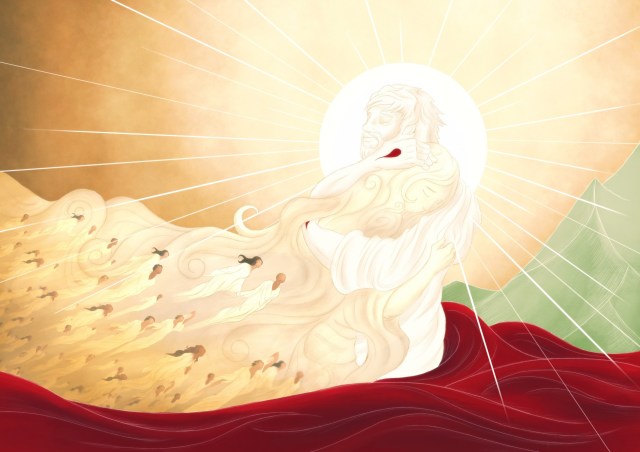
 but we know that when he appears we shall be like him, because we shall see him as he is. 3 And everyone who thus hopes in him purifies himself as he is pure.
 In all likelihood, John wrote this epistle before he wrote the book of Revelation. In that first reading today (Rev. 7:9-17), John got a glimpse of what we will be. John saw an innumerable multitude, “from every nation, from all tribes and peoples and languages.” That means John saw you who speak a language that didn’t even exist in his day. John saw you “standing before the throne and before the Lamb, clothed in white robes, with palm branches in [your] hands, and crying out with a loud voice, ‘Salvation belongs to our God who sits on the throne, and to the Lamb!’”
 34 Jesus answered them, “Truly, truly, I say to you, everyone who practices sin is a slave to sin. 35 The slave does not remain in the house forever; the son remains forever. 36 So if the Son sets you free, you will be free indeed.”
 Though you are a slave to sin, Jesus has come. He has done what the Law could not do. He has justified you by His grace as a gift. Christ has shed His holy and precious blood as a propitiation. And through God-given faith, you are made alive. You are declared righteous. You are forgiven. You are set free, and if the Son sets you free, you will be free indeed.
 Is it lawful to pay taxes to Caesar, or not?” 18 But Jesus, aware of their malice, said, “Why put me to the test, you hypocrites? 19 Show me the coin for the tax.” And they brought him a denarius. 20 And Jesus said to them, “Whose likeness and inscription is this?” 21 They said, “Caesar’s.” Then he said to them, “Therefore render to Caesar the things that are Caesar’s, and to God the things that are God’s.” 22 When they heard it, they marveled. And they left him and went away.
 Because of the government we have a police force, firefighters, and army to protect us. All of those things that we benefit from in this country are done by government and paid for by taxes. So, pay your taxes (Ro. 13:7).
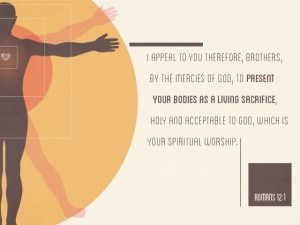 This means that your whole life is given to God. There isn’t one part of your life that is holy and another part that is neutral. Raising children, raking leaves, pumping gas, thanking the soldier for his service, and throwing frozen fish sticks or corn dogs into the oven – it is all service to God. Now, do we do all these things cheerfully? I don’t, and it is a safe bet to say that you don’t either. But we should still do them.
 And your sinful heart? Well, that was Jesus’ job. He came and took all your sin. He suffered God’s wrath and died for it. Jesus rendered to God the things that are God’s. He gave Himself up as a ransom for us all. He has given Himself as a ransom for you. Amen.
 Jesus tells us this parable about the kingdom of heaven. The parable is about how God has arranged for us to be together, but it is a bumpy ride. Ready?
 Back to the parable. The king’s wrath and anger is spent. The city is torched. But rather than singing a duet with Leslie Gore, “It’s my party and I’ll cry if I want to,” the king still wants to feast. This is, after all, his son’s wedding. The king tells his servants, “We are having this party. Those who didn’t want to be here are going to miss out. Go to the highways and invite anyone you find.” So, they do. The banquet hall is filled with all sorts of people – good and bad.
 My fellow failures, don’t treat the God’s grace as cheap. Don’t test His patience. Repent. The feast is open to the unworthy and even the bad but not for the unrepentant.
 “Just who do you think you are? What gives you the right? Who gave you the authority to do these things?” The chief priests and elders want to know because Jesus has been throwing their world into chaos.
 But when you ask the wrong question, you will get the wrong answer. And when you ask Jesus the wrong question, you’re likely to have a question asked of you. And that is exactly what happens. “I’ll tell you by what authority only after you answer Me this, wise guys: John’s baptism, where did it come from? I’ll even make it multiple choice – from God or from man?”
 Repentance is the first part of faith. Believe your sins are what they are. And believe Jesus when He says about your sins that they are forgiven. Believe what Jesus says as He invites you to His table now and says, “This is My Body. This is My Blood shed for you for the forgiveness of your sins.”
 11 And on receiving it they grumbled at the master of the house, 12 saying, ‘These last worked only one hour, and you have made them equal to us who have borne the burden of the day and the scorching heat.’ 13 But he replied to one of them, ‘Friend, I am doing you no wrong. Did you not agree with me for a denarius? 14 Take what belongs to you and go. I choose to give to this last worker as I give to you. 15 Am I not allowed to do what I choose with what belongs to me? Or do you begrudge my generosity?’ 16 So the last will be first, and the first last.”
 Christian, you and I fall into the same trap as those hired at the beginning of the day. We think we have earned or deserved more than what God has given us. When we start to focus on what we do not have, we forget that everything we have is a benevolent gift from God.
 Our parable today depicts grace as undeserved wages. Workers get paid for work that they did not do. And, believer, so do you. You have not done the work of keeping God’s Law. What God has demanded of you, you have not done, but you get treated as though you have. Jesus has borne the heat of the day, and you get His wages. We are those who are hired at the eleventh hour. God be praised, and may we never forget that.
 26 So the servant fell on his knees, imploring him, ‘Have patience with me, and I will pay you everything.’ 27 And out of pity for him, the master of that servant released him and forgave him the debt. 28 But when that same servant went out, he found one of his fellow servants who owed him a hundred denarii, and seizing him, he began to choke him, saying, ‘Pay what you owe.’ 29 So his fellow servant fell down and pleaded with him, ‘Have patience with me, and I will pay you.’ 30 He refused and went and put him in prison until he should pay the debt. 31 When his fellow servants saw what had taken place, they were greatly distressed, and they went and reported to their master all that had taken place. 32 Then his master summoned him and said to him, ‘You wicked servant! I forgave you all that debt because you pleaded with me. 33 Wasn’t it necessary that you should have mercy on your fellow servant, as I had mercy on you?’ 34 And in anger his master delivered him to the jailers, until he should pay all his debt. 35 So also my heavenly Father will do to every one of you, if you do not forgive your brother from your heart.”
 The servant, let’s call him Vinnie, leaves. And, instead of being filled with gratitude and joy, he sees Chuck, his buddy, who owed him 100 denarii. A denarius was a day’s wage, so we’re talking about 3 months’ wages (say between $10 – $15 thousand). With his hands around Chuck’s throat, Vinnie demands that Chuck pay up. Chuck asks for patience, just like Vinnie had. And even though Vinnie had just received mercy for this impossible debt, Vinnie doesn’t give Chuck the very thing he requested from the king. Not even patience.
 In the kingdom of God, you are beggars. You were guilty and could not dig your way out no matter how much time you were given. Even more, you were dead, and how do dead people pay bills? You and I, we need mercy. And in Christ, mercy is exactly what we have. Because of Christ’s payment on the cross, we have been declared innocent, alive, beloved.
 6 “But whoever causes one of these little ones who believe in me to sin, it would be better for him to have a great millstone fastened around his neck and to be drowned in the depth of the sea. 7 Woe to the world for temptations to sin! For it is necessary that temptations come, but woe to the one by whom the temptation comes! 8 And if your hand or your foot causes you to sin, cut it off and throw it away. It is better for you to enter life crippled or lame than with two hands or two feet to be thrown into the eternal fire. 9 And if your eye causes you to sin, tear it out and throw it away. It is better for you to enter life with one eye than with two eyes to be thrown into the hell of fire.
 Again, Jesus says, “Unless you turn and become like children, don’t worry about being great, you won’t even enter the kingdom of heaven.” Little children don’t point to their resume and expect a promotion. Little children don’t hand God a bill, “See all my good works, I believe You owe me.” The things you would point at to prove that you are a good, great Christian are the very things that will condemn you to hell. Repent.

You must be logged in to post a comment.