Mark 7:31–37
31 Then he returned from the region of Tyre and went through Sidon to the Sea of Galilee, in the region of the Decapolis. 32 And they brought to him a man who was deaf and had a speech impediment, and they begged him to lay his hand on him.  33 And taking him aside from the crowd privately, he put his fingers into his ears, and after spitting touched his tongue. 34 And looking up to heaven, he sighed and said to him, “Ephphatha,” that is, “Be opened.” 35 And his ears were opened, his tongue was released, and he spoke plainly. 36 And Jesus charged them to tell no one. But the more he charged them, the more zealously they proclaimed it. 37 And they were astonished beyond measure, saying, “He has done all things well. He even makes the deaf hear and the mute speak.”
In the name of Jesus. Amen.
“Christ has died on the cross for you, and your sins are forgiven.” That is the Gospel message. That is the Good News that Jesus has given His Church to proclaim to the ends of the earth (Lk. 24:26-27). God’s grace and mercy extends to the whole world, and it extends to you. Because Jesus died and rose again, God finds no fault, no spot, no wrinkle, no blemish in you. Because of Jesus, when God looks at you, He sees the perfect, total, complete obedience of Jesus. Who wouldn’t want to hear that message? The unrepentant, the sinner, the very one who needs grace and mercy, sadly, doesn’t want to hear about God’s love.
Why is this? Because our sin has infected us so thoroughly, because we are by nature sinful, we do not want mercy because we do not want to need mercy. We would rather try to work our own way to righteousness than to receive the free gift of Christ’s righteousness.
To give you an example: I’ve been following Planned Parenthood on Twitter since the undercover videos started surfacing. They tweeted a story entitled, “Thank God for My Abortion.” In the article, the author speaks of the kindness of people who helped her abort her unborn child. Her story was full of self-justifying phrases. She was young. She was stupid. Since she couldn’t even take care of herself, she knew she couldn’t take care of a baby. She concludes the article in what sounds like a final attempt at justifying herself, she says, “I suspect this was the one rational decision I made the whole of that year. In short: thank god (note lower case) I had an abortion.” She encourages other women to share their abortion stories and “own” their abortion.
So, I tweeted her back. “Own your abortion, and repent. There is forgiveness in Christ, even for abortion.” She responded, “Um, news flash; I’m not a fundamentalist Christian.” She didn’t even want to hear about the forgiveness that Christ has to offer her. She would rather justify herself, but that will never happen. She doesn’t want forgiveness because she doesn’t want to admit she needs forgiveness. Her conscience will haunt her until she either drowns it out completely or repents. She shut her ears to the Gospel because, to her, the Gospel is only a reminder that she needs forgiveness. It is incredibly sad to see.
To sinners, and too often even to us Christians, the call to repent doesn’t sound like good news. Too often, we are like children thinking mom is trying to take away our toys when all she is doing is calling us to dinner. You see, Biblical repentance has two aspects, two sides if you will – Law and Gospel, contrition and faith. The first side, the Law side, the contrition side, is what we are most familiar with. The Law side of repentance says, “You have done something terrible, something evil. You have broken God’s Law, and you need to feel sorry about it.” That is exactly what all sinners do not want to hear.

We do not want to hear that we have sinned. We do not want to hear that we have offended God and hurt our neighbor. But that is why there is a second aspect of repentance – that is the Gospel, faith, and forgiveness. Yes, you have done something evil and wrong, but God has already forgiven that sin by Jesus’ death on the cross.
Because our sin is so powerful, our ears are completely muffled. You know that you have sinned and you can’t stop thinking about all the transgressions you have committed. So you come to church and hear that Jesus has taken away your condemnation, and the only words you hear are, “your condemnation.” The word that is meant to give you comfort only causes more guilt. You read your Bible and hear that Jesus has taken away the death sentence that was placed upon your head, and all you think of is your death sentence. A voice in your head tells you that this good news, this Gospel, is not for you and can not be for you because you keep giving in to the same temptations over and over again.
Imagine this deaf and mute man responding to Jesus’ word, “Ephphatha,” that is, “Be opened,” by saying, “Stop reminding me that I can’t hear and speak. I haven’t been able to hear and I won’t be able to hear no matter what you say.” That sounds ridiculous, but according to your sinful nature, that is exactly what you do. You fear and you doubt and you close your ears to Jesus. When Jesus says to you, “I forgive you all of your sins,” a demonic voice enters into your head and says, “No. That isn’t true.” And so you are deaf to the word of forgiveness that the Scriptures declare to you. And until that deafness is taken away by the Holy Spirit working through the Word, that deafness will always remain. So what do we do?
We need to shut up and listen to the Word of God. We need to let Jesus’ Word wash over us. We need to stop being so afraid. We need Jesus to do exactly what He did in our Gospel text. We need Him to open our clogged ears, and Jesus’ Word really is that powerful.
This miracle of Jesus is so fascinating. There are plenty of miracles where Jesus simply speaks and healing takes place. He speaks to a lame man, “Rise,” (Mk. 2:11), and the lame man does it. He says to a blind man, “Go your way; your faith has made you well,” (Mk. 10:52). But the lame and the blind are able to hear, they are able to understand and process what Jesus is saying. But here, Jesus speaks to deaf ears – ears that are unable to hear or comprehend what He is saying. But His Word still works. The Word of Jesus works on these deaf ears just as it worked on Lazarus’ dead, deaf ears.
Jesus’ Word works even on dead, deaf ears because that is the very nature of God’s Word. The same creative power which spoke into the chaos and nothingness, “Let there be light,” is in Jesus’ Words. God can speaks into the void, and that which does not exist obeys.
We need Jesus to open our ears to hear His Gospel. 1 Co. 2:14 14 The natural person does not accept the things of the Spirit of God, for they are folly to him, and he is not able to understand them because they are spiritually discerned. Hearing and believing Christ’s Word is the work of the Gospel. Ro. 10:17 17 So faith comes from hearing, and hearing through the word of Christ.
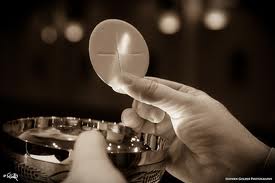 As weird as it is, Jesus stuck His actual fingers into that man’s ears and mouth. But He comes here now to stick His actual body and blood into your mouth and your body. Jesus has been crucified as a ransom for your sins. He has bought you back by paying off the devil. And He is risen, alive, out of death for your justification. Jesus comes to you now in this holy Supper to remove your doubt that this is for you. Jesus comes now to drive away all your evil. He comes to you placing His Body into your body. He binds you to Himself. He clears out your ears and loosens your tongue so that you can confess Him clearly and be saved.
Brothers and sisters, “Ephphatha.” Be opened, and do not be afraid. Jesus opens you not destroy you, but to fill you. Amen.
The peace of God, which surpasses all understanding, will guard your hearts and minds in Christ Jesus. Amen.
 14 And he called the people to him again and said to them, “Hear me, all of you, and understand: 15 There is nothing outside a person that by going into him can defile him, but the things that come out of a person are what defile him.”
 Nothing outside of you defiles you. Whatever goes into you goes out again. What you put into yourself passes through you and goes into the toilet. Yes, Jesus uses bathroom talk here. There is nothing you can put into yourself that makes you defiled. Nothing. So, why does God find fault with you, since nothing you have put into yourself makes you defiled? God finds fault with you and with me because we are sinners. You and I are sinners, but not because we do sinful things. You and I do sinful things because we are sinners. We are unclean because we are unclean – sinful from the time we are conceived.
 God has pierced that evil, that sin, and all the problems of this world in Jesus’ hands and feet. God has drowned our evil in the blood of Jesus and buried it in His tomb (Rev. Fiene). When we see the mess we have made of this world, God points us to Jesus on the cross and says, “Look. That evil you have made, that defilement you have brought to the world, that uncleanness you have within you, look. I am here defeating it.”
 nwashed. 3 (For the Pharisees and all the Jews do not eat unless they wash their hands properly, holding to the tradition of the elders, 4 and when they come from the marketplace, they do not eat unless they wash. And there are many other traditions that they observe, such as the washing of cups and pots and copper vessels and dining couches.) 5 And the Pharisees and the scribes asked him, “Why do your disciples not walk according to the tradition of the elders, but eat with defiled hands?” 6 And he said to them, “Well did Isaiah prophesy of you hypocrites, as it is written,
 Now, we can laugh at these things, but these were serious debates. They understood that God was serious about His Commandments. He had come down on Mt. Sinai and written these rules in stone – twice. God had told them that He was, “A jealous God, visiting the iniquity of the fathers on the children to the third and fourth generation.” So what the leaders of the people did was to (and this is their words) “set a hedge” around the Law. God wanted them to keep the Sabbath holy, so they decided to make sure that they wouldn’t even get close to breaking His command.
 For the Pharisees and for us, because of our sin, God’s Law doesn’t always do what God designed it to do. God’s Law always condemns us. If you think you can earn God’s love by following your little rules, you are adding sin to sin. Romans 4:15 says, “The law brings wrath” (cf. Ro. 7:10-25 and Gal. 3:10). God’s Law always “kills, reviles, accuses, judges, and condemns everything that is not in Christ” (Luther). You are always in a dangerous place when you look at God’s Law and think to yourself, “Well, at least I’m keeping that one pretty well.” You may fool others and you may even fool yourself, but you aren’t fooling God. His Law always convicts. God’s Law is intended to cut you open like a sword, so that you watch in horror “as [your] own blood spills out of [you]” (Rev. D. Matyas).
 Brothers and sisters, God has sent His own Son to be sin for you. Jesus took your sins and was run through with God’s sword of the Law. Jesus’ blood was spilt from His head, hands, feet, and side. God punished your sins upon Jesus as He died on the cross, and in return, God gives you the perfect, complete obedience of Christ. Because you are in Christ, because you have been united to Him in baptism, because you believe His words of forgiveness in the absolution, because you are joined to Jesus as you eat His body and drink His blood, God remembers your sins no more (Jer. 31:34). Your sins are separated from you as far as the east is from the west (Ps. 103:12). Your sins have been smashed into nothingness under God’s foot and cast into the depths of the sea (Mic. 7:19).
 knowing in himself that his disciples were grumbling about this, said to them, “Do you take offense at this? 62 Then what if you were to see the Son of Man ascending to where he was before? 63 It is the Spirit who gives life; the flesh is no help at all. The words that I have spoken to you are spirit and life. 64 But there are some of you who do not believe.” (For Jesus knew from the beginning who those were who did not believe, and who it was who would betray him.) 65 And he said, “This is why I told you that no one can come to me unless it is granted him by the Father.”
 “Will you promise not to – do anything to me, if I do come?” she asks. “I make no promise,” says the Lion. “Do you eat girls?” Jill asks. The Lion responds, “I have swallowed up girls and boys, women and men, kings and emperors, cities and realms.” Jill responds, “I daren’t come and drink.”
 Jesus gave up His own body, His own flesh, on the cross for the life of the world. His life-giving blood was poured out from His pierced side. On the cross, Jesus has purchased and won your salvation. And, now, He delivers that salvation to you through His Word which is Spirit and life. He delivers that salvation to you in the waters of Baptism where He connects His life-giving Word to the water. Jesus delivers that salvation to you in the Spirit-filled words of the absolution. Jesus delivers that salvation to you as you come to His Supper where, through His Word of promise, He comes to you in body and blood in bread and wine.
 We all waste so much time and energy and worry about the things of this world that perish. All the food, clothes, house, home, and luxuries that God is providing – it all will perish. Do not work for the stuff that perishes, but for the food that endures to eternal life.
 48 And he saw that they were making headway painfully, for the wind was against them. And about the fourth watch of the night he came to them, walking on the sea. He meant to pass by them, 49 but when they saw him walking on the sea they thought it was a ghost, and cried out, 50 for they all saw him and were terrified. But immediately he spoke to them and said, “Take heart; it is I. Do not be afraid.” 51 And he got into the boat with them, and the wind ceased. And they were utterly astounded, 52 for they did not understand about the loaves, but their hearts were hardened.
 This is the same language that is used when God “passed before” Moses and revealed His glory (Ex. 33:18-34:9). Remember how God places Moses in the cleft of the rock and defined His name, “Yahweh, a God merciful and gracious. Slow to anger and abounding in steadfast love and faithfulness.” Well, here is Jesus was revealing His divine glory to the disciples. But seeing the divine in the midst of their troubles, knowing that God was present in the midst of their suffering, creates terror because their hearts were hardened and they did not understand the nature of Jesus even after the banquet earlier that day. Seeing Jesus’ reveal His divinity by walking on the water (see Job 9:8, Ps. 77:19, Is. 43:16) sends the disciples into a frenzied fear.
 In the name of Jesus. Amen.
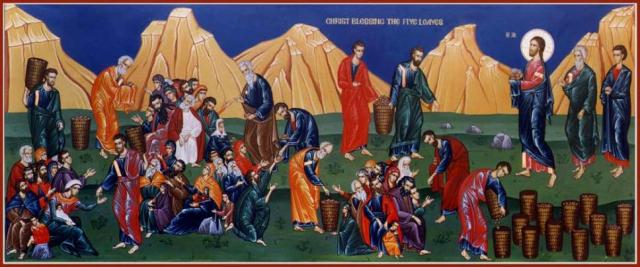
 To every person in that crowd, Jesus gave exactly what was needed. Whether they had problems with their marriage, fights with their kids, struggles to make ends meet, death in the family, or fear of what the future might hold, Jesus knew their need. He taught them, and His words fed their souls. When Jesus teaches, He isn’t merely giving facts, not just describing God, not giving steps to a better life, a better marriage, or better relationships with others. Instead, when Jesus teaches, He gives the words of life. In other words, when Jesus teaches the Word of God, He gives Himself. Jesus gives the Law to expose sin for what it is, and He gives the Gospel – the full and complete release of sin. Jesus steps in as Shepherd, and the lost sheep are made into a flock. But Jesus still isn’t done. He is going to take care of their bodies too.
 Jesus gives thanks, maybe from Ps. 145:15-16, “The eyes of all look to You, and You give them their food in due season. You open Your hand; You satisfy the desire of every living thing.” Jesus hands the bread and fish out to the disciples who, in turn, serve that crowd of 5,000 men plus women and children. They feast. There in the desert wilderness is a banquet prepared by Jesus Himself. He is their shepherd, and they do not lack anything good. And neither do you.
 Yahweh is your Shepherd. You lack nothing. He makes you lie down in green pastures. He leads you beside still waters. Through the death and resurrection of Jesus, He restores your soul. He leads you in paths of righteousness for His name’s sake. Even as you walk through the valley of the shadow of death, you fear no evil because you are already delivered from death. God is with you. His rod and staff comfort you. Even in the midst of your enemies, He prepares a banqueting table before you. He anoints your head with oil, and your cup overflows. God’s goodness and mercy pursue you all the days of your life. And because Christ’s death is your death and His resurrection is your resurrection, you will dwell in His house forever. Amen.
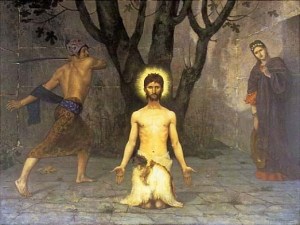 24 And she went out and said to her mother, “For what should I ask?” And she said, “The head of John the Baptist.” 25 And she came in immediately with haste to the king and asked, saying, “I want you to give me at once the head of John the Baptist on a platter.” 26 And the king was exceedingly sorry, but because of his oaths and his guests he did not want to break his word to her. 27 And immediately the king sent an executioner with orders to bring John’s head. He went and beheaded him in the prison 28 and brought his head on a platter and gave it to the girl, and the girl gave it to her mother. 29 When his disciples heard of it, they came and took his body and laid it in a tomb.
 So Herod, this intoxicated idiot, offers her whatever she wishes up to half his kingdom. The girl goes out to talk to her mother, and her mother suggests asking for the head of John the Baptizer. But this girl adds a sadistic little twist of her own. It is a dinner party after all. So she tells Herod to give her the head of John on a platter. Herod was more worried about keeping up appearances with his guests than doing the right, honorable thing. So he sends the executioner to John’s cell. And John becomes a head shorter.
 But you know who Jesus really is. He isn’t John the Baptizer raised from the dead. He is the Savior of the world. Yes, even the Savior of Herod. Jesus died for Herod’s sick, twisted immorality just as He died for all your sick, twisted, and wicked ways as well. Jesus has come to save sinners – even ones as bad as us here at Christ the King. We know, deep down we know, that we are no better than Herod. And so we are here, gathered together in Jesus’ name, to find shelter in the blood that Christ shed for all our sins.
 First, Adam and Eve attempt the impossible. They try to avoid their Creator. They try to hide themselves in the dumbest place – behind leaves and trees. Adam and Eve could have buried themselves under the mountains and God still would have found them. Adam and Eve have been caught, but they still try to flee. God shows up. The leaves haven’t worked. Their little aprons blow away. “The Lord God called to the man and said to him, ‘Where are you?’”
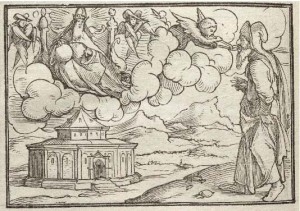 4 And the foundations of the thresholds shook at the voice of him who called, and the house was filled with smoke. 5 And I said: “Woe is me! For I am lost; for I am a man of unclean lips, and I dwell in the midst of a people of unclean lips; for my eyes have seen the King, the Lord of hosts!”
 In your baptism, God the Father, Son, and Holy Spirit has washed away your sins. In the waters of your baptism, the holy blood of Jesus covered you and made you holy. In the waters of your baptism, all evidence of your sin was washed away in the name of the Father, Son, and Holy Spirit. In your baptism, you were given the right to no longer fear the holiness of God.

You must be logged in to post a comment.