In the name of Jesus. Amen.
There are more stars above this building than anyone could count. But if you were to go outside right now, you wouldn’t see them because the sun and clouds hide them. Even at night, you can’t see all of them because of the ‘light pollution’ from the city lights. Those distant bits of God’s creation don’t go anywhere just because the clouds cover them, or because the sun drowns them out, or because the city lights hide them. The stars don’t actually go anywhere. Nobody goes out at noon and says, “Well, I guess the stars are gone.” You know better.
Sadly, we don’t always know better when it comes to God’s presence and help. When a new suffering enters your life and your prayers seem to get no higher than the ceiling, it’s easy to conclude that God either stopped paying attention or abandoned you and those you love. That’s where Jacob was the night he laid his head down on that rock. To better understand his mindset, you have to know how Jacob got here. Many of you know the story, but just to recap it:
Abraham had received the promise that the Messiah and Savior would be born from his descendants. Abraham passed that blessing on to his son, Isaac. Isaac and his wife, Rebekah, had twin sons. Esau was the older of the two and was Isaac’s favorite (Gen. 25:27) because he was a hunter and gatherer—a man’s man. Jacob was the younger twin and his mother’s favorite (Gen. 25:28). Because Esau was the older brother, he was the one who, generally speaking, should have gotten the inheritance and blessing.
One day, Jacob was home cooking a pot of stew. Esau had just come in from the field and was exhausted. Esau asked Jacob for a cup of the stew, but Jacob wanted to make sure that he would get something in return. He asked Esau for his birthright in exchange for that bit of soup. Esau agreed and despised his birthright (Gen. 25:29-34).
Later, when Isaac was blind and thought he was about to die, he told Esau to prepare a meal so Isaac could bless him. Rebekah heard about it and told Jacob to impersonate Esau to get the blessing from Isaac. Rebekah and Jacob decided to lie and trick blind Isaac into blessing Jacob before Esau could finish preparing the meal (see Gen. 27). When Esau finally got back, he learned that Isaac had already passed the blessing on to Jacob. So, Esau decided to kill Jacob once their father died. Rebekah heard about the murder plot and sent Jacob to her family, who lived about 450 miles northeast, and told him to find a wife there. The spot where he lies in our text is about 50 miles into that journey.
Just to add a bit more color to all of this: This text doesn’t explicitly say how old Jacob is. But from the rest of Genesis and events dated to Jacob’s life, we can calculate that Jacob is 77 years old. This is his first time being away from his parents. (Keep that in mind, you high schoolers. You don’t need to be in a hurry to leave your parents’ house at 18.) Jacob had all this swirling in his mind. “I need to stay alive and find a wife so the blessing can pass on from me.”
Jacob would have thought that the whole situation was backwards. Here he is in exile, fleeing out of the land connected to the blessing. He has a rock for a pillow while Esau is back home with his family and in his own bed. Jacob had to be wondering if the words of blessing really going to be his. Would God honor the promise that had been passed to him? Had God left him?
That night, Jacob is not a holy man on a pilgrimage. He’s a lonely man with a guilty conscience, a brother who wants him dead, and nothing to show for himself except words that he’s not sure God meant.
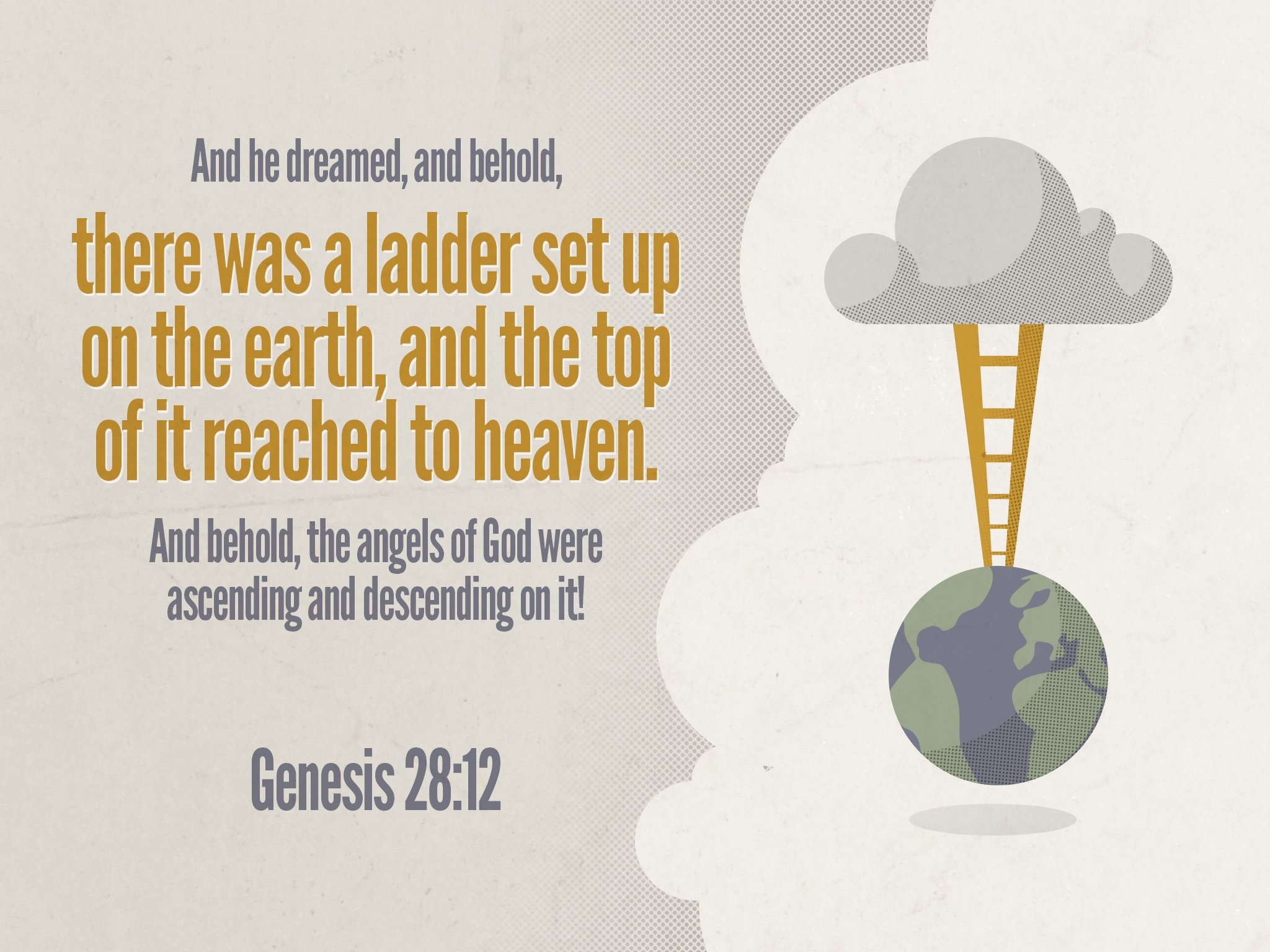
In the midst of all of that, God lets Jacob see what had been there all along. Notice how Moses writes this so the image pops into our head. Behold, there was a ladder set up on earth and reaching heaven. Behold, the angels of God are ascending and descending on that ladder. Behold, Yahweh was there. The text printed in the bulletin makes it sound like Yahweh is standing above the ladder. And that’s a legitimate translation. But the Hebrew can also be translated that Yahweh stood beside Jacob. Either way, God is not far off. But today, take it this way: Yahweh is standing right beside Jacob as he sees this vision and hears this promise.
“I am Yahweh, the God of your fathers. I will give this land to you and to your offspring. The Savior will be one of your descendants, and in Him all the families of the earth will be blessed. I am with you and will keep you wherever you go. You’re leaving this land now, but I will bring you back. I will not leave you until I have done everything I have promised you” (Gen. 28:13-15). God is promising that Jacob’s lying and cheating and circumstances have not changed or negated the promises God had given him.
Jacob wakes up and says, “Surely Yahweh is in this place, and I did not know it” (Gen. 28:16). He doesn’t say, “God has arrived,” or, “I finally got heaven to notice.” It’s, “Surely Yahweh is in this place, and I did not know it.” Heaven had been touching earth the entire time. Jacob just couldn’t see it.
And Jacob isn’t talking about God’s ‘general’ presence here. Jacob knew that God is present everywhere. What he didn’t know was that God was present with him in a particular way—a gracious way. God was there to bless Jacob as he lay among those rocks. Even when the dream ended, Jacob knew God’s presence remained. The light of day did not change the promise God gave in the night. Jacob awoke and named the place Bethel (which means ‘house of God’ [Gen. 28:19]). That place was holy and awesome, not because he slept there, but because it was the gate of heaven, where Yahweh was present with His promise.
That ladder wasn’t something that was just for Jacob that one night. This gracious presence of Yahweh is also for you. In John 1, Jesus calls His first disciples. Specifically, Christ calls Nathanael and promises him, “Truly, truly, I say to you, you will see heaven opened, and the angels of God ascending and descending on the Son of Man” (Jn. 1:51).
Dear saints, that ladder is Christ, your Savior. He is the connection between heaven and earth. Christ is the gracious presence of God with man. This is why the company of angels sings on the night of His birth, “Glory to God in the highest, and on earth peace among those with whom He is pleased” (Lk. 2:14).
The traffic of heaven and the gracious presence of God reaches the lowest place. Here, it comes to a lonely man with his head on a rock, but it goes even lower. It moves toward a lowly manger, to a cross, and to you, even if you feel ignored by God.
In the same way that clouds, sunlight, and light pollution can hide the stars, your suffering, sin, and doubt might obscure the gracious presence of God. But know that the ladder doesn’t wobble and God’s promises don’t disappear. Christ, your Savior, stands there beside you. He comes to you whenever you hear His Word. And He promises, “All authority in heaven and on earth has been given to Me…. And behold, I am with you always, to the end of the age” (Mt. 28:18, 20).
This very sanctuary is for you what Bethel was for Jacob. There at the Font, God connects His Word to water and claims sinners for Himself. There from the altar, God announces His absolution to us, paralyzed sinners. From this table, Christ serves His Body and Blood to us and forgives our sins. And always, Christ promises that He is present here as we gather together (Mt. 18:20).
And the ladder remains in places that look like anything but the gate of heaven. In the hospital room, in the dining room with the empty chair, at the gravesides of our loved ones, God’s gracious presence remains, even if our eyes cannot see it. You have died, and your life is hidden with Christ in God. So set your minds on things that are above, not on things that are on earth (Col. 3:2-3).
Christ, the Ladder between heaven and earth, remains. He will not leave you until He has done what He has promised you (Gen. 28:15). He remains through the resurrection of the dead and into the life of the world to come. Amen.
The peace of God, which surpasses all understanding, will guard your hearts and minds in Christ Jesus (Php. 4:7). Amen.


You must be logged in to post a comment.