Saintly Geometry – Sermon on Ephesians 3:13-21 for the Sixteenth Sunday after Trinity

Ephesians 3:13-21

In the name of Jesus. Amen.

When someone is learning to ride a bike, they need to learn how to balance, how to keep up their speed, and how to stop. Those are the most basic things, but they need to learn other things too. Another dimension of riding a bike is knowing where to look. If a rider looks at the wrong thing, it can lead to a crash. There’s actually a term for it—“target fixation.” Fighter pilots in World War II had to be taught not to lock their focus on the target, or they would fly right into it. Your hands follow your eyes. Pilots, motorcycle riders, and bikers are still taught the dangers of target fixation. A bicyclist has to learn not to stare at the pothole, the mailbox, or the parked car. If they fixate on the thing they are trying to miss, they will drift straight into it. Yes, notice potholes, mailboxes, and cars. Just don’t make them the thing you look at.

Here, the Ephesians are staring at a pothole. Paul, the man who brought the Gospel to them and founded their congregation, was in prison. He’s suffering on account of the Gospel, and they can see it. They see trouble and start doing what comes naturally to all of us. They get fixated on it and start to measure the trouble. How deep is the trouble? How long will it last? Will it spread? Will they also end up in prison? Or will they face something even worse?

Paul knows they are fixated on the wrong thing, which is why he writes, “Do not lose heart over what I am suffering for you, which is for your glory” (Eph. 3:13). Paul isn’t trying to put a positive spin on his suffering or make it sound like everything is just fine. He doesn’t deny it’s happening. But he doesn’t want the Ephesians to fixate on it. He refuses to let suffering be the only thing they measure.

We naturally measure our pain. We stretch our measuring tape across the height, depth, breadth, and length of our troubles. Then we let our hearts live inside those numbers. We could produce an exact 3D rendering of our troubles because we will fixate on them for weeks or months or years. It’s no wonder we keep drifting toward them.

Notice what Paul prays for here. He drops to his knees before the Father to ask for strength for the Ephesians and for you. He asks that, according to the riches of God the Father’s glory, you would “be strengthened with power through the Holy Spirit in your inner being, so that Christ may dwell in your hearts through faith” (Eph. 3:16-17).

The first thing Paul asks for is not that his prison door would open. He prays that the people who are worried about his imprisonment would be strengthened to measure something other than suffering. And the thing he wants them to measure is too big for a weak heart to measure. They will need some help, strength, endurance, and focus to measure Christ’s love.

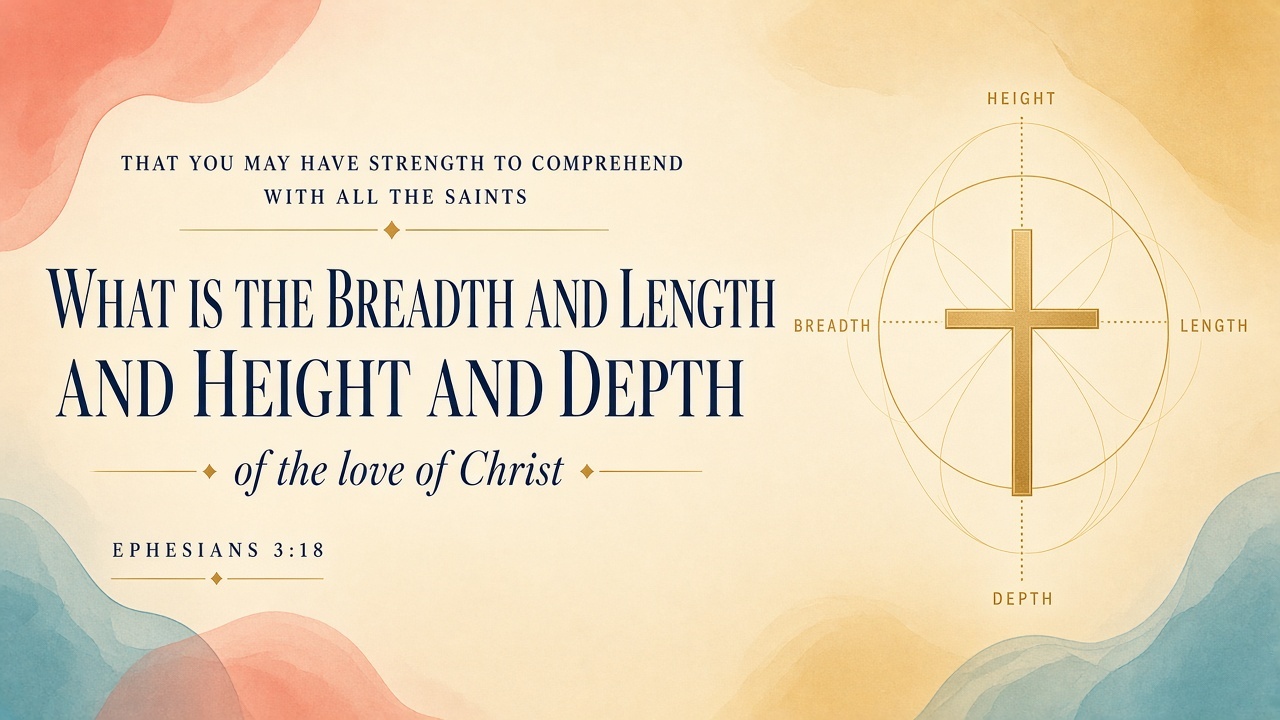
Look at v. 17-19 to see the rest of his prayer. “That you, being rooted and grounded in love, may have strength to comprehend with all the saints what is the breadth and length and height and depth, and to know the love of Christ that surpasses knowledge, that you may be filled with all the fullness of God” (Eph. 3:17-19).

God repeatedly does this in Scripture. There are several times God hands someone a measuring rod when things look hopeless. In a vision, Ezekiel is told to measure the Temple while he is in exile (Ezek. 40:3-5). Zechariah has a vision of a man measuring Jerusalem while it is still a pile of wreckage (Zech. 2:1-5). John is told to measure the Temple of God and those who worship there in the middle of tribulation (Rev. 11:1-2). When it would be natural to simply stare at the wreckage, God will tell people to, “Measure what I have claimed, even before you see it restored.” Here, Paul is handing you the same kind of rod.

So, here’s some saintly geometry for you. Four dimensions: breadth, length, height, depth. He wants them (and you) to measure the immeasurable love of Christ.

Measure its breadth. How wide is the love of Christ? His love is as wide as the world He died for. He is the Lamb of God who takes away the sin of the world (Jn. 1:29) and the propitiation—the atoning sacrifice—for our sins, and not for ours only but for the sins of the whole world (1 Jn. 2:2). No matter how far you drift, Christ’s mercy reaches wider than your wandering.

Measure its length. How long has this love been after you? Paul opened this letter by saying that, from before the foundation of the world, He chose you in Christ (Eph. 1:4). Through every year you can remember all the way to eternity, He who began a good work in you will bring it to completion at the day of Jesus Christ (Php. 1:6). This love was there from eternity past and continues with you until the Last Day. And even after the Last Day it doesn’t run out.

Measure its height. How high has He lifted you? You were dead in your trespasses and sins, but He made you alive together with Christ and seated you with Him in the heavenly places (Eph. 2:1, 5-6). Death looked like the highest wall imaginable. Christ’s love soared over it.

Measure its depth. How deep has Jesus come for you? He came all the way down to earth when He took on flesh for you. But Christ went deeper. He humbled Himself by becoming obedient to the point of death, even death on a cross (Php. 2:8).

Already, that’s a lot of measuring, and it has only scratched the surface. Paul knows that. That’s why he says that the love of Christ surpasses knowledge. Did you catch that in v. 19? Paul wants you to know something that surpasses your capacity to know—the love of Christ. He wants you to be rooted and grounded in that love. Those words—rooted and grounded—are the right words here. A tree doesn’t study to get a degree in soil science. It simply lives in the soil. Christ’s love is the soil God wants you to live in. Sink your roots deep.

Paul says you don’t take this measurement alone but “with all the saints” (Eph. 3:18). You are not the first one holding the rod. The saints who have already finished the race are not measuring their troubles anymore. They are measuring His love, and they are not disappointed.

What he prays for the Ephesians, he prays for you. He asks that God the Father would grant you strength “according to the riches of His glory” (Eph. 3:16). This strengthening happens as the Holy Spirit gives you strength and as Christ dwells in your heart through faith.

And there’s no sugarcoating here. This doesn’t make the suffering go away. Paul was still in prison when they finished reading his letter. But this saintly geometry—the breadth and length and height and depth of Christ’s love—reorients you. Look there. Your heart will follow.

“Now to Him who is able to do far more abundantly than all that we ask or think, according to the power at work within us, to Him be glory in the Church and in Christ Jesus throughout all generations, forever and ever” (Eph. 3:20-21). Amen.

The peace of God, which surpasses all understanding, will guard your hearts and minds in Christ Jesus (Php. 4:7). Amen.
Defiant Joy – Sermon on Habakkuk 3:13-19 for the Fifteenth Sunday after Trinity

Habakkuk 3:13-19

In the name of Jesus. Amen.

“Be careful what you ask for because… you just might get it.” Habakkuk asked God to do something about the sin and violence that surrounded him. God did.

This reading from the end of Habakkuk makes more sense if you know what came before it. Thankfully, summarizing the book of Habakkuk is easy because it’s only three chapters long. The first two chapters are two complaints from Habakkuk (Hab. 1:2-4, 12-2:1) and two responses from God (Hab. 1:5-11, 2:2-20). The book concludes with Habakkuk’s psalm of praise (Hab. 3), which you just heard.

The book starts with Habakkuk praying and asking God to act. He had looked around at his land and countrymen and all he could see was violence, injustice, and sin. He cried out, “God, how long am I going to cry to You, and yet You won’t hear? How many times am I going to point out all the violence, but You don’t do anything? All I can see is sin, destruction, contention, and strife. The wicked surround the righteous. But You just keep twiddling Your thumbs” (Hab. 1:2-4).

God answered, but not in the way Habakkuk expected. God didn’t say that He would start a revival or send a spiritual awakening. Instead, God answered, “I’ll send Babylon, that bitter and hasty nation, with all their military might” (Hab. 1:6a). Then, God talks about how dreaded, fearsome, and violent Babylon is (Hab. 1:7-9). He highlights their pride and arrogance, how Babylon isn’t afraid of anything, and how they laugh at the kingdoms and castles they have demolished (Hab. 1:9-10). God even mentions that they are so prideful that they worship their own might as a god (Hab. 1:11). Babylon—a ruthless, pagan people—is going to be God’s answer for the sin and idolatry of His own people.

Habakkuk isn’t too keen on God’s plan. In his mind, that cure was far worse than the disease. He tries to get God to pump the brakes on His plan, but Habakkuk does it in an extremely arrogant way. He basically tells God, “This plan is no good. You’re too holy to use Babylon like that. I’m going to stand on my mountain of right and wait for You to change Your mind” (Hab. 1:12-2:1).

The majority of chapter 2 is God telling Habakkuk to wait, to trust Him, and to remember that the righteous shall live by faith (Hab. 2:4). He has it all under control, and He’ll deal with Babylon’s sins in His time. That leads to this final chapter, which is Habakkuk’s psalm of trust.

In a way, the whole book is about how God formed and shaped Habakkuk. He began as a man who thinks God is snoozing on the job and who arrogantly tells God, “You don’t know what you’re doing.” But Habakkuk ends up with this bold, confident trust in God’s plan. In a lot of ways, the book of Habakkuk parallels the book of Job. It’s like a bite-sized version—just without the boils and round after round of friends giving bad advice and offering sham comfort.

With that in mind, look again at v. 17 of our text. Habakkuk goes through this list of things that could fail. The fig tree, the vines, the olive trees, fields, flocks, and herds. To our modern ears, sure, that all sounds bad. To the people of Habakkuk’s day, it sounded like the end of the world.

That list of things that could fail crescendos. It doesn’t start out so bad. Figs were generally considered a delicacy, almost like a candy bar. They were nice to have around, but you can live without figs. No fruit on the vines means no grapes and wine. Wine was part of feasting, and it was mixed into ordinary drink. It was more common than figs, so more people would miss it, but you can live without wine. Olives are where things start to get more serious. They used olive oil to bake many things and to light lamps at night. Losing olives would almost be equivalent to your power going out. The flocks and herds at the end were the sources of transportation, work, clothing, and food.

Today, we have ways to adapt if these types of things disappear. The people of Habakkuk’s day didn’t. This isn’t just empty shelves at the grocery store. This is no planes, trains, or trucks coming with product from somewhere else. On top of that, there is no production from the fields. This isn’t just power lines being down and waiting hours or days for the electrical grid to be restored. This is the very plants and dams that produce electricity being destroyed.

This scenario Habakkuk imagines isn’t something you adapt to because every alternative is completely blocked. That kind of devastation would take years or even decades to recover from. Notice (this is important), this isn’t actually happening as Habakkuk sings this song. However, it is likely that all of this will happen. Habakkuk knows God’s plan—Babylon is coming. Habakkuk doesn’t know when, but he knows that. They’re ruthless and brutal. So, he looks into the future that he knows is going to be horrible. It isn’t happening yet. But Habakkuk resolves what he will do when all of this takes place.

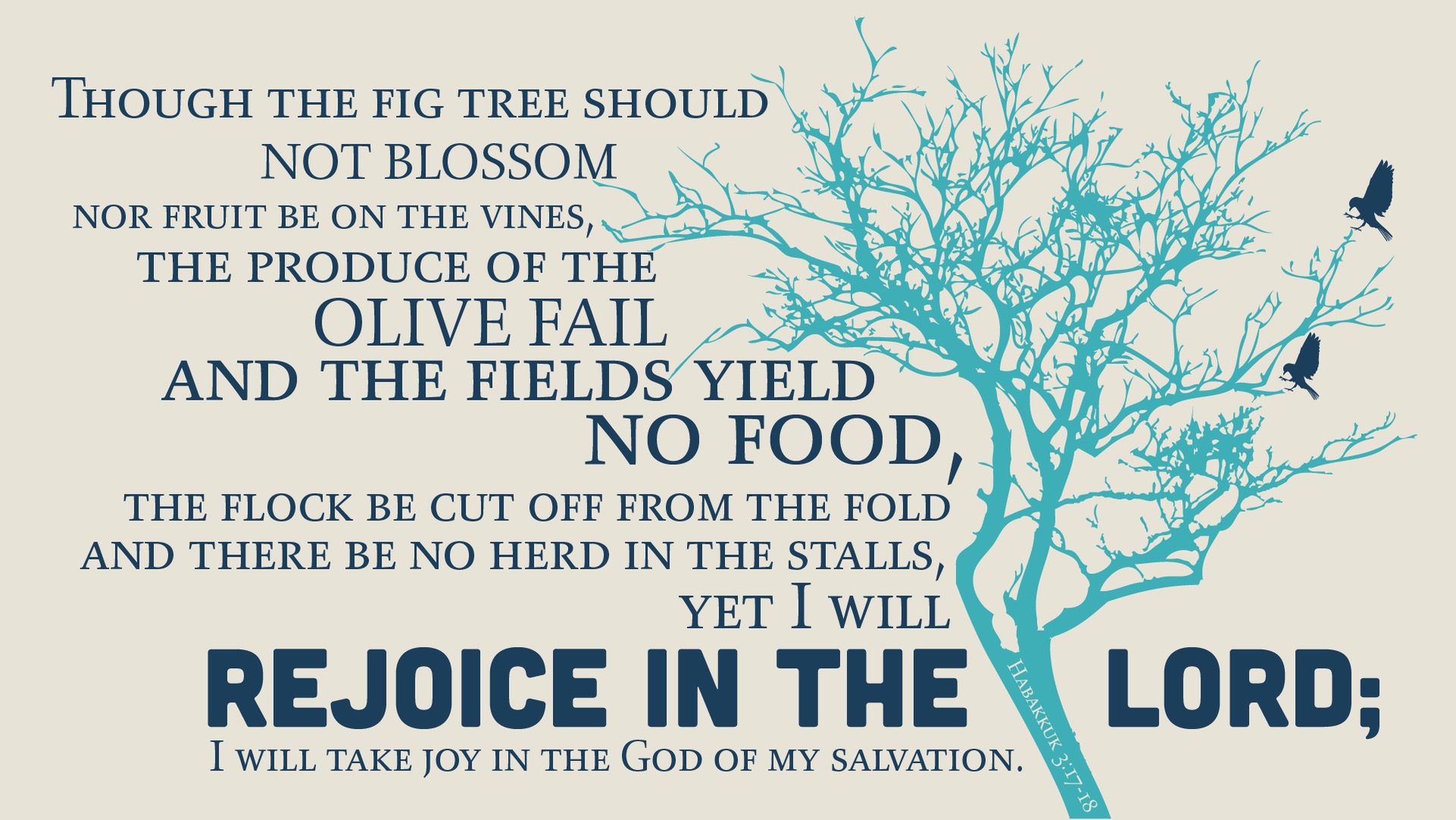
Habakkuk says, “Though all of that should happen, …yet. Yet I will rejoice in the Lord; I will take joy in the God of my salvation” (Hab. 3:17-18). This is defiant joy. And he has this defiant joy because he looks to the past.

Look again at v. 13. When God goes out, He goes out for the salvation of His people. Habakkuk isn’t just mustering up some good feelings. He is remembering and singing about history—specifically the Exodus out of Egypt and the crossing of the Red Sea. He remembers God crushing the head of the wicked and trampling the sea with His horses (Hab. 3:13-15). When they were in Egypt, Israel didn’t have their own horses or a navy. Pharaoh did. But God sent His hosts so the waters became a grave for the enemy and a road for His people.

Habakkuk uses the past as a lens to look at a future that he already knows will be terrible. Babylon is coming, and when it does, the figs may not blossom, the vines and olive trees may fail, the fields may yield no food, and the flocks and herds may disappear. The whole thing fills Habakkuk’s bones with rottenness (Hab. 3:16). Habakkuk doesn’t say that the collapse will be fine. Instead, he says that even if it comes, he already knows that God is at work to save His people. That’s what God has done in the past, and that is what God has promised to do in the future.

Dear saints, the future is out of your hands and full of unknowns. Staring at all those unknowns is the recipe for a life full of worry. Go ahead and glance at the unknowns long enough to name them, but don’t stare at them.

Remember the past. God goes out for the salvation of His people. He has gone out against Pharaoh, and He promises Habakkuk that He’ll take care of Babylon. But most importantly, you can look to the past where God has gone out against the serpent, the enemy of all mankind. When it was time to deal with your greatest enemies—sin, death, and the devil—God didn’t send another evil empire. He sent Christ, His Son. Jesus is the God of your salvation who endured God’s wrath against your sin and went to His death for you. Now, He is risen and ascended to reign on the throne of all creation.

The future is out of your control, but it was never supposed to be in your control. It is in the nail-pierced hands of the God who has already gone out for your salvation. That’s why you can have the same kind of defiant joy that Habakkuk has here. Because of what Christ has done, you don’t have to wait for figs to come back. You can stand in front of barren fields and empty stalls and sing about your God who splits seas. More than that. You can look at the grave—the grave of your loved ones or even your own grave—and declare that your Savior has already defeated it.

Dear saints, your God is your strength right now. Right now, He makes your feet like the deer’s. He makes you tread on your high places (Hab. 3:19). This is not a mood that you feel. It is what Christ is doing for you now, whether you feel it or not.

The future will always be full of things you cannot manage. But you don’t have to wait for your circumstances to get better before you can sing. Christ is your strength right now, and He will never leave you. Sing with Habakkuk now, before trouble comes, and even after it arrives: “Yet I will rejoice in the Lord; I will take joy in the God of my salvation” (Hab. 3:18). Amen.

The peace of God, which surpasses all understanding, will guard your hearts and minds in Christ Jesus (Php. 4:7). Amen.

The Way – Sermon on Proverbs 4:10-23 for the Fourteenth Sunday after Trinity

Proverbs 4:10-23

In the name of Jesus. Amen.

If you had to get from here to Lowe’s, you have many different options as to which route to take. And your route might depend on where your car is parked in our lot. From here, you’d have to decide whether to go east to 220 or west to take River Rd. Let’s just assume you go to 220. As you approach Gateway, you have to start making more decisions. Your main options for going west are Gateway, Demers, or 32nd. And your options for going south are Belmont, Washington, Columbia, or I-29. If it weren’t for the construction, you could also pick 42nd.

There are advantages to each—fewer railroad crossings, less traffic, fewer stoplights, faster speed limits, fewer turns. The decisions you make for your route would probably depend on your preferences. As I was writing this sermon, I pulled up directions from here to Lowe’s not because I need directions but so I could see what route the app recommended as the shortest and which was the fastest. By the way, the shortest isn’t the fastest. Between Apple Maps and Google Maps, there were seven suggested routes. And both apps changed their suggestion as the fastest route multiple times.

Scripture regularly talks about how there are only two ways to go through life. One is the path to life, and the other is the path to death and destruction. Basically, the first nine chapters of Proverbs are a father letting his son know that there are only two routes, two paths, two ways.

Just to be clear, the father isn’t trying to help his son make wise decisions on what career to pursue, where to live, whom to marry, how much to save for retirement, and so on. Those bits of wisdom will come in chapters 10-31. The first nine chapters are mainly about these two ways. Only after the father has given his son a clear understanding of those two ways does he get into all that other stuff. It isn’t that those other things don’t matter. They do. But what matters most is the son being on the right path—the path to life. Everything else in his life can serve being on that right way.

Scripture is clear. You are either allied with your Savior and trusting in Him, or you are against Him. There are no other options, and there is no neutrality (Dt. 30:15; Jer. 21:8). You’re familiar with Jesus saying exactly this, “Whoever is not with Me is against Me” (Mt. 12:30). God is always working on you. You are either being built up in faith toward God or being harmed by whatever else is going into your soul. This is why the father’s instructions here are so clear and urgent. Six times in v. 14-15, the father commands his son to shun the way that is contrary to God. 1) Do not enter the path of the wicked. 2) Do not walk in the way of evil. 3) Avoid it. 4) Do not go on it. 5) Turn away from it. And 6) Pass on. Could the father be any clearer or more fervent?

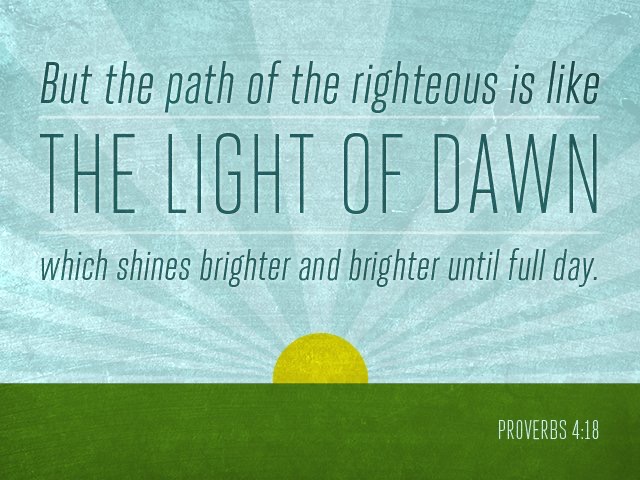
None of this means that the way of life is easy. Jesus doesn’t sugarcoat it. “The gate is narrow and the way is hard that leads to life” (Mt. 7:14). We know from experience that it is through many tribulations that we enter the kingdom of God (Act. 14:22). Yes, that way and path of the righteous is like the light of dawn that shines brighter and brighter until full day (Pr. 4:18). But look again at what Proverbs 4:19 says, “The way of the wicked is like deep darkness; they do not know over what they stumble.” Notice that the text doesn’t say anywhere that the righteous will never stumble. Believers still stumble. We still fall into sin, but the believer knows what caused that stumbling. So, the contrast between the two ways is obviously the destination, but along the way the main difference is the amount of illumination.

When the evil man is stumbling, he doesn’t even know what makes him trip. There’s a foolishness to him. He doesn’t know what is and what isn’t good for his soul because he doesn’t know his Lord. The righteous man is different, but not because he does everything perfectly and never falls into sin.

Dear saints, you aren’t different from unbelievers because you are sinless, have it all together, or have everything figured out. Life is confusing and hard for everyone. The difference between you and an unbeliever is that when you stumble, you know the sin that tripped you up. Even more importantly, you know that you are walking on a narrow way with the One who has saved you from your sin. That’s a big advantage.

The unbeliever doesn’t even know what he’s stumbling over. You do. You can look back and see that root or crack that tripped you up. And even though it causes you to fall—even if it’s a colossal fall—you know the problem. Better than knowing the problem, you know the Savior who is beside you. The Savior who is there to pick you up. The Savior who is there to tend your wounds and heal… you.

This is why the father here doesn’t stop after telling his son to avoid the other way. He presses his son to keep listening. “Be attentive to my words; incline your ear to my sayings. Let them not escape from your sight; keep them within your heart. For they are life to those who find them, and healing to all their flesh” (Pr. 4:20-22). This is how Christ heals you. He puts His Word in your heart. Then, the father closes with the command and promise: “Keep your heart with all vigilance, for from it flow the springs of life” (Pr. 4:23). In other words, the way of life isn’t a route to memorize and master. Instead, it’s a Word that you keep.

Your heart isn’t a room that you do your best to keep tidy and neat. It’s a spring, and whatever is in it will flow out of it. You’ve been given a new heart by your Savior who does not leave your spring empty.

Christ Himself is the Wisdom that the father has been teaching his son. Jesus is the Way that leads to life. He entered the creation that our sin had darkened. On the cross, the Light of the world (Jn. 9:5) was covered, and it looked like the darkness had won, but it hadn’t.

Easter morning is the dawn mentioned in v. 18 of our text. The light of Christ’s resurrection shines brighter and brighter until it will reach full day when Christ returns. Until then, He keeps walking with you on a way that, yes, is narrow and hard. But it isn’t a way that you walk alone.

So, when you fall this week—and you will, I will, we all will—you aren’t in the dark about what hit you. You know the cause. So, repent of that sin. And know the Savior who puts His Word of forgiveness back into your ears and His Body and Blood into you again. He keeps your heart by filling it.

Your navigation apps will keep changing their mind about the fastest way to Lowe’s. But your heavenly Father doesn’t recalculate the way to life. Jesus is and always remains the Way, the Truth, and the Life (Jn. 14:6).

Keep hold of His instruction. Do not let go, because there, and there alone, is Life. Amen.

The peace of God, which surpasses all understanding, will guard your hearts and minds in Christ Jesus (Php. 4:7). Amen.